If you’ve read last week’s post, you know this month I’m doing Gotham Calling’s top 25 graphic novels of 2025.
Like in my previous lists, I’m sticking to English-language editions, although I have to point out that by far one of my favorite reads of last year was the (so far, sadly untranslated) French BD album Parker: La proie. This adaptation of Richard Stark’s novel The Sour Lemon Score, where the tough-as-nails robber Parker methodically chases a guy through the criminal underworld (in the pre-internet 1960s, where it was much easier to fall off the grid), clearly aims for a spot on the shelves next to Darwyn Cooke’s phenomenal series of adaptations of other Parker books (even the title, which means ‘The Prey,’ feels like a riff on the first adaptation, The Hunter). While the visual storytelling isn’t quite as creative as Cooke’s, Kieran’s monochrome artwork is also moody as hell, with a great film noir look, and Doug Headline’s script brilliantly nails the typically labyrinthic plot and sardonic tone.
If you prefer your comics in English, though, there was still plenty of good stuff on the shelves throughout 2025:
20. WE’RE TAKING EVERYONE DOWN WITH US
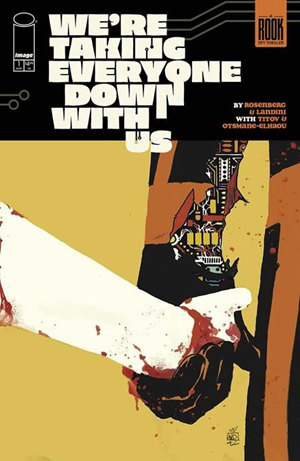
If you step back, you can see We’re Taking Everyone Down With Us contains many of the recognizable trappings of a gonzo super-spy adventure, complete with a horny British secret agent, a villainous transnational cabal, and a genius scientist trying to take over the world, along with some robots, several explosions, and assorted mayhem. Yet co-creators Stefano Landini and Matthew Rosenberg provocatively twist the material in two fundamental ways.
One of them is by skewing the narrative perspective, shifting the main focus to a 13-year-old girl, Annalise, who apparently starts out in the periphery of a wider saga already taking place. The way Annalise sees and (mis)understands the various players, uncontaminated by our expectations of these tropes, is enough to mix up the usual sympathies and loyalties, turning archetypical heroes into villains and vice-versa (and, sometimes, back again).
The other form of subversion has to do with the overall tone of the book, where dark comedy is often combined with absurdist dialogue delivered with a straight face (and with a healthy dose of foul language).
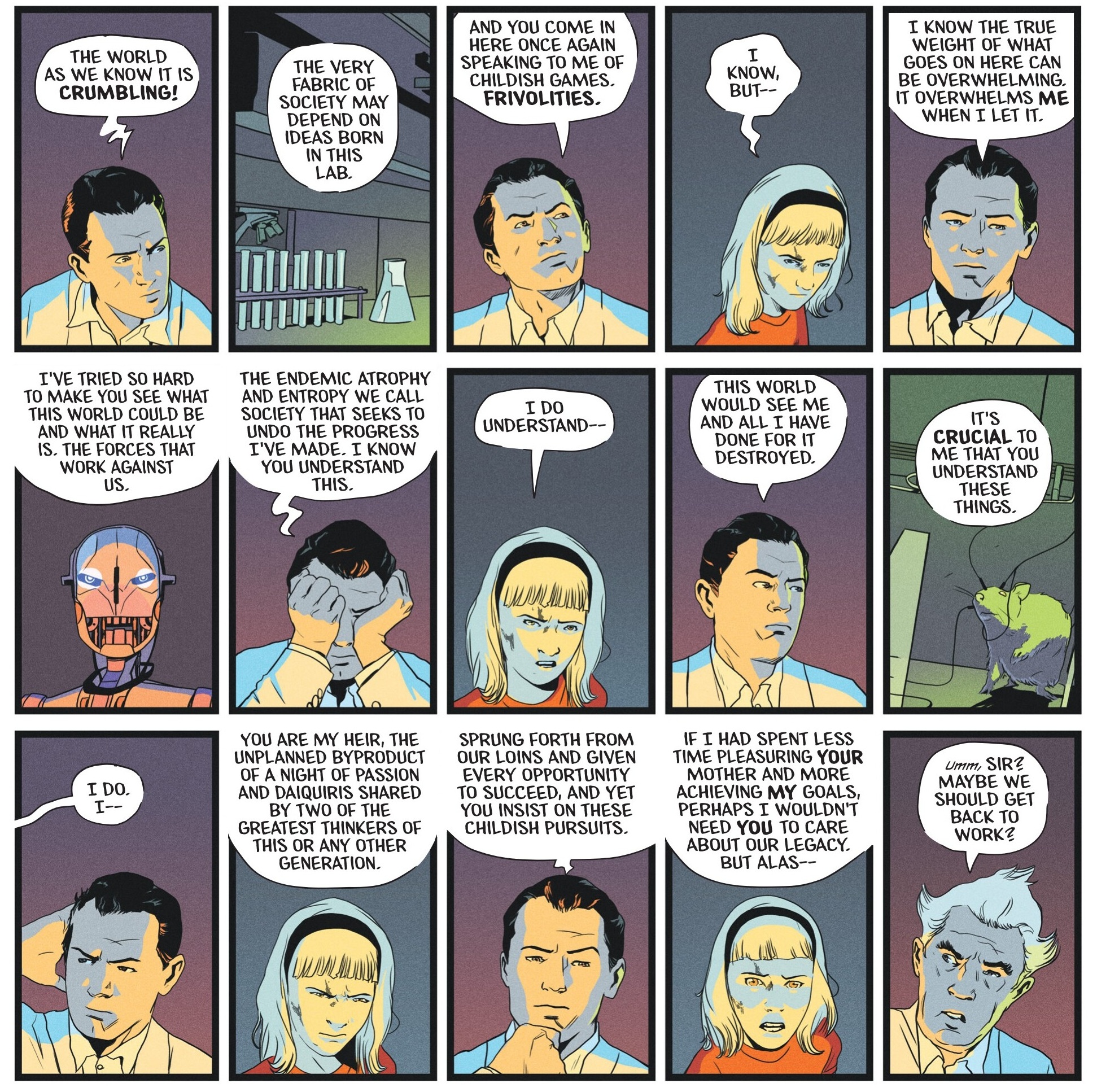
Although visually uneven and occasionally confusing, We’re Taking Everyone Down With Us is nevertheless consistently pleasing thanks to the coloring duo of Jason Wordie and Roman Titov, along with the inventive work of Hassan Otsmane-Elhaou, who once again proves he’s arguably the best letterer in the business today.
The book is labelled as a ‘Rook Spy Thriller,’ which is itself a fun gag, since the 007-ish Rook isn’t the story’s central character (although he clearly believes he is). Landini and Rosenberg promise a sequel at end, titled ‘In Good Hands With Bad Company,’ which will hopefully continue to treat Rook as a deluded opponent rather than a conventional lead.
19. LOST MARVELS: TOWER OF SHADOWS
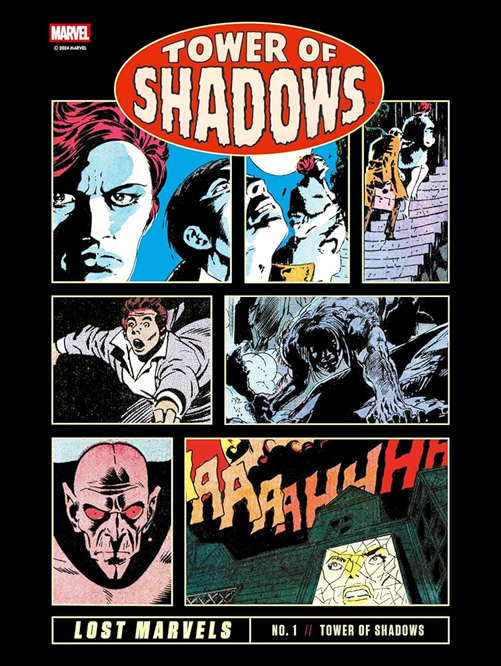
EC’s daring horror comics were one of the main targets of the introduction of strict censorship in the medium, back in the 1950s, which greatly benefitted more innocuous mainstream publishers, like DC and Atlas (which eventually became Marvel). By the late 1960s, however, the standards of the Comics Code Authority had loosened enough that DC turned its long-running titles House of Mystery and House of Secrets into EC-style anthologies – and Marvel soon tried to jump on the game, with the short-lived Tower of Shadows and Chamber of Darkness. Given that Fantagraphics has been doing such a stellar job of reprinting EC’s catalog over the past years, it’s very cool they have now partnered with Marvel to collect those largely forgotten series, restoring their place in the lineage of comic-book horror.
Granted, despite a solid line-up of writers, most stories in Tower of Shadows don’t quite reach EC’s manic heights and pitch-black sense of humor. Nevertheless, it’s fascinating to see them update the same type of misanthropic comedy/horror mix to then-modern phenomena, like the growing fear of automation or the hippie counterculture (the latter given a particularly trippy treatment by Don Heck in ‘Evil is a Baaaad Scene!’). And yes, this means stomaching non-PC stereotypes, but surprisingly few given the medium’s complex history of racism.
What Marvel does bring to the table is a powerhouse of artists, from then-up-and-coming talent like Jim Steranko, Neal Adams, John Romita, and Barry Windsor-Smith to veterans who had worked at EC back in the day, including Johnny Craig, Wally Wood, and Marie Severin (not to mention master of horror Gene Colan, who didn’t work at EC but had also been around the block for decades). The resulting combination is a visual feast for fans of this era of comics.
I’m particularly fond of John Buscema’s mise-en-scene in ‘A Time to Die!,’ where a scheming scientist and his assistant search for a formula for immortality while plotting to kill each other:
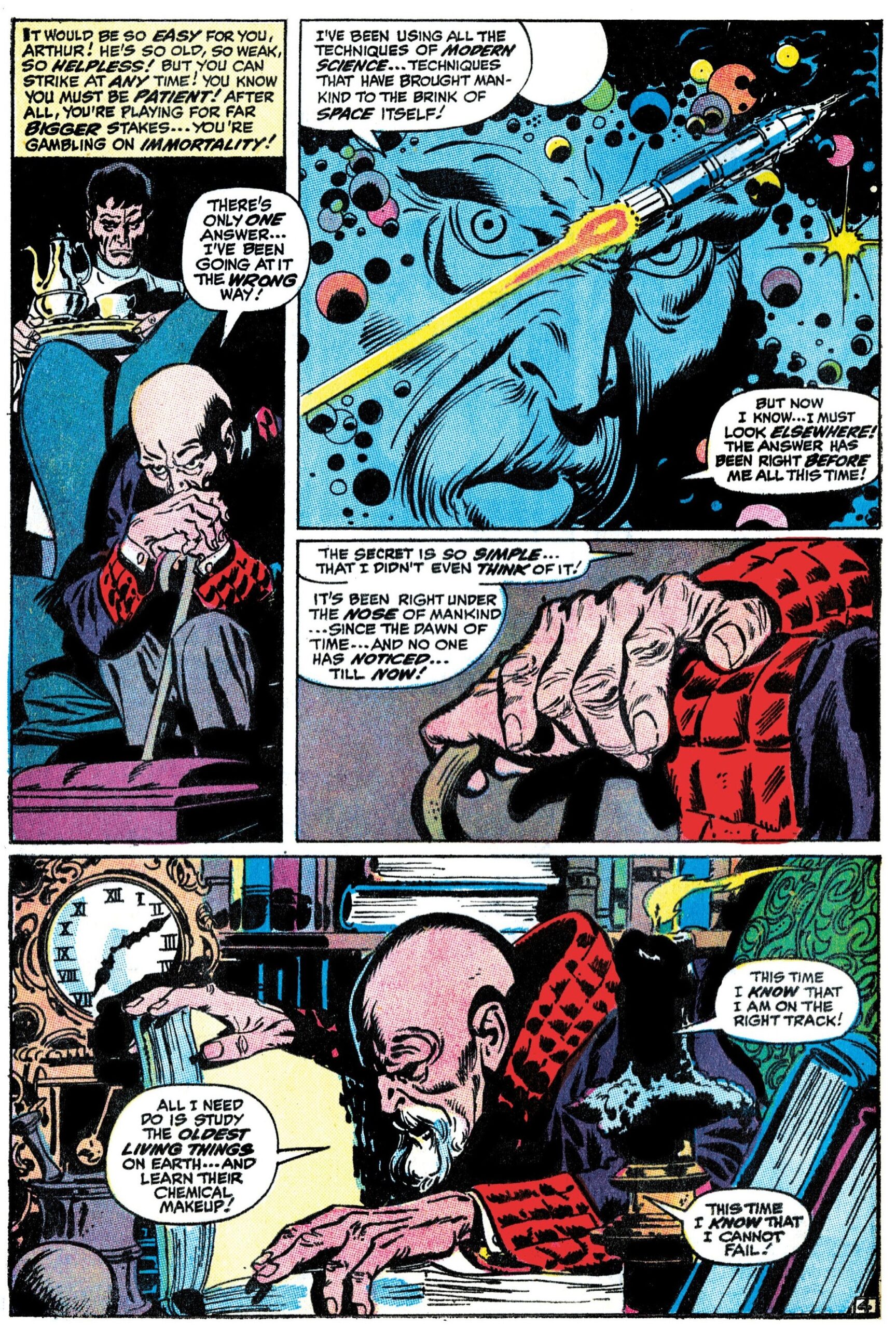
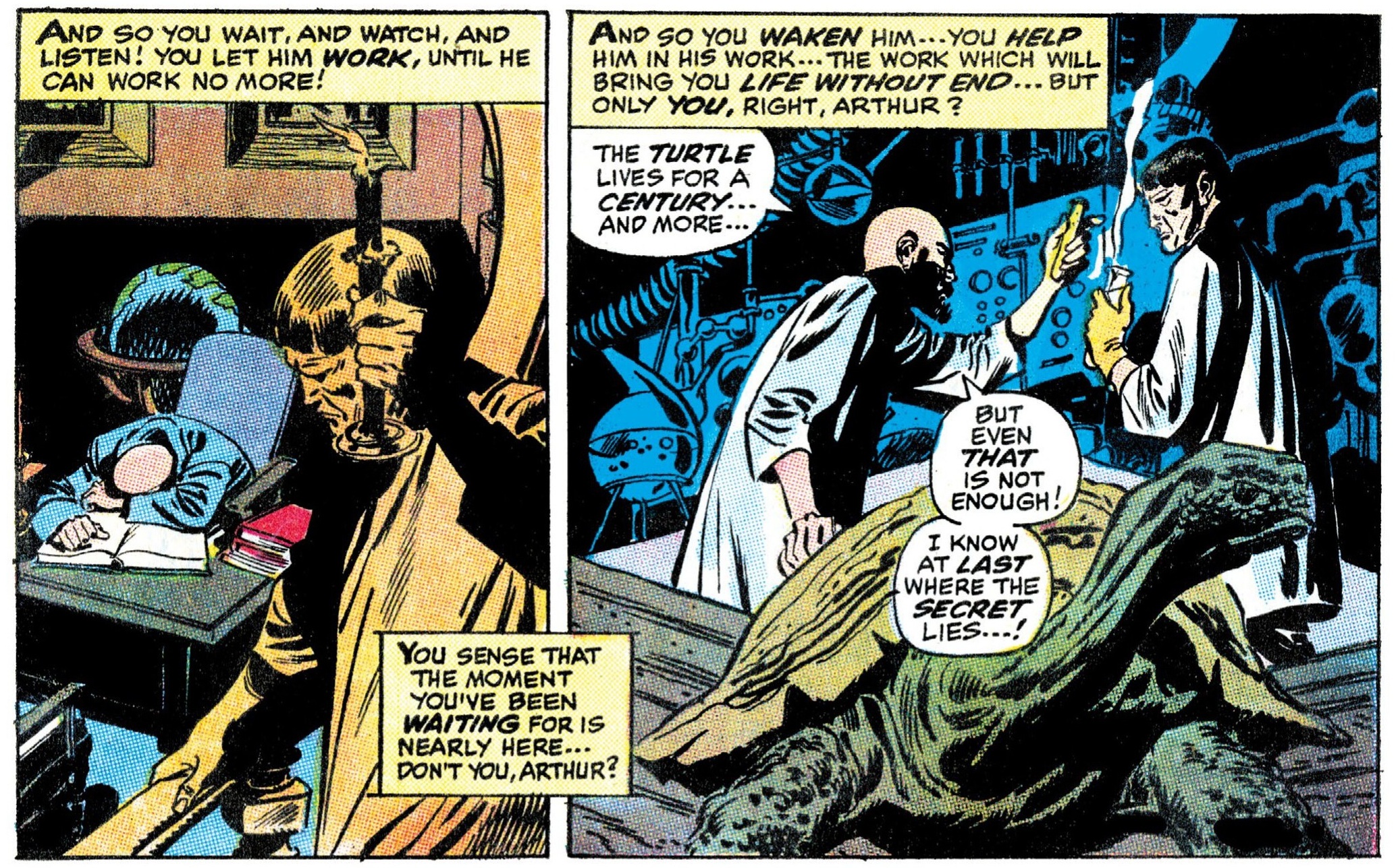
Besides the stories themselves, Lost Marvels: Tower of Shadows has much to offer to aficionados. It includes some of the issues’ backmatter, such as the very Stan Lee-ish column ‘Batty Bulletins to Bewilder, Bewitch, and Bedazzle You!’ and readers’ letters. There is also an amazing introduction and creator biographies by Michael Dean, who provides historical background, formal analysis, and general insights into the material, for example pointing out the suggestive contrast between the EC-like ‘arrogant, unlikeable characters who deserve everything they bring upon themselves’ and ‘Marvel’s otherwise heroic universe.’
18. METAMORPHO: THE ELEMENT MAN
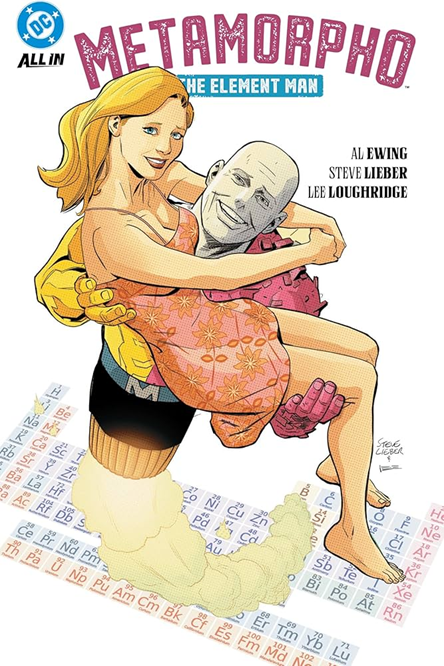
Speaking of 1960s’ comics – Al Ewing wrote the latest reboot of Metamorpho, the Element Man, and Steve Lieber drew it in a style similar to that of Bob Haney and Ramona Fradon back when they created the character, in the Silver Age. Part of the joke is that this series is nevertheless very much set in the present, updating the old cast to our current era of online influencers and AI hysteria, including not only Rex ‘Metamorpho’ Mason, a superhero with the goofy ability to transform himself into any element of the periodic table, but also his girlfriend Sapphire Stagg, her tech millionaire father Simon Stagg, and their servant Java, a defrosted Neanderthal who is also in love with Sapphire (one of DC’s weirdest love triangles).
Although the result isn’t as looney-tunes-y as Elliott Kalan’s and Mindy Lee’s current run on Harley Quinn, it’s just as hilarious, nailing Haney’s voice, complete with an alliterative, hucksterish narrator, amusingly slangy dialogue, and conceptual games (like an issue packed with allusions to sixties’ spy fiction, albeit less caustic than We’re Taking Everyone Down With Us). Yet Lee Loughridge uses slick modern colors, making this a Tom Strong-like hybrid rather than a mere pastiche. It’s that balance and dissonance between the sensibilities of different eras that makes Metamorpho: The Element Man such an enjoyable read…
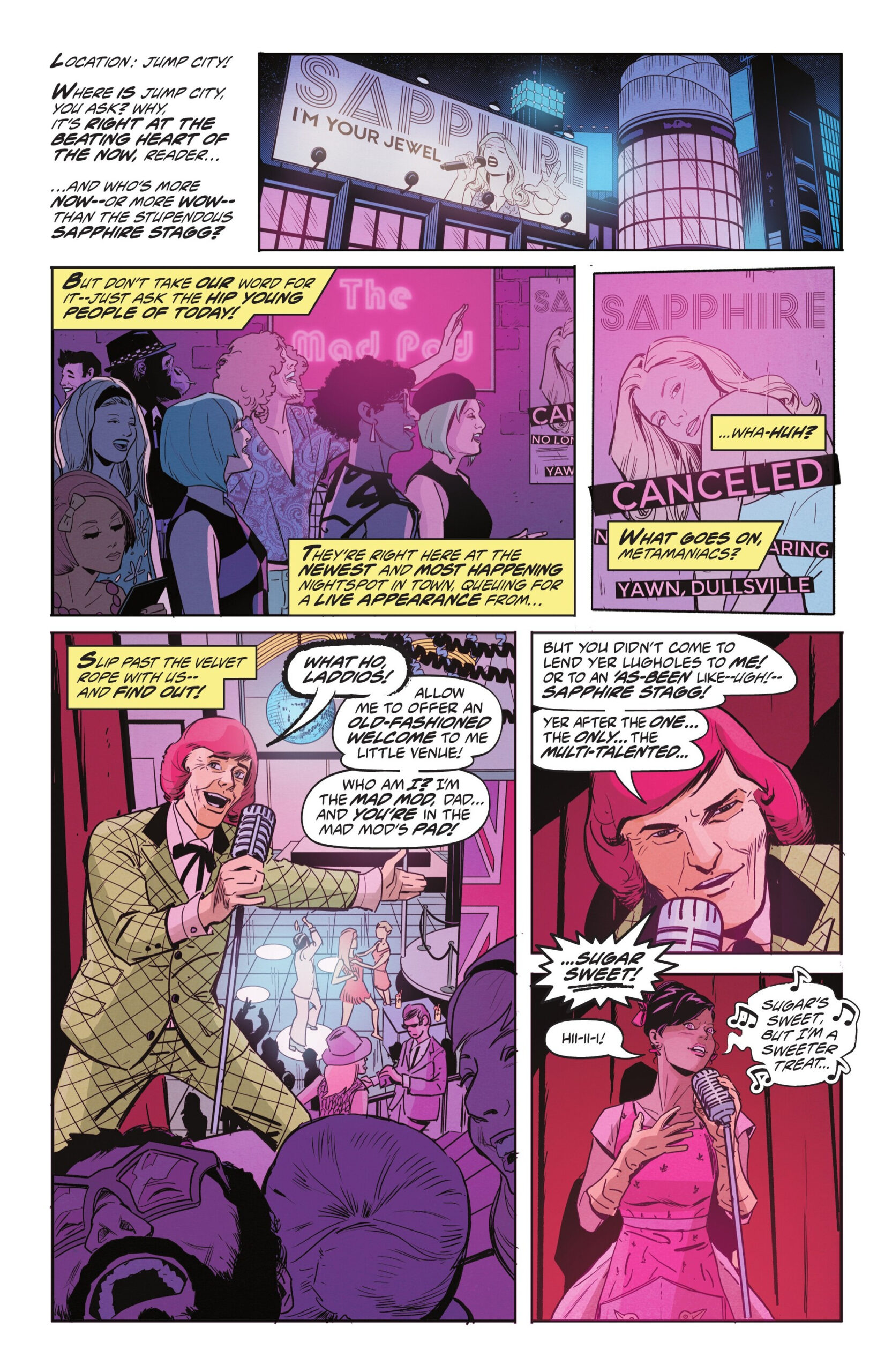
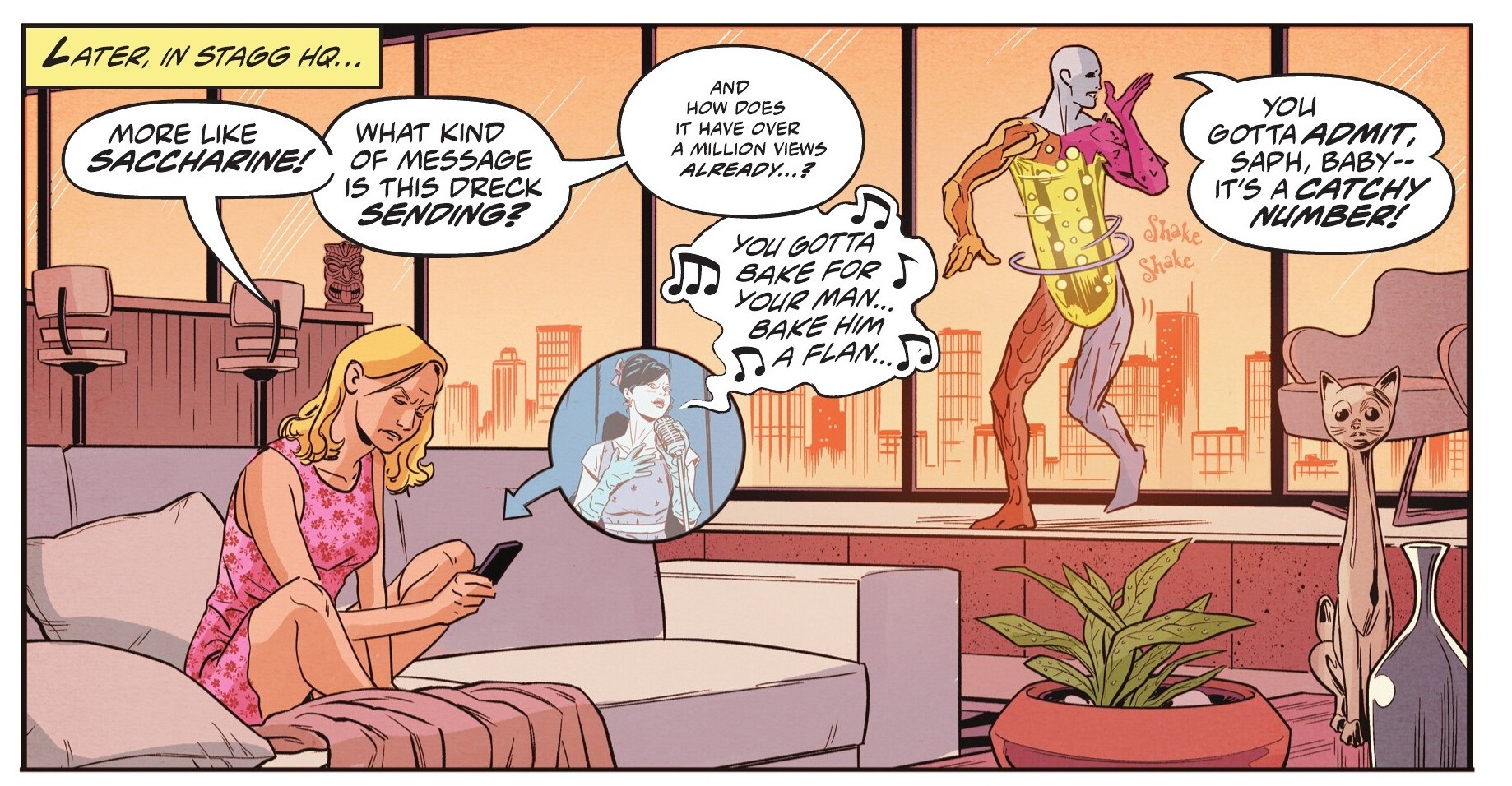
Metafiction aside, the comic works because Al Ewing isn’t just a clever creator, but also a pro who knows how to simultaneously craft a nifty superhero yarn, making great use of Metamorpho’s chemistry-based powers. Plus, he weaves in a bunch of relatively obscure DCU characters, offering another treat to fans while taking advantage of the jokey narration to fill in newcomers on the necessary background (in some cases, it’s even more entertaining if you haven’t come across all these wild concepts before…).
Steve Lieber is a perfect choice for this material, as he remains one of the funniest artists in the field. Rather than going overboard with the cartoonishness, he mostly lets the humorous conversations and situations work for themselves. Then again, you can count on Lieber to play along in different ways whenever needed, like when he designs a splash page that looks like a maze or renders a sequence as a spot-on replica of a Golden Age comic.
17. DEATH IN TRIESTE
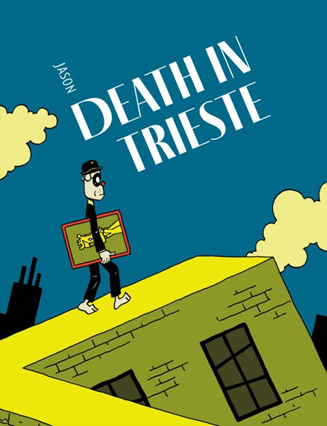
Last year, I read less European comics than usual and the best ones I’ve read haven’t been translated yet (like the abovementioned Parker: La proie), so this list is particularly US-centric, even for Gotham Calling’s standards (manga remains my perennial blind spot, with a few exceptions). Still, there was a new book by Jason, the Norwegian genius behind masterpieces such as Sshhhh!, You Can’t Get Here from There, Low Moon, and, of course, I Killed Adolf Hitler. If you’ve read those or any of the other dozens of books Jason has put out, you know what to expect: clean lines, simple layouts, minimalist art, anthropomorphic dogs and birds standing in for humans, and surreal stories told with a deadpan style. The man is nothing if not consistent.
I guess what Death in Trieste adds to the mix is that surrealism is actually a theme here, not just a form, as the first of its three stories concerns a bonkers criminal plot built around Magritte paintings and the second tale is set among the interwar Dadaist art scene. Plus, there is this beautiful moment:
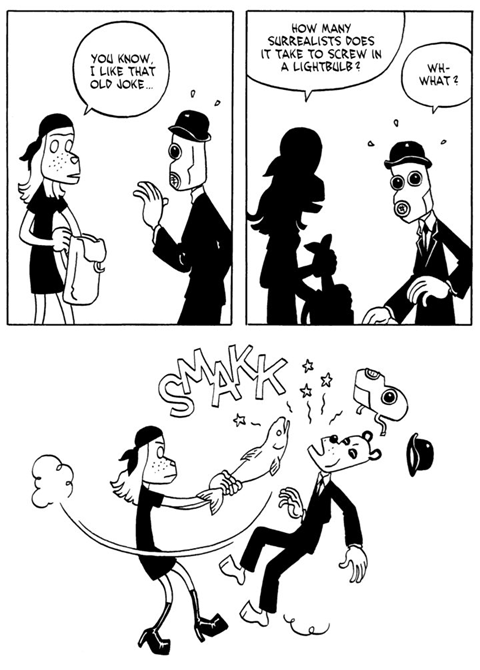
While that first story is a relatively linear thriller (albeit told in Jason’s signature clipped rhythm), the second one is much more fragmented and experimental, confusingly jumping back and forth between several different plotlines. What makes it an even more challenging read is that it’s packed with unexplained references to real-life historical events and people (like Rasputin’s death and Marlene Dietrich’s cabaret acts) as well as to high, middle, and lowbrow culture (from Nosferatu to Jason’s own Athos in America). Hell, David Bowie/Ziggy Stardust is a key character in both the second and the third tales. The latter is appropriately titled ‘Sweet Dreams’ because it also features the Eurythmics, who, like other 1980s’ New Wave bands, turn out to be superheroes and fight mummies.
The result is more esoteric than usual – or maybe Jason is playing with more references that escape me, so I can’t say I enjoyed Death in Trieste on the same level as his other work (which is not to say I didn’t get a jolly good kick out of it!). My assessment may change when I revisit the book in the future, though, as it will definitely benefit from re-reading.
16. ULTRAMEGA: VOL. 2
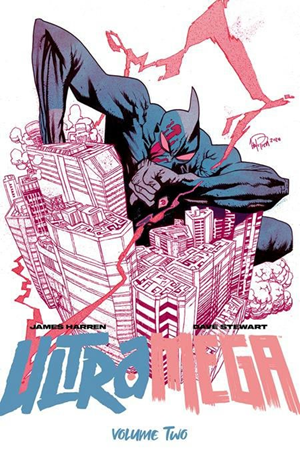
The second – and final – volume of Ultramega continues to fully justify the series’ title, as this comic is all about the wonder of exaggeration. It’s a kaiju saga, so we have humongous monsters, the grossest creatures, and kyodai heroes that can grow to a gigantic size and whose large-scale battles burst with over-the-top destruction, super-gory violence, and the genocidal deaths of both anonymous masses and key characters (although nothing beats the sequence in the first volume where a city was flooded with the blood of a decapitated protagonist). The storytelling itself strives for epic proportions, with its expansive cast reaching out far into the cosmos while constantly raising the stakes as the saga unfolds.
It’s as if James Harren can barely contain his creative passion. The individual issues far surpassed the usual page count and he ended up adding a final chapter just to make sure there was enough room for his uncompromising vision. Harren’s artwork – with appropriately eye-popping colors and hyperbolic letters by Dave Stewart and Rus Wooton – is awesomely exaggerated in a liberating way, full of energy and an almost childlike eagerness to see how far he can push the action… I can totally hear death metal guitar riffs in my head as I read along.
There is also a slapstick vibe to Harren’s cartooning that, suitably, helps prevent Ultramega from taking itself too seriously. This sometimes takes the form of openly comedic passages, from the protective suits that automatically envelop bystanders (suddenly turning them into bubble-like figures) to the fight scenes’ timing and choreography.
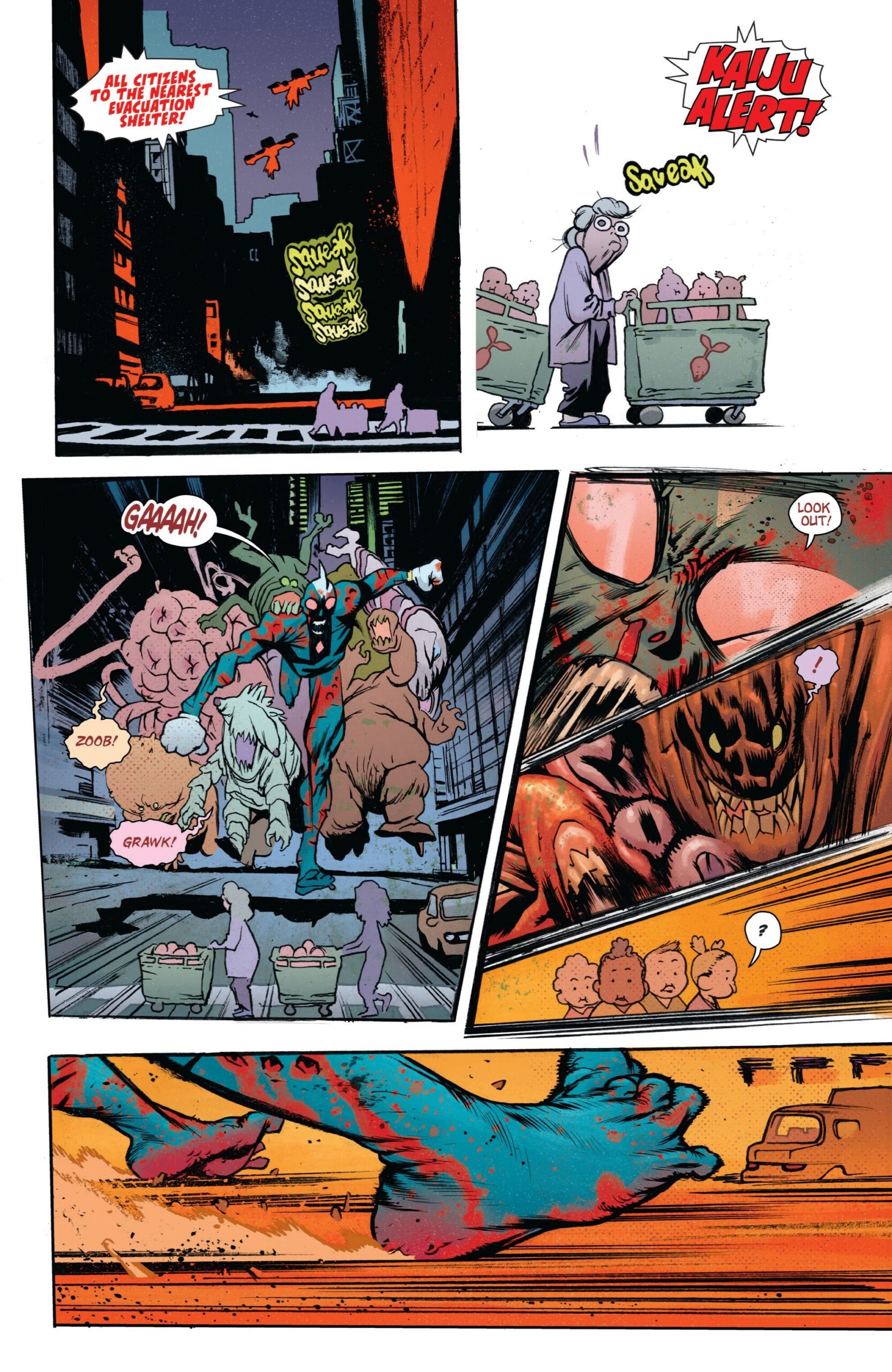
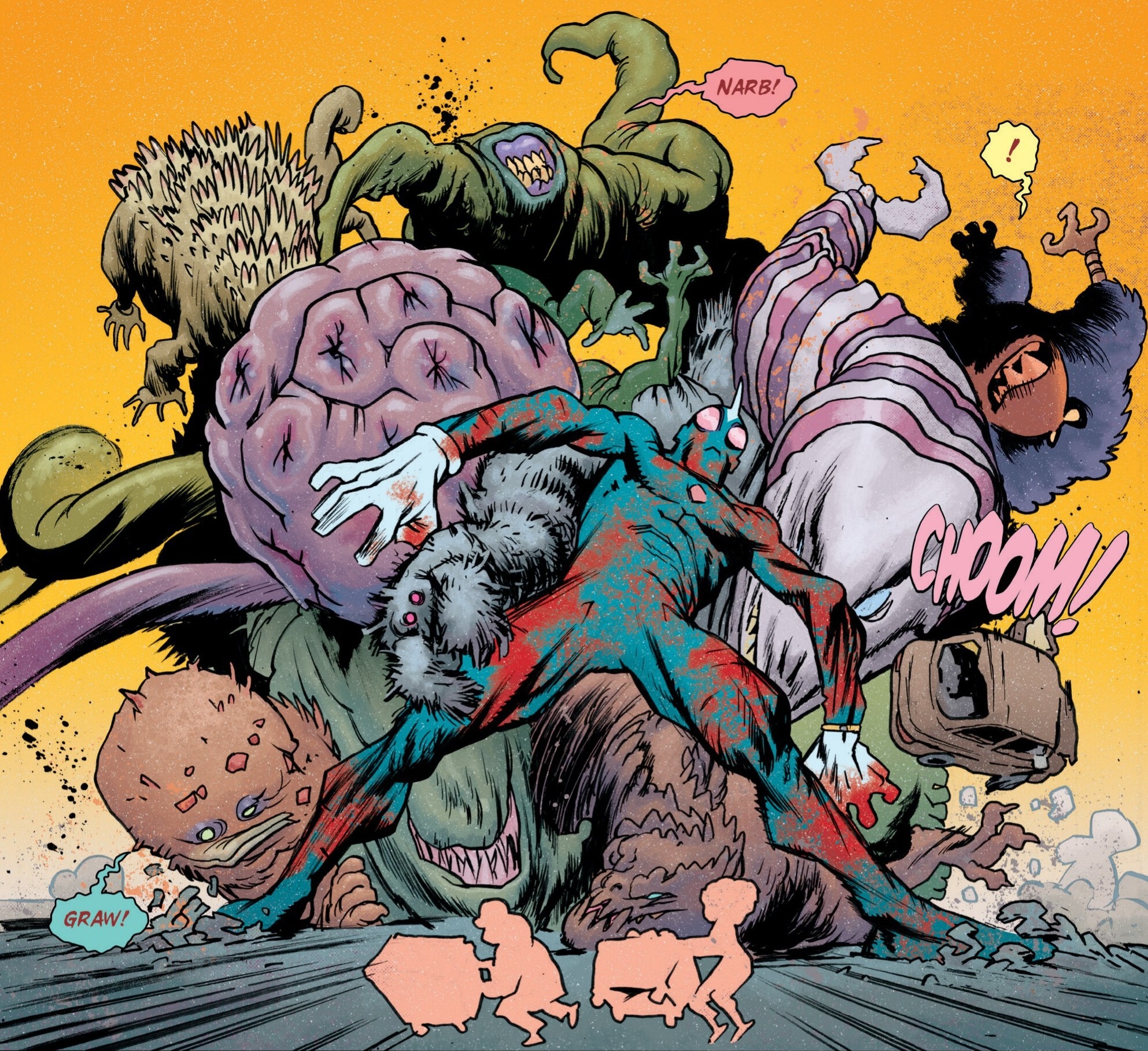
It’s a shame that the larger narrative becomes much more jumbled (and the cast less relatable) in this second volume, compared to the first, but that’s a price I’m willing to pay for James Harren’s unrestrained ambition.
I’m not an expert in this genre, even if I love the original Godzilla film and I’m an even bigger fan of Shin Godzilla (which cleverly – and satirically – reimagined the story with a new bureaucratic, environmental, and geopolitical sensibility). Yet it doesn’t matter… perhaps it even helps. Although owing an obvious debt to tokusatsu cinema and television, manga, and anime, Ultramega also works as a loving ode of just the kind of balls-to-the-wall imagery American comics excel at, overthrowing Gødland as the greatest successor of the spirit of Jack Kirby (there is even what I assume is a deliberate nod to Kirby’s closing triptych).