Once again, I’m complementing the latest lists of film noir gems with a handful of foreign-language recommendations that are just as good as – or, in some cases, much better than – their counterparts from the USA and the UK. After all, the themes and sensibility of noir are hardly exclusive to the Anglo-Saxon world – they can also easily be found in many other regions and cultural contexts (even in some of Jorge Luis Borges’ short stories, like ‘Emma Zunz’).
Like last time, my selection is capped in 1959. This may sound like an weirdly strict chronological border but, especially when it comes to cinema from continental Europe, by 1960 the noir style had definitely become too self-conscious and referential to be considered along similar lines… Godard’s Breathless and Truffaut’s Shoot the Piano Player blew up this genre into a cool postmodern collage and noir never felt exactly the same way again (which is not to say you can’t find the odd exception, like the beautiful Spanish entry Death Whistles the Blues, released in 1964).
As I point out below, these movies are not necessarily trying to fit into the same mold as their American counterparts, but they sure earn their film noir credentials:
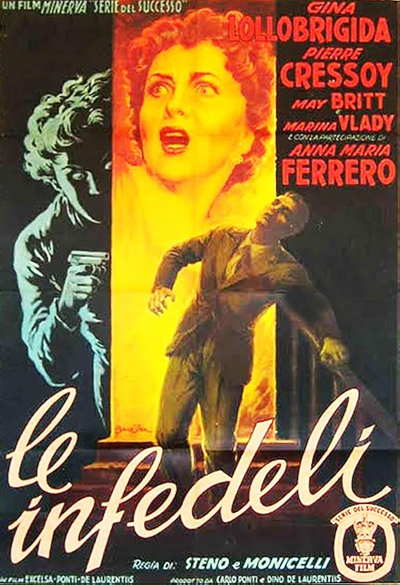
The Unfaithfuls (Italy, 1953)
Even though the early scenes of The Unfaithfuls involve a man hiring a private detective to spy on his wife, you may initially doubt why this should be included in a film noir list, as the tone feels closer to that of a farcical comedy. Step by step, however, Steno’s and Mario Monicelli’s exploration of the hypocritical, morally corrupt elites of postwar Italy elegantly unfolds enough serpentine plot intricacies, blackmail, and ironic twists of fate to satisfy any noir aficionado. To be fair, the movie is more genre-defying than a Bong Joon-ho venture, shifting from romance to psychological thriller, from mystery to melodrama, and from police procedural to social satire while repeatedly – and cleverly – subverting your sympathies. Still, by the final shots, there will be no question that you’ve just watched a wickedly dark masterpiece.
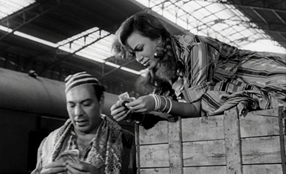
Cairo Station (Egypt, 1958)
Set in the titular train station, where thousands of stories interconnect everyday, this kaleidoscopic tale of lust and murder focuses on a triangle of characters: luggage porter Abu Siri (who is trying to organize a union), his bombshell bride Hannuma (who sells sodas without license, thus pissing off both the authorities and the guy running the official drinks concession), and the creepy, sad-looking Quinawi (who works for the newspaper stand but spends most of his time obsessing over Hannuma). Against the chaotic backdrop of a postcolonial Egypt in ebullition, Cairo Station’s frantic, sexually charged camera and montage, punctuated by the rhythms of the trains (and by some over-the top musical cues), blends social drama with Hitchcockian psychological thriller, culminating in some of the most perverse and suspenseful sequences in the history of noir.
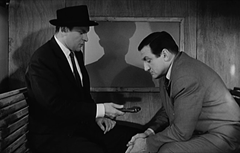
The Tiger Attacks (France, 1959)
Lino Ventura plays a former member of the French Resistance who now just wants to take care of his restaurant and of his sweet family, but damn France pulls him back into a brutal story of dirty international intrigue. With the stolen secret plans for a new fuel formula as the MacGuffin, The Tiger Attacks flirts with espionage, but at its heart it remains a good old fashioned ‘polar’ about a guy caught between rivalling gangsters (including the authorities themselves). Apart from the tense countdown until the moment Ventura inevitably explodes, the film benefits from exquisite cinematography, particularly during a couple of chases in Normandy near the end. Plus, you also get an irresistibly cynical, deadpan script and performances where almost everyone acts as if they’ve been around the block, they know the score, and they sure aren’t willing to even pretend they have more morals than they actually do.
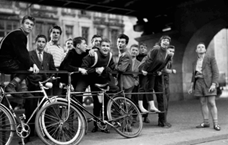
Berlin-Schönhauser Corner (East Germany, 1957)
For a few years after Stalin’s death, East German political orthodoxy loosened up enough for the partnership of screenwriter Wolgang Kohlhaase and director Gerhard Klein to produce a string of gritty – and relatively nuanced – depictions of the GDR’s social tensions (including A Berlin Romance, which is one of my top Cold War movies). Their crime drama Berlin-Schönhauser Corner follows four teen delinquents as they drift aimlessly through East and West Berlin, seeking escape from their dysfunctional homes to the beat of jazzy rock ‘n roll. There is (poetic and neo-)realism in what can be considered a ‘message picture,’ but there’s also an expressionist sensibility akin to noir, both in the story’s darkness and in the low-key lighting (with the characters projecting stark shadows onto the surrounding streets and walls, some of them still bearing the scars of WWII). The movie has understandably been compared to The Wild One and to Rebel Without a Cause, but its angry, energetic portrayal of the system’s disenfranchised underdogs also brings to mind Pickup on South Street, especially since one subplot concerns foreign agents (here slimy western spies rather than slimy commies, of course).
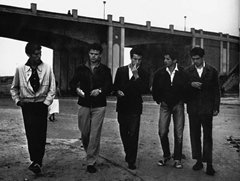
The Delinquents (Spain, 1959)
I admit that this breathtakingly shot tour de force about a young gang in Madrid pulling off one robbery after another in order to fund one of the gang member’s dream of being a bullfighter (because Spain) might finally stretch the definition of film noir beyond reasonability… The narrative is loose, the sensibility is way more naturalistic than stylized, and The Delinquents is so amoral that you can’t even take poetic irony for granted (the only one you know for sure is going to get it in the end is the bull, so beware if you can’t stomach animal cruelty). Fans of noir, however, will find plenty to latch onto in the many tense crime set pieces and the overall saga of lowlifes among urban decay.