This week’s reminder that comics can be awesome is also a tribute to Ogden Whitney’s splendid covers for Adventures into the Unknown:
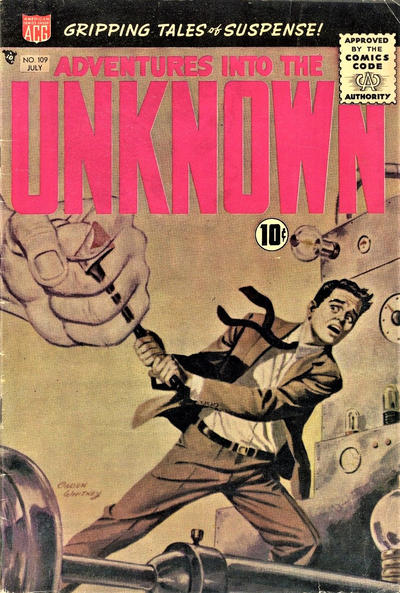
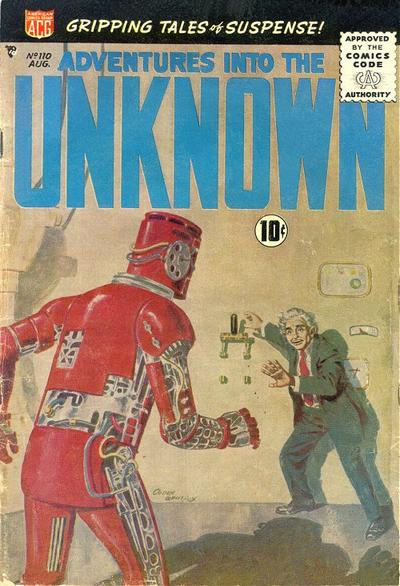
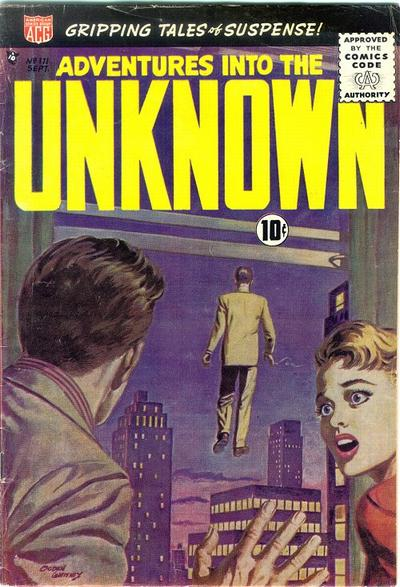
This week’s reminder that comics can be awesome is also a tribute to Ogden Whitney’s splendid covers for Adventures into the Unknown:
The main reason The Ludocrats was Gotham Calling’s 2020 Book of the Year is that, by the time I did the list, I hadn’t yet read Portrait of a Drunk (a nihilistic piece of ribaldry that lives up to Seinfeld’s motto: ‘no hugging, no learning’). Yet it was also because The Ludocrats was a consistently hilarious book that kept surprising me at every turn. This was elevated by the fact that the series verged increasingly into metafiction towards the end, playing both with the medium’s form and with different narrative traditions in original, entertaining ways.
I was hoping for something similar when I picked up the latest reboot of Peter Cannon: Thunderbolt, also written by Kieron Gillen… but boy did I get much more than that!
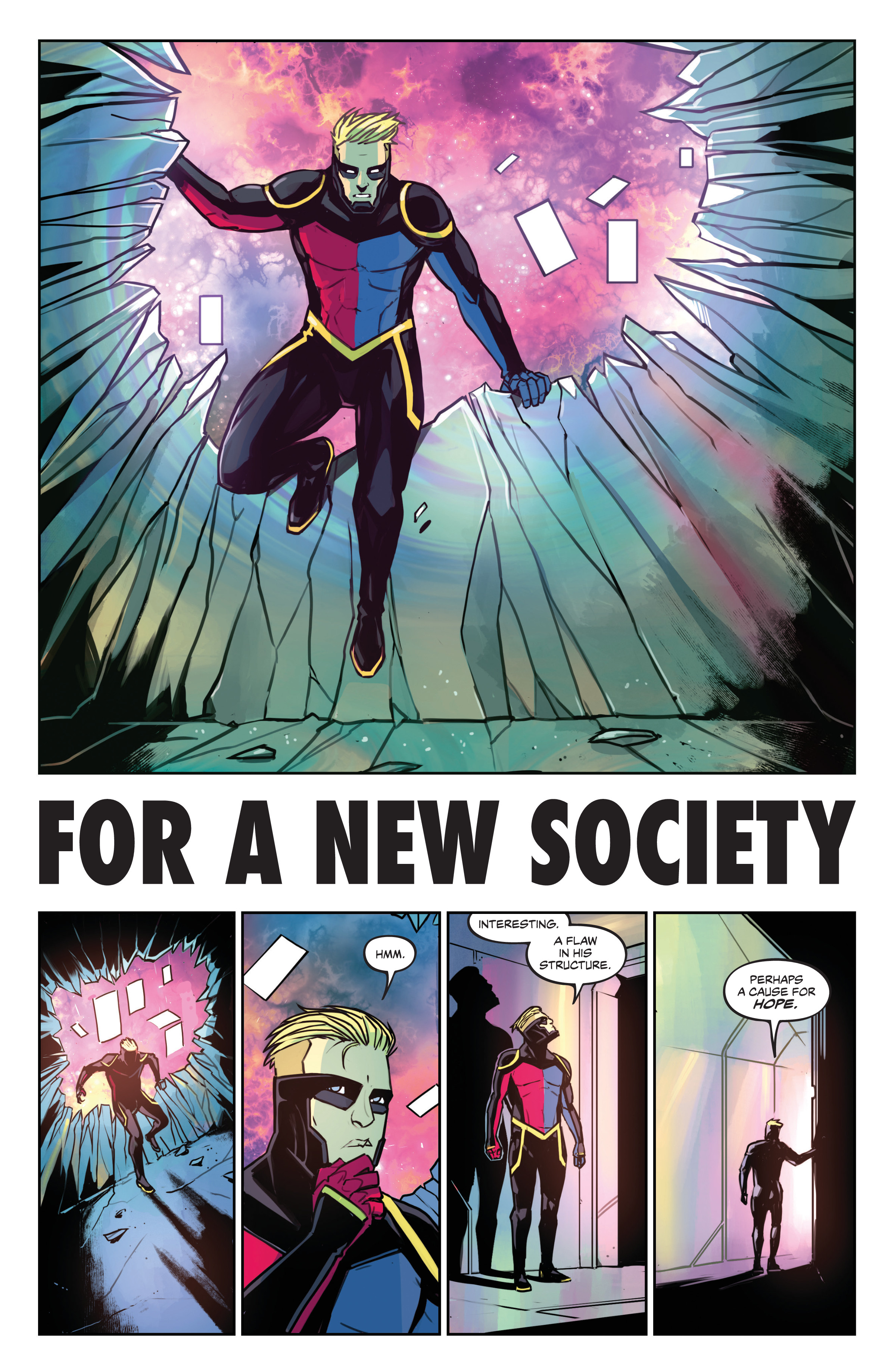 Peter Cannon: Thunderbolt (v3) #5
Some context. Besides The Ludocrats, Kieron Gillen has a long history of engaging in intertextual dialogue with other comics, including with giants of the field. Notably, his 2014 mini-series Three was a response to 300, Frank Miller’s and Lynn Varley’s proto-fascist epic about the Battle of Thermopylae, where three hundred Spartan warriors supposedly held their own for days against Persian invaders that massively outnumbered them. Whereas Miller – through his signature breathtaking visuals and hardboiled dialogue – emphasized the Spartans’ bravery and stamina, Gillen focused on their slave system, telling the story of three helots who held their own against three hundred Spartans (effectively reversing the position of the previous heroes by privileging compassion and class solidarity over manly stoicism and nationalism).
Three is a witty, exciting yarn in its own right, developing characters you come to care about (in contrast to 300’s superficial cast). The polemic with Miller stays relatively indirect, even if King Leonidas’ most quoted line (‘Ready your breakfast. And eat hearty – for tonight we dine in Hell!’) does get subverted at one point (‘So come, any who would dine in Hades… Let those who lived there show you the way.’) and even if the climax at the ravine brings to mind 300’s opening tale about the wolf. Likewise, Ryan Kelly’s artwork and Jordie Bellaire’s colors secure the series’ own identity, despite occasional echoes of Miller’s and Varley’s aesthetics:
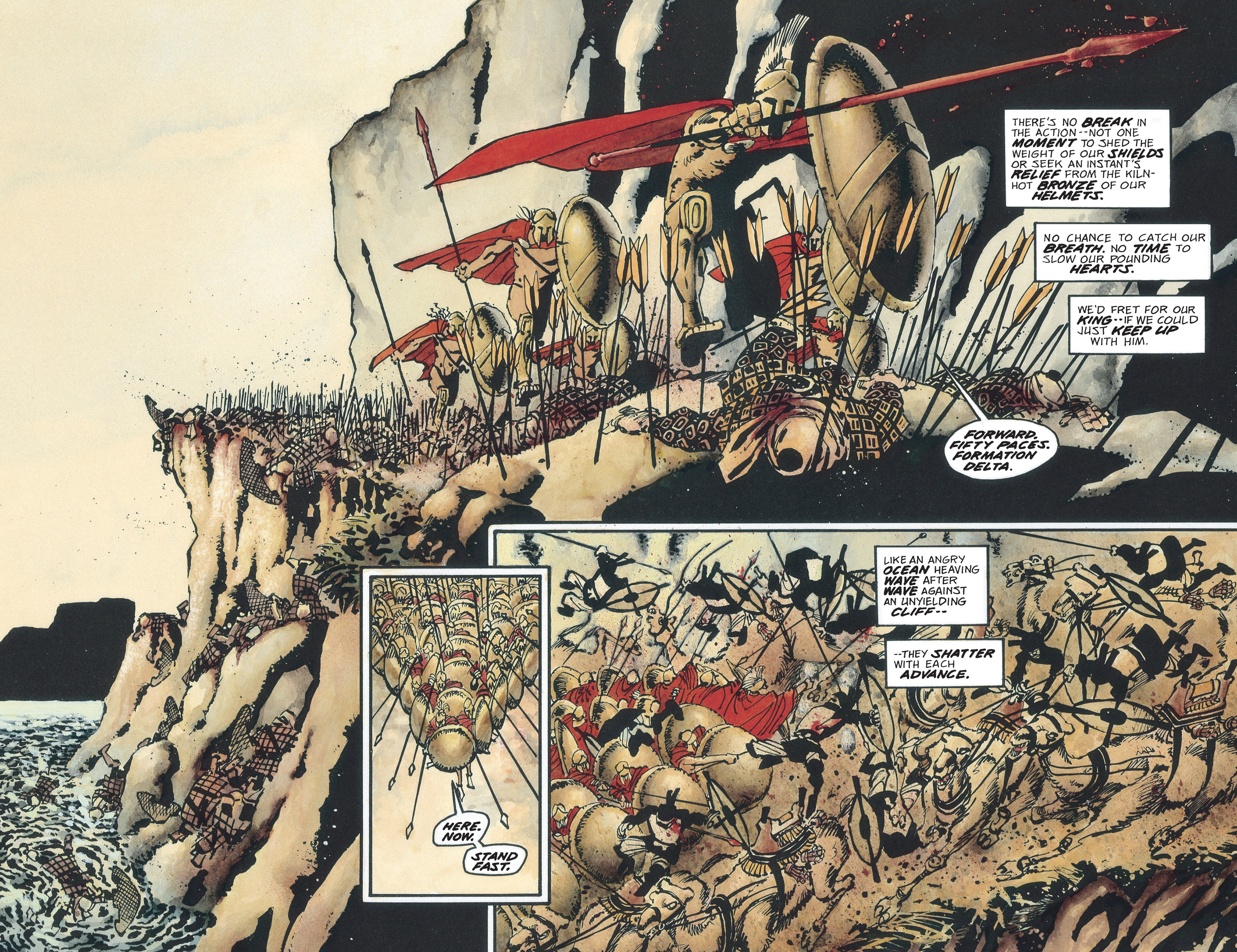 300 #4
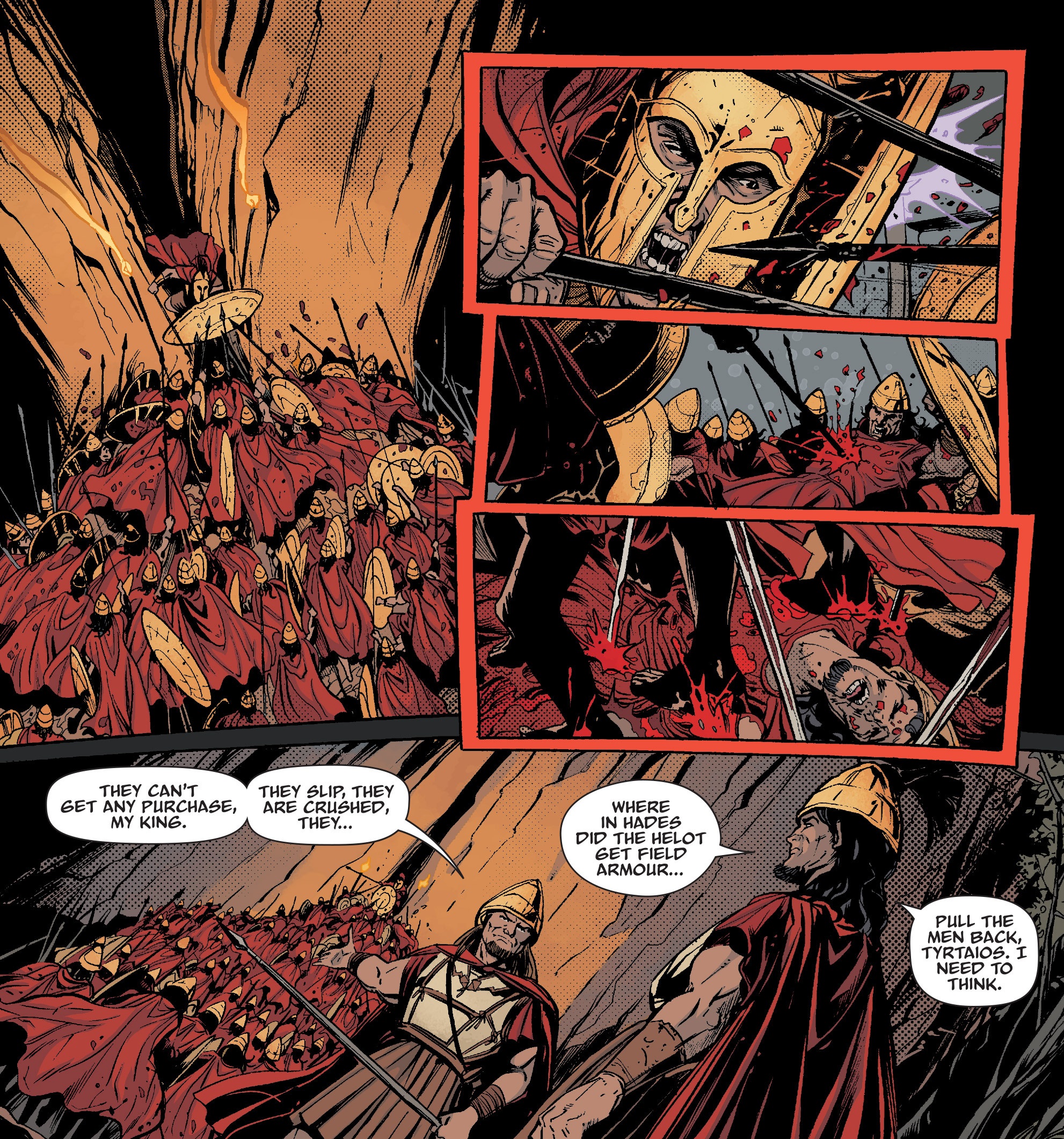 Three #5
If there is one property that lends itself to similar revisionist gestures is Thunderbolt. Originally created by Pete Morisi for Charlton back in 1966 and, later, part of the DCU for a while, Peter Cannon is a white, blonde American (an orphan, as per tradition) raised in a Himalayan lamasery, where he attained peak mental and physical perfection and, as ‘the chosen one,’ was entrusted with the knowledge and wisdom of mystical ancient scrolls, on top of developing kickass martial arts’ skills. Yep, Cannon – along with his confidant, Tabu Singh – embodies several problematic tropes of a certain branch of orientalist fiction, with a touch of eugenics, like a not-so-distant cousin of Doc Savage and Iron Fist (hell, even Batman!).
That said, when Thunderbolt got a reboot at Dynamite, in 2012, writers Steve Darnall and Alex Ross did not mess with any of this stuff (except for one twist I refuse to spoil), approaching it with a straight face and hardly a wink. Not only that, but artist Jonathan Lau rendered the visuals in a classic, if elegant, style, privileging clear, dynamic storytelling of the widescreen variety so common in 21st-century superhero comics. The same mainstream attitude was adopted by colorist Vinicius Andrade and letterer Simon Bowland. The result was a breezy – yet ultimately uninspired – 10-issue run, pitting Peter Cannon against Obama-era villains such as the owner of a FOX News-like network and a hawkish general committed to American exceptionalism. This largely forgettable series has been collected in an omnibus whose most remarkable feature is a previously unpublished Morisi story (which the veteran creator did for DC’s Secret Origins, back in 1988).
Still, at least the action was pretty slick:
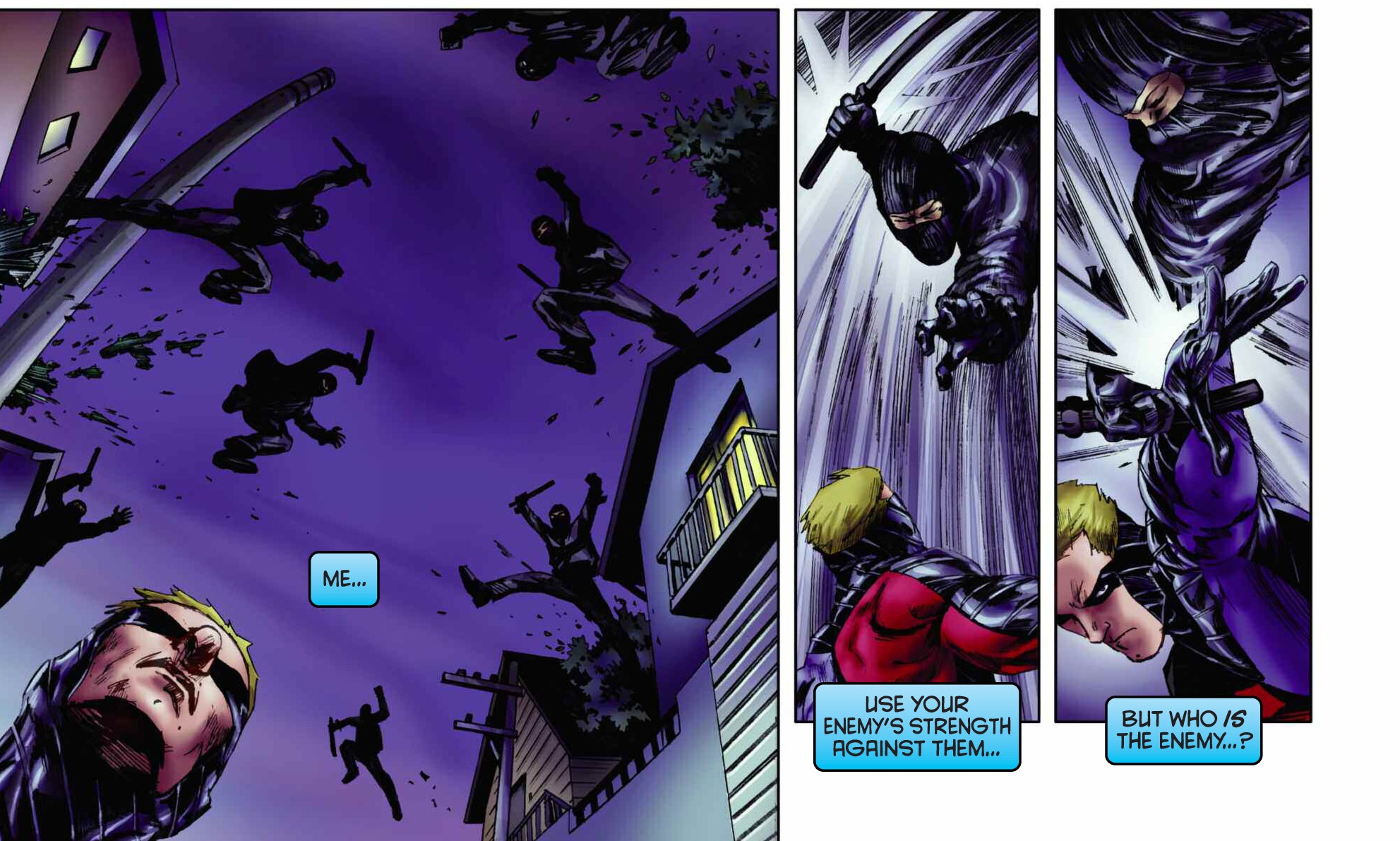
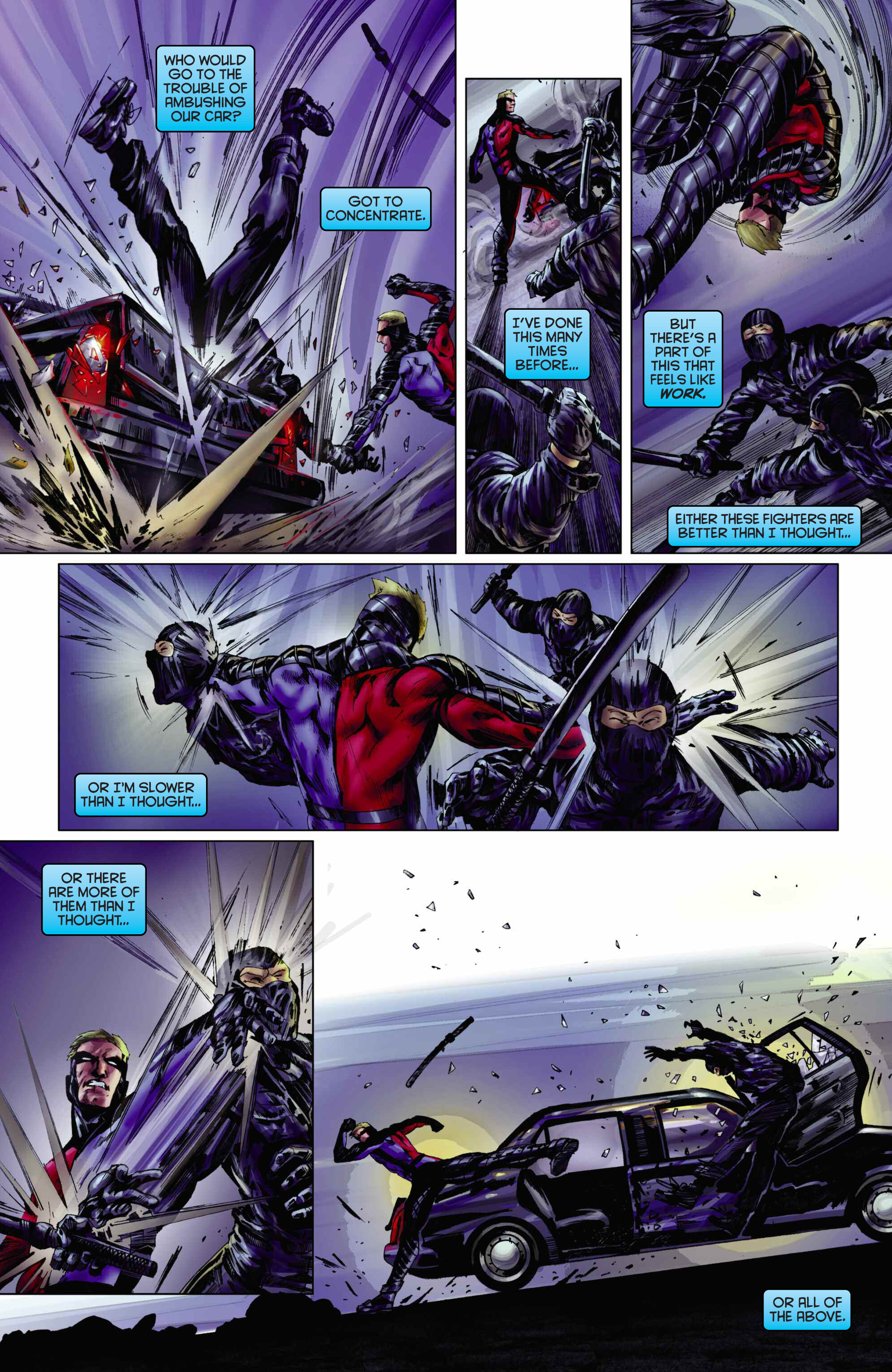 Peter Cannon: Thunderbolt (v2) #2
In 2019, when Kieron Gillen – working with artist Caspar Wijngaard, colorist Mary Safro, and letterer Hassan Otsmane-Elhaou – had a stab at the property, I knew he was bound to bring a higher degree of awareness to this material. If nothing else, I expected him to engage more cleverly with the fact that Thunderbolt had been famously recast as Watchmen’s Ozymandias (there was a nod to this in the previous reboot, but it was as bland as everything else…).
And, sure enough, the connection to Watchmen was there from the get-go. The intro situated the story ’35 minutes into the future,’ in a clear allusion to Ozymandias’ classic line. There were callbacks to other fan-favorite passages and several in-your-face puns, visual and otherwise (‘To watch changes everything.’). The comic also referenced key post-Watchmen superhero texts, such as The Ultimates and Animal Man, not to mention Zack Snyder’s film adaptation (‘How did the cool one in that shit movie put it?’).
The shocking thing that soon became apparent, though, was that this Peter Cannon: Thunderbolt mini-series (collected in a volume suitably called Watch) wasn’t just paying homage to Alan Moore’s and Dave Gibbons’ opus and their impact in the field… It turned out to be a stealth sequel!
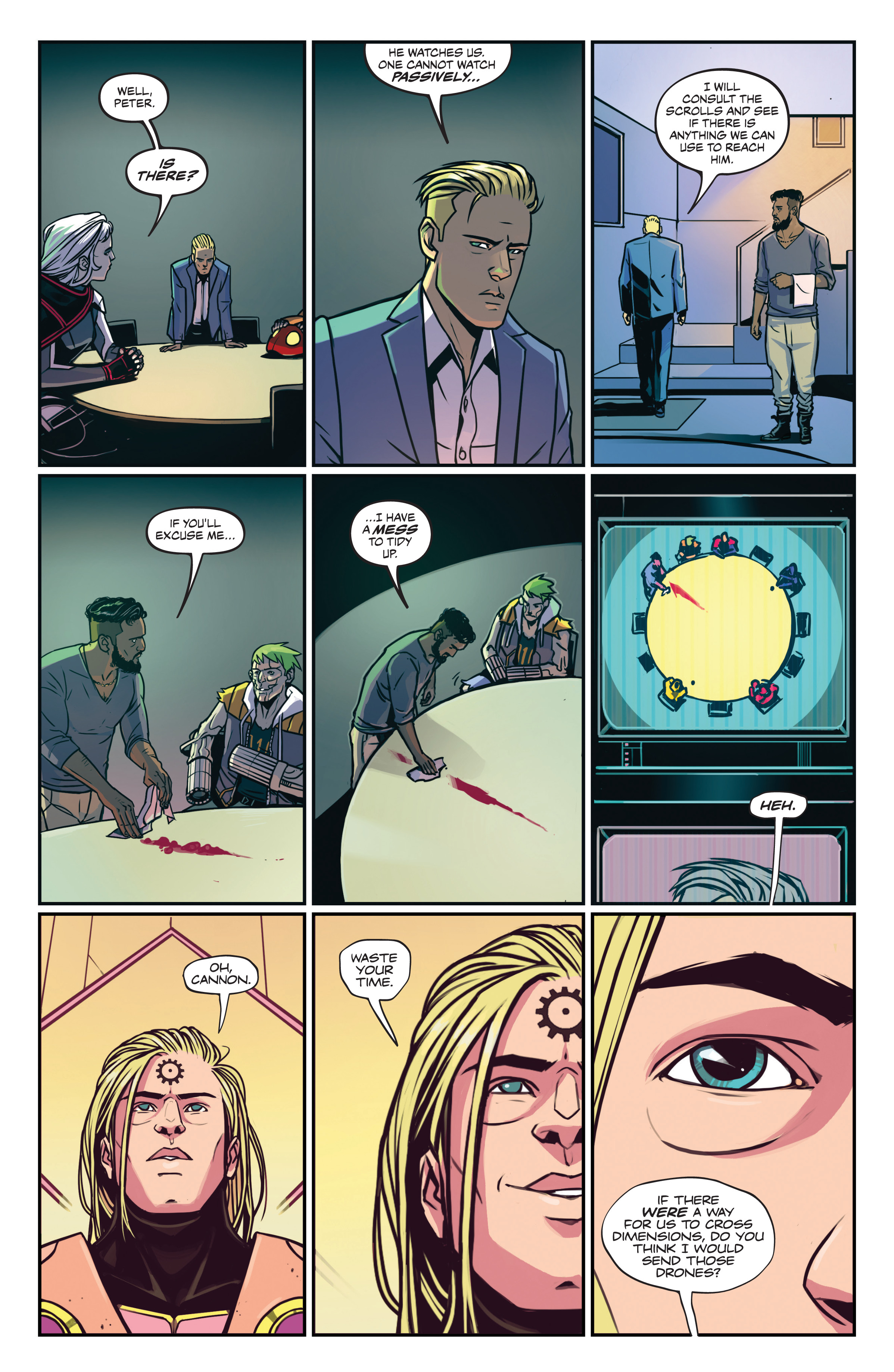 Peter Cannon: Thunderbolt (v3) #2
That’s right, in the same year that HBO released Damon Lindelof’s acclaimed show and DC finished publishing Geoff John’s and Gary Frank’s infamous Doomsday Clock comic, there was a third series providing yet another alternative future for Watchmen’s cast and concepts. (There are many reasons to explain this confluence, but one of them is probably generational: Lindelof, Johns, and Gillen, who are all roughly the same age, must’ve been impressionable teens at the height of Watchmen’s influence, in the late 1980s. They’re now in their mid-40s, at a stage in their careers where they can get the free rein to settle old scores.)
Like the other two sequels (and like DC’s flood of lame prequels and spin-offs in the past decade), Peter Cannon: Thunderbolt establishes its credentials through visual continuity, namely – as you can see above – by revisiting the original’s memorable nine-panel grid as well as the iconic sliced circle motif… Some quotations are even more direct. I’m guessing most readers probably recognized the scan at the top of this post as Wijngaard’s take on Watchmen’s first title page:
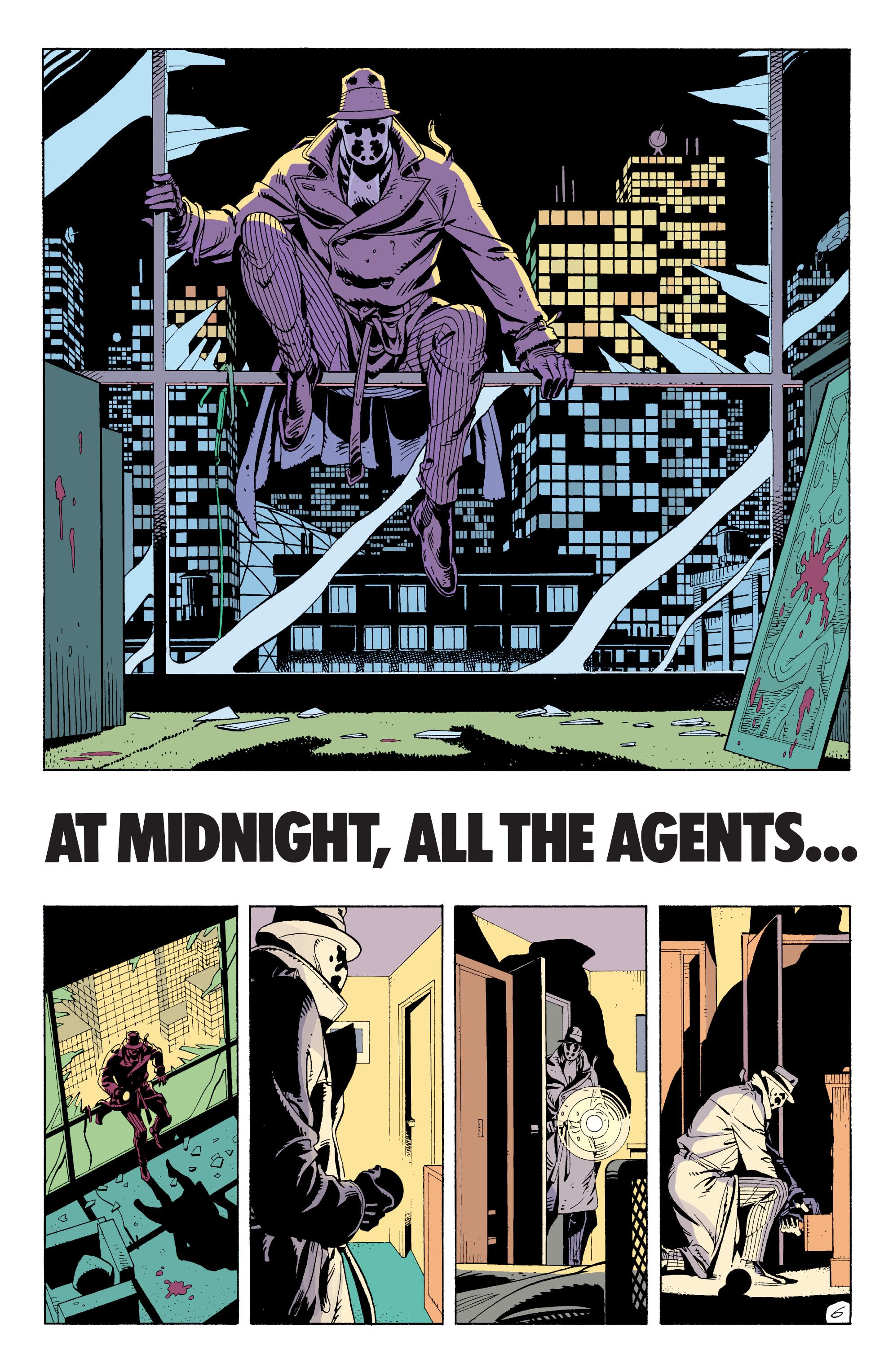 Watchmen #1
While I haven’t much sympathy for DC’s/Warner’s attempts to shamelessly milk Watchmen’s cow – not least because I believe much of the original’s power derives from its self-contained format – I’m willing to open an exception for a smart, playful project published by a smaller company that daringly puts its own spin on this decades-old masterpiece, delivering a thinly-veiled follow-up while poking fun at the evolution of superhero fiction since 1986. (It’s the kind of iconoclastic move Moore himself excelled at in The League of Extraordinary Gentlemen.)
Still, there can be too much of a good thing. Peter Cannon: Thunderbolt is slavishly packed with allusions to all of Watchmen’s greatest hits, from ‘a raft of corpses’ to Rorschach’s finger-breaking torture. The meta-commentary devolves into full-blown lecturing, with characters given awkward, on-the-nose dialogue such as ‘I have transcended your genre.’ or ‘This is not magic. This is… formalism.’ It doesn’t help that the series’ perspective on Watchmen comes across as quite narrow-minded (as if the original had been a purely deconstructive, prescriptive, soulless, humorless work) and the satire of the ensuing wave of simplistic, violent imitators isn’t particularly insightful or groundbreaking either… (You can find a funnier take on these ideas in Warren Ellis’ StormWatch and a more provocative one in Grant Morrison’s The Multiversity.)
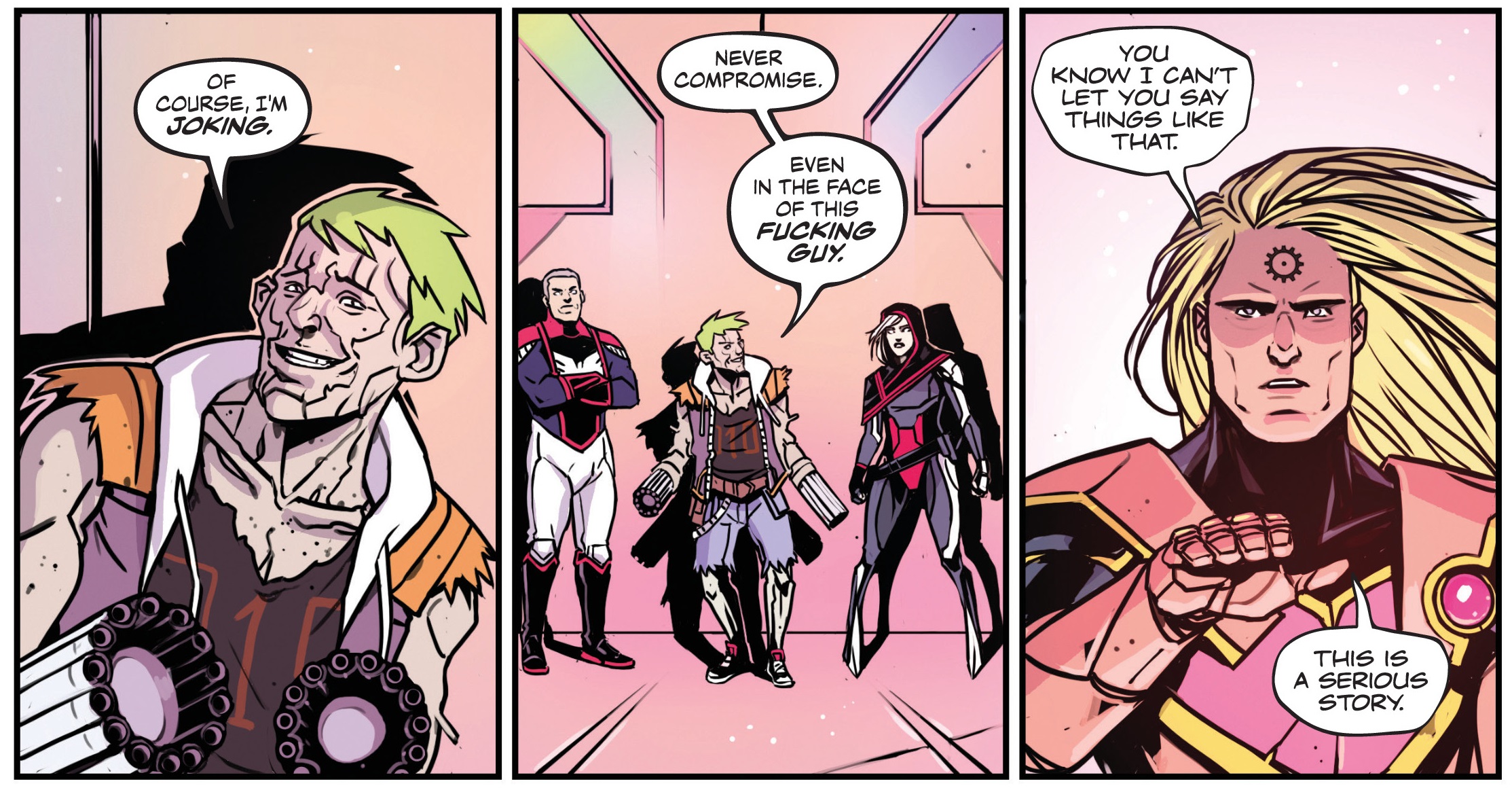 Peter Cannon: Thunderbolt (v3) #2
If you think Watchmen lacks subtlety, wait until you get a load of Peter Cannon: Thunderbolt, where Gillen seems damn set on making sure you get what he is doing. Even a neat riff on the notorious bit from The Ultimates where Captain America points to the symbol on his helmet is spoiled by showing up a second time, in a more obvious guise (plus, again, Ellis’ version made me laugh louder).
One of Moore’s and Gibbons’ major accomplishments in the original was the way they managed to weave multiple layers of metafiction and political themes *without* letting them fully take over the comic – at a primary level, you can disregard the subtext and still be left with a satisfying narrative… Hell, much more than satisfying: it’s riveting and genuinely involving and dramatically powerful and, yes, often drenched in dark comedy (not just ‘a serious story’). In turn, Thunderbolt is playing a whole other game, one where the narrative has, above all, an ancillary role as a gateway for a highly conceptual reflection, eventually leading into downright pastiche…
 Peter Cannon: Thunderbolt (v3) #4
I usually have a lot of time for meta-comics (I loved Gillen’s choose-your-own-adventure tale in Batman: Black & White a couple of months ago) and there are sure plenty of fun moments in Peter Cannon: Thunderbolt – not to mention the fact that Wijngaard’s and Safro’s collaboration makes every single page a delight to look at! For the most part, though, the result is something I appreciated more than giddily enjoyed, nodding with interest and recognition more often than actually smiling (a similar feel to watching the first episodes of WandaVision, before the story took off).
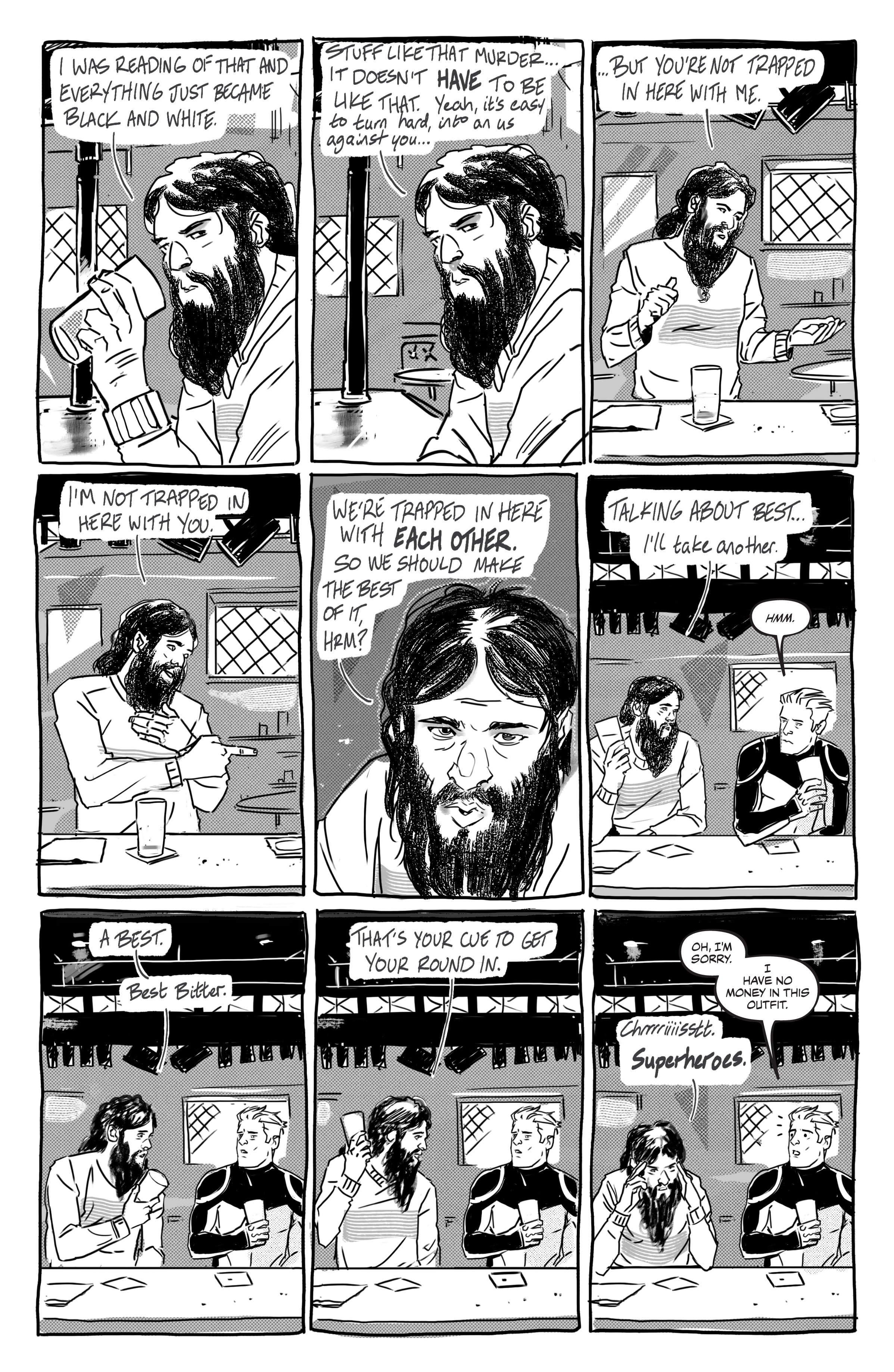
Pages like the one above make me feel like a decoding machine. I see the color-based wordplay, the twist on Rorschach’s badass line about prison, the way Caspar Wijngaard draws the character to look like Alan Moore, and the general evocation (helped by Otsmane-Elhaou’s letters) of slice-of-life indie comics, particularly of Eddie Campbell’s Alec. And yes, I realize the double meaning of this choice, since Campbell went on to work on From Hell, which is also a key post-Watchmen text, signaling Moore’s search for further realism and (temporary) commitment to pushing the medium beyond superheroes after having taken that genre to an extreme…
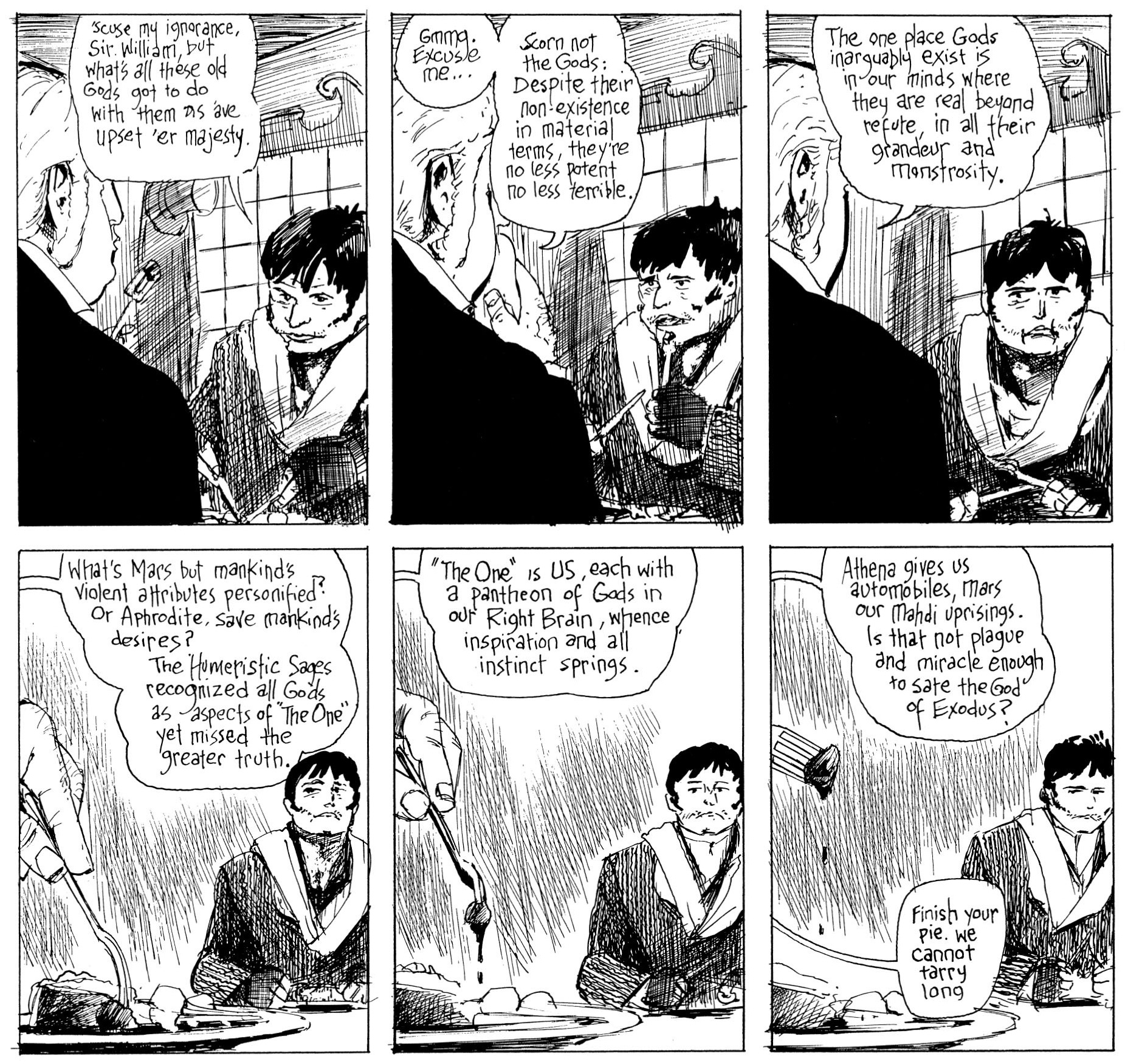 From Hell
I respect that the goals and approach behind Peter Cannon: Thunderbolt were different than those of Watchmen, but I cannot help finding it ironic that this new series ends up doing exactly what it (unfairly) attributes to the original: it comes off as an essentially formalistic exercise trapped in the confines of its own tight design. Sure, the closing lines, sealing the take-away message, do hint at a larger statement about humanity, but those aspects seem somewhat forced, as if they’re just part of the comic’s mechanical structure. Even the hero’s character arc feels like little more than a rhyme with Dr. Manhattan’s (as opposed to Three‘s deeper emotional payoff, for instance).
By this stage, did we really need another explicit reminder that superhero comics should get out of Watchmen’s shadow and try to forge new paths? If we have to keep going back to Alan Moore, then let’s at least find other stuff to reappropriate and cooler ways to do it. For example, when exploring notions of art and divinity in Gødland, Joe Casey and Tom Scioli chose to recontextualize the passage above, from Moore’s and Campbell’s historical graphic novel about Jack the Ripper… in a scene featuring mutant super-mice:
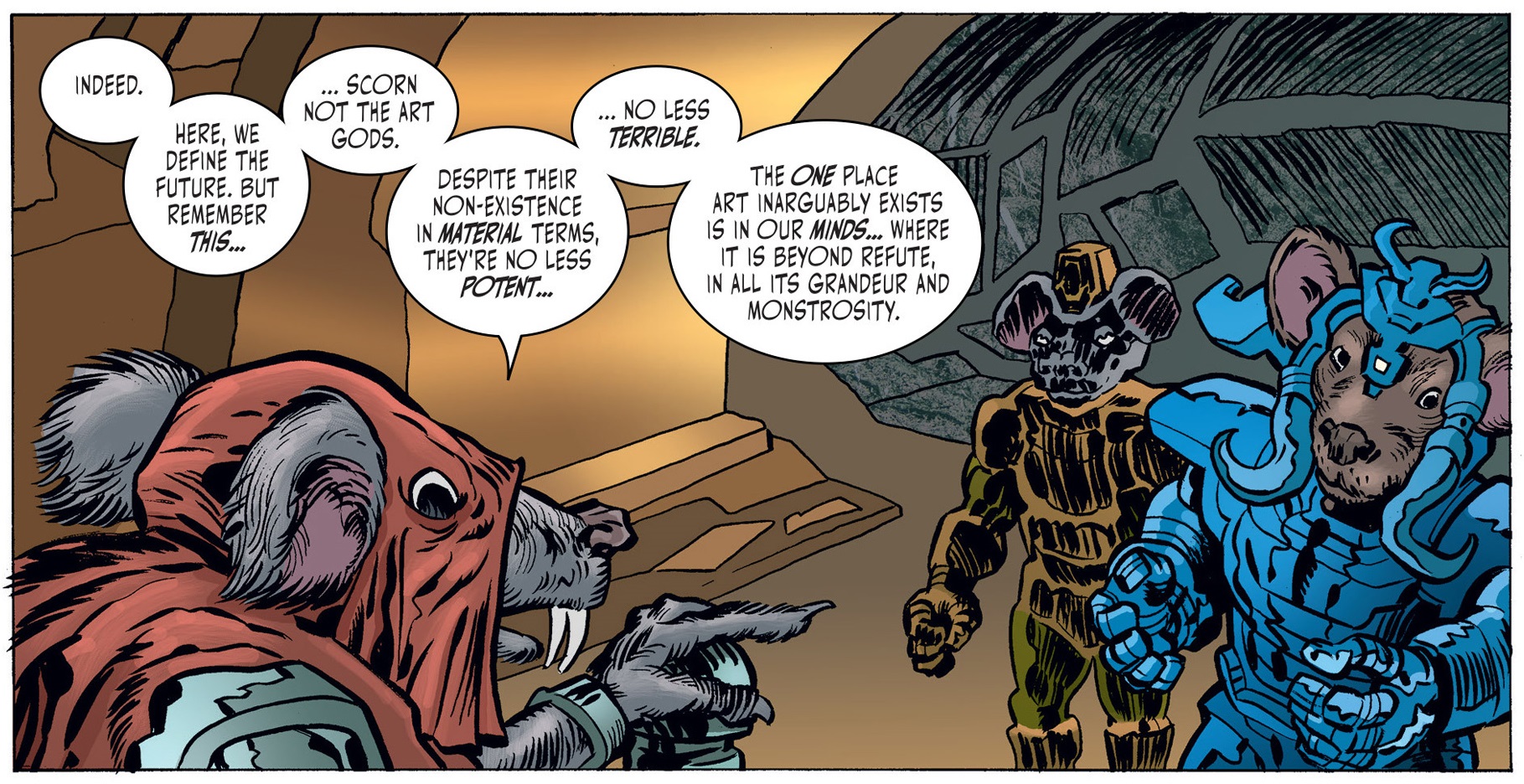 Gødland: Finale
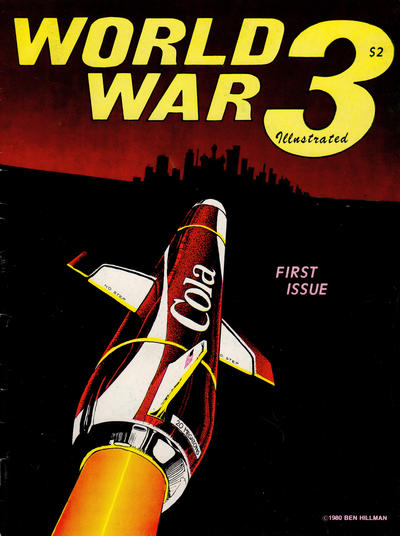
Going back to covers for a while, here is a reminder that comics can be awesome, US icons edition…
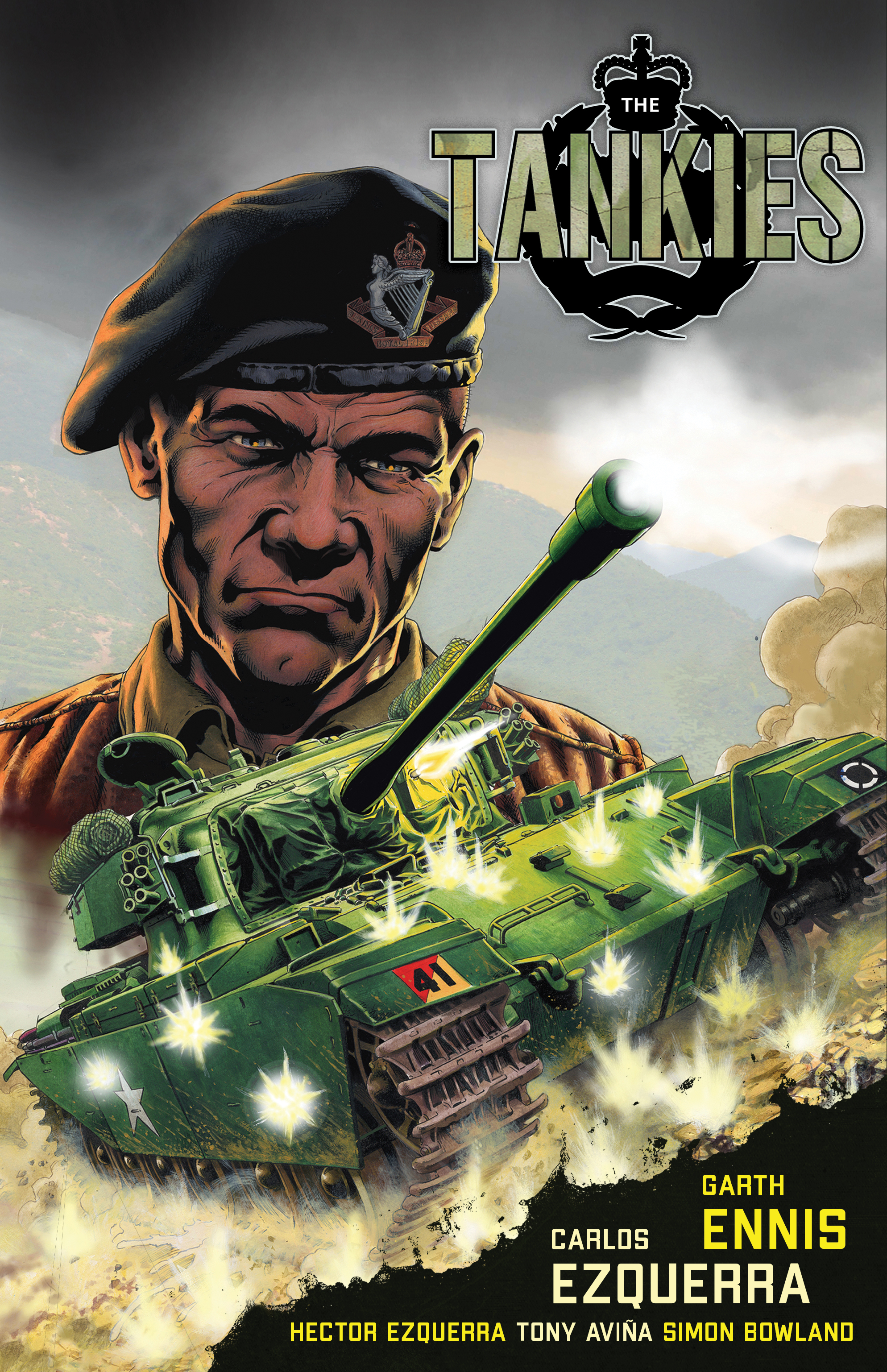
The folks at Dead Reckoning sent a copy of Garth Ennis’ and Carlos Ezquerra’s The Tankies for me to review, so I figured it would be fun to put the book into context by discussing it together with other collections of war comics. After all, military fiction has come a long way since its foundational role in the medium as World War II propaganda and, as we are living in the Golden Age of Reprints, readers can now assess how different creators have tackled this genre in various ways throughout the decades.
CORPSE ON THE IMJIN! AND OTHER STORIES
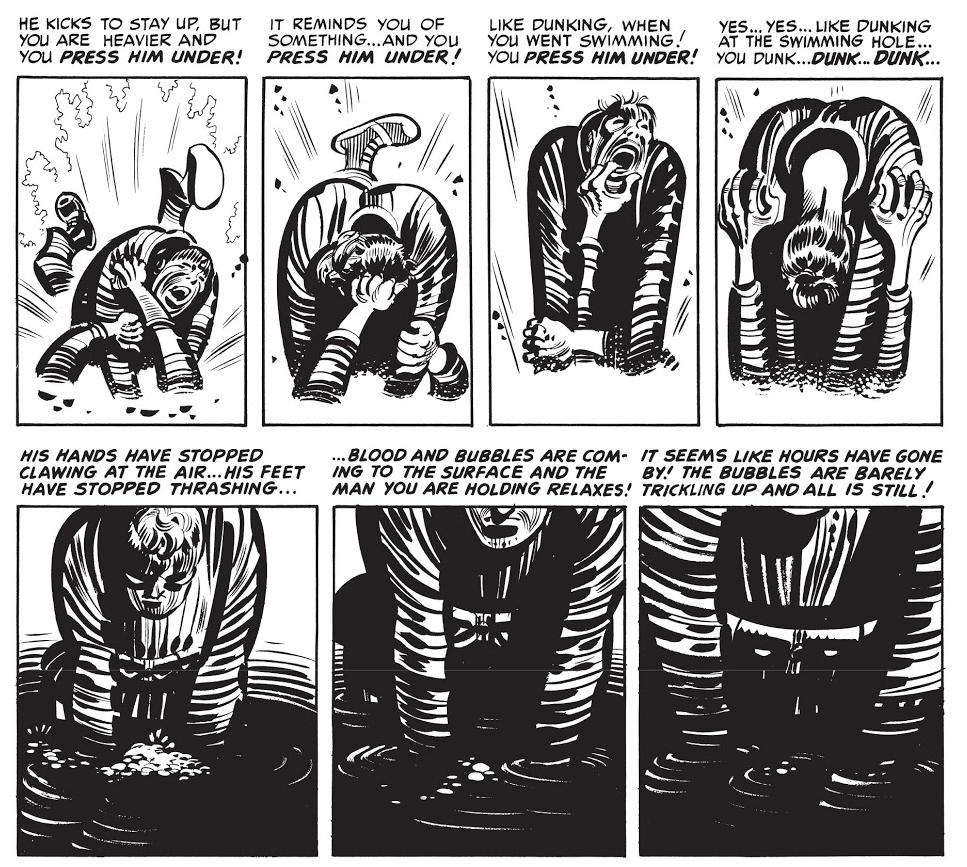
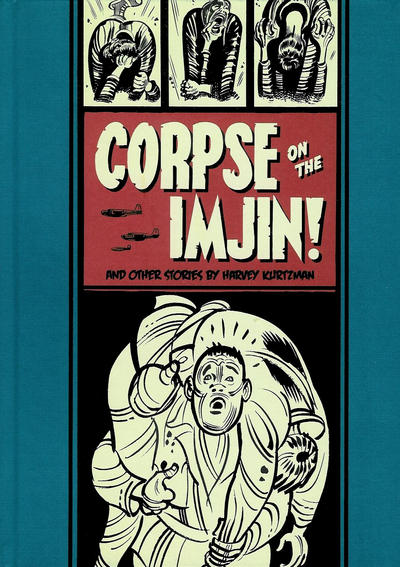
Before going on to mock US popular culture in Mad, Harvey Kurtzman memorably desacralized another key American institution – war – on the pages of two iconic EC anthology series he both edited and wrote: Two-Fisted Tales and Frontline Combat. What’s more, he did it during the Korean War, when most other publishers were spouting hyperpatriotic yarns and the comic-book industry (especially EC) was under the double threat of McCarthyism and the large-scale anti-comics panic of the early 1950s. Fantagraphics’ Corpse on the Imjin! and Other Stories collects dozens of those Kurtzman comics, which he approached in a much grimmer and more serious-minded tone than Mad – according to R.C. Harvey’s introduction, he was emulating Charles Biro’s storytelling in the Lev Gleason crime books (Crime Does Not Pay and Crime and Punishment), with its fact-based ‘hard-edged documentary style.’
A brilliant cartoonist, Harvey Kurtzman also drew a bunch of these tales, here reprinted in a stark black & white full of shadowy negative space and proto-noir atmosphere (except for the covers, which keep Marie Severin’s vivid original colors). Kurtzman’s delightfully exaggerated, rubbery figure work makes for quite a striking juxtaposition with the vicious content, combining thoughtful layouts and a sense of well-researched authenticity with highly expressionistic visuals. There are a few early experiments, including a brutal take on colonialism (‘Conquest’) and a couple of straightforward adventures about pirates and criminals in exotic lands, still privileging excitement over any political message beyond a general contempt for ruthless greed. For the most part, though, this is one of the greatest collections of war comics ever – the titular story, in particular, is a masterpiece of the medium, unflinchingly capturing the agony of taking a human life with your bare hands (as shown above).
Reacting against the way other comics mobilized young readers by romanticizing combat and dehumanizing the enemy, Kurtzman made a point of deglamorizing warfare and highlighting how symmetrical – and immoral – were many of the actions of soldiers on the two sides. A running motif is the notion that a life is a life and, even if you have to kill in some circumstances, you shouldn’t enjoy doing it… The impact of the glorification of war on impressionable kids is directly fictionalized in this collection’s final story (‘Memphis!’), with a character concluding that grown-ups ‘ain’t got no more sense ‘bout how serious war is’ than children. And while Kurtzman worried about other comics’ influence, the authorities’ worried about his own: Grant Geissman’s The History of EC Comics quotes fascinating documents from the files of the FBI, which closely monitored Kurtzman and, in 1952, actually consulted the Department of Justice over whether these comics constituted a violation of the sedition statutes. After all, in the words of a confidential informant: ‘Some of the material is detrimental to the morale of the combat soldiers and emphasizes the horrors, hardships, and futility of war.’
That said, the book doesn’t hit you on the head with the same message over and over. The stories touch on different aspects of conflict and they even contain a variety of perspectives: for every preachy (‘And now that your bodies are growing cold and your limbs are stiffening, how do you like death, Li and Abner? How do you like death, humanity?’), you get a gruffier, Sam Fuller-esque outing. In fact, these comics aren’t all necessarily anti-war – or even anti-Korean War. It’s just that they try to problematize and nuance the era’s racist jingoism by humanizing both the Americans (not supermen) and the Koreans (not supervillains). For instance, ‘Contact!’ takes a clear stance against the use of white supremacy to justify giddily slaughtering Asians, but the closing narration still sounds awkwardly naïve (‘And remember, if we believe in good, we can’t go wrong!’) – Kurtzman himself calls that line ‘dreadful’ in a 1982 interview collected at the end of the book!
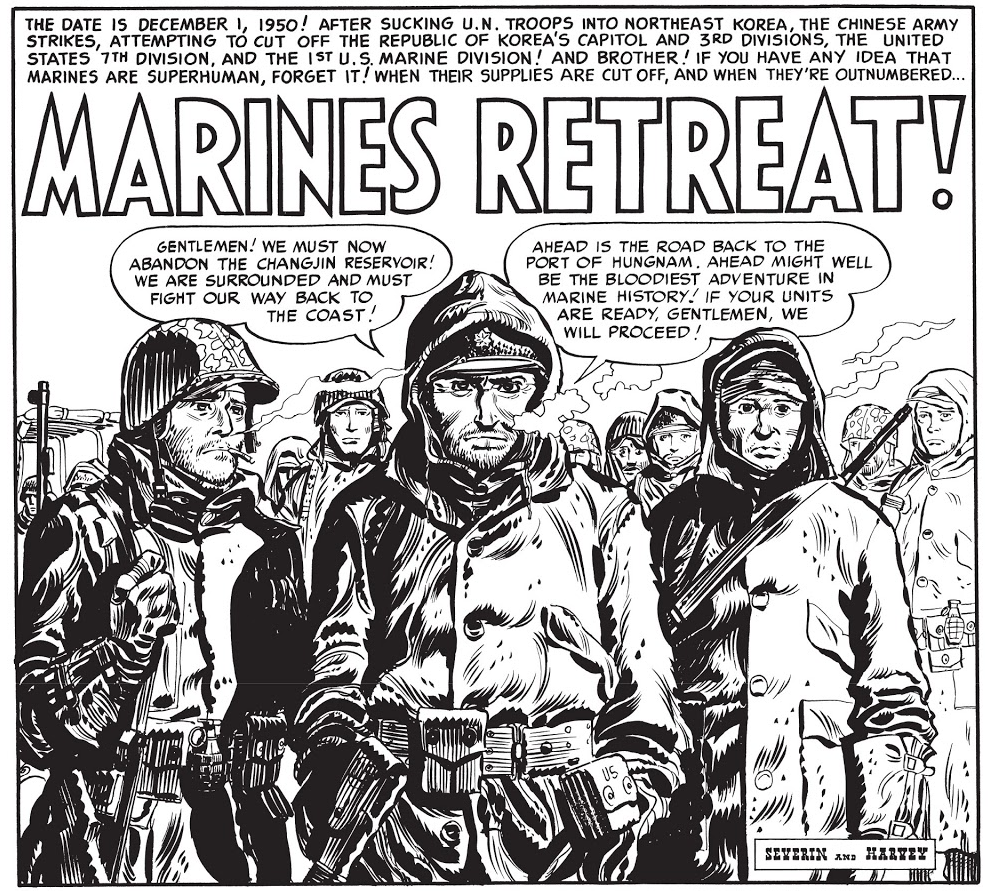
The panel above was pencilled by John Severin, one of a core team of acclaimed artists who illustrated Harvey Kurtzman’s scripts – and meticulous layouts – at the time and whose work is collected in the second half of the book. Other names include Alex Toth, Russ Heath, Dave Berg, Gene Colan, Ric Estrada, Johnny Craig, Joe Kubert, and Reed Crandall. Like Severin, most of them had a much more realistic style than Kurtzman, so the obsession with historical detail he demanded shines through even more in their work (not to mention the fact that many of them were war veterans themselves and therefore familiar with a lot of what they were drawing). This section is quite diverse in terms of content as well, with tales (they’re more like vignettes, really) about naval battles, trenches, and aircraft (Toth’s specialty) spreading to WWII, WWI, the Spanish-American War, the Civil War, and even the American Revolutionary War (Kubert’s harrowing ‘Bonhomme Richard!’).
As if all this wasn’t enough, Corpse on the Imjin! and Other Stories also contains insightful essays by scholar Jared Gardner, cartoonist Frank Stack, and EC experts S.C. Ringgenberg and Ted White. It’s a must-read for any fan of classic comics and/or military fiction.
BATTLE CLASSICS: FIGHTING MANN * WAR DOG
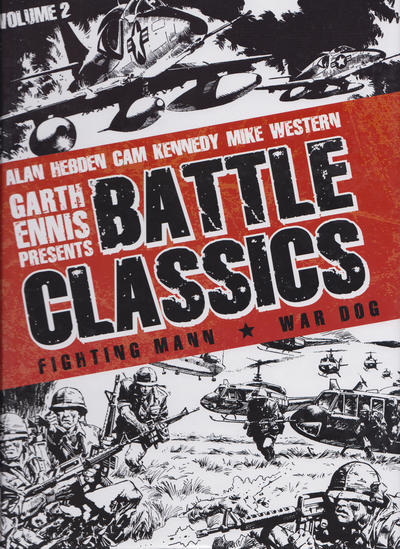
Although they share a fondness for both caustic humor and dead-serious military fiction, Garth Ennis clearly owes less to Harvey Kurtzman than to the revival of war comics in the UK in the mid-to-late 1970s on the pages of Battle Picture Weekly, the anthology launched by the awesome duo of Pat Mills and John Wagner. Much of it consisted of violent thrillers with morally questionable anti-heroes, often illustrated by artists such as Cam Kennedy and Carlos Ezquerra, so it’s not difficult to spot the influence. In fact, Ennis himself has been quite open about it, even curating a selection of reprints of his favorite tales from this era, titled Battle Classics, whose second volume compiles the serials Fighting Mann and War Dog.
Originally serialized in 1980-1981, Fighting Mann is a brisk, full-throttle action yarn about Walter Mann, a retired US marine colonel who goes to Vietnam in 1967 to investigate the mysterious disappearance of his navy pilot son. Mann finds out the disappearance is connected to something called ‘the Laotian problem’ and gradually gets involved in a web of cold war intrigue, but he spends most of the time struggling for his life, which tends to get threatened on every third page, as practically everyone seems out to get him, from the Vietnamese (North and South) to the CIA and the Khmer Rouge, among many others…
This is war as grist for kickass adventure, tastelessly exploiting a real-world conflict for cheap thrills, as writer Alan Hebden seems less interested in questioning or defending the US intervention in Vietnam than in supplying an endless stream of explosions, cliffhangers, and spy games. Still, you get a tour through various aspects and players of the Southeast Asian war zone – including historical episodes such as the Tet Offensive or the fire aboard the USS Forrestal – and thus a hint of its geopolitical complexity and massive carnage. I’m not saying you get a balanced, equidistant picture, since the Vietnamese do generally come off worse than the Americans (in turn, Mann appears to get along fine with a Russian KGB agent), but ultimately nobody is particularly likable on either side anyway, except perhaps for Chong, a South Korean who fought alongside Mann in the Korean War and whose resourcefulness and loyalty make him a key ally. Hebden had a knack for these cynical narratives (he also wrote Death Squad, whose leads belonged to a Wehrmacht punishment battalion in WWII’s Eastern Front), brazenly foregoing any proselytizing – or even any deep characterization – in the name of relentless forward momentum. Mann himself is a pulsating storytelling engine, moving with determination and macho stoicism through a jungle of armed characters and battle situations, at first barely pausing to contemplate the implications of what is happening around him, yet eventually getting wrapped up in the conflict.
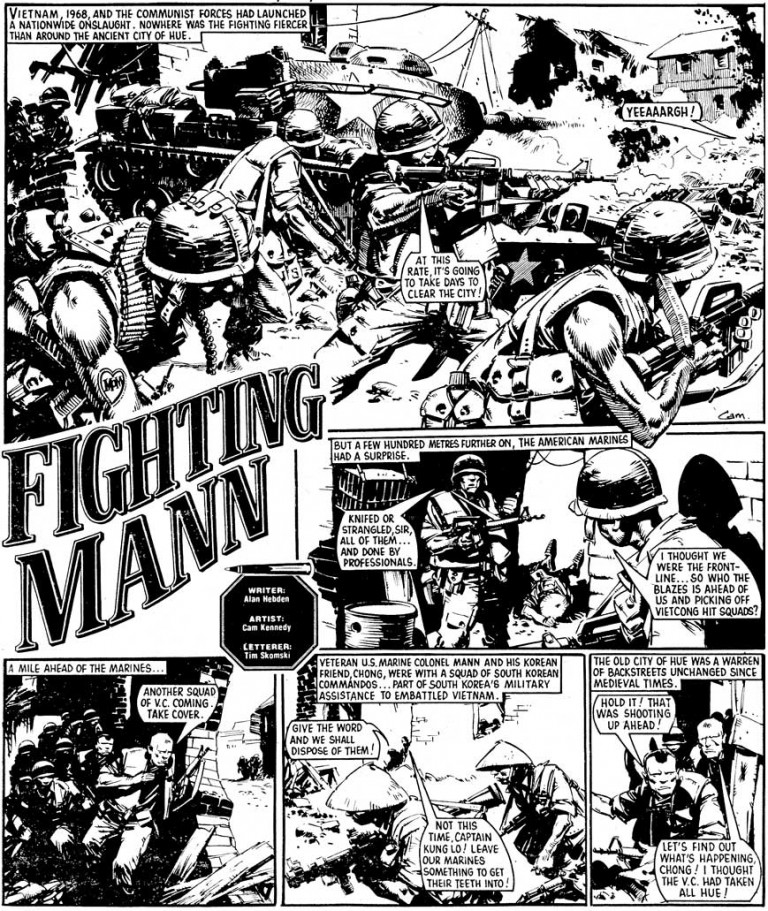
If there is never a boring moment in this comic, that’s also because of Cam Kennedy’s top-notch artwork. Kennedy’s style combines meticulous, quasi-photographic renditions – especially of weapons and aircraft – with a lot of evocative brushstrokes and hatching, his sharp inks making the most out of the format (unlike the stories in Corpse on the Imjin!, these were originally published in black & white). Sometimes a few strategically placed lines are enough for us to conjure up a sprawling landscape and assorted vegetation in our mind. The result is nothing short of stunning.
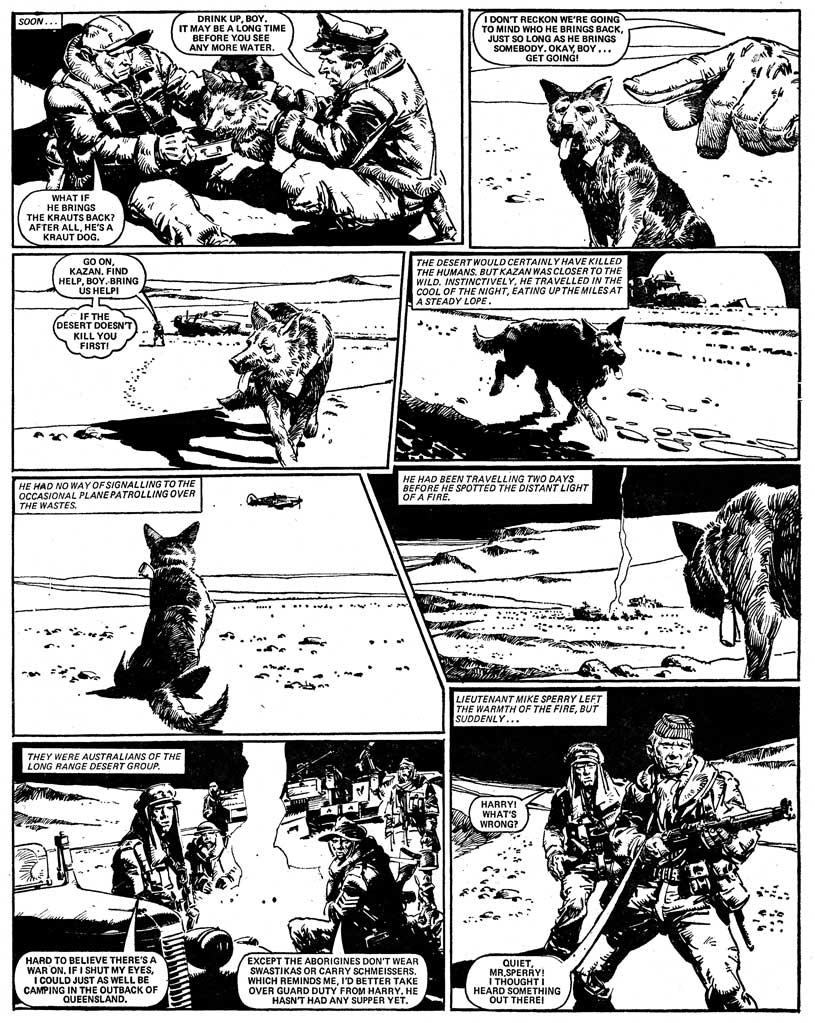
The last part of the book collects 1979’s War Dog, about a German Shepherd trained by the Lufwaffe who ends up travelling through several WWII hot spots. Imagine a more brutal version of Lassie, set against one of the most horrible backdrops in contemporary history, approached with a fairly naturalistic tone up until the ferocious finale… Alan Hedben writes it in the same action-driven, unsentimental style as Fighting Mann, using another moving protagonist to guide readers through different regions and players in an (even more) international conflict. Also, he joins complicit artists who privilege gritty visuals and accuracy over melodramatics: first Mike Western and then, once again, the reliable Cam Kennedy (who did the page above).
Titan really did a bang-up job with Battle Classics. A hardback collection with thick paper and extra-large size, the book lets the artwork breathe, inviting you to contemplate each carefully composed sequence in all its detail and virtuoso draftsmanship, the original pages (which apparently were in a wretched state) wonderfully restored by Moose Harris. You also get interesting text pieces by Garth Ennis, which I recommend reading after the respective comics, to avoid spoilers.
THE TANKIES
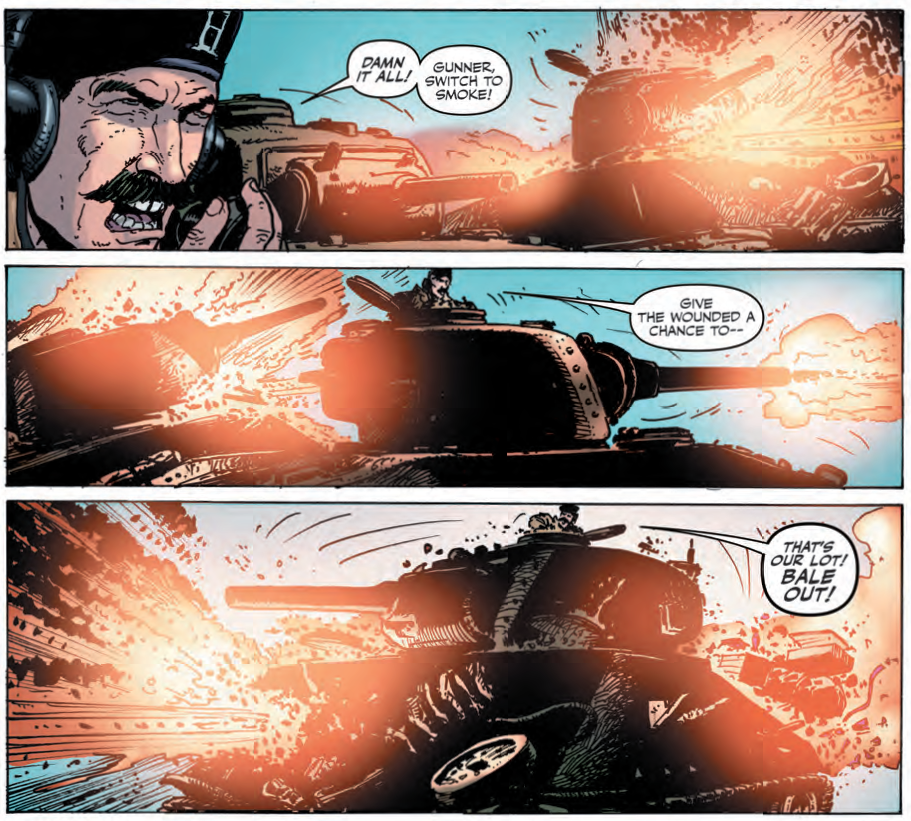
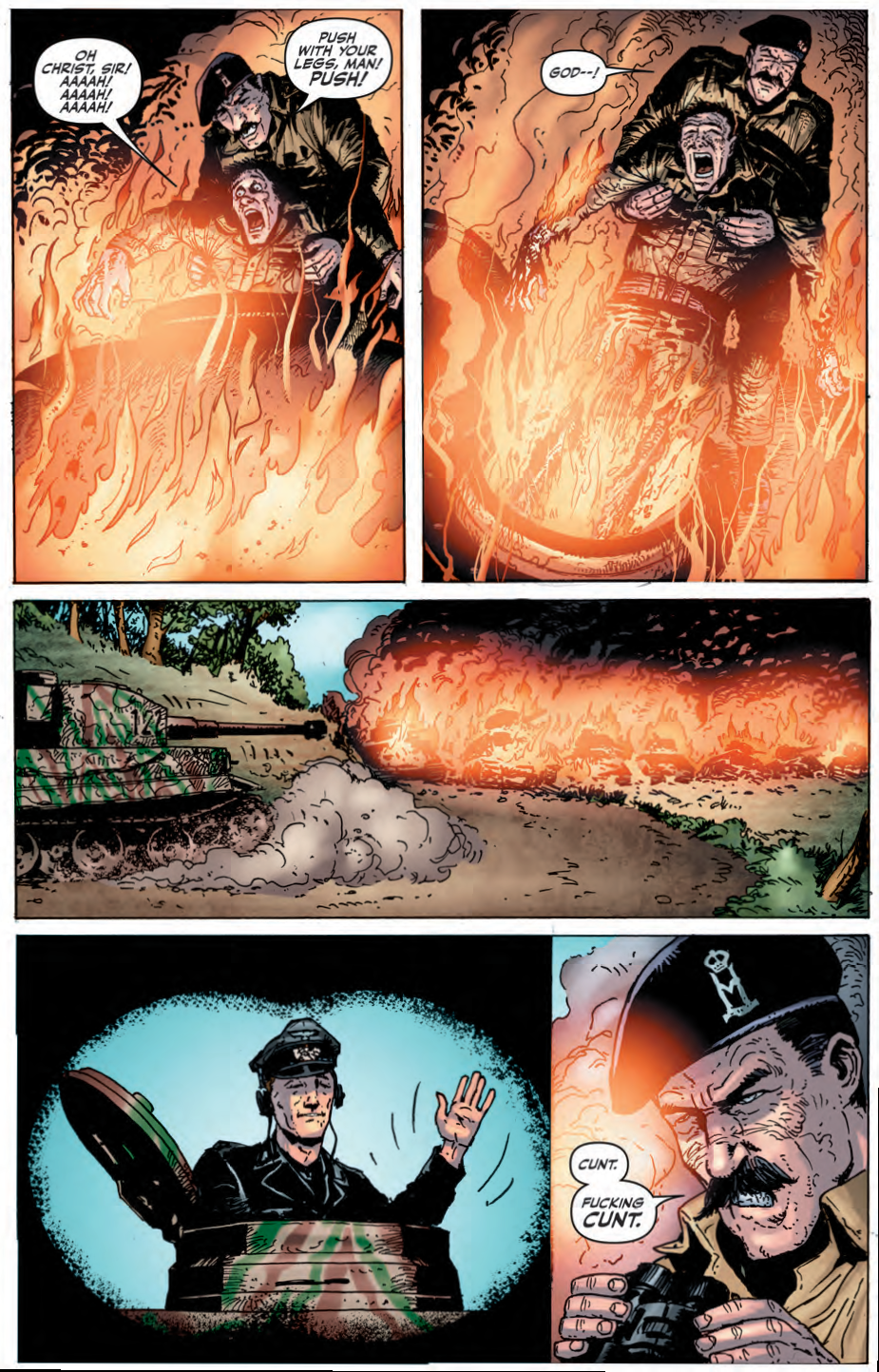
This brings us to The Tankies, which collects a trio of mini-series first published by Dynamite in 2009-2013, part of the Battlefields meta-series. These had been collected separately before, but they do belong together, as they follow the same rugged tank commander, Stiles, through World War II and the Korean War, in charge of a Churchill, then a Firefly, and then a Centurion. An imprint of the Naval Institute Press, Dead Reckoning has been building a solid catalog of war comics (especially older works and translations), so it makes sense for them to get some of Garth Ennis’ stuff in there, even if these particular series are hardly modern classics… Perhaps DR republished them as a tribute to Carlos Ezquerra, who died just a few years ago, but in that case we deserved some kind of essay about his artwork rather than just a reprint of his his rough sketches and character designs (although it’s quite cool to compare them to the versions inked by his son, Hector).
When these tales originally came out, Ennis had already become a superstar of realistic WWII comics. You could see him stretch his writing muscles in other earlier Battlefields minis – ‘Night Witches’ and ‘Dear Billy’ – but ‘The Tankies’ was clearly a looser project, with less investment in characterization (I dare anyone to distinguish the personality of more than a couple of crewmen) and plotting (most chapter breaks feel random and half-hearted). Alternatively, this can perhaps be considered the more grounded of the bunch, with its generally unremarkable cast and disjointed narrative amounting to a semi-documentary glimpse into life on the battlefront. In any case, what you do get – and for some of us this can be enough – is a lot of historical and technical detail, placing you in the middle of the action while capturing both the fascinating logistics and the sense of desperation of tank battles in these specific war zones.
The result is certainly not for all tastes – and not just because of the hardcore language and gore. In addition to the jargon-heavy dialogue, Stiles has a painfully thick Newcastle accent, so you can only get much of what he’s saying by reading those bits out loud, phonetically (this wouldn’t be so bad if not for the fact that some of the action in the middle is told rather than shown, making it a very text-driven work…). Moreover, while Carlos Ezquerra draws on decades of experience doing WWII comics through his typical mix of unattractive faces and intuitive storytelling, his art doesn’t exactly benefit from Tony Aviña’s bright colors, which feel way too clean for such dirty settings (even though the palette appears suitably flatter in this edition compared to the original comics, if I’m not mistaken).
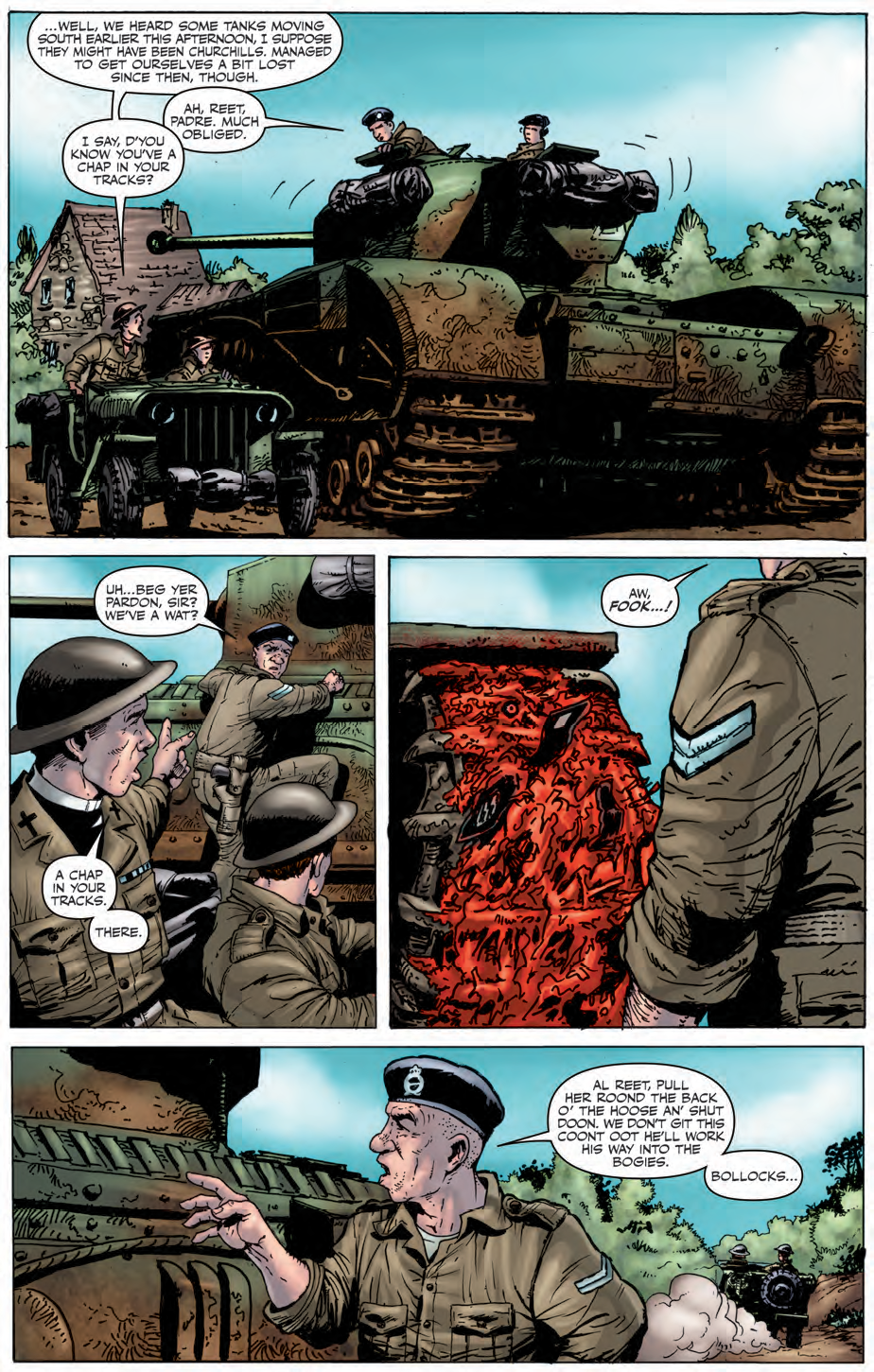
Still, there are rewarding moments for those willing to plough through. Ennis has fun playing with the petty rivalries within the crew, especially between the Geordie corporal and the Cockney gunner. Plus, there’s the obligatory gallows humor:
Putting The Tankies into a larger context made this an engaging reread. Although the book conveys respect for many of the men on the ground, including the Germans, it’s less interested in humanizing the Koreans than some of Kurtzman’s tales. In turn, it also rejects the more conventional adventure beats that punctuate Hedben’s scripts. Ennis doesn’t challenge the need for war, yet he also doesn’t shy away from its grisly reality – and neither does Carlos Ezquerra, whose depictions of combat are anything but romantic. Like Ezquerra’s sketchbook, Ennis’ thought-provoking, historically informative afterword had been previously published in The Complete Battlefields, so I was disappointed by the lack of new material (Michael J. Vassallo’s introduction was one of the high points of Dead Reckoning’s Atlas at War!), but this remains a worthy collection for any military history buffs out there who haven’t got these comics already – it should fit nicely on the shelf next to the other two books.
Above all, I cannot help considering The Tankies within Garth Ennis’ trajectory. Having grown up in Northern Ireland in the 1970s/80s, part of this writer’s success has always been to take his influences from the creative explosion in the British comics from his childhood and translate them into the American market. For instance, you can see a lot of Judge Dredd in his Punisher and one of Hitman’s arcs was a direct homage to 2000 AD’s ‘Flesh.’ Likewise, Ennis’ war comics feel like clear successors to the likes of Battle, albeit often more sophisticated and less gimmicky… The brilliant tank yarn ‘Johann’s Tiger’ (whose protagonist gets a passing mention in The Tankies) was no doubt inspired by the serial Hellman of Hammer Force. While not as memorable as ‘Johann’s Tiger,’ The Tankies blatantly fits into this trajectory as well, as its abundant slang, sardonic voice, and men-on-a-mission framework wouldn’t look out of place on the pages that first formed Ennis’ sensibility (except for the amount of swearing).
Kelly Kanayama has written insightfully about this lineage: ‘a typical lead character in a 1970s British war comic and a typical Ennis protagonist are both hardbitten sociopolitical underdogs who adhere to semi-cynical but nonetheless strict moral codes formed by some kind of trauma. But the connections between British war comics and Ennis’ work extend beyond character development to encompass the worlds in which these characters operate. War can be described, albeit reductively, as unrestrained violence generated by male-dominated sociopolitical structures and perpetuated in the blood of Good Men (“the real heroes are,” etc.) – and few Ennis comics could exist without the dissonance between these two, asking us as they do to decry the former while giving our hearts to the latter.’
The Tankies thus transports readers not just to the muddy countryside of French, German, and Korean battlefields in the 1940s/50s, but also to a later era when British creators channeled into boys’ comics the war stories they had heard from their parents, implicitly pitting them against the armed conflicts haunting their own generation (including in Northern Ireland)… just as Ennis wrote these comics under the specter of a decade of disgraced military interventions in the Middle East.
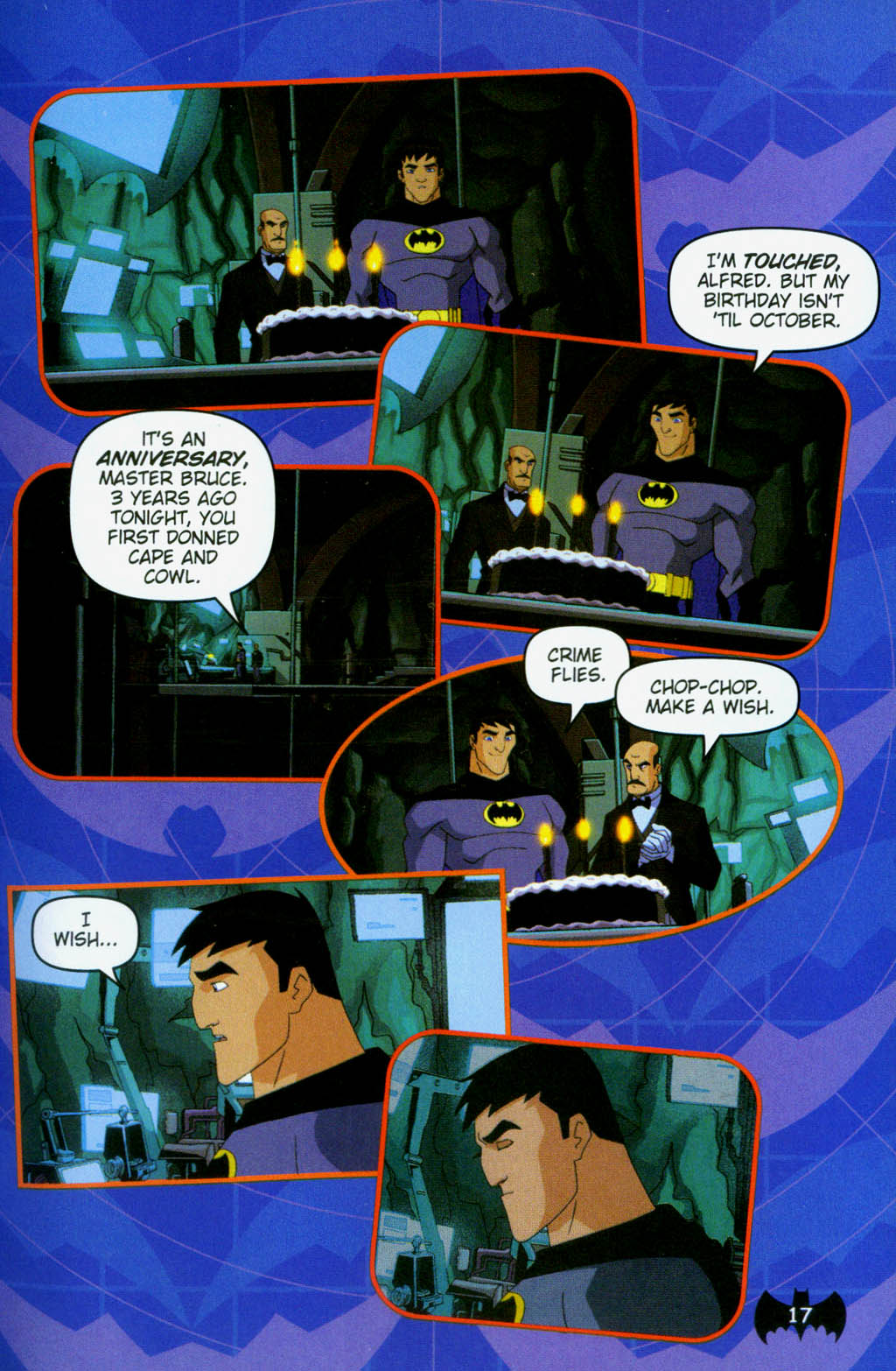 The Batman: Jam Packed Action!
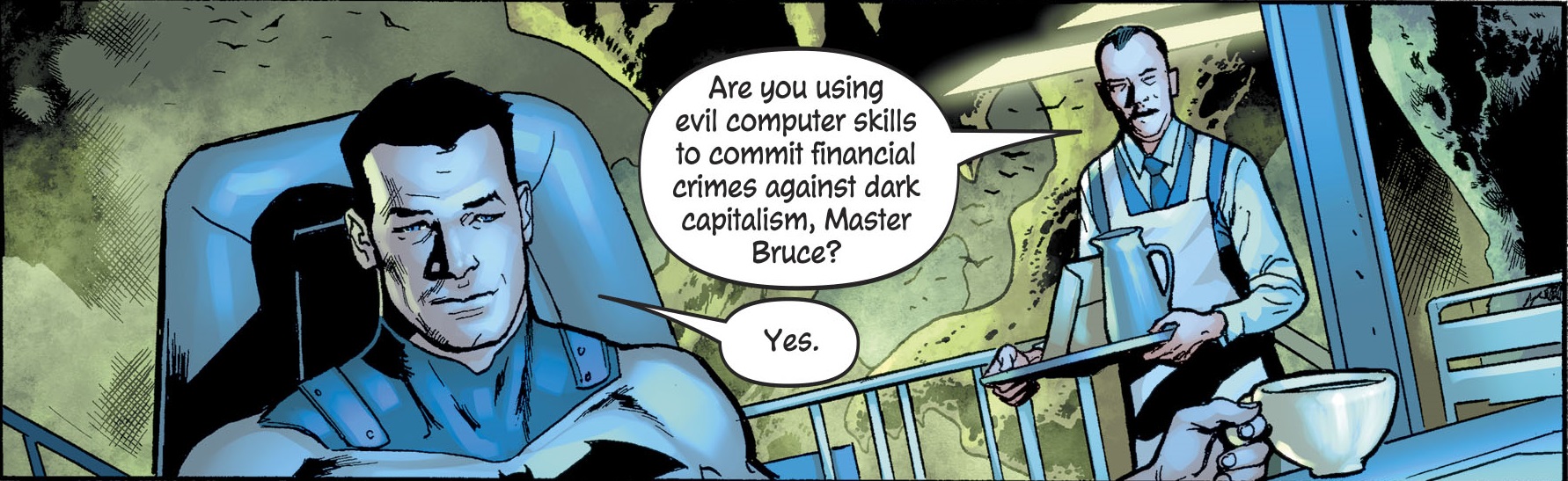 The Batman’s Grave #3
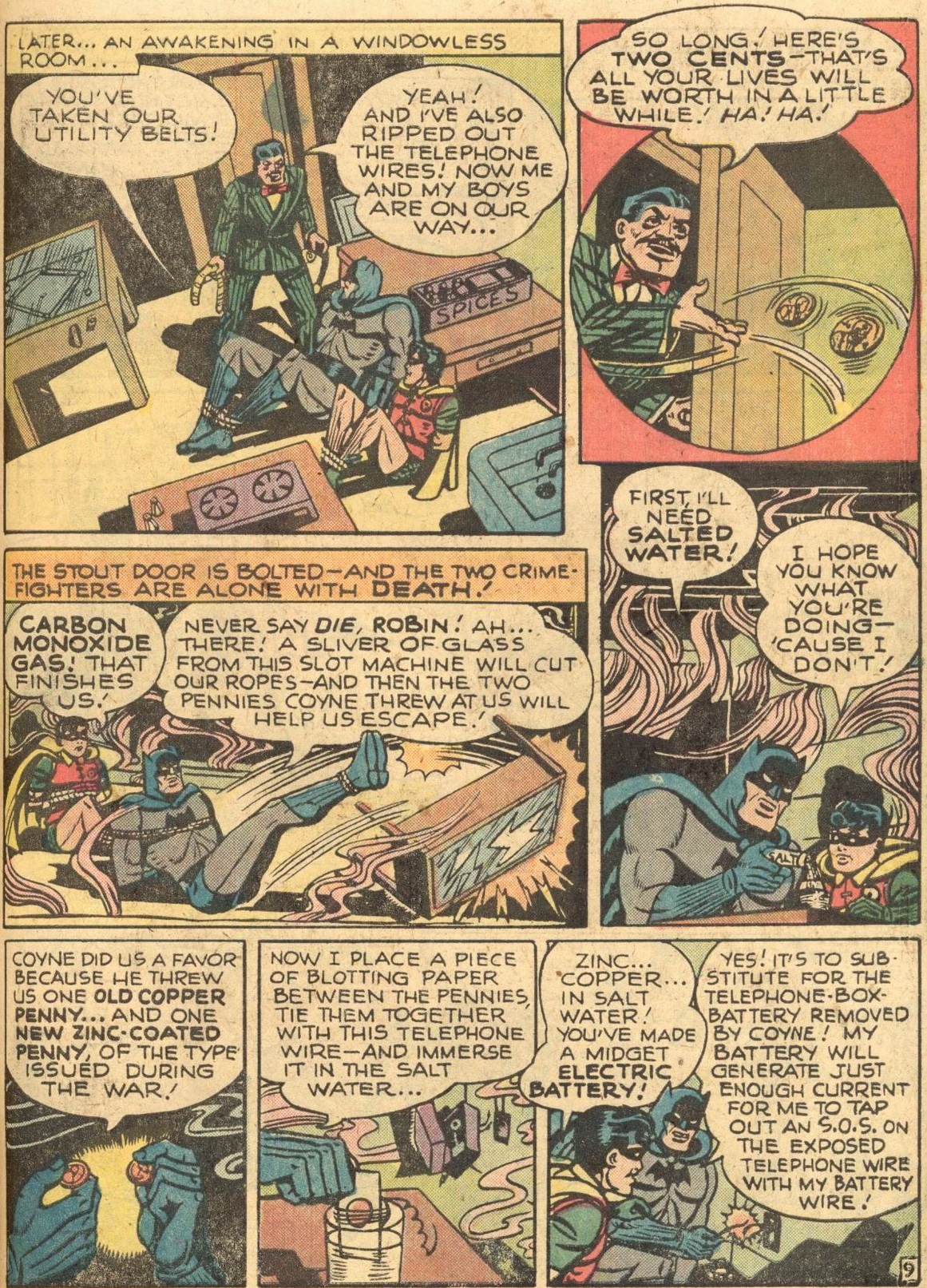 World’s Finest Comics #30
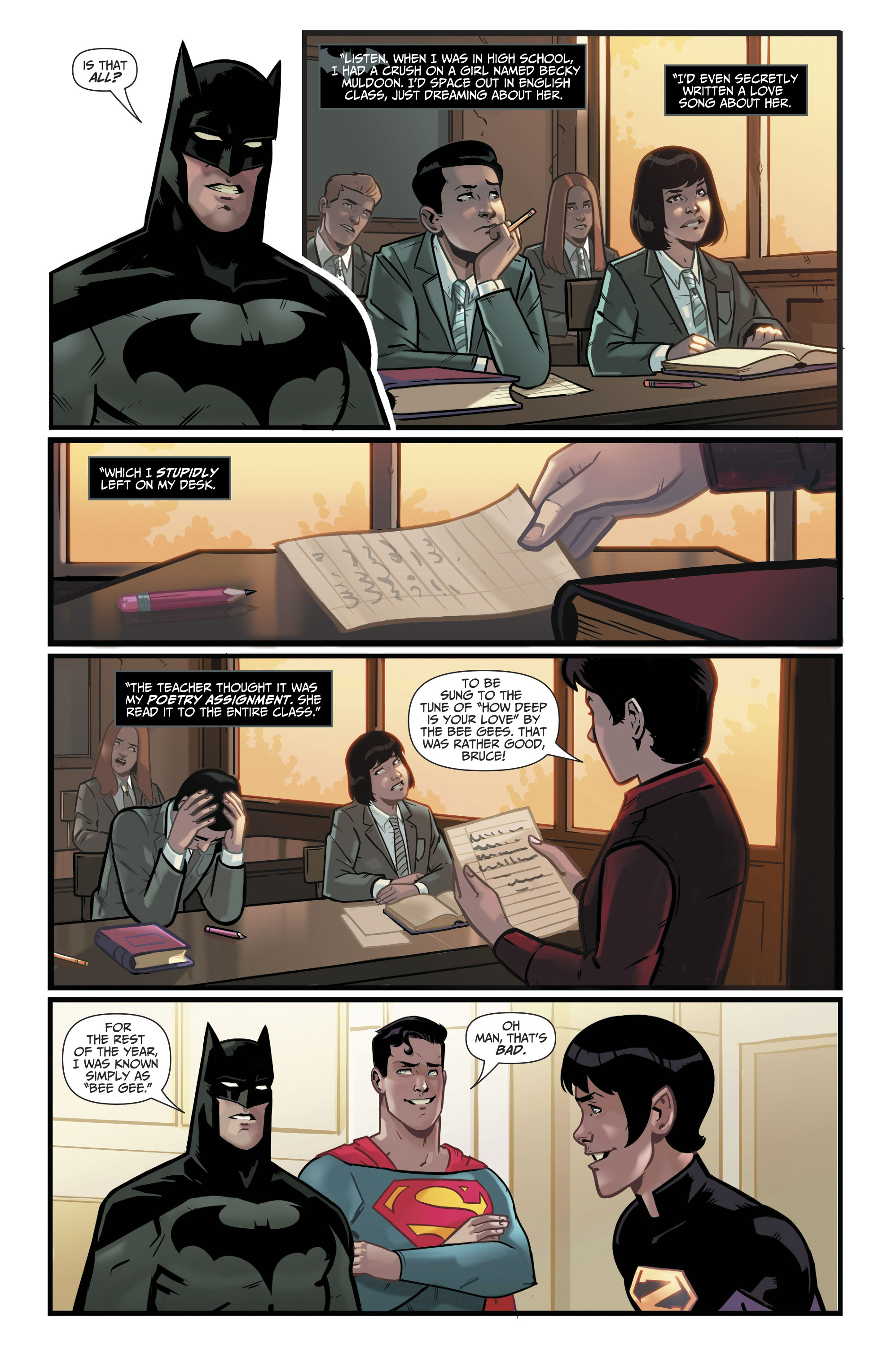 Wonder Twins #1
 Batman: Universe #5
 Superman’s Pal Jimmy Olsen (v2) #5