-
Recent Posts
Categories
- ART OF BATMAN COMICS (36)
- ART OF HORROR COMICS (35)
- AWESOME COVERS (59)
- BATMAN COMICS FOR BEGINNERS (35)
- BOOKS OF THE YEAR (22)
- COLD WAR CINEMA (12)
- COVERS OF BATMAN COMICS (52)
- FANTASTIC ADVENTURES (51)
- GLIMPSES INTO AWESOMENESS (98)
- GLIMPSES INTO THE FUTURE (23)
- GLIMPSES INTO THE PAST (83)
- GOTHAM CITIZENS (37)
- GOTHAM INTERLUDES (86)
- HARDBOILED CRIME (42)
- HEADSHOTS (12)
- MANIFESTO (3)
- POLITICS OF BATMAN COMICS (21)
- SPYCRAFT & WARFARE (47)
- SUPER POWERS (16)
- WEBS OF FICTION (56)
- WILD WEST (7)
- WRITERS OF BATMAN COMICS (20)
- WRITERS OF SUPERMAN COMICS (4)
Drop me a line at
imbaytor@yahoo.com
Taking a break… (August 2019)
Posted in GOTHAM INTERLUDES
Tagged Rick Burchett, Rick Taylor, Tim Harkins, Ty Templeton
Leave a comment
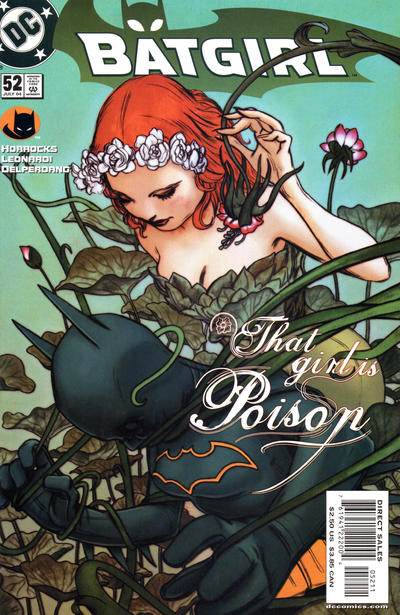
10 luscious Poison Ivy covers
An extreme embodiment of the femme fatale trope (because her kisses make her literally irresistible and she uses her manipulative powers to commit crimes), Poison Ivy may feel like a somewhat outdated and problematic character in light of current gender discourse. Then again, her post-anthropocene sensibility and environmentalist crusade seem completely in tune with the times, given the growing public awareness of looming ecological collapse!
Regardless, today I want to highlight Poison Ivy’s aesthetics… There was always something funky about Pamela Isley’s provocative demeanour and floral clothing style, but her looks have become even cooler since the mid-90s, when artists started drawing her as more of a green-skinned, voluptuous plant-human hybrid. Here are ten beautiful covers that explore the character’s rich visual potential, conveying in different ways (sexy, creepy, funny…) that, when it comes to Poison Ivy, you can look but you’d better not touch.


COMICS CAN BE AWESOME (August 2019)
Your August reminder that comics can be awesome…
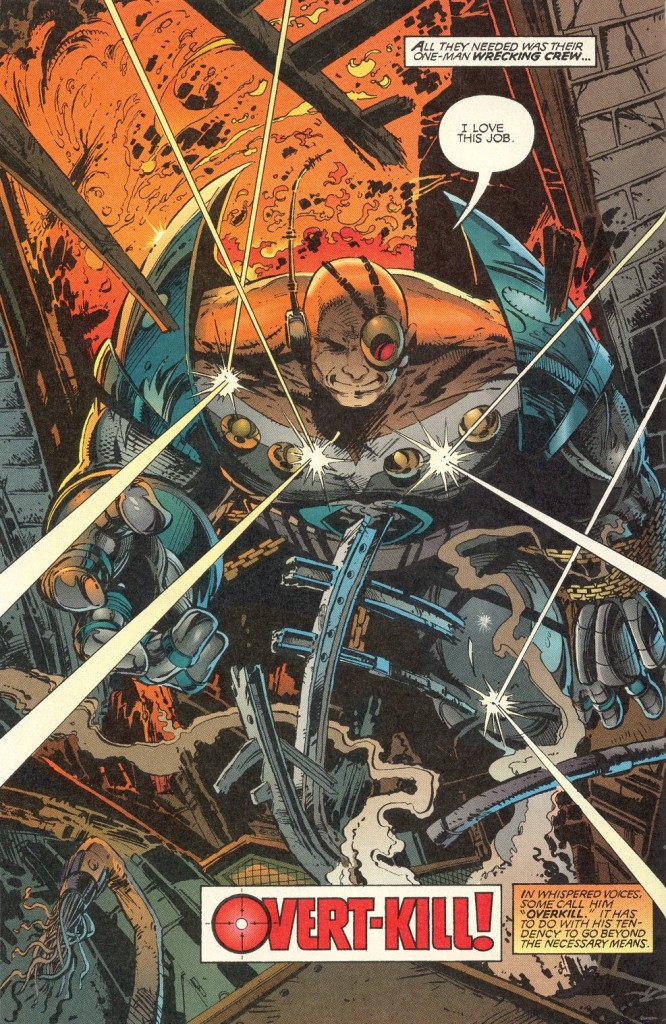
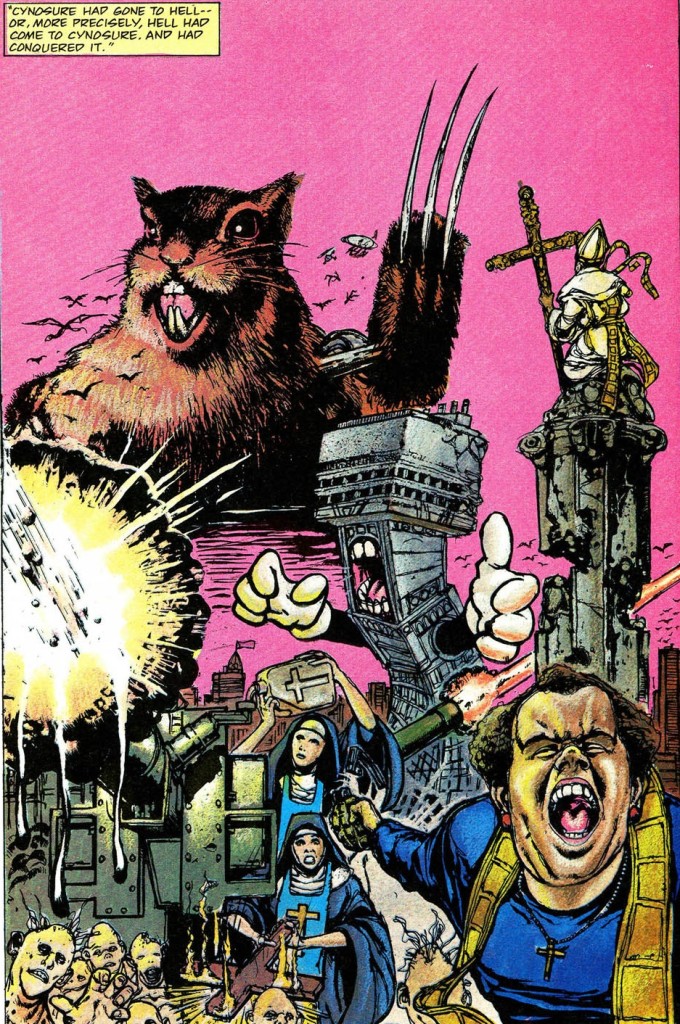 GrimJack #67
 Spawn #6
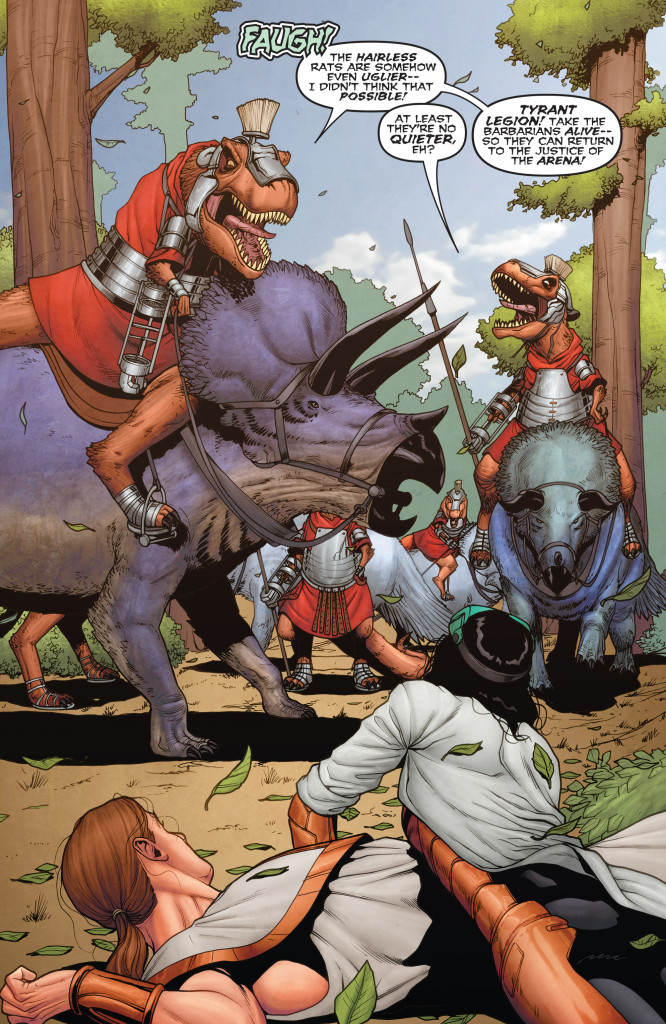 Ivar, Timewalker #9
Spotlight on Fury: Peacemaker
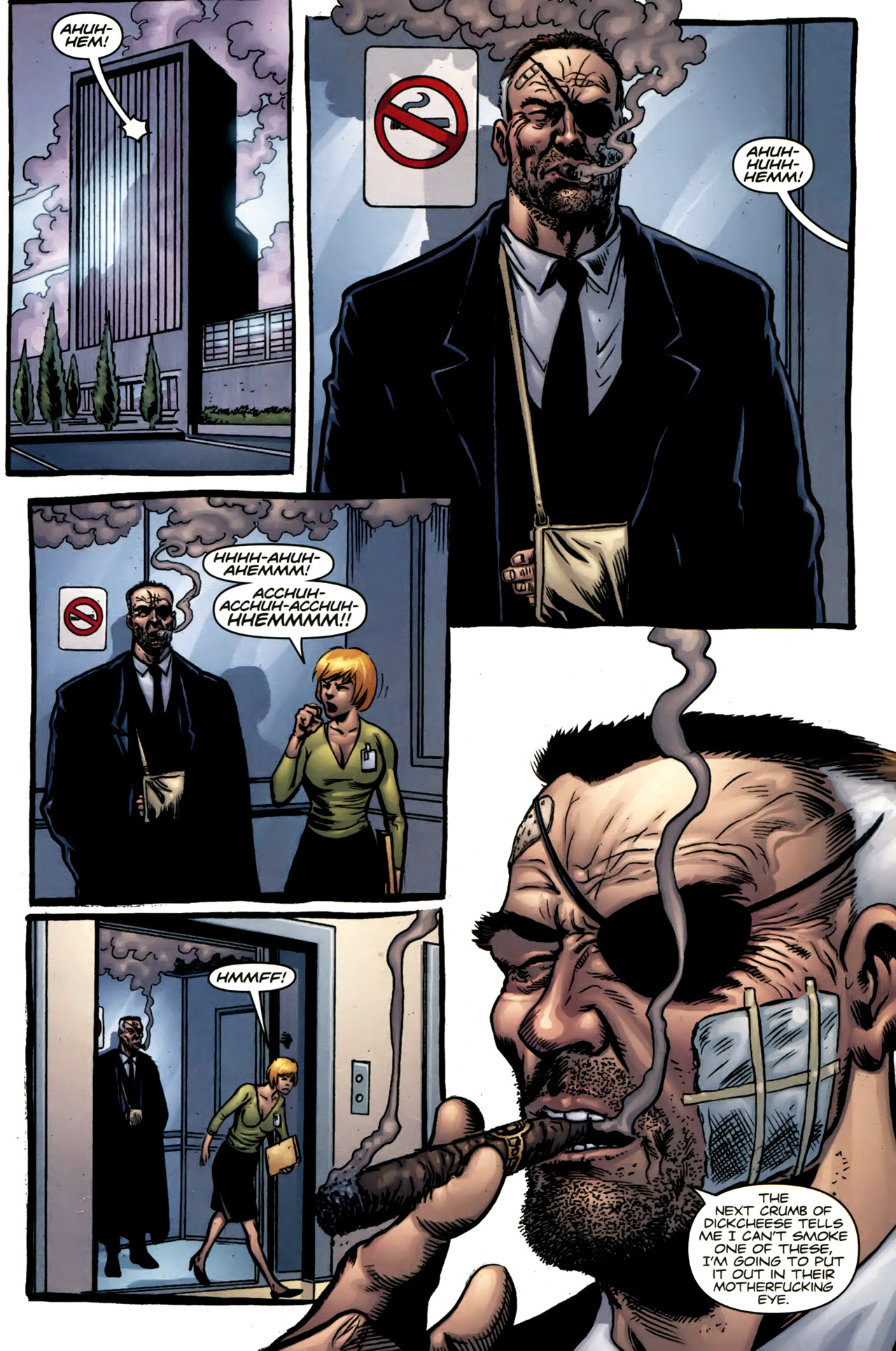
We kicked off this year’s Spy Fiction Month with a comic set in World War II and we’ll finish with one as well. Like I mentioned last week, in 2001 Garth Ennis and Darick Robertson reinvented Marvel’s war-hero-turned-super-spy Nick Fury as a grizzled veteran addicted to combat, not to mention a foul-mouthed alpha male out of step with the times…
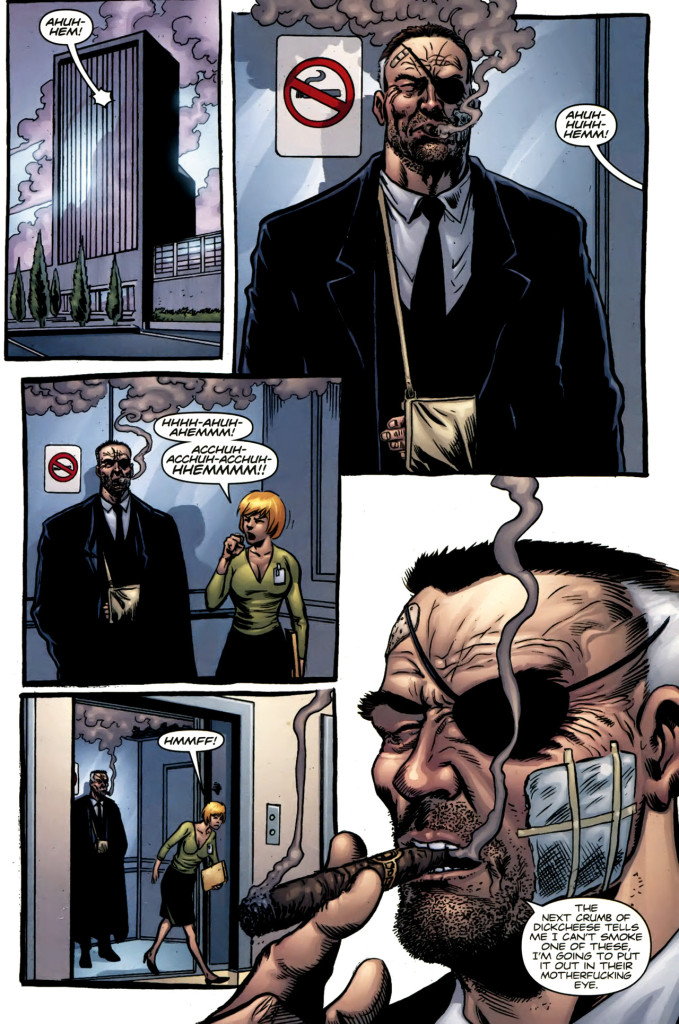 Fury MAX #6
This take on Nick Fury was so appealing that Garth Ennis has kept going back to it. Colonel Fury was a recurring character in his run on The Punisher MAX and he has starred in two more Ennis-written limited series so far, starting with 2006’s Peacemaker, once again illustrated by Darick Robertson.
A World War II tale, this is basically a prequel to Fury MAX. The plot is completely independent, with Peacemaker working perfectly well as a standalone read, but it sets up the characterization that Fury displayed in the previous mini-series (and it has a small Easter Egg calling back to a throwaway line about Rudi Gagarin, the villain of Fury MAX).
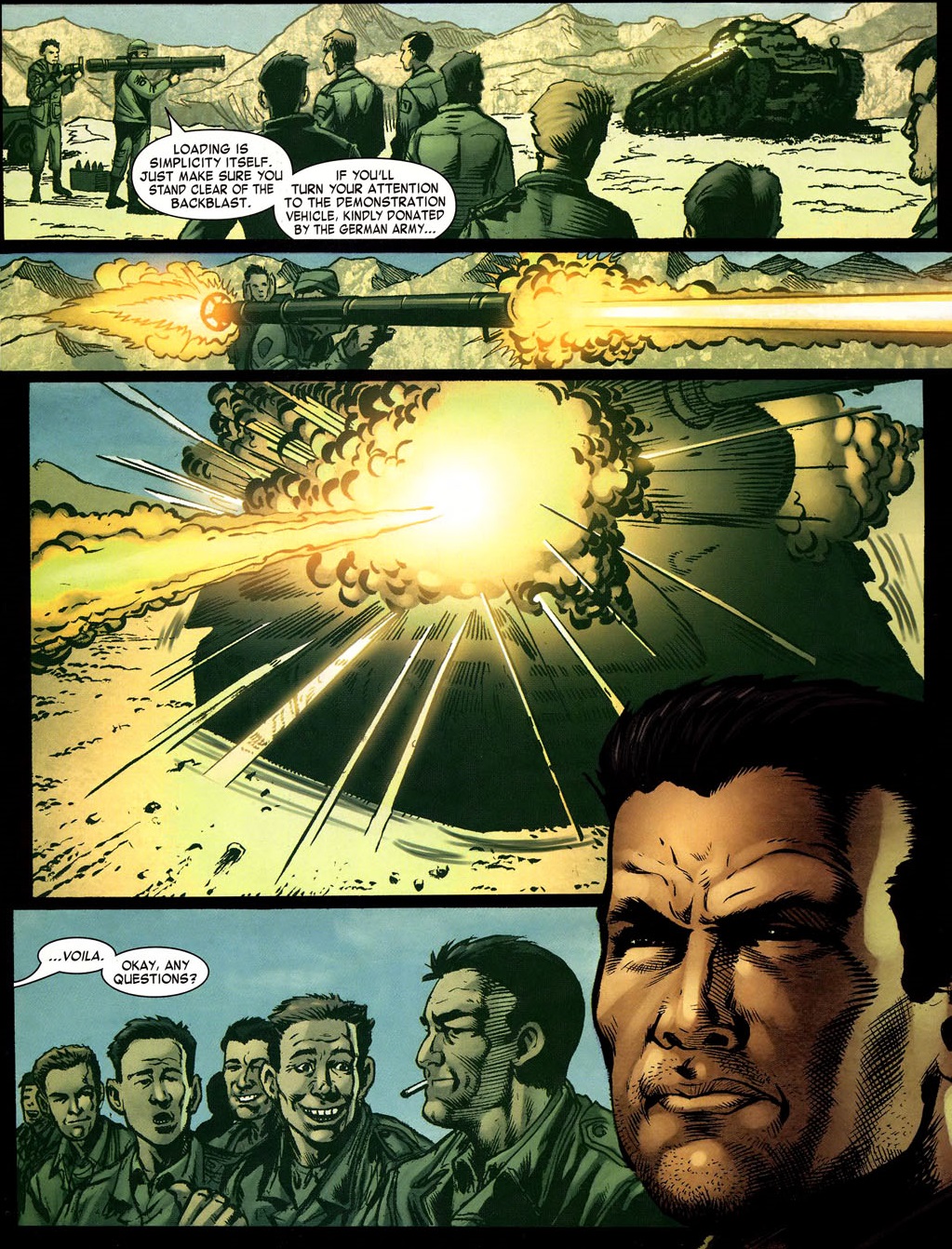
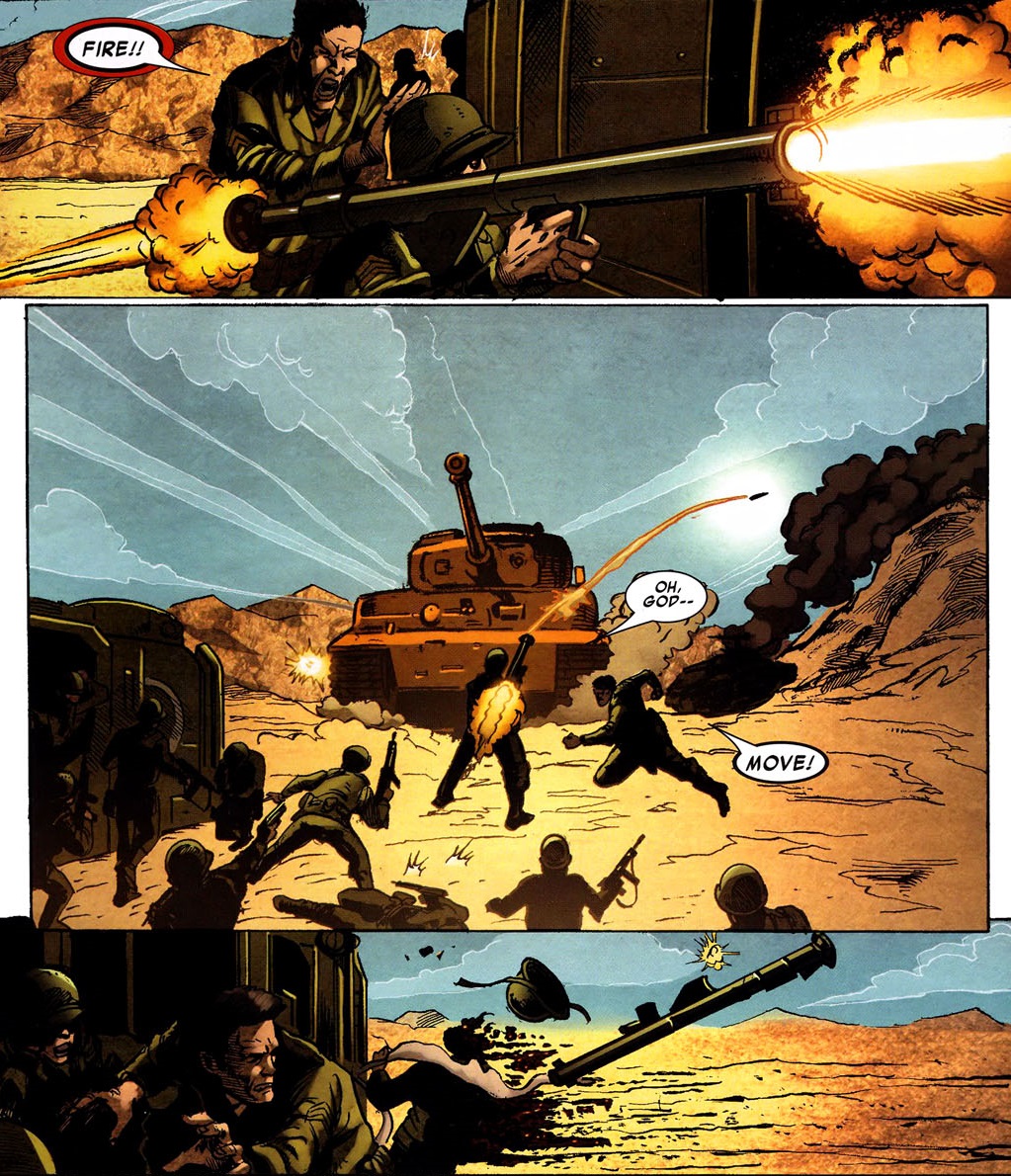
The opening of Peacemaker reads like a straight-up military yarn set in the North African desert. This is fine by me, not just because I’m into this kind of stuff (Zoltán Korda’s Sahara is such an awesome film!), but because Garth Ennis is arguably the greatest writer of WWII comics. He kicks things off with a griping sequence – perhaps a nod at the training and equipment failures in the then-recent U.S. wars in Afghanistan and Iraq – neatly contrasting the overconfidence of the American forces going into battle (in mini-flashbacks that stand out because of Raúl Treviño’s subtle color changes) with their first brutal clashes against the well-prepared German army.

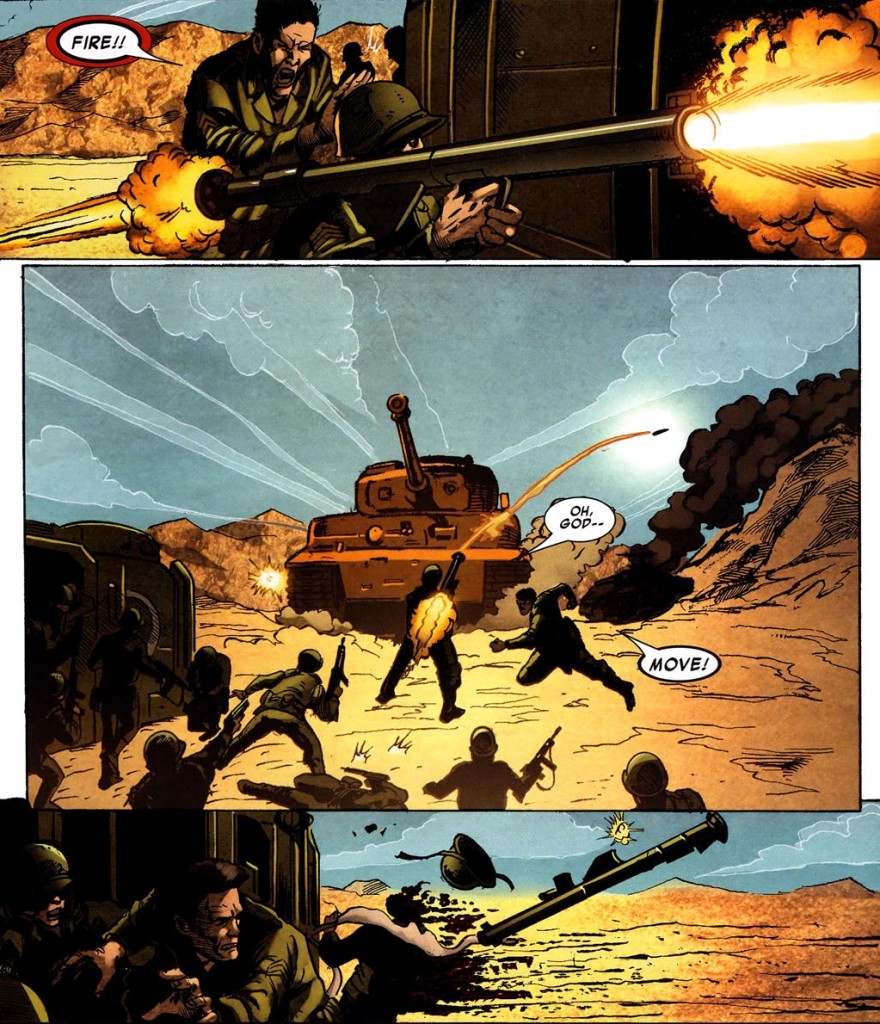 Fury: Peacemaker #1
Yet the point is not the battle itself or even its geostrategic implications, as Peacemaker is above all a character study about a younger, then-Sergeant Nick Fury. In a classic Ennis trope, the first time we see Fury he is threatening to kill his superior in the middle of combat (‘Lieutenant, you show these men some leadership or I swear to God I’ll blow your head off!!’). After a military clusterfuck, Fury ends up adrift behind enemy lines and eventually gets rescued by a brigade of the U.K.’s Special Air Service (the SAS being another recurring presence in this Northern Irish writer’s comics) headed by Captain Peter Kynaston. The latter proves to be a decisive influence on Fury, especially when they go on a joint mission to assassinate a brilliant German field marshal, Stephen Barkhorn.
If you know the creators’ track record, you’ll rightly assume that Peacemaker’s approach to WWII adventure feels closer to the black comedy of Inglourious Basterds than to the lighthearted pulp of Captain America: The First Avenger. Still, both Ennis’ script and Robertson’s pencils (once again inked by Jimmy Palmiotti, replaced in the final issues by Rodney Ramos) are much more restrained than in their Fury MAX mini-series, downplaying the raunchy farce and hardcore gore in favor of a more grounded and wittier tone. (Notably, Peacemaker came out in the Marvel Knights line rather than the R-rated MAX imprint, so there is no harsh swearing or nudity in this one.)
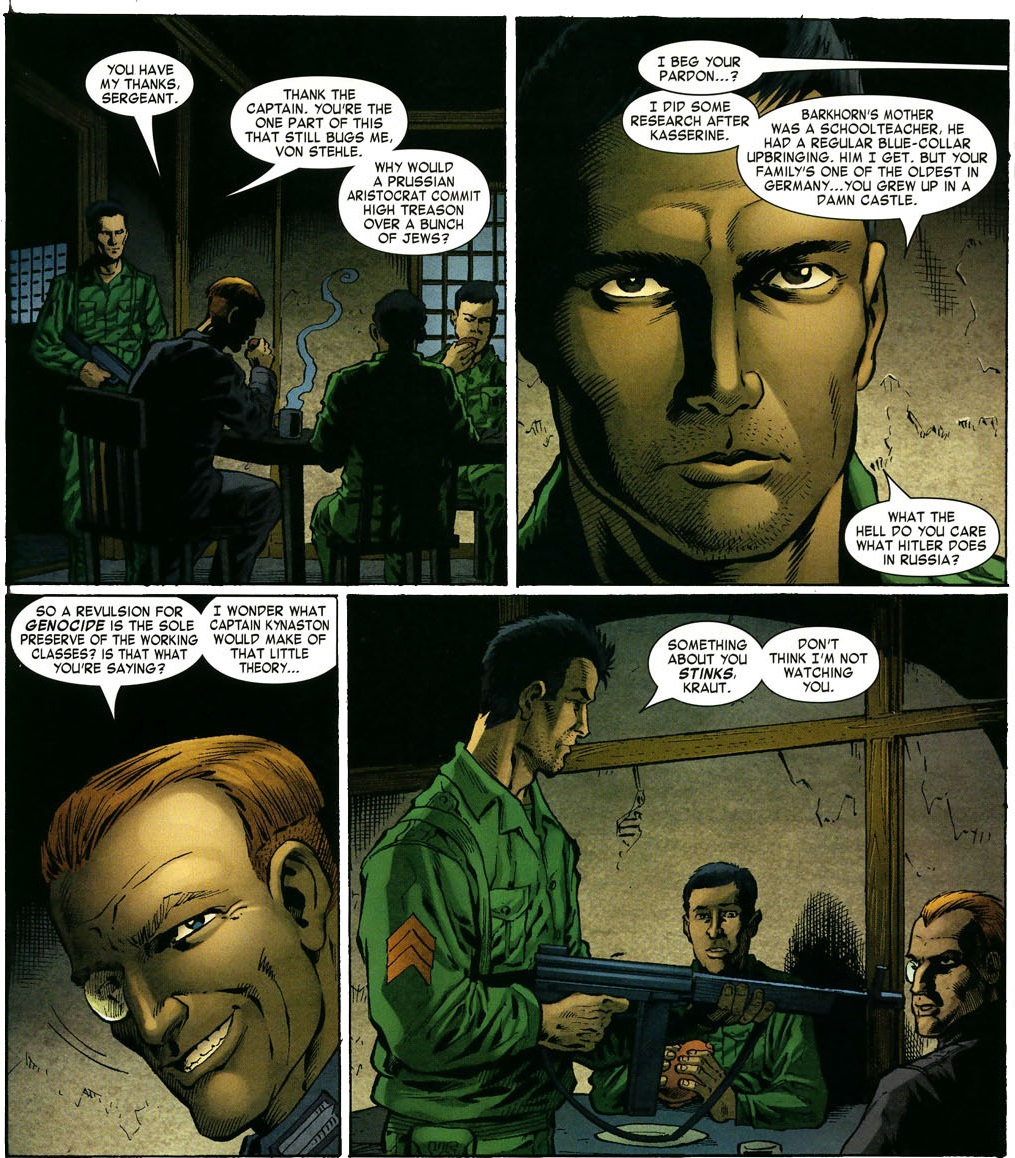
Regardless – or perhaps because of it – the dialogue is a joy to read. Ennis does his usual shtick, drowning the cast’s banter in thick military slang (including the usual national nicknames: the Jerry, the Huns, the Ivans…) and expecting you to follow along without much obvious guidance. Barkhorn’s chief of staff, the monocle-wearing Oberstleutnant Hans von Stehle, gets the best lines, displaying the kind of dry wit that instantly turns him into a memorable opponent.
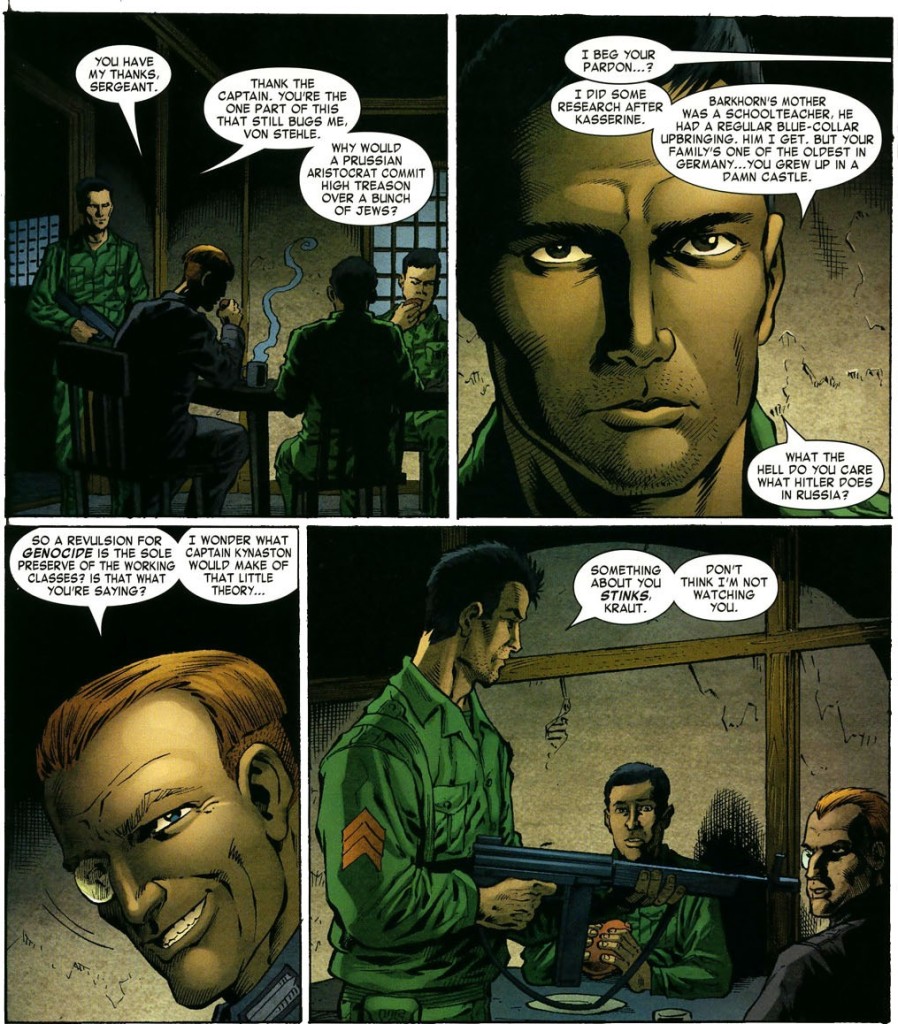 Fury: Peacemaker #5
It’s not just that there are no dumb characters, for once. Peacemaker also does a nice job of showing different points of view within the German camp, bringing to the table a level of multilayered moral complexity you also find in some of Garth Ennis’ other war stories (like in the tremendous Night Witches).
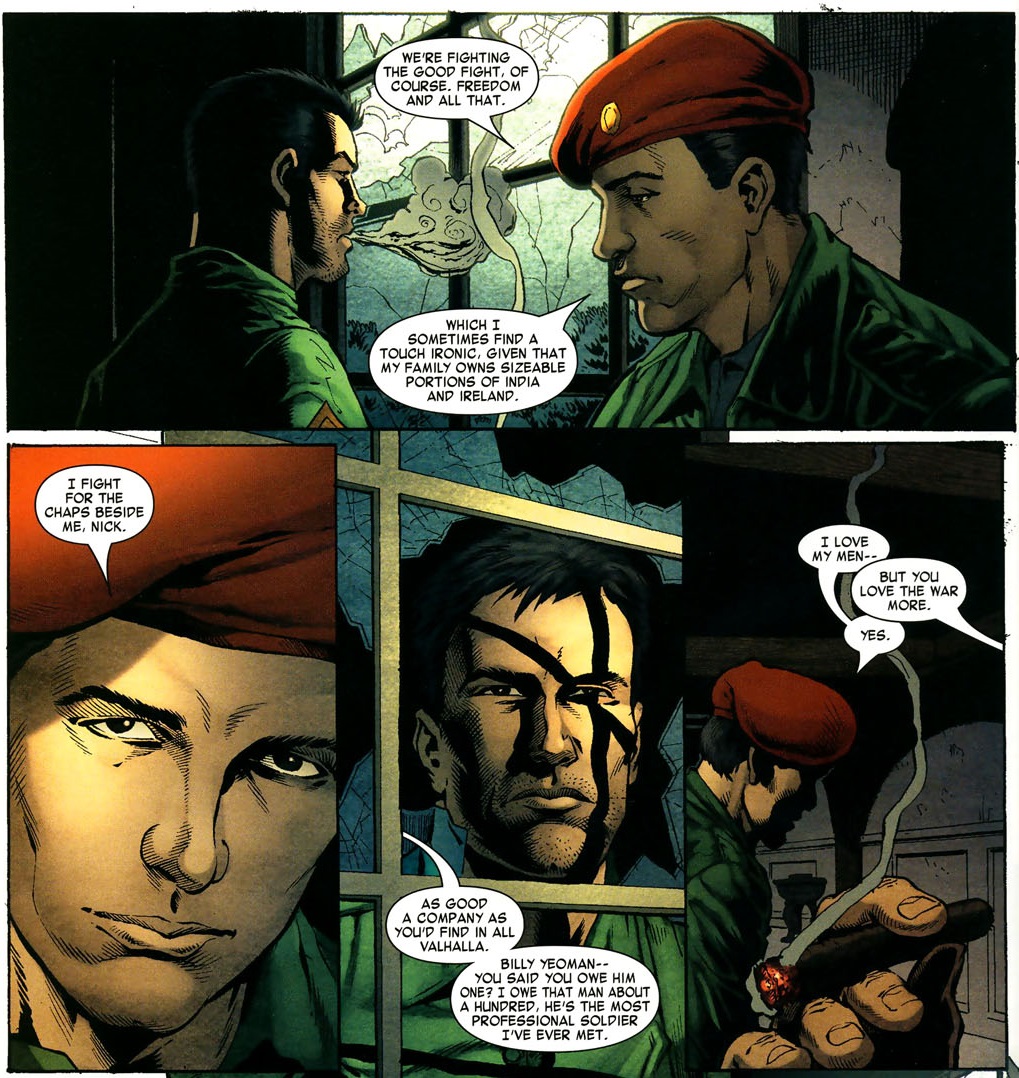
That said, the series’ main themes are clearly spelled out. In their first meeting, Stephen Barkhorn explicitly tells Nick Fury that if he wants to be good at war, he should learn to enjoy it. Later, you can see the glint in Fury’s eyes as Peter Kynaston tells him about this irregular force driving behind enemy lines, away from their own ‘damn fool general staff,’ raising hell where it hurts the most by hitting German supply convoys and ammunition dumps, ‘not overly concerned with spit and polish.’
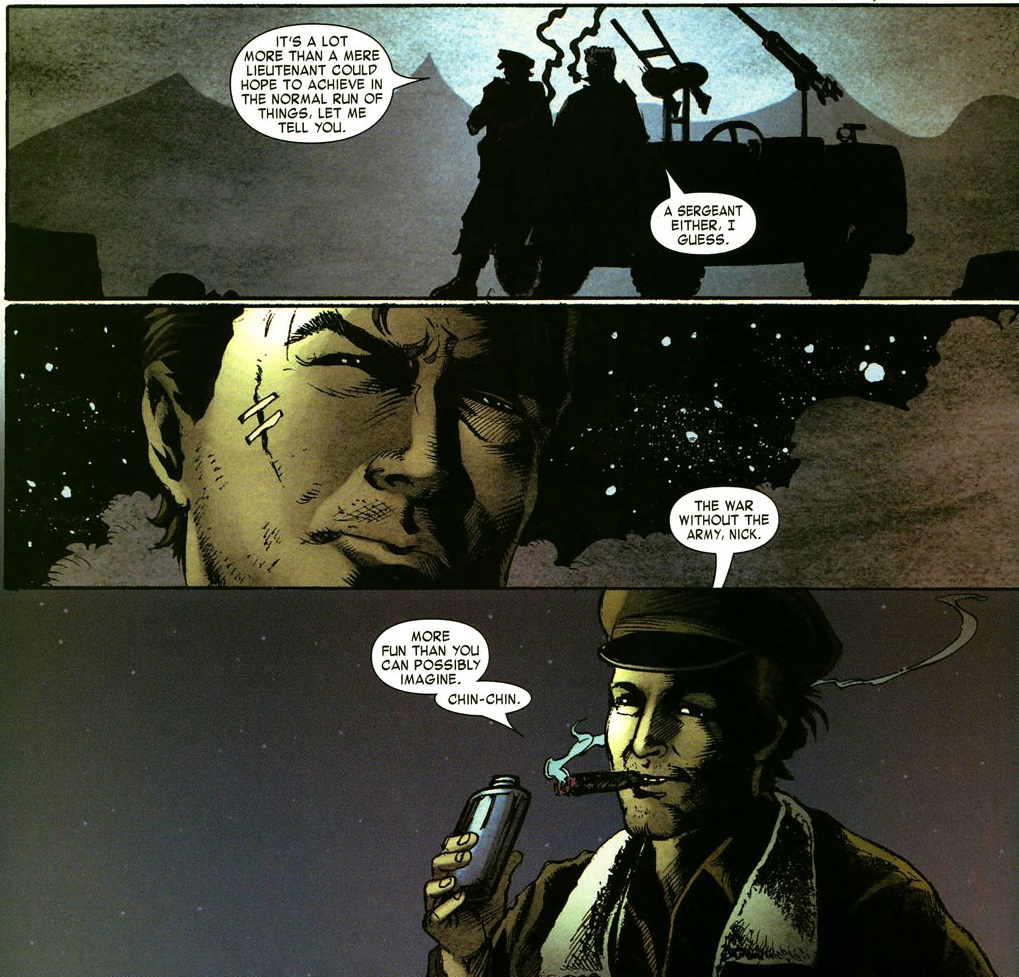 Fury: Peacemaker #2
By the end, when Nick Fury toasts to the looming Cold War, there is little doubt that this has been the story of Fury falling in love with warfare.
But is it a spy comic as well? Up to a point. The bulk of Peacemaker concerns Fury’s and Kynaston’s secret assignment to assassinate Barkhorn, with the twist that instead of their target they find a group of officials who claim they are willing to put an end to the war. Half of the story takes place during a siege at a German estate, where our protagonists have to deal with different types of tension. First and foremost, they’re never sure if they can trust their seemingly cooperative prisoners. But on top of that, they have to deal with the possibility of ending World War II earlier, which is not as straightforward a decision as it may sound…
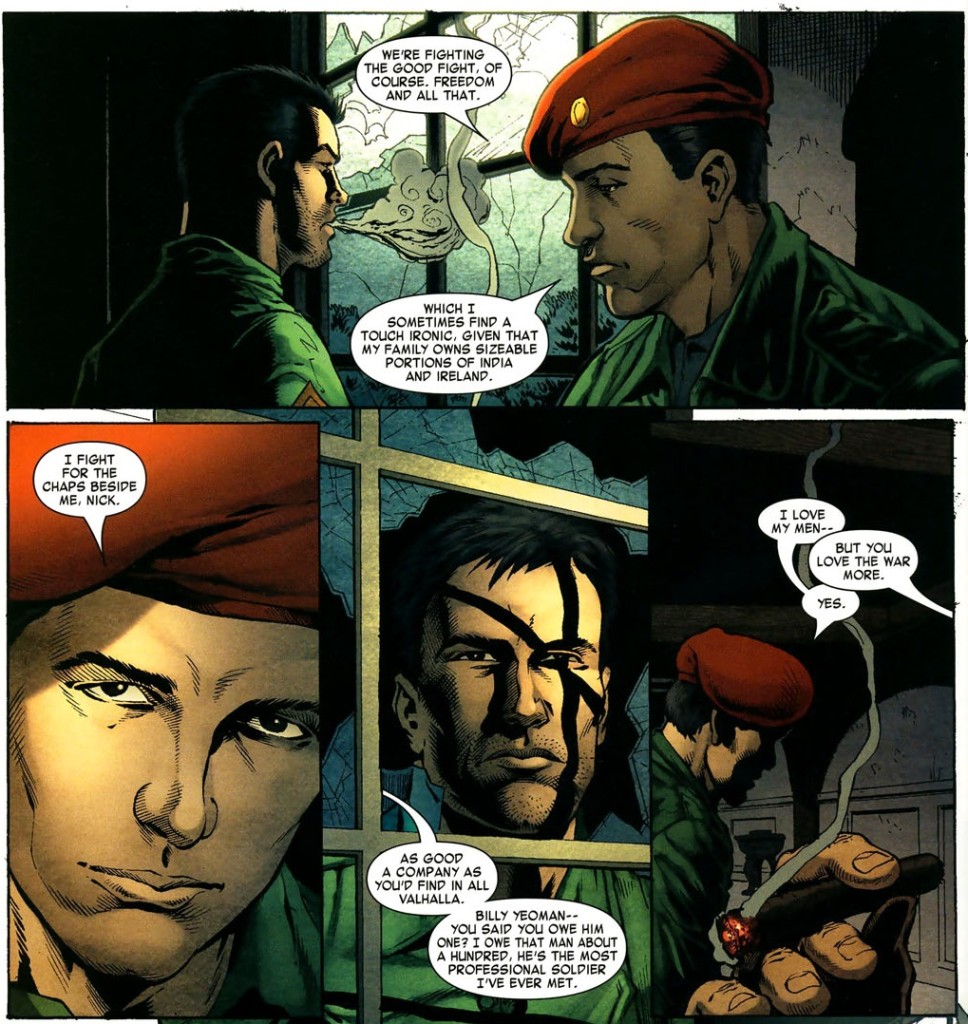 Fury: Peacemaker #5
Check out the panel foreshadowing Nick Fury’s future eye-loss by literally crossing out his eye with shadows as he listens to Kynaston’s sinister views (not too distant from the Nazis’ own cult of war). It’s not just an eye that Fury is about to lose…
Posted in SPYCRAFT & WARFARE
Tagged Darick Robertson, espionage, Garth Ennis, Jimmy Palmiotti, Nick Fury, politics, Raúl Treviño, Rodney Ramos, World War II
Leave a comment
Spotlight on Fury MAX
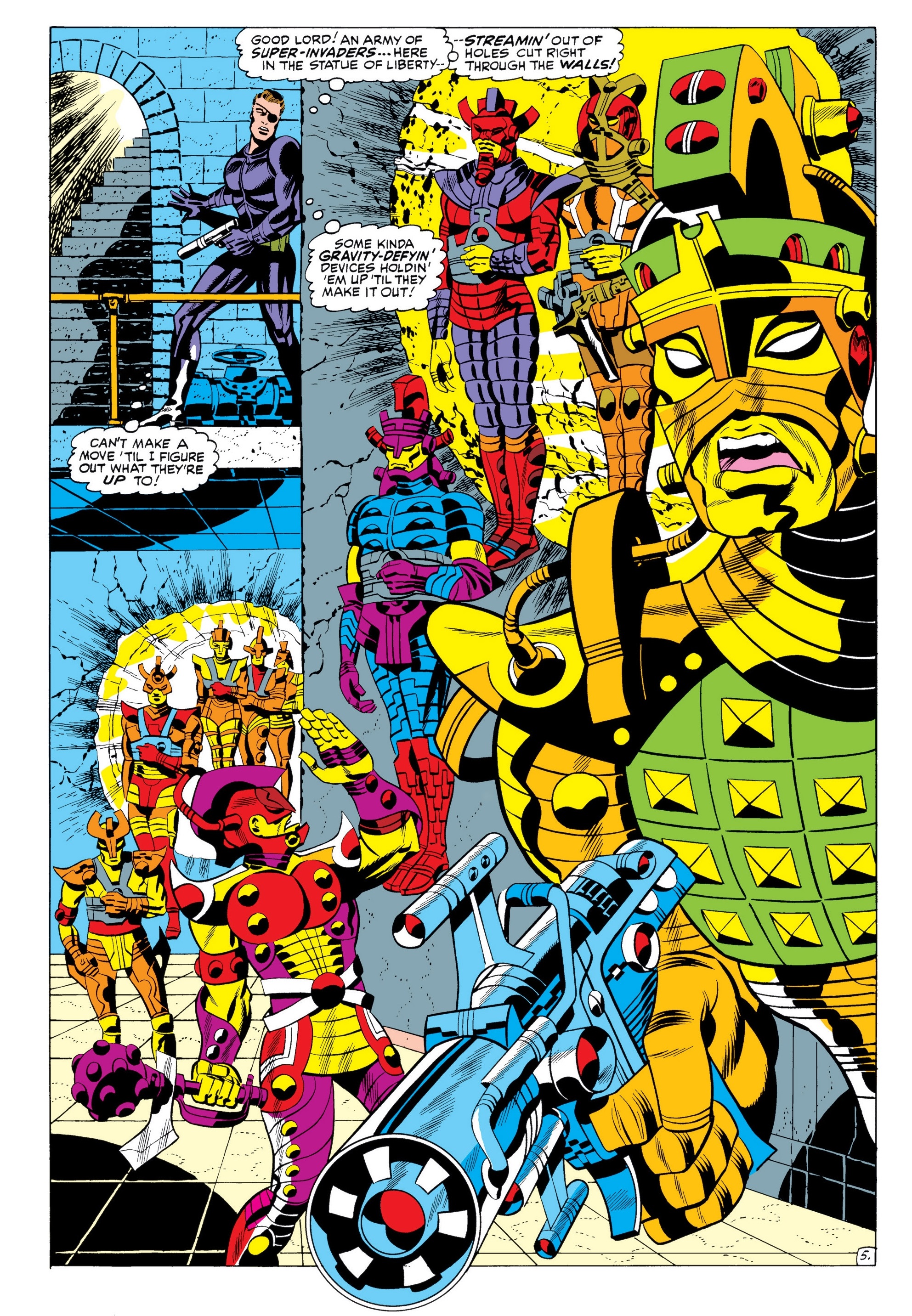
Way before Samuel L. Jackson embodied the role, Colonel Nick Fury was already a household name for Marvel fans, having starred in a string of seminal psychedelic spy comics by Jack Kirby and Jim Steranko back in the 1960s…
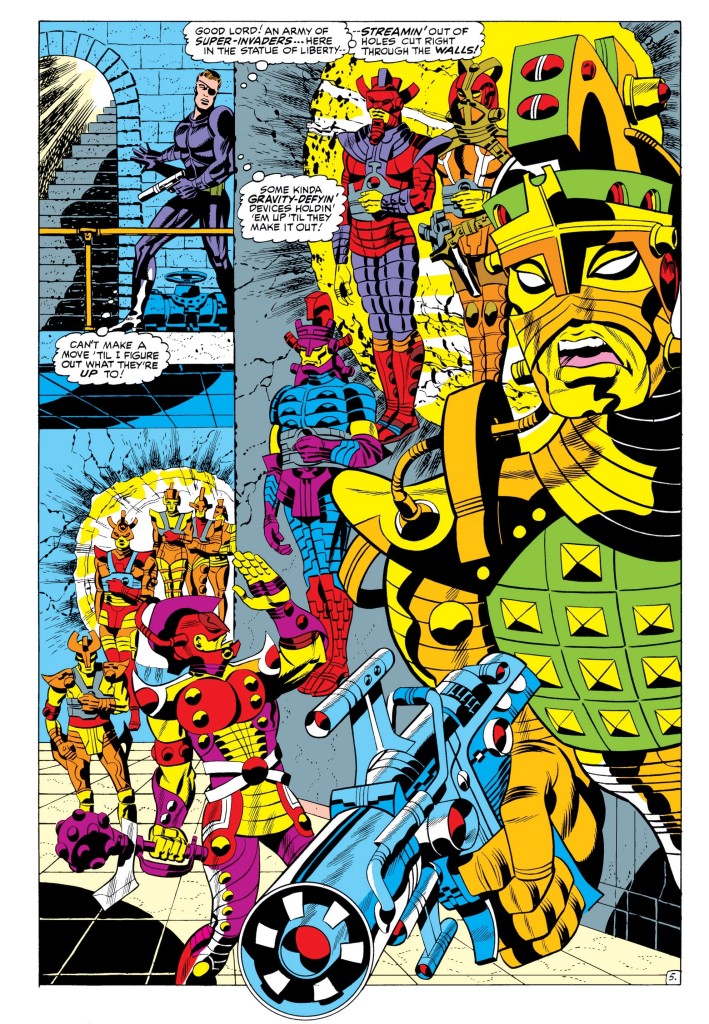 Strange Tales #160
(For a hilarious tribute to these runs, as well as to Kirby’s and Steranko’s similar work on Captain America, check out Big Bang Presents #6.)
Since his glory days, though, the cigar-chewing, one-eyed agent of S.H.I.E.L.D. has had an uneven career, both in his own series (I have a soft spot for D.G. Chichester’s run in the early ‘90s) and as a guest in other characters’ vehicles (Elektra: Assassin being a high point). The most memorable take on the property in ages occurred in 2001, when Garth Ennis and Darick Robertson reimagined Nick Fury – in an irreverent 6-issue mini-series published by Marvel’s ‘adults only’ MAX imprint – as an embittered old man having trouble adjusting to the post-Cold War era.
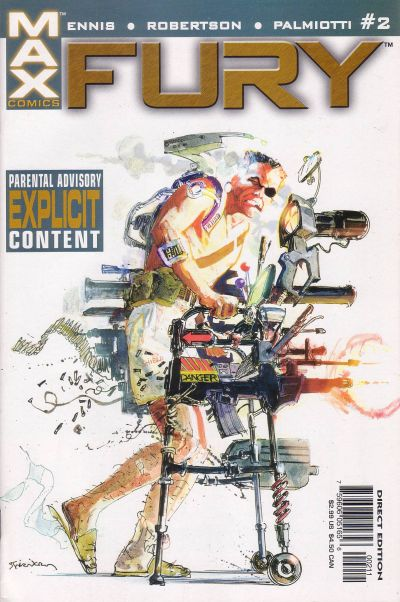
This mini-series – which I’m calling Fury MAX to distinguish it from all the other comics called Fury – was one of several bold creative choices taken by Marvel during the prolific Bill Jemas/Joe Quesada editorial partnership in the early 2000s, along with giving a free rein to Grant Morrison (New X-Men, Marvel Boy, Fantastic Four: 1234) and launching such idiosyncratic runs as Peter Milligan’s and Mike Allred’s X-Force or Brian Michael Bendis’ and Alex Maleev’s Daredevil. By hiring Garth Ennis (fresh off Preacher and The Punisher: Welcome Back, Frank) and Darick Robertson (during the final stretch of Transmetropolitan) to do a book without the Comics Code Authority seal, edited by former Vertigo editor Axel Alonso, it’s a fair bet Marvel’s big shots knew they were bound to get oodles of foul language, gory violence, and pitch-black humor, but I wonder if they anticipated just how subversive things were going to get…
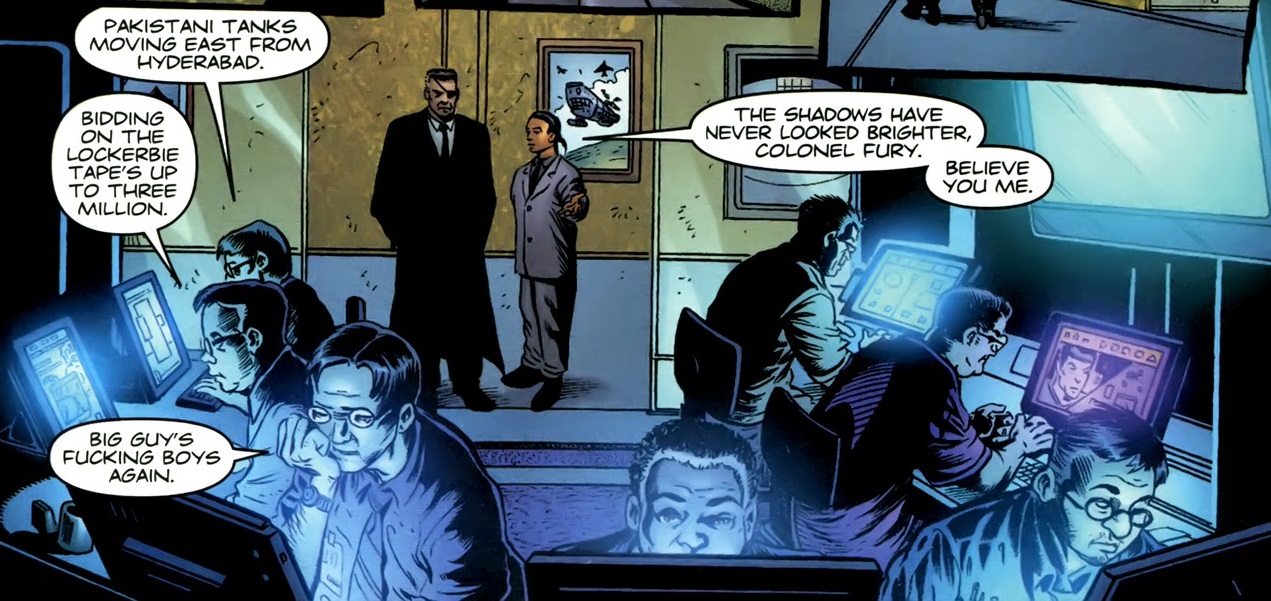
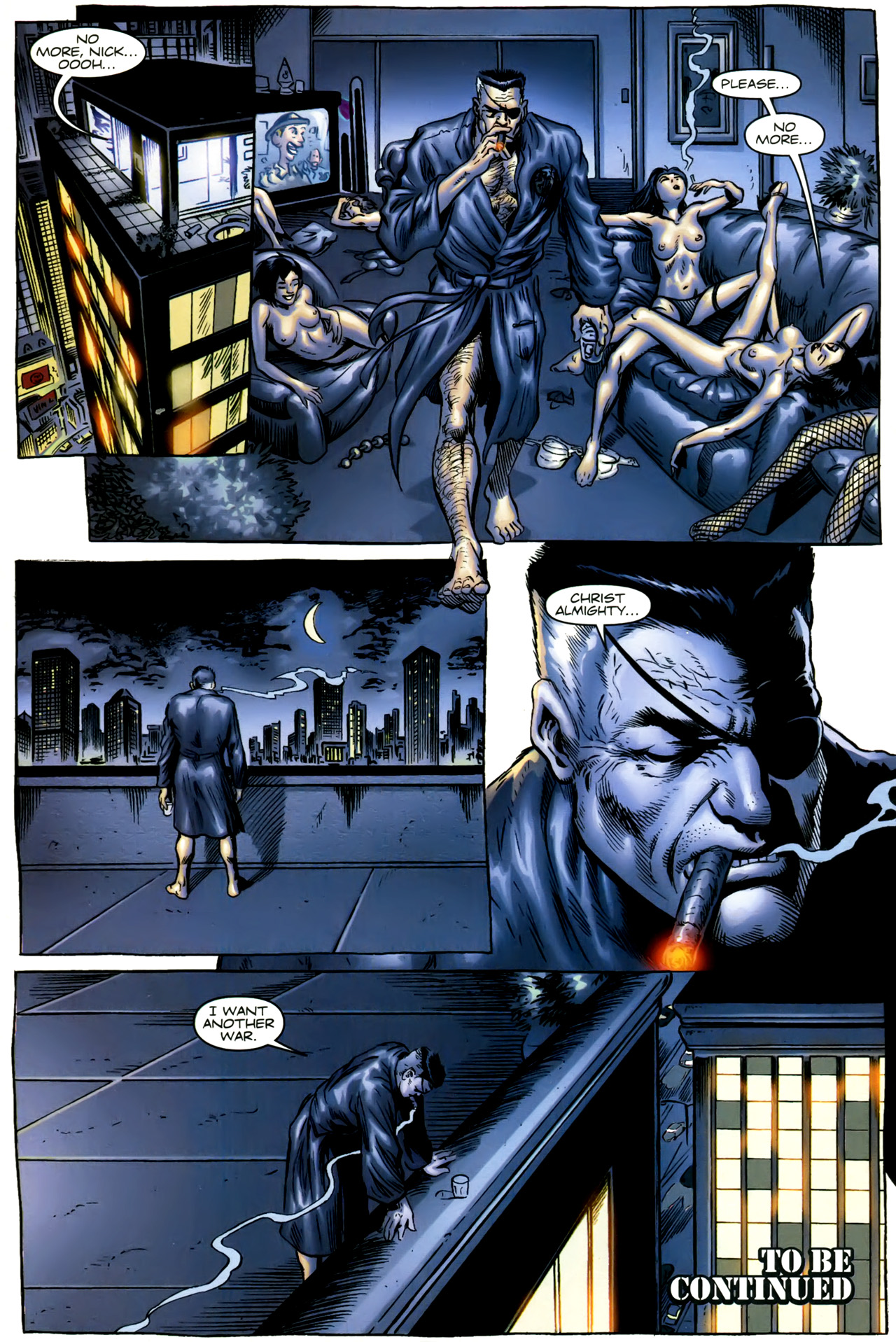
The very first page sets the tone, with a splash of a rugged-looking Colonel Fury pointing a huge-ass weapon and grittily ordering ‘Kill them all.’ Below, the issue’s title warns readers: ‘Be Careful What You Wish For.’ You can pretty much tell from the outset that the series will combine two quintessential Ennis motifs: on the one hand, his flair for iconoclastic takes on beloved, established characters and, on the other hand, his fondness for the stoic, unapologetic ‘man’s man’ archetype. Indeed, Fury MAX reinvents the titular lead both as a nasty bastard (who fantasizes about murdering his adoptive nephew, presumably because the latter doesn’t match his brand of virility) and as an old-school cold warrior who feels emasculated by corporate bureaucrats that (according to the collected edition’s back-cover) are ‘more interested in recruiting highly trained computer specialists and high-priced suits than spies and commandos.’
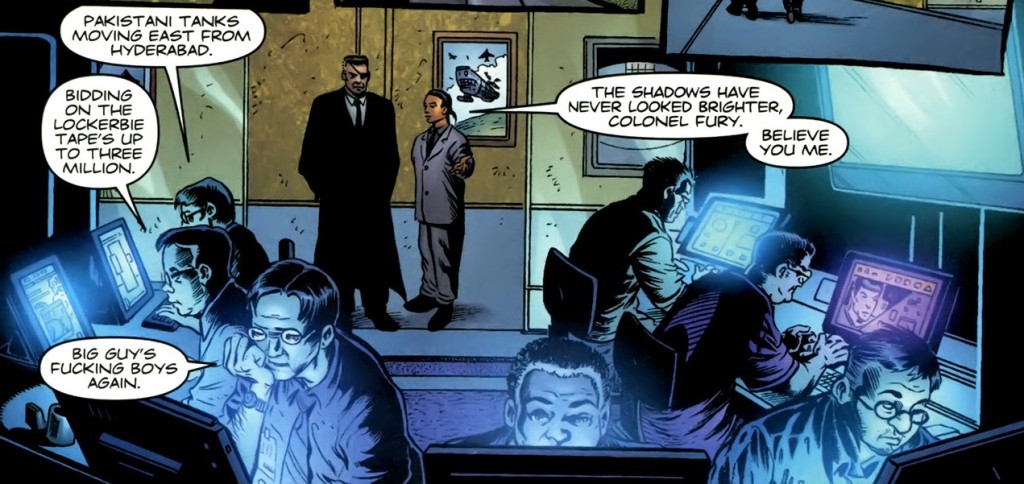 Fury MAX #1
(Notice the picture of the Helicarrier relegated to the background, signaling changing times…)
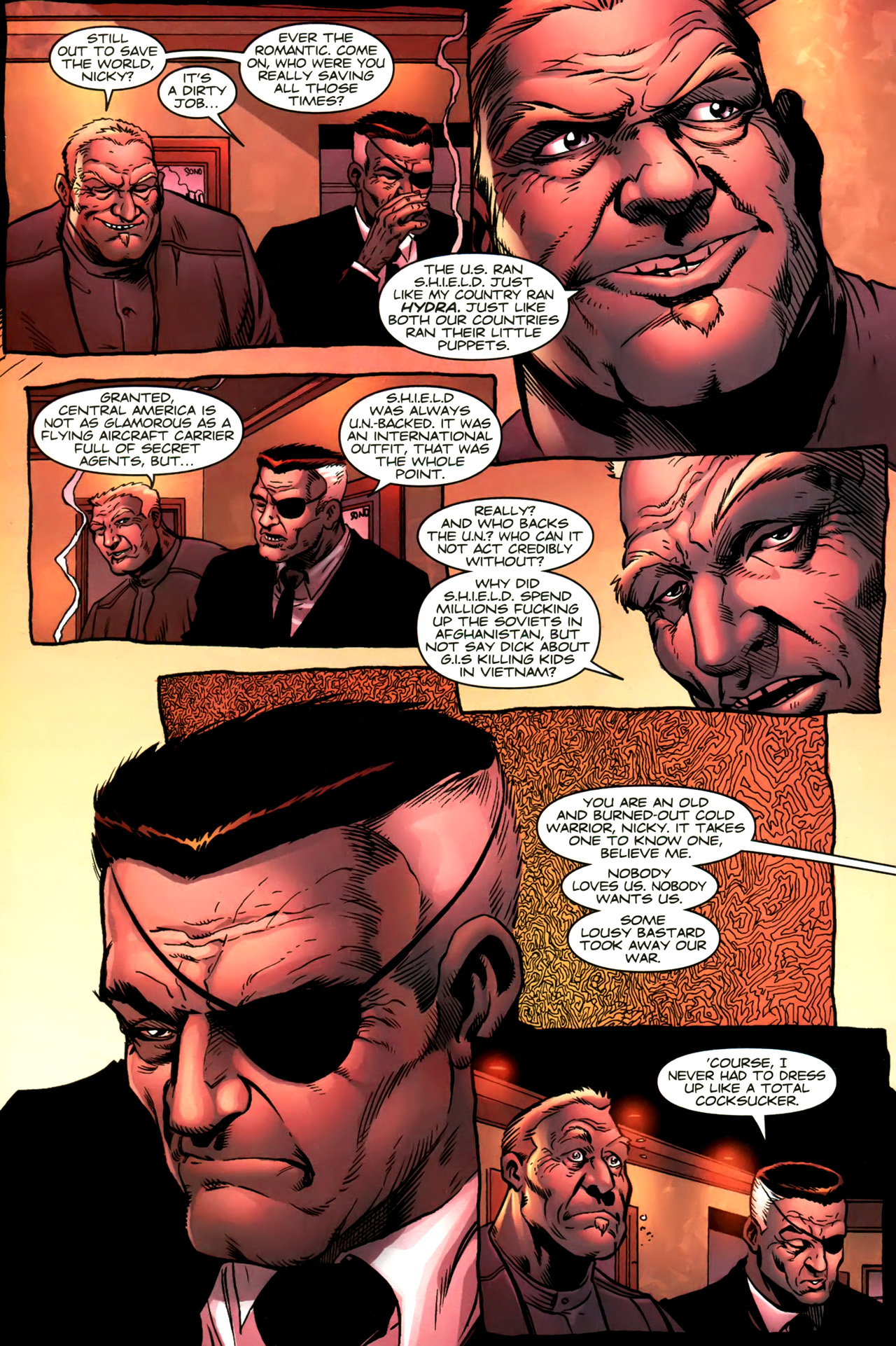
Fury MAX gets some comedic mileage out of the mere act of dirtying up Marvel’s super-agent, taking the piss by placing a recognizable hero in adult situations such as swearing (including plenty of homophobic slurs), screwing hookers, and ruthlessly slaughtering dozens of people. (It was the very early days of the MAX imprint, so this kind of thing still felt relatively fresh… Alias came out at the same time, Cage and The Hood came out in the following year.) Setting aside for a moment Garth Ennis’ penchant for editorializing, there is clearly a humorous slant to scenes like the one where a decadent Nick Fury delivers an outrageous rant about the previous decade: ‘What happened to this country? When did the assholes start running things? How did they get away with the pissant little rules they make us live by? Why do they use ten words to hint at what just one would say? I feel like I blinked and someone turned the place into the United States of Pussies…’
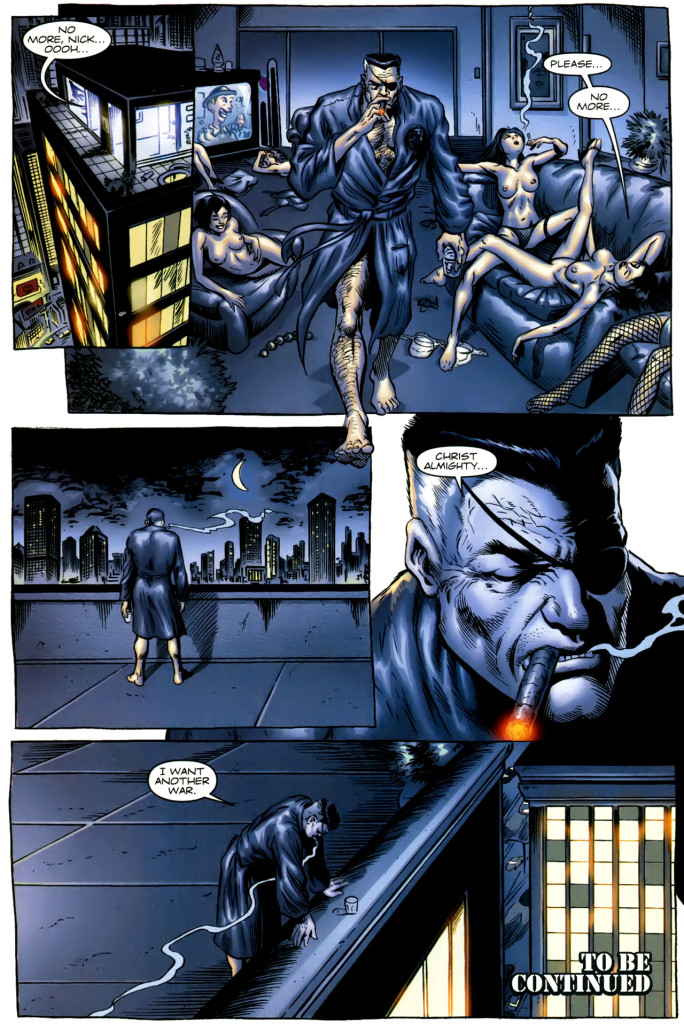 Fury MAX #1
Darick Robertson is a perfect partner-in-crime. It’s not just that his art has always displayed great comedic timing… Robertson visibly delights in drawing over-the-top sex and grotesque carnage. And here Ennis gives him several chances to go wild, whether by depicting a monstrous, disfigured henchman (called ‘Fuckface,’ because this is that kind of comic) or by bringing to life the climactic bloodfest (where Fury rips out an enemy’s entrails and strangles him with his own intestines, because this is also that kind of comic), well-served by Jimmy Palmiotti’s thick inks and the glossy colors of Avalon Studios.
Robertson’s excellent storytelling pace and stylish character designs make the various lengthy ‘talking heads’ sequences utterly compelling, which also works well with Ennis’ characteristically dialogue-rich script.
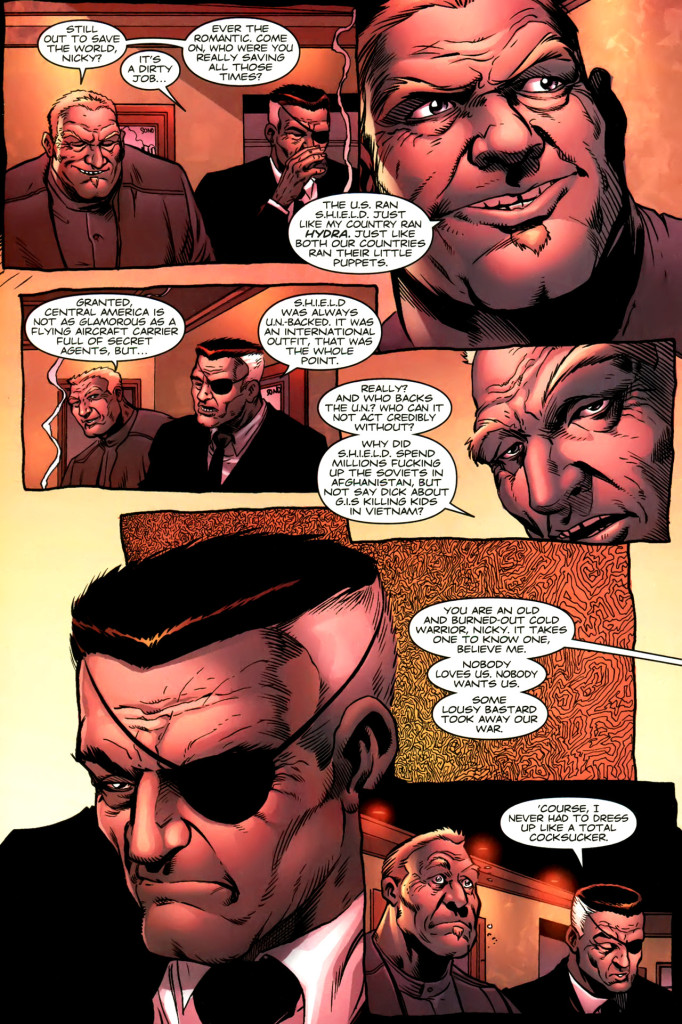
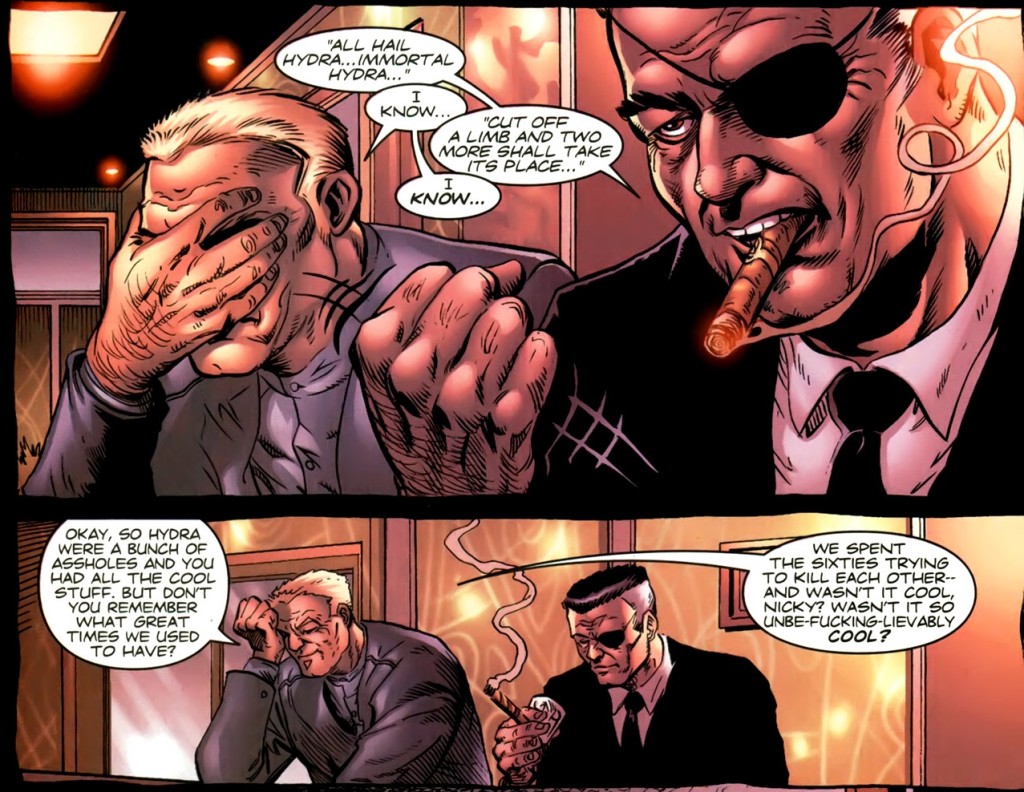 Fury MAX #1
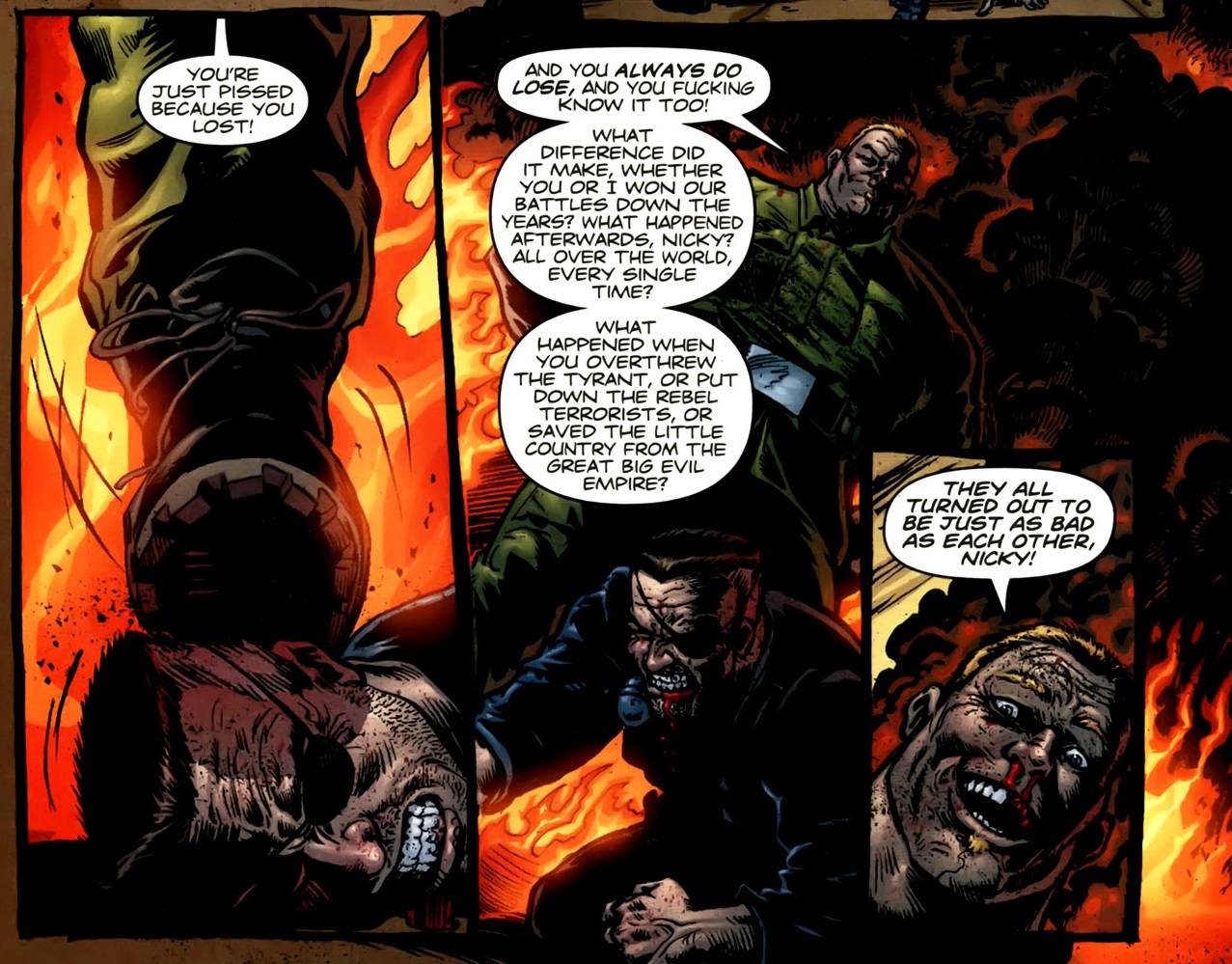
As you can tell from this scene, there is a revisionist edge to Fury MAX, not unlike what Frank Miller did with Batman in The Dark Knight Returns. It’s as if these comics are showing us how their protagonists – and their worlds – truly were all along, casting even the past in a different light.
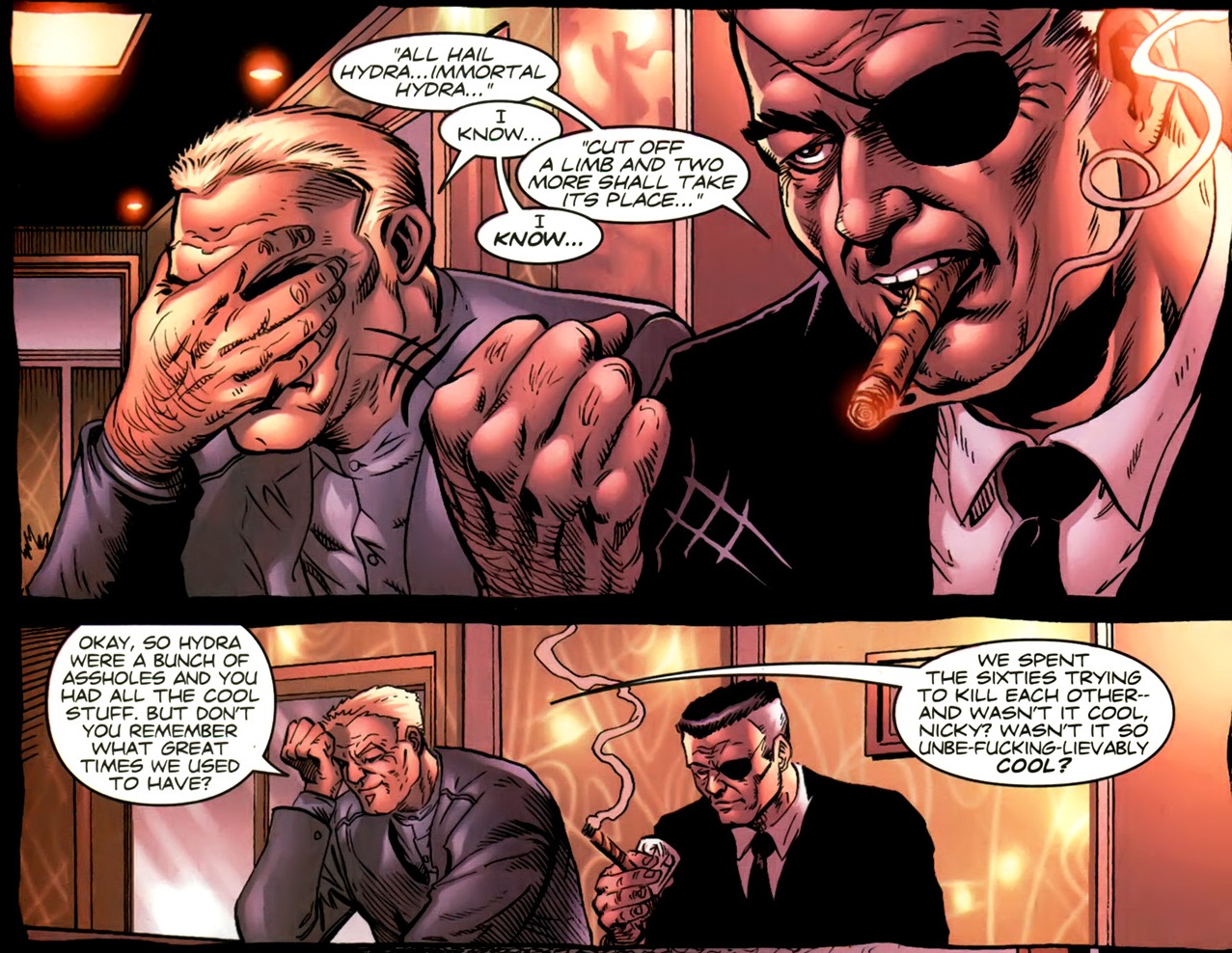
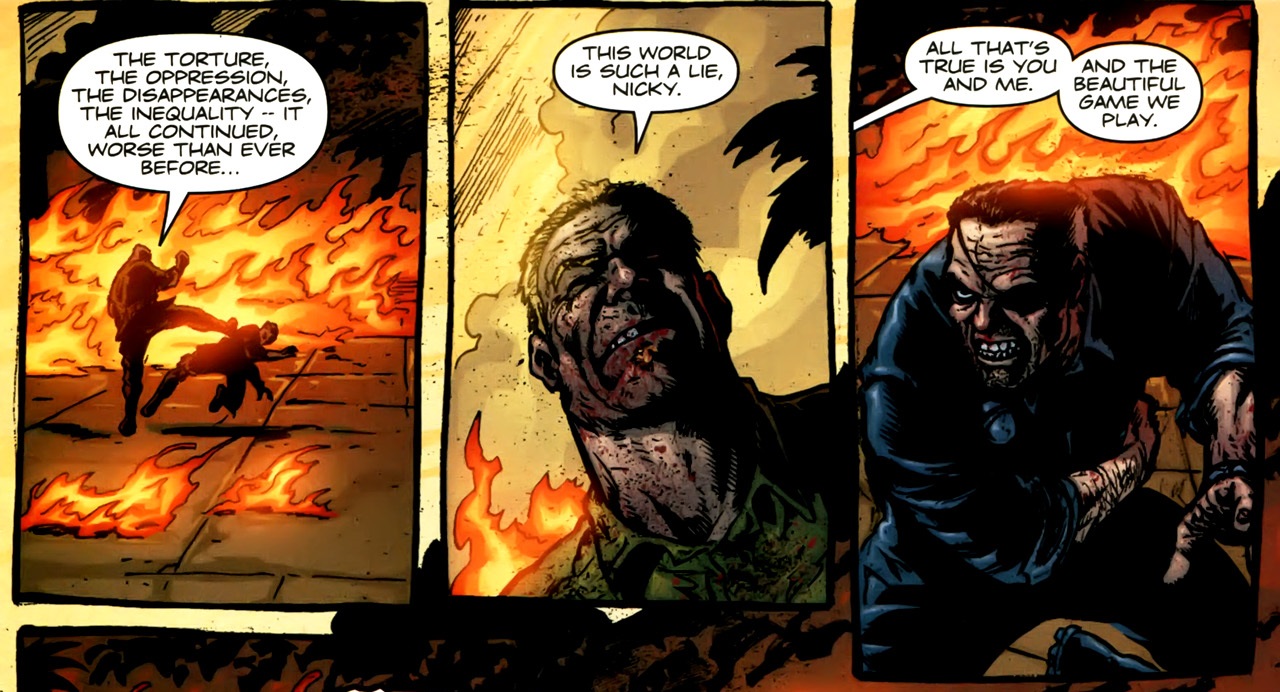
This revelatory approach leads to one of the series’ most provocative gestures, namely the heavily implied suggestion that, contrary to what he claims, Nick Fury’s driving motivation is not so much a concern for the weak and the ‘little people’ (which, as shown in his relationship with his nephew, Fury can’t stand up-close), but rather an addiction to the adrenaline of combat. The comic’s central plot involves Rudi Gagarin – an ex-Hydra, ex-Soviet hawk – trying to kickstart a new large-scale geopolitical conflict because he misses the old days (‘Guys like you and me, battling it out with the fate of the world at stake… A war in the shadows, a war the little people never knew about… You set up a government here, knock down a rebel force there… You convince some generalissimo to invade his neighbor… He thinks it keeps the guns coming in, you know it’ll keep coke going out, and all the while you’re fucking the idiot’s wife…’). Revealingly, when he tells Fury about this plan, Fury doesn’t stop him straight away, so Gagarin does end up setting it in motion (by staging a military coup in the strategic Napolean Island), which results in an orgy of violence. In the final images – a callback to the balcony scene shown earlier in this post – we see a melancholic Fury coming to grips with what he has done.
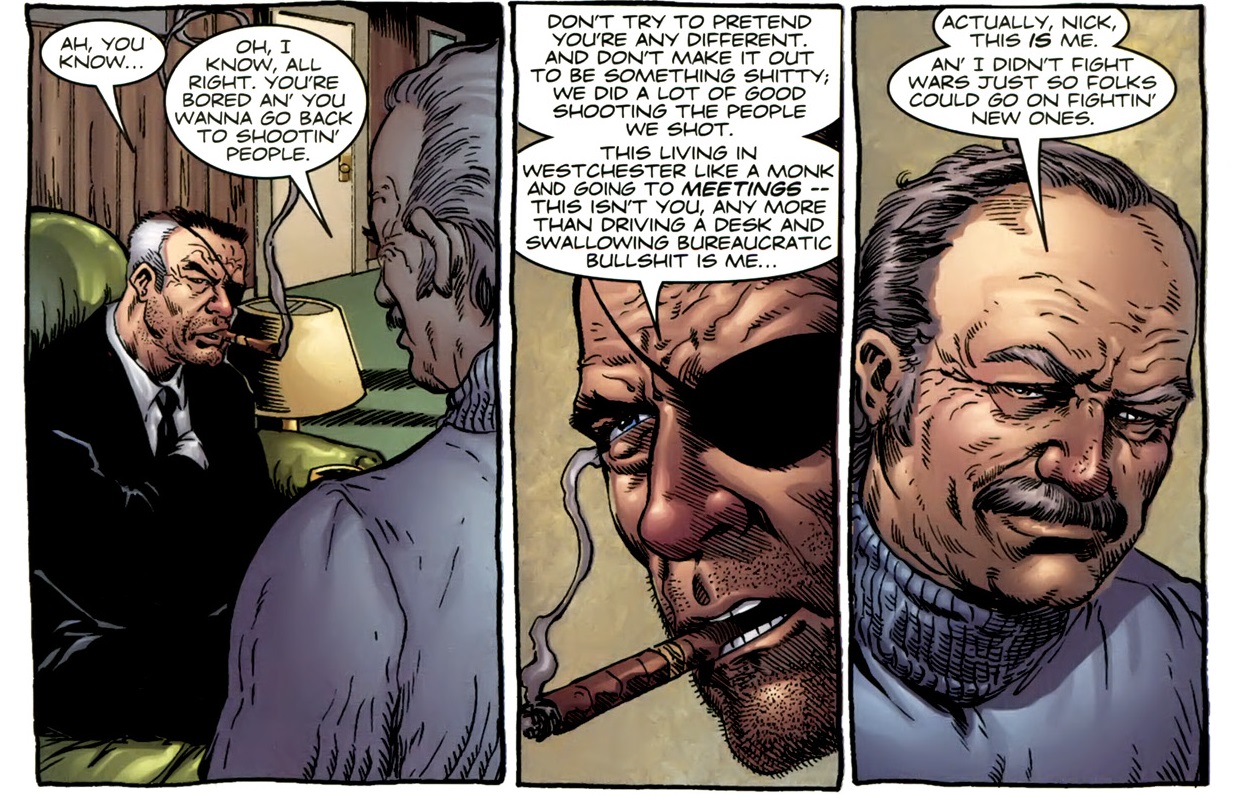
It’s a Garth Ennis comic, so none of this is incredibly subtle. Indeed, a retired Dum Dum Dugan sees right through Nick Fury:
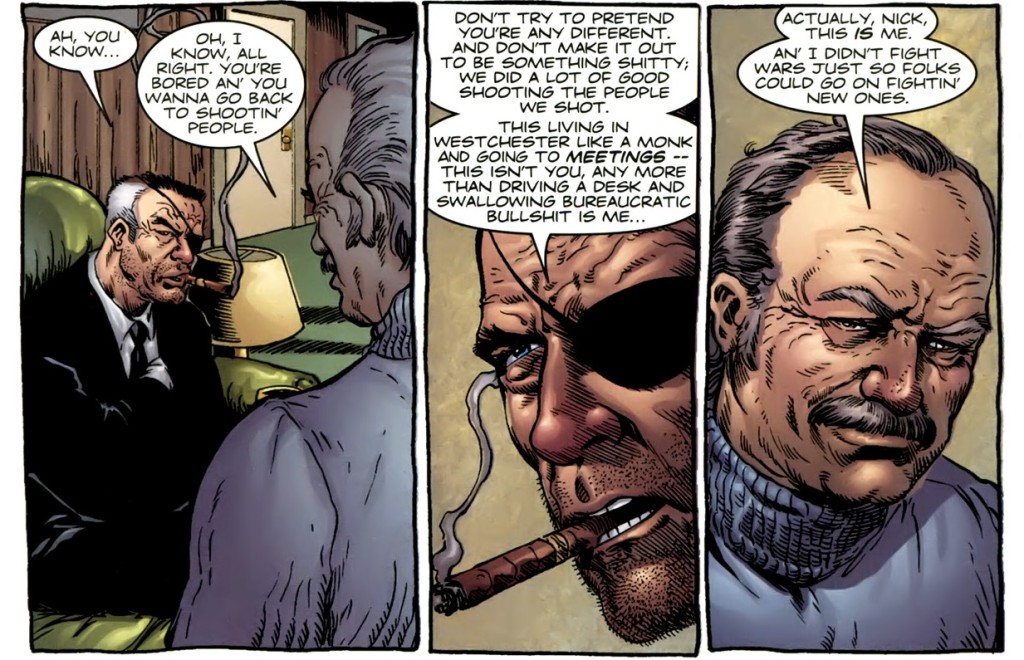 Fury MAX #2
The point is not that Nick Fury and Rudi Gagarin are the same. Despite both embodying military discipline and an overall sense of ultra-tough masculinity (including the desire and ability to satisfy multiple women in one go), the comic acknowledges differences. The nuances are especially clear in issue #4, where Fury’s approach to his crew (‘So long as you do your job you can ask all the questions you want.’) comes across as comparatively less despotic than Gagarin’s (‘Give me further cause for disappointment… and Fuckface will sleep with you.’).
The biggest difference between them is that Nick Fury gets a rush out of fighting for freedom, whereas Rudi Gagarin is gleefully nihilistic, openly admitting that what he enjoys is the great game itself (‘it was like chess with blood…’). You can argue that Fury is more ideological and Gagarin more cynical… or that the former is just more hypocritical and self-deluded than the latter. In any case, their relationship illustrates a core theme of Ennis’ work, namely the ambiguous line separating the notion that you-need-to-be-macho-to-get-shit-done from the sense that getting-shit-done-is-a-pretext-to-indulge-in-machismo.
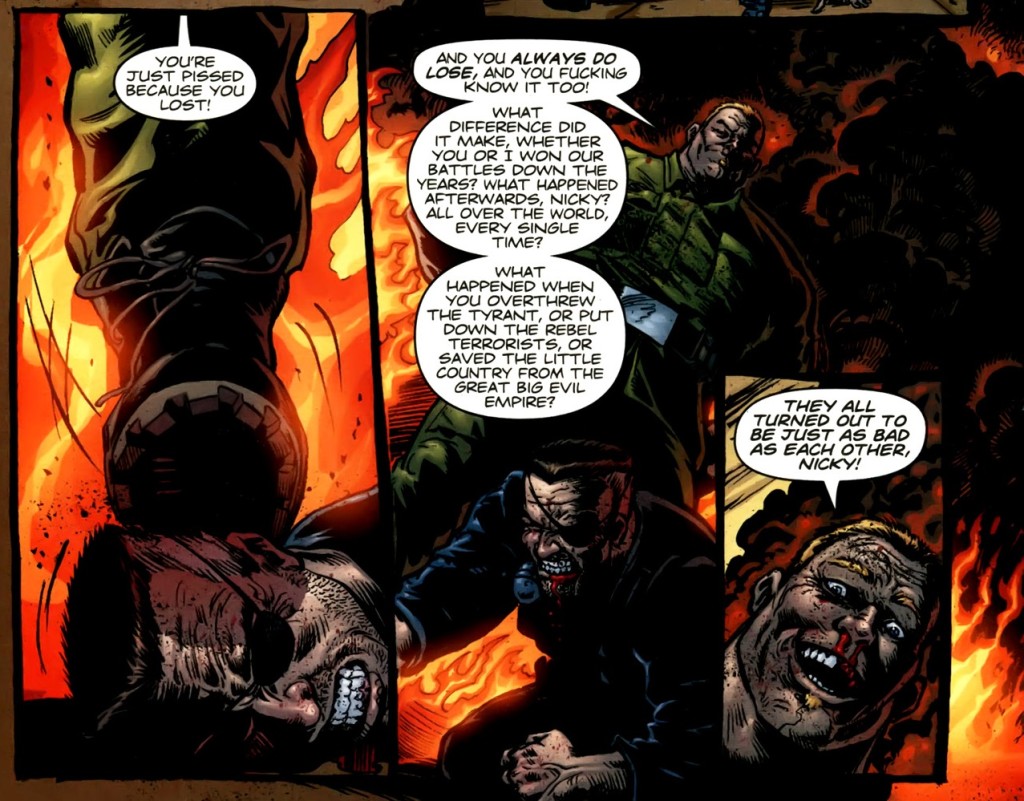
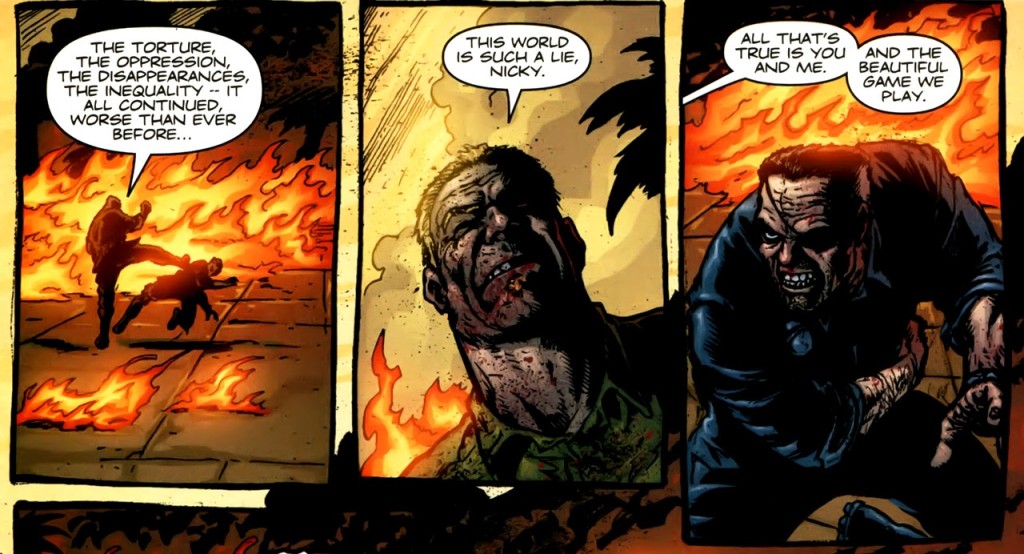 Fury MAX #6
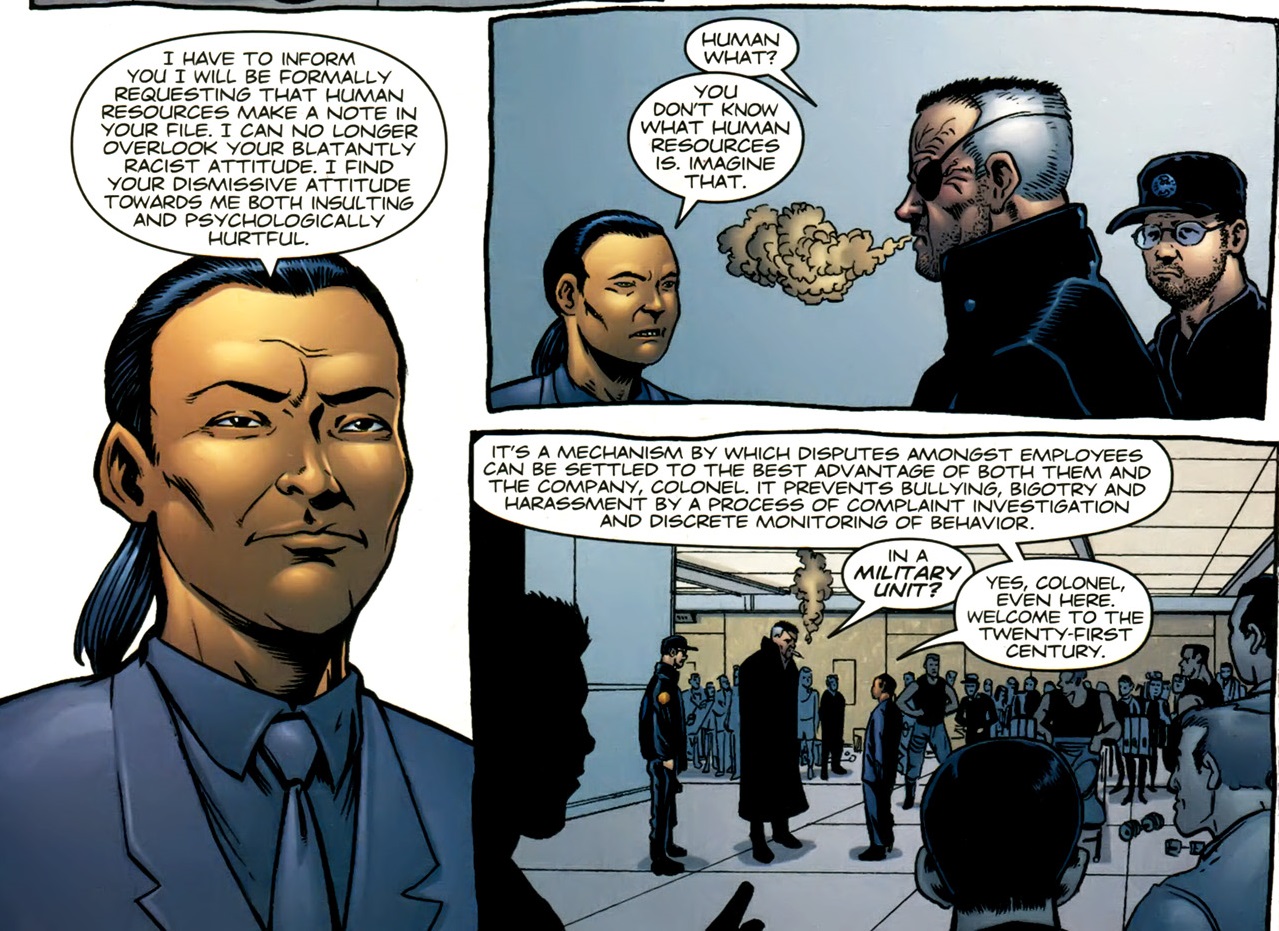
As it should be clear by now, on top of the geeky dimension of character revisionism, Fury MAX is also subversive on more political levels. One of those levels – the least interesting one – has to do with the dated attempts to seem edgy by attacking political correctness. This version of Nick Fury comes across like Clint Eastwood’s cranky, take-no-shit persona in Gran Torino and The Mule – he is a curmudgeon who calls a spade a spade and will only respect you if you don’t get offended.
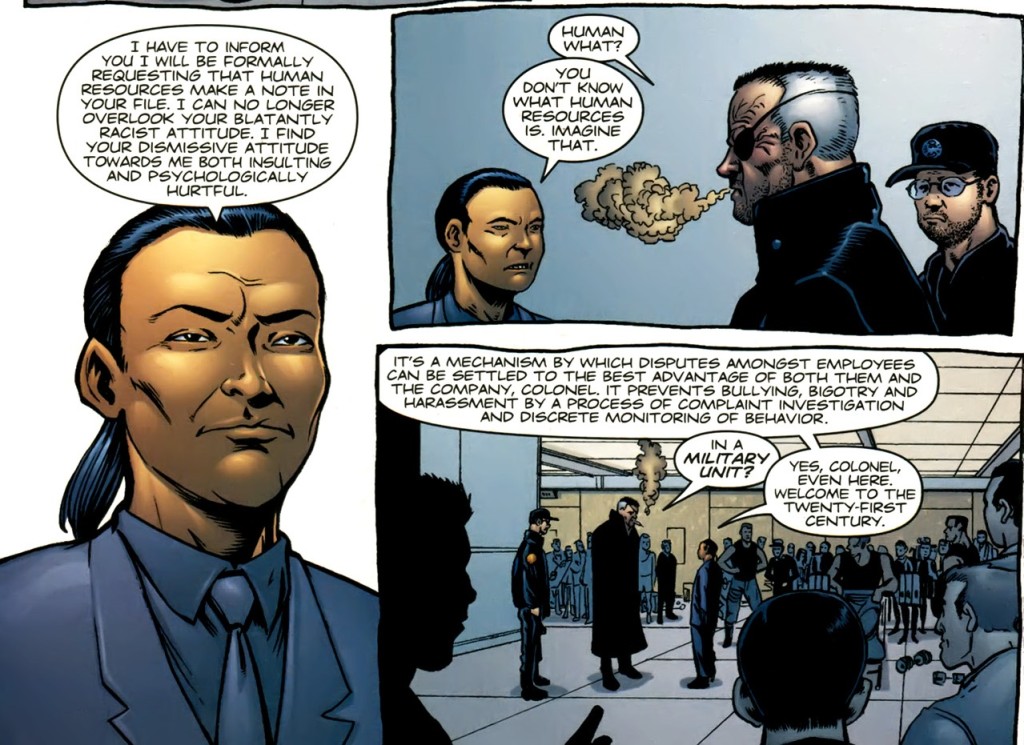 Fury MAX #3
That said, just like Eastwood’s latest film complicates its benevolent depiction of small-scale anti-PC provocations by pitting them against the wider context of systemic racism (on which the whole premise of the film hinges), Fury MAX also throws its reactionary impulses into seemingly contradictory directions. Ultimately, Garth Ennis’ style fits comfortably into a tradition of British literature – together with the likes of Tom Sharpe’s Ancestral Vices or Ben Elton’s Blast from the Past – that embeds poignant political satire in outlandish off-color comedy.
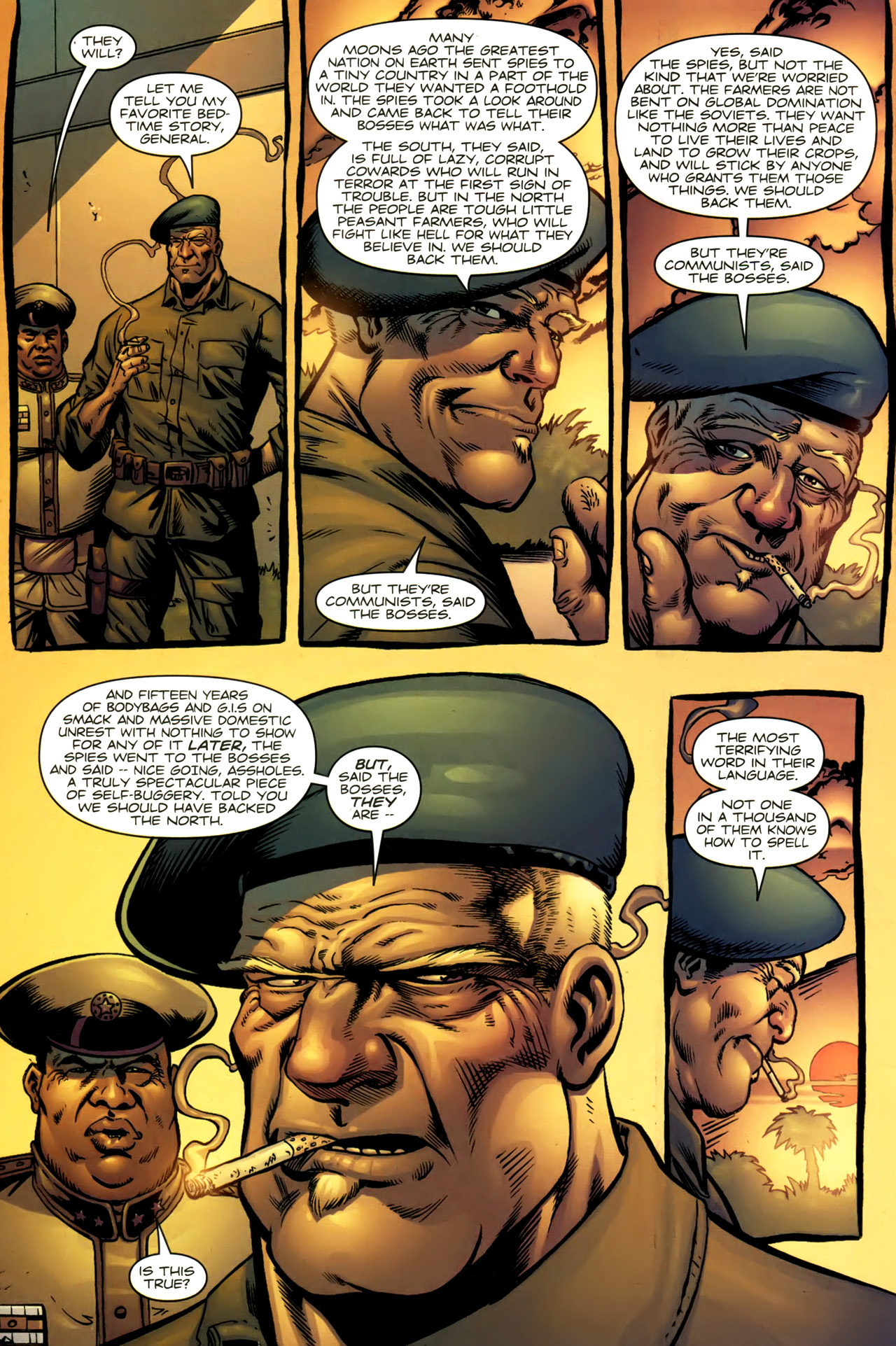
For one thing, Ennis has his share of fun at the expense of North American anti-communism. Indeed, this is a comic clearly plotted (and mostly written, I assume) before 9/11, back when George W. Bush sounded like the most inarticulate president imaginable (‘They say he’s dumb, but what about the people who let him near the microphone?’) and when neocons still seemed to be coping with the loss of their longstanding enemy by looking back at the Cold War rather than throwing themselves at the Global War on Terror… Notably, Gagarin backs a coup by a tropical dictator, General Makawao, because at the time those were still more fashionable as enemies than Muslim fundamentalism.
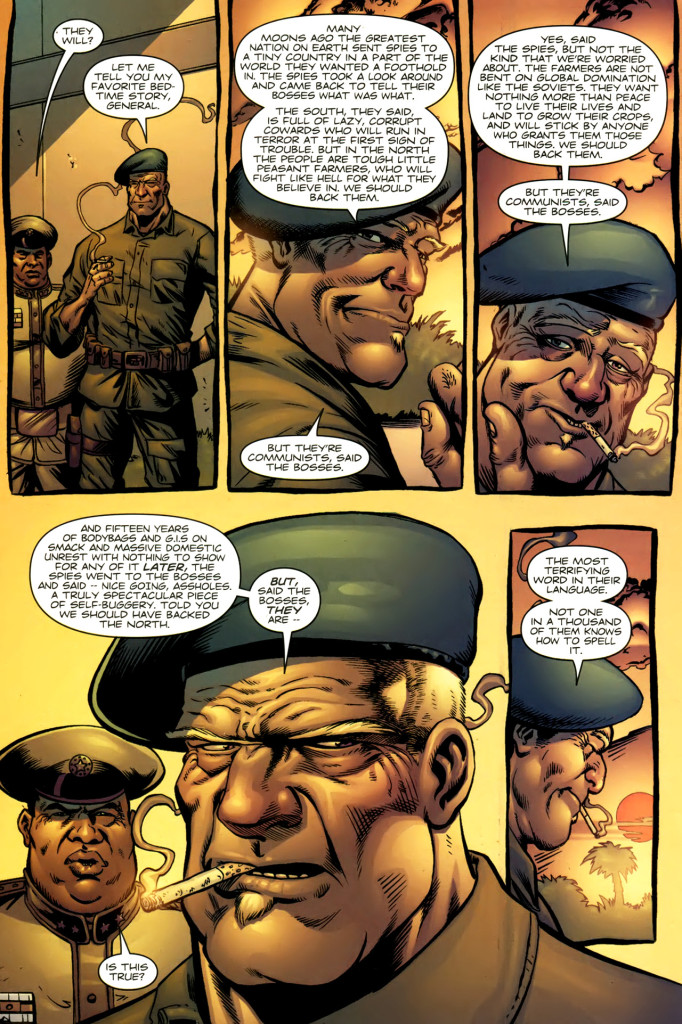 Fury MAX #3
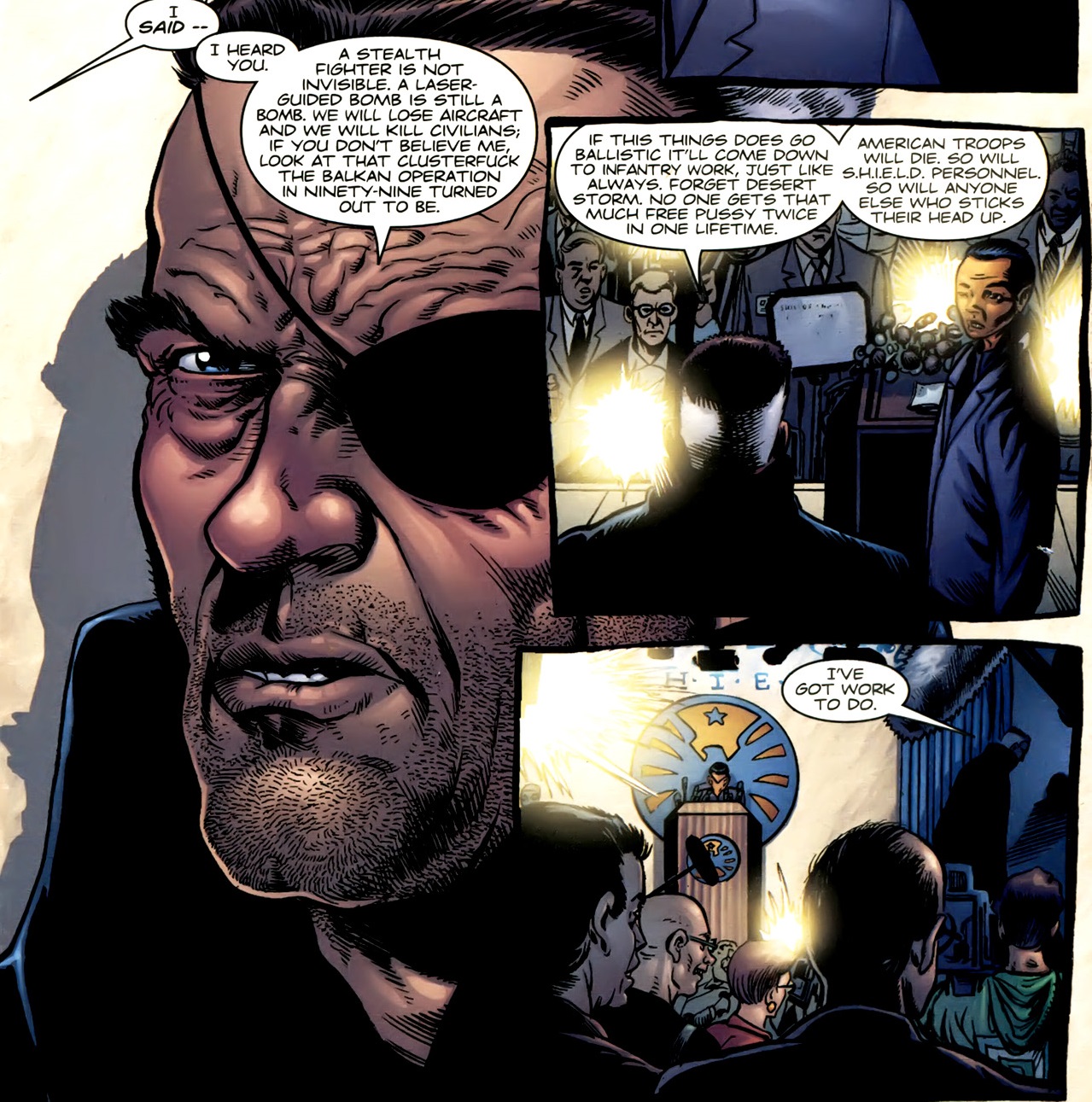
We also get an interesting glimpse into late ‘90s debates on the future of warfare during a conference when Nick Fury bursts out that, for all the talk of stealth and smart weapons, at the end of the day you’re still going to need balls of steel to go to war. At first sight, the scene may look like just another amusing demonstration of Fury’s straight-talking, zero-patience-for-softies-and-tech-nerds attitude but, looking back, it now seems like a prescient warning against the upcoming military interventions in Afghanistan and Iraq:
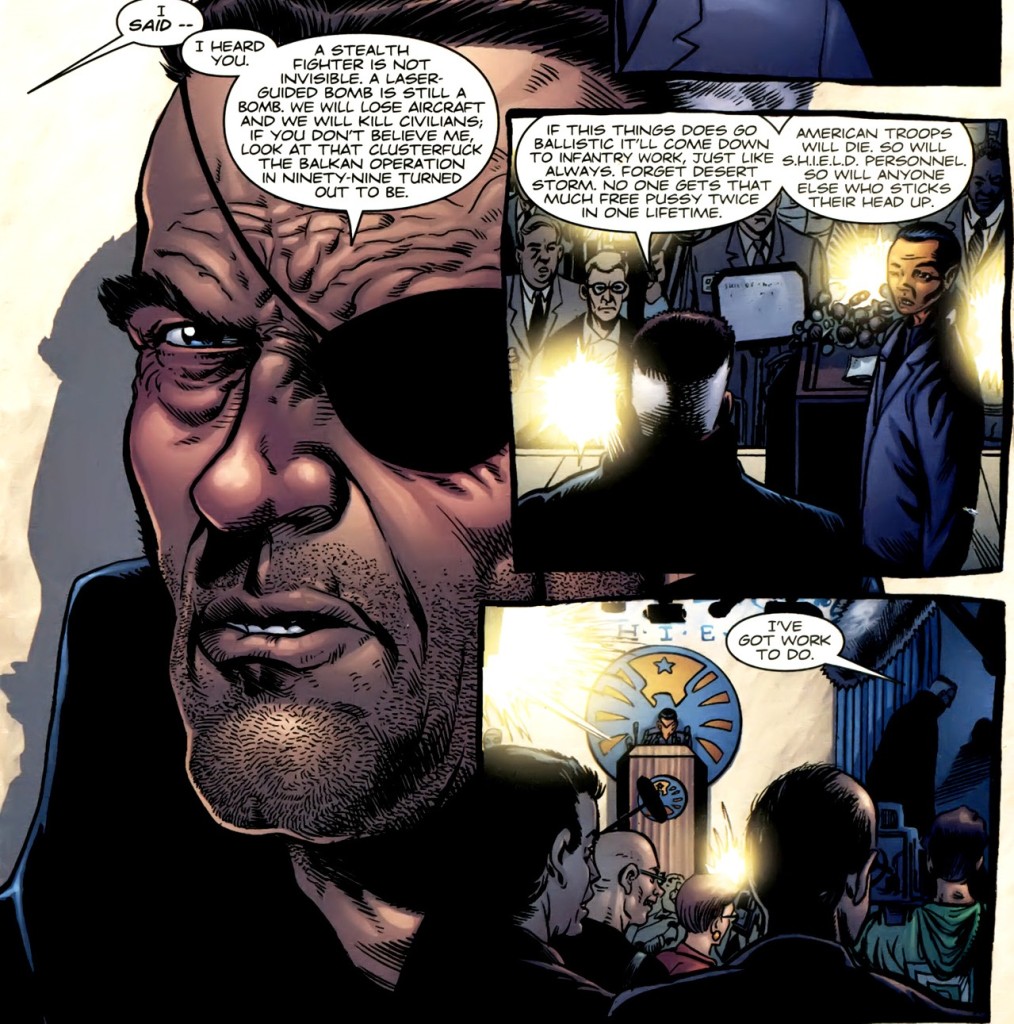 Fury MAX #3
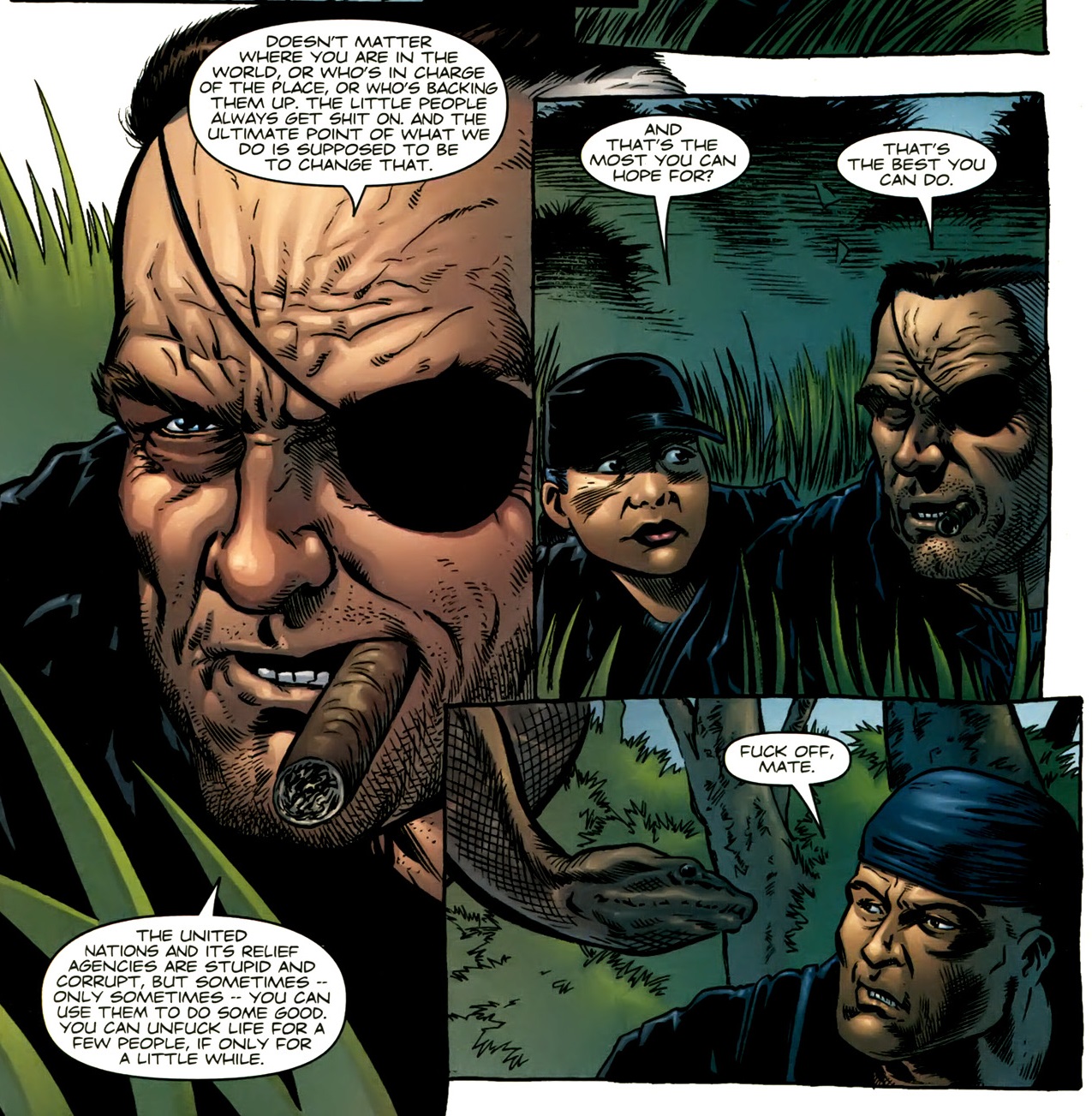
The fascinating thing is that if, on the one hand, Nick Fury seems to represent the Bush-era United States because he’s so eager to embark on yet another ostensibly righteous crusade, on the other hand it’s precisely against the jingoism of the actual U.S. government that he claims to be fighting. Fury frames his mission – and that of the U.N.-backed S.H.I.E.L.D. – as preventing an American intervention in Napolean Island by sorting things out before they escalate into a crisis. As he puts it at one point: ‘This agency is not about to become the U.S. government’s puppet. We exist to do the job – not to fuck up so they can say No more Mr. Nice Guy and carpet-bomb a whole country off the map.’ Or, later, in a pep talk to his crew: ‘the smaller the role American forces play in toppling the Makawao regime, the less excuse the U.S. has to get a toehold afterwards. I’d rather have the U.N. peacekeepers here than some Company-backed fucker a thousand times worse than Makawao.’
Yep, for all the pre-alt-right flavor of some of its rhetoric, Fury MAX still makes the case that, warts and all, the United Nations are at least preferable to American imperialism…
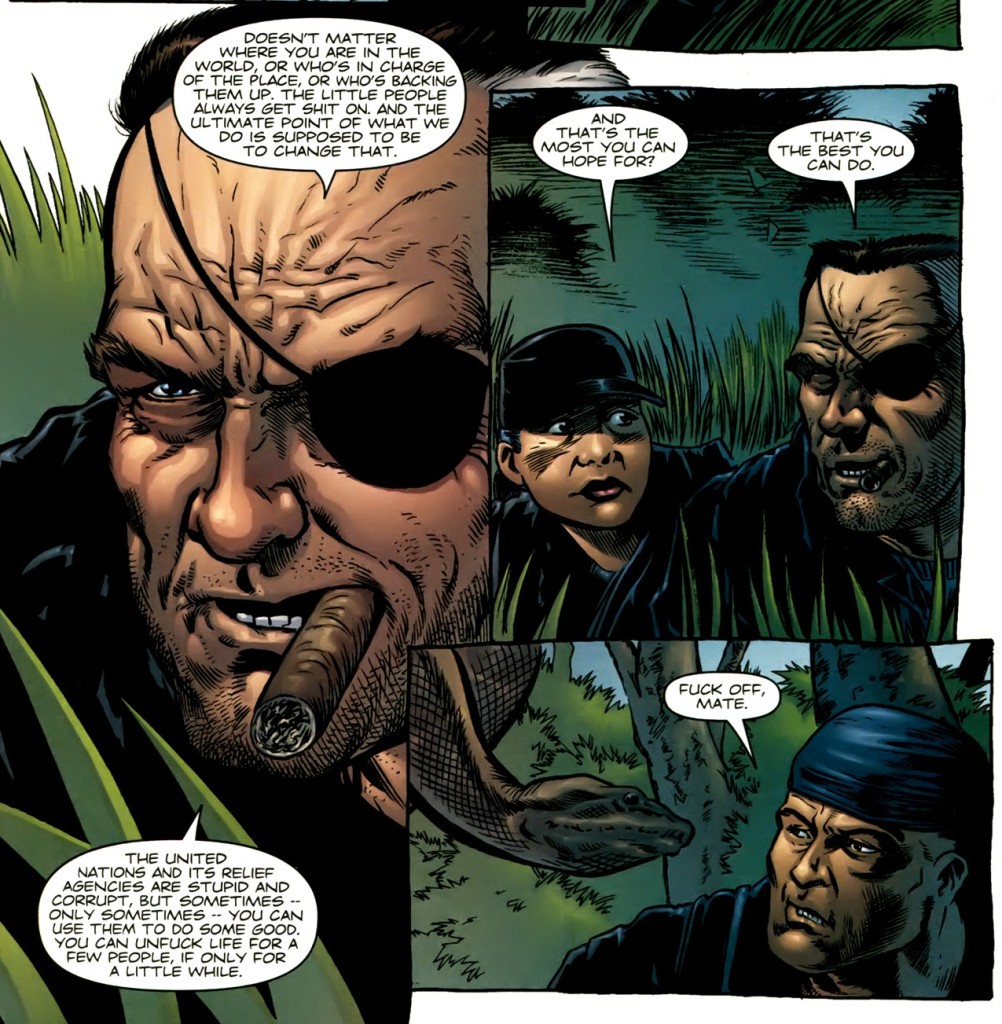 Fury MAX #4
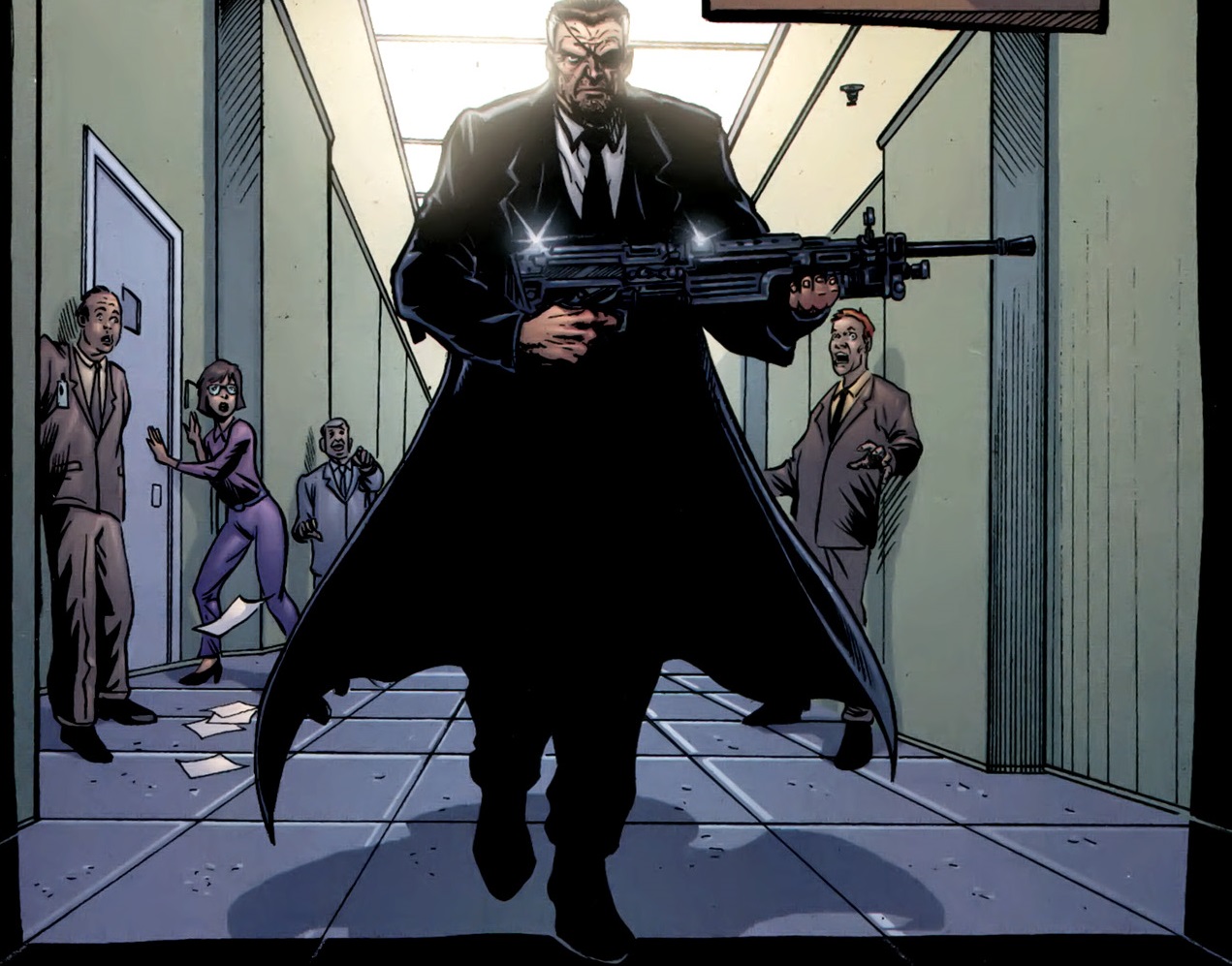
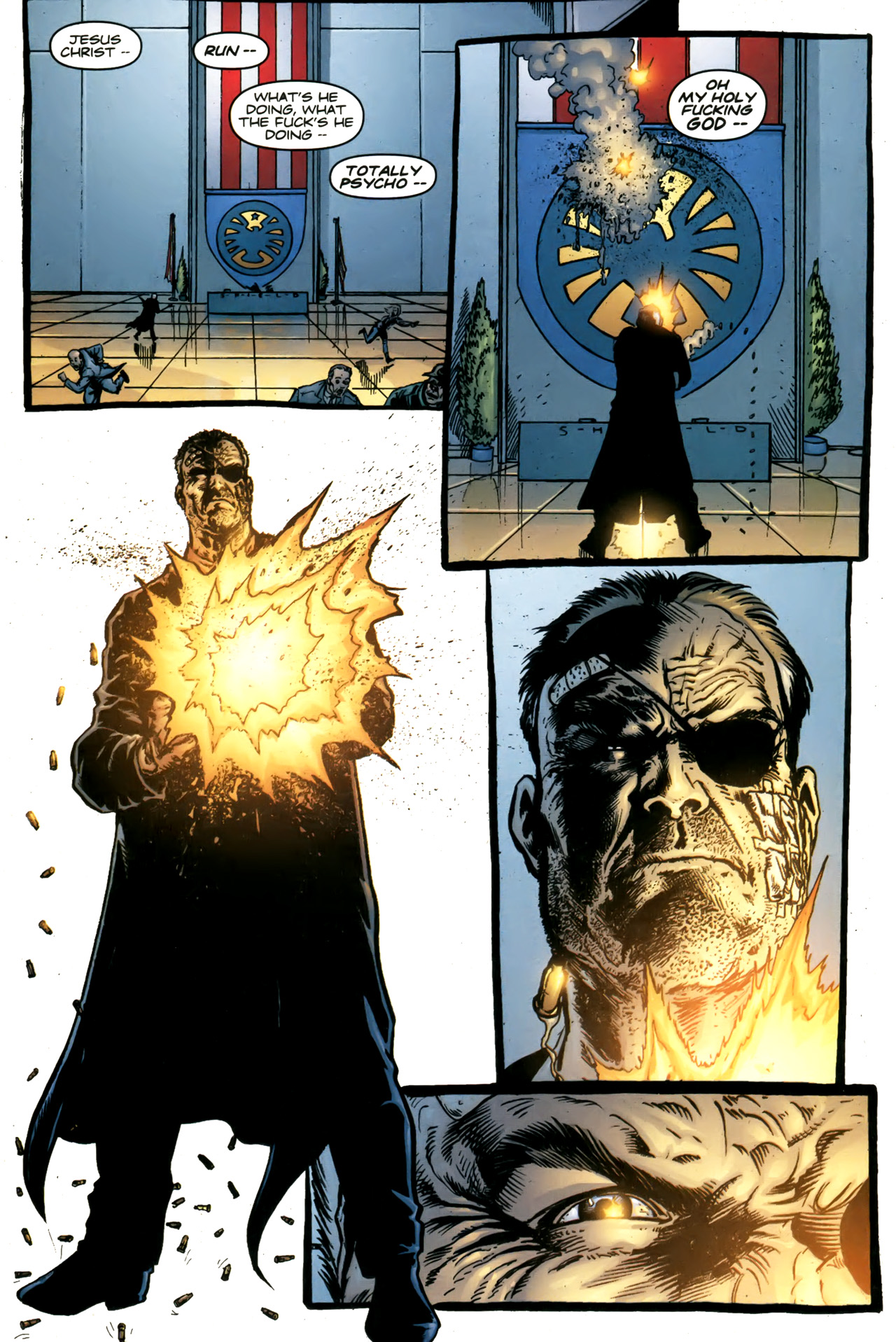
This leads to a great spin on that scene near the end of Rambo II where Sylvester Stallone shoots up the office of a slimy government bureaucrat who had betrayed the American war effort. In this version, Nick Fury takes it out on the bureaucrats of the United Nations because they sold out to U.S. warmongers!
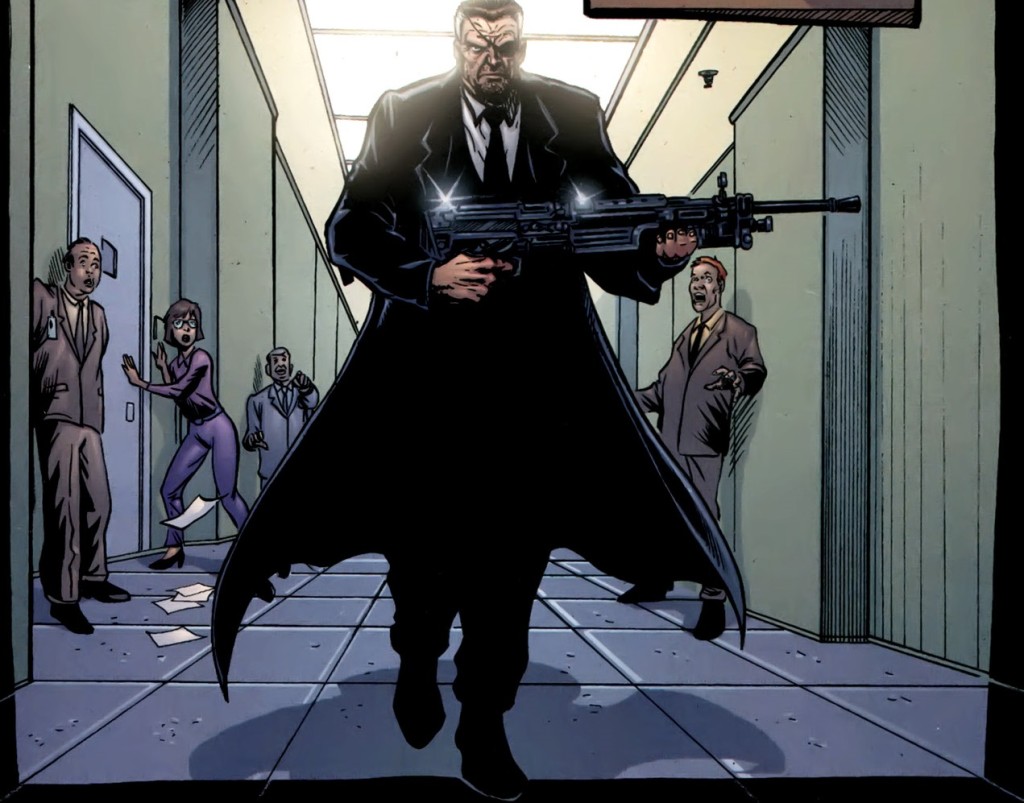
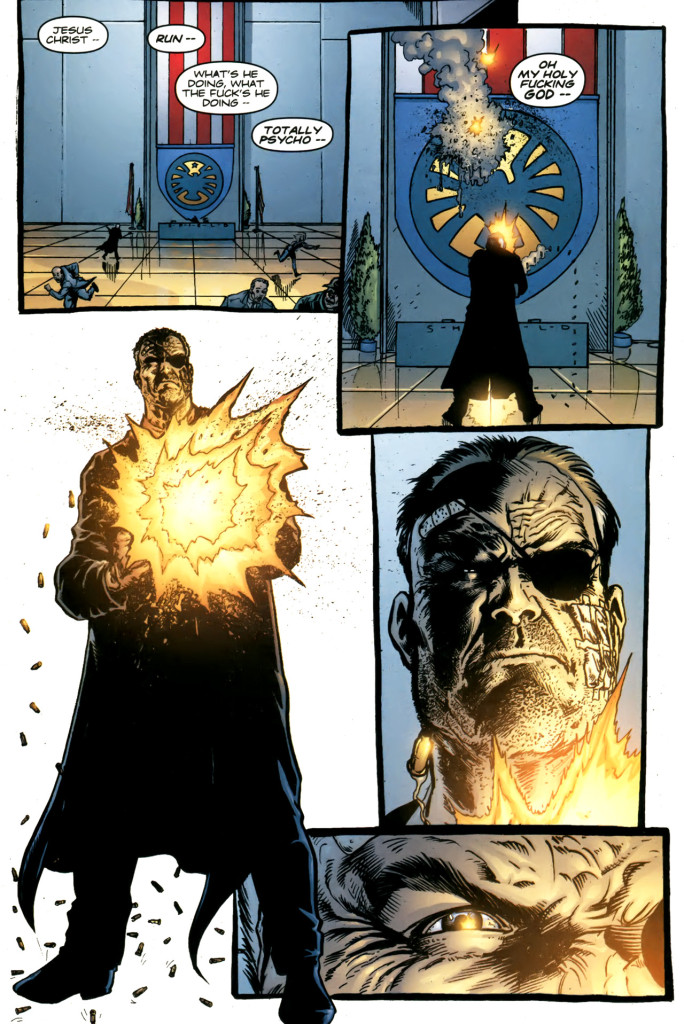 Fury MAX #6
By taking right-wing rhetoric and imagery and hectically putting it in the service of a kind of murky anti-right-wing critique, this scene gloriously sums up Fury MAX – and, in fact, much of Garth Ennis’ oeuvre.
Posted in SPYCRAFT & WARFARE
Tagged Axel Alonso, Bill Jemas, Cold War, D.G. Chichester, Darick Robertson, espionage, Garth Ennis, Jimmy Palmiotti, Joe Quesada, Nick Fury, politics
Leave a comment
A couple of excellent spy novels
Shifting gears for a bit, today let’s talk about a couple of cool books without drawings that came out almost a decade ago…
OUR KIND OF TRAITOR
(John le Carré, 2010)
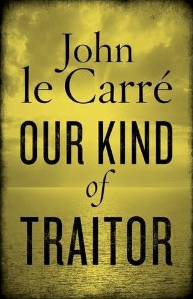
“At seven o’clock of a Caribbean morning, on the island of Antigua, one Peregrine Makepiece, otherwise known as Perry, an all-round amateur athlete of distinction and until recently tutor in English literature at a distinguished Oxford college, played three sets of tennis against a muscular, stiff-backed, bald, brown-eyed Russian man of dignified bearing in his middle fifties called Dima. How this match came about was quickly the subject of intense examination by British agents professionally disposed against the workings of chance. Yet the events leading up to it were on Perry’s side blameless.”
John le Carré, the absolute master of the sophisticated spy novel, penned this no-frills thriller about a bourgeois British couple who, during a tennis-playing holiday in the Caribbean, cross paths with a Russian oligarch and soon find themselves embroiled in a shady web of international intrigue. Although much less ambitious than le Carré’s classic, sprawling Cold War epics, Our Kind of Traitor is nevertheless a gripping page-turner that benefits from the veteran writer’s sharp wit and characterization, not to mention his usual digs at the political climate (in this case, at the floods of criminal Russian money pouring into the British establishment).
Unless you’re new to the game, you’ve probably seen some of this before. It’s one of those Hitchcockian ventures in which naïve civilians enter the world of espionage, their amateurish goodwill pitted against the plots of cynical, seasoned professionals. Le Carré had already mined this territory in Absolute Friends, The Tailor of Panama, The Mission Song, The Night Manager, and Single & Single (which also dealt with the Russian mob) among others, doing countless variations on the scene where a handler at the MI6 teaches the hero about the basic rules of the job. Yet here le Carré has fun twisting some of the old formulas, for example with this prep speech that the couple gets just before a crucial stage of the operation:
“This is not, repeat not, a training session. We don’t happen to have a couple of years to spare: just a few hours spread over a couple of weeks. So it’s familiarization, it’s confidence-building, it’s establishing trust in all weathers. You in us, us in you. But you are not spies. So for Christ’s sake don’t try to be. Don’t even think about surveillance. You are not surveillance-conscious people. You’re a young couple enjoying a spree in Paris. So don’t for fuck’s sake start dawdling at shop windows, peering over your shoulders or ducking into side alleys.”
Le Carré’s storytelling is a delight, as usual. We get a third-person subjective narrator whose viewpoint shifts from chapter to chapter (and later from subsection to subsection, during the suspenseful climax), giving us insight into the perspectives of various players. After a first act revolving mostly around the couple’s experience, the focus moves to the UK’s secret services – against the background of the financial crisis and austerity policies – and suddenly the narrative gains a new set of layers. As the final pages approach, we feel as powerless as the protagonists, knowing that machinations are taking place somewhere far away… their fate is in the hands of forces beyond their control. There is the typical amount of loose ends, some of them fueling the overall paranoia, some of them leaving us with the haunting responsibility of imagining what happened to the handful of characters left unaccounted for by the end.
Expect lyrical descriptions of tennis matches, especially during the sequence at the French Open final, which cannot help but bring to mind Alfred Hitchcock’s Strangers on a Train.
THE LAST RUN
(Greg Rucka, 2010)
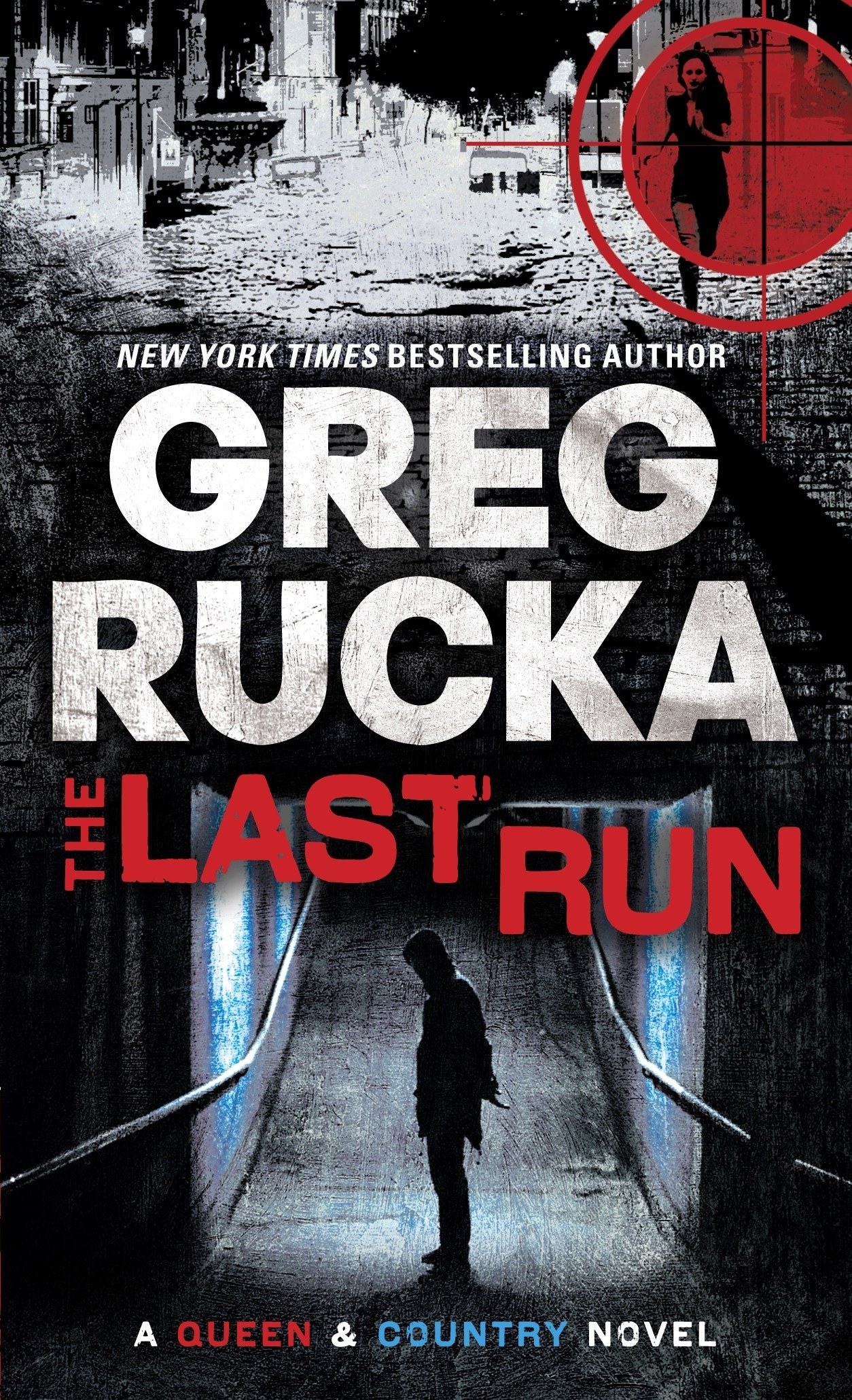
“For Tara Chace, it was the fall that did it, the absurdly long pause that came between missing the handhold and slamming into the ground. Like all falls that are too far, this one lasted long enough for her to realize what happened, and what, as a result, would inevitably happen next. It was a moment of perfect clarity; not of vision, but of self-awareness, and Chace saw herself then as she had only four other times in her life. She saw herself as the woman she was – frankly, honestly, without self-pity, judgment, or false modesty. Who she was, who she had been, and who she wished to be.
Then she hit the ground, her back impacting first, followed almost immediately by her skull.”
There are different ways you can approach The Last Run. You can approach it as the final volume in Greg Rucka’s trilogy of gritty novels about MI6 agent (aka ‘minder’) Tara Chace. You can approach it as the culmination of the excellent comic book series Queen & Country (itself a sort of unofficial sequel/quasi-remake of the brilliant TV show The Sandbaggers). Or, if you’re late to the party, you can just read it as a self-contained tale, since Rucka conveys all the background you need about the characters and the intricate administrative framework of the British intelligence branch. In any case, make sure you check out this page-turner about an operation to lift an important Iranian defector, told in a taut, realistic style and building up to a surprising payoff.
The two previous novels in the series – 2004’s A Gentleman’s Game and 2005’s Private Wars – were both great spy thrillers about the War on Terror. Despite providing several tense action set pieces, what made those books stand out was the weight given to the bureaucracy and infighting within the secret services. Everyone had an ulterior agenda and Rucka excelled at bringing those agendas together… and often pitting them against each other! I especially like Private Wars, which is one hell of a yarn revolving around a couple of missions in Uzbekistan, a real setting (with some creative tweaking) whose brutal description packs a punch. There is some nasty stuff in there (including a couple of torture scenes that are pretty hard to stomach), but it’s still a much more intelligent and thought-provoking novel than the trashy cover suggests.
The Last Run keeps the series’ best traits, including its moral ambiguity. Once again, we don’t get just the MI6’s perspective – we also spend plenty of time with its opponents (in this case, with a unit of Iran’s Ministry of Intelligence and Security), fleshing them out and complexifying what could’ve been a facile narrative of heroes and villains. And once again, the book doesn’t shy away from telling us how ruthless both sides can be, in specific circumstances.
In terms of writing, Rucka maintains a smooth pace, often toying a bit with time within each chapter to keep readers on the edge. His prose is not particularly rich in terms of language, but his storytelling is top-notch, including the kind of attention to detail that effectively sells you on the cast’s astuteness and professionalism.
“‘I’m a marine biologist?’
Teagle slid a folder across the briefing table towards her. ‘You can read up on it. You’ve published a couple of very well-received papers on the subject, in point of fact. It’s a very good cover for the job, Tara. Of all the countries on the Caspian, Iran is the only one to make any effort at sustaining the sturgeon population, and they’re quite proud of the fact.’
‘I never did like caviar,’ Chace said, leafing through the folder.
‘The cover also justifies why you’ll be in the north, why you’ll have access to a boat, why you’ll be carrying a GPS, a sat phone. You can even get away with carrying a knife, if you like. After all, you’ve got to open those fish somehow.’”
All in all, The Last Run – like the rest of the Queen & Country series – should be required reading for any fan of the genre. There are codes and dead drops and double-crosses and enough tradecraft to fill a manual. There are long stretches of political discussions and backroom deals, but also bursts of vicious violence that suddenly shift the narrative. Moreover, Tara Chace continues to be a tough, resourceful operative with just enough vulnerability to make her a truly engrossing protagonist. Let’s hope Rucka brings her back soon, somehow!
Posted in SPYCRAFT & WARFARE
Tagged books without pictures, espionage, Greg Rucka, John le Carré, politics, Queen & Country
Leave a comment
Spotlight on The Unknown Soldier, 1975-1976
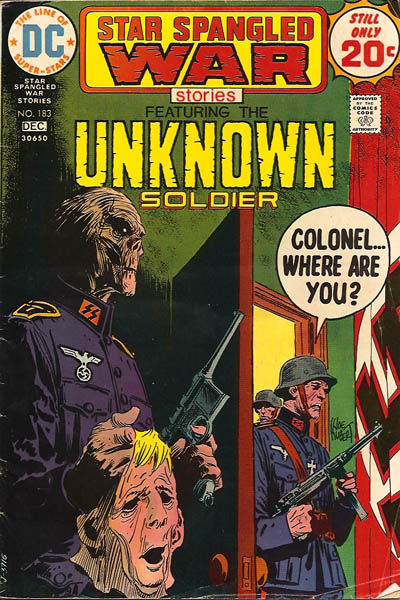
In the early 1970s, the Unknown Soldier feature of Star Spangled War Stories told exciting spy adventures set in World War II, starring a disfigured operative turned master-of-disguise who undertook secret missions under direct orders from Washington. As I explained last week, that series was not without a certain degree of grittiness. However, when the team of editor Joe Orlando, writer David Michelinie, and artist Gerry Talaoc took over, in issue #183 (cover-dated November-December 1974), they raised the bar to another level.
The new guys infused The Unknown Soldier with a no-holds-barred, take-no-hostages attitude. A more accurate way to put it is that they finally engaged with the increasing tension between the series’ premise and the current zeitgeist, embracing the skepticism of authority in general and militarism in particular ushered in by the Watergate scandal and the tail end of the Vietnam War.
Let’s start with the most obvious changes. We now got a first-person narration, making us feel more complicit with the protagonist’s moral dilemmas. Plus, instead of keeping his facial features suggestively mysterious through shadows and mise-en-scène, the comic now regularly rubbed our eyes on his zombie-like visage – in fact, it was plastered all over the covers:
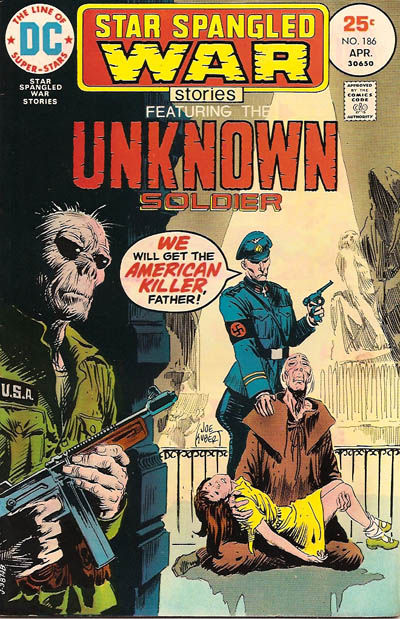
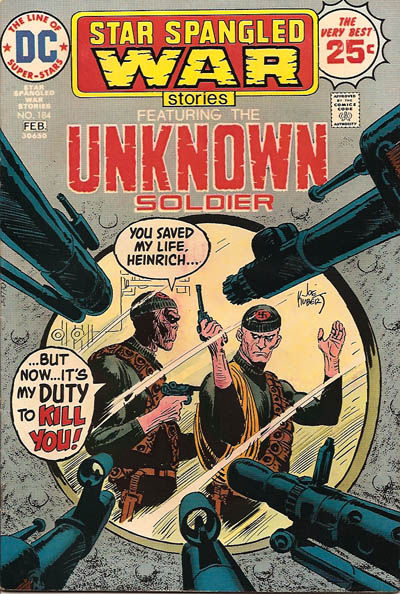
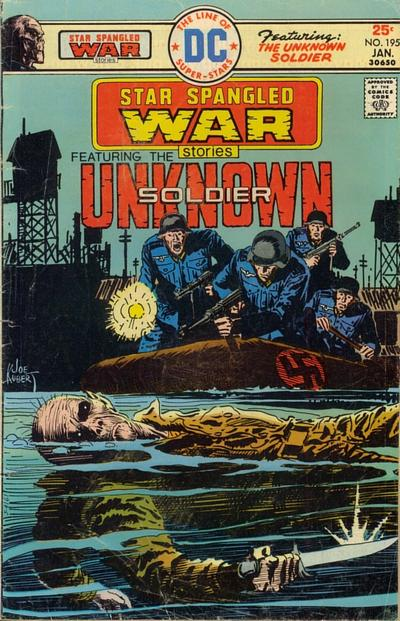
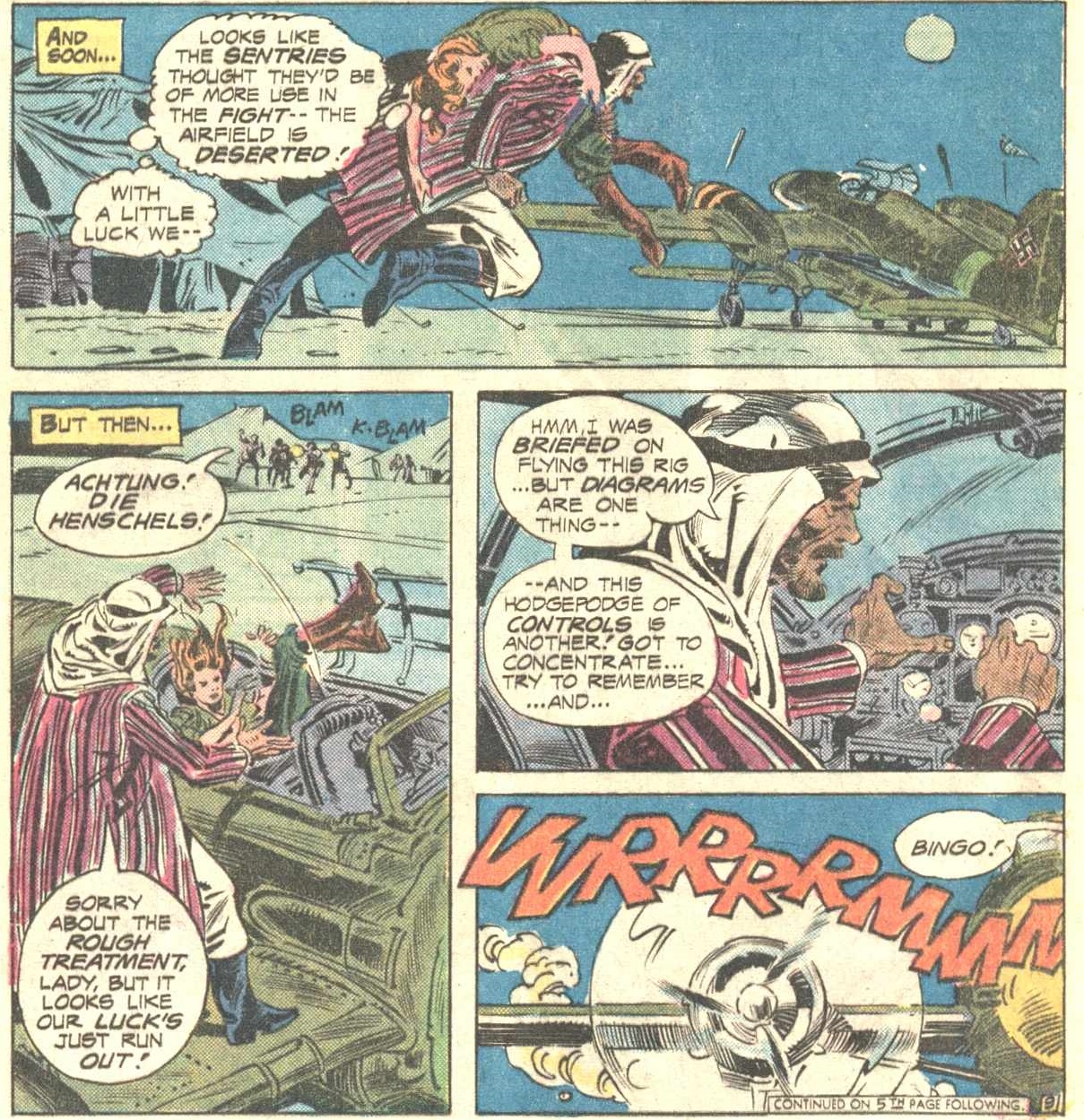
You’d think such a decision would reflect a shift in genre – after all, the visual of a grotesque man wrapped in bandages who can assume other people’s faces seems tailor-made for horror (it’s actually the premise of Sam Raimi’s Darkman). However, I’d argue the choice had more to do with politics than genre: by having this Red Skull-looking special agent fighting on the side of the United States of America, the new creative team seemed to be implying that the Unknown Soldier’s disfigurement didn’t just make him a symbol of the generic, anonymous fighter – it made him a walking metaphor for the fact that even the Allies could be unmasked as secretly ugly. His own internal narration suggested as much, telling us that ‘a special training program had wiped away my identity, channeled my bitterness into deadly strength, honed me into a soulless war machine.’
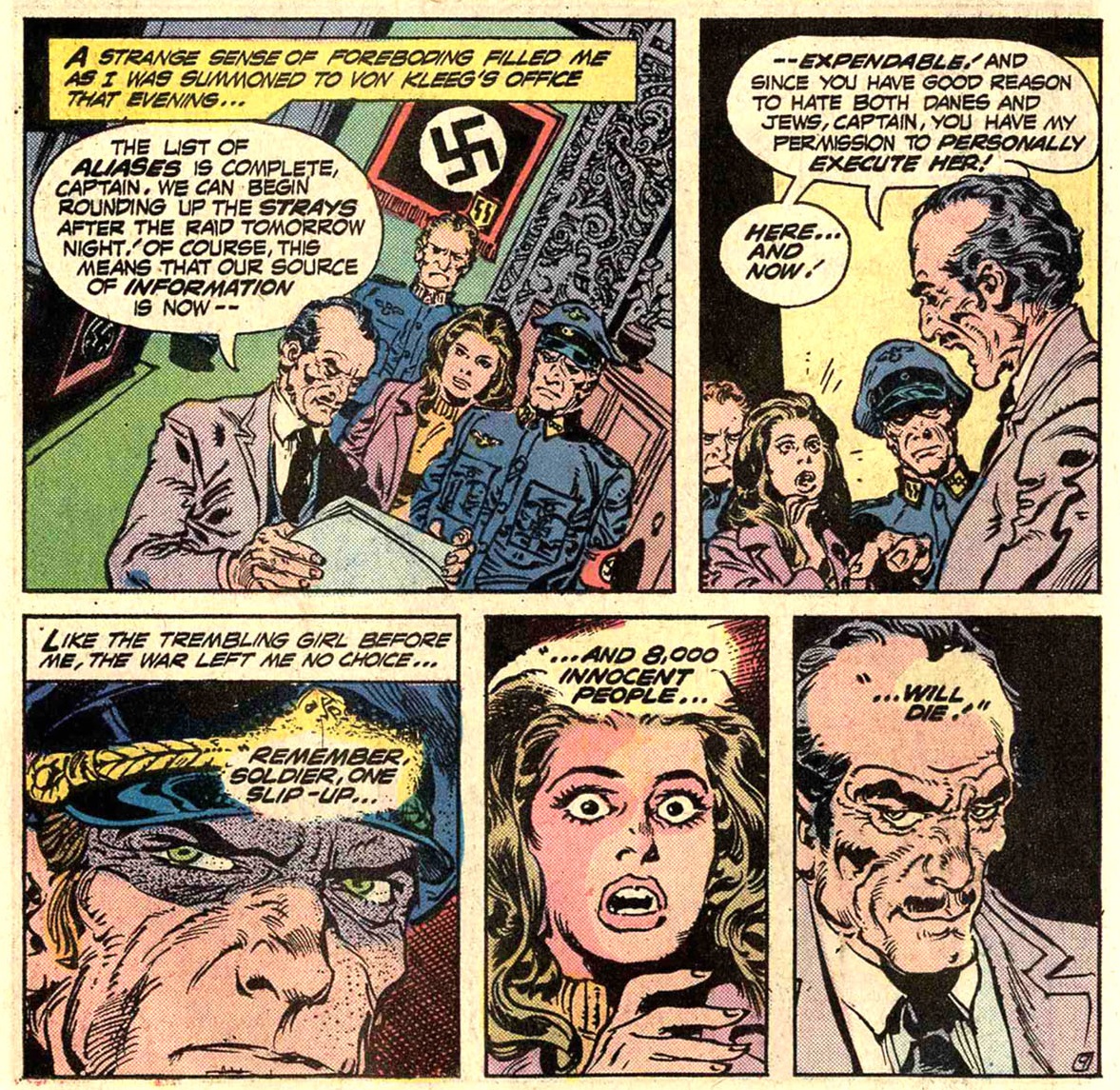
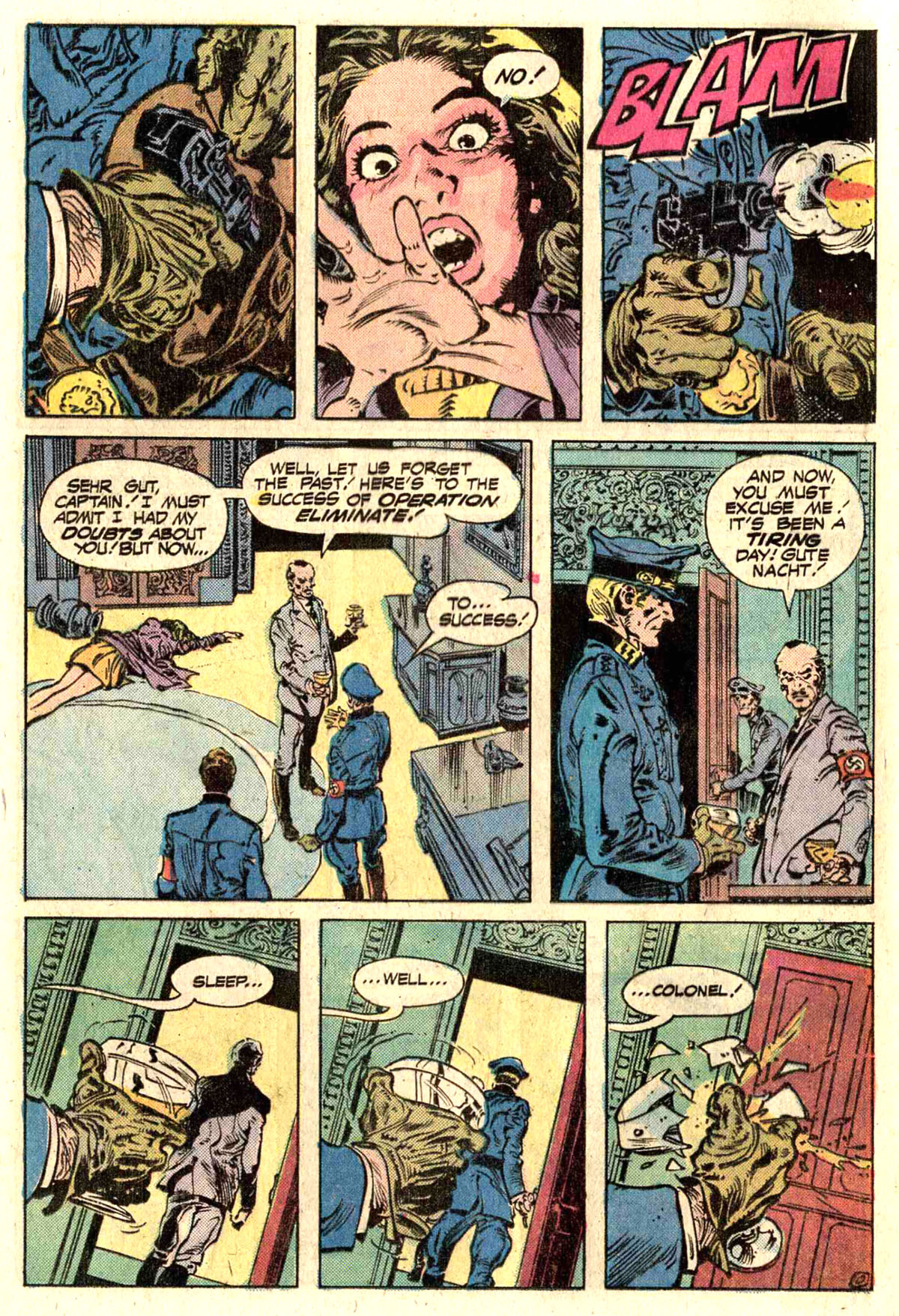
The point was that even a supposedly ‘just war’ like WWII was ultimately a horrible hell where everybody looked bad, to some degree. The notion that warfare left nobody untainted was driven home in their very first story, ‘8,000 to One,’ where the Unknown Soldier – while passing off as an SS Kommando officer in order to secure the escape of eight thousand Jews to safety – was asked to prove his loyalty by shooting a Jewish woman in cold blood:
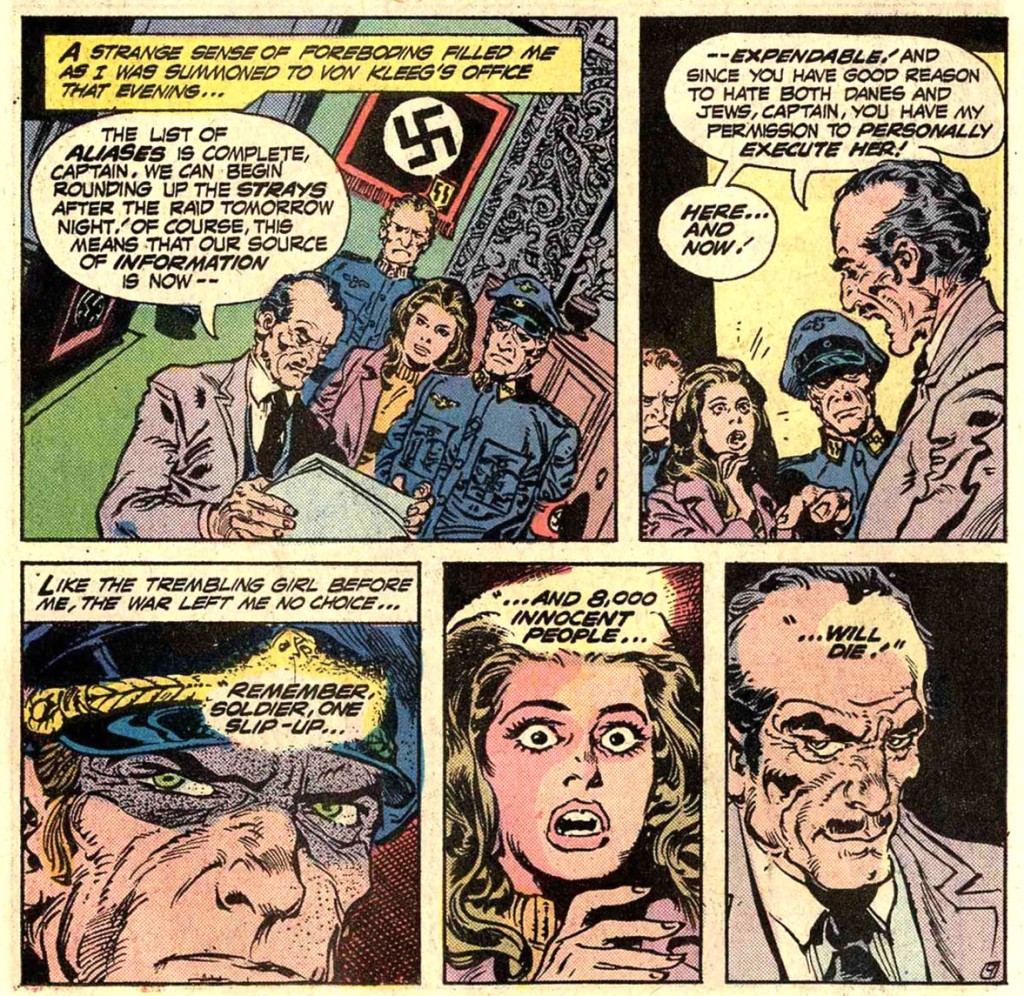
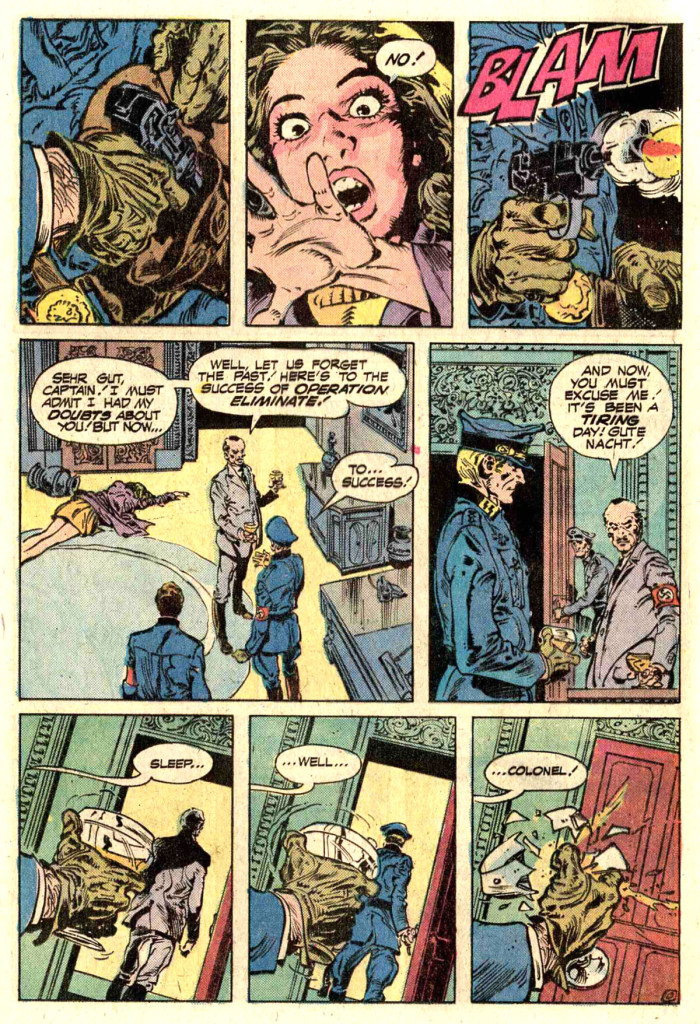 Star Spangled War Stories #183
The next story was just as brutal: in ‘A Sense of Obligation,’ the Unknown Soldier is forced to shoot a man who has just saved his life, with both of them tragically aware that each is enacting a similar kind of patriotic duty. In fact, practically every story in this run involves characters having to make the difficult choice of killing someone they don’t want to kill (this includes a vicious fill-in written by Gerry Conway, titled ‘Save the Children!’).
It’s not too much of a stretch to assume the creators were trying to say something about the inherently perverse nature of war. Hell, as if the book’s name wasn’t explicit enough, most tales opened with a tagline describing what was to come as ‘a story of war,’ usually together with a portentous narration and an impressively designed title…
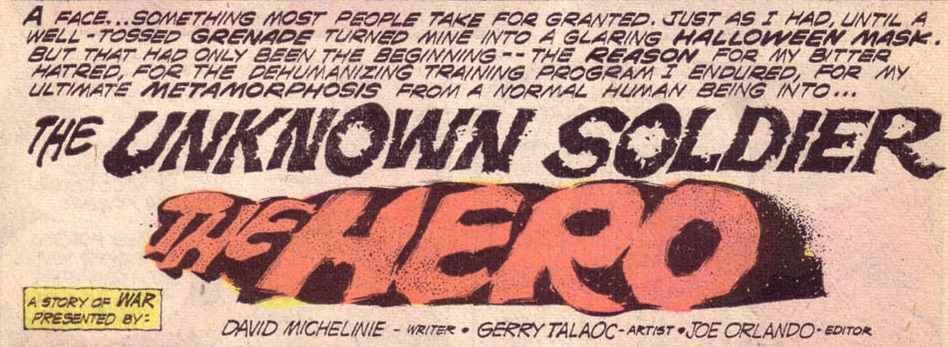 Star Spangled War Stories #185
As you can see, the comic was more passionate than subtle. In ‘Project: Omega’ (which possibly inspired last year’s Overlord), a German scientist creates an army of animalistic beasts. He explains that ‘I only wanted to save lives, not turn men into mindless zombies!’ – and a Nazi officer replies: ‘But, my dear doctor – what do you think good soldiers are?’ (Later in that story, you can bet there is a close-up of the doctor as he regrets ‘putting one’s patriotism… above his humanity…’)
In a way, the series became a succession of morbid morality plays…
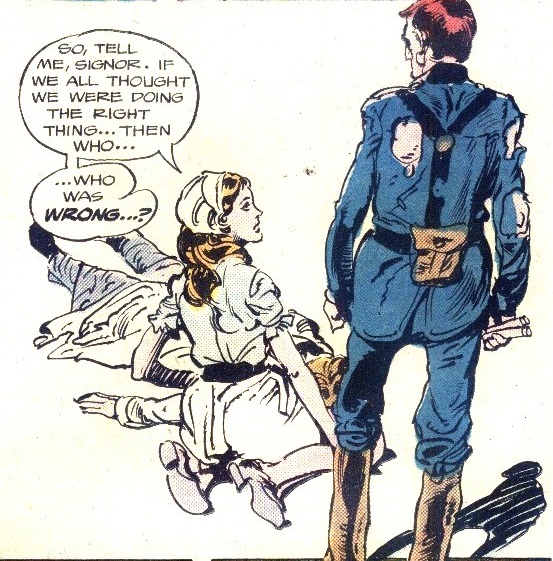 Star Spangled War Stories #202
Since war itself (and not just the enemy) was cast as such a malignant force, the series’ hero became more of an anti-hero, as he embodied armed conflict at its most impersonal, sacrificing whomever got in the way of his missions. In this regard, the series’ tone grew closer to films like Phil Karlson’s Hornets’ Nest, which conveyed a much nastier vision of the Allies’ role in WWII.
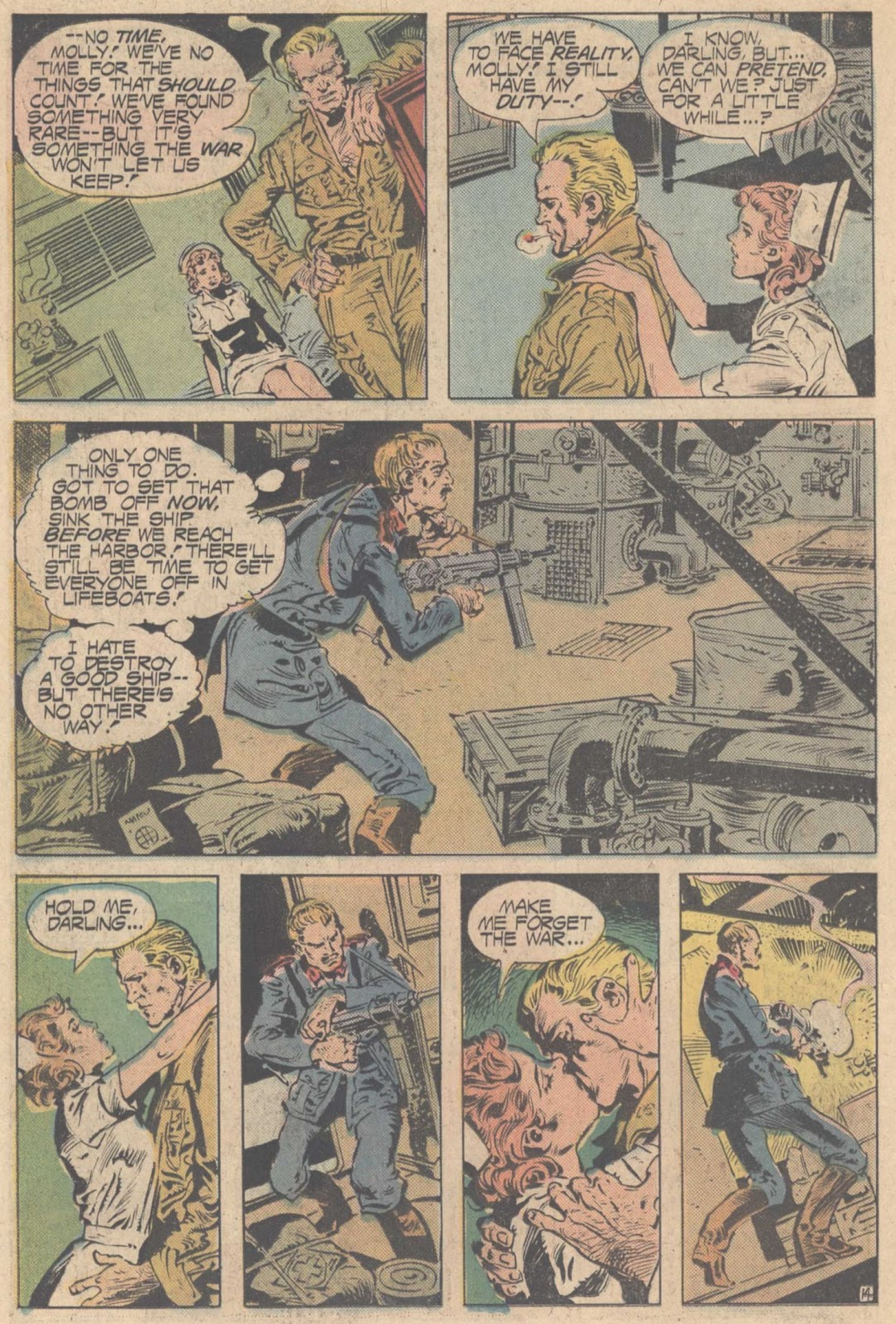
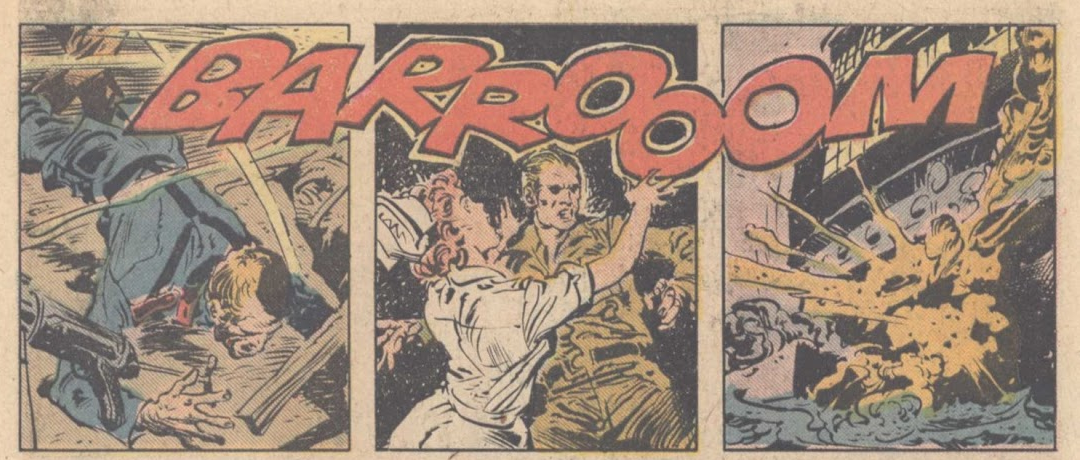
For instance, ‘Encounter’ clearly frames the Unknown Soldier as an abominable force of destruction by intercutting his actions (sabotaging a ship) with a couple of lovers (from different sides of the conflict) trying to see beyond the reality of war:
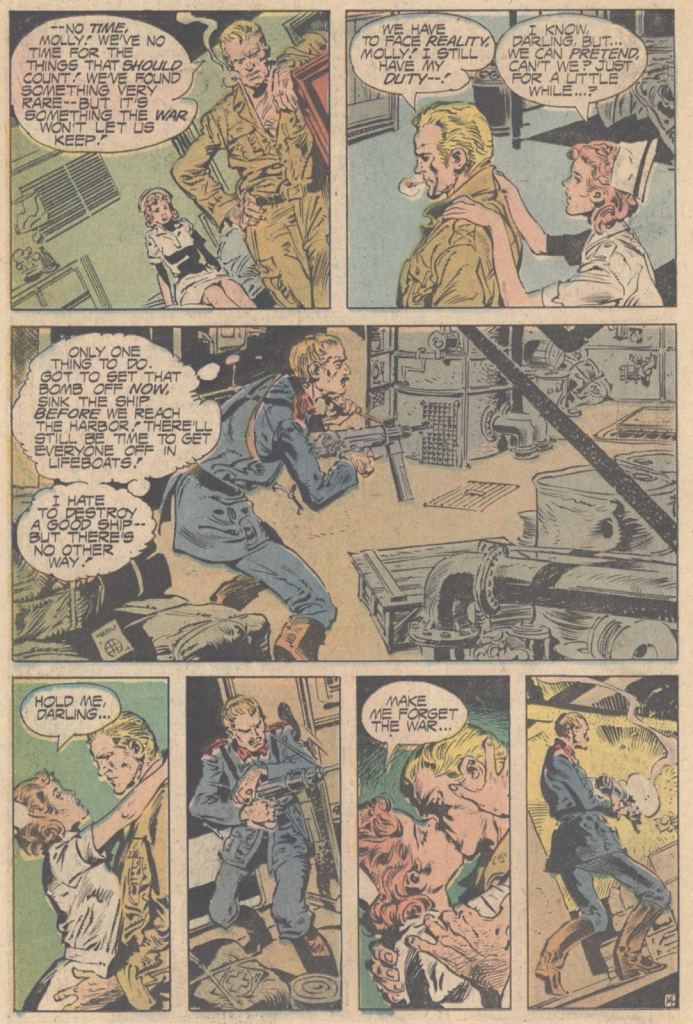
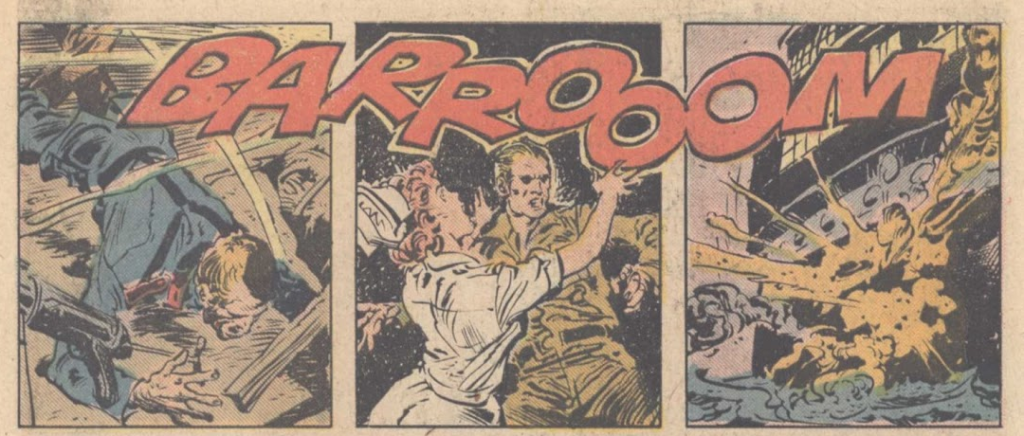 Star Spangled War Stories #184
The amazing thing about this shift his how coherent it was with what had come before. The Unknown Soldier had always been presented as an obedient combatant and an expert in espionage – David Michelinie’s scripts didn’t contradict that, they merely reframed these elements in a dirtier light. After all, it’s not just that the Unknown Soldier represented war at a time when Vietnam had demystified the concept; he also represented covert operations, a practice that had become increasingly disreputable the more people found out about the CIA’s history of staged coups and other foreign interventions.
Thus, somehow, this WWII series became eerily timely. The 1944/1945 stories seemed to draw on the spirit of 1974/1975, with a boom of rampant, desperate ruthlessness as each war reached a climax. The text itself hinted at this parallel:
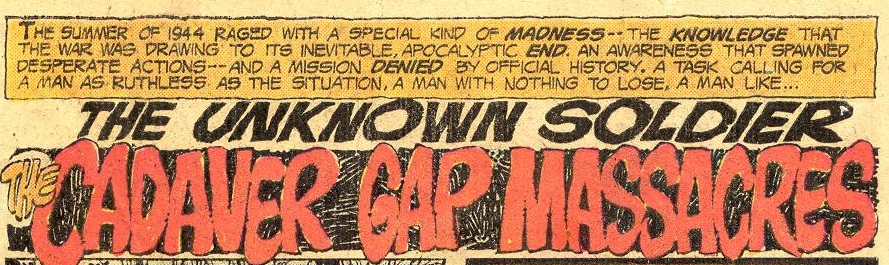 Star Spangled War Stories #189
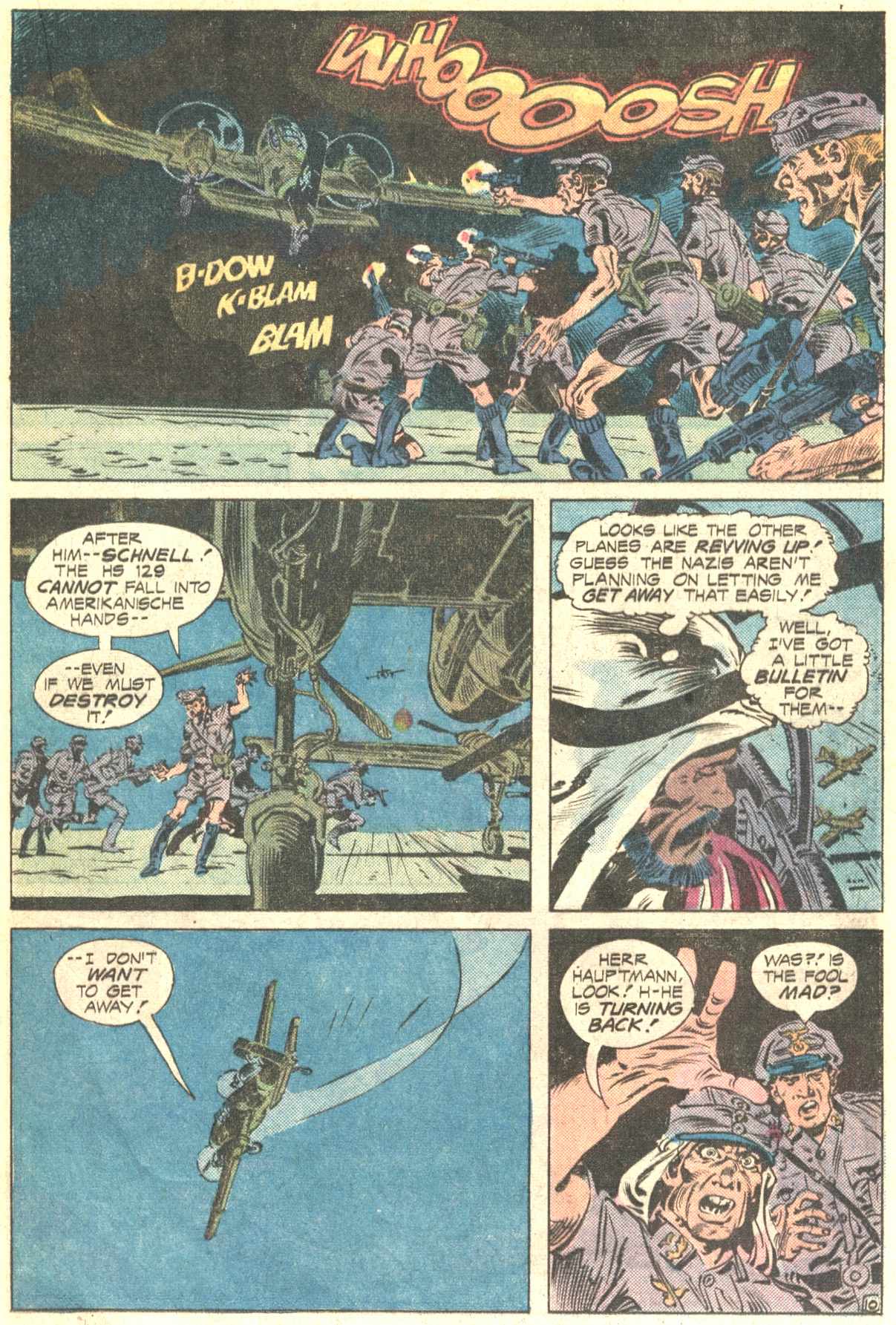
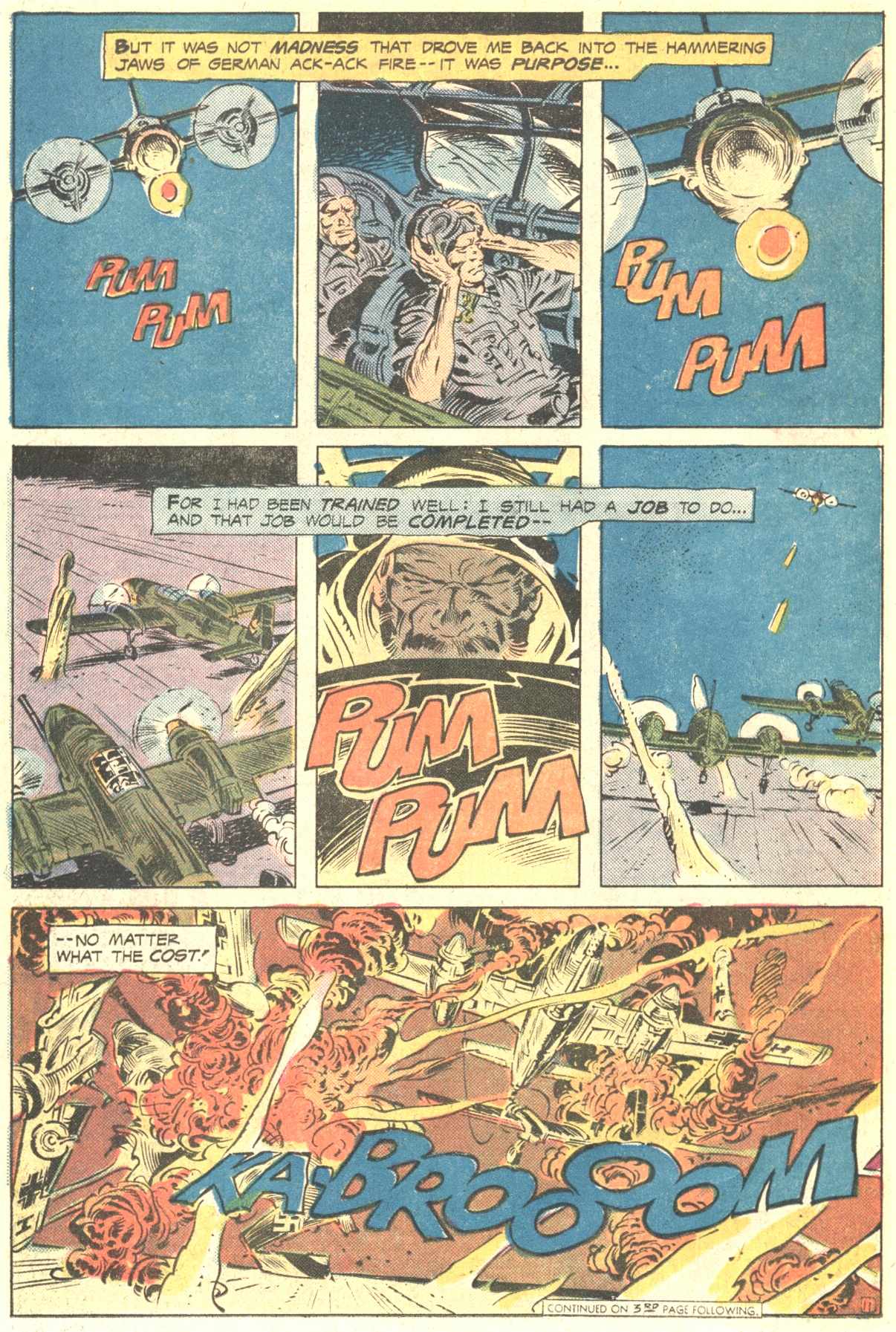
All this may make The Unknown Soldier sound preachy and downbeat but, like I said, the new team never fully departed from the series’ origins as a showcase for hell-for-leather adventure (it’s a classic case of having your cake and eating it too). I guess you can argue they merely rearranged the emphasis: instead of being a thrilling entertainment that occasionally acknowledged the most unappealing elements of war, the comic became an indictment of war that couldn’t help but depict it in a thrilling way (if nothing else because Gerry Talaoc’s art was so damn lively):
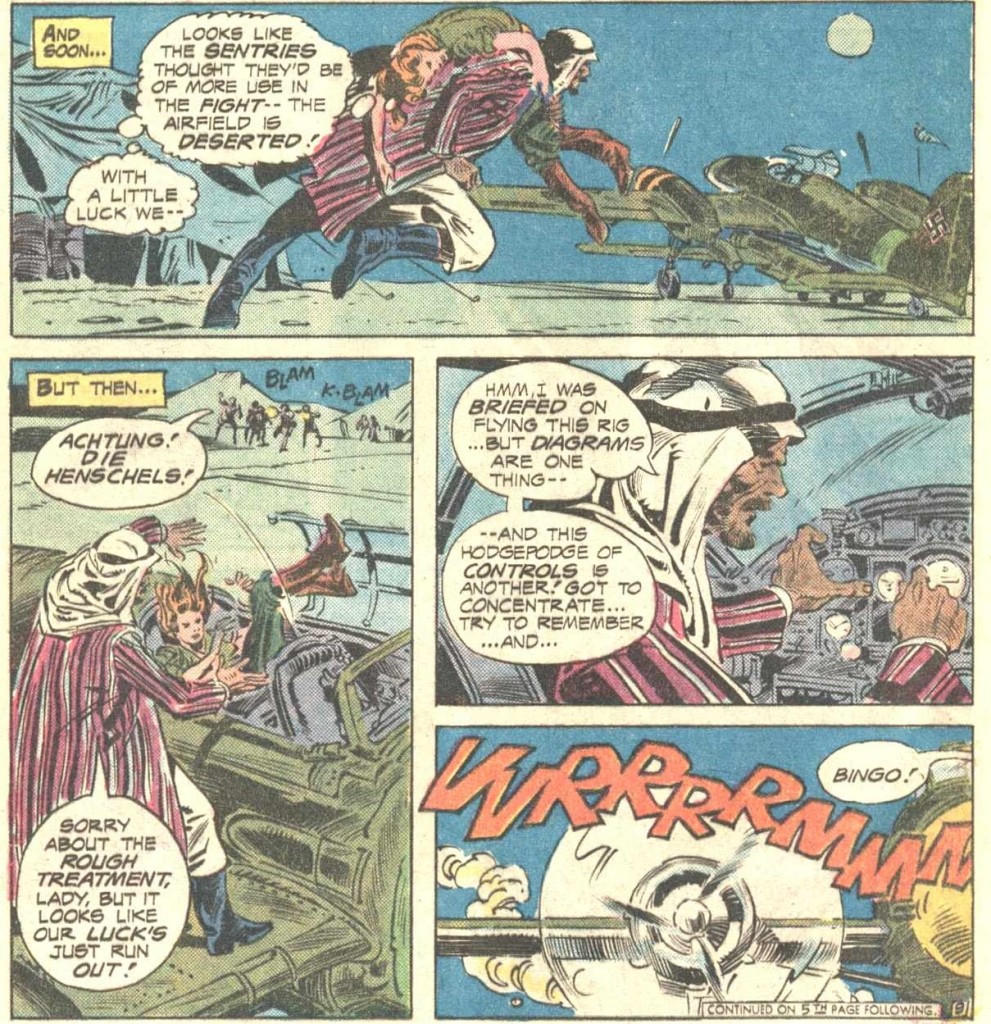
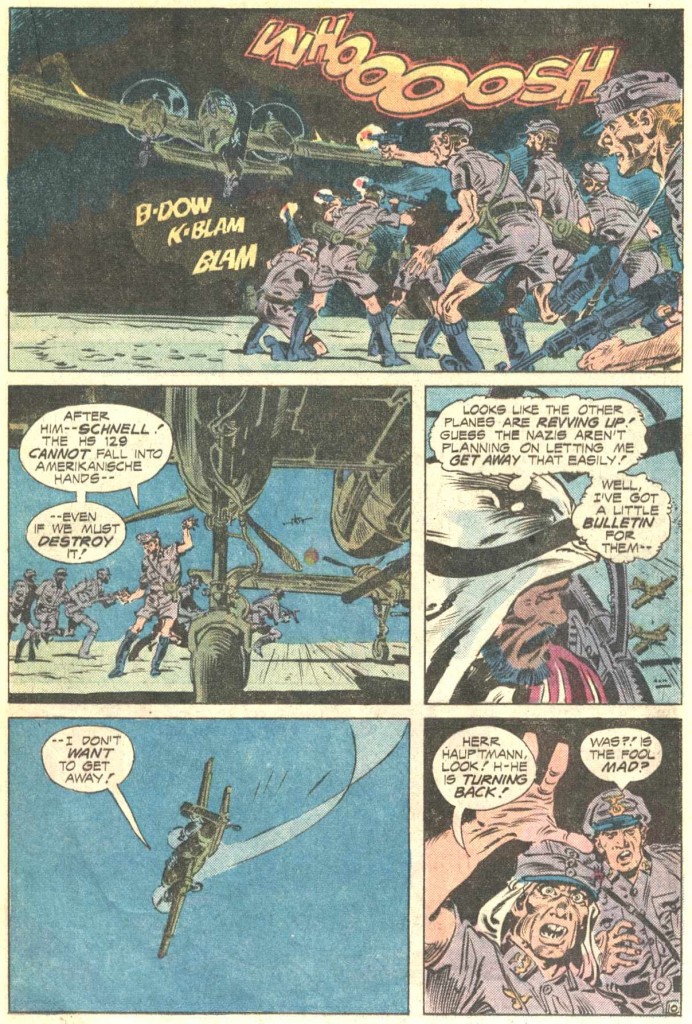
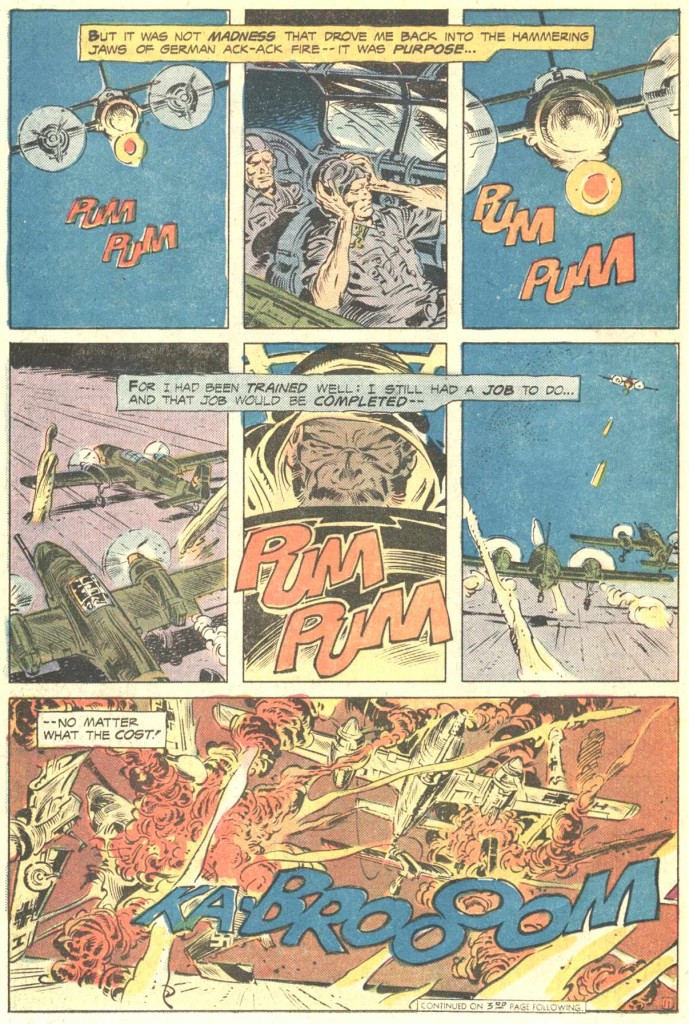 Star Spangled War Stories #197
Posted in SPYCRAFT & WARFARE
Tagged Cold War, David Michelinie, espionage, Gerry Conway, Gerry Talaoc, Joe Orlando, politics, Unknown Soldier, World War II
Leave a comment
Spotlight on The Unknown Soldier, 1970-1974
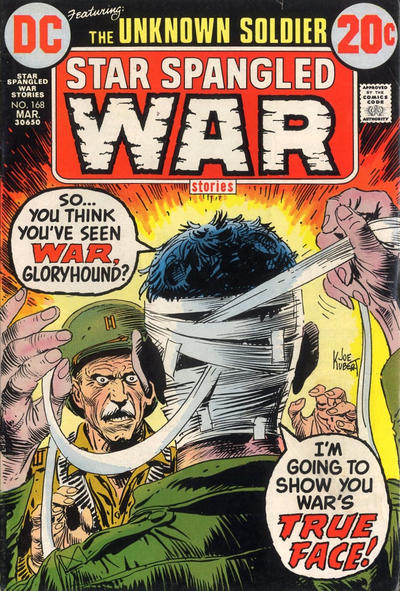
There is a whole branch of spy fiction focusing on World War II going back to the time of the conflict itself. In cinema, the British kicked things off with thrillers such as Night Train to Munich and Contraband. Hollywood followed suit with a bunch of neat productions: Five Graves to Cairo, Journey into Fear, Northern Pursuit, The Conspirators, Ministry of Fear, the list goes on and on (those of you into grim ‘n gritty make sure to check out Lewis Milestone’s Edge of Darkness).
This subgenre outlived the war and mutated along the way, but by the late ‘60s and ‘70s it was still bringing to the big screen such riveting movies as Where Eagles Dare and The Eagle Has Landed. It was also around this time that DC put out its finest foray into the field of WWII spy yarns, in the form of The Unknown Soldier…
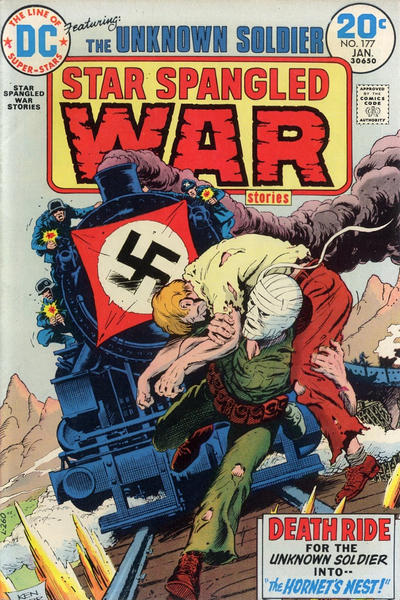
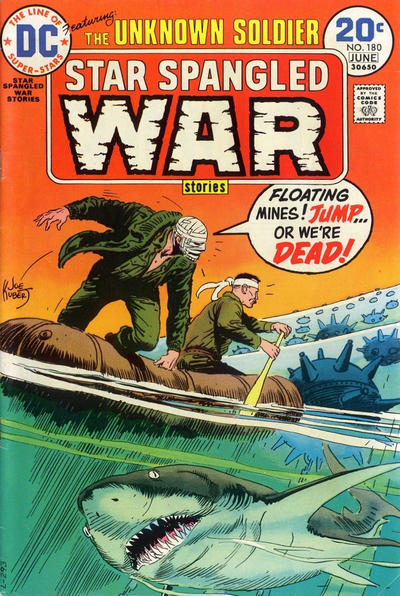
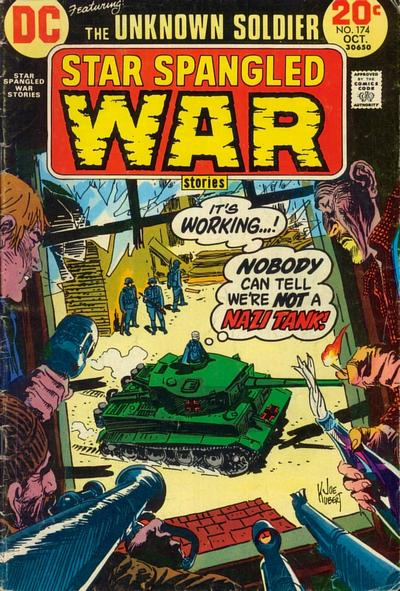
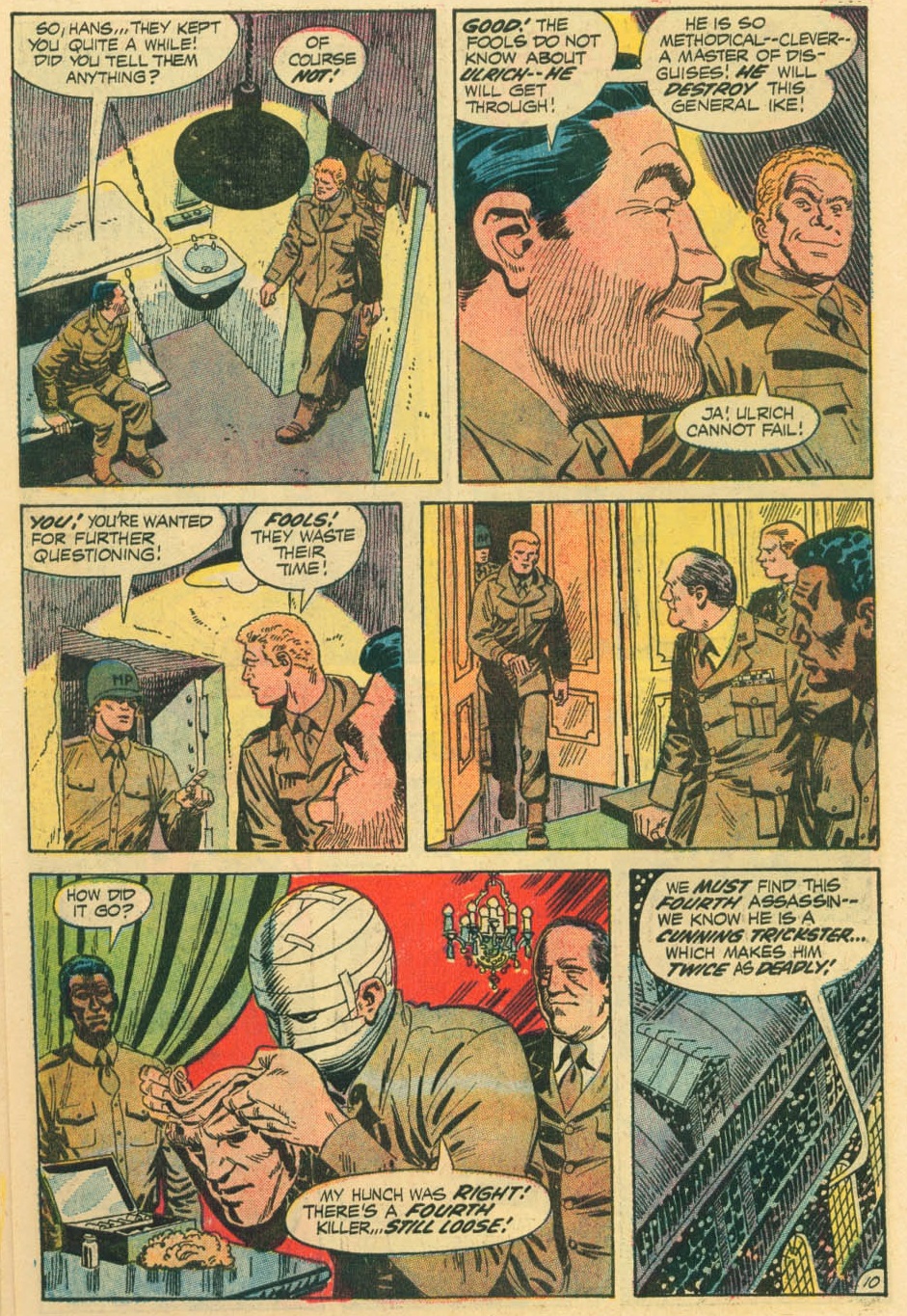
The Unknown Soldier made his debut in ‘They Came from Shangri-La!’ (Star Spangled War Stories #151, cover-dated June-July 1970), written, edited, and drawn by Joe Kubert. [edit: It turns out that, although this was the first story of his own feature, the character’s debut had actually taken place in an earlier Sgt. Rock comic, ‘I Knew the Unknown Soldier!’ (Our Army at War #168, June 1966), by Robert Kanigher and Joe Kubert.] A veteran of the industry, Kubert was one of the undisputed masters of war comics (he had already enriched DC’s portfolio with the creation of Sgt. Rock and Enemy Ace) and he found a versatile new angle here: the Unknown Soldier was a chameleonic US agent with an expertise on the various areas of the military, so you could throw him into pretty much any kind of tale. The faceless character was also a pretty explicit embodiment of the US fighting spirit and armed forces, lending himself to easy symbolism (especially as he was often framed near his namesake monument in Washington). When he was not on a mission, the Unknown Soldier wore bandages around his head (a la the Invisible Man), which visually represented both his anonymity and the sacrificial violence of war.
Having established this winning concept (including an origin story after three issues), Kubert gradually passed the torch to other competent hands. In terms of writing, he brought in Bob Haney, who churned out dynamic scripts like nobody’s business – and who further developed the series’ gimmick, revealing that the Unknown Soldier had a collection of face masks in his Washington headquarters that he wore over his bandages (yes, over the bandages) while on the field. Jack Sparling took over the art and, after a couple of years, the great Archie Goodwin took over as editor – at first editing his own scripts and later handing writing duties over to Frank Robbins.
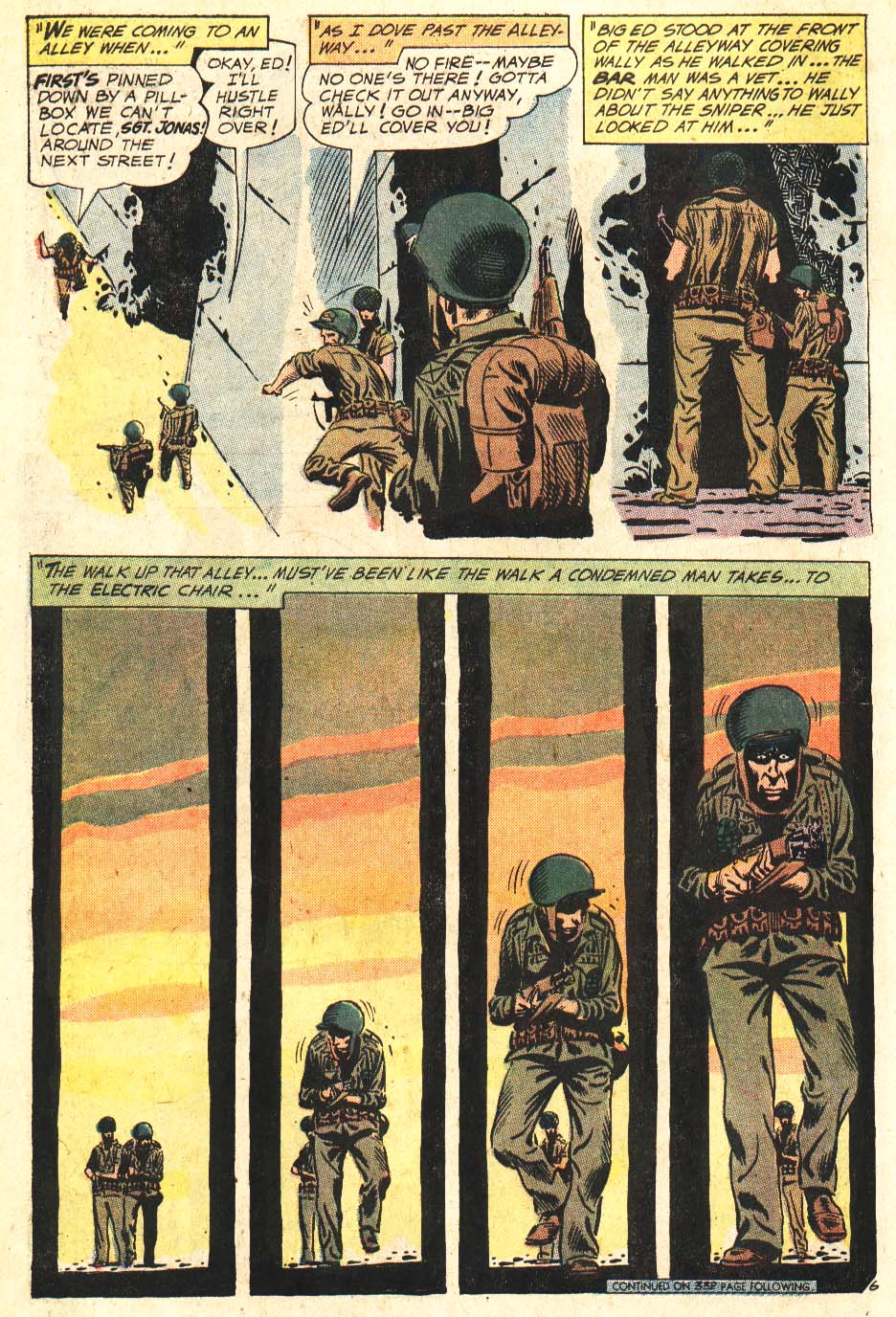
Despite the changes to the creative team, the series’ style remained relatively consistent. For one thing, it was always first and foremost a war comic… At one point, Kubert even recycled a Sgt. Rock story he had done with Robert Kanigher for Our Army at War back in 1960, including this tense page:
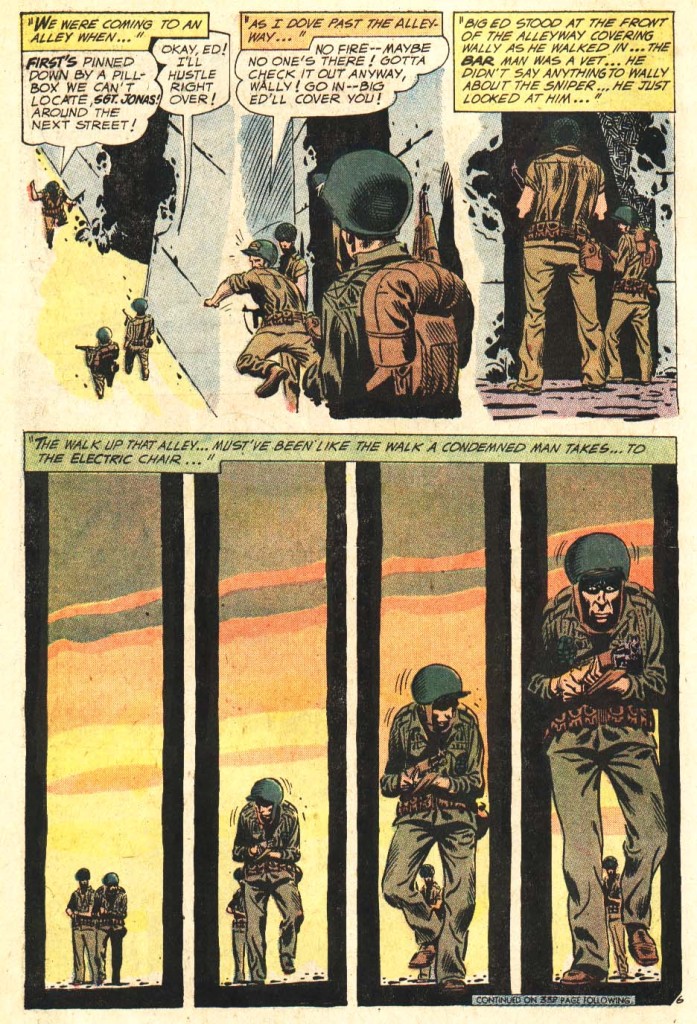 Star Spangled War Stories #162
That said, there was an undeniable element of espionage involved, if nothing else because the Unknown Soldier was always going on secret missions and pretending to be someone else. Tales like ‘The Long Jump’ (set in Nazi-occupied Holland) and ‘Three Targets for the Viper!’ (set in Morocco, with the obligatory nod to Casablanca) are in the mold of old-school WWII spy adventures and wouldn’t look too out of place as storyboards for classic Hollywood. Hell, between the face masks and the plot twists, ‘Destroy the Devil’s Broomstick!’ (set in a Japanese submarine) feels like an episode of the original Mission: Impossible TV series!
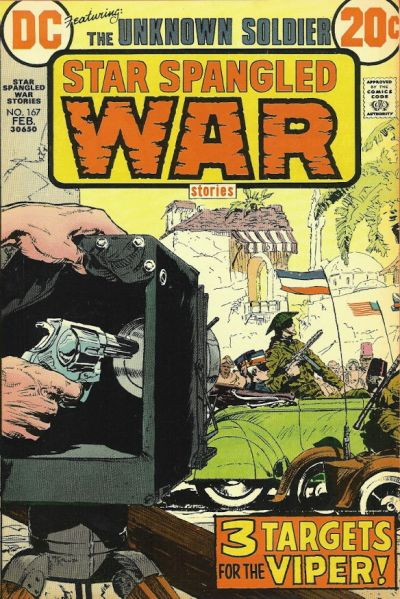
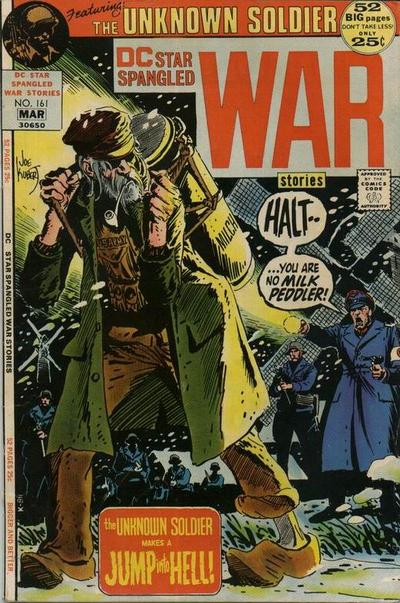
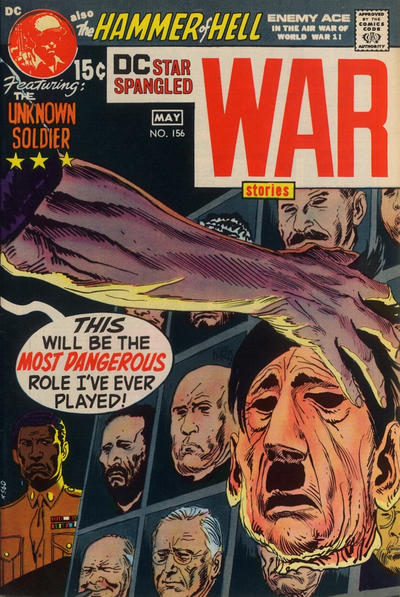
The whole thing oozed with suspense and deception. There were codes and passwords, disguises and fake identities, violent action and a constant sense of danger, usually culminating in scenes where the Unknown Soldier had to bullshit his way out while a German or a Japanese officer pointed a gun at him.
Moreover, besides infiltrating the enemy, our hero did counterintelligence operations, often detecting Nazi spies among the Americans, for example in the gripping ‘Kill the General’ and ‘The True Glory.’
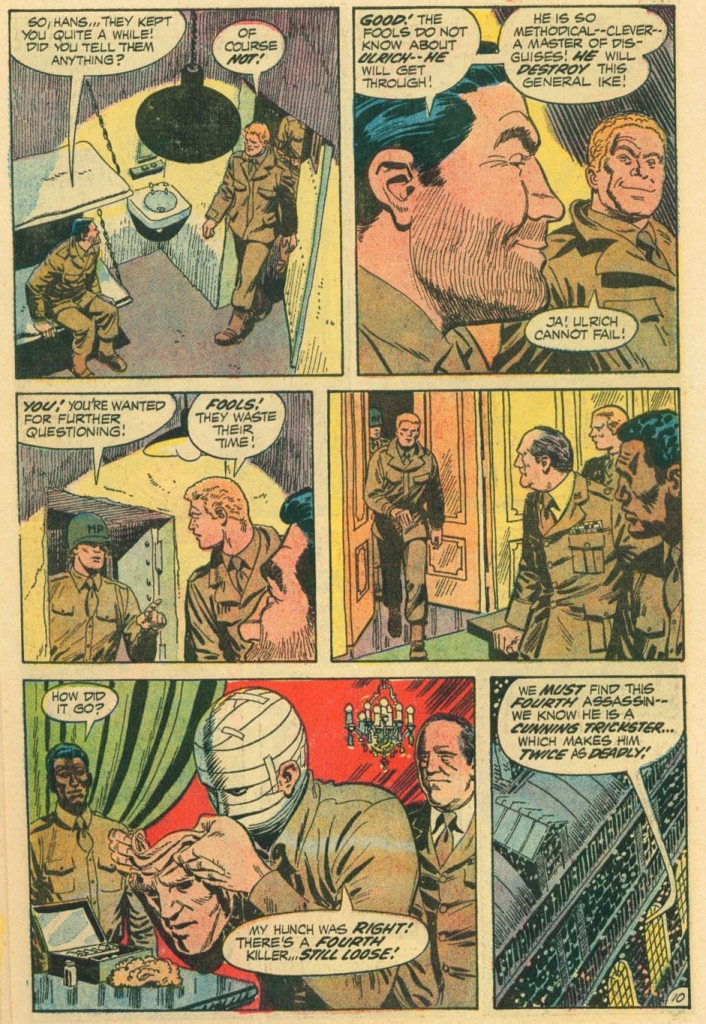 Star Spangled War Stories #163
If it seems odd that such gung-ho comics were coming out during the controversial Vietnam War, bear in mind that, while the US forces weren’t normally depicted unfavorably, these stories were smarter and more nuanced than mere jingoistic yarns about American soldiers kicking ass… Despite a few caricatural villains, there was a general sense that the war was made up of vulnerable humans and conflicted individuals. This was especially the case in the tales of Archie Goodwin, who tended to temper seemingly heroic actions with ironic twists, exposing the murky morality of the war context.
It wasn’t just that some of the US troops were shown as fallible – militarily as well as ethically. More than once, the Unknown Soldier completed his assignment thanks to the sympathetic help of someone from the opposite side, including people who had lost loved ones because of his actions (although they were usually unaware of his role, which was particularly heartbreaking to see).
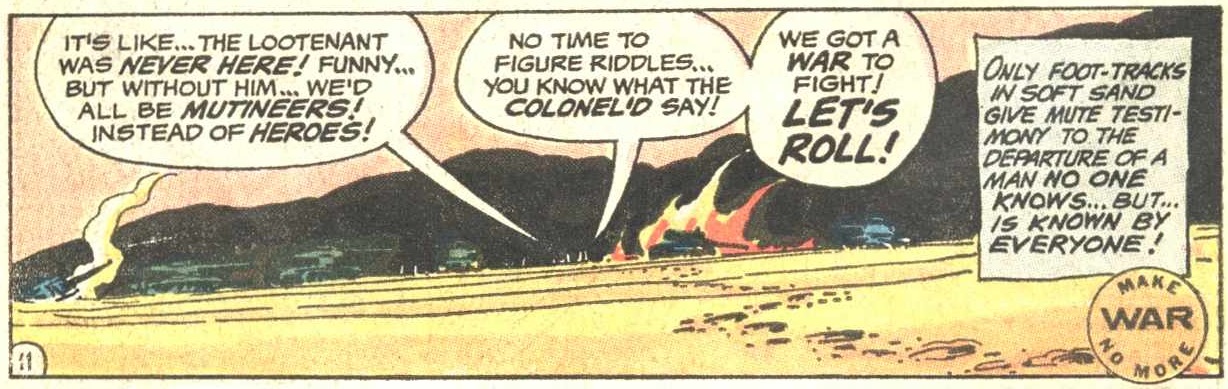
Plus, in a fascinating move, between mid-1971 and late 1972 the last panel of each tale in Star Spangled War Stories finished with a stamp saying ‘Make War No More.’ In the case of the Unknown Soldier’s tales, this meant that, even though we inevitably rooted for the successful completion of the hero’s mission, there was always something downbeat about the ending…
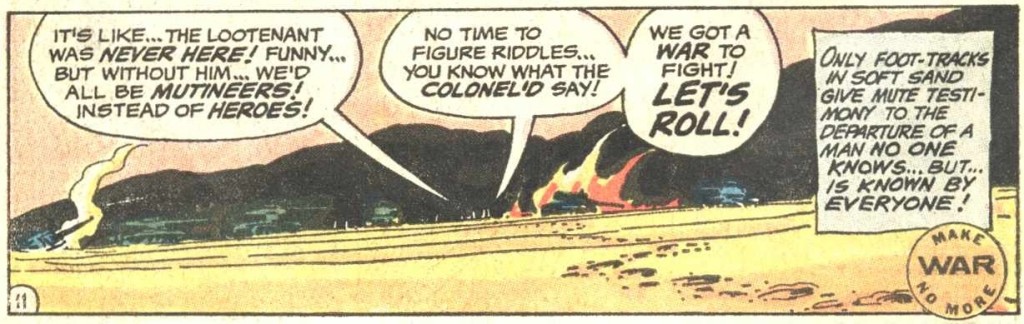 Star Spangled War Stories #159
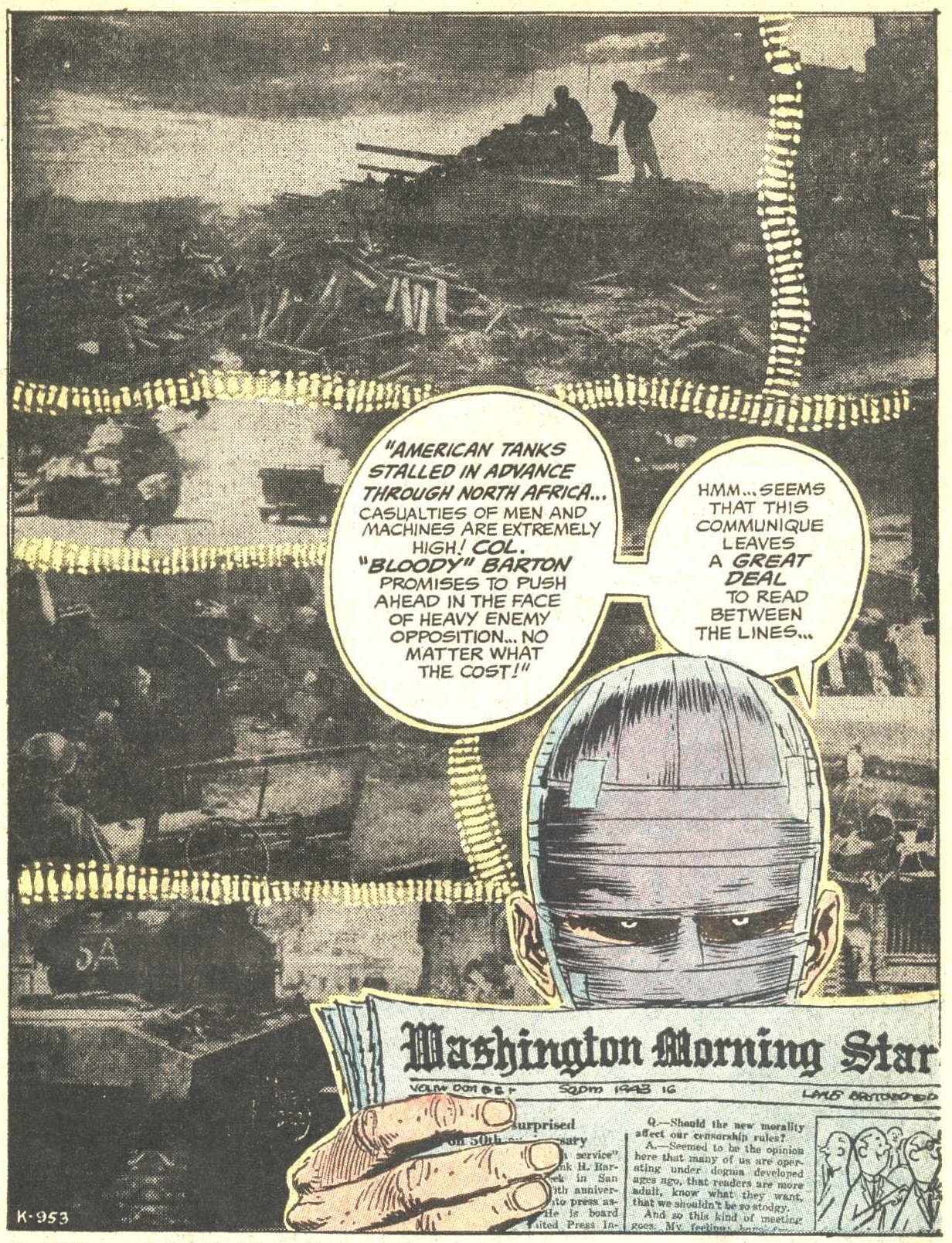
Indeed, for all the thrilling games of cat-and-mouse, The Unknown Soldier didn’t disregard the grim background of the war, including the specificities of WWII. Archie Goodwin, who had been behind the hard-hitting anti-war series Blazing Combat, brought a similar flavor to tales such as ‘The Glory Hound!’ (where the Unknown Soldier denounced the fake glamour of battle by showing his scarred face to an eager captain). Frank Robbins probably watched Hell in the Pacific before penning ‘The Doomsday Heroes!’ As for Bob Haney’s ‘Totentanz,’ it’s probably one of the grimmest slice of comics to come out of the early ‘70s… Joe Kubert even opens it with a collage that includes photos of corpses from Nazi concentration camps!
This kind of opening photocollage – disturbingly stressing the series’ links to real world events – soon became a trademark of the comic:
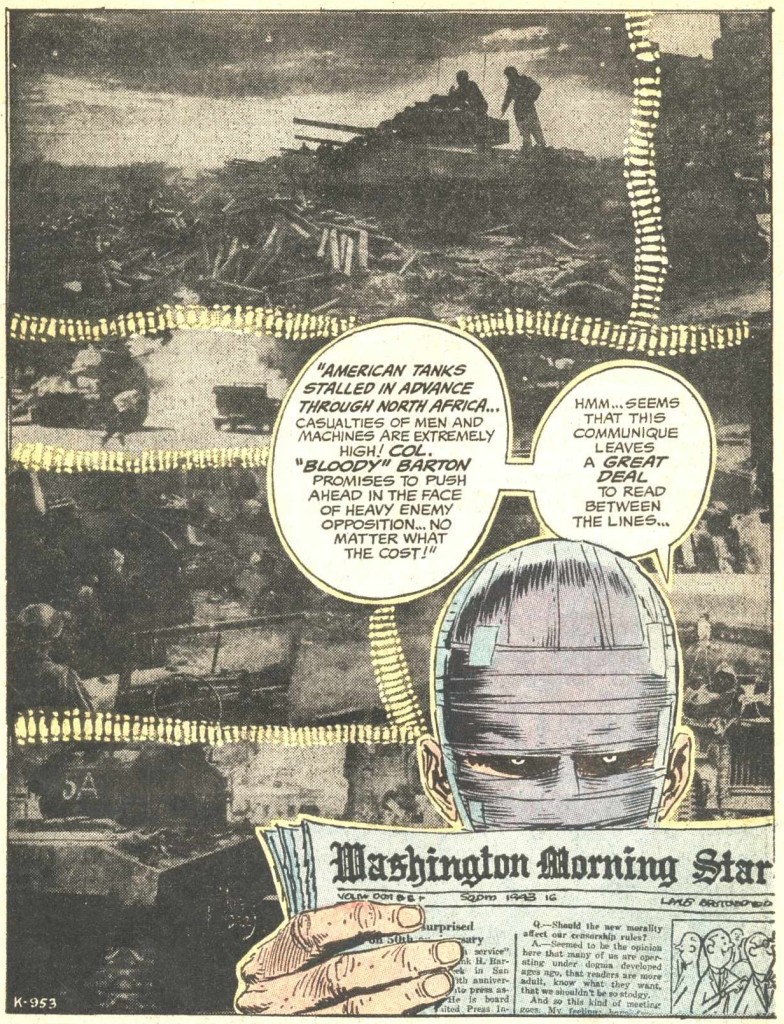 Star Spangled War Stories #159
And then there is ‘A Town Called Hate!’ Set in a small French town, in this remarkable tale the Unknown Soldier has to deal with a deadly confrontation between US troops and a corps of African American engineers. Frank Robbins’ previous attempts to address racial tension (including in the Batman story ‘Blind Justice… Blind Fear!’ in Detective Comics #421) had not been incredibly sophisticated, but this one has a lot going for it, exposing the persistence of American racism even as Washington claimed to be fighting against the Nazis’ racist ideology. Although the emphasis on blacks and whites overcoming their bigotry in order to fight the common (external) enemy can be seen as a reactionary, Cold War-tinged downplaying of domestic racial issues, the powerful ending actually feels closer to the cynical punchline of The Hateful Eight.
That said, at the end of the day The Unknown Soldier was still a comic heavily shaped by Bob Haney, so it was not above some pulp trappings. Always one for corny nicknames, Haney’s purple narration kept calling our hero ‘the immortal man of war’ and ‘the man nobody knows, yet is known by everyone…’ – and the ensuing writers kept this approach. Thus, there was a discernible tension between the comic’s clear desire to entertain and the inescapable self-awareness that came with fictionalizing warfare at such politically charged times.
I think Frank Robbins proved to be particularly deft at negotiating this tension. After years of standalone tales, he turned the series into more of an ongoing saga, introducing other recurring characters and multi-part storylines, starting with the awesome ‘Operation SNAFU!’ (Star Spangled War Stories #174). His work had a truly appealing two-fisted thriller vibe, culminating in a quest in the Philippine jungle that had quite personal stakes for the Unknow Soldier.
In late 1974, however, the underlying tension finally burst as the series’ lingering themes were faced head-on by an entirely new creative team. We’ll talk about that next week.
Posted in SPYCRAFT & WARFARE
Tagged Archie Goodwin, Bob Haney, espionage, Frank Robins, Jack Sparling, Joe Kubert, movies, politics, Robert Kanigher, Unknown Soldier, World War II
Leave a comment
COMICS CAN BE AWESOME (July 2019)
July is Spy Fiction Month here at the blog. Before going on my yearly marathon of posts about foreign intrigue and counter-intelligence, though, let us all just take a moment to contemplate the fact that comics can be many different things… and they can definitely be awesome in many different ways!
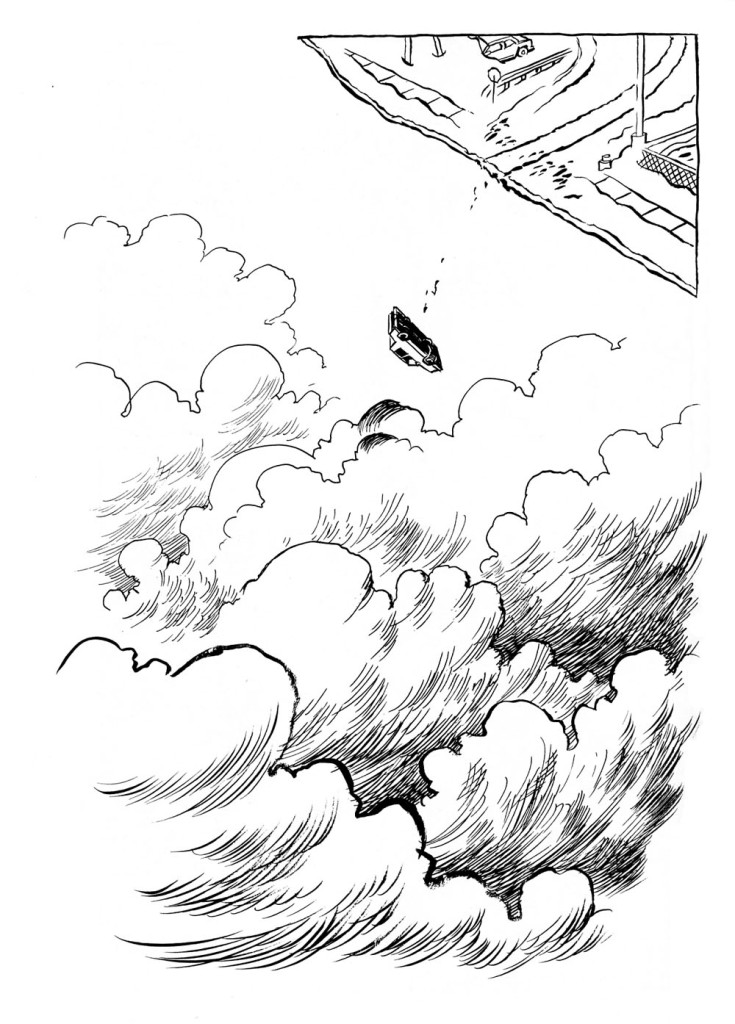 Blankets
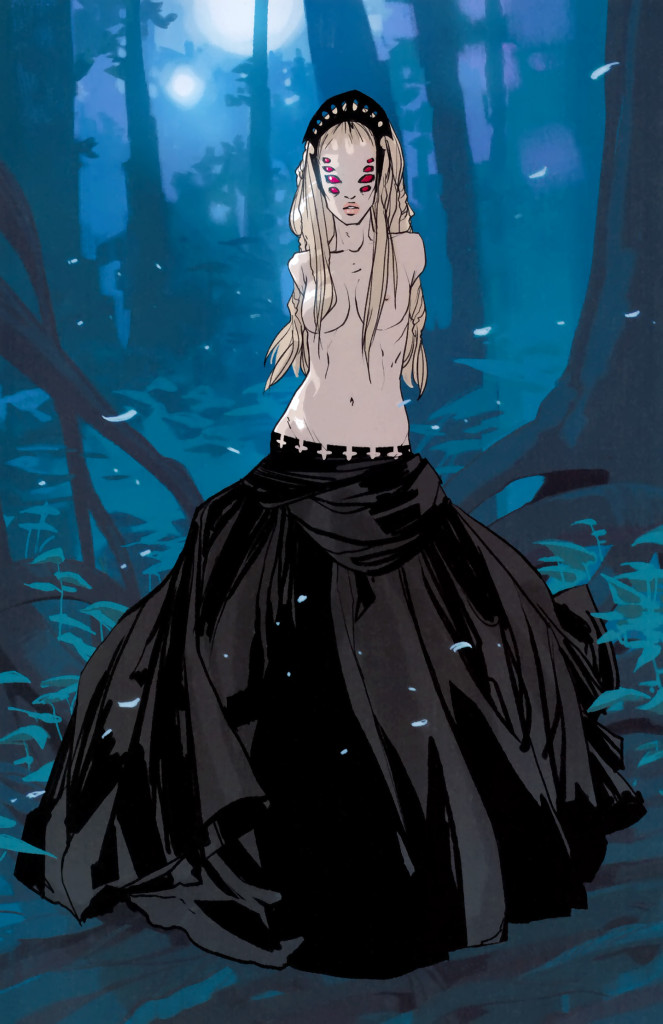 Saga #2
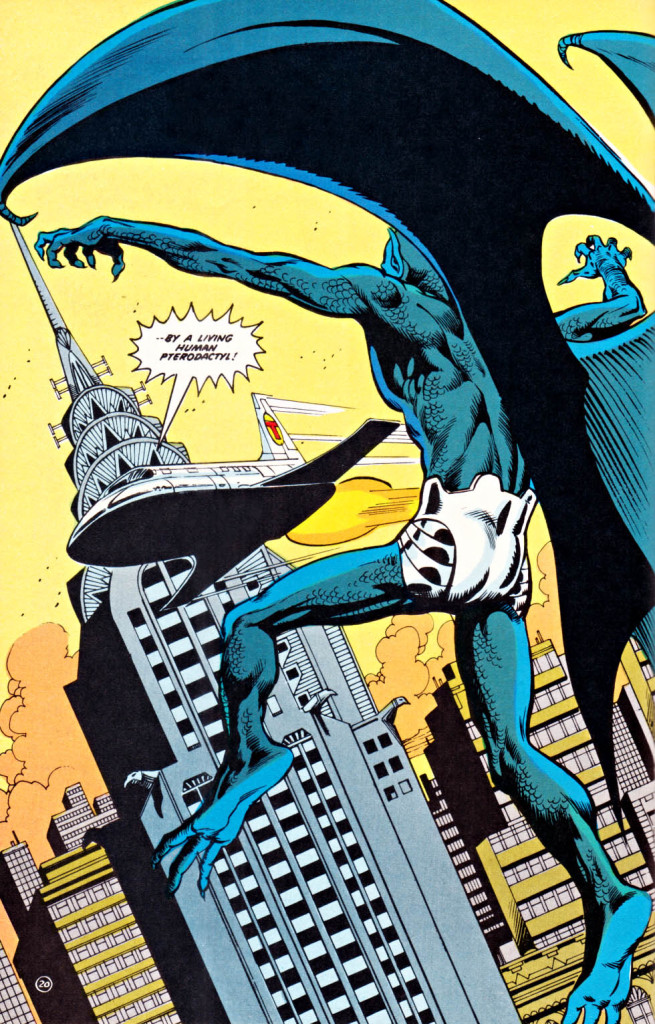 The New Teen Titans (v2) #24
3 ‘silent’ sequences by Tim Levins
If there is one Batman run that doesn’t get enough praise, it’s the strand of highly entertaining stories published in Gotham Adventures #15-60, from 1999 to 2003, written by Scott Peterson, mostly with pencils by Tim Levins, inks by Terry Beatty, and colors by Lee Loughridge. Adapting the characters and visuals of The New Batman Adventures animated show, these were action-packed comics that steadily delivered exciting standalone tales without talking down to their audience. The ultra-compressed narratives – effectively carried by taut dialogue as well as by an art style of crisp lines and low average of panels per page – were a lesson in minimalistic storytelling, spinning twist-filled yarns that were rich in characterization yet never felt overloaded.
Of the many outstanding features of this run worth pointing out, today I want to focus on Tim Levins’ ability to bring to life ‘silent’ (i.e. wordless, without even sound effects) sequences that go on for pages. Scott Peterson clearly trusted his artists to convey all the necessary information and knew that readers enjoyed visually-driven set pieces, so his scripts provided Levins (and the rest of the creative team) with plenty of chances to shine.
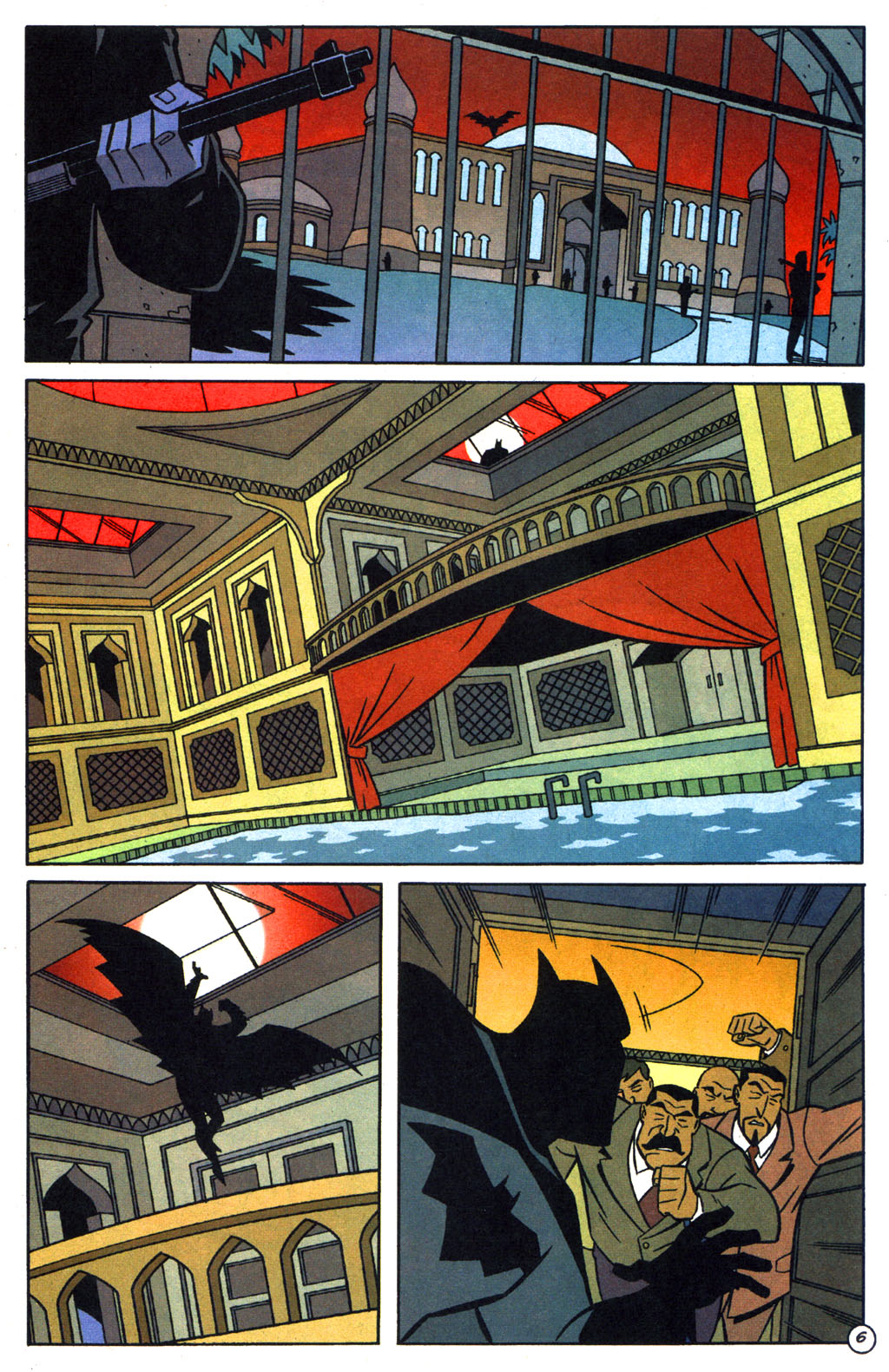
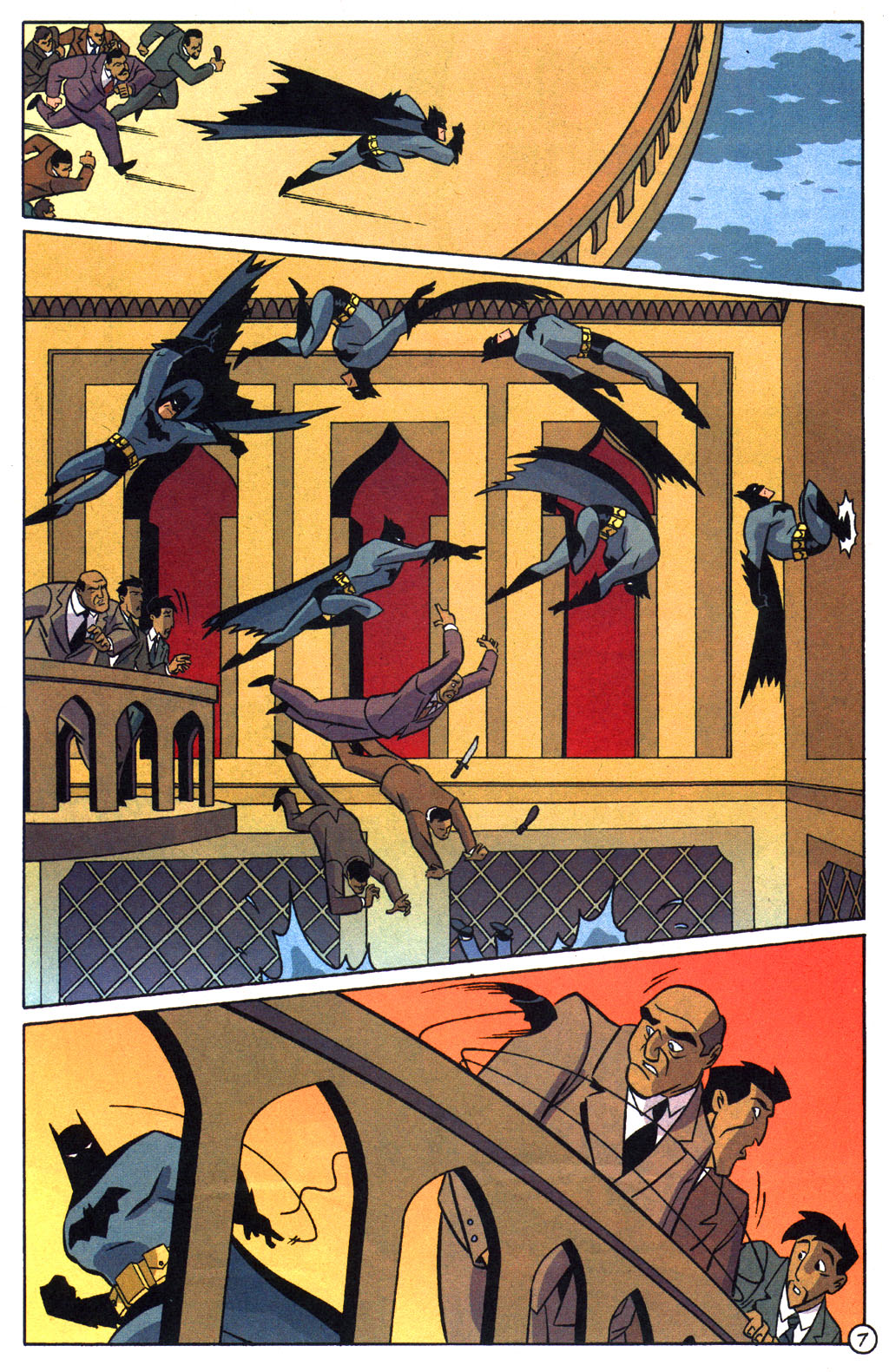
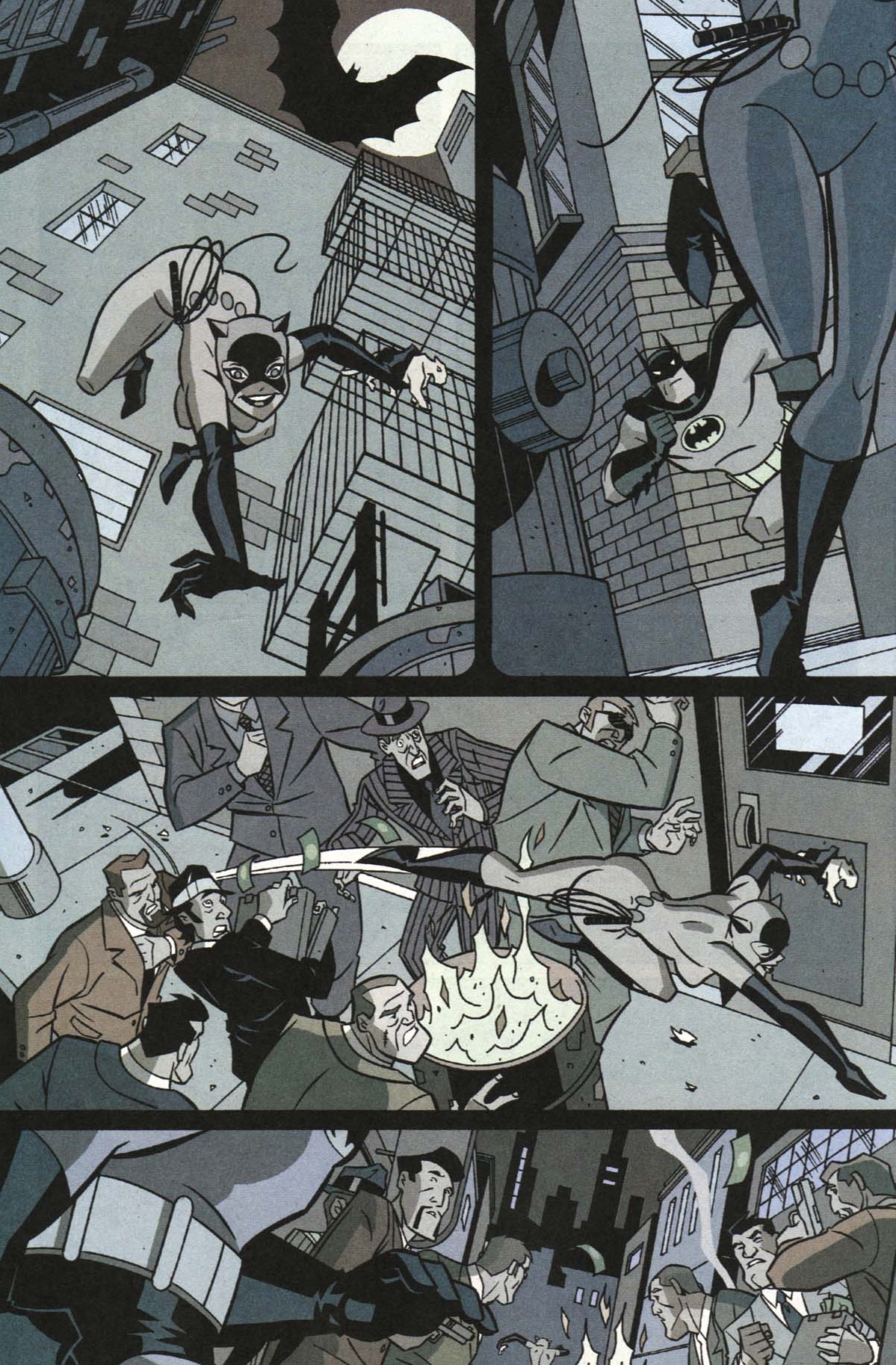
Levins rose up to the challenge. Take ‘Do the Wrong Thing’ (Gotham Adventures #23, cover-dated April 2000), a super-fast-paced affair in which the Dark Knight investigates the mysterious disappearance of some of Waynecorp’s business associates. Between the opening splash page and the downbeat dénouement, we get a string of tight scene-to-scene transitions, a fair amount of detective work, and a climactic fight with global stakes (keeping with the show’s running theme of rogues with sympathetic motivations taken to violent extremes). And yet, among all this, the issue still manages to include a trio of lengthy ‘silent’ sequences in which Levins shows off his skills, starting with this one:

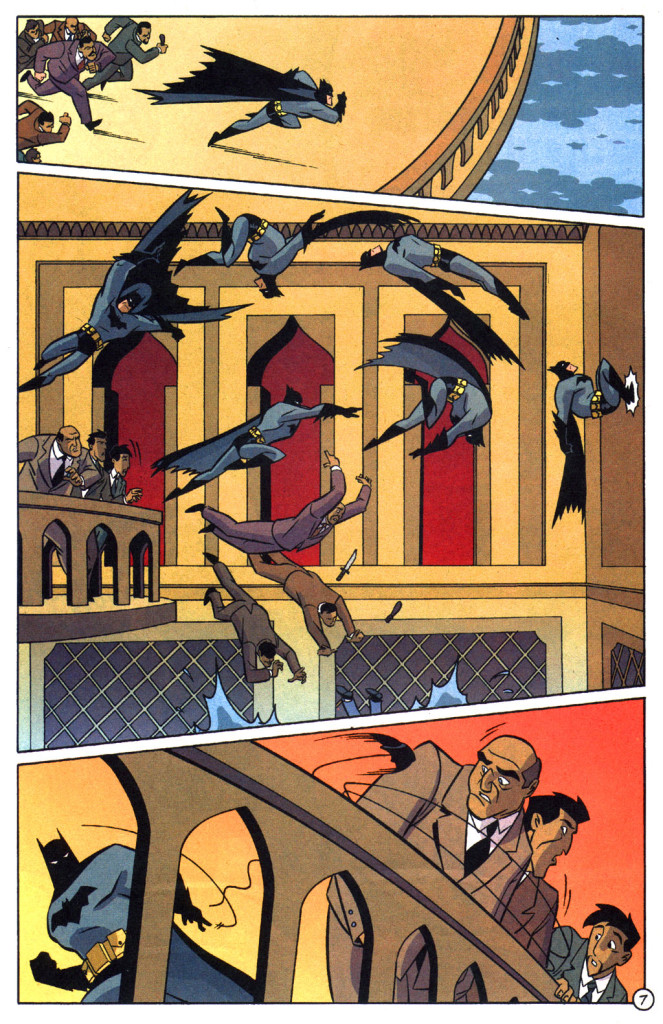 Gotham Adventures #23
Working with one of the best inkers in the business, Tim Levins’ deft pencils inject this sequence with peerless vitality through tilted angles and, in the second page, tilted borders (as the layout smoothly establishes the scene’s rhythm). Notice how Levins uses a small number of panels, letting the pages breathe, yet suddenly multiplies the images of the Caped Crusader, which gives the impression of a quick (yet clear) succession of graceful movements. Besides creating a loop for the readers’ gaze as it follows the action across the page (thus further increasing the dynamism of the reading experience), this neat trick efficiently illustrates an incredible acrobatic feat, underlining how athletic and cool Batman is.
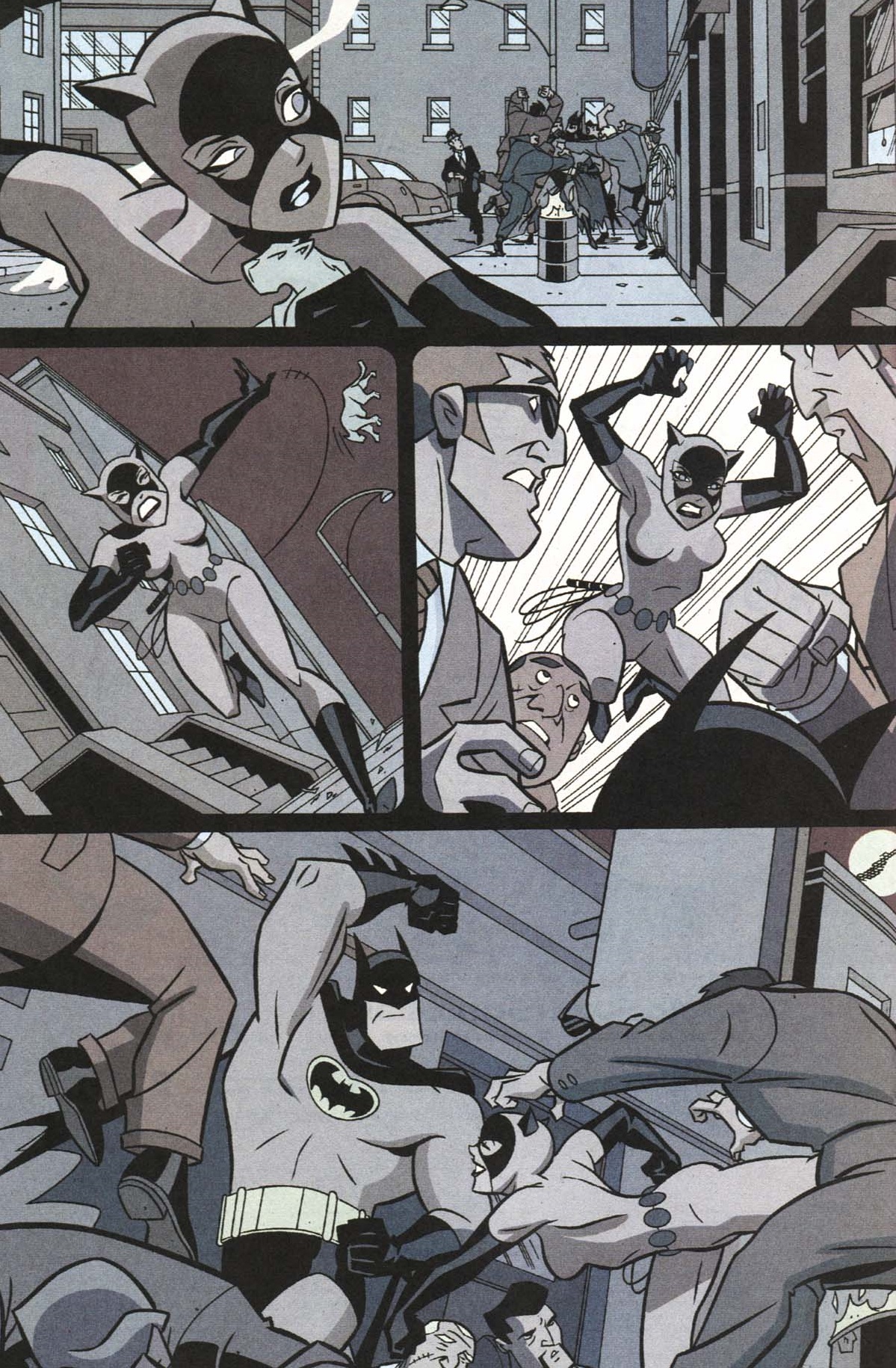
Along with delivering thrills, this type of wordless sequences can serve to clinch characterization. In ‘Second Timers’ (Gotham Adventures #50, cover-dated July 2002), a typically multilayered issue about the difficult relationship between Batman and Catwoman, Tim Levins gets to explore the characters’ conflicted feelings, including through this amusing flashback where Selina goes through a whole range of emotions:

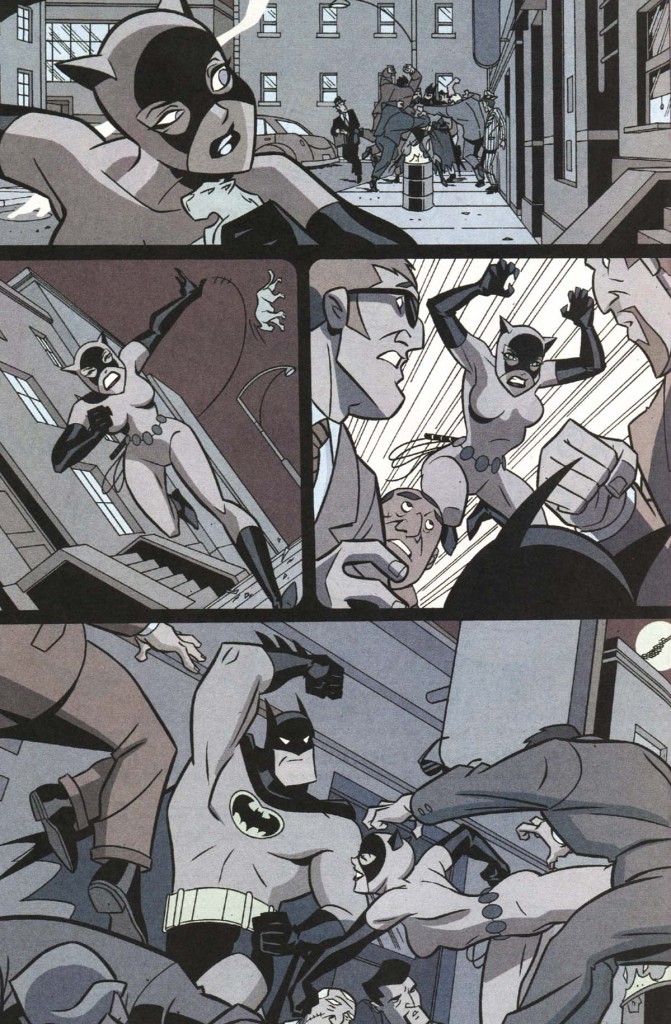 Gotham Adventures #50
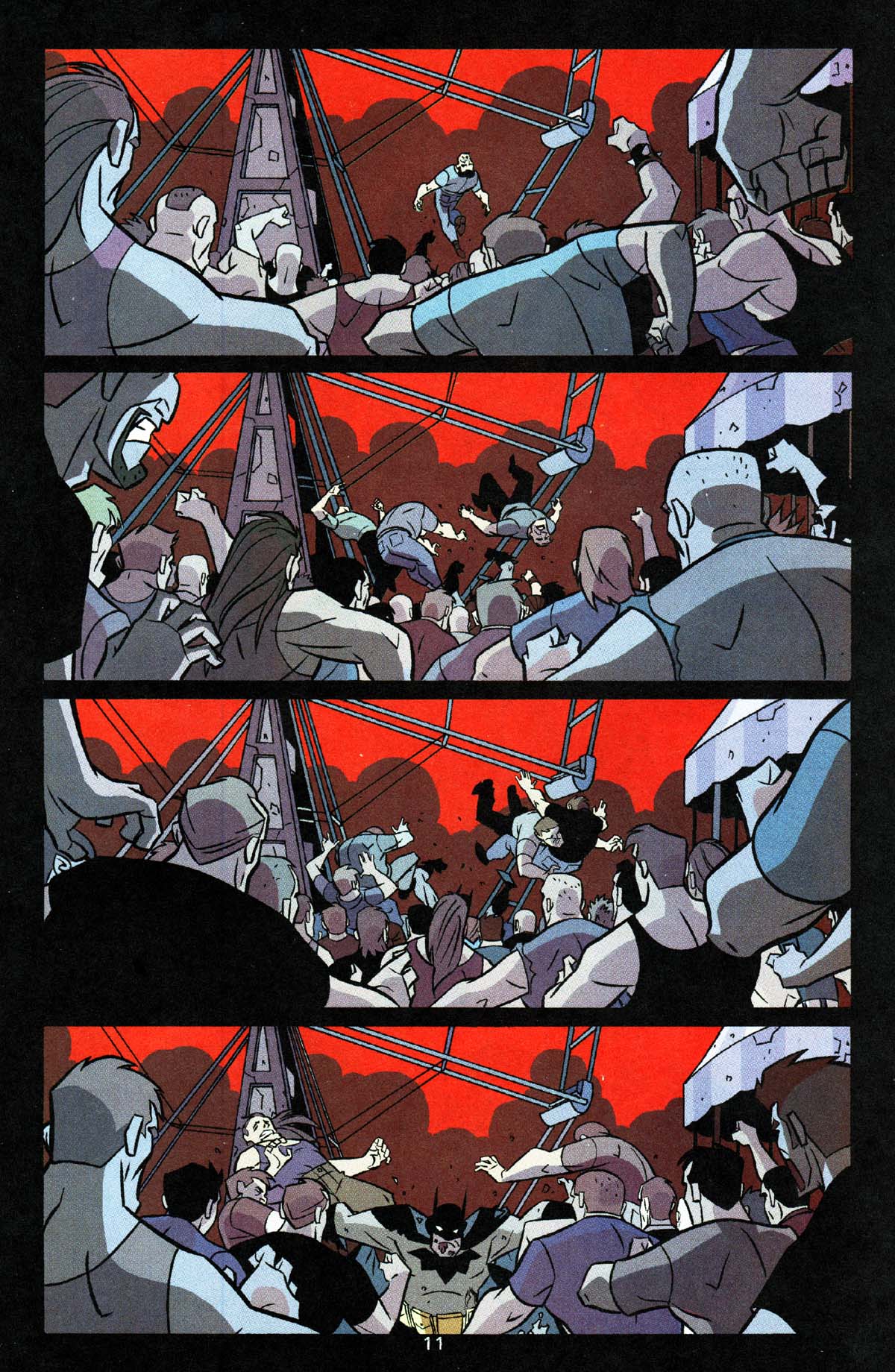
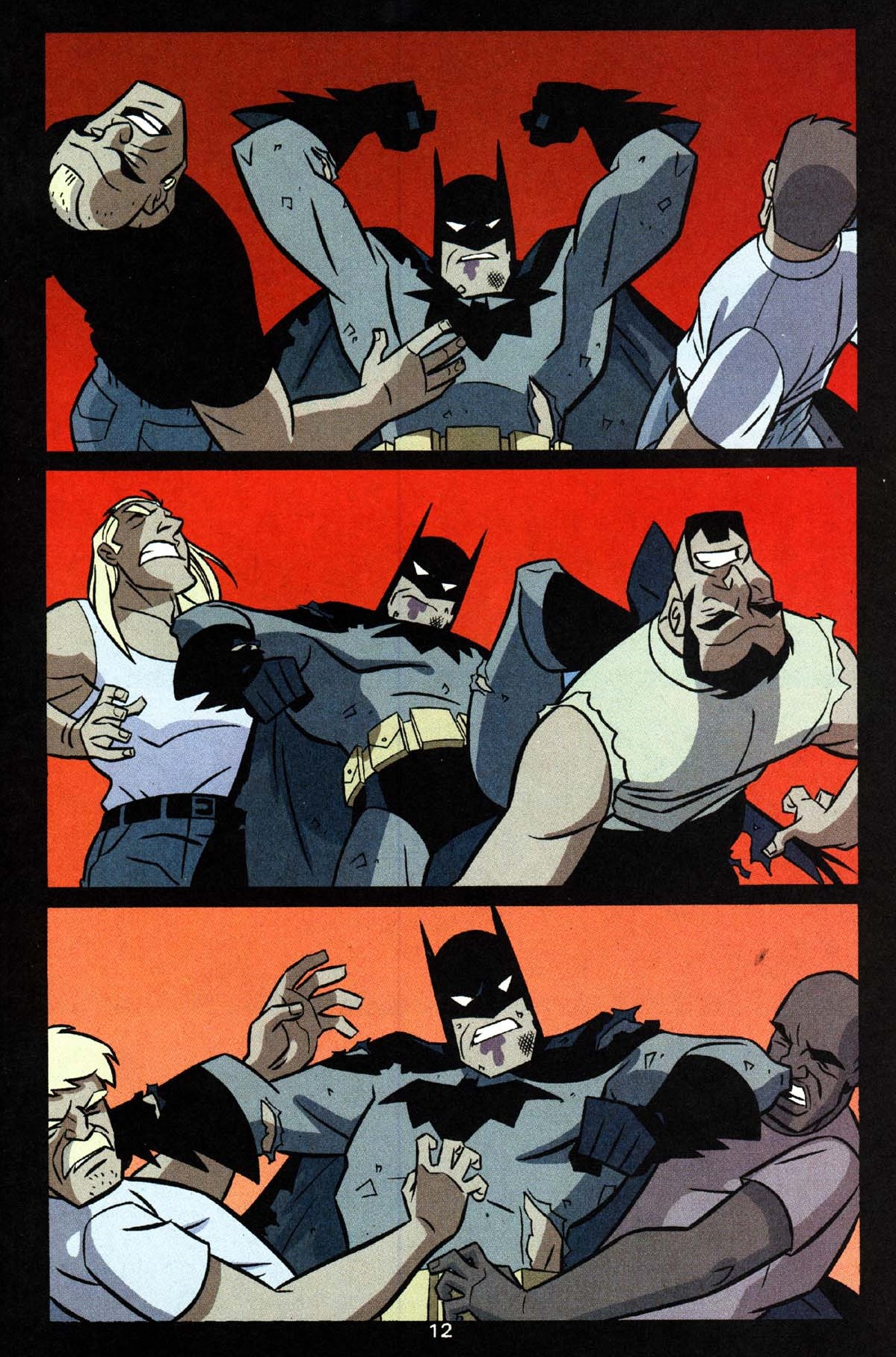
Levins sure knows how to frame a free-for-all fight scene for maximum effect… Aware of this, Scott Peterson let him have one last hurrah in their knockout final issue, ‘Leaves’ (Gotham Adventures #60, cover-dated May 2003), another deceptively simple tale that actually strikes at the heart of the Batman mythos while kind of reimagining the classic one-shot The Killing Joke.
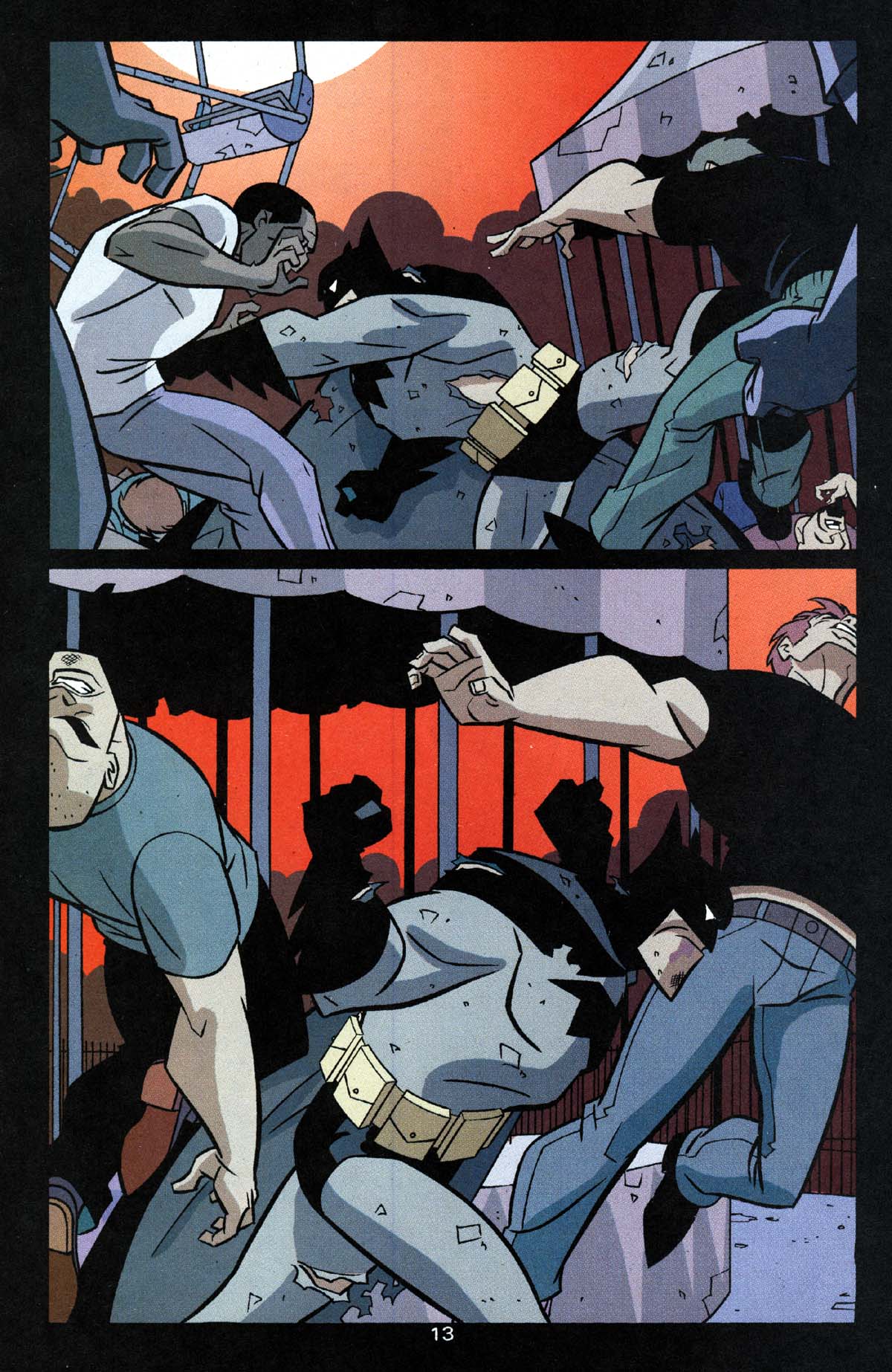
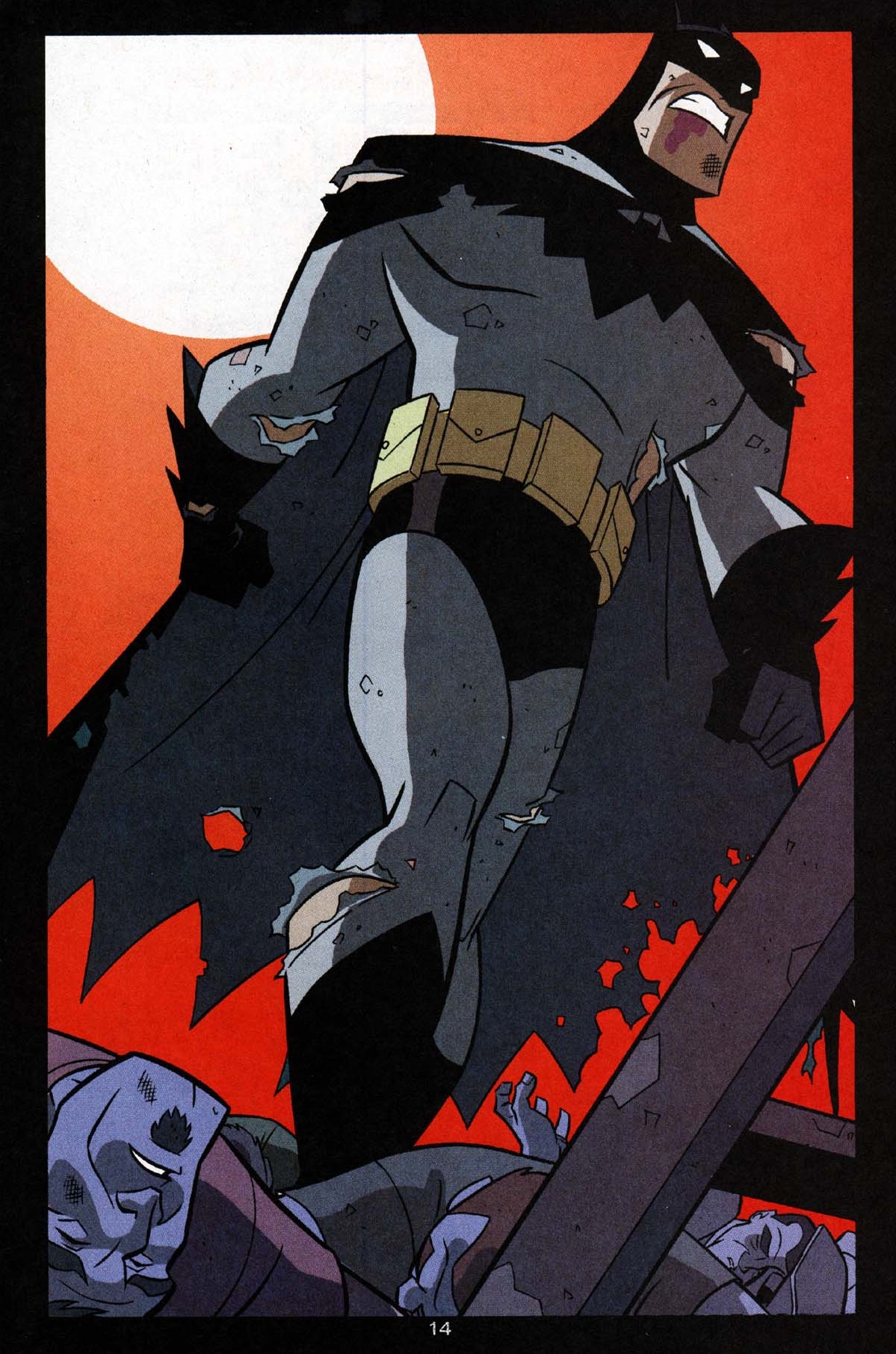
At one point, the Dark Knight singlehandedly faces around fifty thugs at dawn. Stylishly framed against a red sky (like in the sequence from ‘Do the Wrong Thing,’ except that here Loughridge pushes the mood even further by enveloping the bodies in a dusky palette), Tim Levins delivers a seriously badass battle that captures the exhilarating sense of an individual overcoming overpowering odds. The result is a virtuoso sequence akin to flicks like Kill Zone 2, John Wick 3, or The Night Comes for Us.
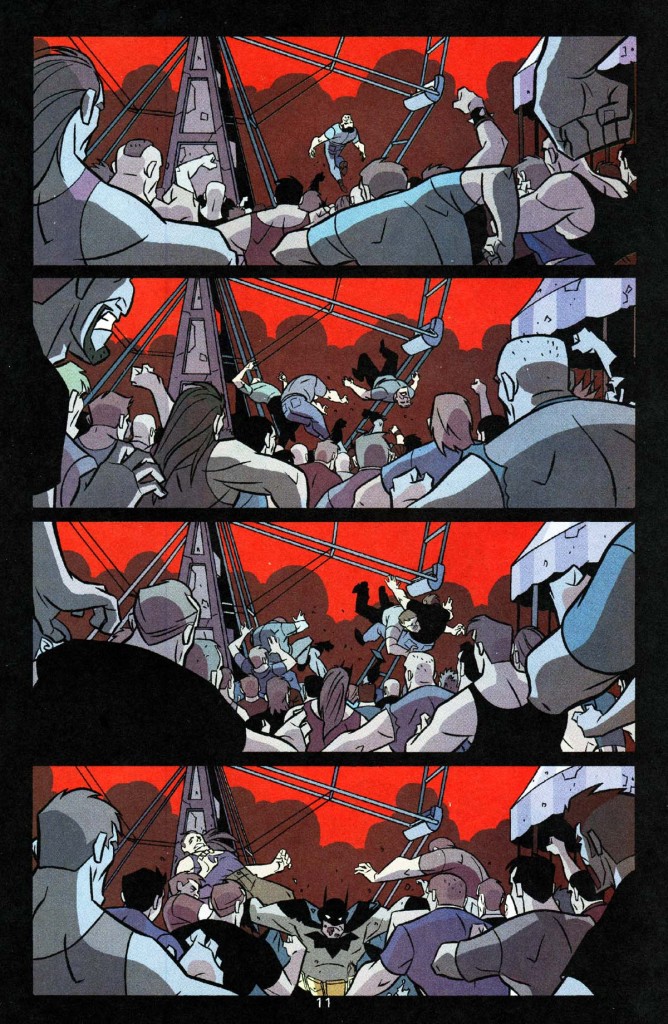
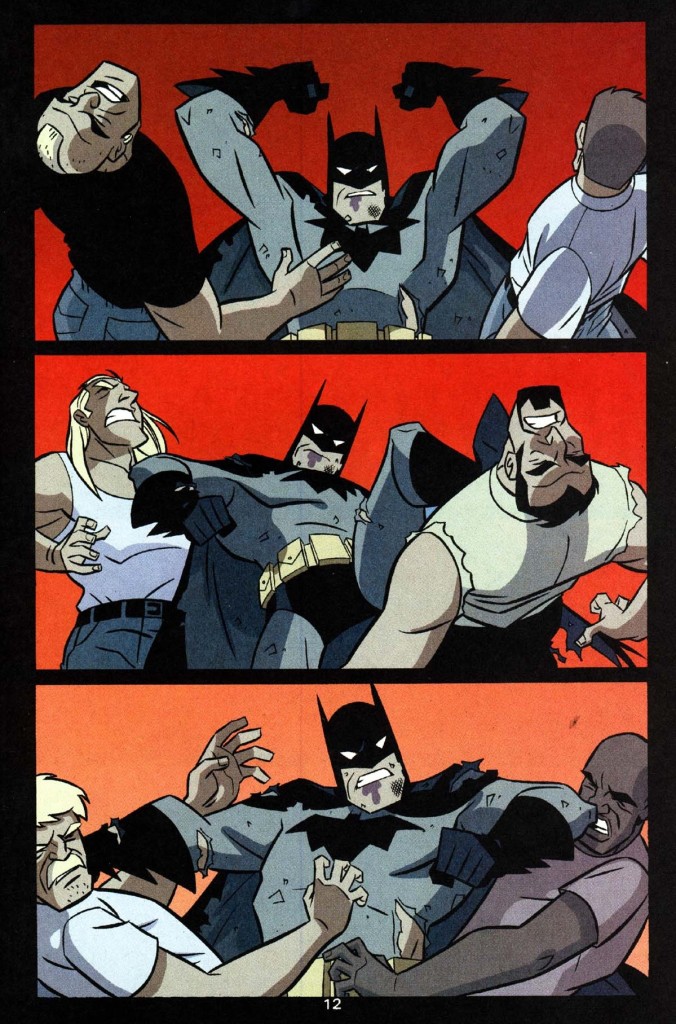
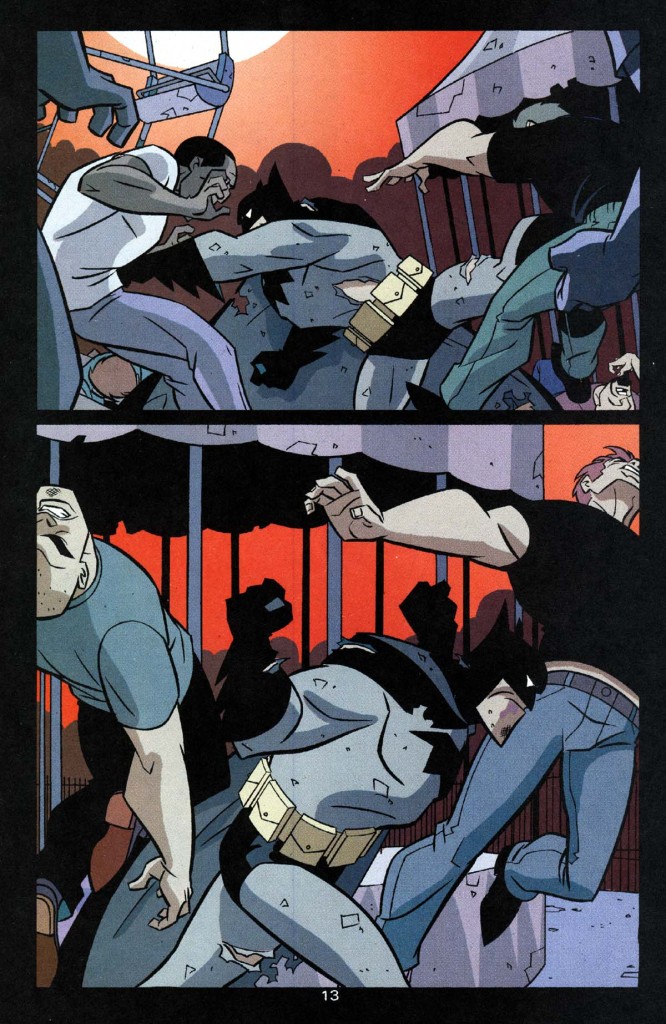
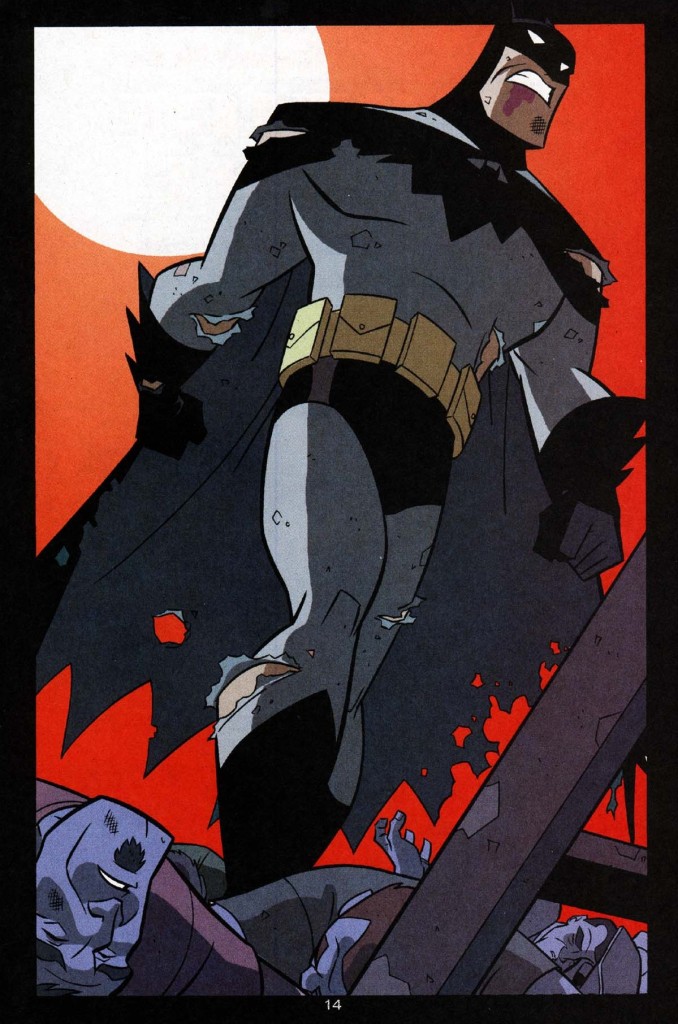 Gotham Adventures #60
Posted in ART OF BATMAN COMICS
Tagged Batman: The Animated Series, Lee Loughridge, Scott Peterson, Terry Beatty, Tim Levins
3 Comments