Against my better judgment, let’s look at more exciting adventures where shameless brand extension meets schlocky nerdy fun. I know these are cynical, blatantly manipulative works assigned to mercenary creators who could have been in pursuit of more original stories and ideas, but why do these still work so well at a basic junk food level?
PREDATOR VS. WOLVERINE
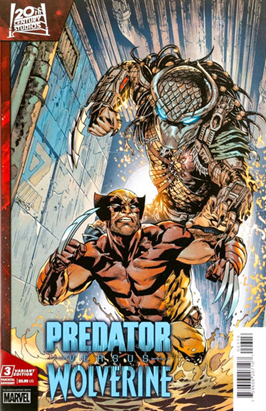
There is a whole subgenre of crossovers – of which Predator versus Wolverine is a full-fledged representative – built around flashbacks to the franchises’ histories, retconning characters from separate universes into each other’s pasts. The appeal is twofold. Fans get to revisit different eras, including pastiches and callbacks (I’m guessing most of those reading this blog will have recognized the scene being riffed in the cover above), building on or reframing previous hits. And because versions of characters can vary starkly along their timeline (in this case, Wolverine before and after he regained his memory, before and after he joined the X-Men, etc), it’s like getting multiple crossovers for the price of one.
Here, the combination hugely benefits from Benjamin Percy’s robust understanding of what makes the quintessential Predator and Wolverine yarns work. They tend to share a hunter/prey motif, pitting seemingly unstoppable forces against each other, most notably in the form of mega-alpha males. Plus, although Percy plays fast and loose with bits of Wolverine’s continuity (somewhat merging the Chris Claremont and Grant Morrison eras), he smoothly nails the character’s inner voice. Logan’s monologue is what drives the comic, since the Predator, suitably, is at its scariest when presented as a mysterious, quasi-impenetrable foe that cannot be reasoned with and whose motivations are merely discernible from interpreting his actions…
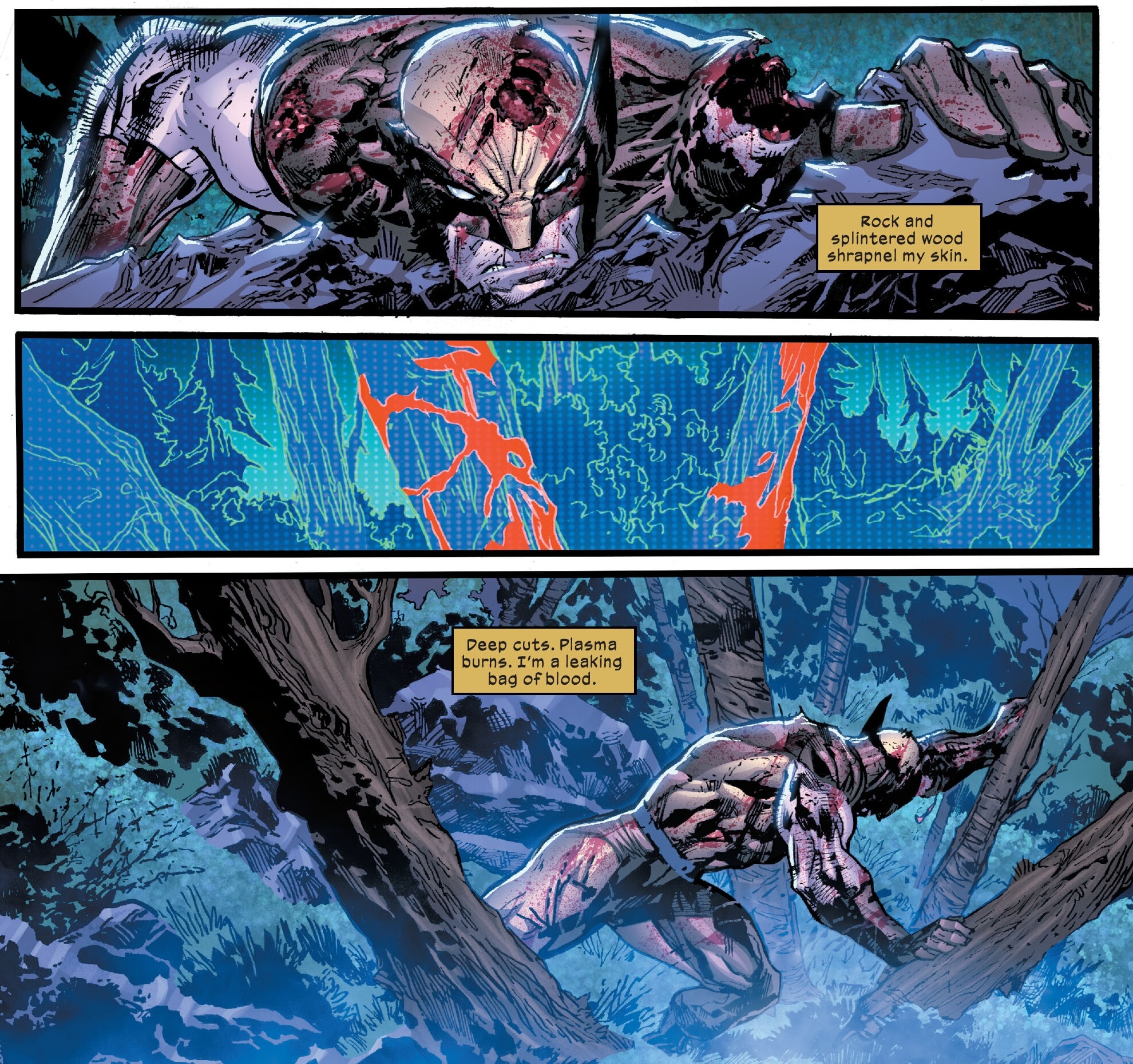
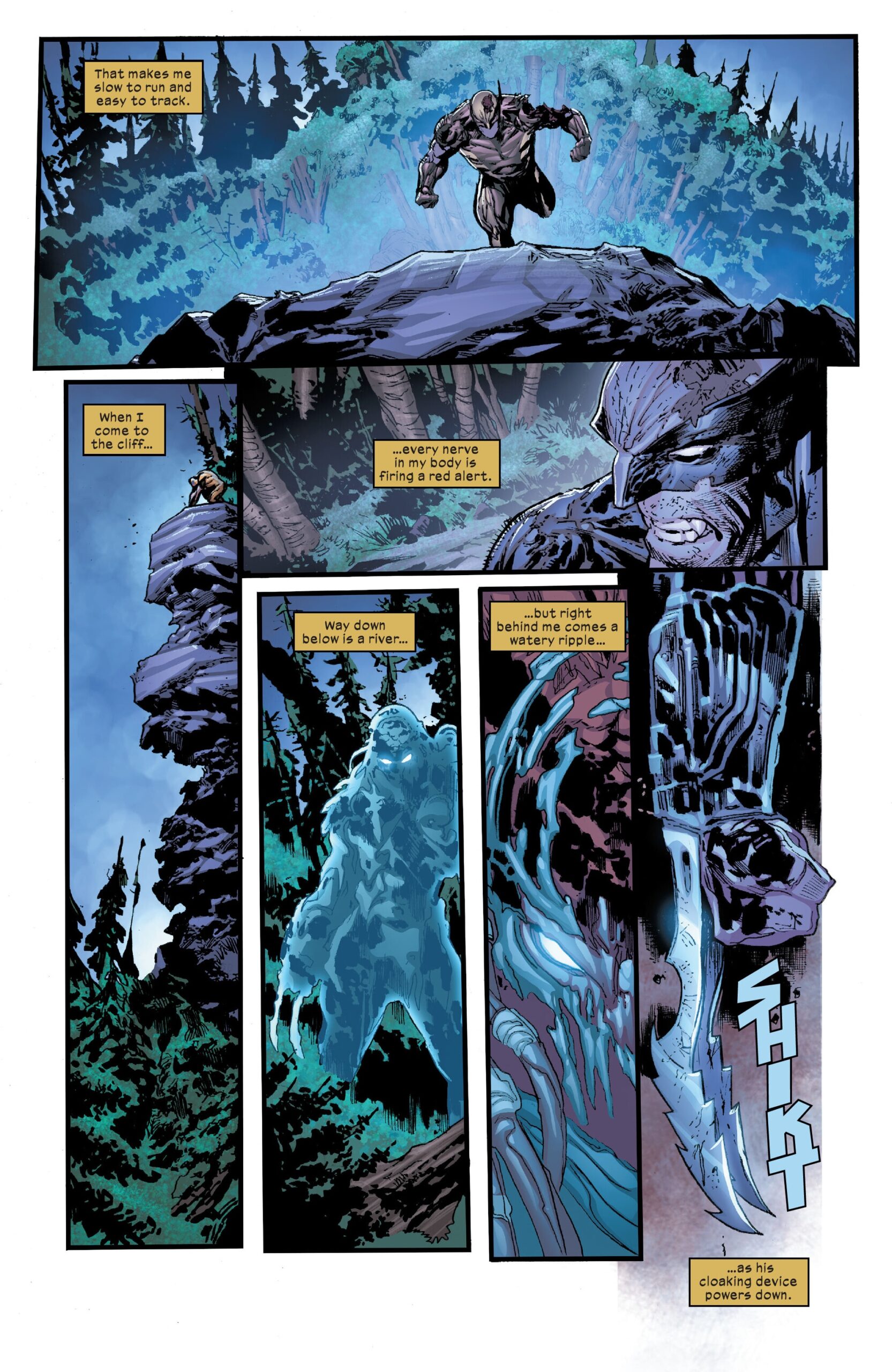
While Ken Lashley handles the present-day action, the neatest thing about Predator vs. Wolverine is that the flashbacks are assigned to various other artists. Each era has a distinctive feel, whether it’s Greg Land and Jay Leisten doing a slick post-Origin western or Kei Zama majestically exploring the flowery setting during a kinetic fight in Wolverine’s Japanese period. The result is an aesthetically diverse, if unpretentious, adventure spanning over a hundred years (albeit at a quick pace) which should be easy to enjoy even by those unfamiliar with the background of either Wolverine or the Predator species (aka Yautja).
If the usual challenge of intercompany crossovers is their blatant inconsequentiality, this sort of backwards-looking approach pushes the illusion of change onto the past, appealing to other major forces in this segment of culture, namely masturbatory nostalgia, the pleasure of recognition, and the reward for specialized knowledge. Thus, as a bonus, those of us who come with a baggage get to geek out over the way Hayden Sherman apes not only the designs, but also the dense page layout style of Barry Windsor-Smith’s Weapon X, as if we’re reading a missing chapter from that brutal, provocative classic… and the Predator turns out to have been there all along!
Because corporate capitalism is unable to leave a good thing alone, Percy soon followed this series with the less accomplished Predator vs. Black Panther and Predator vs. Spider-Man before the saga’s culmination in the full-throttle bloodbath of Predator Kills the Marvel Universe. I’m a sucker, though, so I’m actually looking forward to seeing what Greg Pak does with the upcoming Predator vs. Planet of the Apes.
DIE!NAMITE: BLOOD RED
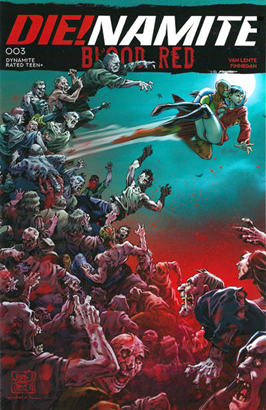
When Dynamite hired Fred Van Lente to do with this publisher’s intellectual properties a version of what he had done with the string of riotous Marvel Zombies mini-series (where familiar characters bloodily decimated and/or were turned into flesh-eating undead), what we got was even more of a hoot. Unlike Marvel, Dynamite did not have a coherent superhero universe, but rather an idiosyncratic combination of public domain and licensed properties from various places, set in different eras, planets, and alternate realities. In other words, Van Lente, co-writer Declan Shalvey, and the rest of the team weren’t just introducing a zombie plague into an established world, they were also introducing these worlds to each other, including settings and heroes from early 20th-century pulps (like John Carter of Mars), iconoclastic psychos from 1990s’ indie comics (like Evil Ernie), and Dynamite’s own unhinged vigilante Jennifer Blood.
The attitude is plastered on the title itself: Die!Namite. This series of series lives up to the company’s edgelord house style, full of ultra-violence and raunchiness, although essentially played for laughs while still delivering a thrilling fantasy epic. Much of the cast are bastards that constantly insult and betray each other, so the twists keep on coming. Indeed, practically every page has some hilarious lines, plot turns, and awesome action…
What’s more, for the most part, these books don’t settle for mere cameos. They respect each character’s distinct voices and significantly integrate bits of their mythos into the overall story, often in a clear, ingenious way that makes it understandable for the uninitiated. That said, like Predator vs. Wolverine, they are obviously also riddled with Easter Eggs for the respective fans: when Ash Williams joined the tale in the second series, Die!Namite Lives!, layouts and panels paid tribute to a montage in Evil Dead II and the poster from Army of Darkness.
Because they’re written by Fred Van Lente, these comics are smarter than I make it sound, like an even more caustic version of The League of Extraordinary Gentlemen. Heck, they even get away with some proper emotional development (like in the romantic special Our Bloody Valentine, set shortly before Die!Namite #5). And they never get boring, as they constantly throw in new locations and gonzo ideas: the third series, Die!Namite Never Dies, culminates with a game of (un)living chess on Mars!
The fourth installment, subtitled Blood Red, shakes things up once again, throwing us into a baffling new status quo. It also radically shifts the aesthetics, as Vincenzo Carratú’s sexy, dynamic art, with bright colors by Kike J. Diaz, gives way to the more restrained, thick-heavy style of Marco Finnegan, moodily colored by Ellie Wright.
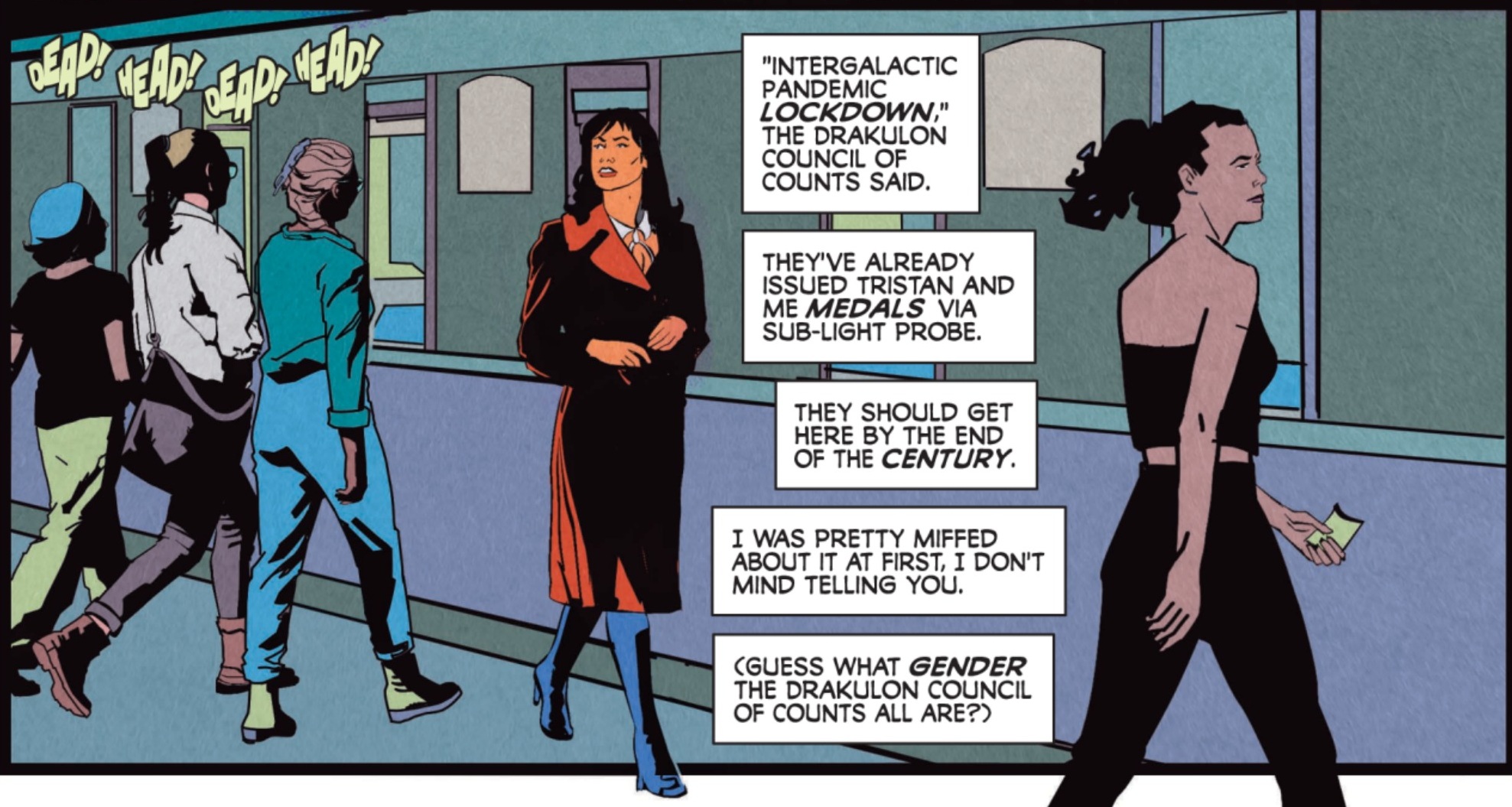
For all the cheesecake visuals in the earlier series (especially the softcore lurid covers), several female figures have stood out at the center of the narrative as both funny and badass, ranging from Red Sonja to the horror/erotic star Vampirella. Engaging with gender issues more directly, Blood Red is set in a post-apocalyptic dystopia (complete with quirky riffs on the Mad Max films) where a variant of the zombie virus only affects those with a Y chromosome, which both intensifies the war of the sexes (women are even more likely to be killed by men) and inverts social dynamics (as the only functioning gender, women fully lead and run society, practically reducing men to slavery).
Blood Red is an Elseworlds take on what was already an Elseworlds saga, so the vibe gets even more meta and dizzier, with deeper cuts. And while it’s generally light on spectacular action compared to its predecessors, the series certainly picks up in the final stretch, when Jordi Pérez takes over the art.
I can’t wait to see what comes next. Regardless of the business considerations that initially prompted this messy crossover, what a delightfully weird project this has turned out to be!
BATMAN/DEADPOOL
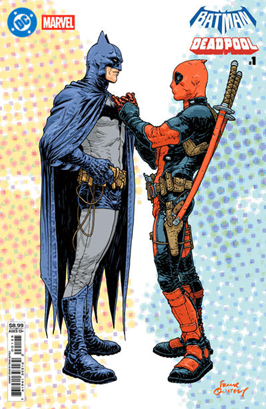
Finally, last year brought us the first crossovers between the DC and Marvel universes in over two decades, starting with Marvel’s special one-shot Deadpool/Batman. That one wasn’t bad, as far as these things go, efficiently ticking all the boxes. Zeb Wells has a solid take on both voices and his dialogue is packed with zingers. The Dark Knight acts sharp and cool while the Merc With a Mouth, true to form, seeks to undermine that hero’s seriousness by pointing out how silly Batman’s world actually is, only to gradually fall prey of the latter’s own peculiar dynamics. The contrast works especially well because you’re pulled in both directions, as the story gets kookier but the art plays things straight, with Greg Capullo, Tim Townsend, and Alex Sinclair handling it like any other job – if you don’t read the text, for the most part you could be forgiven for thinking this was an irony-free bombastic superhero action yarn (although Clayton Cowles contributes with some playful lettering, most notably in the villain’s reveal).
The project’s main attraction, though, was DC’s Batman/Deadpool, whose leading feature (‘The Cosmic Kiss Caper!’) was penned by Grant Morrison, one of the most interesting and acclaimed writers of Batman comics (and, let’s face it, of non-Batman comics). As far as I recall, Morrison had never explored Deadpool before, but this work leans towards that franchise’s sensibility by providing a slapstick cornucopia of metafictional gags. Appropriately, then, this time around artist Dan Mora, letterer Todd Klein, and (to a lesser extent) colorist Alejandro Sánchez also throw themselves into a humorous mode. Still, like Wells, Morrison doesn’t settle for making Batman the butt of Deadpool’s jokes. Instead, we get a Caped Crusader with his own sense of humor who mocks his team-up partner’s derivative features.
For fans keener on following authors rather than specific franchises, Deadpool is a mere vehicle/bait here, as the major crossover in ‘The Cosmic Kiss Caper!’ involves bringing together some of Grant Morrison’s creations from the writer’s stints at both DC and Marvel. In fact, even Morrison shows up, having been written into the DCU back in Animal Man #26 (and then bizarrely brought back in Suicide Squad #58). The whole thing is as self-indulgent as it sounds, but I suppose it fits into yet another beloved subgenre: amusing tales about creators interacting with their characters have been a staple of superhero comics going as far back as Gardner Fox’s Flash stories from the Golden/Silver Age (and recently revisited in the sweet The Avengers in the Veracity Trap!).
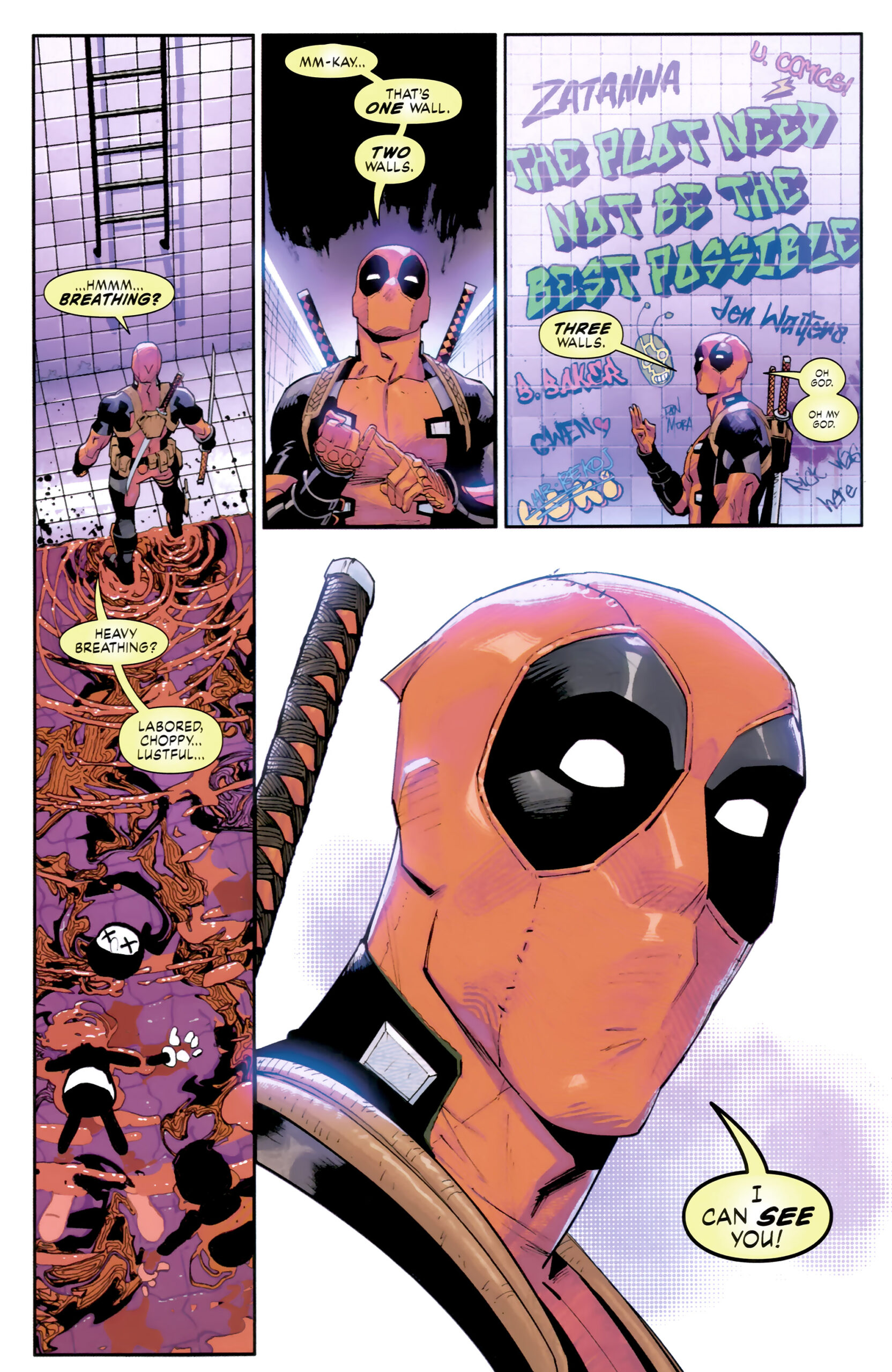
That said, Morrison, not for the first time, can get a bit annoying when trying too hard show off cleverness, like in the fourth-wall joke you see below (similarly, a dig at Rob Liefeld’s infamous difficulty with drawing feet didn’t make me laugh as much as the cute gag in the background of the film Deadpool & Wolverine).
Honestly, the best part of this whole stunt is that both Batman/Deadpool and Deadpool/Batman came packed with a bunch of zany backups where some of the greatest creators working today also got to play, merging these two universes in various other ways. Scott Snyder, James Tynion IV, and Joshua Williamson have fun contrasting John Constantine’s and Doctor Strange’s approaches to magic. Bruno Redondo draws the hell out of a team-up between Nightwing and Wolverine (Laura Kinney), as does Amanda Conner when hilariously pairing Harley Quinn with the Hulk. Chip Zdarsky and Terry Dodson imagine an alternate history where Wonder Woman and Captain America have been part of each other’s lives throughout the ages (thus joining the subgenre of Predator vs. Wolverine). In the quasi-wordless ‘Catch,’ Kelly Thompson and Gurihu have Krypto playing ball with Jeff the Land Shark. Al Ewing wrote the funniest tale of the bunch (even if it’s just two-pages long), where Rocket Racoon switches places with Green Lantern. In turn, Kevin Smith’s and Adam Kubert’s ‘The Red and the Green,’ pitting Daredevil against Green Arrow, is mostly worth it for the geeky punchline (pun intended). Even Frank Miller joins the party for a vicious punch-up between the Dark Knight and Wolverine (Logan).
The same applies to the other two specials DC and Marvel have just put out, teaming Spider-Man with Superman. While the main stories are OK, the real gems are in the backups. At their worst, creators just have heroes explain their differences and similarities to each other, but the best ones deliver highly satisfying short pieces: Gail Simone, whose comics tend to be especially open about characters’ sexuality, matches Power Girl with the Punisher; Matt Fraction, Steve Lieber, Nathan Fairbairn, and Clayton Cowles reunite for a Jimmy Olsen adventure that is even wilder than their brilliant 2020 book; Dan Slott and Marcos Martin pull off a nifty retro fest in which Spider-Man Noir crosses paths with Golden Age Superman (the one from Earth-2, who can’t fly).
As a fan of both lines, it’s still enough to make me smile from ear to ear.