A Dredd reminder that comics can be awesome…
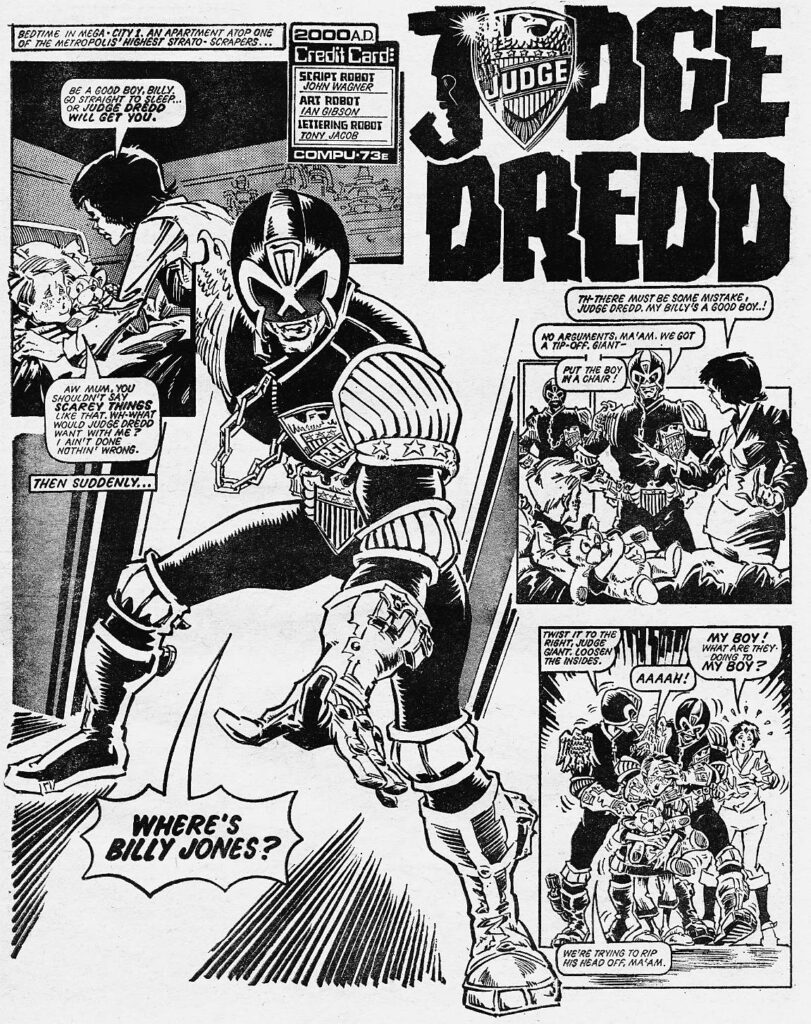
2000 AD #38
Shadow of the Bat #52
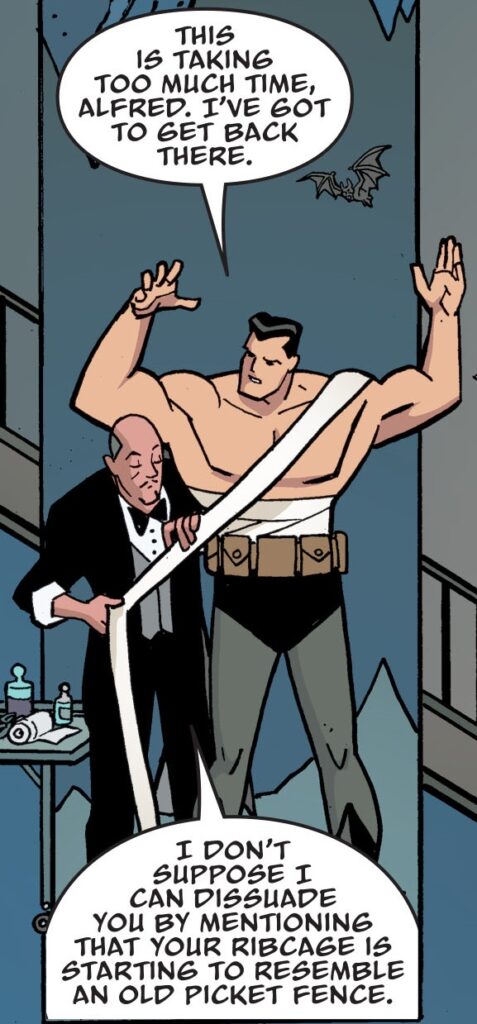
Batman: The Adventures Continue #1
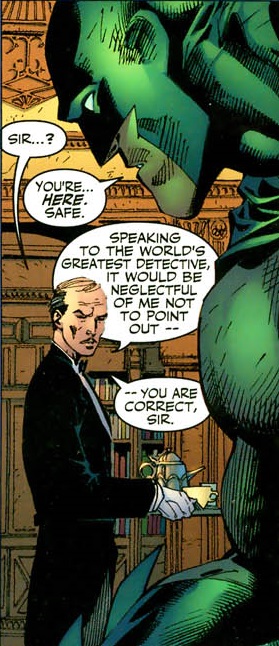
Batman #616
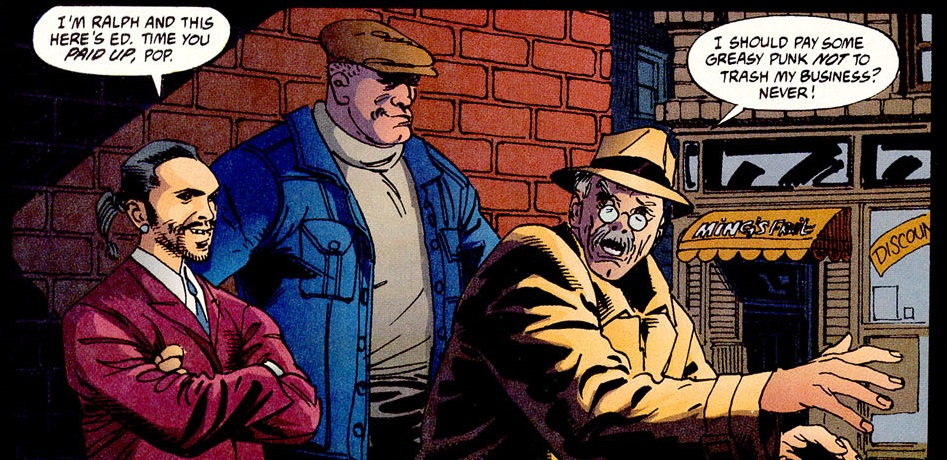
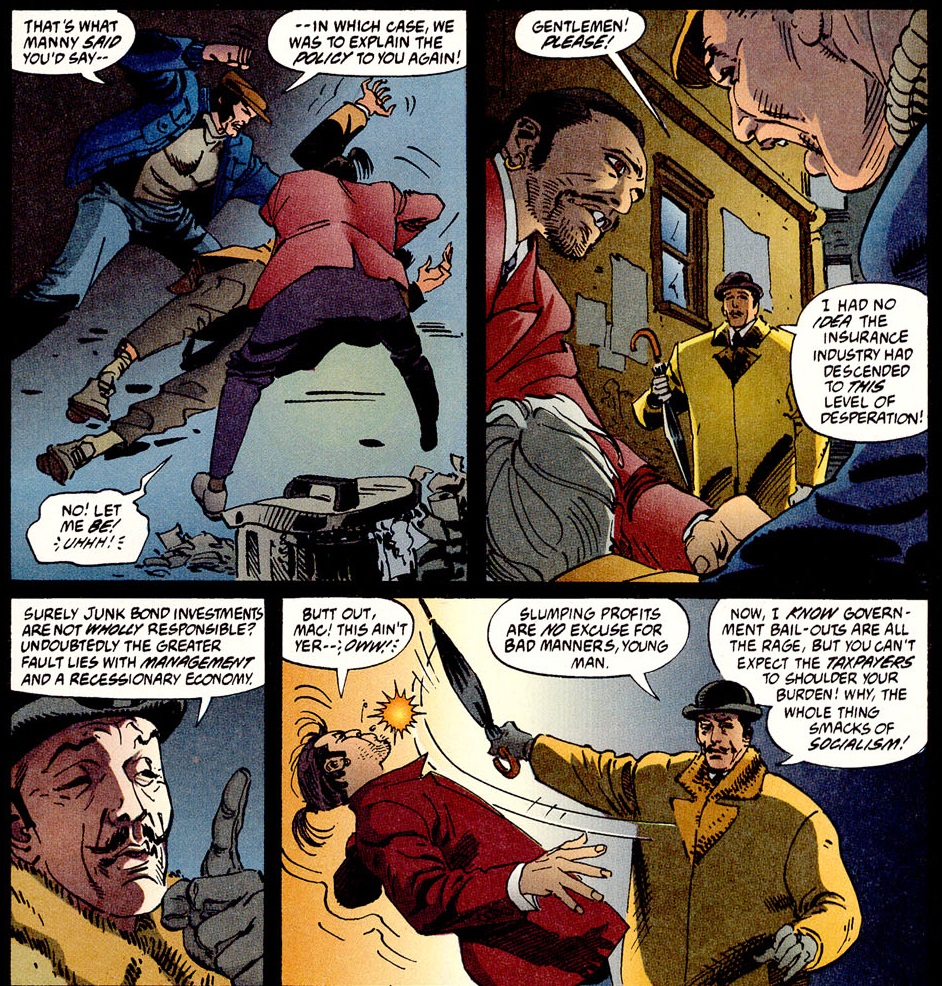
Legends of the Dark Knight #41
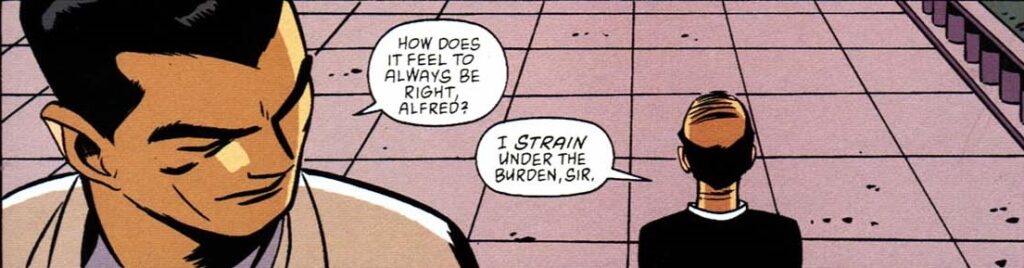
Robin: Year One #1
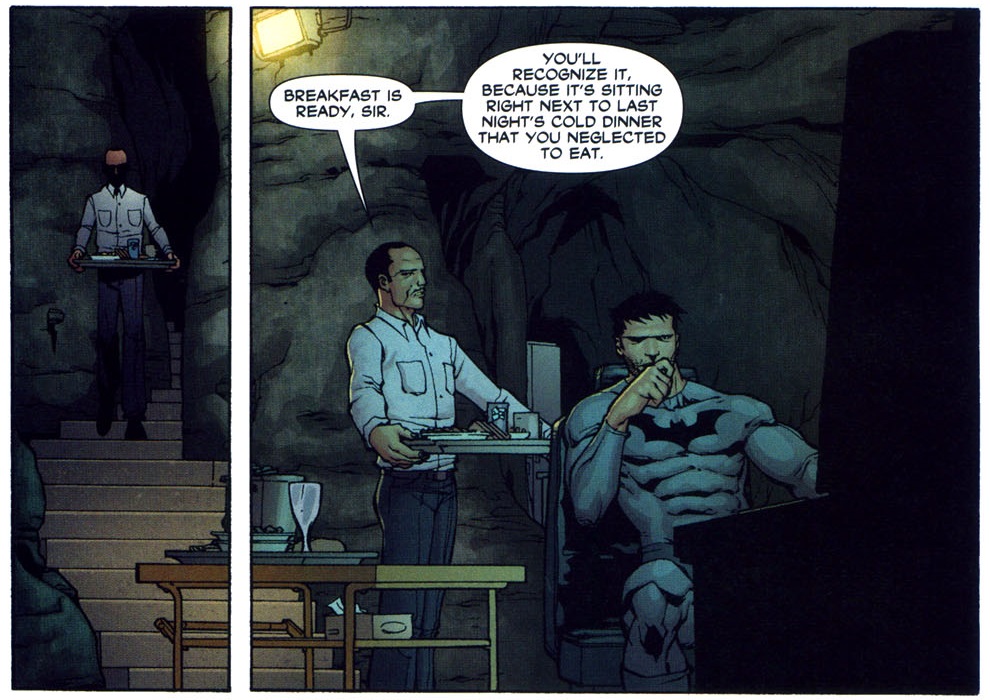
Batman #643
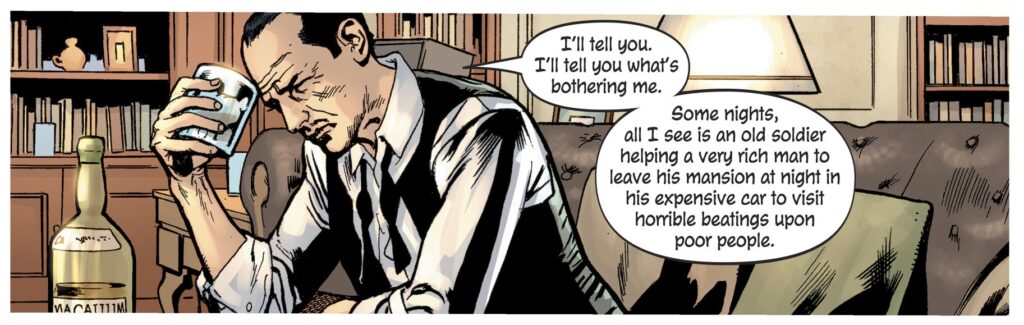
The Batman’s Grave #1
A brawling reminder that comics can be awesome…
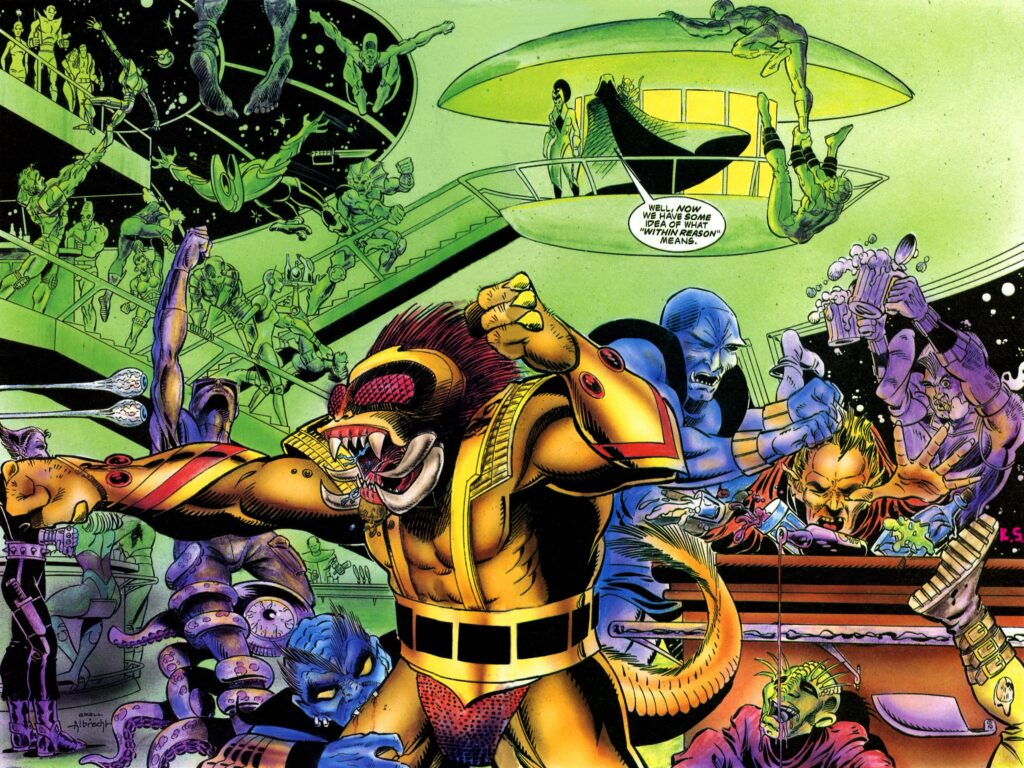
Starslayer: the Director’s Cut #1

Captain Midnight #22
2001: A Space Odyssey #3
Last week, I mentioned that humor played a key role in Lucky Luke from the very beginning. Today, I want to take a closer look at the types of humor developed in the series’ earliest years…
The Bluefeet are Coming!
Back when Morris was both writing and drawing Lucky Luke, the comedy was primarily visual, sharing a sensibility with the style of his close friend – and genius – André Franquin.
For instance, having struck gold with Pat Poker, Morris built a string of stories around equally colorful villains – and, after the snake-oil salesman Doctor Doxey (a good idea with a mediocre execution), he placed great emphasis in their appearance, making sure that almost every panel with them was funny to look at in some way.
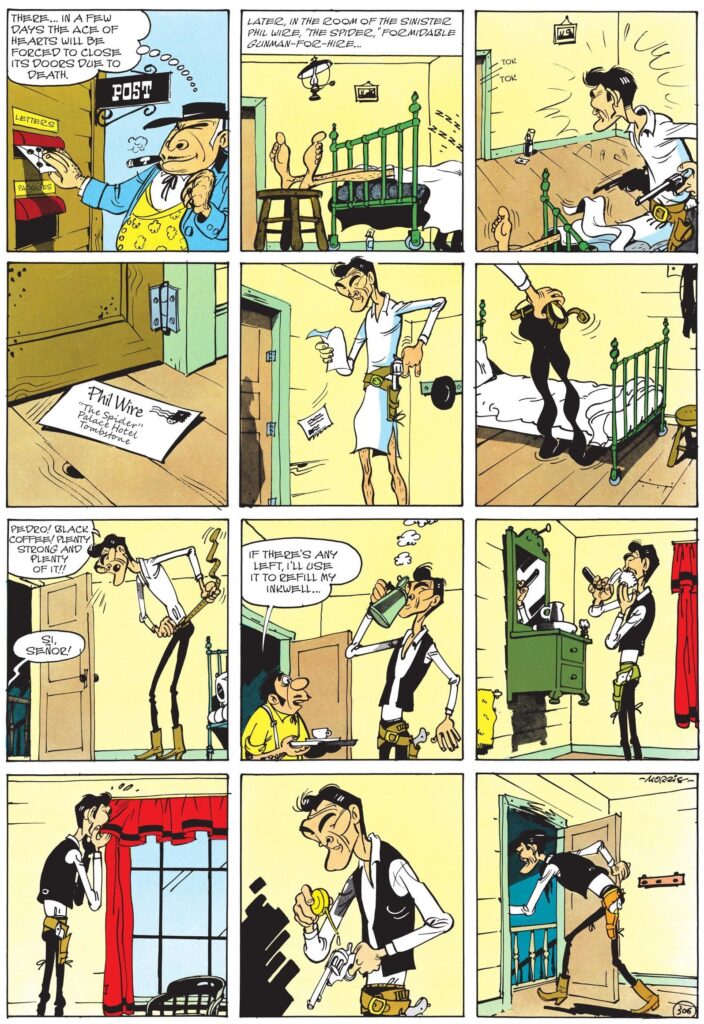
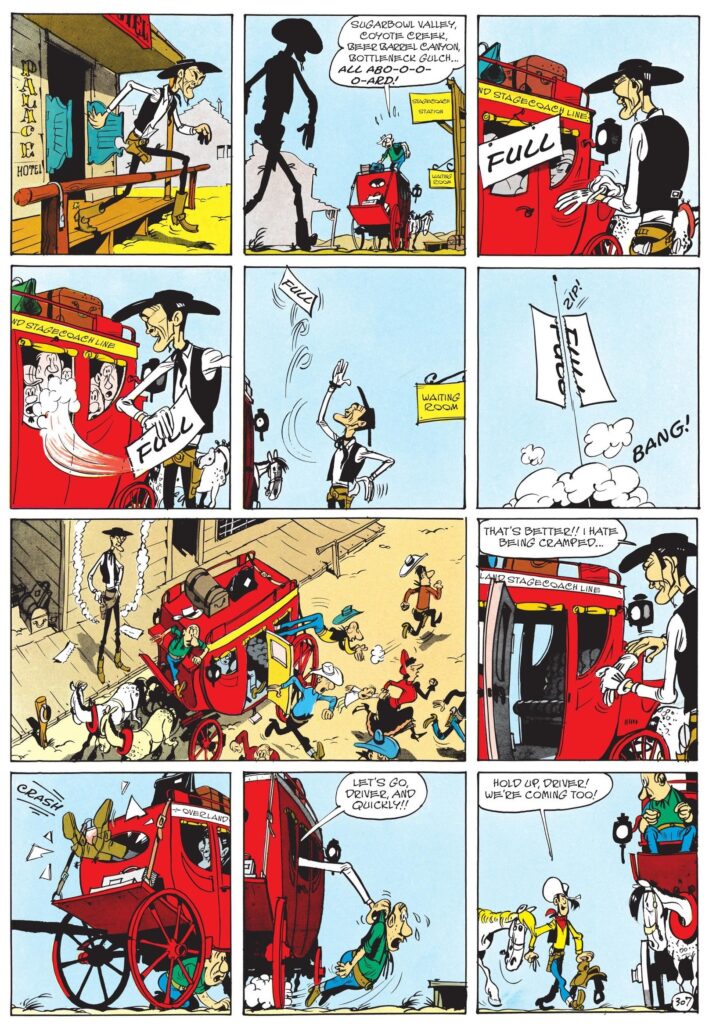
Notably, in the album Phil Wire, not only did Morris module the titular gunslinger to look like Jack Palance in Shane, but he also made him comically tall and had a blast coming up with different ways to showcase this feature:
Lucky Luke and Phil Wire “The Spider”
The chuckles, of course, derive not just from the character’s physiognomy, but also from Morris’ mise-en-scène, constantly framing the action from amusing angles (like when we only see the boots and arm coming out of the stagecoach).
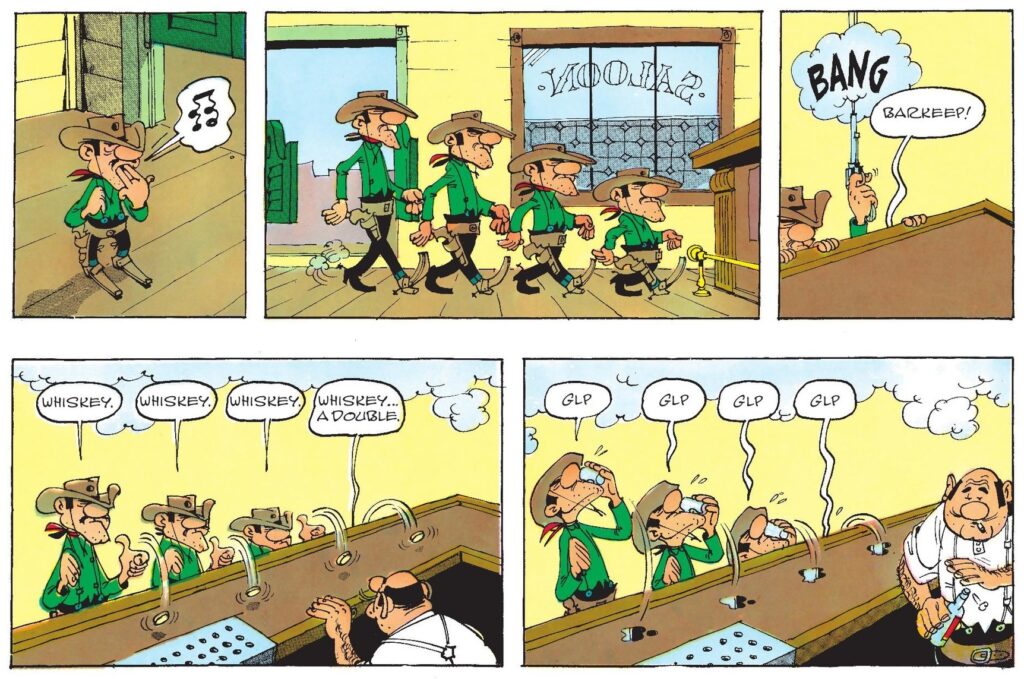
Similarly, in ‘Outlaw,’ besides designing the four Dalton Brothers with descending heights, Morris often had them act in perfect sync and played with the fact that readers could therefore imagine what each of them was doing even when they were outside the frame…
Outlaws
The inclusion of the Daltons was also the first time – of many – when Lucky Luke drew inspiration from real historical figures. This was to become another recurring source of humor: an iconoclastic approach to the icons of the Old West.
Morris’ deconstructive attitude is particularly explicit in ‘Return of the Dalton Brothers,’ a sequel to both ‘Outlaws’ and ‘Desperado City’ where Lucky Luke exposes the lies of a sheriff who can’t stop bragging about his courage and feats (among other things, he claims he’s the one who got the Daltons). Thus, eight years before John Ford’s The Man Who Shot Liberty Valance famously proclaimed ‘When the legend becomes fact, print the legend,’ Morris irreverently spit in the face of the American propensity for self-mythologization.
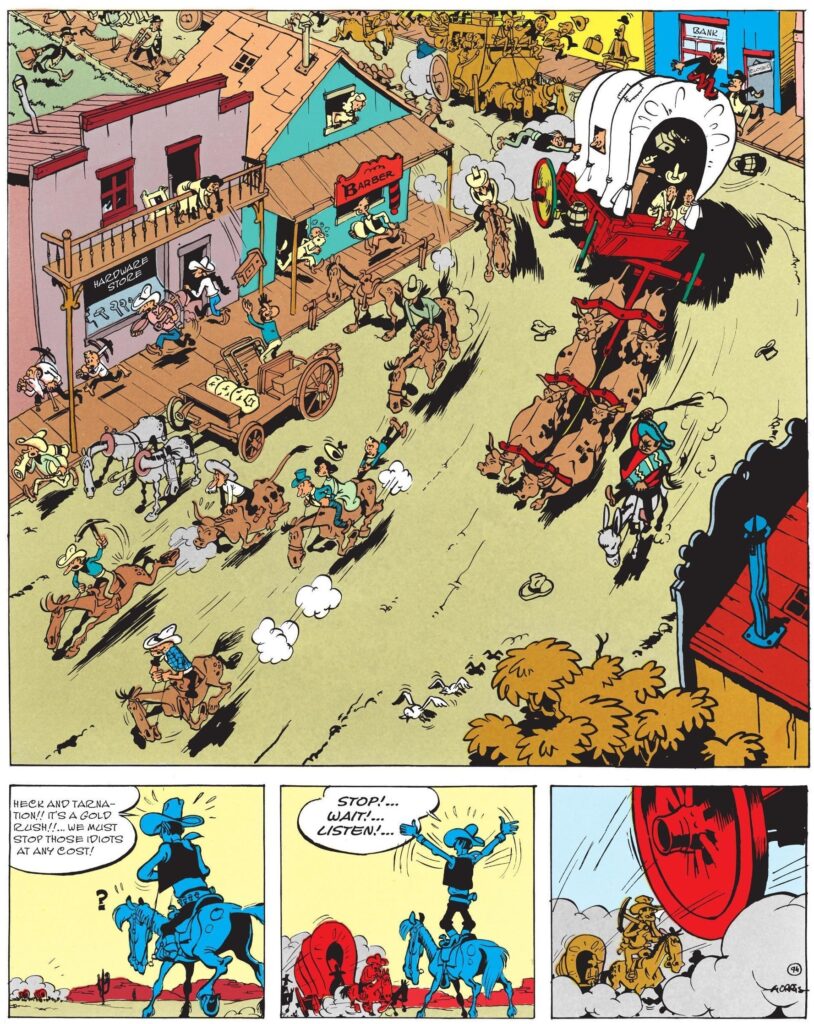
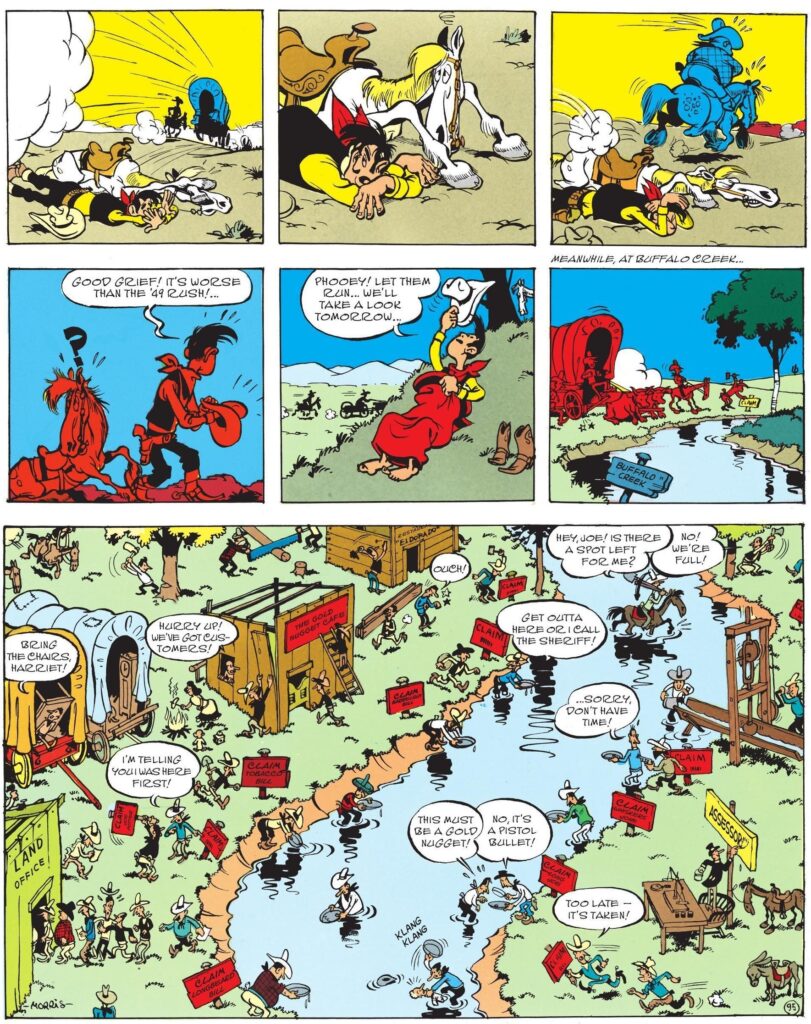
In fact, Morris’ satirical bent had already been displayed in the funniest of his earlier stories, ‘The Buffalo Creek Gold Rush.’ There, Lucky Luke unwittingly starts a rumor that rapidly spirals into an all-out gold rush of maniacally overblown proportions, resulting in a madcap take on greedy capitalism and rampant speculation.
Although the comedy in ‘The Buffalo Creek Gold Rush’ is more situational, it is crucially carried by Morris’ lively drawings, in particular by one of his signature moves: alternating between regular panels (which secure a steady pace) and detailed splashes packed with gags (which convey a general vibe of rollicking chaos).
The Buffalo Creek Gold Rush
Rails on the Prairie, written by René Goscinny, successfully merges this sort of satire of American modernity with a more direct spoof of Hollywood westerns. Doing for Ford’s The Iron Horse and for Cecil B. DeMille’s Union Pacific the same that Airplane! later did for the Airport movies, the album places Lucky Luke in the middle of the construction of the railroad and has him fight against both natural and human-conceived obstacles, including attacks by Native Americans and sabotage attempts by evil speculators. (In fact, I suspect Brian Donlevy’s performance in Union Pacific had already informed the character of O’Sullivan in Phil Wire.)
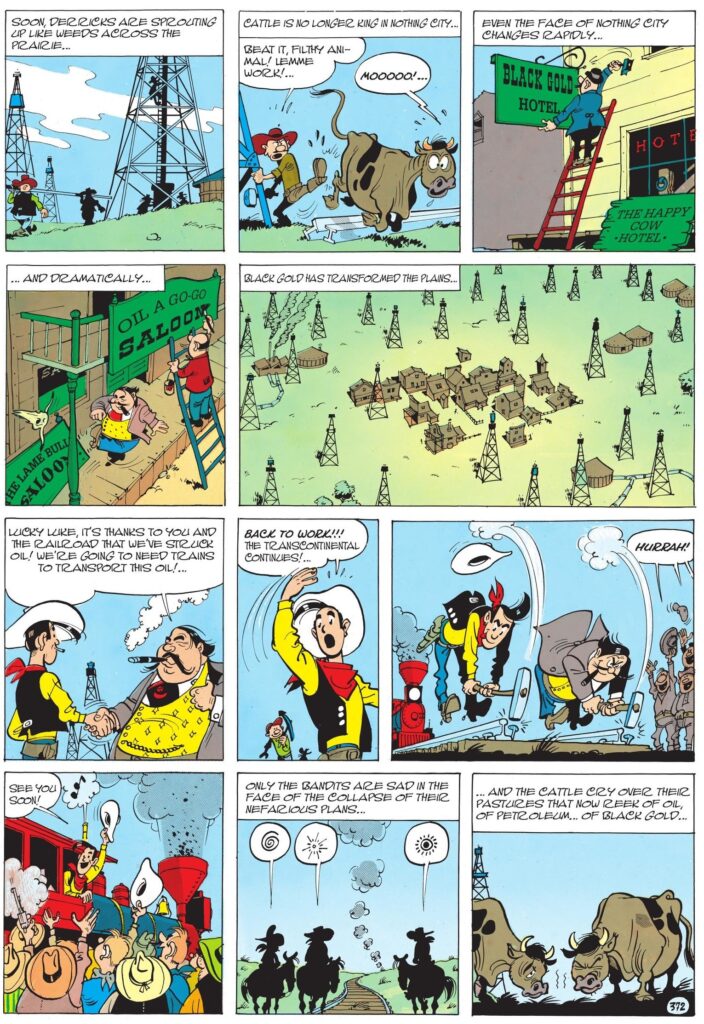
By helping out the development of the railroad – and, in later books, of other technologies – Lucky Luke is shown making the USA what it is (or, rather, what it came to represent in popular imagination at home and abroad). Ludicrously speeding up this process or mixing up the chronology, however, makes so-called progress look absurd and grotesque… For example, in a variation of a sequence from Tintin in America, when the rail workers find oil, all the local stockmen immediately switch their trade:
Rails on the Prairie
I mentioned the construction work was attacked by Native Americans, right? Indeed, like the Hollywood westerns and cartoons that inspired Lucky Luke – and like most (American and European) comics at the time – the series contains racialized caricatures of blacks, Asians, Mexicans, and what was then commonly known as ‘Indians,’ with the latter two groups often rendered as bumbling drunks (yep, even more so than the goofy white settlers).
On the one hand, I guess there is a case to be made that Lucky Luke wasn’t meant to relate to reality as much as to the stereotypes about the Old West on the screen (hence the absence of Chinese workers in Rails on the Prairie), which it ultimately mocked. Hell, the series could practically fit into the tradition of Weird West fiction, where the American myths are brazenly warped in a way that acknowledges their unreality. On the other hand, it would be disingenuous to pretend that there was no continuity between such a depiction of violent, superstitious, savage Indians and the ideas used to justify genocide in the United States not that long before.
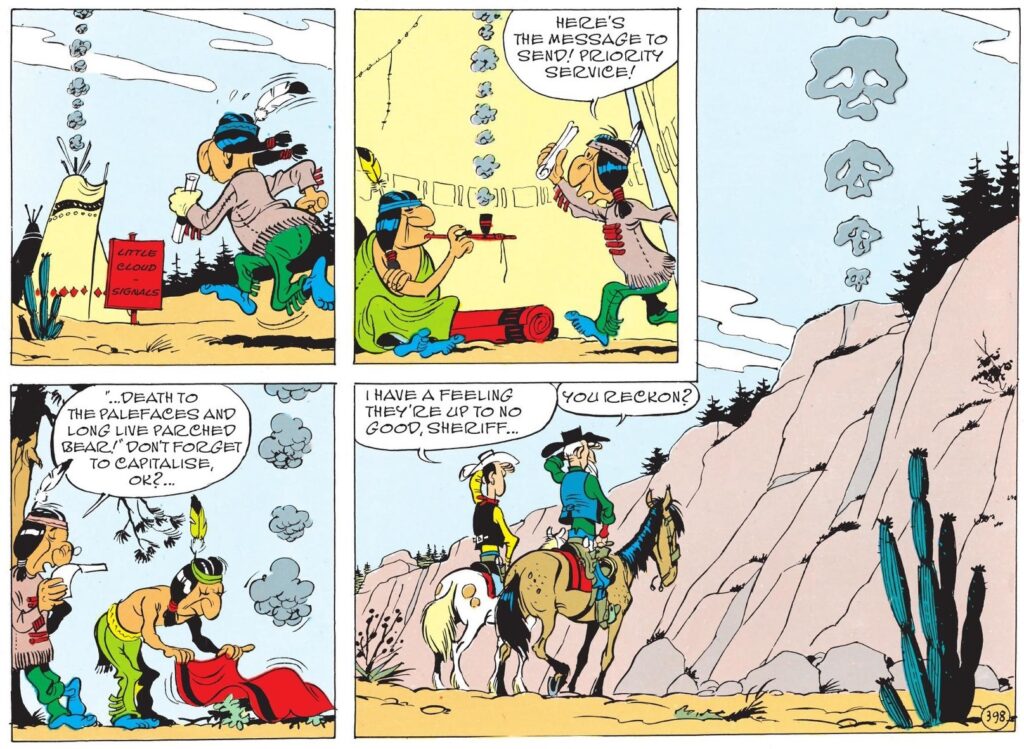
With this in mind, one of the most un-PC albums has got to be The Bluefeet are Coming!, the last album Morris scripted before permanently handing over writing duties to Goscinny. In it, a despicable bucktoothed Mexican, called Pedro Cucaracha (i.e. cockroach), joins forces with the titular (fictitious) tribe, led by the alcoholic Chief Parched Bear, to lay siege on the town of Rattlesnake Valley.
I’ll be honest here: I absolutely adored this book as a kid, not least because it tells one hell of a siege yarn. Even more than Rio Bravo and Seven Samurai, which I only saw later, this is the tale that turned me into an unabashed fan of siege narratives, especially the ones that combine genuine tension with gallows humor…
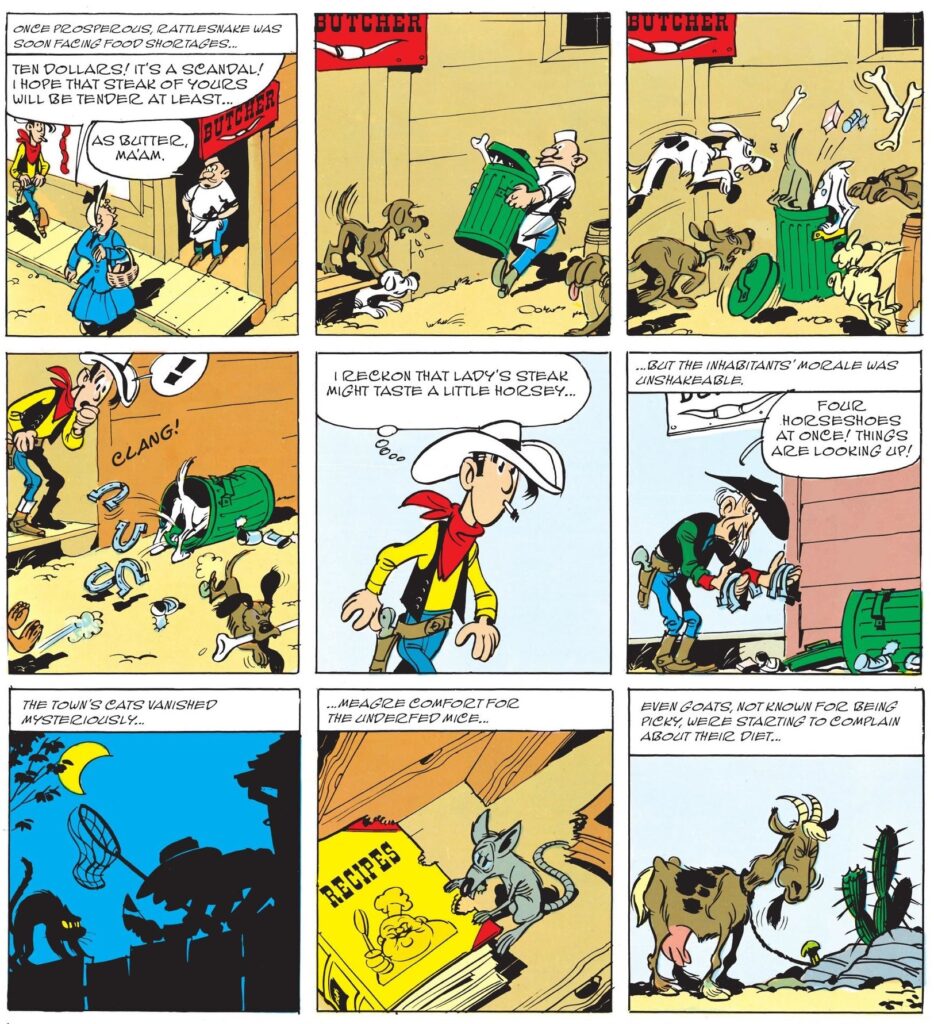
The Bluefeet are Coming!
As for the ethnic imagery and prejudiced, infantilizing depiction of the villains, it’s not just that I was not aware of the sociopolitical implications… I remember taking it all as just another feature of the series’ distorted world. I expected everyone to be – and look – silly except for Lucky Luke, who was the perennial straight man.
After all, the larger joke was precisely that Luke was a proper hero (i.e. one that could’ve ridden out of a classic western) engaged in proper adventures (i.e. with familiar dramatic stakes) while surrounded by a cast of wacky characters!
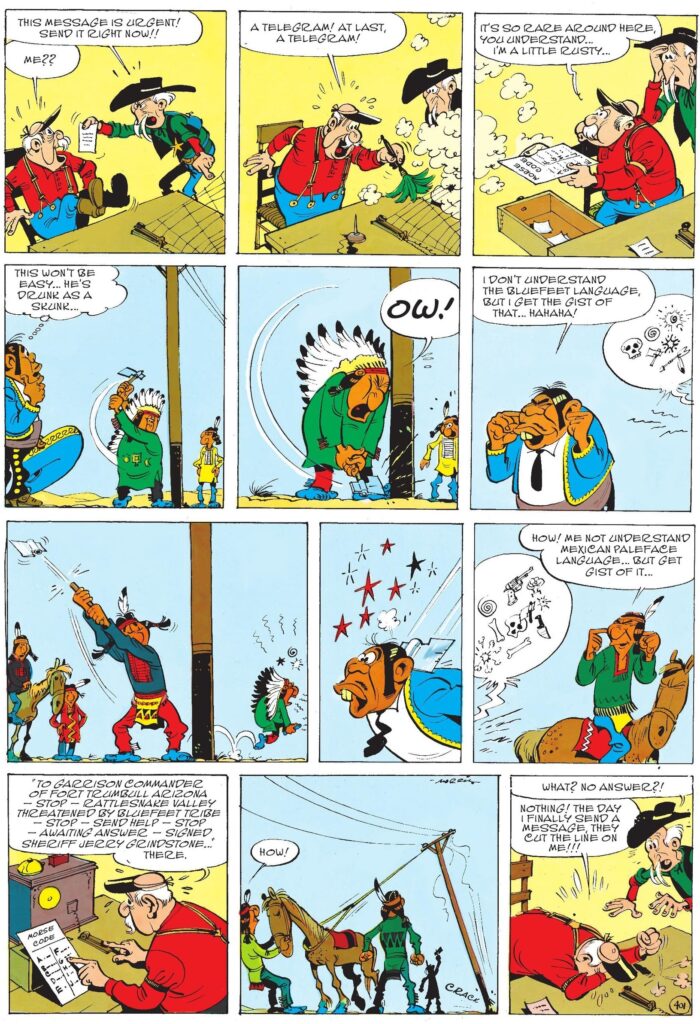
The Bluefeet are Coming!
Now, I’m certainly not saying there isn’t anything racist and otherizing about Cucaracha’s physique or the Bluefeets’ broken English (especially once you bear in mind that they’re not supposed to be talking English here, but their own native tongue). Looking at it as an adult, this is quite plain to see!
Yet I’d like to point out there is more going on here than a simplistic caricature of difference. Notice the classic gag in the two strips in the middle of the page: although the panels have different sizes, the content has a parallel structure, thus conveying that the characters aren’t so different at the end of the day… and both can be objects and agents (and, in this case, fans) of comedy.
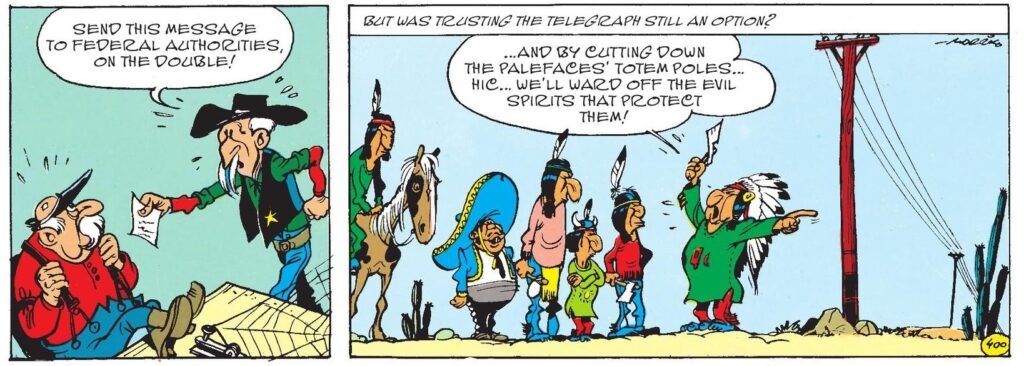
And it’s not just the non-whites that are equalized in this way – so are the cowboys and Indians:
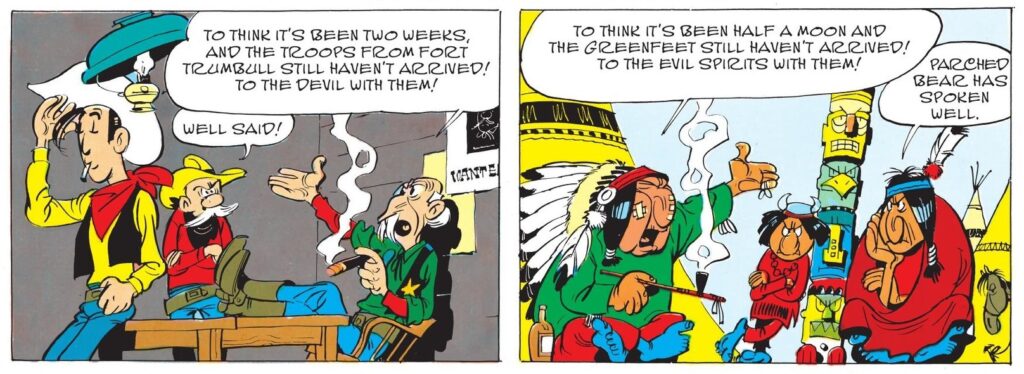
The Bluefeet are Coming!
Rattlesnake’s sheriff is as clumsy and gullible as the Bluefeets’ chief – and in both their communities there are followers as well as sceptics. This is not to say that it feels the same to laugh at the oppressors and at the oppressed… But I do find it striking that, for all the humor based on the notion of difference, there is also plenty of humor subverting the expectation of difference.
Indeed, for every joke about Native Americans being violent (collecting scalps), superstitious (interpreting phenomena through religious lenses), and savage (displaying ‘strange’ customs and a childlike ignorance of ‘civilization’), you’ll find jokes predicated on the twist that they turn out to be harmless, don’t take their culture all that seriously, and engage in recognizable variations of western technology and behavior. Then again, none of this is all that linear: in some of the latter cases, the humor comes from the blatant inaccuracy of what’s being presented (i.e. from the fact that difference is clearly being downplayed), just like the former gags are also ostensibly unrealistic (i.e. the joke there is that difference is clearly being exaggerated).
My point, though, is that, even if not necessarily balanced, Lucky Luke’s humor isn’t unidirectional. Like many other traditional Eurocomics – including, as mentioned before, Hergé’s Adventures of Tintin – the series somehow blends culturally insensitive (written and visual) discourse with a progressive dimension of humanist tolerance and social justice…
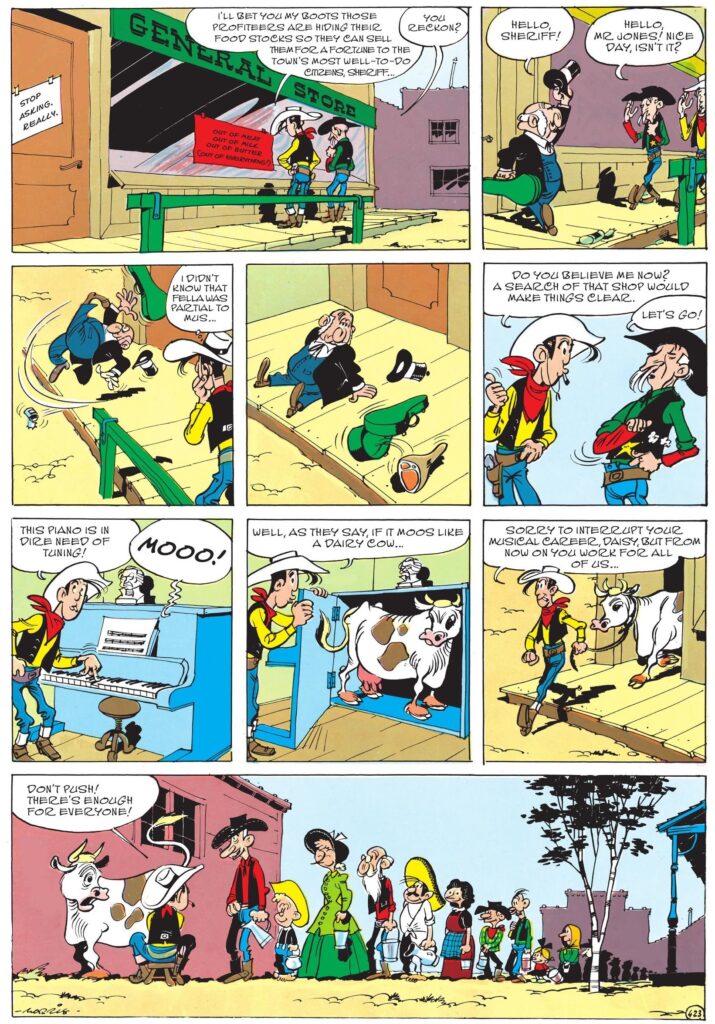
The Bluefeet are Coming!
An explosive reminder that comics can be awesome:
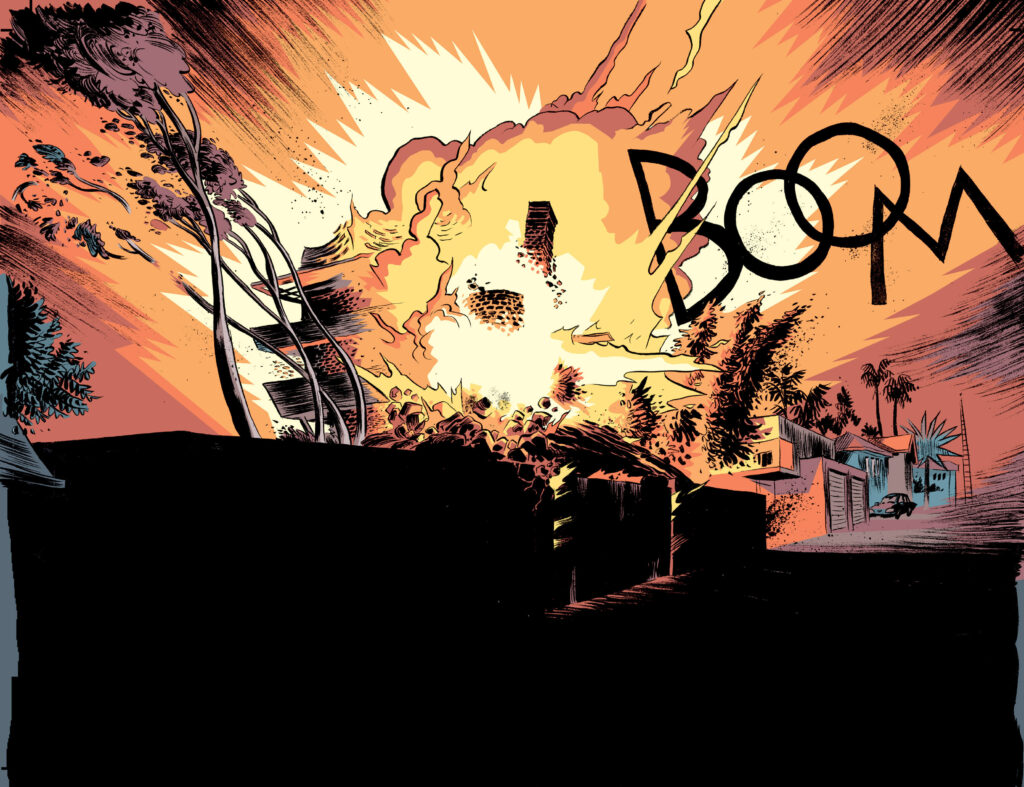
Casanova: Acedia #7
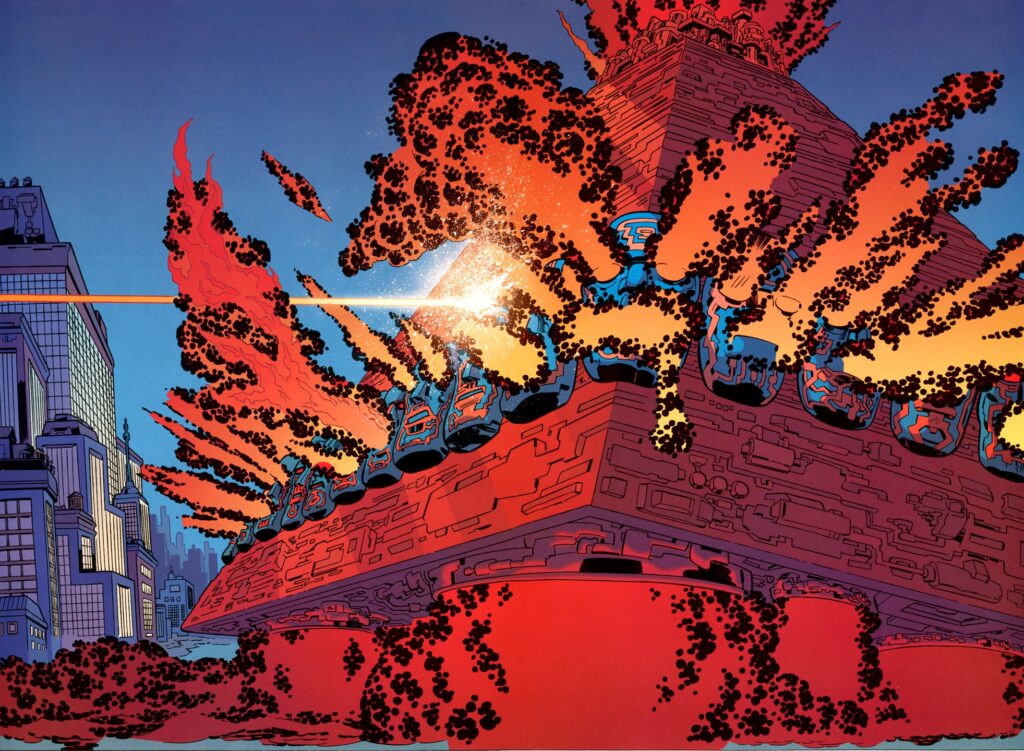
Gødland #12
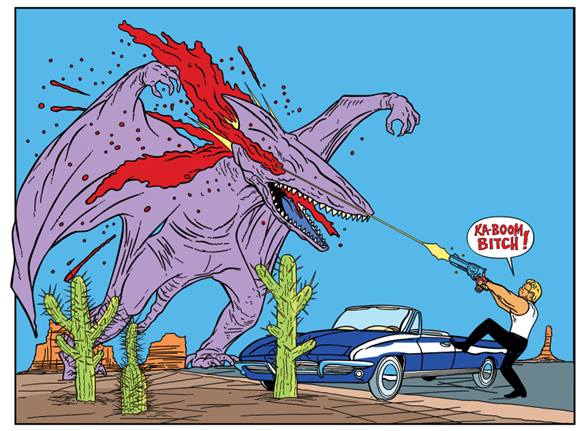
Last Driver
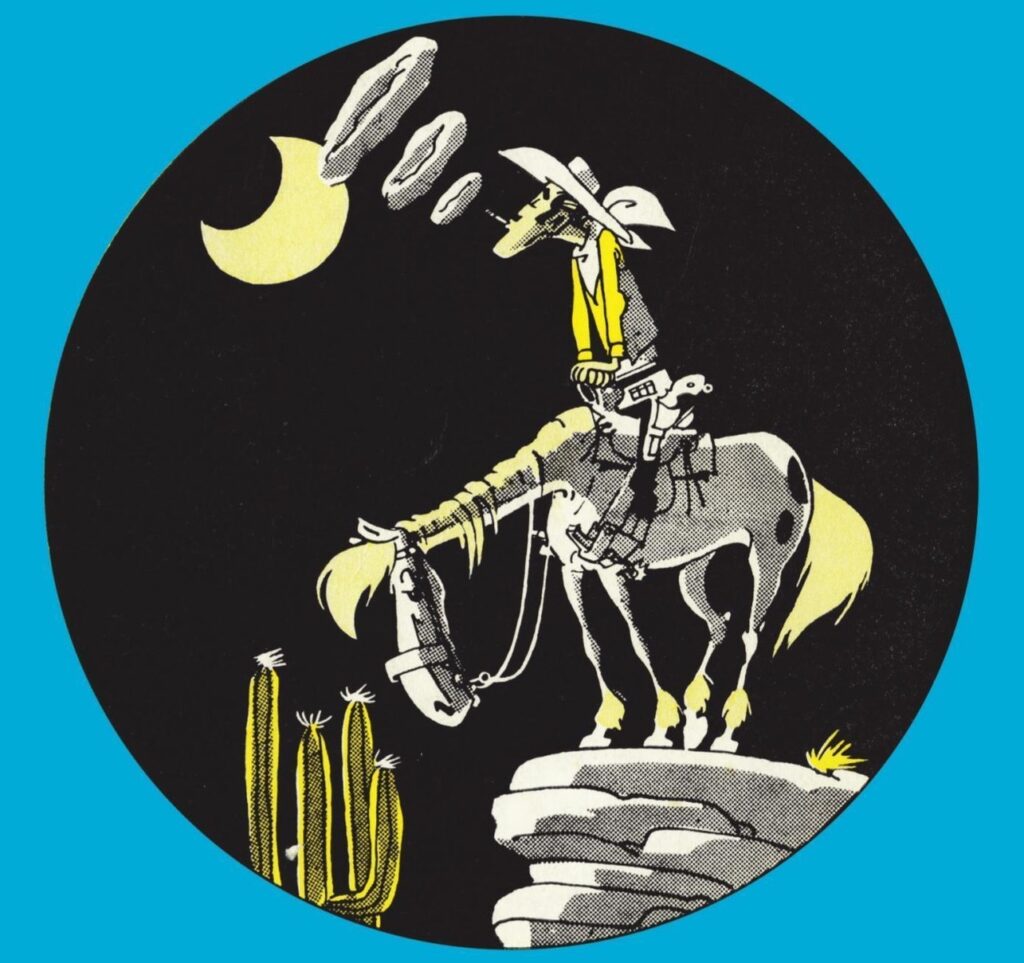
Last year, when I did a couple of posts about The Adventures of Tintin, I naively mentioned I wanted to write more, throughout 2022, about the Belgian bandes dessinées I read growing up. My work schedule didn’t allow me to fulfill this plan and I doubt 2023 will be much different… Still, I’ll try to make it at least a yearly thing, not so much out of nostalgia, but because I find it interesting to look back on these books now and to place them in a historical context that was far from my mind when I first encountered them as a kid.
This time around, I want to focus on the early years of the popular western comic Lucky Luke, originally written and drawn by Morris.
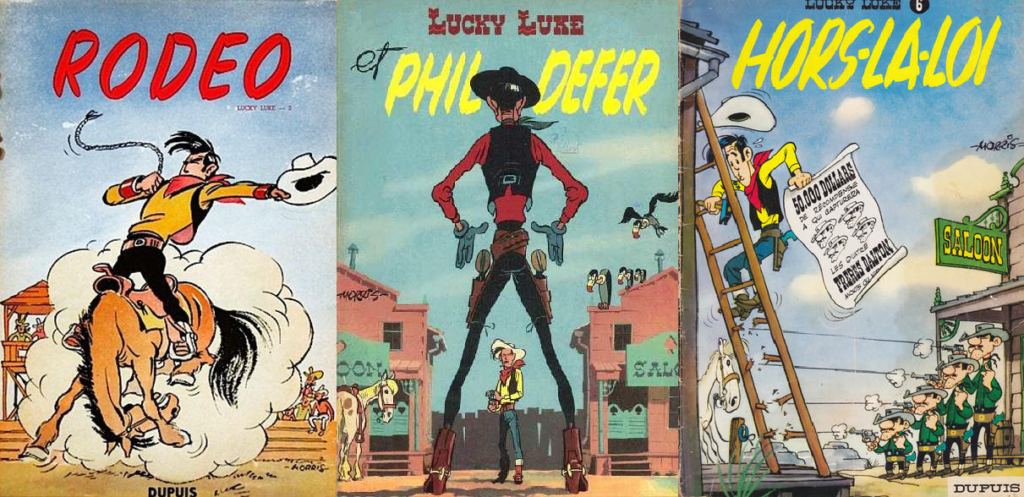
Now that I think about it, the dozens and dozens of books (or ‘albums,’ as BD books are usually called) about the quick-draw drifter Lucky Luke – and his faithful white horse, Jolly Jumper – must’ve been where my whole passion for westerns started. This is where I first came across many of the genre’s tropes – and while I could spot the silliness in the series’ exaggerated depiction of the so-called Wild West, I also approached the stories as rip-roaring adventure yarns involving exciting gunfights in a violent, quasi-lawless world.
For all its caustic comedy, Lucky Luke didn’t immediately strike me as a spoof of something that took itself seriously – in fact, when I later found John Ford’s and Howard Hawk’s movies, in my teens, I think I fell in love because they looked like a more serious version of something that I used to consume as a child, almost as if those were the revisionist texts rather than the other way around (that said, those films contain plenty of humor themselves…).
I’m sure it helped that, when I first met him, Lucky Luke was a damn cool dude:
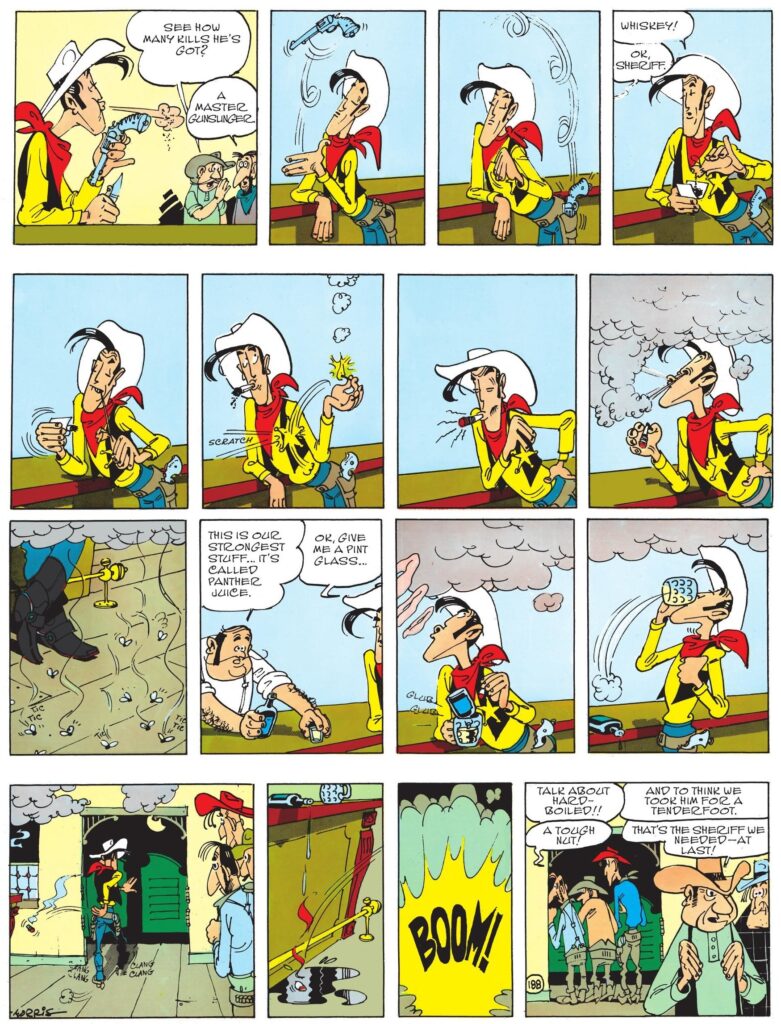
Clean-up in Red City
The page above is from one of the first albums I read, Lucky Luke versus Pat Poker, which also happened to be the oldest one I owned (it was originally published in 1953). There are a few older albums, however, which I only checked out recently and which would’ve probably made a somewhat different impression…
As many a fan knows, a series’ first installments aren’t always the best place to start, as some concepts take a while to find their feet. For instance, you shouldn’t try to get into Terry Pratchett’s Discworld through The Colour of Magic (I personally recommend the fourth book, Mort) or into Judge Dredd through The Complete Case Files 01 (you’ll be better served with the volume 02, which collects the classic arcs ‘The Cursed Earth’ and ‘The Day the Law Died!’). Likewise, those initial Lucky Luke comics are still extremely crude compared to what was to come.
By the time Morris created and developed Lucky Luke, on the pages of the Belgian BD magazine Le Journal de Spirou in the mid-to-late 1940s, there was already quite a tradition of western comedies drawing humor from the genre’s conventions, including classic films featuring Buster Keaton, Laurel & Hardy, Bob Hope, and the Marx Brothers. However, having now tracked down the strip’s very first stories, I can’t help noticing a much more specific influence: the very basic plots (which are little more than loose springboards for Morris to draw the hell out of dynamic fights and chases), the rounder designs, and the cartoony slapstick owe a crystal-clear debt to American animated shorts, most notably the ones about Popeye the Sailor Man.
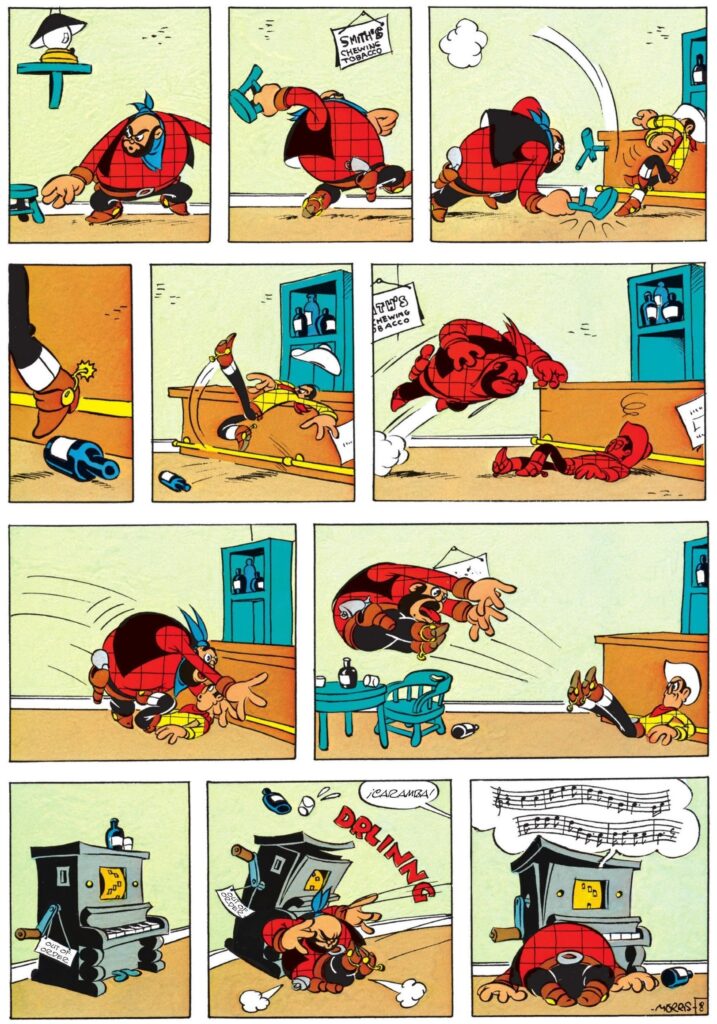
Arizona
More than a pastiche of horse operas, then, Lucky Luke started out as a comic-book version of the kind of stuff Max Fleischer, Tex Avery, and Chuck Jones were doing on the screen. Seriously, I keep expecting Droopy Dog to pop up in ‘Lucky Luke Versus Cigarette Caesar,’ where an escaped convict tries to flee from Luke but constantly runs into him no matter where he goes (the latter even hides inside a cactus and at the bottom of a well), almost as if our lonesome cowboy has suddenly gained supernatural powers. The whole thing is unabashedly goofy, rejecting any sense of realism for the sake of nonsense gags (one of which anticipates Leone’s A Fistful of Dollars). And so, along with the clichés of the western genre, we get the clichés of that era of comedy!
A Belgian creator in the postwar years doing stories about the mythology of the United States, inspired by Hollywood movies and cartoons, may seem like a straightforward case of cultural imperialism, with a triumphant USA flooding a devasted Europe with its values and imagery in the aftermath of WWII. Indeed, Morris was an Americanophile, but he didn’t just access the US from the outside: he traveled throughout the country – and through Mexico – in search of landscapes and inspiration before moving to Brooklyn in 1948, where he lived for a few years, absorbing American culture from within while watching westerns on television and doing research at the New York Public Library.
According to the introduction in the second volume of Cinebook’s Lucky Luke: The Complete Collection, it was during this research that Morris came to know more about the Dalton gang, whom he used as characters in the story ‘Outlaws’ (and whose fictitious cousins later became Lucky Luke’s most recognizable recurring villains). Morris made up the Daltons’ comical appearance, but he allegedly based their demeanor on his impression of reality: ‘accounts followed where the Daltons were often referred to as “eternal runners-up” of crime, and it’s easy to see why. The reality was that they envied their cousins, the James brothers, who were truly dangerous bandits, and they wanted to match their exploits. Unfortunately, they had neither the intelligence nor the skill. Actually, I’m convinced they were complete idiots. All of their attacks on banks and stagecoaches were poorly prepared, turned into terrible bloodbaths, and only yielded measly loot – peanuts, really.’
On top of depicting the Dalton brothers as incredibly stupid and nasty, Morris originally tried to get some dark laughs out of their pathetic deaths through a gory drawing of the leader of the gang, Bob Dalton, getting shot in the head by Lucky Luke. However, publisher Charles Dupuis ordered the image modified out of fear that the story would get banned in France by the Committee in Charge of Surveillance and Control over Publications Aimed at Children and Adolescents (whose censorship had a protectionist agenda and was usually stricter with Belgian imports), which would’ve deprived them of the coveted French market.
Yes, I mentioned that Lucky Luke was meant to shoot Bob Dalton. In fact, in the earlier comics it was not unheard of for the series’ protagonist to kill his opponents – something that changed precisely in response to France’s censorious law of 1949, turning Lucky Luke into a more virtuous hero.
As with Batman, though, this refusal to kill didn’t make Luke any less of a badass. Hell, it made him even more impressive and the resolutions to his conflicts necessarily more imaginative:
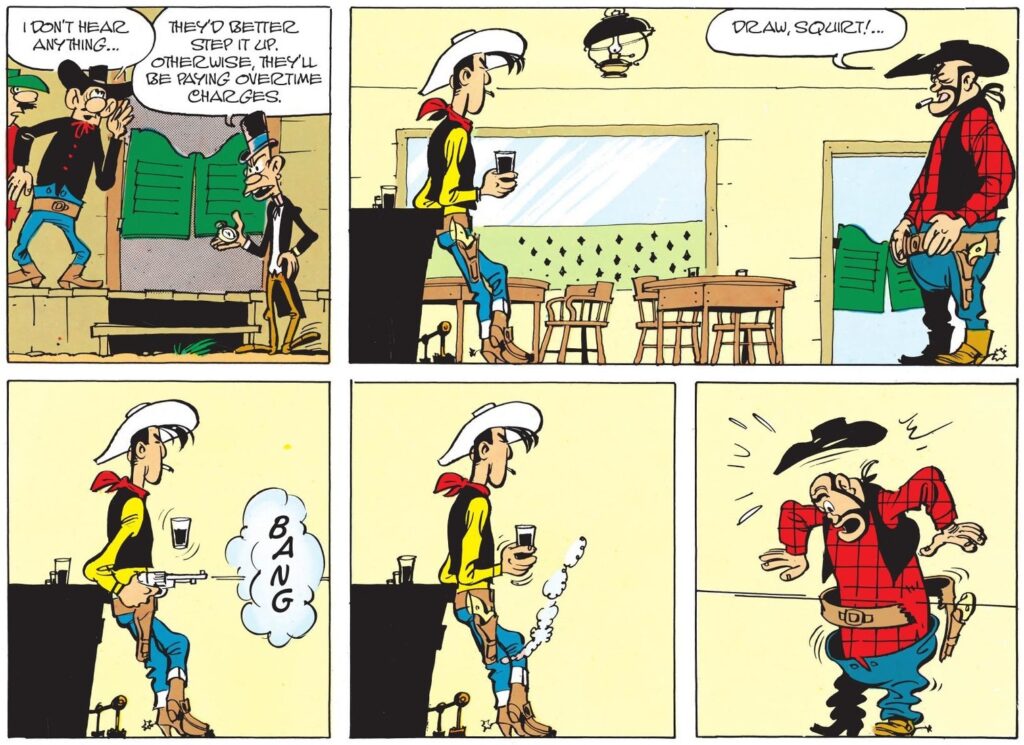
Rails on the Prairie
That said, for a bit in the early 1950s the tendency was actually for Lucky Luke to turn, if not exactly grittier, at least less cartoonish. You can see this in the two tales collected in Lucky Luke versus Pat Poker, ‘Clean-up in Red City’ and ‘Rough and Tumble in Tumbleweed.’ The first one is a variation of the film Destry Rides Again: assigned to clean up a town where sheriffs have a limited lifespan, Lucky Luke is initially underestimated by the town’s folks, who patronize him as a harmless tenderfoot, but he soon turns things around, using his wits as well as his guns and fists.
The memorable main villain here is the card shark Pat Poker, who is such a scoundrel he even cheats when playing alone:
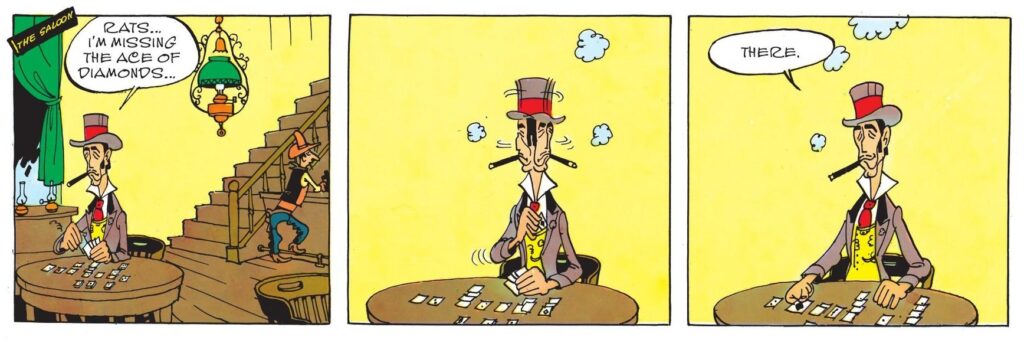
Clean-up in Red City
As you can see from this example, there is still humor to the proceedings, although it’s not the central focus anymore, just something that makes the action more colorful. Even when the gags are slightly surreal, the whole thing generally feels more like a comedic western than like a western comedy.
I can’t tell you how many times I’ve read Lucky Luke versus Pat Poker as a kid, but I’m guessing the number would be in the dozens, as I still recall almost every scene by heart. It was never my favorite Lucky Luke comic, but it left a mark – no matter how much of a goody goody two shoes he became in later albums, for me Lucky Luke was always cool because I had seen how much butt he could kick when push came to shove.
For instance, check out this thriller-worthy, Hitchcockian sequence in which Pat Poker tries to have our hero shot from across the street but Lucky Luke turns the tables on him while acting in complete control of the situation:
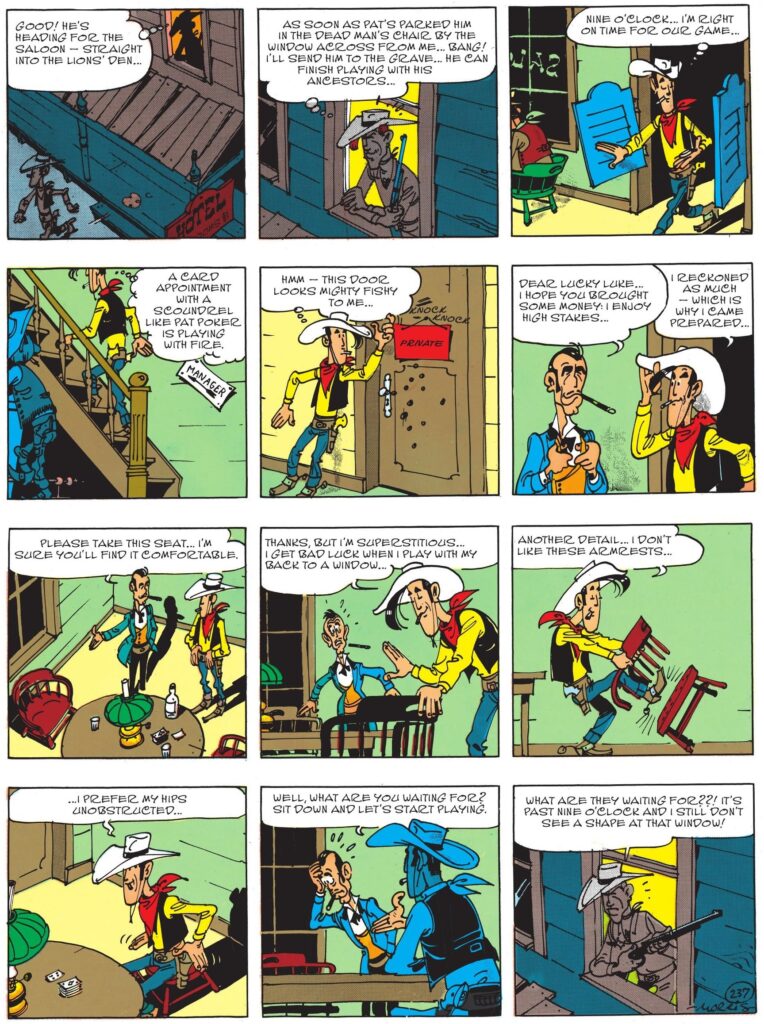
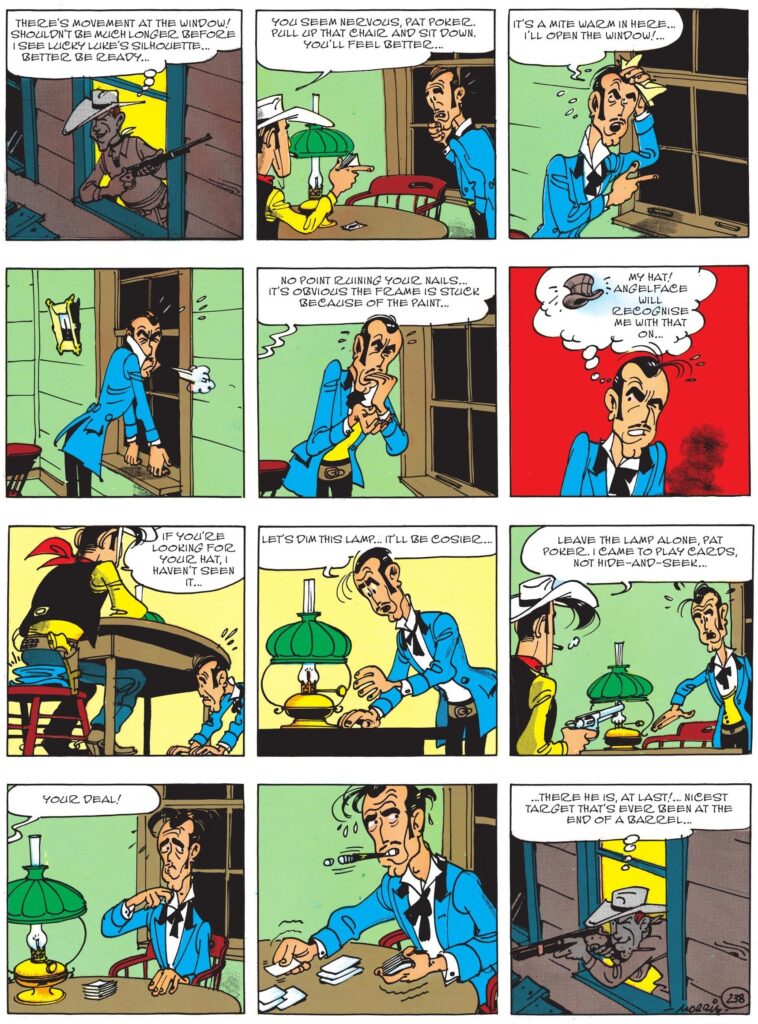
Rough and Tumble in Tumbleweed
Since this was the oldest album I owned, I always assumed Lucky Luke had begun as a (togue-in-cheek) western and gradually moved toward outright parody. As it turns out, zany humor was at the core of the series from the start and there was only a brief intermediary period where things seemed to be going in a different direction.
The return to full-blown comedy in the mid-1950s can be explained through two main factors, as outlined by Christelle and Bertrand Pissavy-Yvernault’s informative introductions to the first volumes of Lucky Luke: The Complete Collection. In New York City, Morris used to hang out with comic-book creators John Severin, Jack Davis, Will Elder, and Harvey Kurtzman (whose first names, Pissavy-Yvernault speculate, inspired the names of the Daltons’ cousins), having followed up close the conception of EC’s MAD Magazine, whose parodic style proved to be an important influence. Also in New York, Morris met René Goscinny, who eventually became Lucky Luke’s prolific scriptwriter for the following decades and whose sense of humor ended up shaping the series’ identity.
Indeed, Goscinny’s intial album, Rails on the Prairie, is already packed with the same relentless mix of anachronisms, puns, and social satire – plus an ironic narration – that you can also find in his scripts for Asterix and Iznogoud:
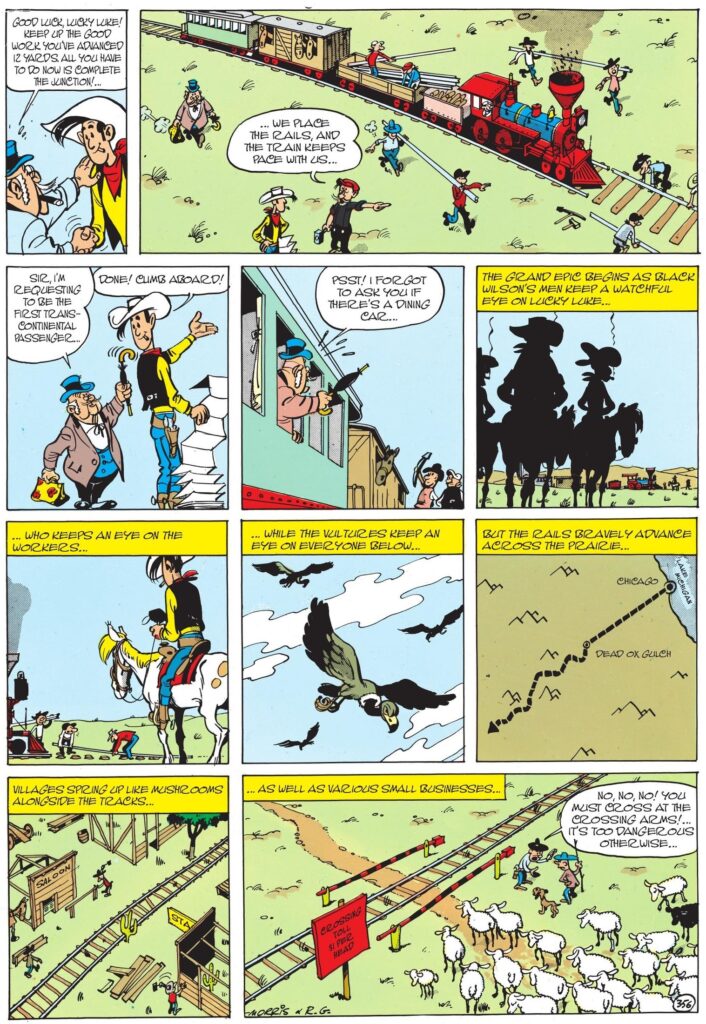
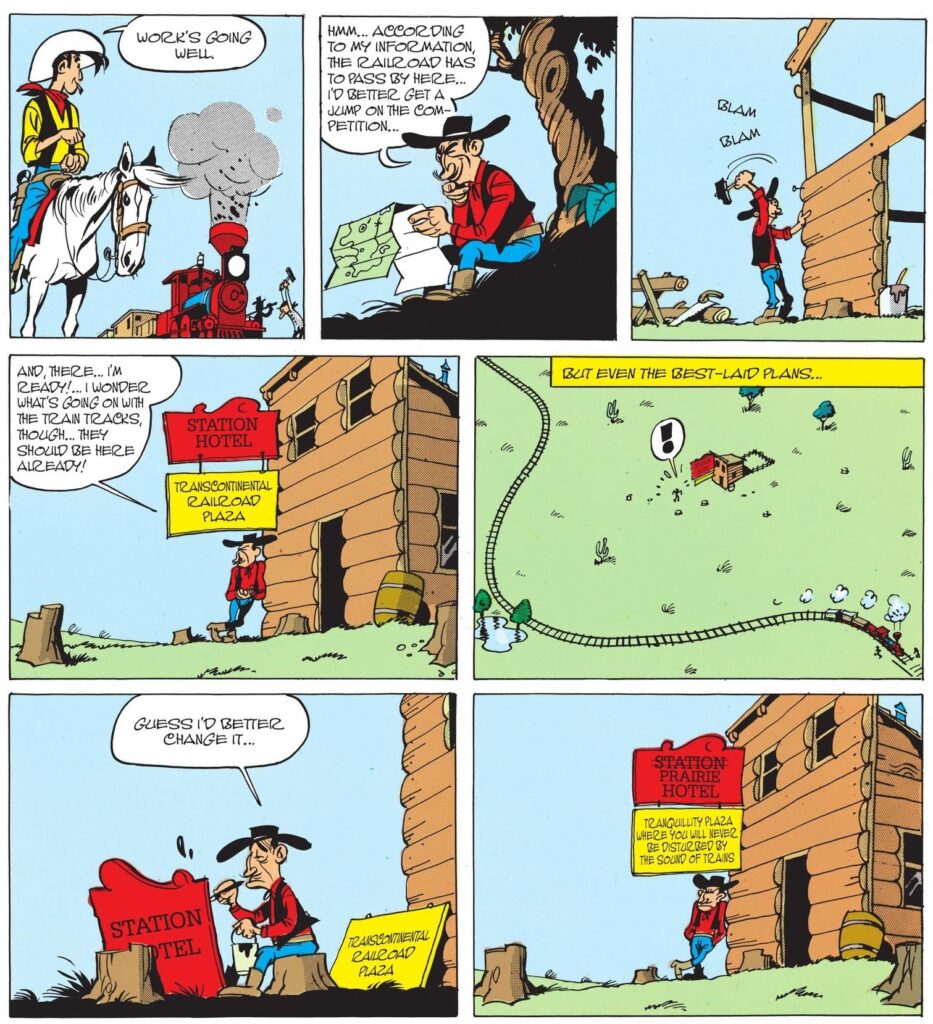
Rails on the Prairie
Next week, we’ll look closer at Lucky Luke’s approach to humor.
Just another kickass reminder that comics can be awesome…
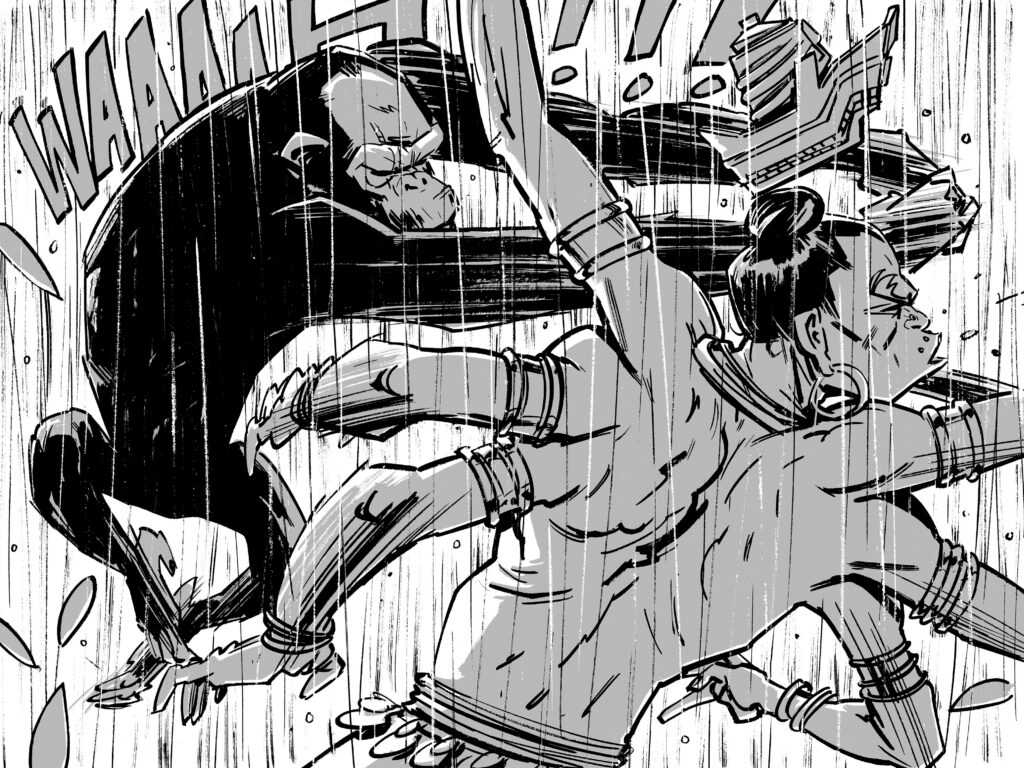
Guerillas (v3) #5
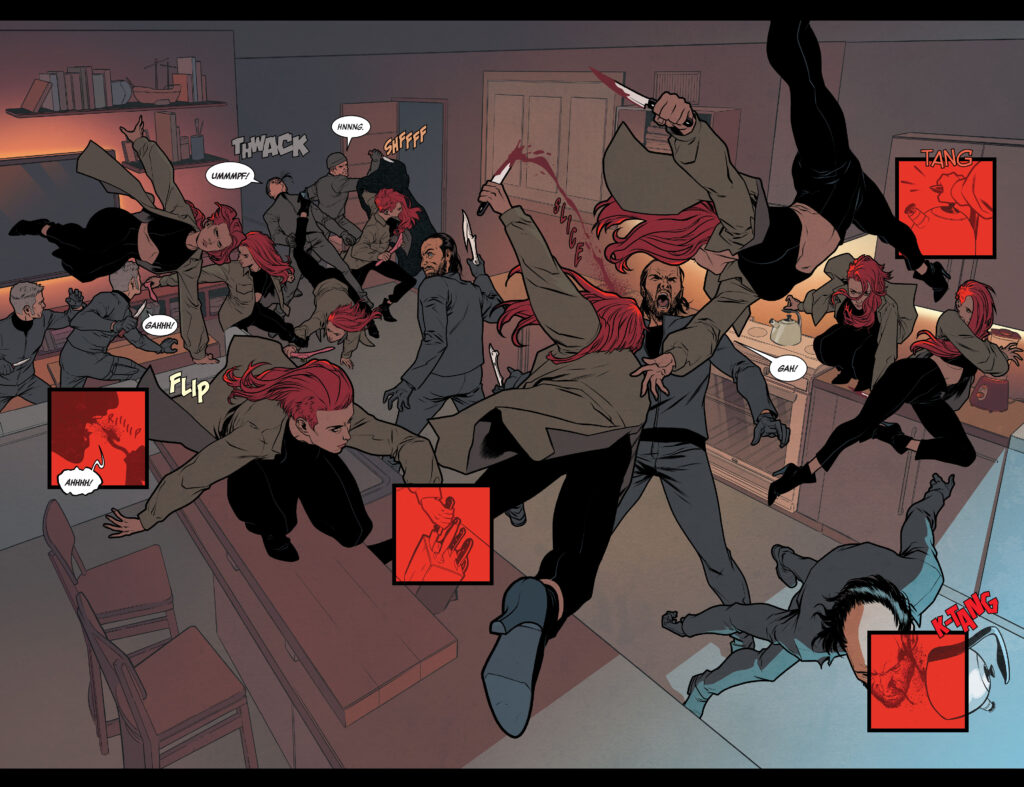
Black Widow (v8) #3
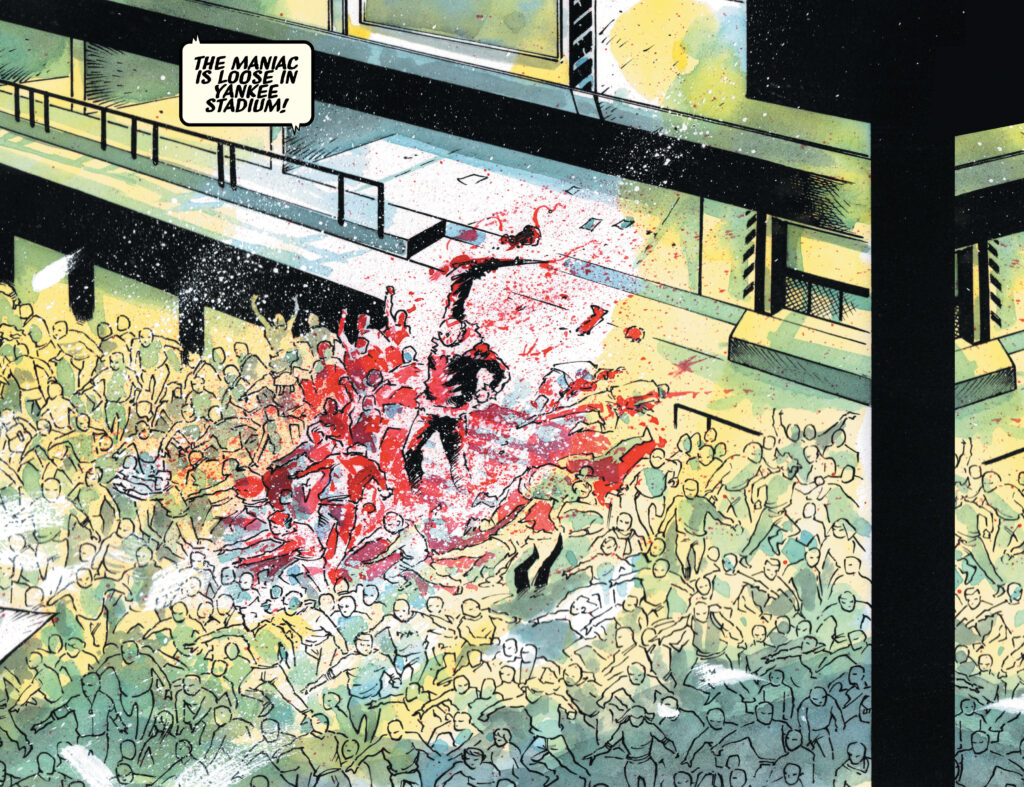
Maniac of New York: The Bronx is Burning #4
So, I finally started watching Andor and it’s as neat as I’d heard. It’s Star Wars as a taut cyberpunk heist, compelingly acted and with enough of a distinct vibe to feel more satisfying than the endless retread of the same stock characters and plotlines that the franchise has been delivering on the big screen. It also engages with fascism and anti-colonialism in a more thoughtful way than any of those films (or the latest Dune), even including – thematically appropriate, if politically tasteless – nods to The Battle of Algiers. Technically, this is a prequel to Rogue One (an enjoyable, if messy, picture whose controversies I touched on at the time) but, from what I’ve watched so far, there’s no need to have seen it (or any other SW movies, for that matter) to appreciate Andor.
Honestly, it’s nice to see Star Wars pillaging from new places. The original trilogy’s pedigree included not only American adventure movies – swashbucklers, westerns, war stories, and even hard science fiction like 1950’s Destination Moon – but also a number of foreign influences, from French comics (Valérian and Laureline) to Kurosawa’s samurai epics (especially the gorgeous-but-goofy The Hidden Fortress), not to mention Nazi propaganda (Triumph of the Will being a recurrent visual reference). George Lucas brought further influences for the prequels, such as peplums and political thrillers. In Attack of the Clones, it’s hard to miss the echoes of The Fifth Element (the high-speed chase among the flying cars) and Chaplin’s Modern Times (the slapstick sequence at the assembly line).
But it wasn’t just cinema and comics… There’s also plenty of literature in Star Wars’ family tree. Today, I want to highlight two books that should fit into that genealogy:
THE SECRET OF SINHARAT
(Leigh Brackett, 1964)
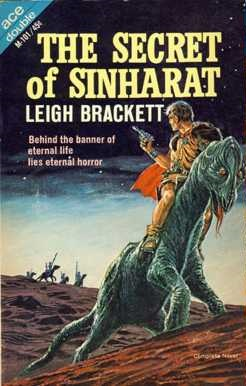
“For hours the hard-pressed beast had fled across the Martian desert with its rider. Now it was spent. It faltered and broke stride, and when the rider cursed and dug his heels into the scaly sides, the brute only turned its head and hissed at him. It stumbled on a few more paces into the lee of a sandhill, and there it stopped, crouching down in the dust.
The man dismounted. The creature’s eyes burned like green lamps in the light of the little moons, and he knew that it was no use trying to urge it on. He looked back the way he had come.
In the distance there were four black shadows grouped together in the barren emptiness. They were running fast. In a few minutes they would be upon him.”
Known as the Queen of Space Opera, Leigh Brackett wrote some of the best pulp stories about two-fisted escapades in other planets, usually owing more to sword & sorcery fantasy than to science fiction. Set in a future where the Solar System has been colonized for ages and where various alien species co-exist – and occasionally try to conquer each other’s territory – her works anticipate that initial Star Wars sensation of entire civilizations having risen and fallen in the distant past, as if we are now witnessing, if not post-apocalyptic times, at least a particularly decadent era in the ruins of ancient empires. (No wonder Lucas hired Brackett to write the first draft of The Empire Strikes Back!)
Many of Leigh Brackett’s tales feature Eric John Stark, a cunning human outlaw raised by Mercurian natives who, when threatened, tends to revert back to his savage origins (he has a whole alter ego and everything). Although clearly sharing the DNA of Conan and Tarzan, Stark has the sort of stoic, world-weary characterization that you can also find in Brackett’s screenplays for Howard Hawks… Indeed, some scenes could almost be read as novelizations of Hawks’ moody westerns, albeit with ray guns and an extraterrestrial twist:
“‘It’s been a long time, Eric,’ he said.
Stark nodded. “Sixteen years.” The two men studied each other for a moment, and then Stark said, “I thought you were still on Mercury, Ashton.”
“They’ve called all us experienced hands in to Mars.” He held out cigarettes. “Smoke?”
Stark took one. They bent over Ashton’s lighter, and then stood there smoking while the wind blew red dust over their feet and the three men of the patrol waited quietly beside the Banning. Ashton was taking no chances. The electro-beam could stun without injury.”
Eric John Stark made his debut in the novella ‘Queen of the Martian Catacombs’ (originally published in 1949, in the magazine Planet Stories), which Leigh Brackett significantly revised and expanded in the 1964 novel The Secret of Sinharat. The plot involves Stark infiltrating a band of mercenaries hired by a barbarian leader who is preparing to wage a war on Mars, mobilizing the locals with promises of immortality. A barrage of treachery, seduction, magic, and harsh physical violence culminates in the mystical city of Sinharat, which was supposedly inhabited by a sinister nation of Martian wizards hundreds of years ago.
The situations and story beats will be familiar to anyone who has read or seen their share of adventure fiction. What makes this my platonic ideal of the so-called ‘sword and planet’ subgenre is Brackett’s gripping pace and hardboiled prose. In short, pithy paragraphs, she paints riveting descriptions of action, landscape, and psychology, vividly transporting us into her fantastic worlds.
“The dead sea bottom widened away under the black sky. As they left the lights of Valkis behind, winding their way over the sand and the ribs of coral, dropping lower with every mile into the vast basin, it was hard to believe that there could be life anywhere on a world that could produce such cosmic desolation.
The little moons fled away, trailing their eerie shadows over rock formations tortured into impossible shapes by wind and water, peering into clefts that seemed to have no bottom, turning the sand white as bone. The iron stars blazed, so close that the wind seemed edged with their frosty light. And in all that endless space nothing moved, and the silence was so deep that the coughing howl of a sand-cat far away to the east made Stark jump with its loudness.
Yet Stark was not oppressed by the wilderness. Born and bred to the wild and barren places, this desert was more kin to him than the cities of men.”
FOUNDATION AND EMPIRE
(Isaac Asimov, 1952)
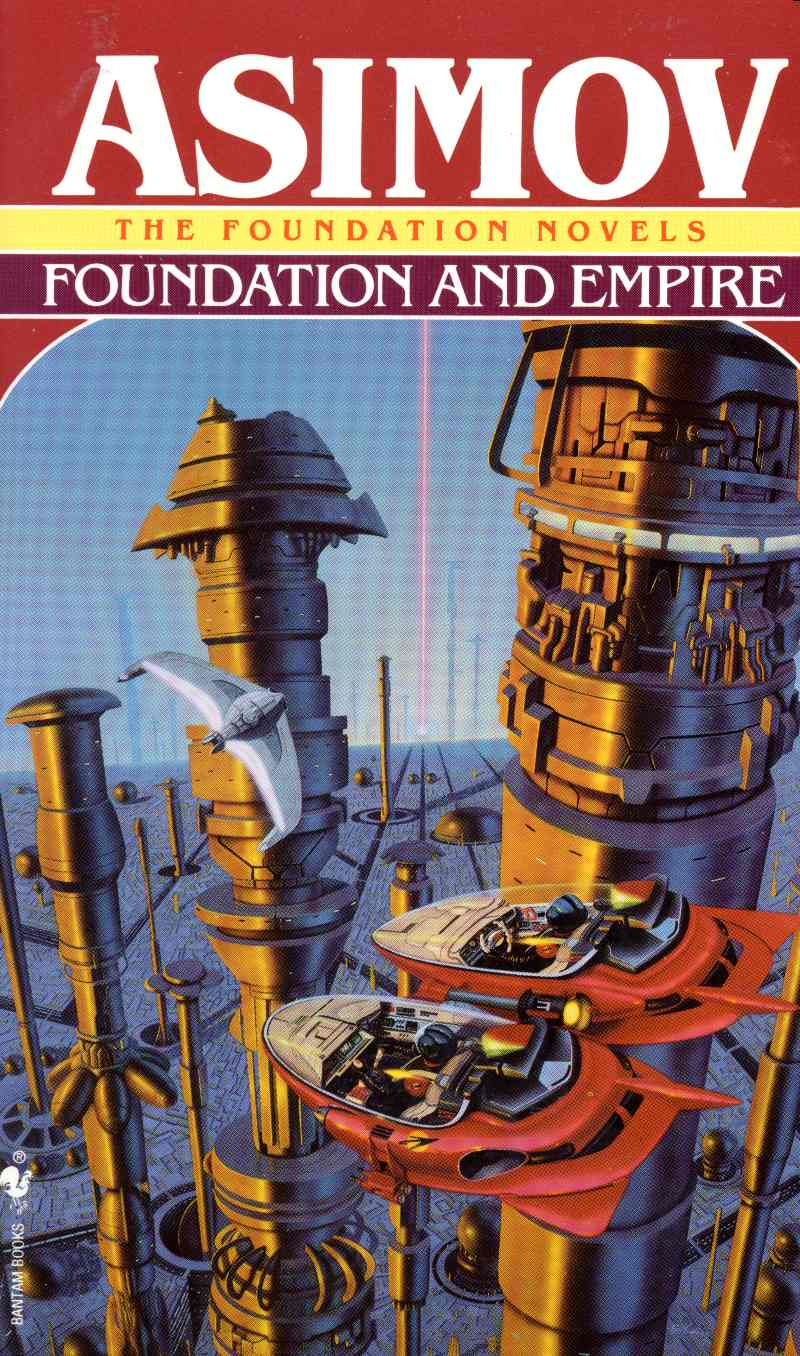
“Bel Riose travelled without escort, which is not what court etiquette prescribes for the head of a fleet stationed in a yet-sullen stellar system on the Marches of the Galactic Empire.
But Bel Riose was young and energetic – energetic enough to be sent as near the end of the universe as possible by an unemotional and calculating court – and curious besides. Strange and improbable tales fancifully-repeated by hundreds and murkily-known to thousands intrigued the last faculty; the possibility of a military venture engaged the other two. The combination was overpowering.”
The first sequel to Isaac Asimov’s Foundation kicks off a few decades after the original novel and continues to leap forward, telling the further story of the eponymous institution – an odd political organization built around the centuries-old predictions of psychohistorian Hari Seldon, who used hyper-advanced mathematics and sociology to chart the emergence of a successor to the decadent Galactic Empire. Although the text does a smooth job of filling you in about all this, so that technically you can get into the book without having read what came before, Foundation and Empire is a very direct continuation of Foundation, not just building on the general framework but also picking up loose ends and calling back to events and characters from the previous volume… while also setting up the third one (curiously enough, called Second Foundation).
And yet, it’s not just more of the same. If that previous volume was a futuristic history of imperialism, chronicling the replacement of military force by religion and then economics as the major sources of international/interplanetary power – each of them backed by science and technology – this one is more specifically centered on space war, first against the remnants of the Galactic Empire (hence the boring title) and then against a mysterious antagonist called The Mule. The main shift is that, for the most part, the Foundation is now viewed from the outside or from its margins rather than from the perspective of its successive leaders. Likewise, the premises and logic of psychohistory are continuously tested and dissected rather than taken for granted (‘The laws of history are as absolute as the laws of physics, and if the probabilities of error are greater, it is only because history does not deal with as many humans as physics does atoms, so that individual variations count for more.’). I love shifts like this, which implicitly invite readers to question their loyalties and adjust their mind-frame about whom to root for – or, at least, whom they expect to win at the end of the day.
Another change is the fact that Foundation and Empire is quite humorous, including a much livelier and more idiosyncratic cast. Among the best new characters are the cynical Emperor Cleon II and his slimy secretary Brodrig:
“The low-born, faithful Brodrig; faithful because he was hated with a unanimous and cordial hatred that was the only point of agreement between the dozen cliques that divided his court.
Brodrig – the faithful favorite, who had to be faithful, since unless he owned the fastest speed-ship in the Galaxy and took to it the day of the Emperor’s death, it would be the atom-chamber the day after.”
Akin to its predecessor, Foundation and Empire reads like an anthology of interconnected political thrillers laden with shocking twists, double-crosses, and cloak & dagger, plus a fair amount of military strategy… And yes, there are some lethal laser blasts, but the protagonists are essentially cerebral men (and one woman) who favor mind games and calculations. Most scenes are about witty dialogue through which characters exchange arguments and hypotheses. At one point, a general even distances himself from the kind of figures that populate Leigh Brackett’s work: ‘I am a soldier, not a cleft-chinned, barrel-chested hero of a subetheric tridimensional thriller.’
It helps that Asimov’s prose had flourished since the first installment, with more inventive turns of phrase and a keen ability (that should inspire envy in many a professional historian) to clearly – yet enthrallingly – describe large processes. When his narrative returns to the imperial capital of Trantor, the depiction is even more impressive than the one in the original Foundation:
“And in the center of a cluster of ten thousand stars, whose light tore to shreds the feebly encircling darkness, there circled the huge Imperial planet, Trantor.
But it was more than a planet; it was the living pulse beat of an Empire of twenty million stellar systems. It had only one function, administration; one purpose, government; and one manufactured product, law.
The entire world was one functional distortion. There was no living object on its surface but man, his pets, and his parasites. No blade of grass or fragment of uncovered soil could be found outside the hundred square miles of the Imperial Palace. No water outside the Palace grounds existed but in the vast underground cisterns that held the water supply of a world.
The lustrous, indestructible, incorruptible metal that was the unbroken surface of the planet was the foundation of the huge metal structures that mazed the planet. They were structures connected by causeways; laced by corridors; cubbyholed by offices; basemented by the huge retail centers that covered square miles; penthoused by the glittering amusement world that sparkled into life each night.”
A reminder that comic-book double-page spreads can be awesome:
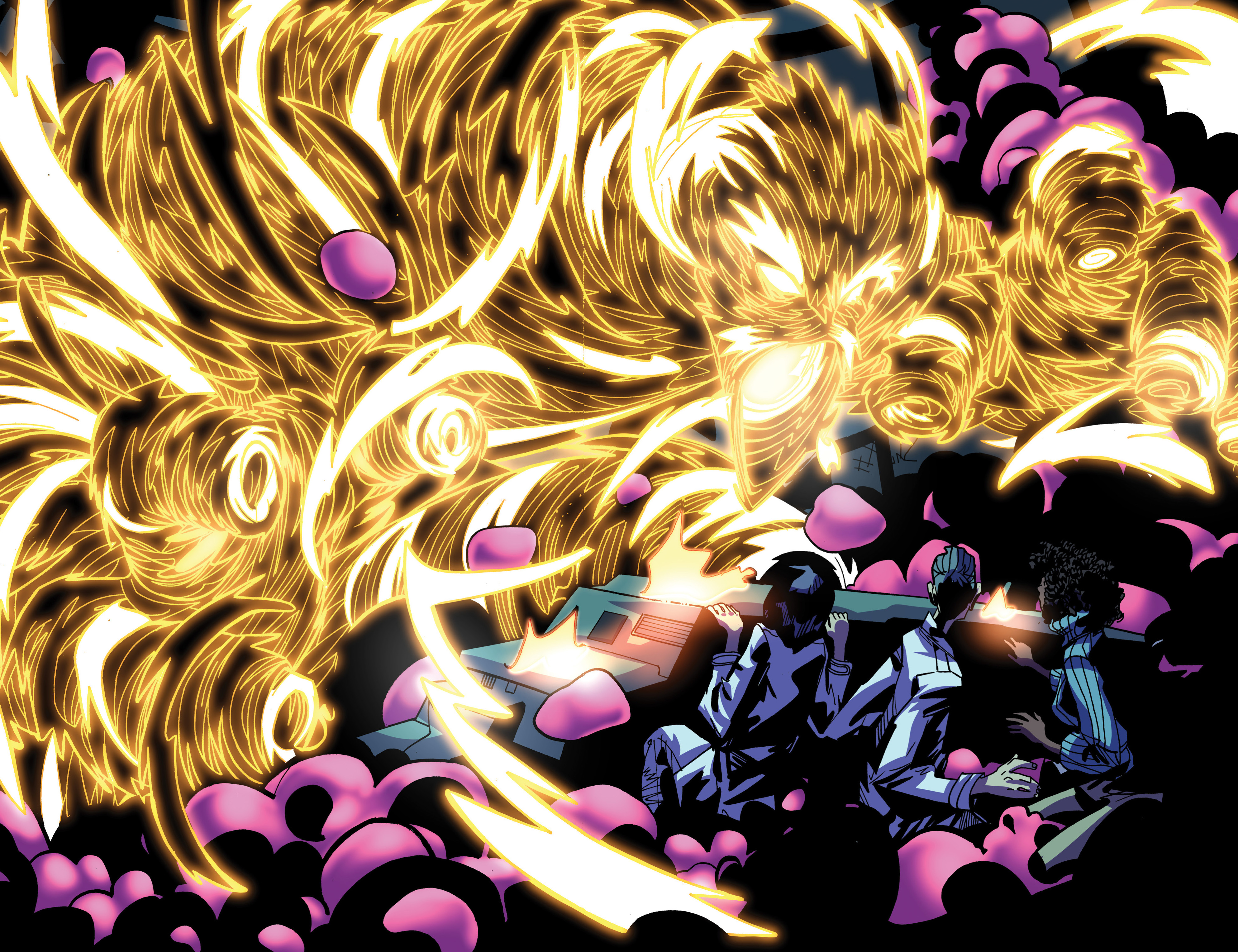 Accell #8
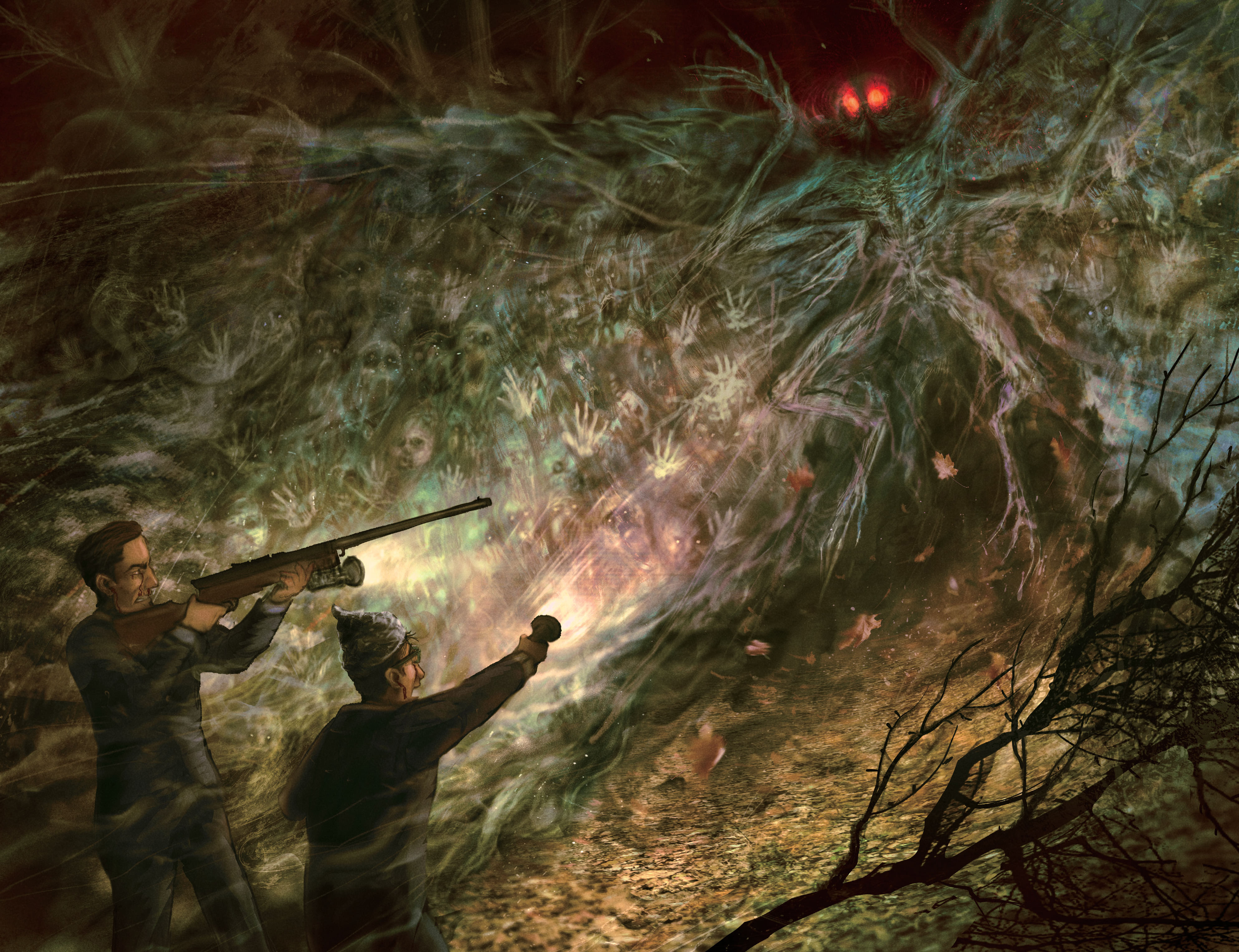 The Department of Truth #15
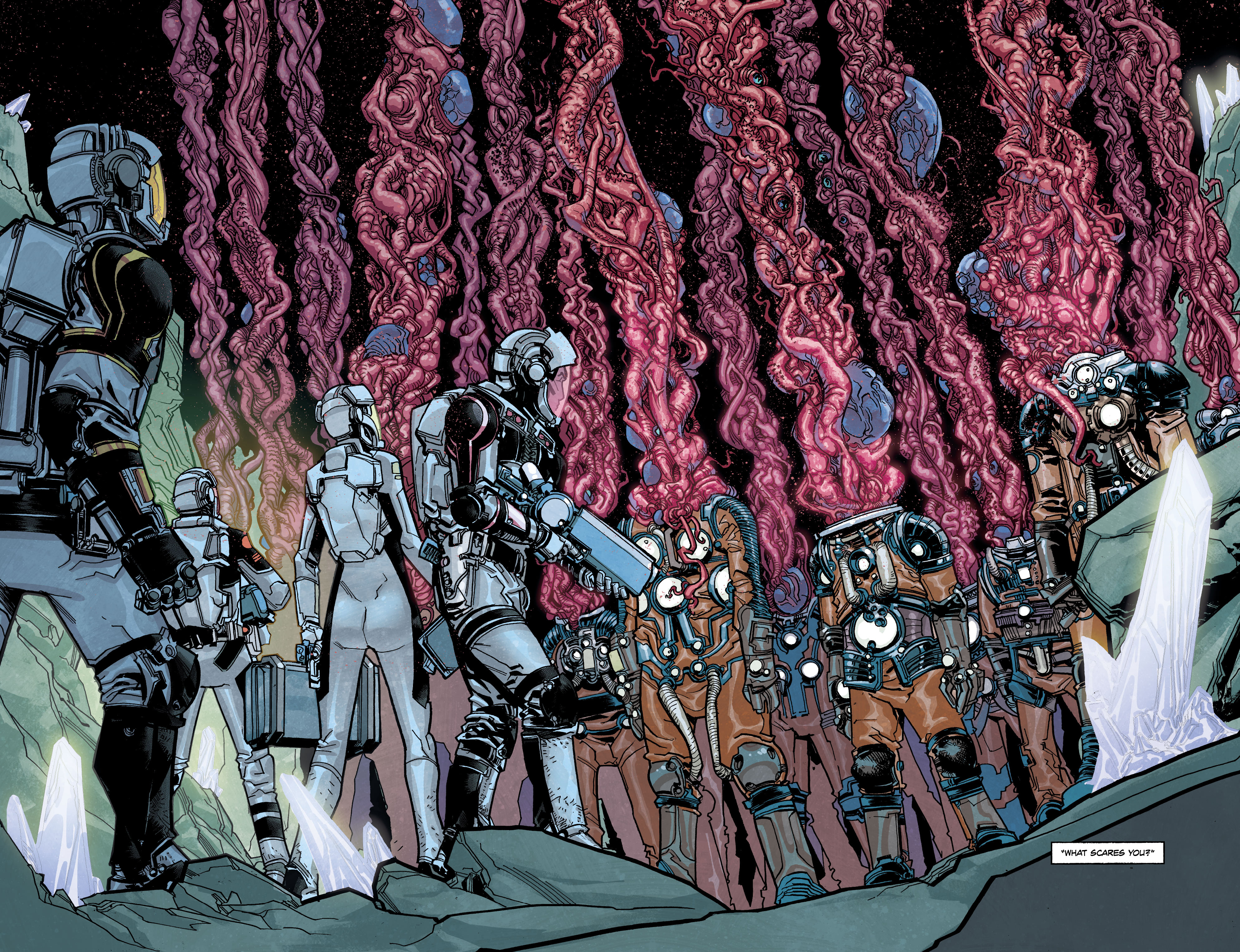 Rogue Planet #2
I read less comics than usual in 2022 – especially new stuff – so the pool for Gotham Calling’s book of the year was somewhat limited. Like last time, the one graphic novel that was bound to be the strongest contender proved trickier to get than I hoped… I’m referring to Emil Ferris’ much-awaited second volume of My Favorite Thing Is Monsters, which I still haven’t been able to get but which will no doubt earn a write-up whenever I finally feast my eyes upon it (like it happened with the elusive Tunnels last year).
That said, it’s not as if there weren’t enough astonishing comics to choose from. The mind-bending series The Department of Truth ambitiously expanded its scope and experimentation in the latest volumes, so it once again proved to be an exceptionally stimulating read (between this and The Nice House on the Lake, James Tynion IV almost became the first writer to get the top spot on my list twice). And when I felt in the mood for more grounded storytelling, the ultra-atmospheric crime yarns of That Texas Blood grew into my most reliable monthly fix throughout 2022.
Meanwhile, a bunch of longtime creators returned to their deservedly acclaimed masterworks, from decades ago, and – for the most part – managed to provide worthy follow-ups. Most notably, Bryan Talbot’s The Legend of Luther Arkwright revisited the multiversal political intrigue of the titular telepath’s bizarre saga – and, while the tapestry of interconnected narratives feels messier this time around (one strand does little more than recount events from the previous books; another gets stuck in morally simplistic territory about good & bad people), these are minor side effects of how incredibly ambitious, personal, and maximalist the whole project turned out to be.
That said, my favorite book of 2022 – and the one that most vividly reignited the sheer joy I can get from genre comics – was Catwoman: Lonely City.

Written, drawn, colored, and lettered by Cliff Chiang – who also provided the sublime covers – Catwoman: Lonely City collects a clever, prestige-sized, stupendous-looking mini-series set in a near future where Batman has died and an ageing Selina ‘Catwoman’ Kyle has been in jail for a decade. Finally released, she encounters a gentrified Gotham – ‘cleaner, safer, and a lot less free’ – whose mayor, Harvey Dent (formerly Two-Face), has cracked down on caped vigilantes and outlawed all civilian masks (including Halloween costumes, which is oddly literal).
Following a classic formula, Selina then tries to put together a crew of misfits for one last score, albeit in a police state where armed ‘tactical officers’ patrol the streets wearing Batman uniforms and the Dark Knight’s technology has been put in the service of mass surveillance. (It gets weirder.)
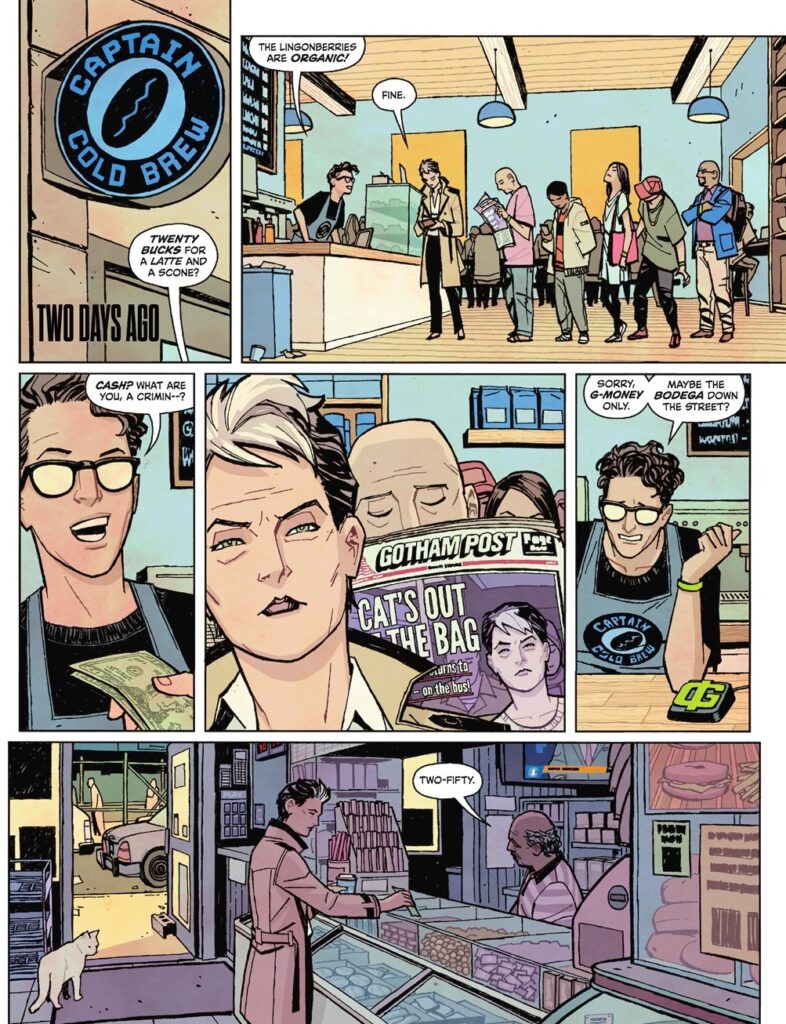
Batman comics are usually not a good way to predict the future (even if in 2003’s Gotham Knights #42 a virus did mutate from bats to humans, almost killing Alfred as a result), but they tend to provide an entertainingly distorted image of the present. True to form, Lonely City doesn’t feel like it’s set in the day after tomorrow as much as in another version of today:
It’s hard not to see in this tale of an older (anti-)hero coming back from retirement, set in a somewhat satirical dystopia,a response to Frank Miller’s The Dark Knight Returns. Other comics have followed Miller’s footsteps – most notably Old Man Logan – although Lonely City’s intertextuality stands out, not just because of the direct formal echoes (such as the exposition conveyed through rows of panels simulating TV screens), but also because of Catwoman’s own status… This is yet another alternative Gotham, but instead of DKR’s fantasies about macho vigilante justice against street criminals (which relegated Selina to a minor role as a beat-up sex worker), it’s framed from the perspective of an outlaw woman fighting against an oppressive system (with a mostly absent Batman).
They’re both libertarian fables, in a way, but while 1980s’ Miller caricatured social collapse and a foreign policy heading for nuclear war, 21st-century Chiang focuses on urban segregation and on authoritarian domestic control, from privacy intrusion to a militarized police force. The ironic twist is that, by having the cops employ the Dark Knight’s symbols and tech, this Gotham City comes off like an extrapolation of DKR’s own fascistic undertones…
And, to be sure, in the end it turns out the main thing Catwoman rebels against is the very desire to prolong Batman’s legacy in whatever twisted form. You can love something and move on. There are other stories to tell.
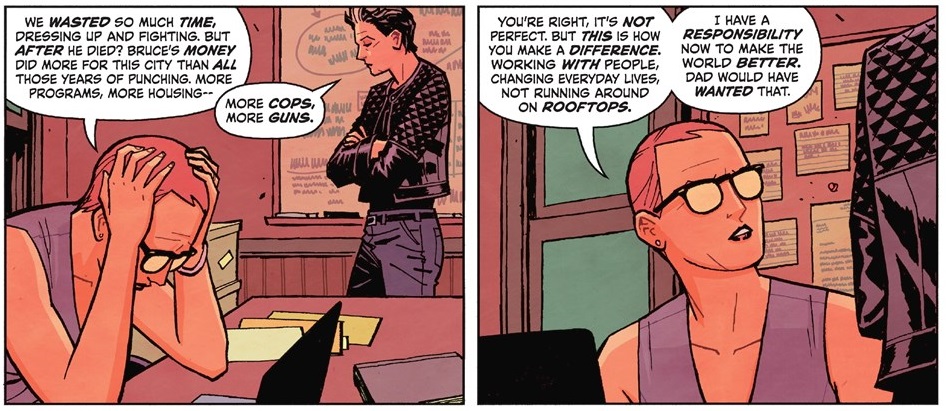
Without ever going fully meta, the result is nevertheless self-reflexive and, in places, arguably deconstructive. The blurb on the back cover claims that ‘Gotham has grown up – it’s put away costumed heroism and villainy as childish things.’ Yet Lonely City seems less interested in commenting about The Dark Knight Returns than in finding its own place in the house Frank Miller built.
Indeed, just as Miller played with readers’ awareness of the Adam West television show, so does Cliff Chiang play with awareness of Miller’s work. And not just DKR, either. Batman: Year One – which rebooted Catwoman as well – casts as much of a shadow, with plenty of riffs on that classic in both the visuals and the dialogue (as pointed out in this review), down to the final scene.
In fact, Lonely City is full of nods all around, with Chiang using not only the story (future Gotham is its own subgenre, including such gems as Batman: Year 100), but also the designs, the lettering, and the colors to evoke the franchise’s different eras, ranging from Richmond Lewis’ washed-out palette in Year One down to Wildstorm FX’s quasi-monochrome compositions around the turn of the millennium…
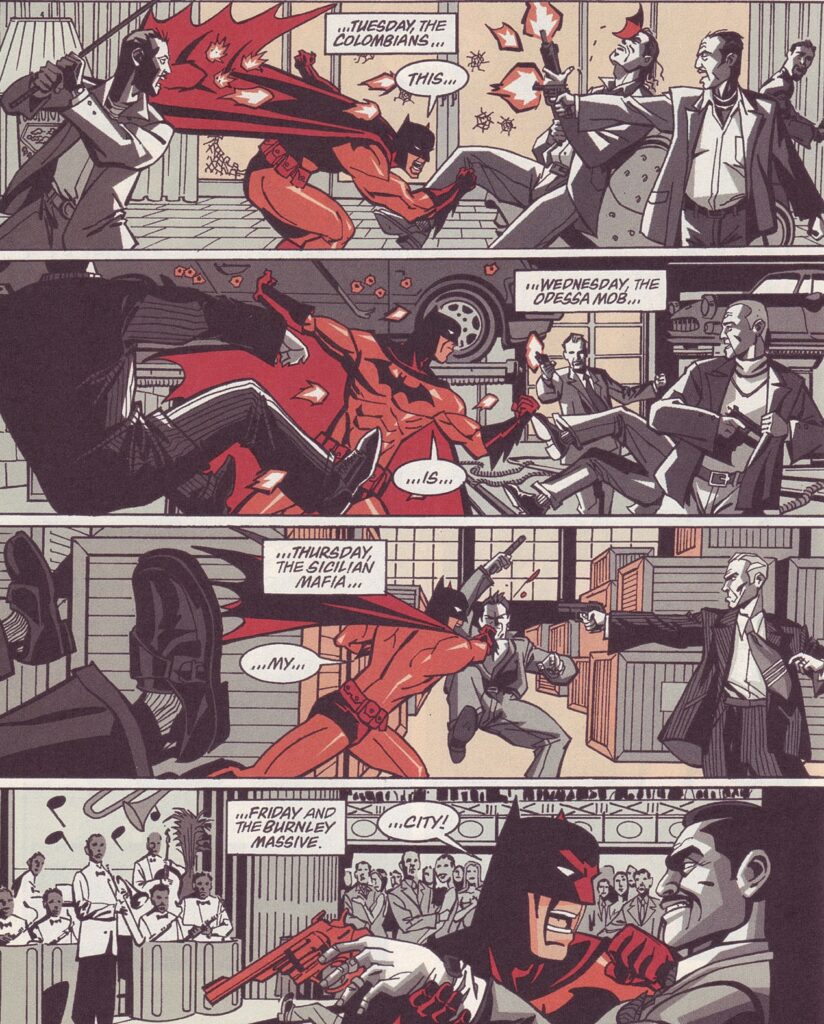
Detective Comics #743
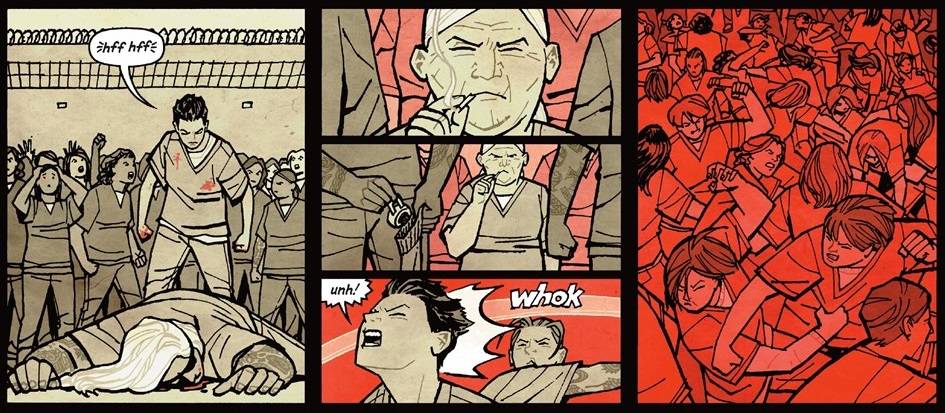
It’s to the book’s credit that the whole thing feels quite coherent. All these references are filtered through Cliff Chiang’s own distinctive art style, avoiding full-of pastiches, and the homages generally don’t call too much attention to themselves, nor will they get in the way of those who don’t recognize every deep cut.
This negotiation between suggesting a larger history on one level while still communicating story and characterization in a more direct fashion is one of the series’ major strengths. In control over the various elements of the whole process (script, art, colors, letters), Chiang seems to always know which one is conveying the bulk of emotion and/or information, so he strategically ‘mutes’ the others so as not to unnecessarily overwhelm the reader, thus mining the medium’s potential for all its worth.
Although comic books share features of novels and films, they don’t fully mimic either of them, as they’re not as text-heavy as novels and they certainly don’t display as many images as a film. This is for the best: a medium’s boundaries and limitations can be stimulating in their own way, giving us more room for imagination (in the case of comics, this starts, of course, with our constant interpretation of what happened between each panel or how each character’s voice sounds like). It’s why I tend to prefer this type of artwork and colors, which do not look ‘realistic’ – the adjustment process in my brain is a source of pleasure, asking me to engage more actively with the book and ultimately be more of a participant (even a co-creator) in the storytelling process. In reading and rereading Lonely City, I kept feeling Chiang engrossingly pulling me in, inviting me to give life to his stylized figures and to fill in the ellipses not just between the images, but in the cast’s insinuated backstories (by drawing on my own repository of memories of previous adventures, combined with a healthy dose of speculation).
I suppose Lonely City operates in something like Grant Morrison’s hyper-continuity, blending into the same unified past all the previous Batman comics, no matter how inconsistent in narrative and tone (especially if you go back to the earliest days…). This means that all the coolest tales did take place, somehow, including the many variations of the history of Selina Kyle, who over the years has been a burglar, a prostitute, and a crimefighter. Through backdrop props and flashbacks, Chiang thus gets to draw Catwoman’s various costumes, whether from the Golden Age or from Jim Balent’s and Darwyn Cooke’s iconic runs.
One of the most memorable sequences beautifully brings together the sexy aesthetics, playfulness, and elegance of the character’s most famous TV iterations, in the 1960s’ show and in the 1990s’ Batman: The Animated Series (and its many-spin-offs):
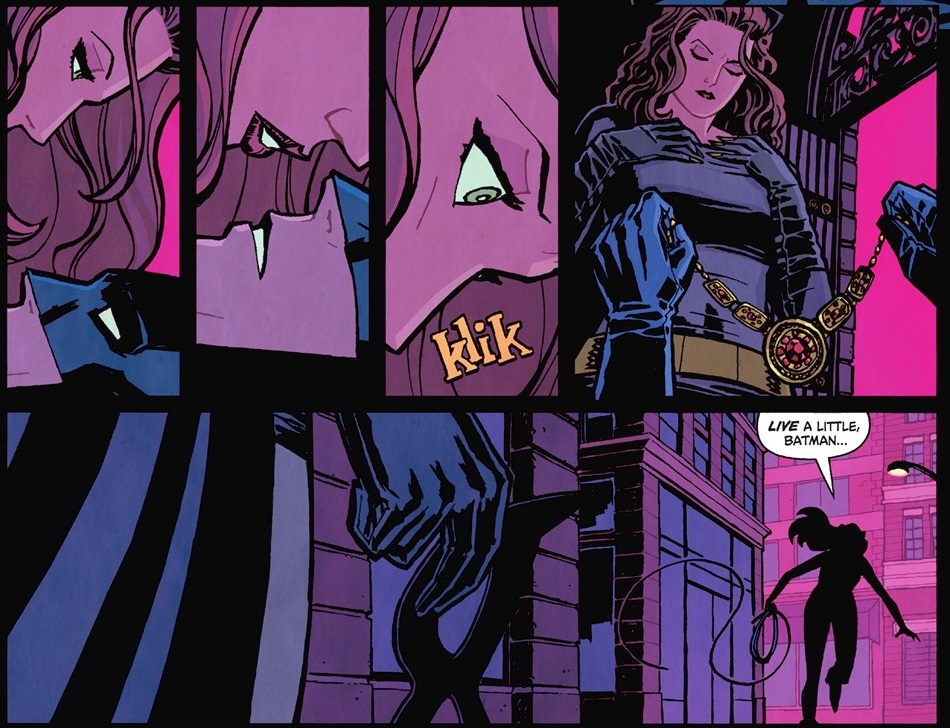
These winks, along with the countless Easter Eggs and more substantial appearances by familiar faces and places (I’m sure that, as I write this, someone is already working on an annotated guide!), could’ve devolved into facile fan-service or intricate metafiction, a la Donny Cates’ and Geoff Shaw’s Crossover. Beyond all the geekgasms, however, there is enough plot and action to hold one’s attention – like in many of the greatest Batman narratives, the intrigue concerns city politics, and like in many of the greatest Catwoman adventures, there is a string of neat capers, each one a dynamic set piece on its own. The smooth panel transitions and page layouts make this the most exciting heist book I’ve read since Stray Bullets: Sunshine & Roses.
Still, DC veterans are bound to get a special kick out of this one. After riffing on DKR, Lonely City moves into Dark Knight Strikes Again territory, digging up colorful characters and concepts from across the wider DC lore, way beyond the Gotham corner of this universe. At first, the inclusions tie into the general motif of rampant capitalism and commodification, whether it’s the spy agency Checkmate having been turned into a private security contractor or – as you can see from the Captain Cold Brew in the initial scan – the running gag about superhero/villain names being converted into brand logos (which implies that, within this reality, perhaps some of the old heroes and villains actually endorsed these products and are now living off the royalties).
By the time we get to the Zatanna cameo (not to mention the climactic demon swordfight), though, Lonely City – for all its revisionist touches – has become a pure superhero yarn… one where minor plot points don’t necessarily derive from elements that have been set up in this particular story, but from elements that old-school fans may know because they’ve encountered them before in other comics (or, at this stage, perhaps in a handful of movies and streaming shows). But what can I say: as one of those fans, I can’t deny the awesomeness of seeing Selina Kyle shoot a weaponized umbrella against a canister of Scarecrow gas.
That said, if part of the allure is to find out what happened to all those members of the Rogues’ Gallery, finally giving them closure in a post-Batman world, a lifetime of investment in this cast means the payoff can be particularly funny, interesting, and even emotional.
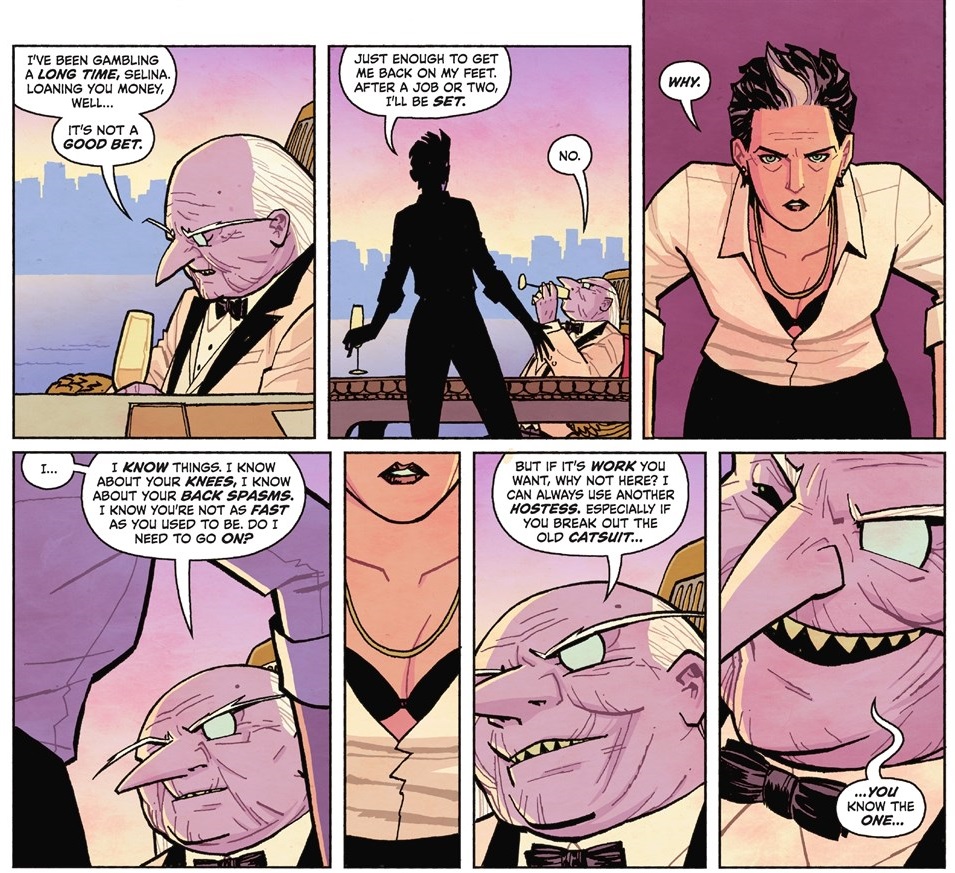
The sexual allusion above isn’t just Cliff Chiang making the most out of DC’s Black Label permissiveness. As a self-conscious comic about an older Catwoman (who, in the past, has exploited, indulged, and emancipated herself from bondage), Lonely City deals with sexism and agism and other forms of discrimination, even if it’s not ostentatious about it.
Chiang redesigns characters’ bodies to show how they’ve aged in a variety of ways, from getting wrinkles to putting on weight. He also expands the overall ethnic diversity, including through an Asian shopkeeper called OGBeast (an amusing spin on the KGBeast) that I’ve little doubt is here to stay.
As age becomes a core theme – along with grief and nostalgia – Lonely City pulls off an impressive multilayered balancing act. On the one hand, it uses the weight of the franchise’s accumulated history to conjure up deep resonance in older readers like me… After all, there is also a sentimental side to geekiness, informed as it is by an urge to maintain a personal, individualized relation to the mass culture we consume. On the other hand, a series of endearingly rendered character moments manage to bring these specific iterations to life with almost unprecedented clarity and melancholy, thanks to Chiang’s abovementioned command of the form and an especially insightful take on their possible psychologies.
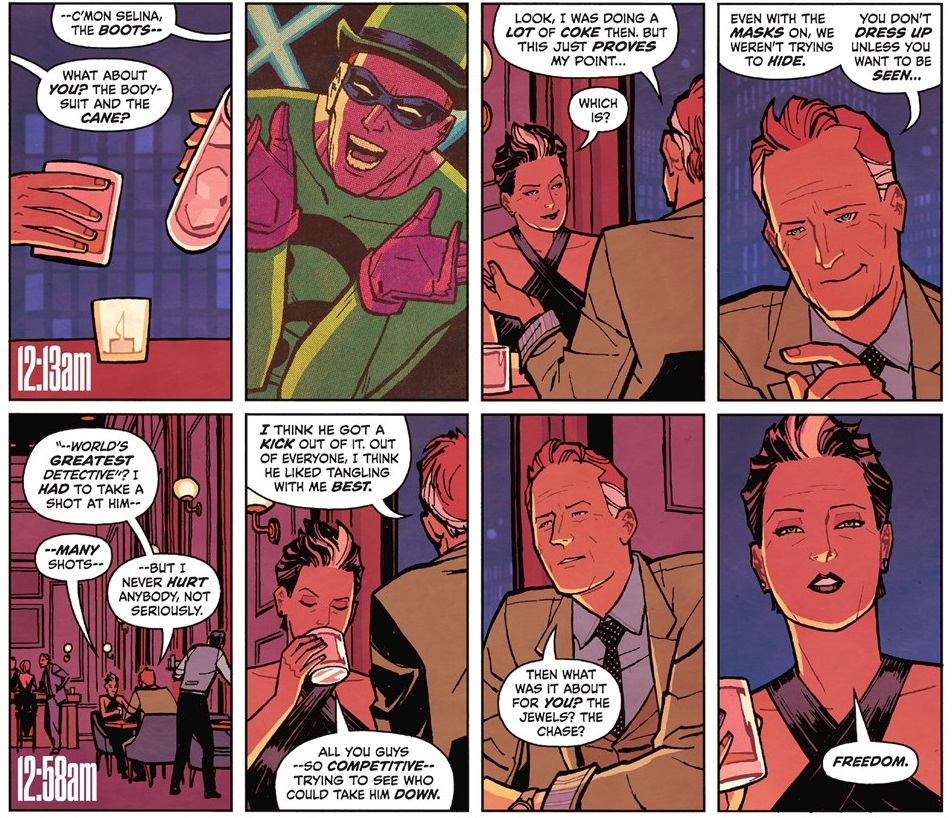
After all these years of reading and blogging about them, watching Catwoman and the Riddler reminisce about their past, I felt as if, in a magical way, I was gazing into to their true selves, finding in these people (and in this comic) something both recognizable and surprising at the same time.