
-
Recent Posts
Categories
- ART OF BATMAN COMICS (36)
- ART OF HORROR COMICS (35)
- AWESOME COVERS (59)
- BATMAN COMICS FOR BEGINNERS (35)
- BOOKS OF THE YEAR (22)
- COLD WAR CINEMA (12)
- COVERS OF BATMAN COMICS (52)
- FANTASTIC ADVENTURES (51)
- GLIMPSES INTO AWESOMENESS (98)
- GLIMPSES INTO THE FUTURE (23)
- GLIMPSES INTO THE PAST (83)
- GOTHAM CITIZENS (37)
- GOTHAM INTERLUDES (86)
- HARDBOILED CRIME (42)
- HEADSHOTS (12)
- MANIFESTO (3)
- POLITICS OF BATMAN COMICS (21)
- SPYCRAFT & WARFARE (47)
- SUPER POWERS (16)
- WEBS OF FICTION (56)
- WILD WEST (7)
- WRITERS OF BATMAN COMICS (20)
- WRITERS OF SUPERMAN COMICS (4)
Drop me a line at
imbaytor@yahoo.com
A month of Batman moments – Day 5
Posted in GOTHAM INTERLUDES
Tagged Dan Curtis Johnson, Dave Stewart, Phil Balsman, Seth Fisher
Leave a comment
A month of Batman moments – Day 4
 Wonder Twins #9
A month of Batman moments – Day 3
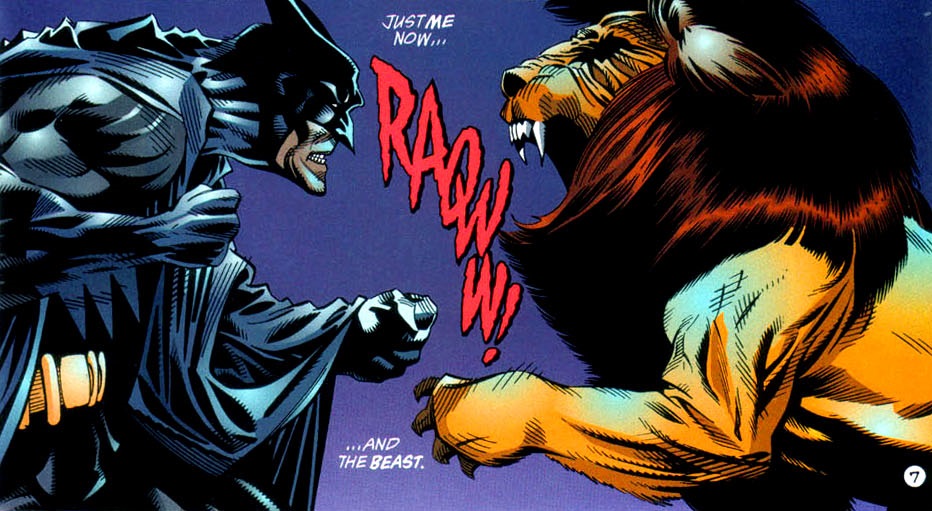 Batman #528
Posted in GOTHAM INTERLUDES
Tagged Doug Moench, Greg Wright, John Beatty, Kelley Jones, Todd Klein
Leave a comment
A month of Batman moments – Day 2
 World’s Finest (v2) #4
Posted in GOTHAM INTERLUDES
Tagged Alex Sinclair, Clem Robins, Dave Taylor, Karl Kesel, Robert Campanella
Leave a comment
A month of Batman moments – Day 1
This month I’m trying out something different… Every day, I will share a brief moment that highlights various sorts of Batman coolness, from the Dark Knight’s badass fighting skills to his silly puns, from his determined courage to his constant resourcefulness (including his bat-themed gadgets), all the while treading the line between serious pathos and goofy surrealism.
Let’s get the ball rolling with a neat panel that succinctly combines the Caped Crusader’s fabulous athletic moves with his foundational resentment against the kind of tool that killed his parents:
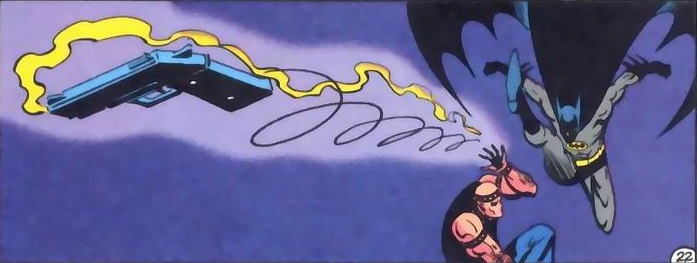 Shadow of the Bat #13
Posted in GOTHAM INTERLUDES
Tagged Adrienne Roy, Alan Grant, Batman's personality, guns, Norm Breyfogle
Leave a comment
Batman movies without Batman – part 2
If you’ve read last week’s post, you know I’ve been listing films that somehow feel like Batman movies, even though the Caped Crusader is nowhere to be found…
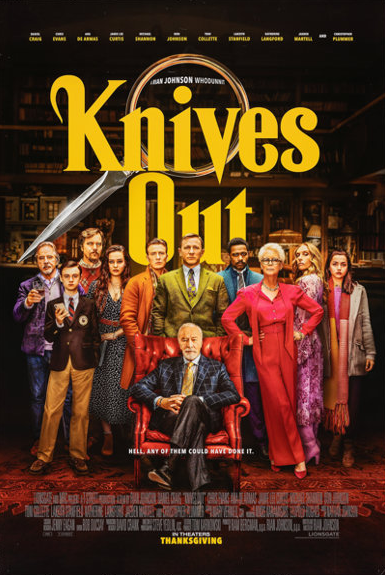 Knives Out
Many classic Batman comics used to be about fun mysteries – and ‘fun’ is certainly the first word that comes to mind when considering Rian Johnson’s intricate whodunit Knives Out, with its idiosyncratic list of suspects following the death of a rich patriarch. Despite his ridiculous southern drawl, at times it seems like Daniel Craig’s private eye Benoit Blanc could almost match wits with the World’s Greatest Detective!
It’s about class, too.
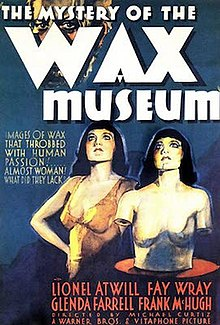 Mystery of the Wax Museum
Wonderfully shot in beautiful two-strip Technicolor (which makes each image look as if it was colored by Adrienne Roy during her pink/blue phase), with cubist touches in the set design, Michael Curtiz’s Mystery of the Wax Museum is exactly the kind of gothic chiller in which Basil ‘Clayface’ Karlo would’ve starred back in his acting days. Not only that: it’s a mystery involving bodysnatching, a disfigured villain, a millionaire playboy, and a very Lois Lane-ish reporter (albeit more of a drinker) who keeps wittily locking horns with the film’s avant-la-lettre version of Perry White.
The foul play may not be as inventive as the one in Batman #250’s ‘The Deadly Number’s Game!’ (which also revolves around a wax museum), but the result is much, much creepier.
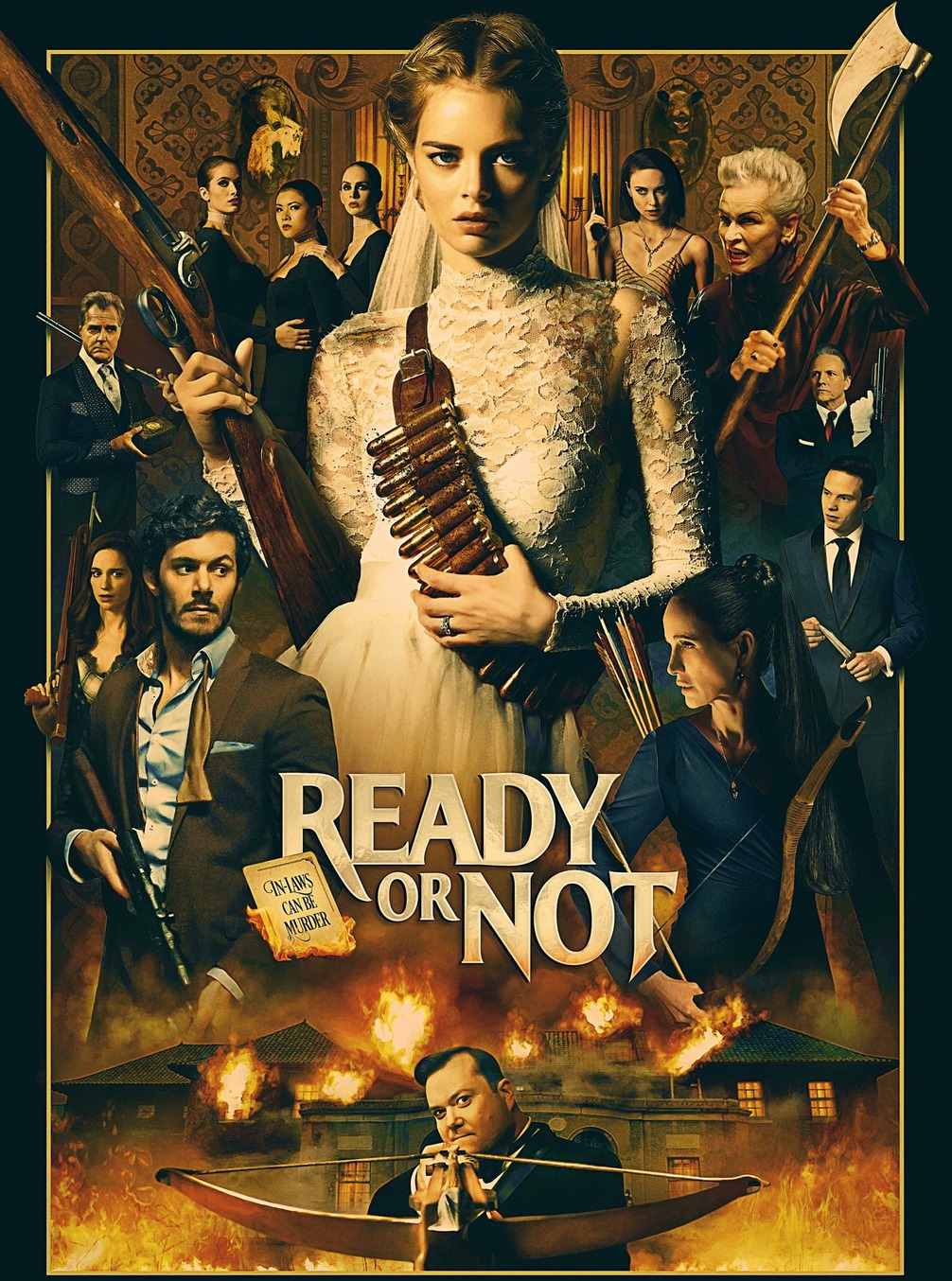 Ready or Not
Going back to class struggle… There is a long tradition of horror movies that deliver biting commentary on capitalist society (notable works include David Cronenberg’s Videodrome, George A. Romero’s Dawn of the Dead, and Michael Wadleigh’s Wolfen), but few are as darkly hilarious as Matt Bettinelli-Olpin’s and Tyler Gillett’s Ready or Not. An outrageously silly premise – which involves an increasingly bloody game of hide and seek at a Wayne Stately Manor-like mansion – is given the kind of unapologetically brisk treatment you’d expect from an old-school Batman tale by the likes of Bob Haney or Alan Grant.
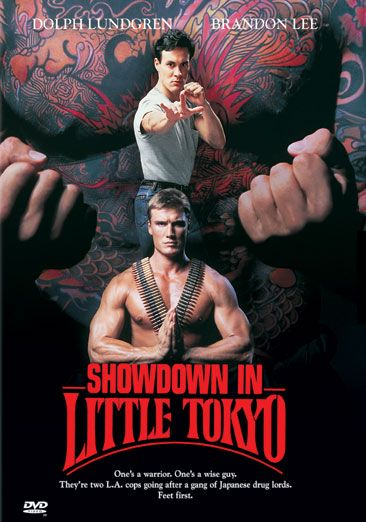 Showdown in Little Tokyo
Absurd macho bullshit in all its schlocky glory. This is a buddy cop action movie set in L.A.’s Little Tokyo, starring Dolph Lundgren and Brandon Lee, with the joke being that Lundgren, who looks like a Swedish giant, knows more about Japanese culture than the son of Bruce Lee (which isn’t much of a joke, since Lee has a Chinese background, but this isn’t a movie you watch for cultural sensitivity anyway… and, hey, at least it doesn’t take itself as seriously as the similar Rising Sun, whose orientalism I find much more jarring). Nudity aside, Showdown in Little Tokyo has pretty much the same type of vibe as those Chuck Dixon comics about martial arts and the Asian-American underworld, including plenty of amusing quips and acrobatic violence.
While Lundgren may pick up a gun more often than Batman would’ve, nobody can deny he looks like a live-action cartoon on the screen, his muscles rivalling those of the Dark Knight even when the latter is drawn by Tim Sale or Jim Lee… Plus, his character always dresses in black and he totally saw his parents murdered in front of him as a child, so this practically comes off like an Elseworlds tale!
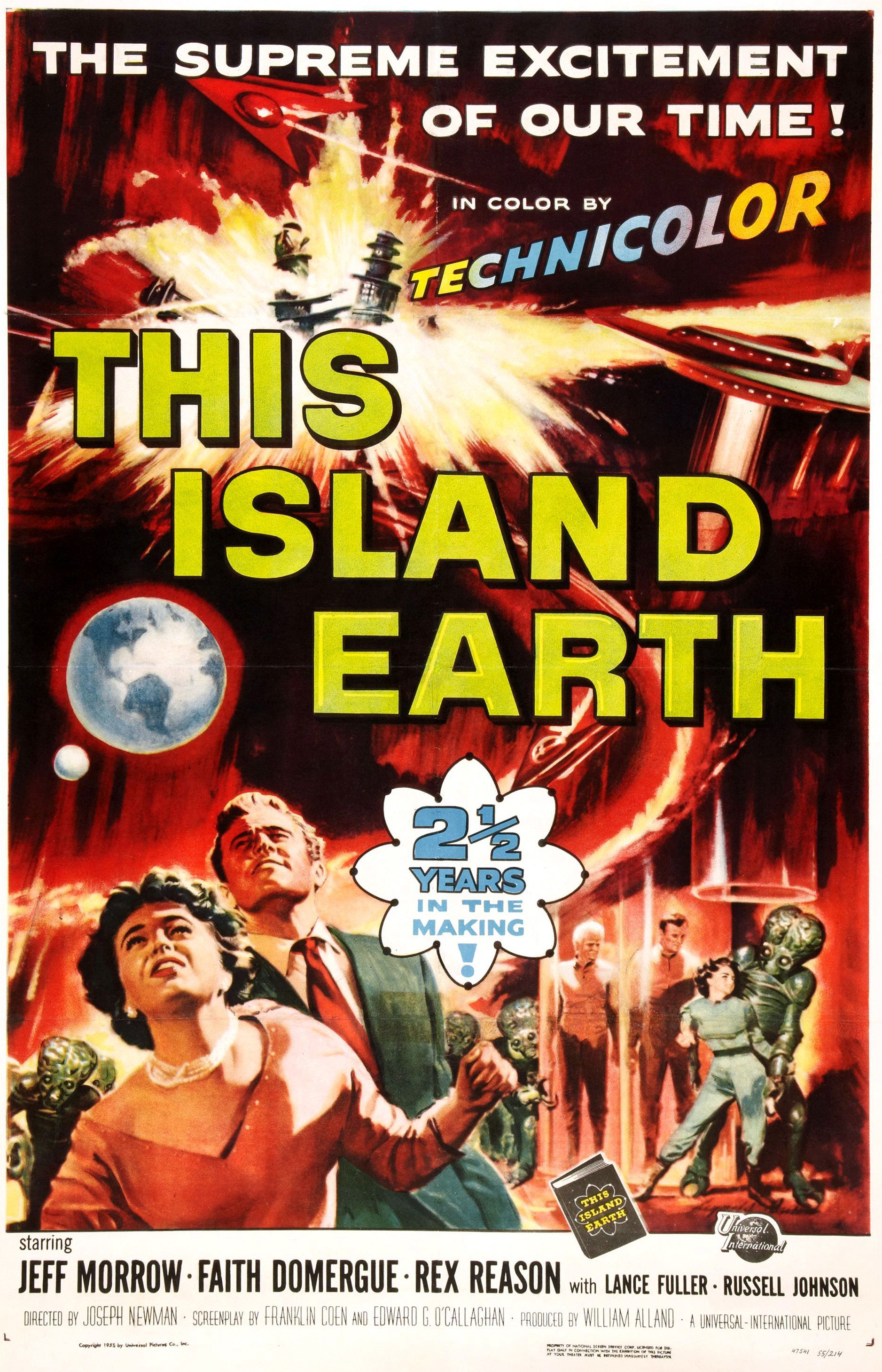 This Island Earth
The Caped Crusader has had his fair share of awesome adventures in outer space, including a few memorable episodes of The Brave and the Bold TV show, such as ‘The Eyes of Despero!’ and ‘The Super-Batman of Planet X!’ (the latter one adapting the psychedelic classic from Batman #113), so I had to include at least one entry related to this subgenre… Joseph M. Newman’s This Island Earth follows a two-fisted scientist who finds himself in a pulpy crescendo that culminates in interplanetary war and shares much of the tone of the Silver Age comics coming out at the time, in the mid-1950s. Even the colorful, now-cheesy special effects bring to mind the endearingly simplistic artwork of Sheldon Moldoff.
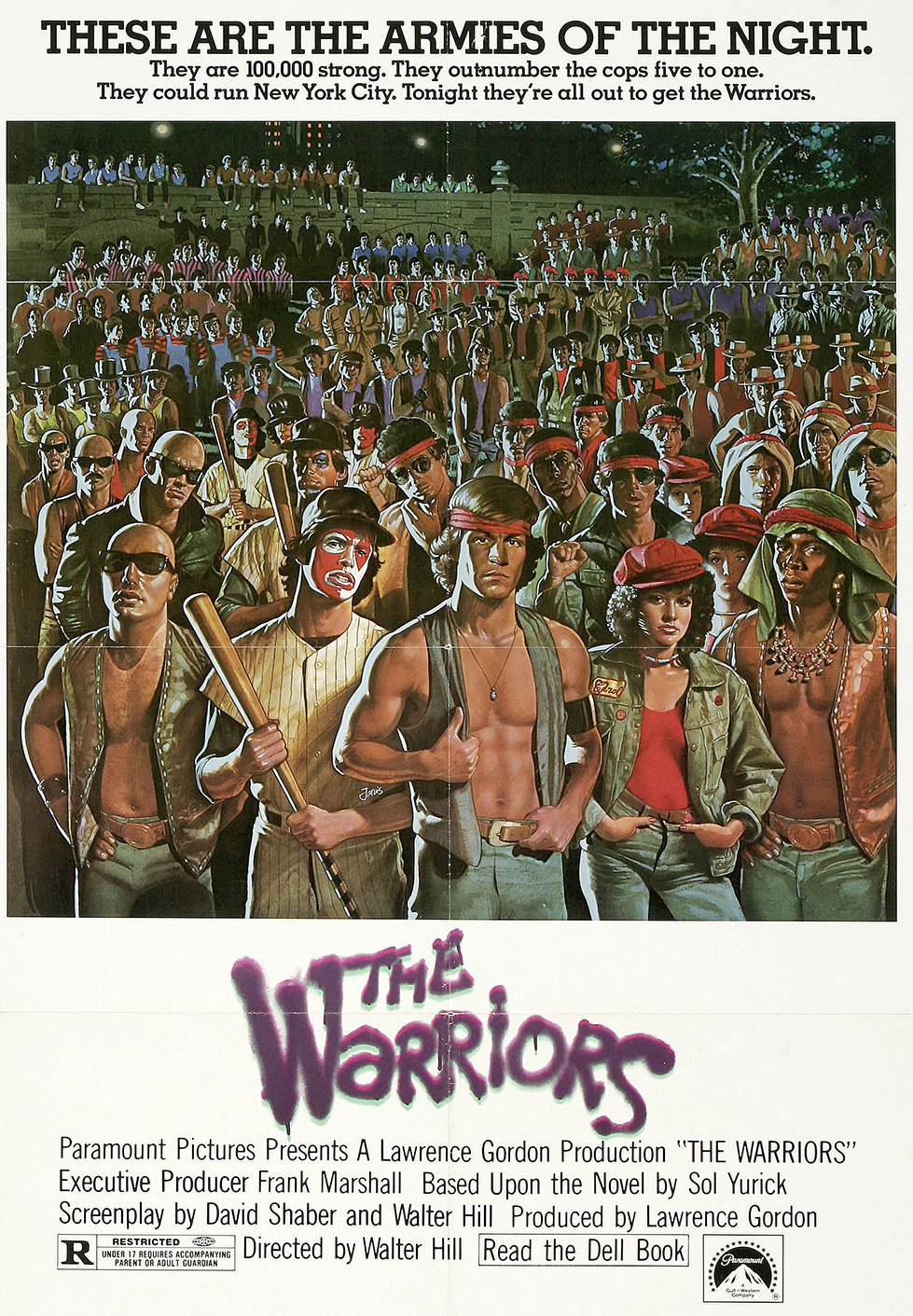 The Warriors
Let’s finish with a masterpiece. This adrenaline-charged tale of a street gang trying to make it from the Bronx to Connie Island while every other gang in town (including the biggest one: the police) is out to get them truly feels like a vision of a Batman-less Gotham City. As if it wasn’t enough having gangs dressed like mimes and baseball players, the Ultimate Director’s Cut added a cheesy effect that renders some transitions in the form of comic book panels, strengthening the overall pulpy flavor. It’s also interesting to think of the Warriors as a Gotham gang, as it gives you a refreshingly judgement-free look at the kind of characters whose function is often as a mere punching bag for the Dynamic Duo (the best scene, arguably, is the quiet moment in the subway train when the grimy, downtrodden heroes sit face-to-face with two couples of giggling, better-off kids and the film’s empathy doesn’t necessarily flow in the same direction as Batman’s usually does).
That said, there are plenty of other reasons to watch Walter Hill’s 1979 cult classic. From its punk attitude to the provocative tension between different types of masculinity and femininity, The Warriors is a kickass action thriller, a great One Crazy Night movie, and a major addition to your quintessential New York filmography.
Posted in WEBS OF FICTION
Tagged Chuck Dixon, horror, movies, politics, science fiction, Sheldon Moldoff
Leave a comment
COMICS CAN BE AWESOME (26 April 2021)
A monstrous reminder that comics can be awesome…
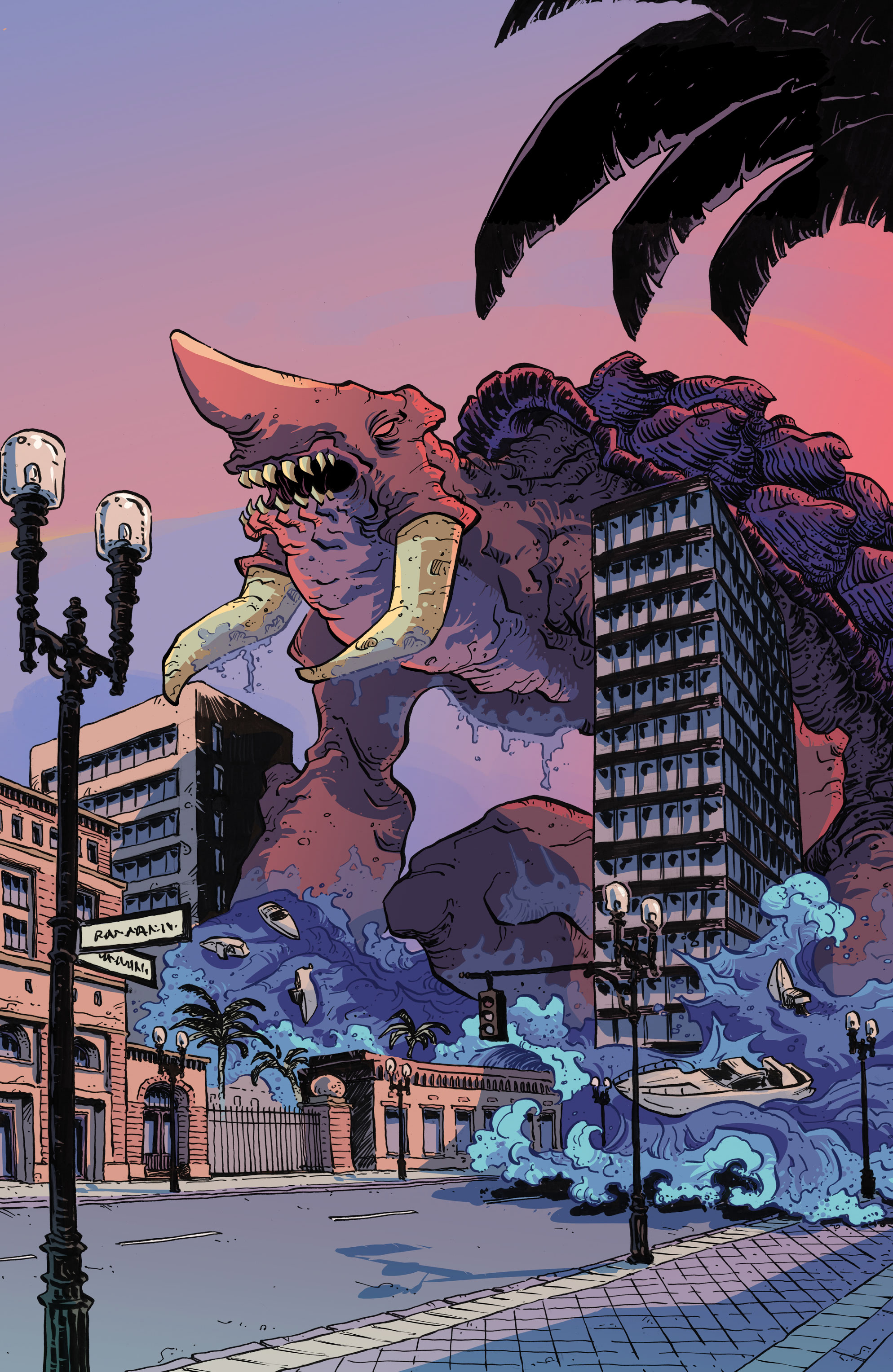 Kaiju $core #1
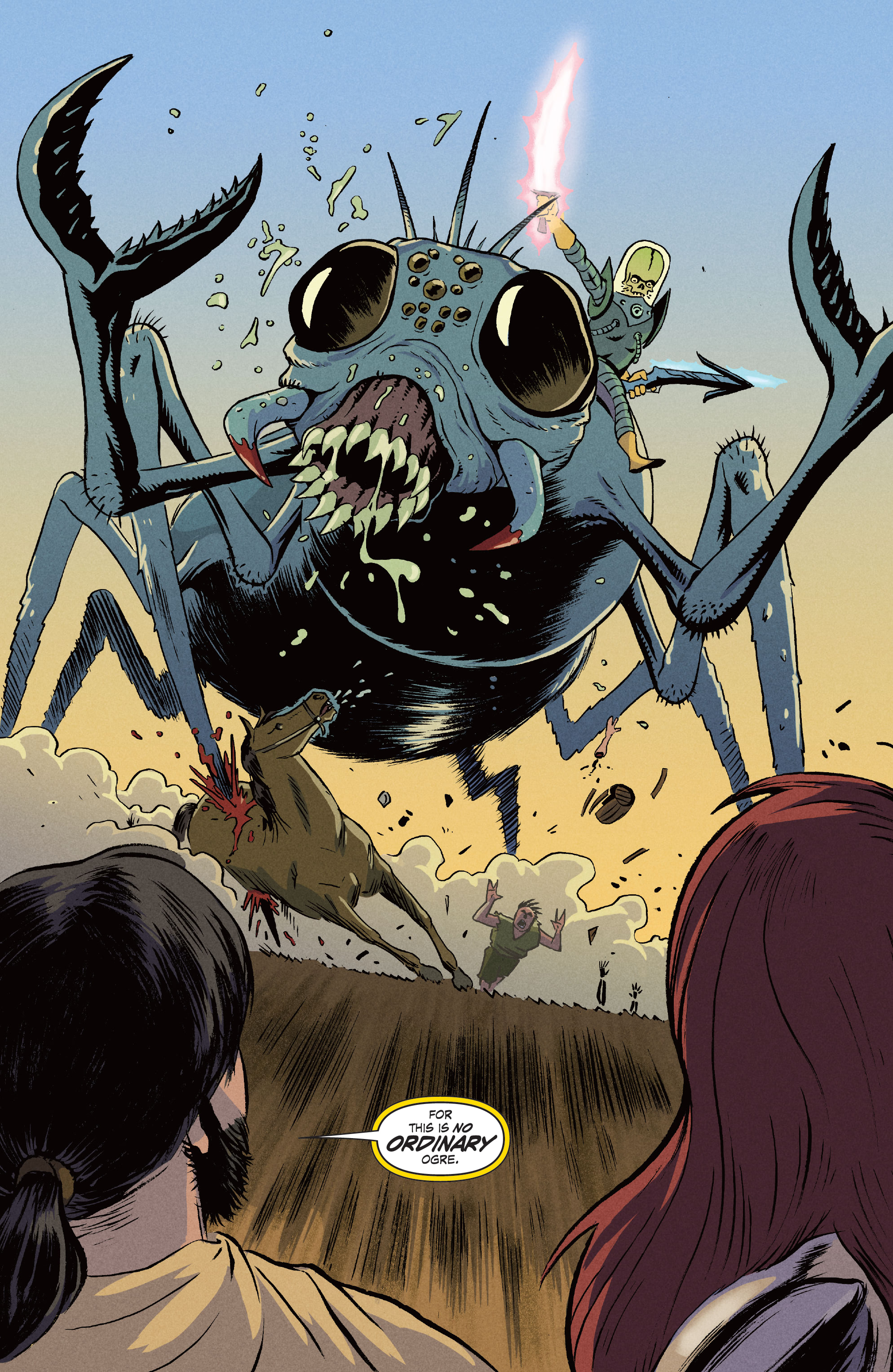 Mars Attacks Red Sonja #1
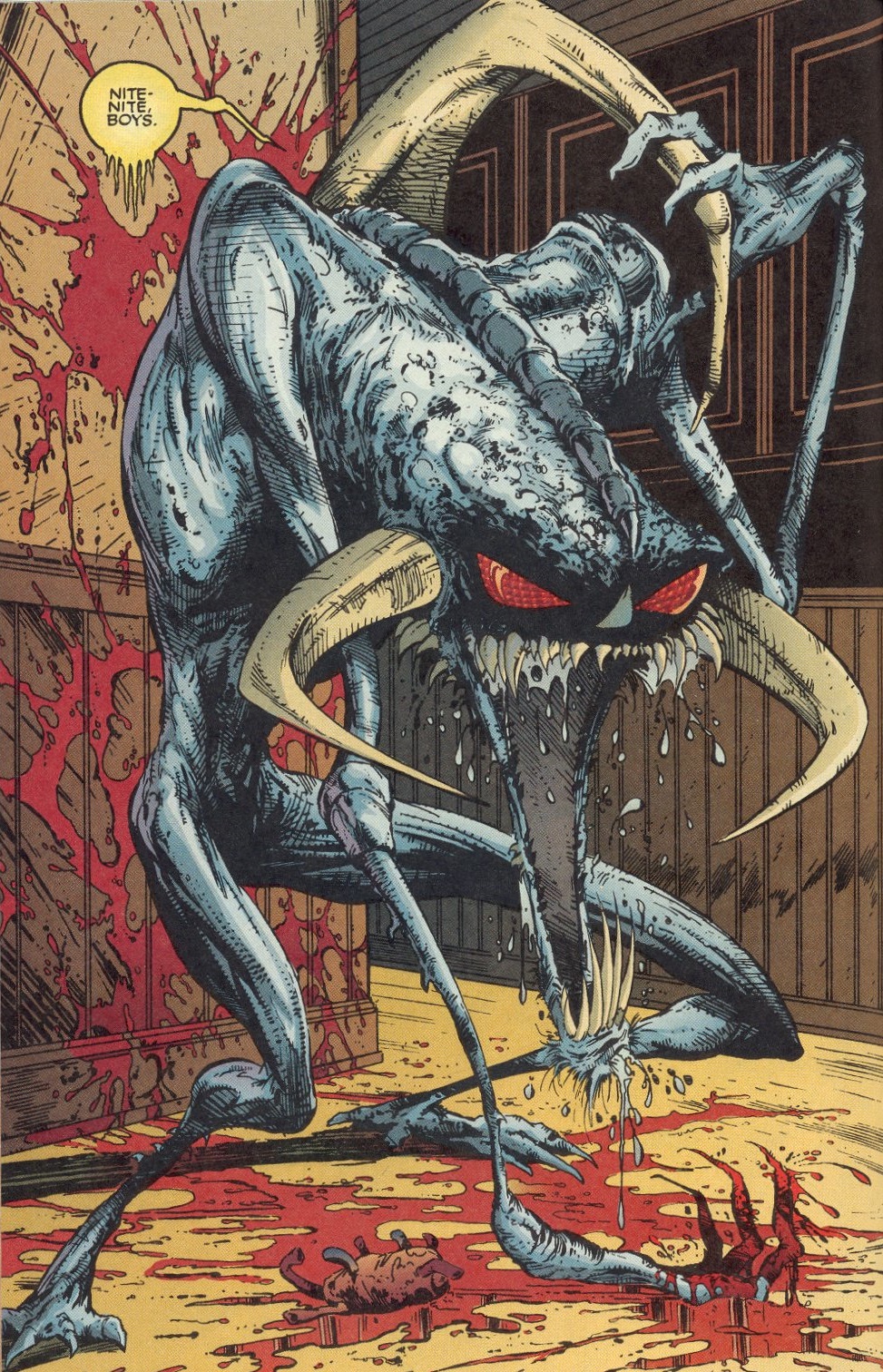 Spawn #2
Batman movies without Batman – part 1
The Dark Knight has starred in over a dozen theatrical films – plus a string of direct-to-video projects – and, in fact, his filmography has become a fascinating object in its own right. Not only are there extremely disparate takes on the character, but there’s also a schizophrenic intertextual conversation developing ever since 1966’s Batman: The Movie’s opening dedication ‘to lovers of adventure, lovers of pure escapism, lovers of the unadulterated entertainment, lovers of the ridiculous and bizarre… to the fun lovers everywhere.’
Several films have made a point of forcefully distancing themselves from this campy, lighthearted spirit – materialized in the Caped Crusader’s infamous can of shark repellent spray – by injecting viciously dark, adult content into their stories about a bat-clad superhero who frequently fights a clown (besides the films directed by Tim Burton, Christopher Nolan, Zack Snyder, and Todd Phillips, it’s the case of many animated pictures). In turn, productions primarily aimed at kids have specialized in mocking those ‘grown-up’ films, with the likes of Return of the Caped Crusaders and The Lego Batman Movie directly poking fun at the very notion of a ‘serious’ take on this material. And then, of course, there is Takashi Okazaki’s and Junpei Mizusaki’s Batman Ninja, which totally plays by its own rules…
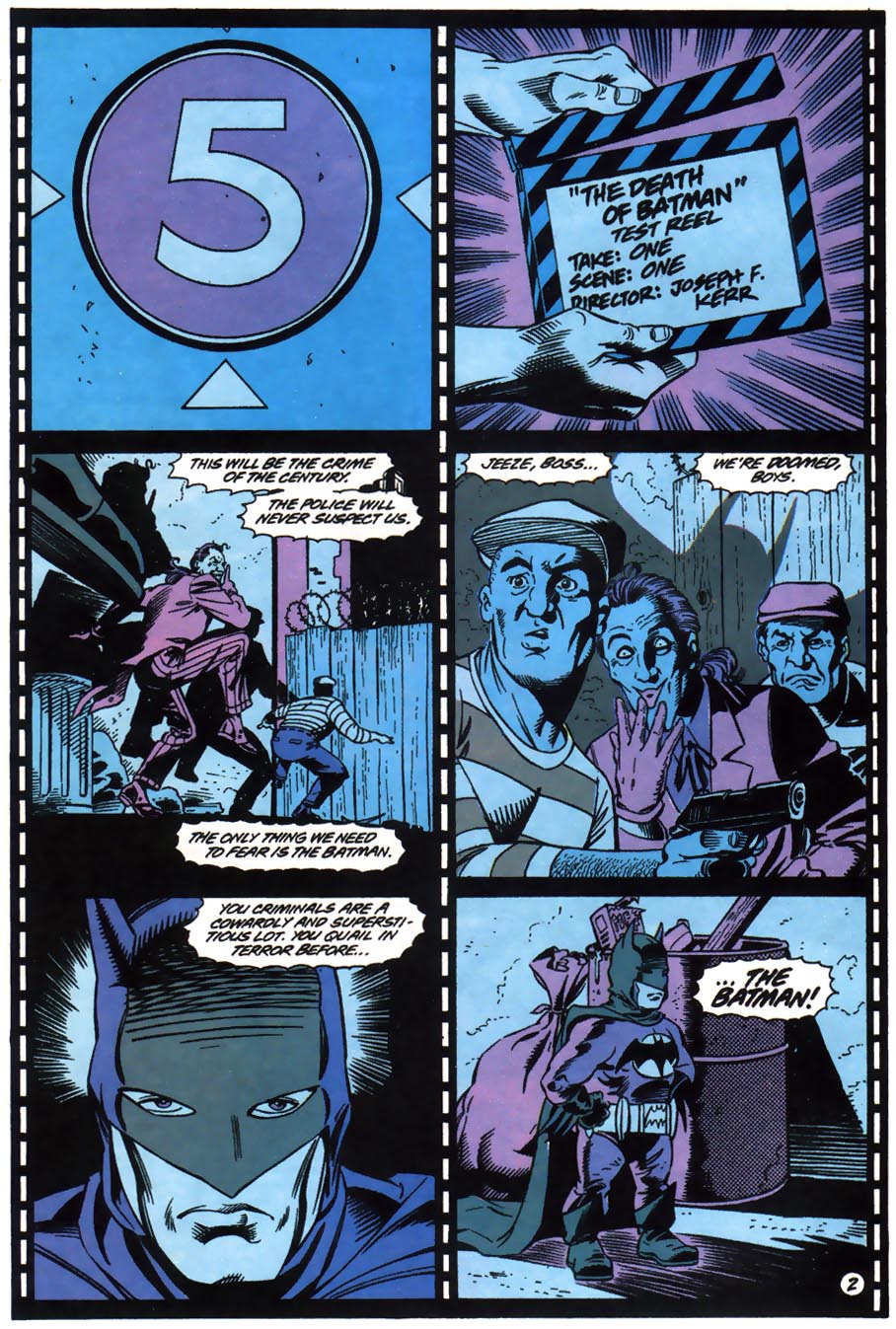
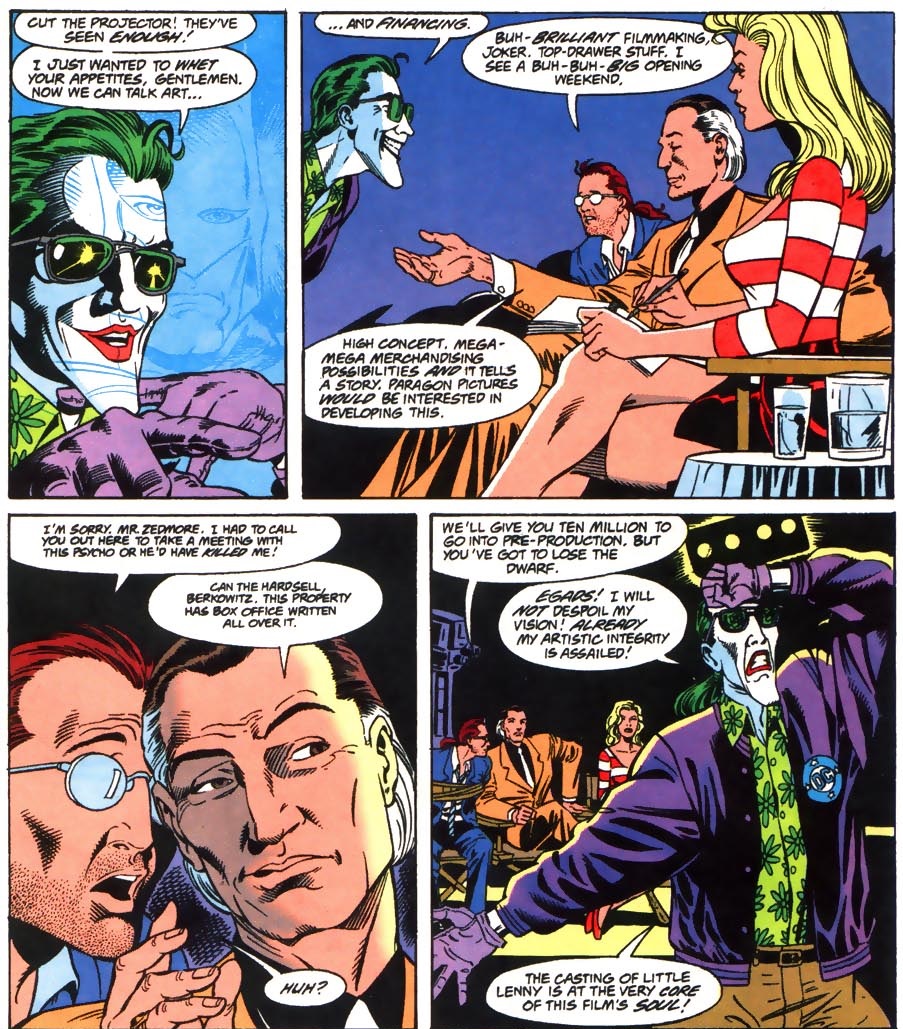
Still, nothing’s beats the Joker’s vision:

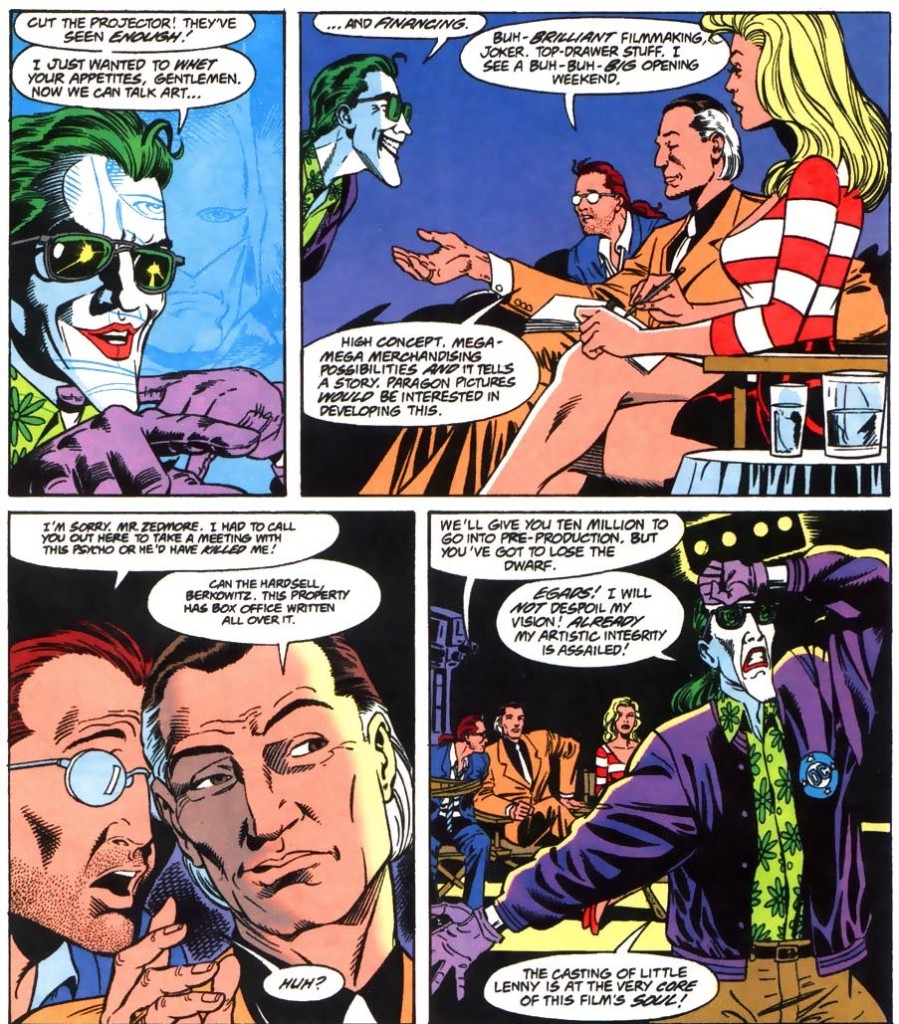 Detective Comics #671
Early on in this blog, almost six years ago, I had a stab at a diverse list of films that could appeal to fans of the Caped Crusader. These were movies without a Batman, but which kind of seemed to take place in his corner of the DCU. At the time, I was trying to prove fans didn’t have to settle for Batman v Superman: Dawn of Justice. Well, now we’ve got that film’s proper sequel in the form of Zack Snyder’s much hyped cut of Justice League – a stylish, if bloated, epic whose praise tends to rely on skewed comparisons (not as stupid as Snyder’s Batman v Superman, not as forgettable as Whedon’s Justice League) and whose main entertainment value is actually watching the unleashed director indulge in his eccentricities without any sense of restraint (from the emo music video with slow-motion CGI raindrops dripping from Aquaman’s beard to Batman’s baffling, lengthy conversation with the Joker about the horrible deaths of characters who were not in the movie). So, I’ve decided to come up with another dozen suggestions to add to the list.
Once again, the idea was to pick relatively loose connections that reflected the many sensibilities in Batman’s various eras. While these films aren’t all necessarily the highest peaks of the art form, they can serve to scratch an itch or two when you’re in a Dark Knight-ish type of mood…
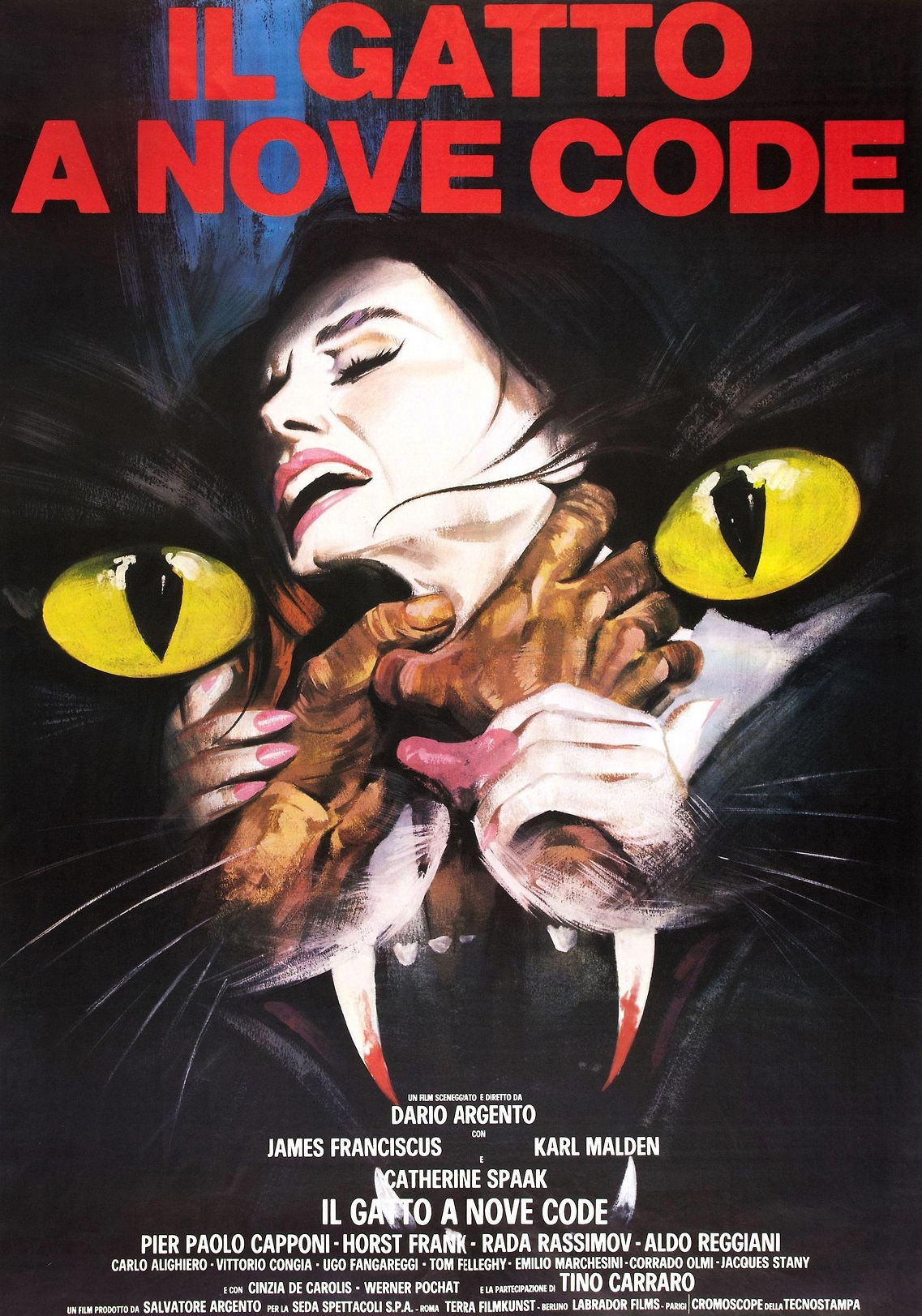 The Cat o’ Nine Tails
Dario Argento’s The Cat o’ Nine Tails has less in common with the director’s better known – and much more aesthetically impressive – giallo flicks than with Alfred Hitchcock’s brand of clever suspense… and, I would argue, with a certain type of Bronze Age-era approach to the Caped Crusader, back when Batman regularly starred in a bunch of delightfully convoluted detective stories (often written by Frank Robbins). After all, this hypnotic thriller features not only a labyrinthic whodunit and some elaborate grisly murders, but also a particularly memorable action climax which I can totally imagine in a comic.
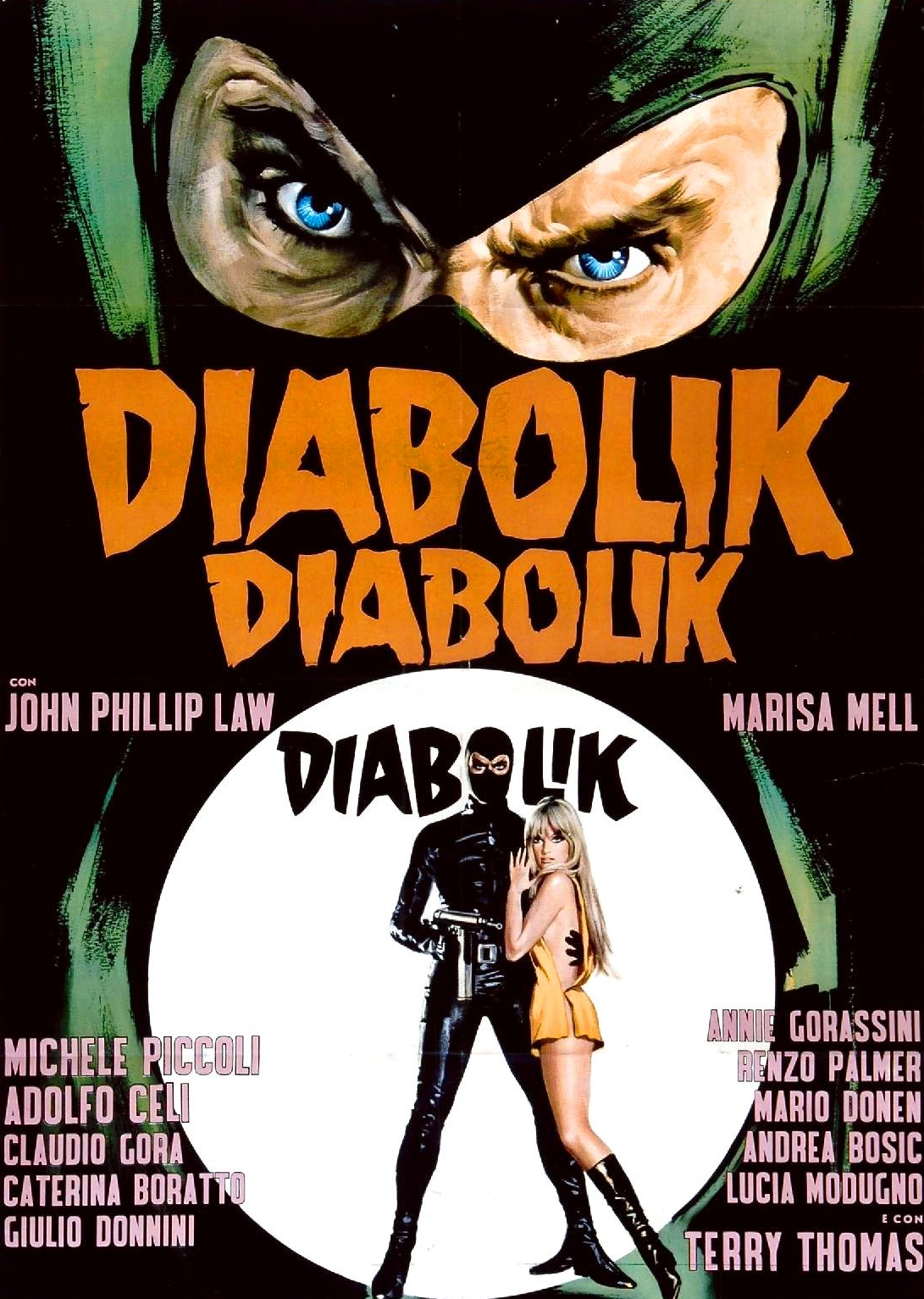 Danger: Diabolik
What if the Dark Knight was a super-criminal/anarchist rather than a superhero? That would be Mark Millar’s and Steve McNiven’s Nemesis, right? And what if you took the silliness and visual flair of Gardner Fox’s & Carmine Infantino’s comics and put it in the service of a kinky kitsch comedy full of trippy colors and astonishing set design? That would be Batman ’66 (or, if taken even further, Joel Schumacher’s Batman & Robin), right? And what if you packed action scenes with highly kinetic chases and gizmos that create illusions to throw pursuers off of cliffs? I guess that would be a Road Runner cartoon, right? But what if you blended all of this into a lavish production that oozes style from every pore, boasts an ultra-catchy soundtrack, and features a scene in which the ‘hero’ has sex wrapped up in stolen bank notes?
In 1968, Mario Bava (another Italian cult director!) beat the Americans to the punch in terms of pulling off something that truly *looks* like a superhero comic brought to life. It’s hardly a masterpiece in terms of plot, and it’s probably too sleazy for some people’s tastes (it’s based on an Italian comic, after all), but since the protagonist wears a ninja-like black mask and his headquarters are in a massive sci-fi cave underneath a fancy house, I’d say Batman fans owe it to themselves to check out this curio. Hell, there is even a bit involving laughing gas, shortly followed by a scene where a Poison Ivy-lookalike hands out weed to a bunch of hippies at a party!
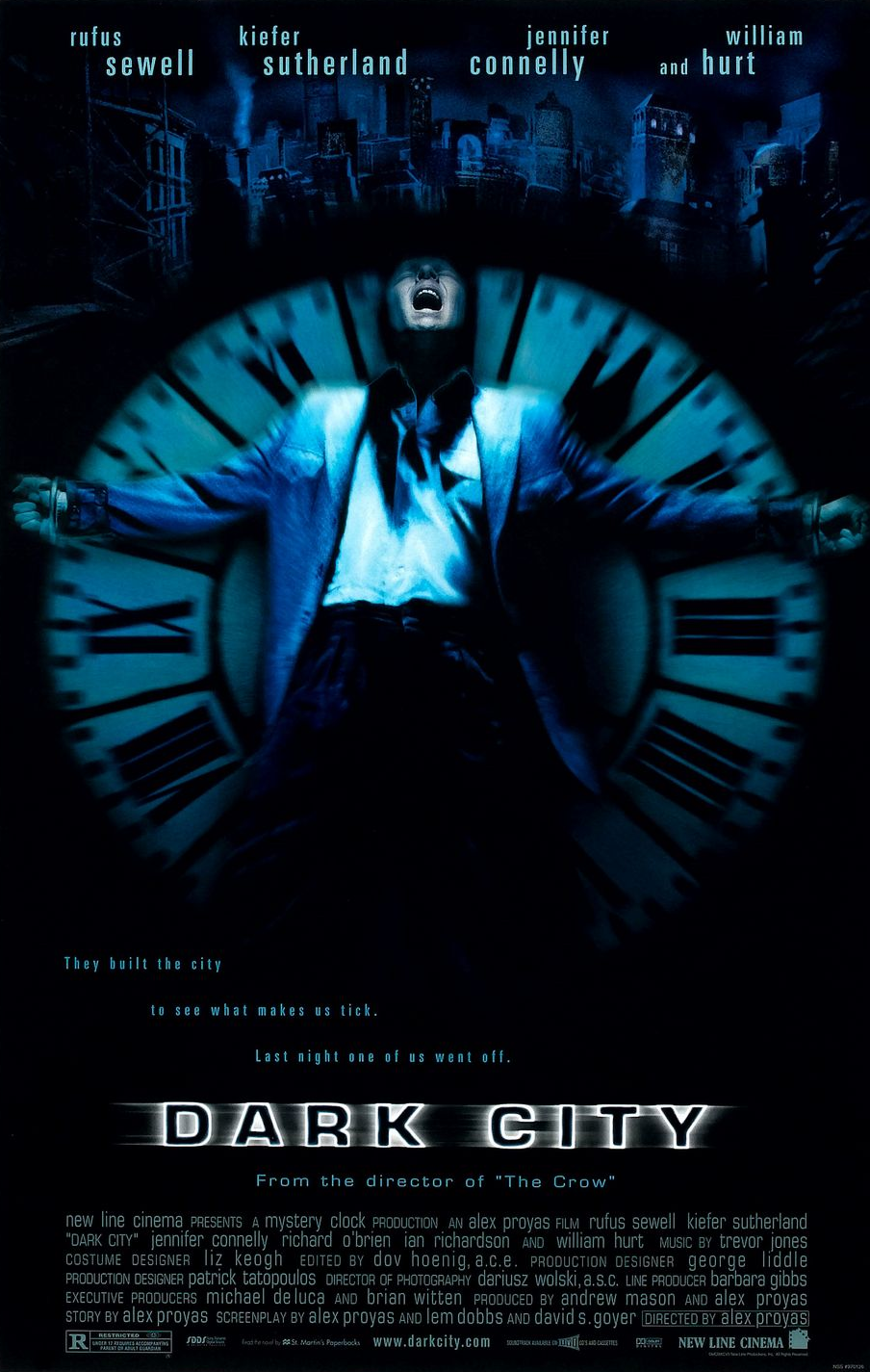 Dark City
As a whole, the plot of Alex Proyas’ geek-favorite slice of surrealist science fiction has little in common with Batman’s usual tales, even if there are a number of works in which Bruce Wayne – much like Rufus Sewell’s protagonist – wakes up to a severe identity crisis, not really sure he can trust his scrambled memories. Story aside, Dark City’s setting – as the title suggests – has a striking visual resemblance to Gotham and, indeed, the film’s aesthetics often feel close to nightmarish illustrations by the likes of Jae Lee or Kelley Jones. I’m not taking a big leap here, as the comic book influence is pretty clear, from the cartoony characterization down to the superhero-ish climax (sure enough, the script was co-written by David S. Goyer). That said, the main sources are cinematic: after a very noirish opening, the main inspiration becomes 1920s’ German expressionism, to the point where much of it feels like a futuristic reimagining of The Cabinet of Dr. Caligari (which is also a key reference for the tone of many a Batman yarn).
(By the way, I recommend the 2008 Director’s Cut.)
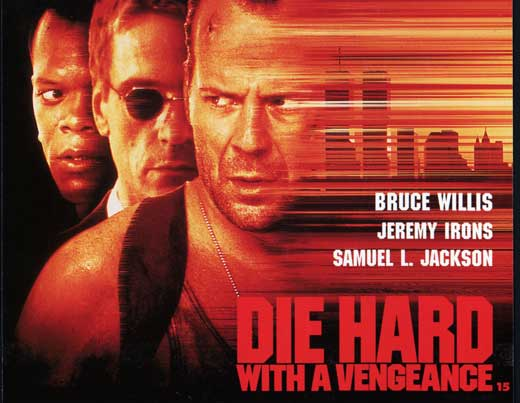 Die Hard with a Vengeance
This stone-cold classic perfectly closes the original Die Hard trilogy (in fact, this would’ve been a perfect ending to the whole franchise, as it’s been all downhill since then). After a skyscraper and an airport, it is now a whole city that becomes the setting for a game of cat and mouse between John McClane and a bunch of terrorists, but the movie does more than merely recycle the old formula… Rather than pushing the coincidence of McClane accidentally finding himself in yet another similar situation, this time around the baddie is deliberately going after him. And rather than disregarding the post-Rodney King conversation by telling one more heroic cop story, Die Hard with a Vengeance faced the issue head-on, with racial tension shaping almost every key moment in the film. Moreover, rather than having McClane be the only competent guy around (a flaw in the first sequel, I think, since the appeal of the original Die Hard was that he was a more-or-less ordinary Joe in an extraordinary situation), here he gets partnered with a resourceful – and funny – companion, making this basically a buddy movie. In turn, from a casting perspective, Bruce Willis is joined by an equally charismatic actor, Samuel L. Jackson, making DHwaV one of three cinematic masterpieces where both of them show up, along with Pulp Fiction and Unbreakable (if you’re feeling generous, you can add the spoof Loaded Weapon 1, where Willis has a cameo as McClane!).
Anyway, Jeremy Irons’ ‘Simon Says’ villain is pretty much a Batman rogue, sending out clues (in the form of riddles) about his heist while setting up challenges for the heroes all over New York/Gotham City… Hell, he even leaves the duo in a deathtrap near the end! Plus, the puzzle-like script and John McTiernan’s muscular direction were no doubt a major inspiration for Nolan’s The Dark Knight and The Dark Knight Rises.
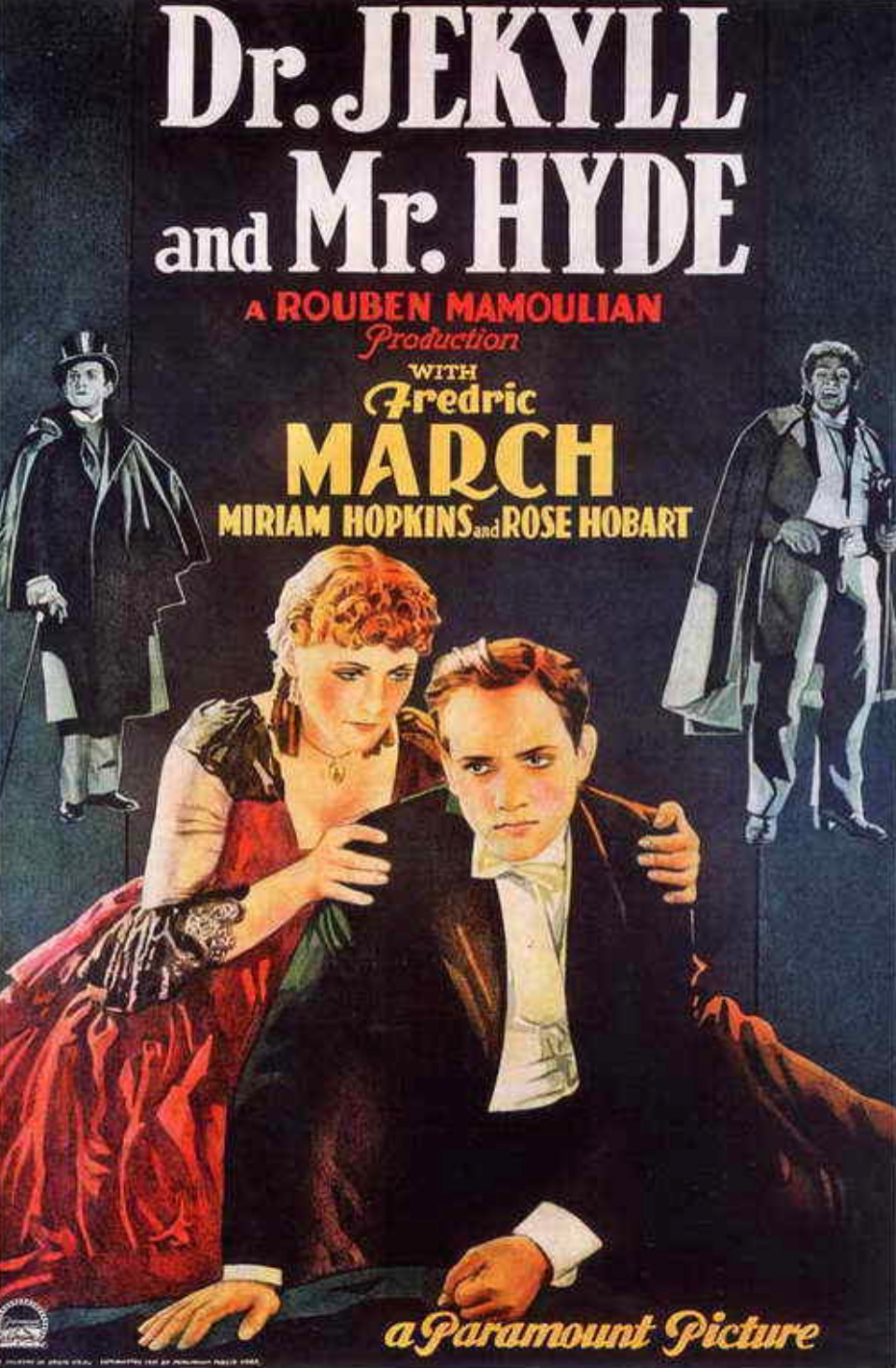 Dr. Jekyll and Mr. Hyde
Robert Louis Stevenson’s novella The Strange Case of Dr Jekyll and Mr Hyde is a foundational text for the Dark Knight mythos, with its gothic take on the duality of human souls informing both Bruce Wayne/Batman and many of his foes, most notably Harvey Dent/Two-Face (although the scientist experimenting on himself with monstrous results also brings to mind the likes of Kirk Langstrom/Man-Bat). Among the various filmed adaptations, my favorite one remains Rouben Mamoulian’s perverse piece of horror, not least because of the fascinating sexual overtones (the movie came out in 1931, before Hollywood censors started strictly enforcing the Hays Code), which make this version of Hyde as disturbing, in its own way, as the one in Alan Moore’s and Kevin O’Neil’s The League of Extraordinary Gentlemen. There are visual connections as well, what with the extensive POV sequences (to which Gene Colan paid homage decades later), the split screens (not unlike comic book panels), the expressionistic cinematography (whose shots could’ve fit into the pages of any Batman: Black & White issue), and Hyde’s Joker-like grin and demeanor.
(Terence Fisher’s The Two Faces of Dr. Jekyll is pretty twisted as well, but it’s not nearly as Gotham-y…)
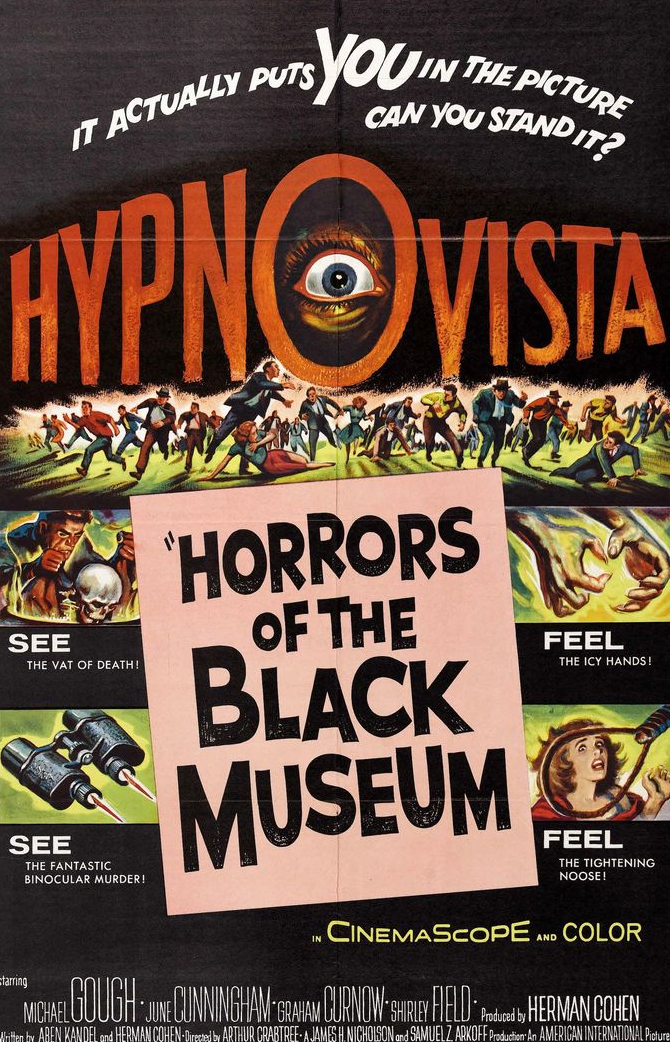 Horrors of the Black Museum
We’ll wrap up this week with another movie about a Batman villain without a Batman, albeit much more low-key than Die Hard with a Vengeance or even Dr. Jekyll and Mr. Hyde… There is a lot to like in Arthur Crabtree’s macabre thriller about a serial killer with a theatrical personality – complete with a lair and everything – who resorts to quirky contraptions to murder each victim in shockingly gory ways. Yet it’s also fun to imagine how things would’ve worked out if the killing spree had taken place in Gotham City and was illustrated by Jim Aparo (especially the climax at the fair).
COMICS CAN BE AWESOME (19 April 2021)
A breathtaking reminder that comics can be awesome…
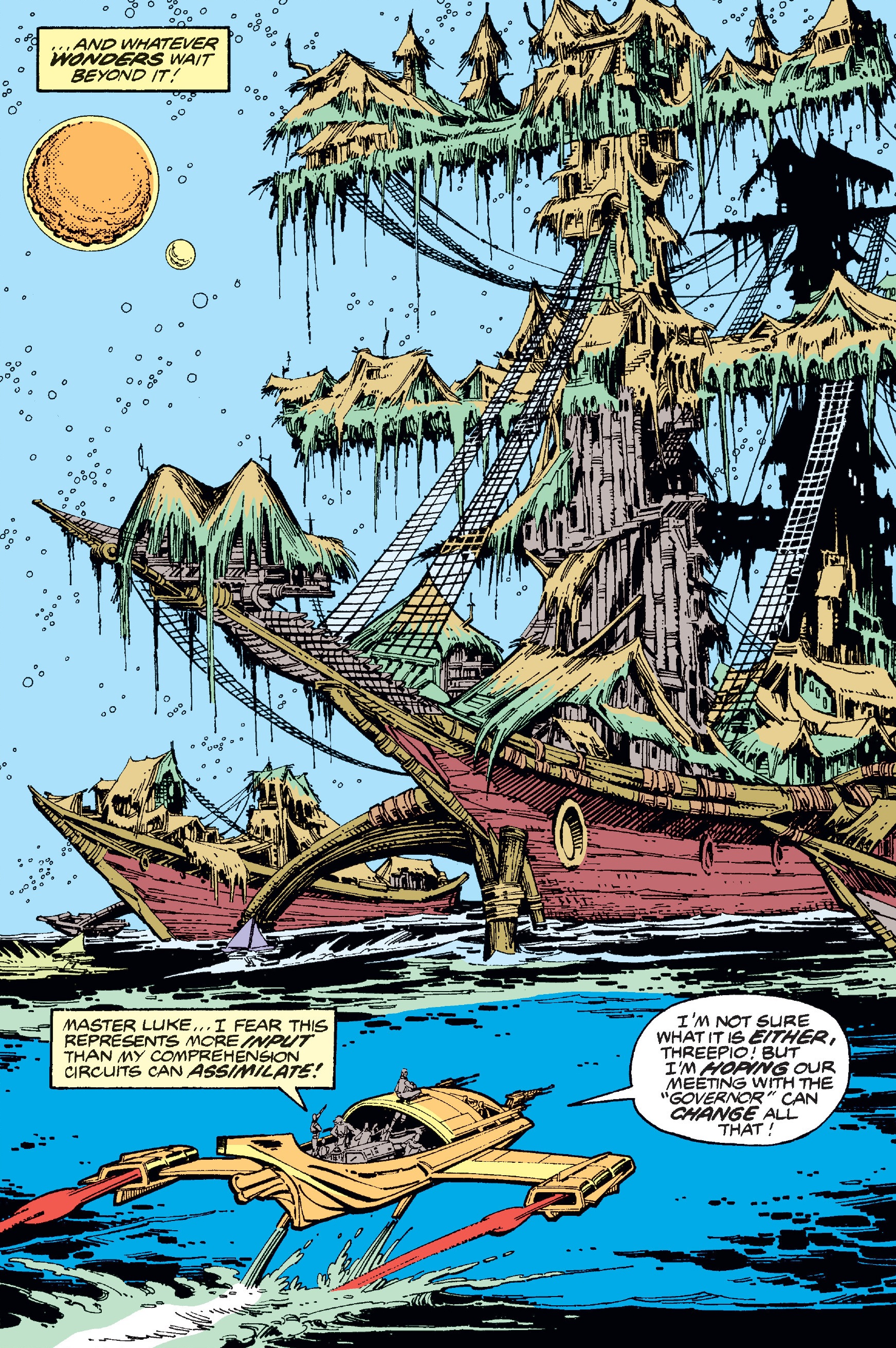 Star Wars #12
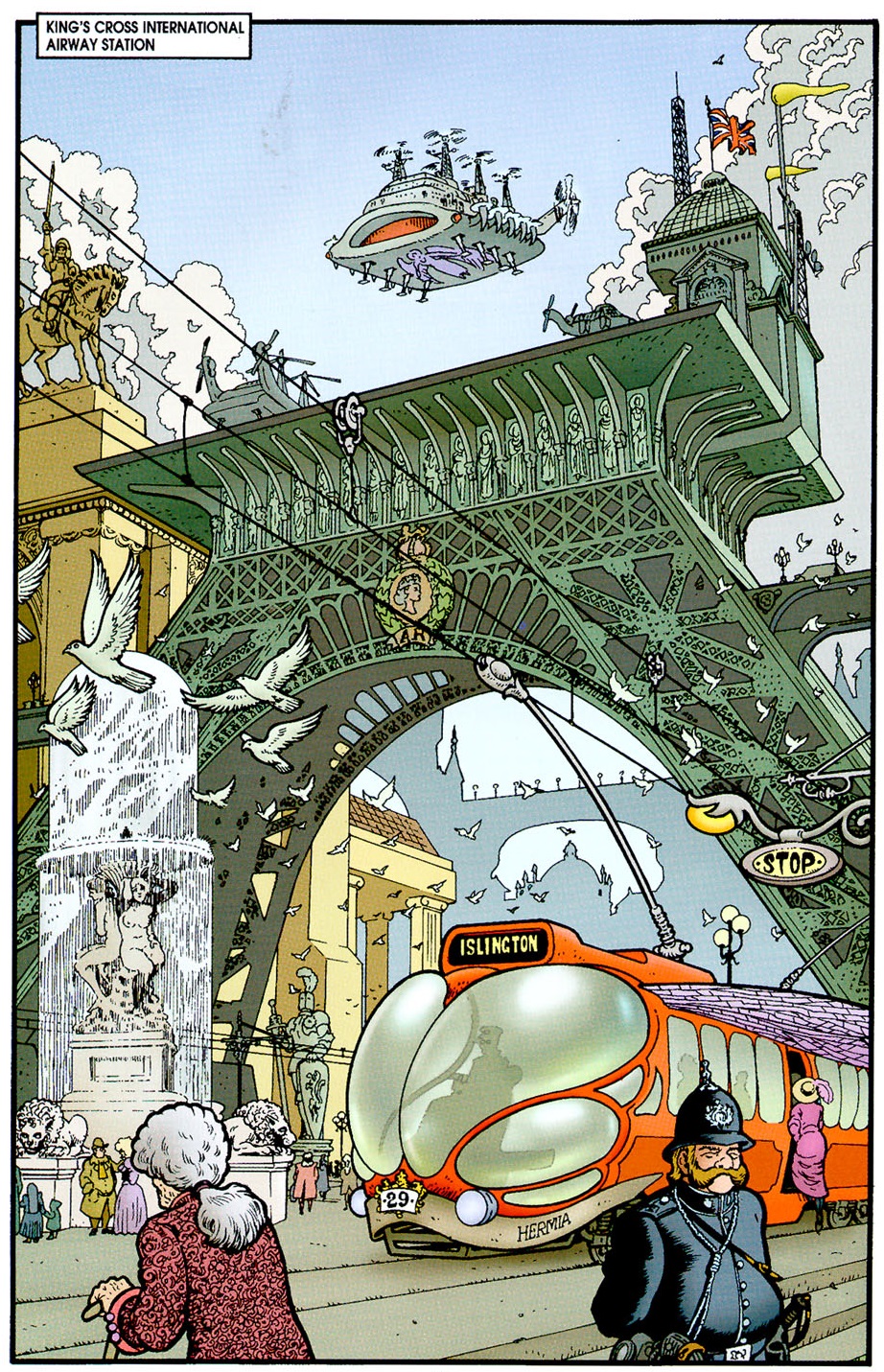 Heart of Empire #1
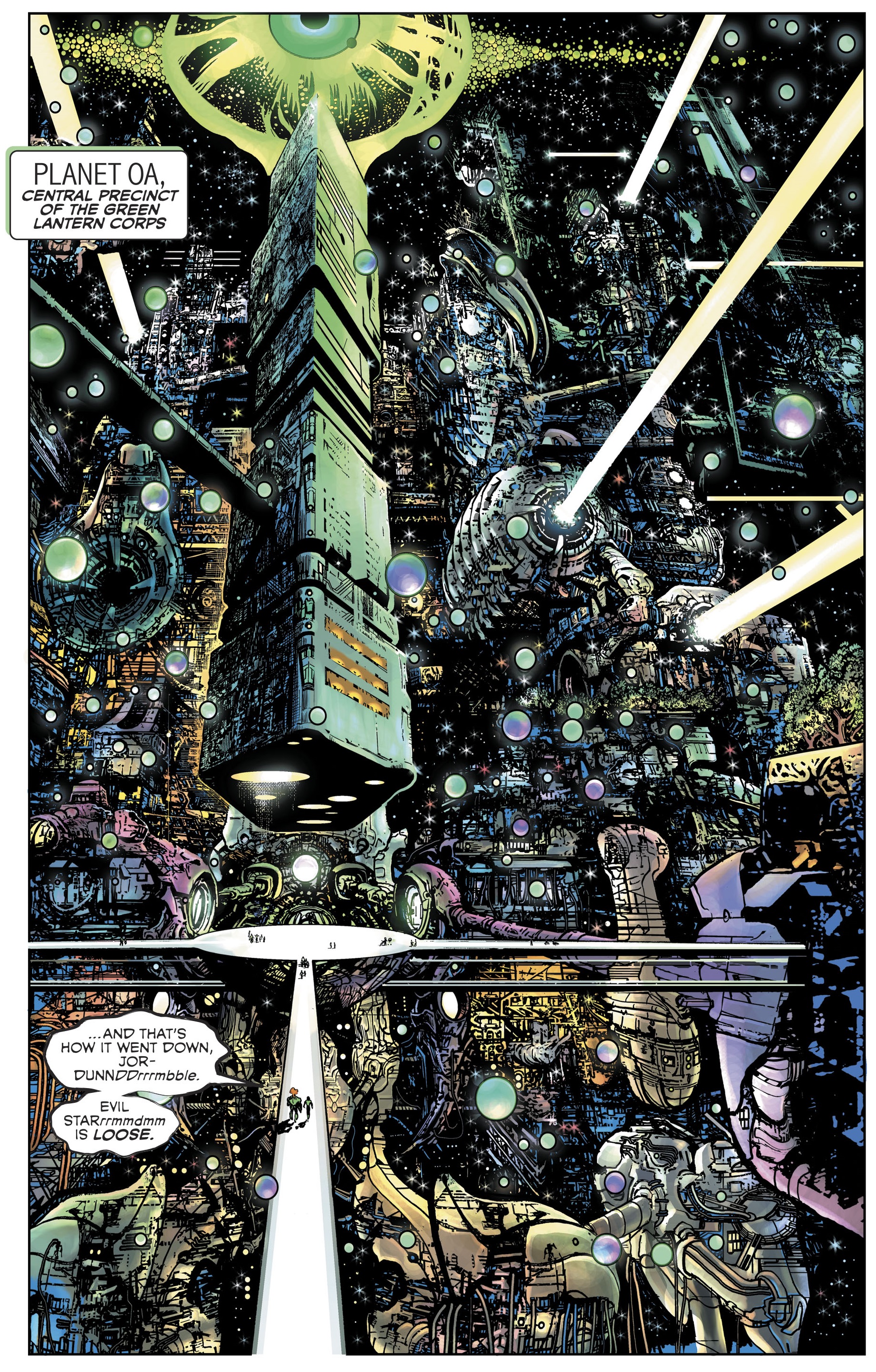 The Green Lantern (v5) #2
Spotlight on The Unknown Soldier, 1980-1982
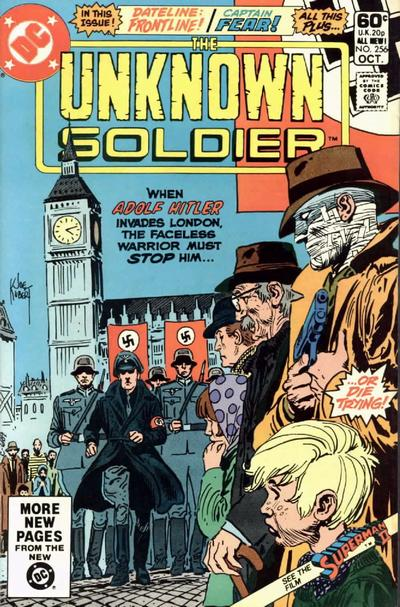
This is the final installment in my overview of Bob Haney’s neglected run on The Unknown Soldier, which ended with a bang.
By 1980, this World War II-set comic had turned into a fairly mechanic, well-oiled enterprise. Haney churned out scripts with his usual quota of high-octane thrills – mostly standalone tales, yet with the occasional cliffhanger ending and a few recurring characters. The art chores were secured by Dick Ayers, a veteran workhorse in the industry (not to mention a WWII veteran himself). Ayers’ vast portfolio already included a ten-year stint as the primary artist on Sgt. Fury and His Howling Commandos, as well as loads of other war comics at both Marvel and DC, so he was comfortable briskly knocking out WWII adventures that, even when not at their most inspired, were never less than serviceable, especially given Gerry Talaoc’s crisp inks. Starting with issue #237 (cover-dated March 1980), colorist Bob LeRose gradually took over from Jerry Serpe – a change that wasn’t too noticeable at first, although LeRose did eventually introduce tighter, more subdued colors, which conjured up a grittier atmosphere. Len Wein became editor in #239 and seemed satisfied with The Unknown Soldier’s direction as a solid genre series.
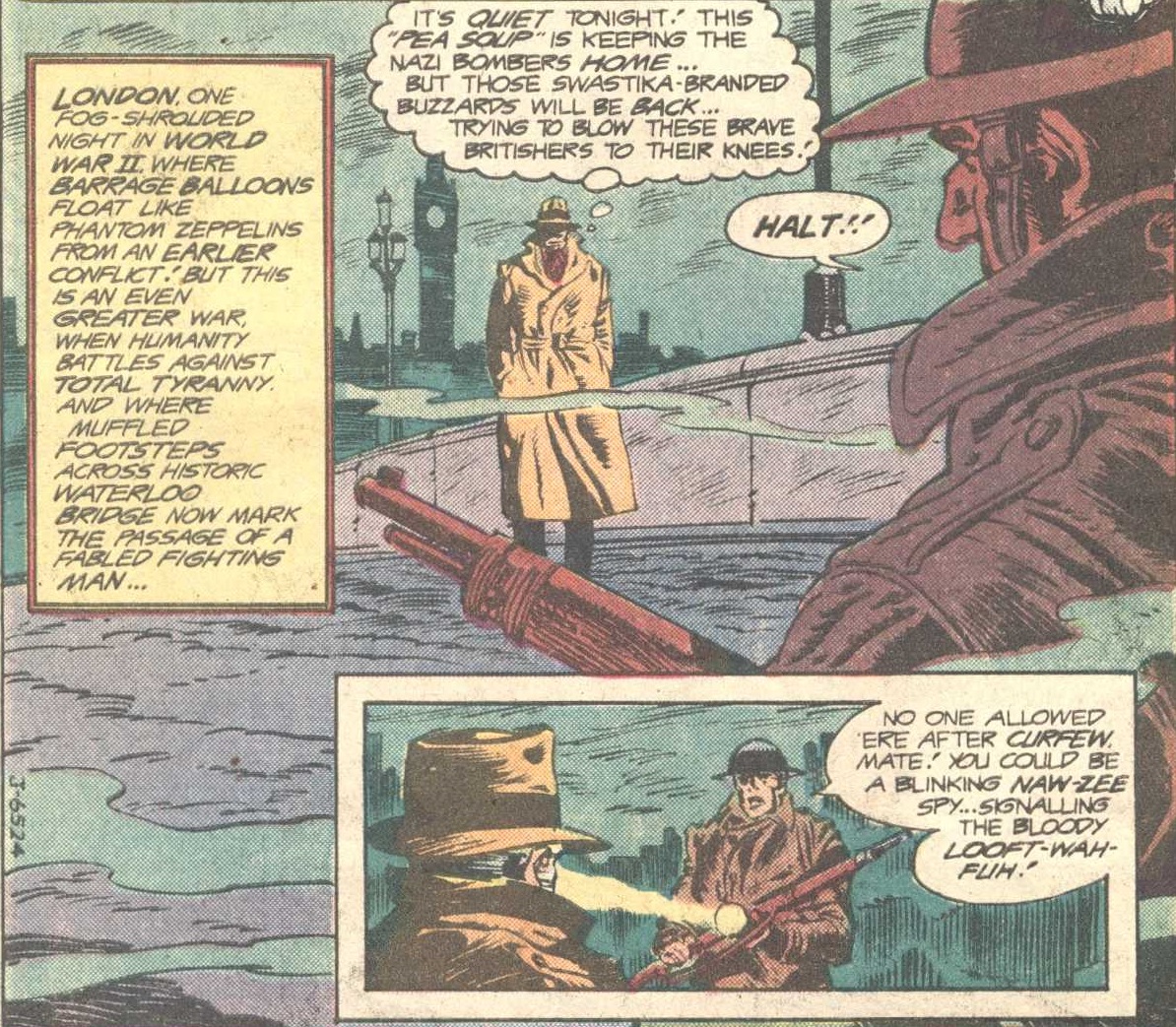
The issues from this era delivered what can be catalogued as relatively straight spy tales, with the possible exception of that wacky story in which the Unknown Soldier disguised himself as a proto-Pied Piper in order to lure away German children who were being used as human shields (explicitly taking advantage of the fact that they had been indoctrinated by the Hitler Youth to follow orders without questions). Even Haney’s colorful prose could be considered a part of the comic’s general throwback vibe…
 The Unknown Soldier #241
By ‘throwback vibe’ I mean that the series, for better or worse, had grown highly disconnected from the present, settling for reliving the moral universe of World War II (albeit in its more liberal version) almost as if it had been penned during that period. Naturally, a case can be made that the very act of depicting moral certitude in the turn towards the Reaganite 1980s ultimately adds up to an implicit endorsement of the righteousness of the United States’ interventionism abroad… Still, even when the Unknown Soldier went to the USSR, in ‘Red Flows the Don!’ (#242), instead of a Cold War-era propaganda-informed caricature, you got a somber take on the brutality of the Eastern Front and a recognition of the Russian partisans’ spirit of sacrifice.
(That said, if you want a thoughtful, gut-wrenching, and more historically realistic take on the Russian Front, go grab yourself a copy of Garth Ennis’ and Steve Epting’s graphic novel about Soviet women snipers, Sara, which looks absolutely stunning, not least because of Elizabeth Breitweiser’s coloring. In turn, if you’d like an intricate WWII spy thriller featuring communists, only with much more sex and swearing, have a go at Howard Chaykin’s Blackhawk!)
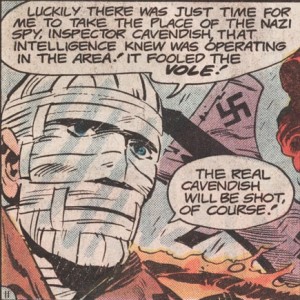
As I’ve mentioned before, Bob Haney’s Unknown Soldier was not a conflicted individual. For the most part, he was a fully committed agent who didn’t hesitate before killing traitors in cold blood or, as seen in a later issue, making nonchalant statements like this one:
 The Unknown Soldier #257
(To be fair, in one of his final stories, at least the Unknown Soldier grudgingly lets a group of exhausted US sailors flee into neutral Sweden, after one of them poignantly explains to him: ‘Not every fighting man is like you…! Not everyone can go on forever!’)
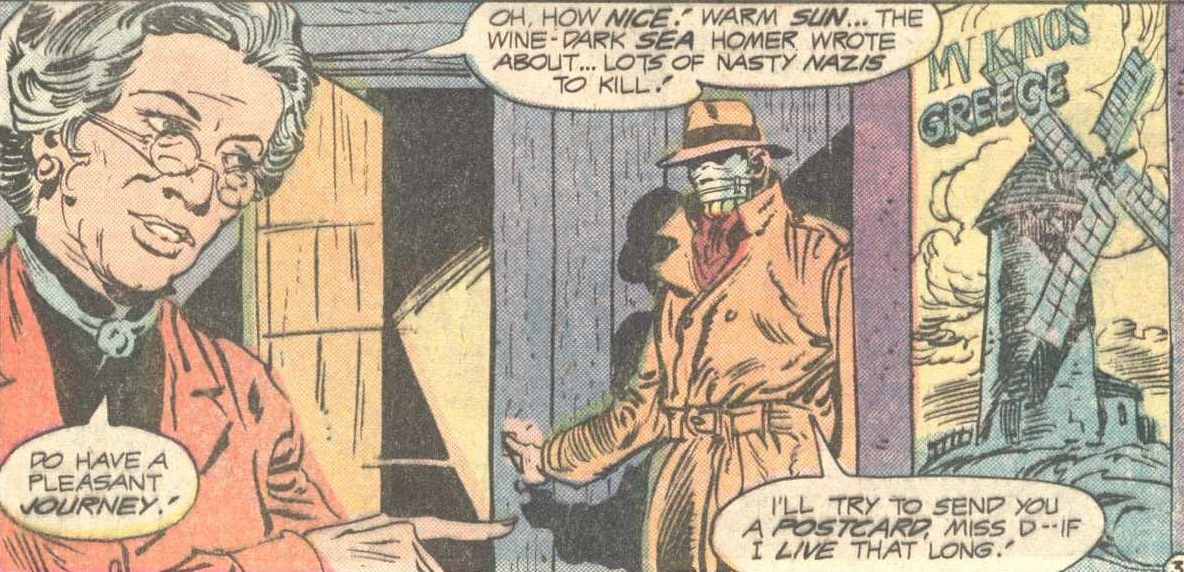
The whole premise of a committed, ultra-efficient secret agent gave the comic a discernable James Bond flavor, although without the campier aspects. There was even a (much less sexualized) version of Miss Moneypenny:
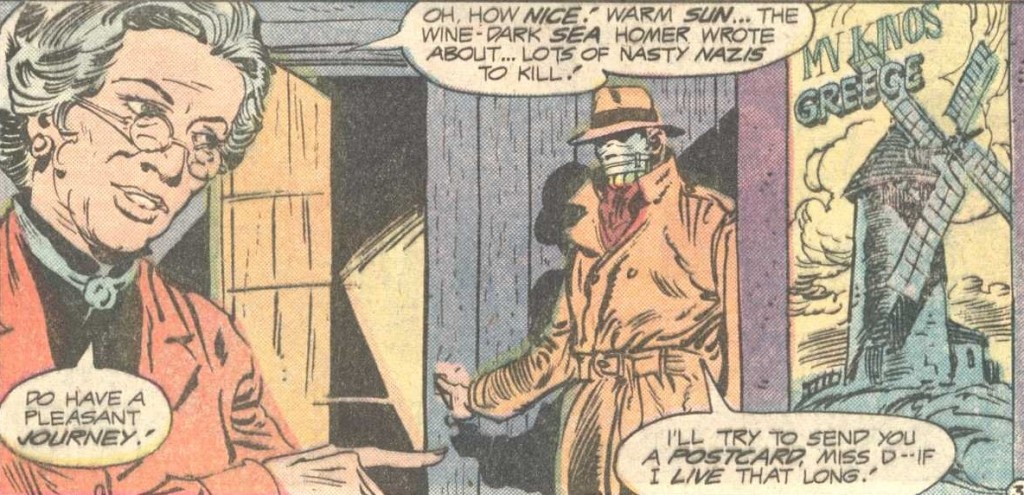 The Unknown Soldier #241
(This panel also works as a smooth bit of foreshadowing, as those windmills will eventually play a key role in the story, which is actually a pretty neat spy thriller…)
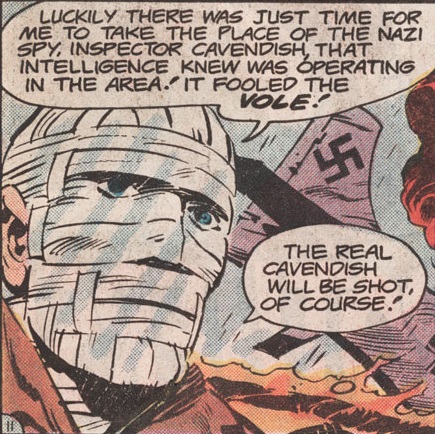
Not that anyone could accuse the series of lacking a specific identity. For one thing, Bob Haney stuck to the ridiculous gimmick that the Unknown Soldier wore incredibly perfect masks *over* his bandages. Haney also toyed with the fact that anyone could wear bandages and pass themselves off as the Unknown Soldier – if the hero’s facelessness made him a master of disguise, it also made it easy for his enemies to disguise themselves as him! In fact, almost everybody turned out to be able to seamlessly disguise themselves whenever it proved convenient to the plot… The growing number of Scooby-esque unmaskings made readers increasingly unsure about whom to trust.
Moreover, in a two-parter running in issues #248-249, Haney reworked the protagonist’s origin, tweaking Joe Kubert’s initial version only to then reveal it as just a cover story and then replace it with an update (which combined the original with the retroactive introduction of the more recent supporting cast), adding to the overall uncertain feel of artificial layers wrapped around more layers.
That two-parter also marked a shift into more superhero-y territory. Having pushed grimness to the brink in ‘Season in Hell!’ (#247), set in the Warsaw ghetto, Bob Haney injected the series with a renewed sense of daring buoyancy and spectacle. In a typical move of mainstream comics, issue #250 was a blockbuster saga pitting the Unknown Soldier against DC’s other major WWII characters (the ones featured in DC Goes to War), including Sgt. Rock, Mlle. Marie, the Losers, and the Haunted Tank. It was a fun reminder that, despite the absence of superheroes and similar characters, the comic was firmly set in the DCU’s World War II (a fact that, years later, led to a wonderful homage to this run, in Rick Veitch’s Swamp Thing #82).
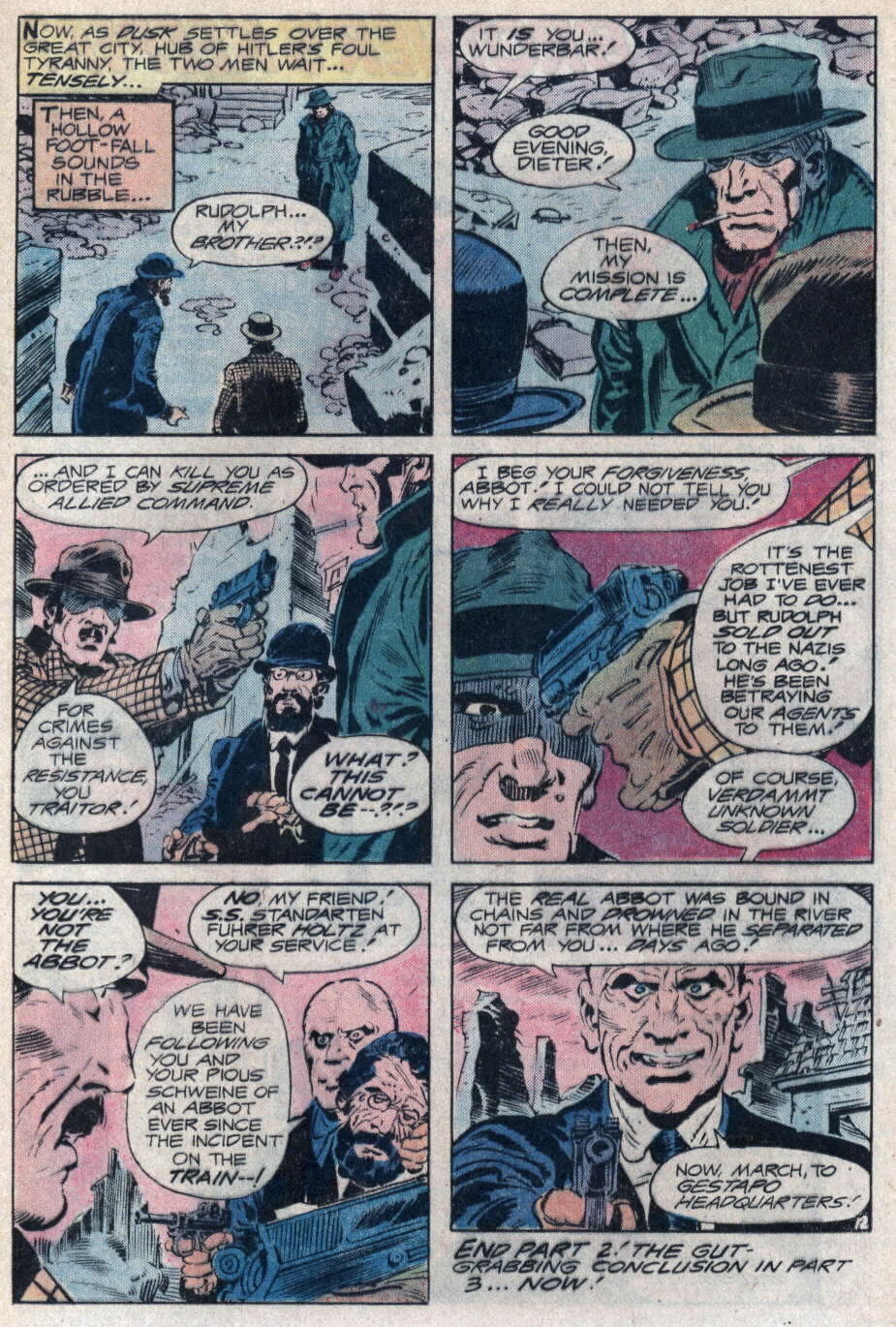
The next issue is even wilder, as it piles up so many plot twists that it feels almost like a parody of the series’ formula… It involves the Unknow Soldier recruiting an abbot to help him make contact with his (the abbot’s) brother, who is an important leader of the German underground resistance. This is what happens when they finally meet (the Unknown Soldier is the mustachioed guy in the checkered coat):
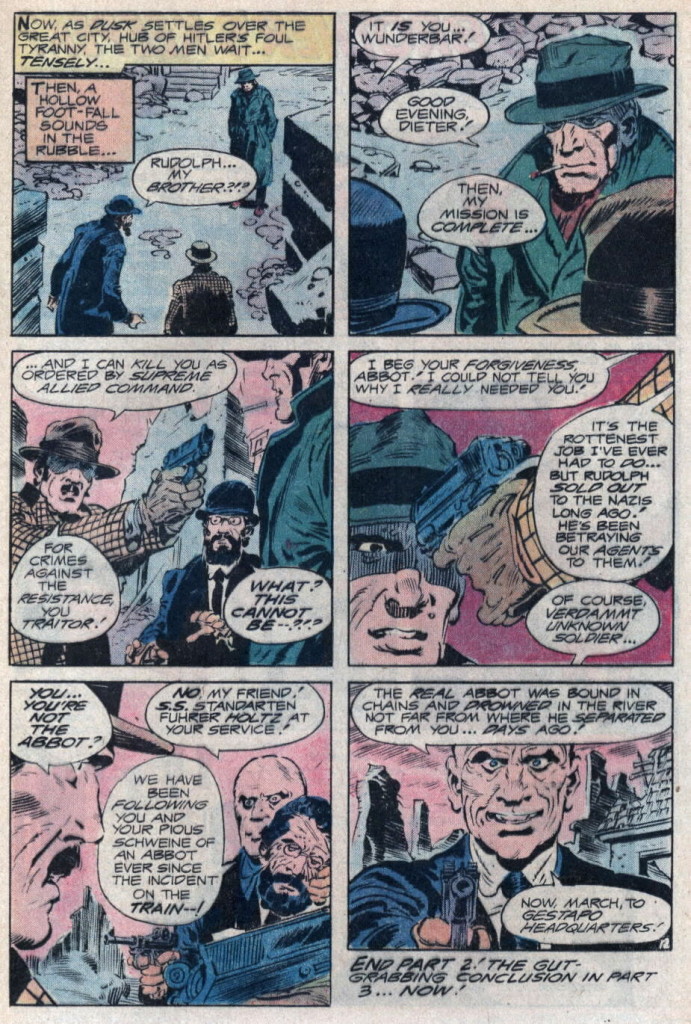 The Unknown Soldier #251
You’d think things would be allowed to settle for a bit after these two sudden, successive switcheroos, but you’d be wrong.
The pace is so relentless that in the very next page we get this:
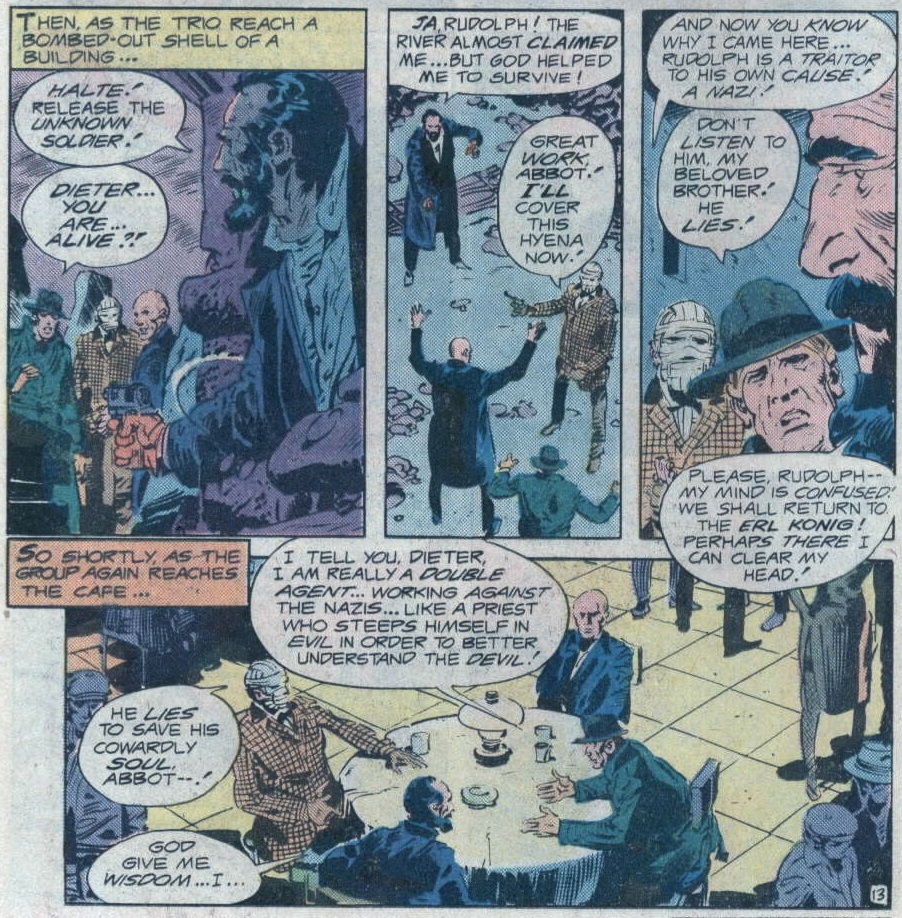 The Unknown Soldier #251
By then then, all bets were off. One of the Unknown Soldier’s missions in this latter stage involved tackling the fact that the moon was driving pilots insane. In another one, he fought Nazi circus magicians among the mystical atmosphere of Stonehenge. And, of course, there was the issue where our hero and his lover found themselves possessed by a sorcerous version of the Beauty and the Beast!
Sure, not all of them were like this. You also got a clever whodunit set on the North-African front (complete with a major tank battle) and one arc inspired by George Seaton’s underrated spy movie 36 Hours. Yet every time you felt the comic had returned to safer ground, the next issue would burn the rulebook all over again!
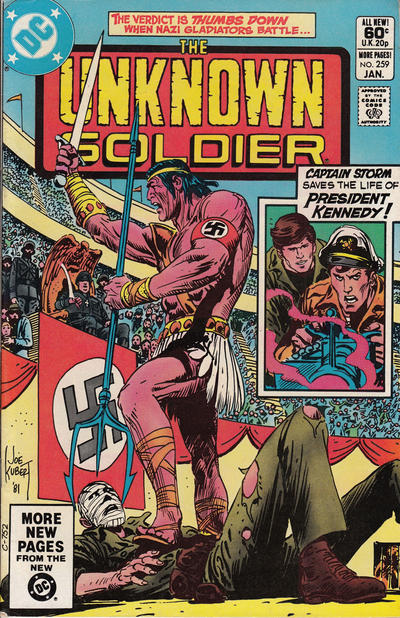
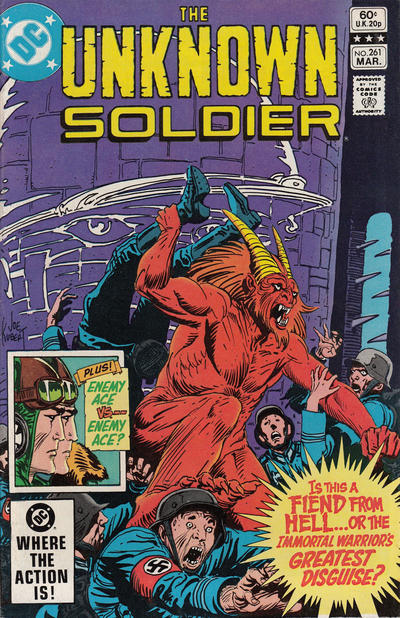
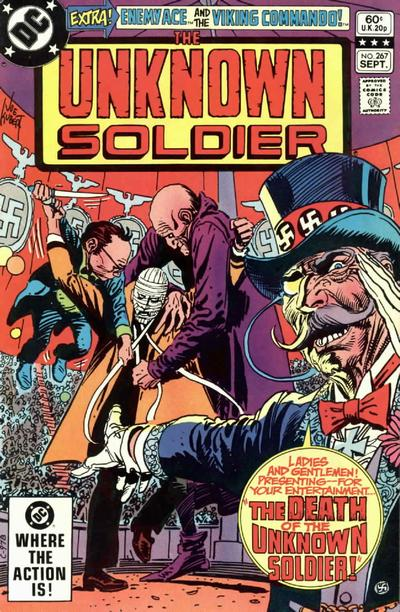
I don’t know where this final burst into strange fantasy came from. Perhaps it was the fact that Mike W. Barr joined the editorial team. Or perhaps at least part of the explanation may involve the hype surrounding what came to be the next age-defining historical adventure blockbuster: Raiders of the Lost Ark.
Indeed, if the David Michelinie-penned Unknown Soldier sometimes captured the tone of Italian ‘macaroni combat’ movies, Bob Haney’s late run seemed increasingly in tune with the spirit of Indiana Jones. When his hero went on a mission in China, rather than finding himself immersed in cloak & dagger intrigue, the Unknown Soldier now got involved in an ancient conflict between local pirates and warlords who didn’t give a damn about his mission…
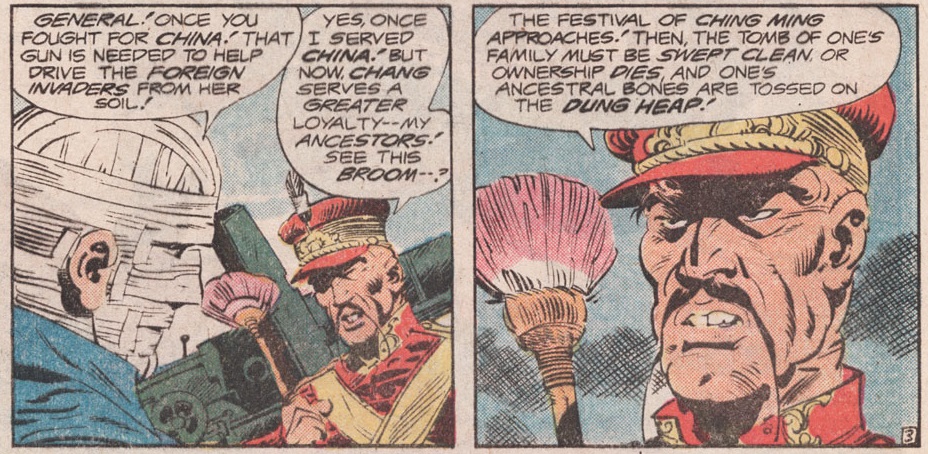
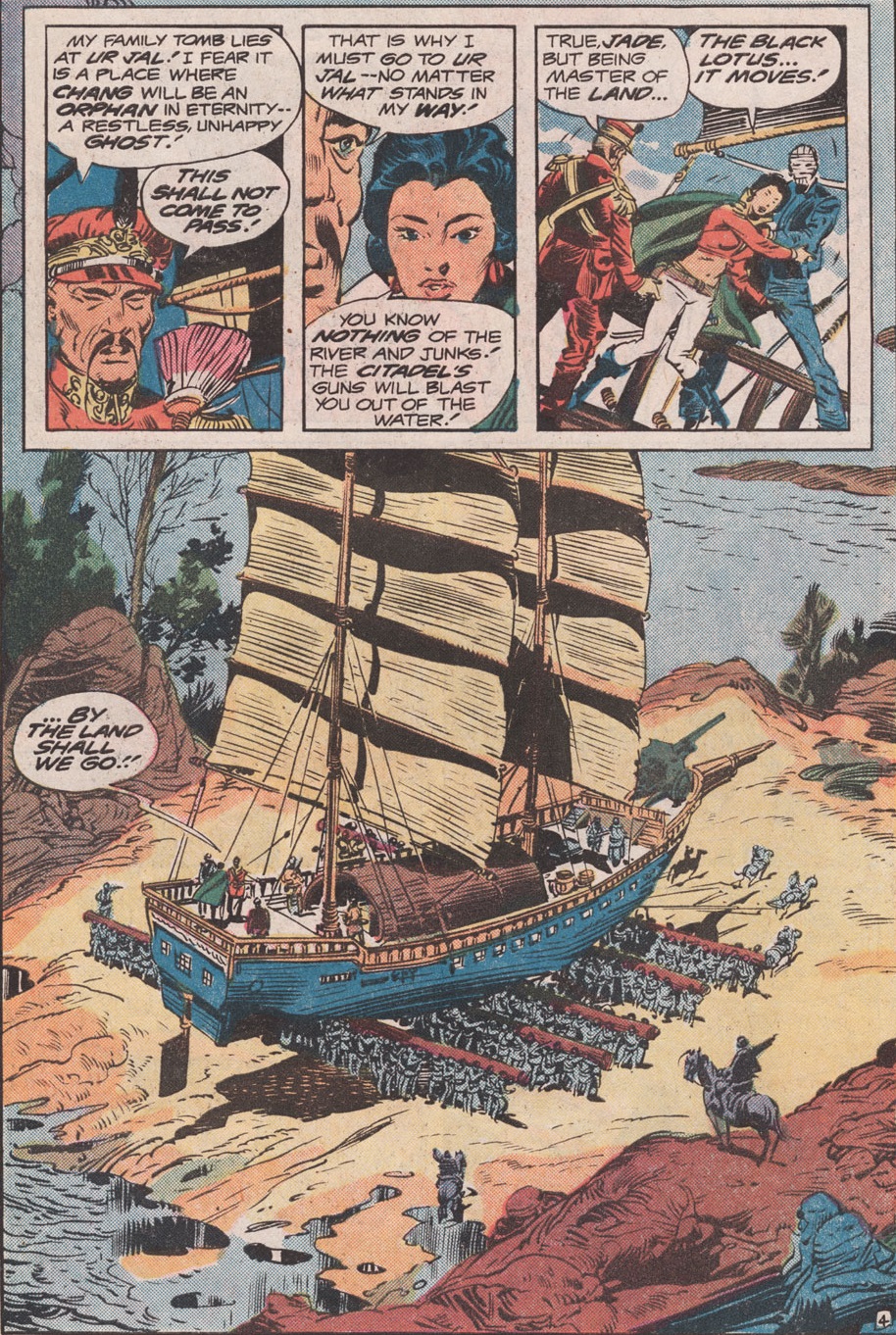 The Unknown Soldier #255
I know the timing isn’t absolutely right and the tonal similarities probably have more to do with shared sources of inspiration than with direct influence. However, when you look at the splash page below, with the torn papyrus-like caption, the Nazi villain’s look, the borrowed religious imagery, and the set piece’s recognizably pulpy action (complete with a monk pointing a crossbow in the background), you’ve got to wonder… That comic came out on 24 September 1981 (according to Mike’s Amazing World), three months after the premiere of Raiders of the Lost Ark, so the creators didn’t necessarily watch the film before the issue was practically ready, but maybe some of the movie’s earlier promotional campaign had an impact, even if on a subconscious level…
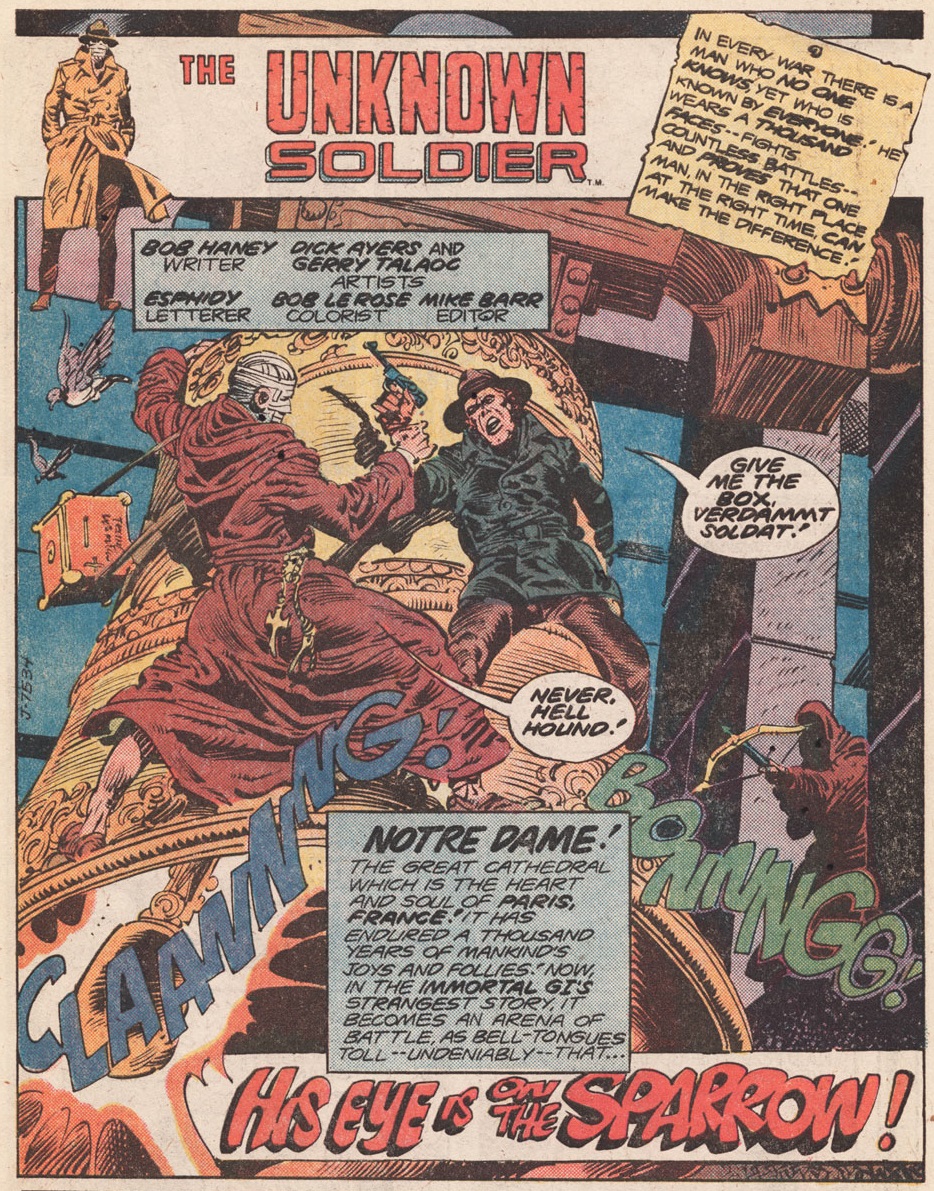 The Unknown Soldier #258
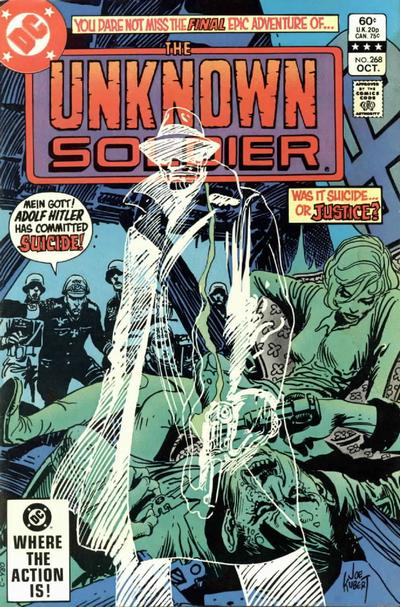
And where did all this lead up to? In retrospect, it should come as little surprise that the epic final issue, #268, which came out in July 1982 (yet was cover-dated October), involved a desperate Adolf Hitler preparing an invasion of biologically weaponized blood-sucking octopi, a denouement that was then topped with a revisionist twist worthy of Quentin Tarantino (if not quite as radical as the one in Inglourious Basterds). Pulling out all the stops, the issue even poignantly killed off much of the recurring cast, including the hero himself…
Yes, earlier that year, the (commitedly anti-war) DC Comics Presents #42, written by Paul Levitz, had already established that the Unknown Soldier secretly survived WWII, which took some of the edge out of this twist. To be fair, though, Haney and Ayers did leave that door open anyway, through an ambiguous final image where a soldier’s gesture could be taken as a reference to the hero’s habit of scratching at the base of his facial disguises.
All in all, this is one of the all-time greatest finales to a comic book run.