Classic hardboiled crime novels

If, like me, you dig pretty much everything noirish (even if it’s a highly derivative mash-up of familiar tropes, a weirdly pretentious cheapie about an incompetent hitman, a sleazy erotic thriller with contradictory gender politics, or a mystical, sluggishly paced Bhutanese mystery), surely some of the appeal Batman comics hold for you is the remarkable influence of hardboiled pulp fiction and film noir.
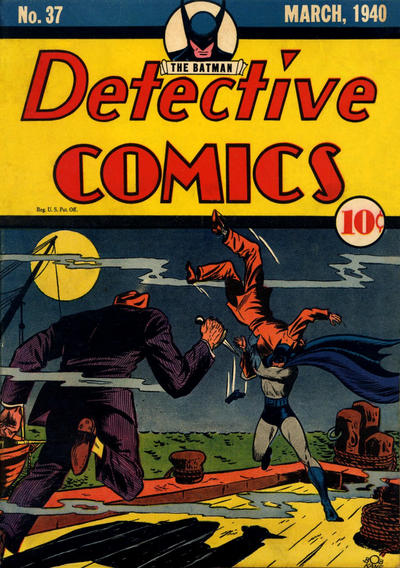
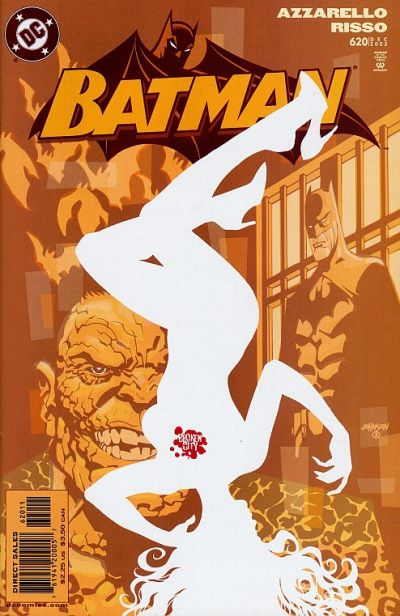
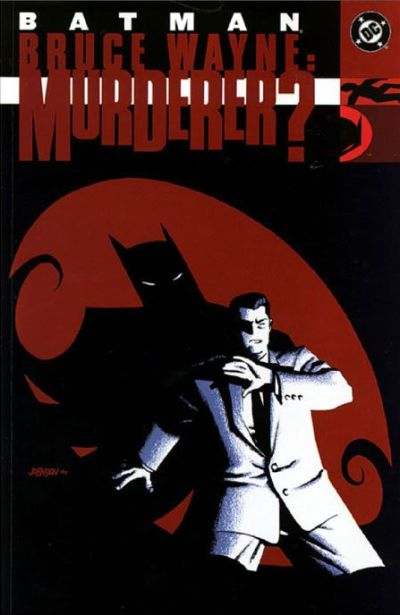
Detective Comics 37     Batman 620     Bruce Wayne: Murderer

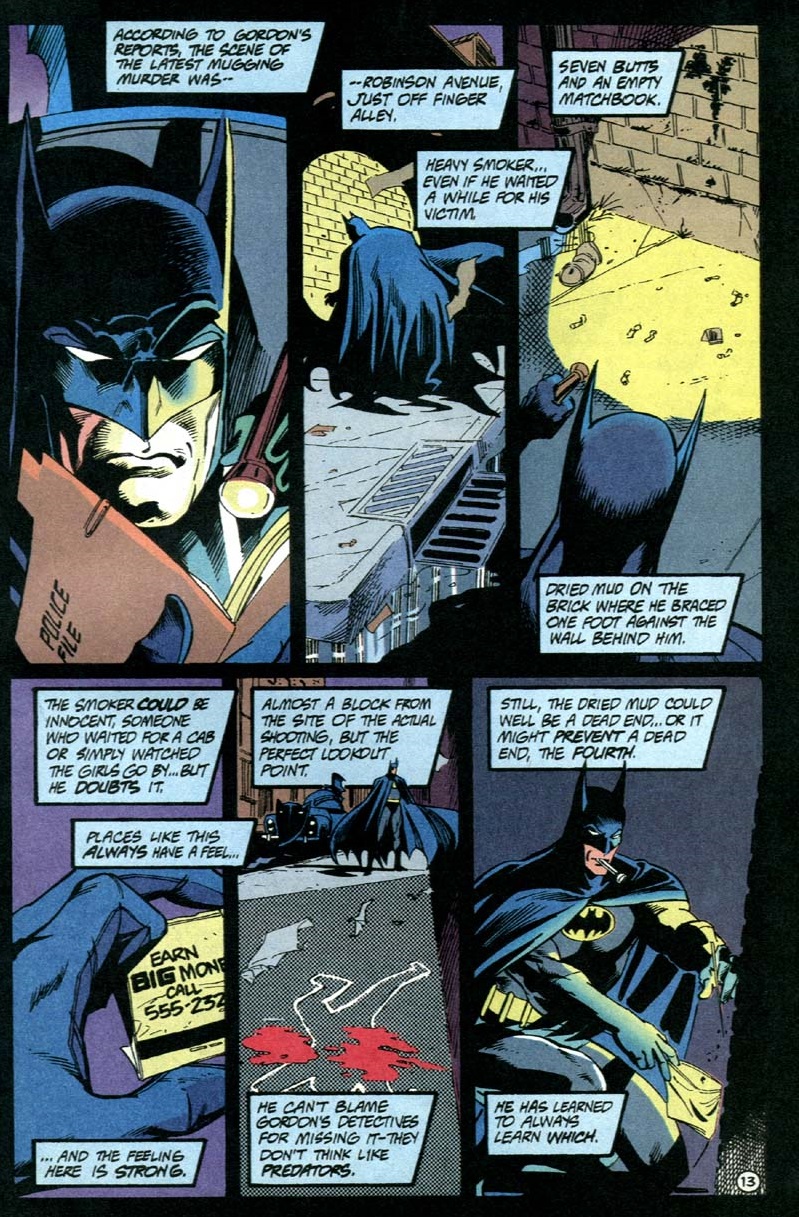
This influence was clear from the very first stories and, while the Dark Knight went on to have many other kinds of adventures, several writers and artists have kept the genre connection alive (most notably Frank Miller, Bruce Timm, and Brian Azzarello). Apart from Elseworlds pastiches like Nine Lives and Gotham Noir, you can find blatant homages to all those hard-hitting, convoluted tales of betrayal and murder – written in a scathing staccato rhythm oozing with male gaze, a sense of doom, and atmospheric slang, filled with slick mobsters, femmes fatales, tough guys in search of justice, and desperate protagonists haunted by their past – in gritty comics such as Batman: Year One, The Long Halloween, Broken City, Gordon’s Law, and City of Crime.

Yet perhaps you’re coming at it from the opposite direction. Perhaps you gained a taste for these elements through the comics and are now wondering about having a look at the original source. In that case, you are in for a ride, my friend! A couple of years ago, I suggested a bunch of film noir gems but, if you want to engage with the genre at its best, make sure you also pick up these three quintessential novels:

RED HARVEST

(Dashiell Hammett, 1929)
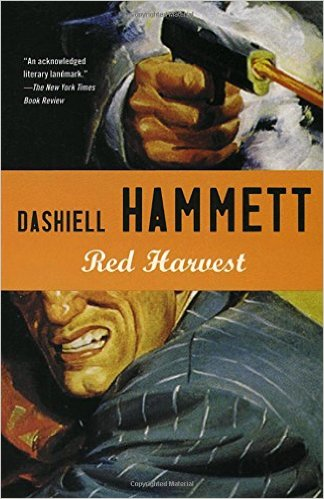
Red Harvest

“I first heard Personville called Poisonville by a red-haired mucker named Hickey Dewey in the Big Ship in Butte. He also called his shirt a shoit. I didn’t think anything of what he had done to the city’s name. Later I heard men who could manage their r’s give it the same pronunciation. I still didn’t see anything in it but the meaningless sort of humor that used to make richardsnary the thieves’ word for dictionary. A few years later I went to Personville and learned better.”

While working a case in a city that seriously rubs him the wrong way, an unnamed private investigator (an operative of the Continental Detective Agency) decides to declare war on crime by manipulating a dozen gangsters into killing each other. Less of a pure detective tale than Dashiell Hammett’s The Maltese Falcon, this is essentially a chain of interconnected mysteries, as the book keeps providing new twists almost until the final paragraph.

Hammett’s anti-hero spins this sordid yarn like a furious scriptwriter on a tight deadline, keeping most descriptions on the surface while letting you work out each character’s hidden agenda – they all have one! – based on their external actions and dialogue. He gives you just enough to feel the reek of smoke and sleaze all around. You can also sense the narrator gradually getting carried away by his self-imposed mission.

“This damned burg’s getting me. If I don’t get away soon I’ll be going blood-simple like the natives.”

The result is one hell of a page-turner, with quite a cinematic flair… No wonder Red Harvest – mixed with the also-cool-but-not-as-cool The Glass Key – served as inspiration for the phenomenal movies Yojimbo, A Fistful of Dollars, and Miller’s Crossing. (The quote above also inspired the title of the Coen brothers’ neo-noir Blood Simple.)

Furthermore, there is a lot of Gotham City in Personville (aka ‘Poisonville’) with its gaudy buildings, overwhelming corruption, and endless supply of devious bastards.

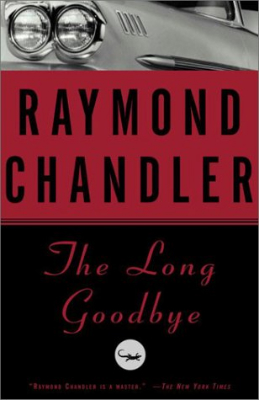
THE LONG GOODBYE

(Raymond Chandler, 1953)
The Long Goodbye

“The first time I laid eyes on Terry Lennox he was drunk in a Rolls-Royce Silver Wraith outside the terrace of The Dancers. The parking lot attendant had brought the car out and he was still holding the door open because Terry Lennox’s left foot was still dangling outside, as if he had forgotten he had one. He had a young-looking face but his hair was bone white. You could tell by his eyes that he was plastered to the hairline, but otherwise he looked like any other nice young guy in a dinner jacket who had been spending too much money in a joint that exists for that purpose and no other.

There was a girl beside him. Her hair was a lovely shade of dark red and she had a distant smile on her lips and over her shoulders she had a blue mink that almost made the Rolls-Royce look like just another automobile. It didn’t quite. Nothing can.”

The premise of The Long Goodbye involves the sardonic (if principled) private eye Phillip Marlowe trying to clear the name of his friend Terry Lennox, who seems to have murdered his wife. However, once again the labyrinthine plot keeps on spinning in surprising directions until the bitter end.

Raymond Chandler’s prose is a joy to read. He’s a master of witty turns of phrase and logical yet unexpected punchlines, with a sharp eye for detail (especially when it comes to capturing the decadence of Los Angeles). This is one of his most ‘literary’ novels, packed with beautiful descriptions, intriguing characterization, some social commentary, and a genuinely melancholic atmosphere drenched in hopeless loneliness and alcoholism. That said, Chandler doesn’t stray too far from his pulp origins: he still gives readers plenty of violence and hardboiled one-liners. While not as seedy as The Big Sleep, this is one mean read.

“I’m a licensed private investigator and have been for quite a while. I’m a lone wolf, unmarried, getting middle-aged, and not rich. I’ve been in jail more than once and I don’t do divorce business. I like liquor and women and chess and a few other things. The cops don’t like me too well, but I know a couple I get along with. I’m a native son, born in Santa Rosa, both parents dead, no brothers or sisters, and when I get knocked off in a dark alley sometime, if it happens, as it could to anyone in my business, nobody will feel that the bottom has dropped out of his or her life.”

Twenty years later, Robert Altman did a bizarre film adaptation that hugely simplified the story (although adding an extra knockout twist at the end!) while transposing it from the noirish 1950s to the New Age 1970s. If nothing else, the picture is worth watching just for all the little quirks, like the fact that Elliott Gould of all people is cast as Marlowe or the fact that every tune in the soundtrack is a variation of the same song.

THE HUNTER

(Richard Stark, 1962)

The Hunter

“When a fresh-faced guy in a Chevy offered him a lift, Parker told him to go to hell. The guy said, “Screw you, buddy,” yanked his Chevy back into the stream of traffic, and roared on down to the toolbooths. Parker spat in the right-hand lane, lit his last cigarette, and walked across the George Washington Bridge.”

Sure, we all love watching rugged detectives played by Humphrey Bogart and Alan Ladd struggling to do what’s right in an unfair world, but a great allure of film noir is also the sub-genre of movies where you find yourself rooting for hardened criminals who are just trying to pull a job in as professional a manner as possible (Jules Dassin’s Rififi, Paul Wendkos’ The Burglar, George Sherman’s Larceny). Under the pseudonym Richard Stark, writer Donald E. Westlake gave us his share of this type of stories in dozens of deliciously nasty thrillers about Parker, a ruthless freelance robber with big hands and a craftsmanlike, take-no-shit attitude.

In the series’ first entry, The Hunter, we meet Parker after he has been double-crossed and left for dead. We follow him – and, in the mid-section, one of his prey – as he methodically tortures and/or kills his way up the mob-like organization known as the Outfit in order to get his revenge… and his money back. Unlike the two books I mentioned above, The Hunter is written in the third person, but the gripping, unsentimental style actually mirrors Parker’s personality.

“It was his belt buckle that saved him. Her first shot had hit the buckle, mashing it into his flesh. The gun had jumped in her hand, the next five shots all going over his falling body and into the wood of the door. But she’d fired six shots at him, and she’d seen him fall, and she couldn’t believe that he was anything but dead.”

As others have pointed out, one of the things that makes The Hunter so enduring is that, even though it starts out as a personal revenge quest, it ultimately turns into a confrontation between a solo entrepreneur and a big corporation. The novel efficiently sets up a whole underground world of organized crime, with strict rules, specialized hotels, and an intriguing sense of community (not unlike the recent John Wick movies). It’s also a tight little beast, the action unfolding in a way that is as straightforward and relentless as Parker himself.

This book has been loosely adapted to the big screen at least three times (with the titles Point Blank, Full Contact, and Payback) and there is a gorgeous graphic novel rendition as well. Moreover, with its skill at delivering taut dialogue and keen heist plots, the Parker series was an obvious influence on the Catwoman comics of Chuck Dixon and Darwyn Cooke.

NEXT: Batman collections.

Posted in HARDBOILED CRIME | Tagged , | Leave a comment

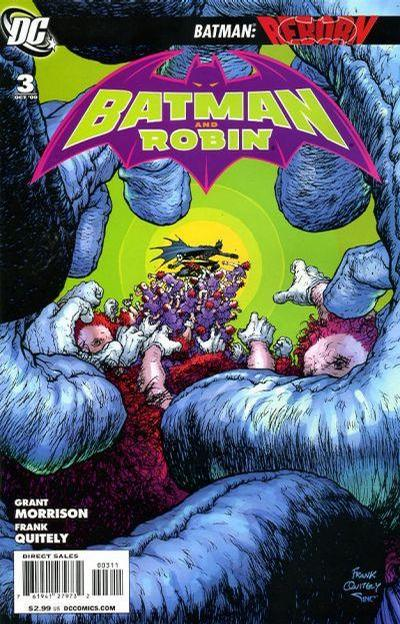
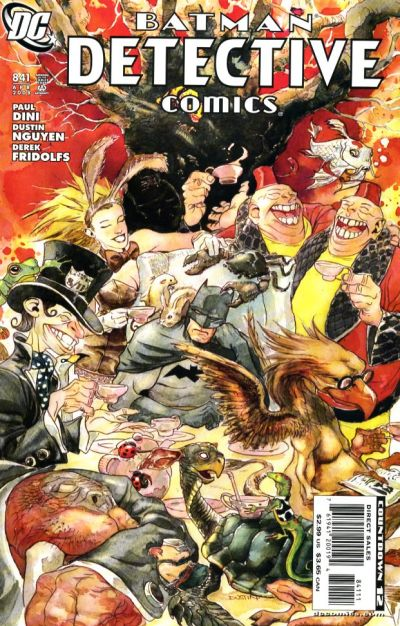
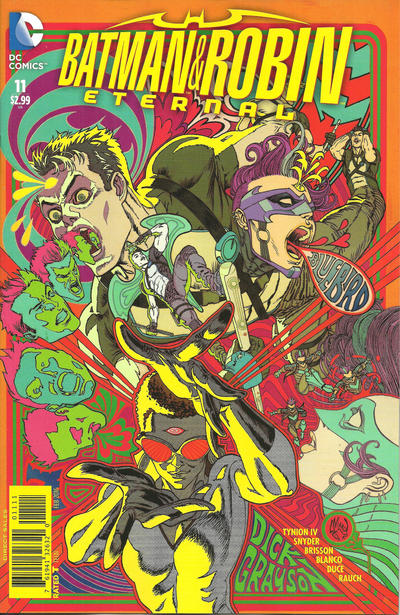
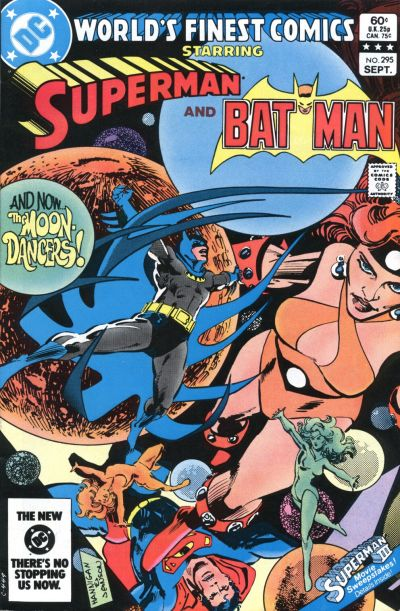
12 trippy Batman covers

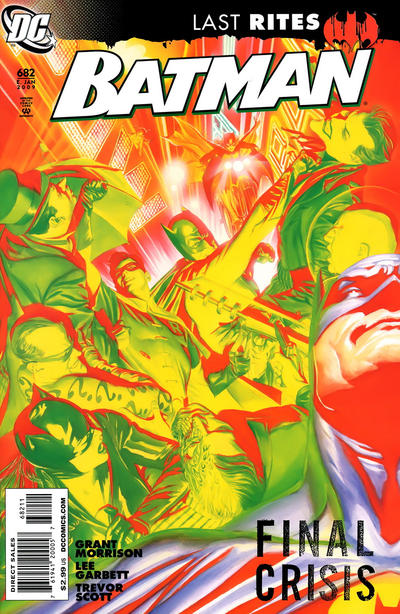
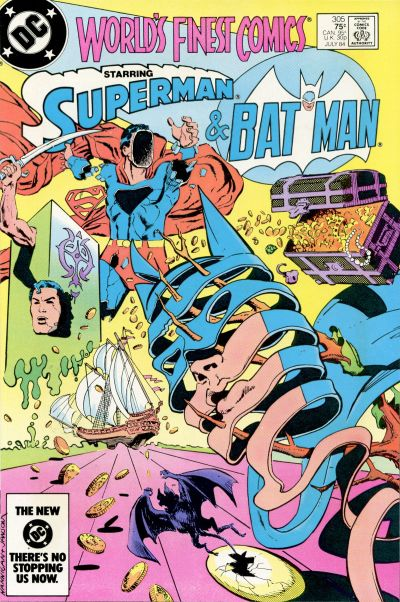
I’ve often pointed out in this blog that, during the Silver Age, many Batman covers achieved a level of psychedelia akin to a bad acid trip. However, this phenomenon isn’t exclusive to the 1950s and 1960s… Here are a dozen later examples (taken from the Grand Comics Database) of brilliant cover artists – and especially colorists! – trying to drive comic fans magnificently insane:

Norm Breyfogle

Batman 473

Will Simpson

Legends of the Dark Knight 93

Alex Ross

Batman 682

Ed Hannigan and Klaus Janson

World's Finest Comics 305

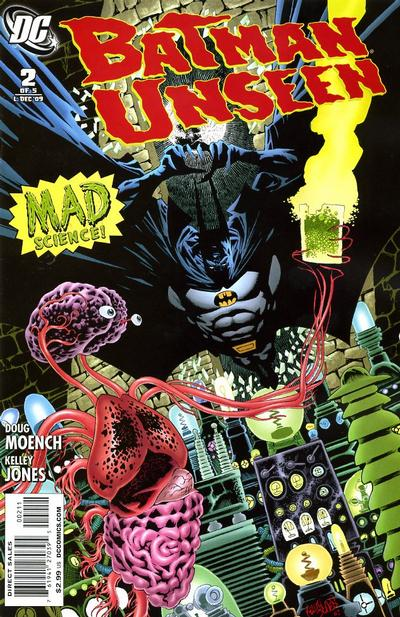
Kelley Jones

Batman: Unseen #2

Frank Quitely and Alex Sinclair

Batman and Robin 3

Dustin Nguyen

Detective Comics 841

Guillem March

Batman & Robin Eternal 11

Ed Hannigan and Klaus Janson (again)

World's Finest Comics 295

Rich Buckler and Karl Kesel

World's Finest Comics 321

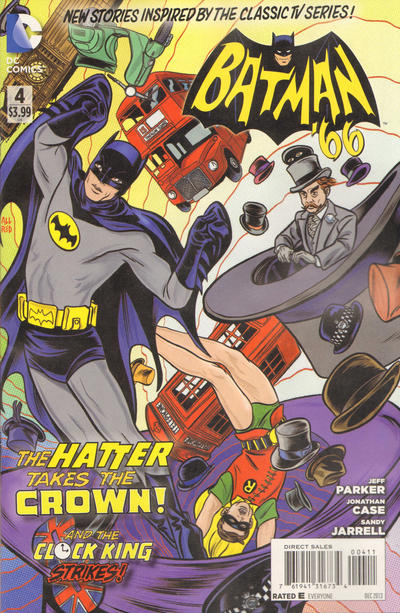
Michael Allred and Laura Allred

Batman '66 4

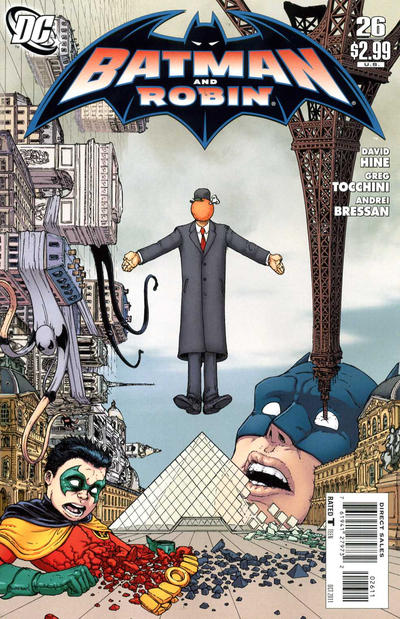
Chris Burnham

Batman and Robin 26

NEXT: Pulp fiction.

Posted in COVERS OF BATMAN COMICS | Tagged , , , , , , , , , , , , , , , | 1 Comment

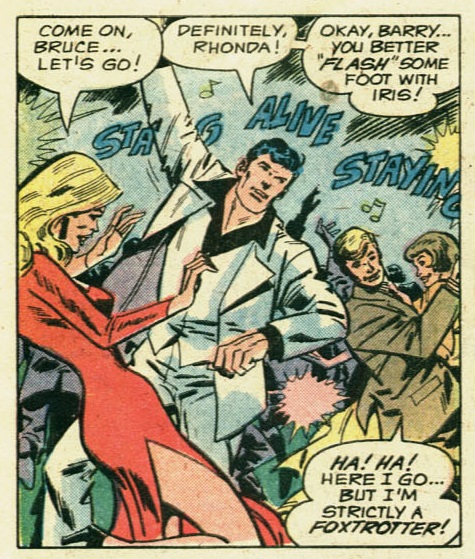
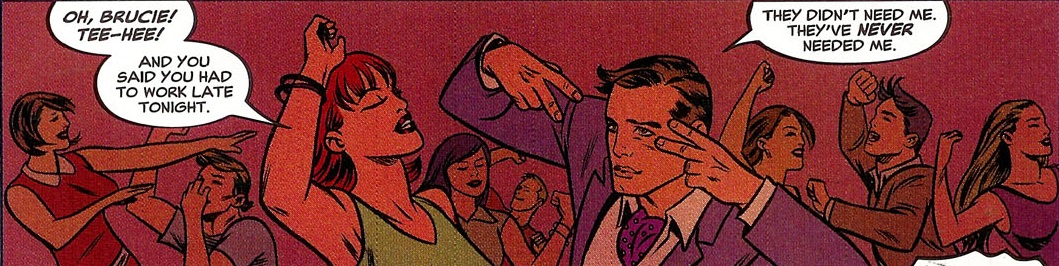
Bruce Wayne, disco party animal

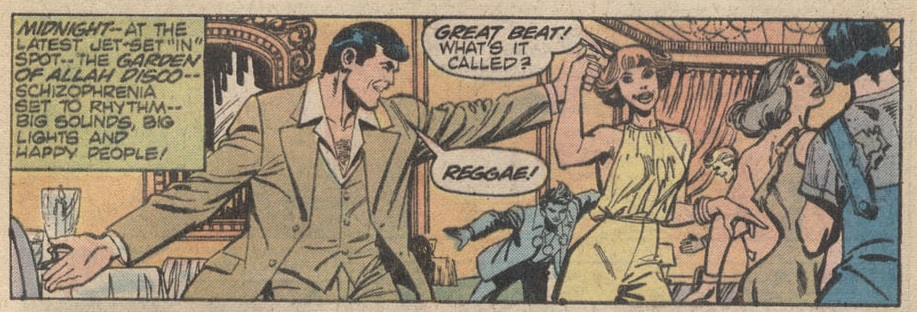
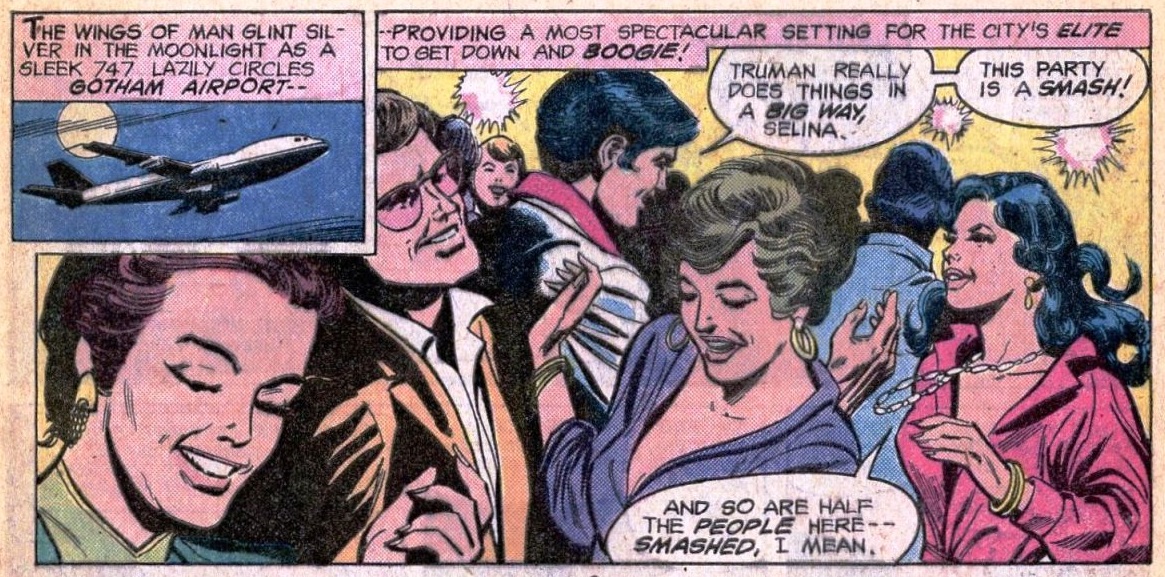
Chris McKay’s The Lego Batman Movie may be a genuinely funny absurdist comedy, an inventive visual delight with spot-on voice acting, a postmodern, good-natured spoof of superhero blockbusters as well as, at the same time, an action-packed mega-crossover adventure yarn in its own right, a feast of geeky cameos and easter eggs, a surprisingly wide-ranging and detailed homage to the depictions of the Caped Crusader across multiple media, a meta-commentary about the different ways Batman can be cool,  the closest thing to a Brave and the Bold feature-length film we are ever going to get, and way more charming, clever, and engaging than any shameless 104-minutes-long advertisement for toys had any right to be, but it did get one thing wrong. Batman is not into rap metal… he is totally into disco music:

batman 302Batman #302
batman 318Batman #318
brave-and-the-bold-151The Brave and the Bold #151
solo-07Solo #7


NEXT: Surrealist Batman covers.

Posted in GOTHAM CITIZENS | Tagged , | Leave a comment

Doug Moench’s over-the-top Batman

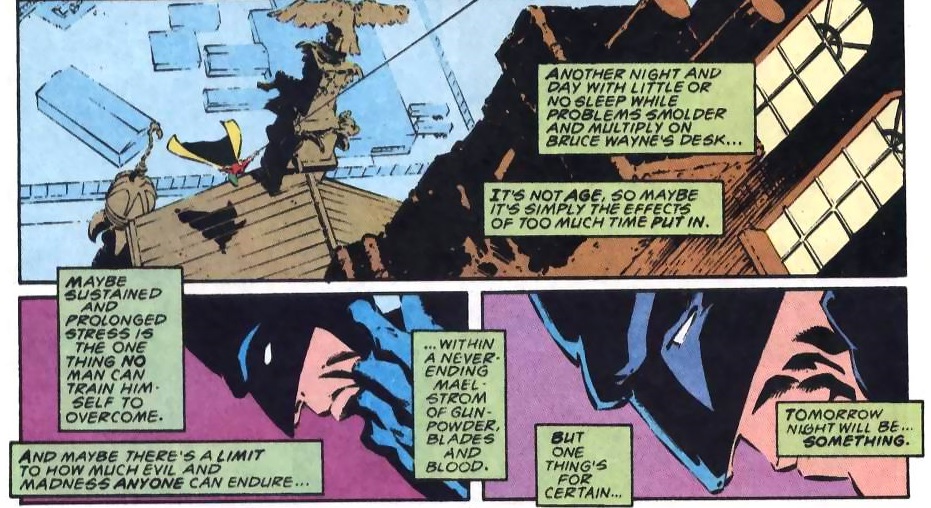
After an (unfortunately still) underappreciated run in Batman and Detective Comics in the mid-1980s, Doug Moench took a break for about five years before returning to Gotham City with a new attitude. If his earlier work had an emphasis on grounded action and characterization, filtered through a literary sensibility, Moench now chose to forgo most attempts at realism, instead engaging with the Dark Knight’s world as if it was an outlandish caricature.

His eccentric approach was all the more remarkable because Doug Moench ended up playing a central role in defining the feel of modern Batman comics. Besides a lengthy run on Batman (1992-1998), he went on to write several neat story-arcs for Legends of the Dark Knight as well as a pretty awful Catwoman run, not to mention a bunch of specials and short stories in anthologies like Showcase, Batman Chronicles, and Batman 80-Page Giant.

When people associate the 1990s with a brooding, über-grim Batman, this is largely a result of Moench’s purple prose…

Batman 485Batman #485

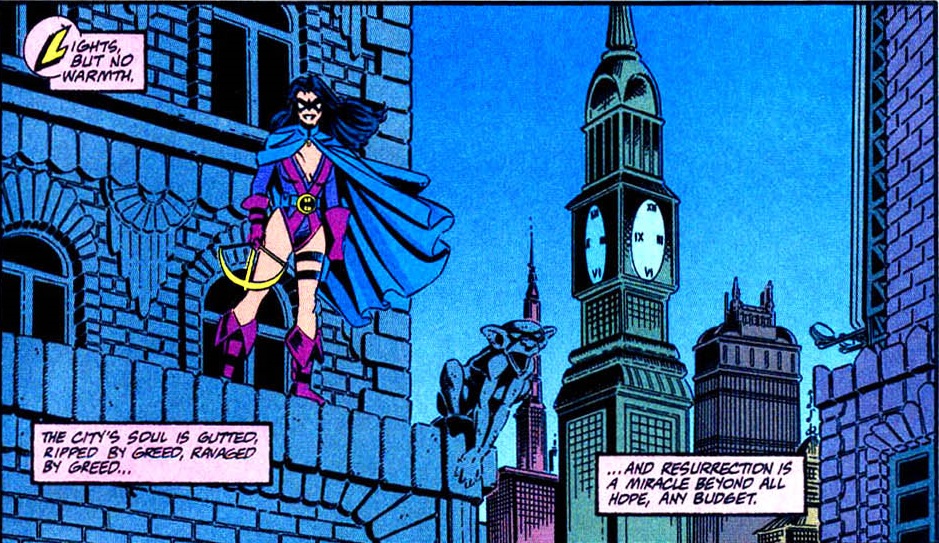
Such a way of writing Batman is often seen as an editorially-mandated, post-Dark Knight Returns trend (and surely there is some truth to that), but it should also be seen in the context of Doug Moench’s evolution into full-on operatic mode.

Seriously, it’s like Moench read Rorschach’s diaries and felt like they were not gritty enough…

showcase 93 #9Showcase ’93 #9

At first, when Moench returned to the Gotham corner of the DCU as a regular writer, his take on it didn’t come across as strikingly different from what he had done before… He seemed to be picking up where he left off, bringing back characters created during his former run – such as Circe and Harvey Bullock – and doing callbacks to his tales about Black Mask (in Batman #484) and the Dark Rider (in Batman #515), as well as to Gerry Conway’s original Killer Croc storyline (in Batman #489), thus establishing them as part of post-Crisis continuity.

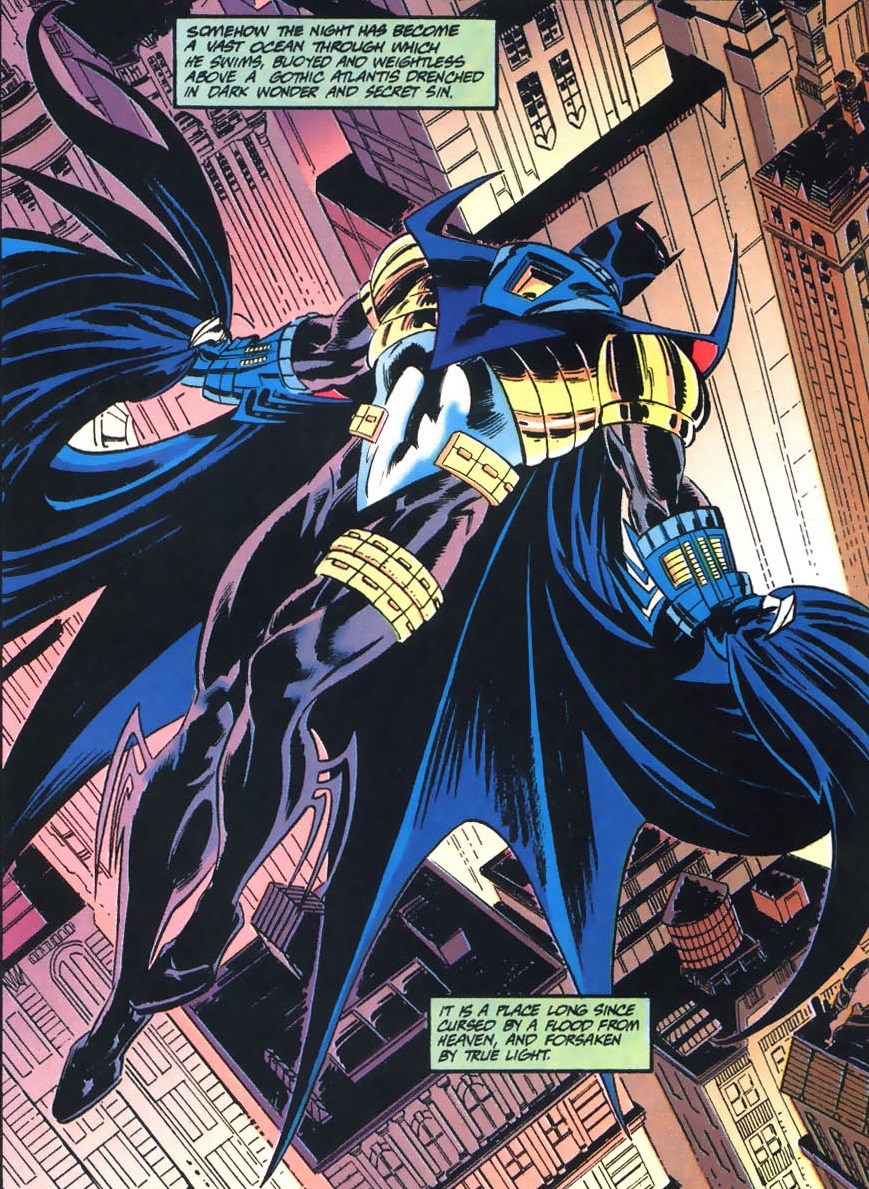
It didn’t take long before we got some glimpses of the high-octane madness to come, though. You could see Doug Moench absorbing the genre’s turn towards darkness, especially as he became one of the main writers of 1992’s ‘Knightfall’ story-arc, in which he explored Bruce Wayne’s psychological and physical breakdown. Moench also helped shape Bruce’s temporary successor, the demented Jean-Paul Valley (aka AzBats), who looked and acted quite differently from the regular Batman yet drew from the same dark well:

Batman 500Batman #500

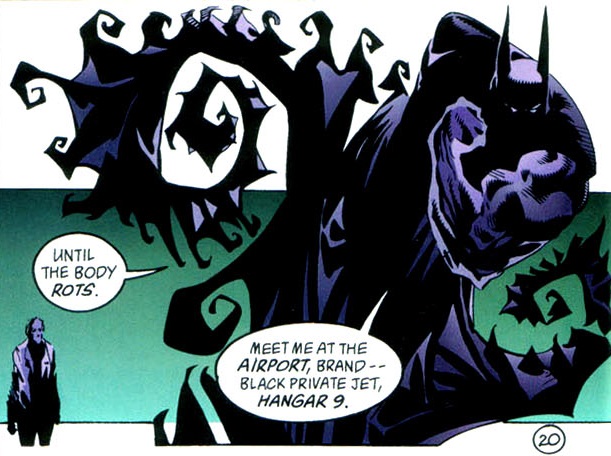
That said, it was after the ‘Knightfall’ and ‘Prodigal’ crossovers that Doug Moench’s characterization became really over-the-top. Most of the cast began to talk and act in preposterously exaggerated ways, striking shameless dramatic poses and uttering ill-disguised exposition, as if consciously owning up to the fact that they were comic book heroes and villains.

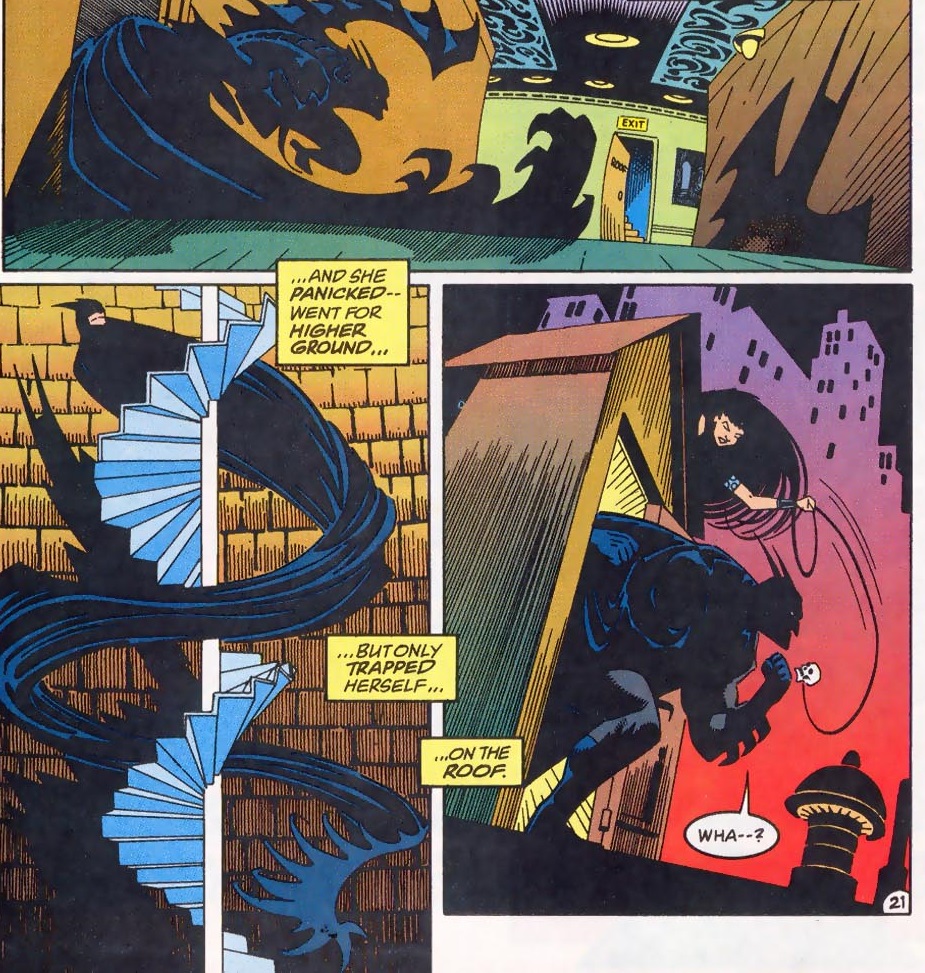
Not by accident, this shift coincided with the time when Kelley Jones became the regular artist on Batman, in late 1994. Jones’ pencils – savagely inked by John Beatty – are themselves as outrageously over-the-top as you can get, adorning the Dark Knight with some of the most bewildering, goddamned gothic capes and shadows ever to grace mainstream comics:

batman 516Batman #516
Batman 530Batman #530

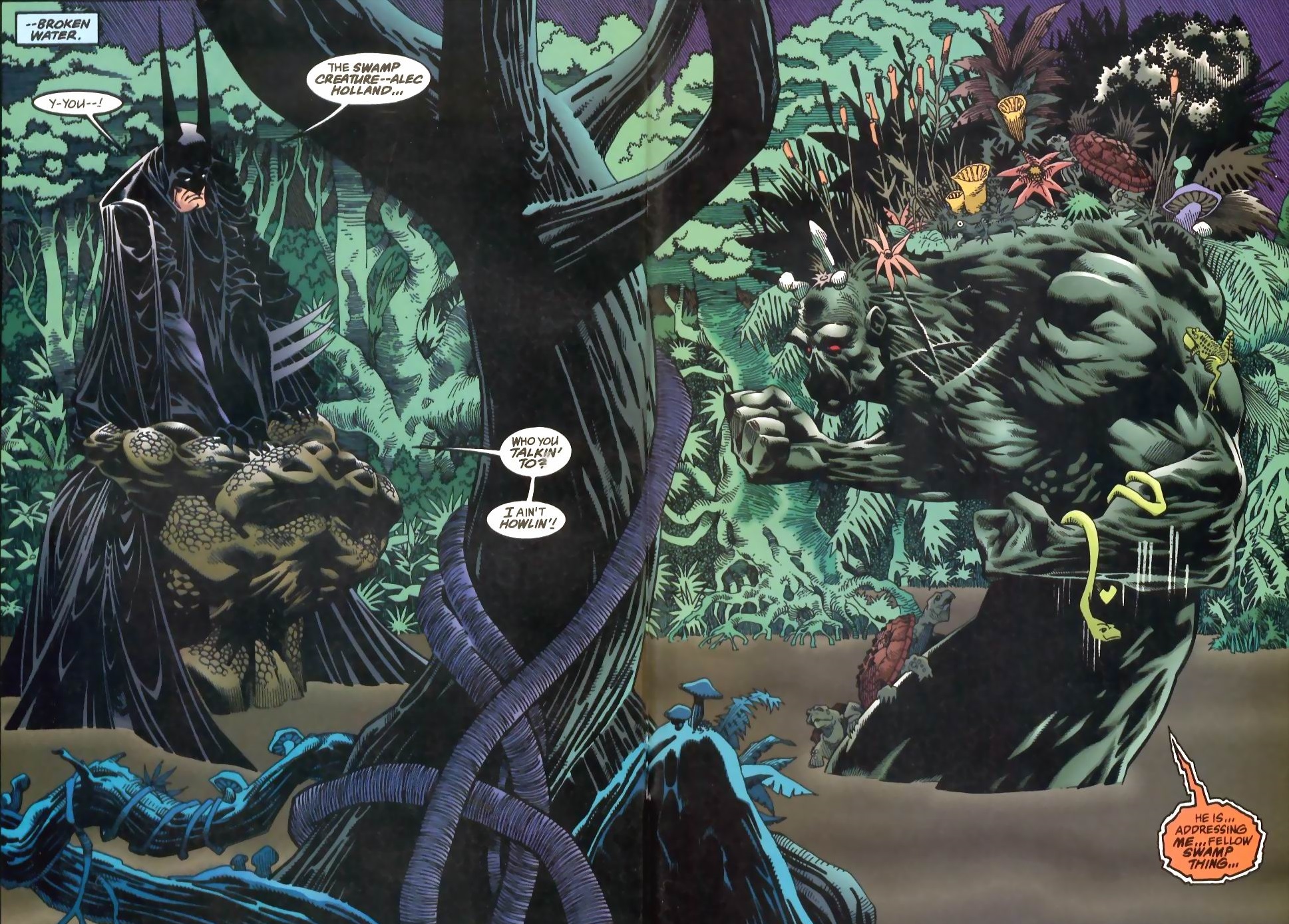
Doug Moench clearly decided to write for Kelley Jones’ strengths and he just swung for the fences. Moench’s scripts filled the series with freakish monsters and big, bodacious violence while giving Jones the chance to draw, in his own inimitable style, classic horror-inspired characters like the demon Etrigan, the Spectre, Man-Bat, Deadman, and Swamp Thing:

Batman 522Batman #522

(Yes, that’s Killer Croc making a killer pun.)

Outright embracing Kelley Jones’ cartoony neo-gothic vibe, Doug Moench soaked Batman’s stories in squirm-inducing ghoulish murders and dismembered body parts. On top of confrontations with most of the typical rogues gallery, the Dynamic Duo chased sick new villains who desecrated corpses and ripped people’s faces off, right there on the page!

In Moench’s defense, that kind of thing was not too unusual in the bat-books of the time… On an average month, you could easily find yourself starring at graphic depictions of a guy getting drilled alive, or being burned to a crisp, or getting his hands sawed off (or all of the above, in the case of Catwoman/Wildcat #4).

Likewise, in terms of overarching narrative, the Moench/Jones/Beatty run was immersed in its larger family of titles. Although most stories were self-contained, there was tight continuity between the bat-books in the form of background subplots that carried over from book to book and then paid off in occasional crossovers which wrapped the various series into the same meta-narrative – like in the cool ‘Contagion’ arc, where a dangerous virus outbreak in Gotham City brought together the casts of Batman, Detective Comics, Robin, Shadow of the Bat, Catwoman, and Azrael (there was also a Batman Chronicles tie-in, which launched Hitman).

None of this changes the fact that Doug Moench’s issues had quite a distinct voice. And while the tales illustrated by Kelley Jones were the ones where Moench went further over the edge, there were other fascinating collaborations. In particular, he did a number of comics with J.H. Williams III who, already at the time, enjoyed weaving intricate conceptual patterns into the layouts:
Batman Annual #21Batman Annual #21

Kelley Jones’ and J.H. Williams III’s flair for decorating the borders of pages with thematic details was an obvious fit for Doug Moench who – as I’ve mentioned time and time again in this blog – has a thing for bountiful symbolism, a trait that definitely did not go away in the nineties… See, for example, how when Moench updated the origin of Jonathan Crane, the Scarecrow (in Batman Annual #19), he appeared to have squeezed in every single symbol, play on words, and intertextual reference to fear and scarecrows (and to Jonathan Crane’s name) he could find!

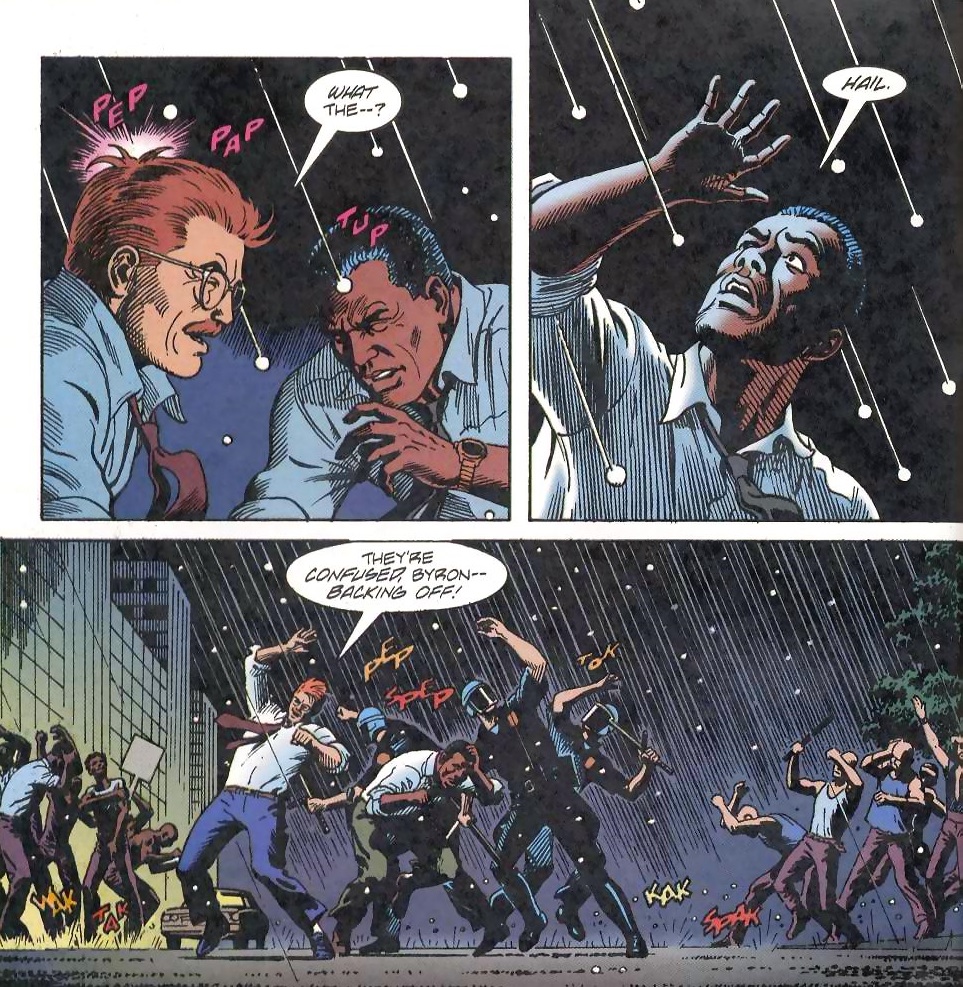
Even better: check out ‘Heat’ (Legends of the Dark Knight #46-49), in which there is a heat wave, a serial killer going after hot women, and racial tension heating up (due to the suspicion that the killer may be African-American, leading the authorities and white supremacist skinheads to persecute the black community, almost ushering in a riot). Plus, Catwoman is basically in heat, heavily hitting on Batman. And Billy Wilder’s Some Like It Hot is totally playing on television. And – I kid you not – the comic is drawn by Russ Heath! Seriously, given the racial theme, all that’s missing is a reference to the (awesome) film In the Heat of the Night

Sure, these may not be the most interesting genre comics to deal with racism, but I just love Moench’s commitment. To cap things off, the threat of a violent clash is resolved literally and symbolically with a break in the heat (introduced through another irresistible pun):

Legends of the Dark Knight 49Legends of the Dark Knight #49

Doug Moench also touched on the issue of race in ‘Suit of Evil Souls/The Greatest Evil’ (Batman #551-552), where the Caped Crusader teamed up with Ragman to fight the antisemitic gang Aryan Reich. What’s more, in ‘Ballistic’ (Batman Annual #17) – part of the lame ‘Bloodlines’ crossover (the one about alien vampires) – Moench tried to establish an enduring Asian-American hero through Kelvin Mao, a cop-turned-gun-toting-mutant-mercenary with the most ‘90s look and attitude you can imagine… Moench brought Ballistic back a couple of times, but it didn’t help that the stories were as uninspired as the character himself (even though, at one point, he did fight a post-punk version of the Three Stooges).

Speaking of politics, it was not uncommon for Moench’s characters to launch into political discussions, whether about Gotham’s fictional mayoral race (Batman #523) or about the actual post-Soviet world order (Batman #515). Above all, Moench kept returning to the topic of shadowy government operations and conspiracies.

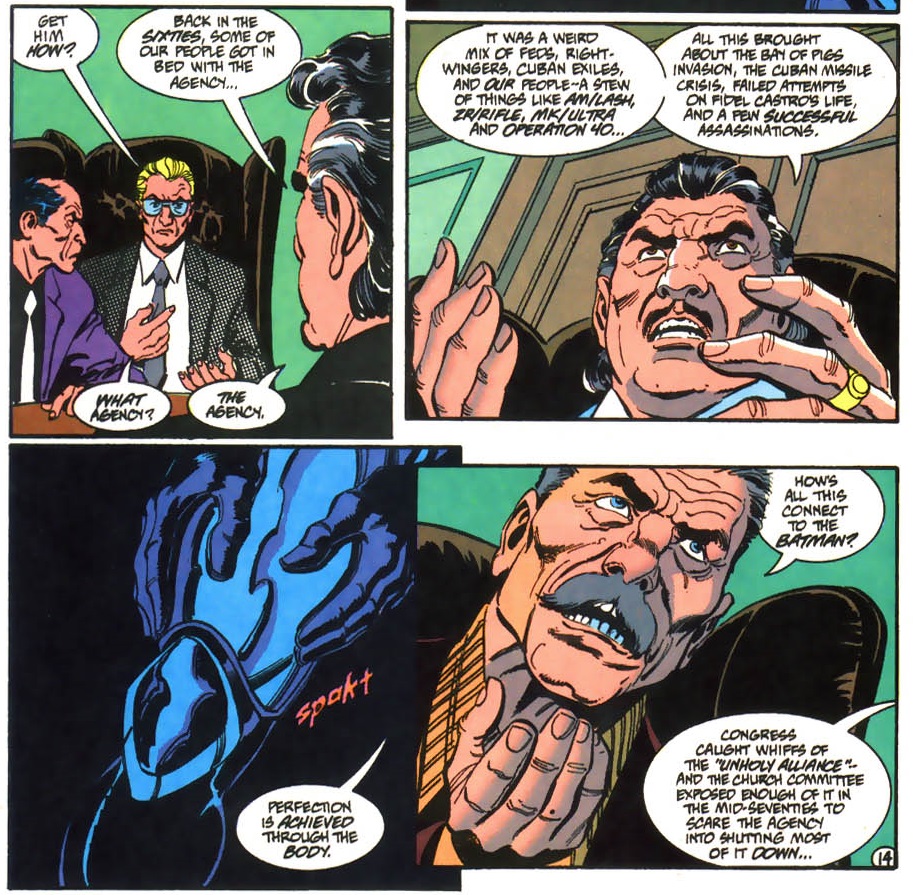
Batman 501Batman #501

(The above excerpt is from a story in which mobsters hire Mekros – a mercenary who uses CIA techniques to brainwash himself – in order to get Batman. The CIA then sends its own corrupt assassin after Mekros, creating a free-for-all of action and double-crosses.)

More than a go-to narrative trick – like Grant Morrison’s nanotech or Denny O’Neil’s animal cruelty – this topic seemed to truly fascinate Doug Moench, who never missed a chance to feed our sense of paranoia, more often than not by reminding readers that the government can’t be trusted. (He also wrote, for Paradox Press, the anthologies The Big Book of Conspiracies and The Big Book of the Unexplained.)

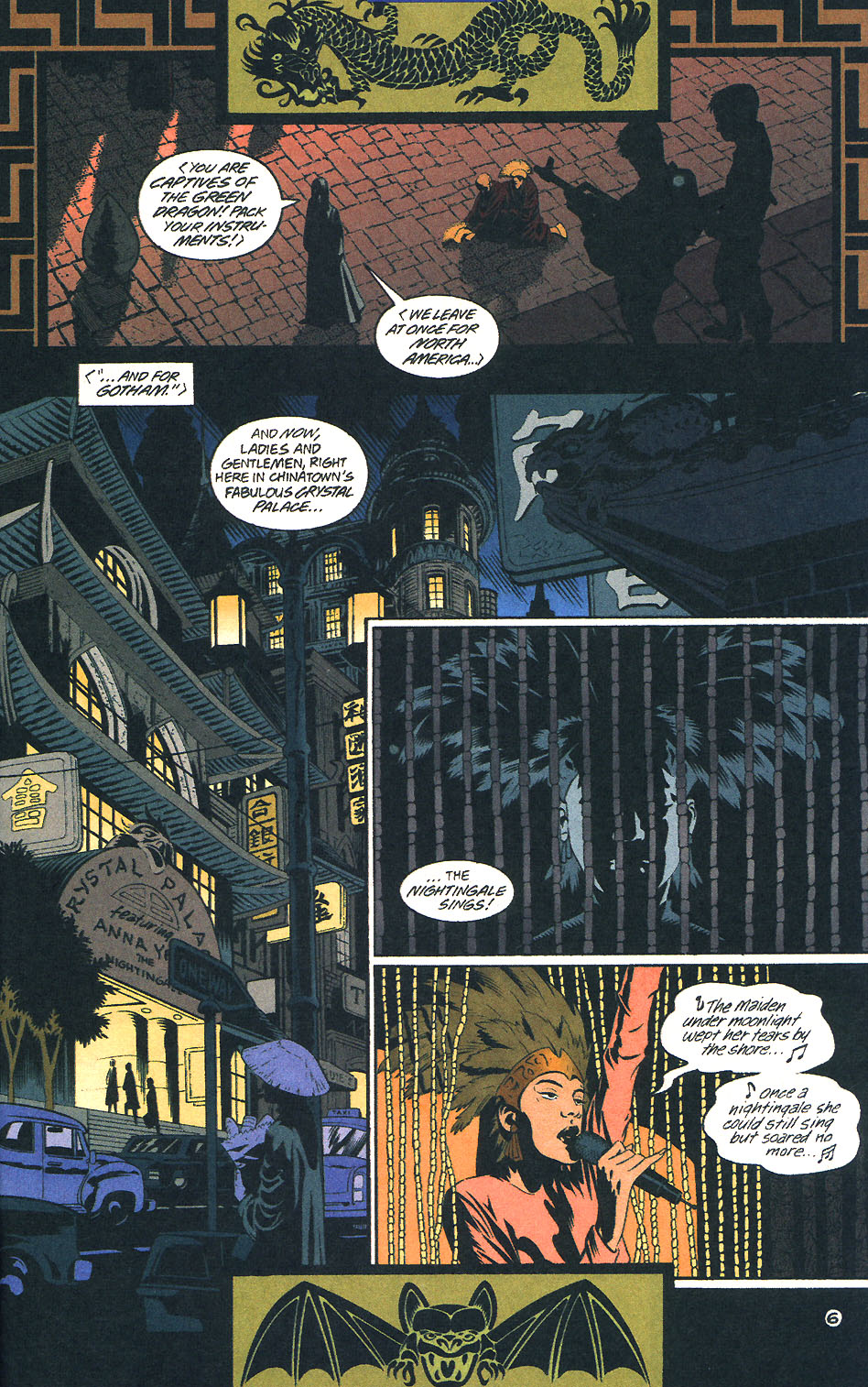
I suppose this tendency reached its apogee in ‘Conspiracy’ (Legends of the Dark Knight #86-88), where Moench knit a kaleidoscopic tale of satanic rituals, political assassinations, bikers, serial killers,  the Mob, the LAPD, Hollywood, the CIA, new agers, secret societies, and whatever else is missing from your conspiracy theory scorecard. By the end, the story implied that even Batman’s existence could be part of the cabal… (It’s a nifty arc, later collected in a DC Comics Presents one-shot. The art by J.H. Williams III, Mick Gray, and Dan Brown nails the eerie mood one associates with the sinister cults of Los Angeles, later mined by the comic series Fatale and the film Starry Eyes.)

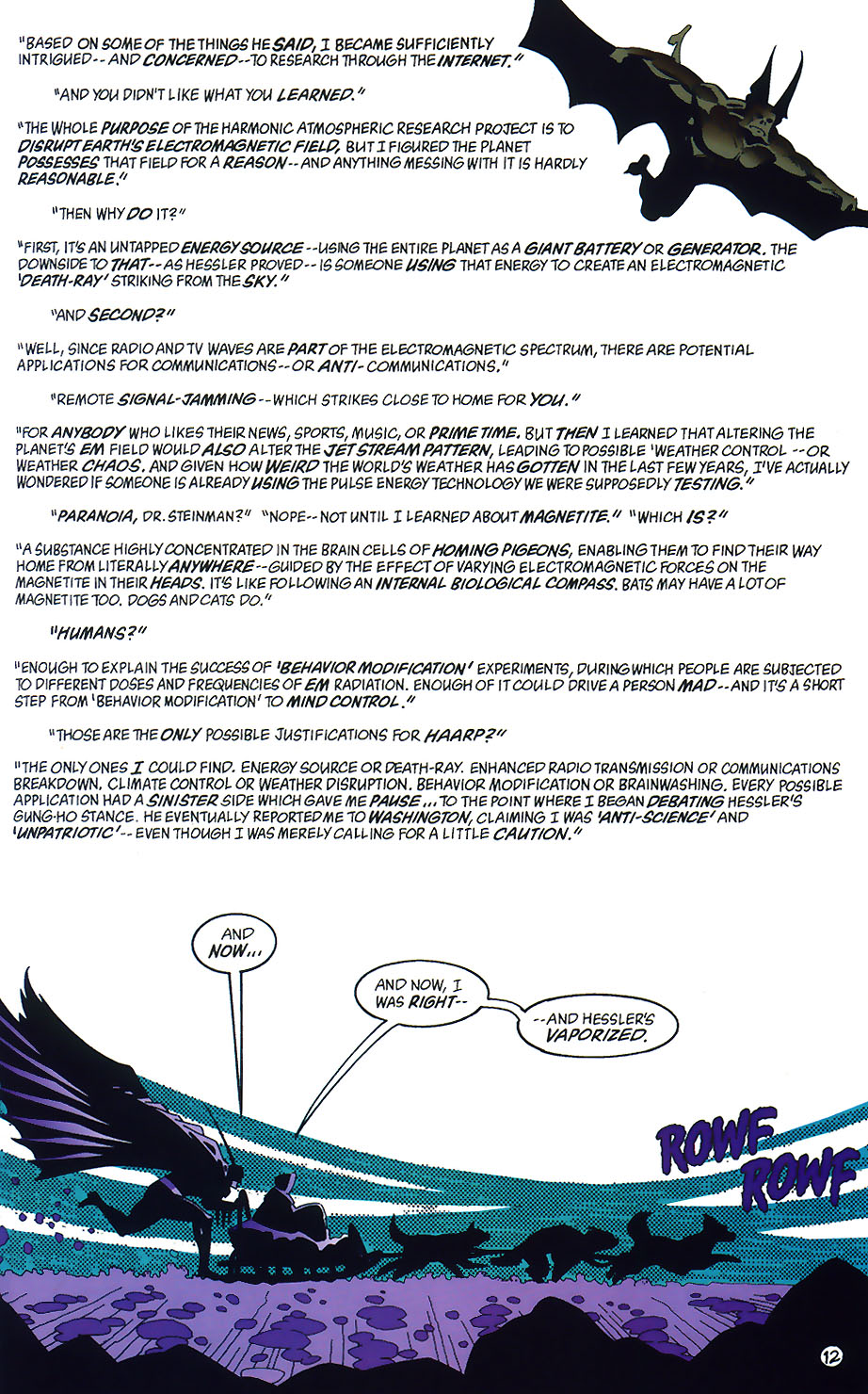
Another memorable instance of a plot revolving around covert operations took place in Batman 536-538. Man-Bat crashes into a secret program run by the US government in the Arctic, where scientists are bouncing harmonics off the upper atmosphere in order to weaponize ‘pulse energy.’ Washington sends in a team of shady troubleshooters to kill Man-Bat and it’s up to the Caped Crusader to both save the monster’s life and put an end to the dealings of the real monsters, i.e. the unethical HAARP (Harmonic Atmospheric Research Project). Moench gets so worked up with conspiracy theories that at one point he even forgets this is supposed to be a comic book:

Batman #538Batman #538

Interestingly, after having pushed the Dark Knight to an almost abstract extreme, in the second half of this run Moench tried to humanize him once again by devoting more attention to Bruce Wayne. We see Bruce trying to get more involved in the Wayne Foundation, which leads to a hilarious scene in Batman #541 in which he shows up in the building unannounced and causes a panic because everyone assumes there is about to be a hostile takeover.

Moreover, Doug Moench gave Bruce Wayne a love interest in the form of radio host Vesper Fairchild:

Batman 540Batman #540

The later issues do a fine job of turning Vesper Fairchild into a likable addition to the cast and giving some weight to her romance with Bruce Wayne (although, as usual, the writers who came afterwards had her brutally murdered).

In fact, in case it is not clear already, perhaps I should stress that, despite all the baroque trappings, Doug Moench’s ‘90s output is not exactly shallow. It still includes quite a few relatively grounded stories and character moments (particularly among the contributions to Legends of the Dark Knight). And although gleefully geared towards throat-grabbing horror and superhero adventure, the main Batman title did not ignore the detective side of the Caped Crusader…

Batman 00Batman #00

At the end of the day, the truth is that the division between Doug Moench’s ‘80s and post-‘80s phases is not entirely linear. For one thing, Moench was certainly no stranger to wild spectacle in the eighties, having also indulged in the era’s brand of delirious macho excess later spoofed by the likes of Sexcastle and Kung Fury. (Most notably, he wrote the sci-fi mini-series Slash Maraud, which features futuristic dinosaurs, alien despots, biker amazons, a cult devoted to classic horror movies, and a humanoid bear who at one point fights a gang of Nazis.)

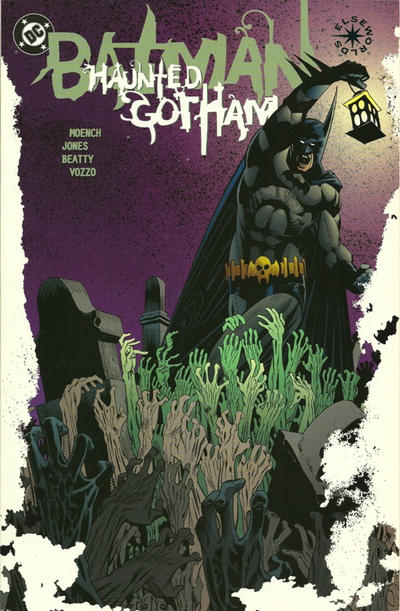
Yet Moench’s post-eighties evolution is hard to deny, as he has taken Batman comics into darker and darker places over the years. The ultimate example of this is probably the handful of one-shots and mini-series he has produced with Kelley Jones, putting Burtonian spins on the Gotham cast (including, famously, one in which Batman battles Dracula).

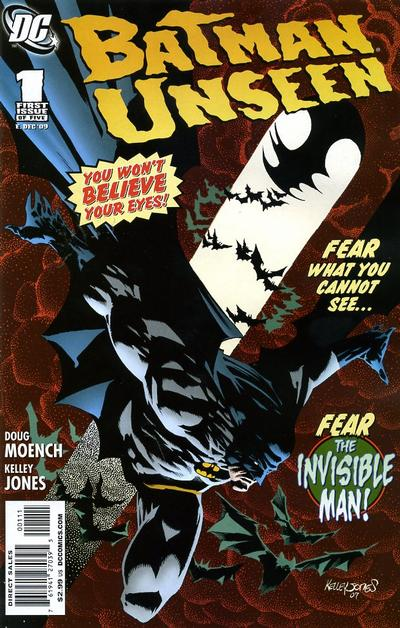
Haunted Gotham     Dark Joker     Batman Unseen

NEXT: Batman owns the dance floor.

Posted in WRITERS OF BATMAN COMICS | Tagged , , , , , , , , , , , | 1 Comment

Between Gotham City and Casablanca

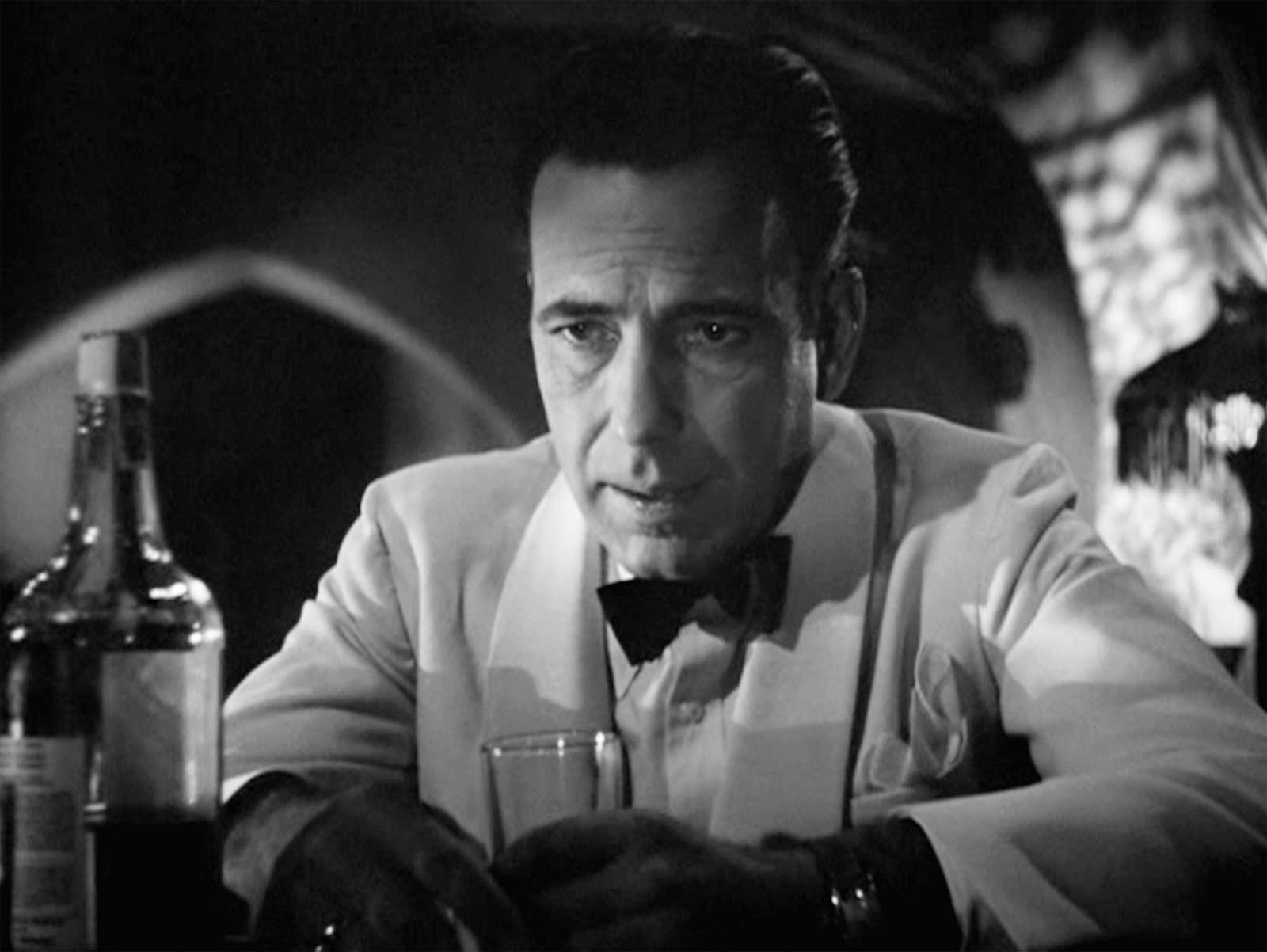
I’m pretty sure I’m not breaking any new ground by stating that Casablanca is one of the most enjoyable films ever made. This 1942 classic about heartbreak and antifascism in a French colony bursting with contraband and political intrigue manages to succeed on several different levels: it is a compelling spy thriller, a memorable romantic drama, an effective piece of WWII propaganda, and shockingly funny to boot.

It’s not just that Casablanca has a powerful story and witty dialogue – the movie also has the cast to carry them. With his sardonic lisp and weary look, Humphrey Bogart nails even the most unlikely exchanges as Rick Blaine, like when Captain Renault (Claude Rains) asks him what brought him to Casablanca and he replies: My health. I came to Casablanca for the waters. When Renault doubts Rick – ‘What waters? We’re in the desert.’ – Bogie coolly throws him off with the dry line: I was misinformed.’ (even though technically he wouldn’t have been misinformed, since Casablanca is in fact on the coast, not in the desert).

Casablanca

This Warner production was considered a success already at the time, both at the box office and critically, winning awards for best picture, director, and screenplay. Casablanca soon spawned a number of more or less explicit attempts to mimic its formula, including – among many others – To Have and Have Not, The Conspirators, and Five Graves to Cairo. After the war, you would continue to find echoes of its themes and atmosphere on the big screen for decades to come, from the noirish The Third Man to the frothy Macao – all the way up to last year’s Allied (where Brad Pitt plays a straight-faced version of the scene he played for laughs at the climax of Inglourious Basterds).

Casablanca‘s enduring resonance in pop culture cannot be overstated. In 1946, the Marx Brothers spoofed its opening scenes in A Night in Casablanca (one of their lesser vehicles, but with a few funny gags and one-liners nonetheless). By 1972, you could still get away with something like Play It Again, Sam, a charming comedy essentially revolving around references to this Hollywood masterpiece. In the mid-nineties, there was a trashy cyberpunk remake, starring Pamela Anderson.

Comics have celebrated Casablanca as much as any other media while taking advantage of its reputation. For example, Bill Pearson and Don Newton recreated the setting and characters in ‘The Mystery of the Mali Ibex’ (Phantom #70), a clever mash-up of Bogart flicks, including riffs on The Maltese Falcon, To Have and Have Not, The Treasure of Sierra Madre, Key Largo, and The African Queen. The people at Rick’s Café Américain also showed up in Martin Pasko’s and Tom Yeates’ ‘Here’s Lookin’ At You, Kid’ (The Saga of the Swamp Thing #8), where Vietnam vets magically brought to life elements from various old films.

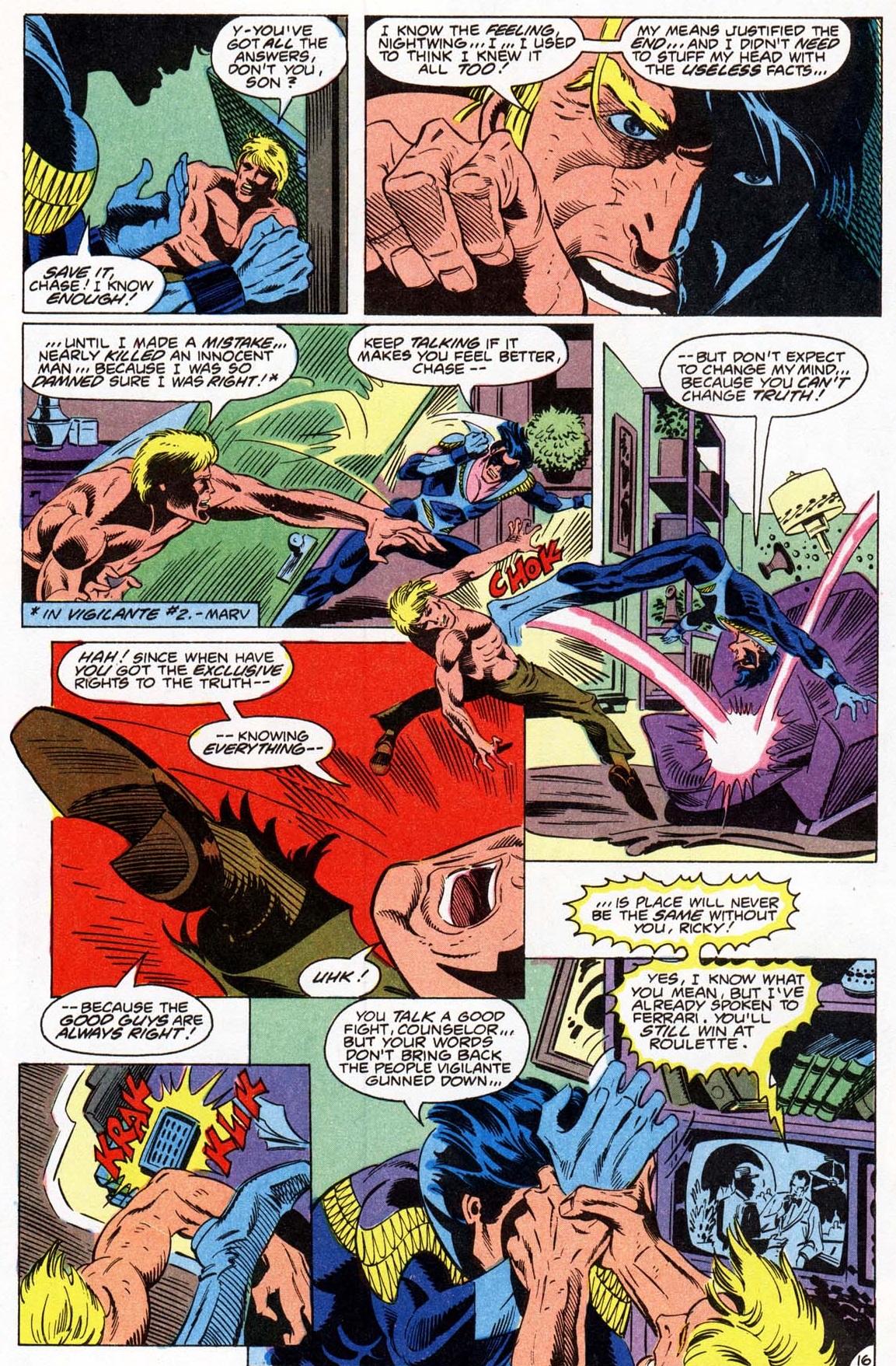
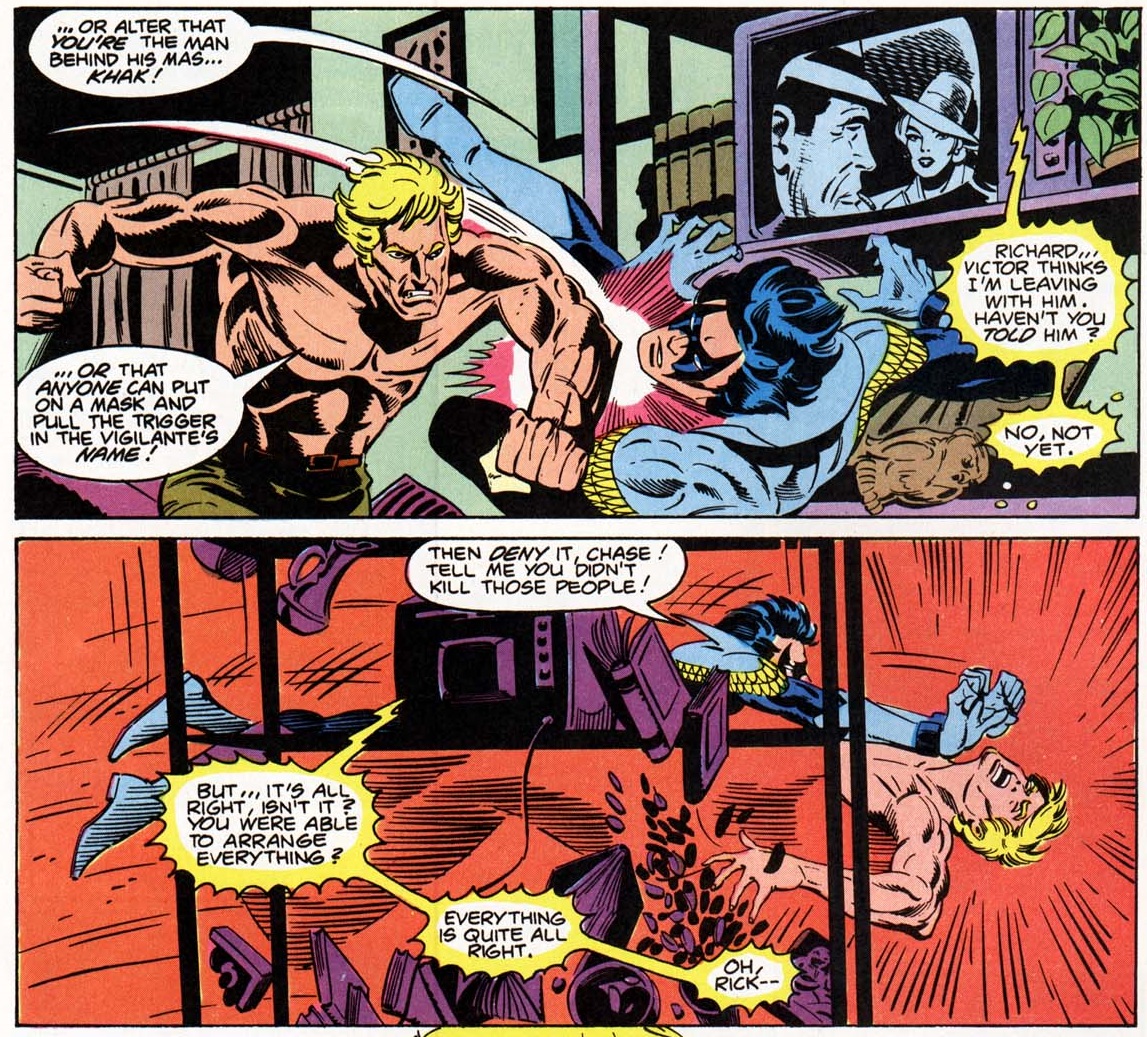
Needless to say, Casablanca has been incorporated into some comics featuring the citizens of Gotham City as well. Writer Paul Kupperberg integrated the final scene (in which an unlikely friendship emerges between two characters who had recently threatened to kill each other) into two of his series. In the 1985 Vigilante story ‘Shadow of a Madman!’ – with art by Tod Smith and Rick Magyar, colored by Tatjana Wood – the movie is playing on television when Nightwing gets into a fight with Adrian Chase over Vigilante’s latest killing spree…

Vigilante 21Vigilante 21Vigilante #21

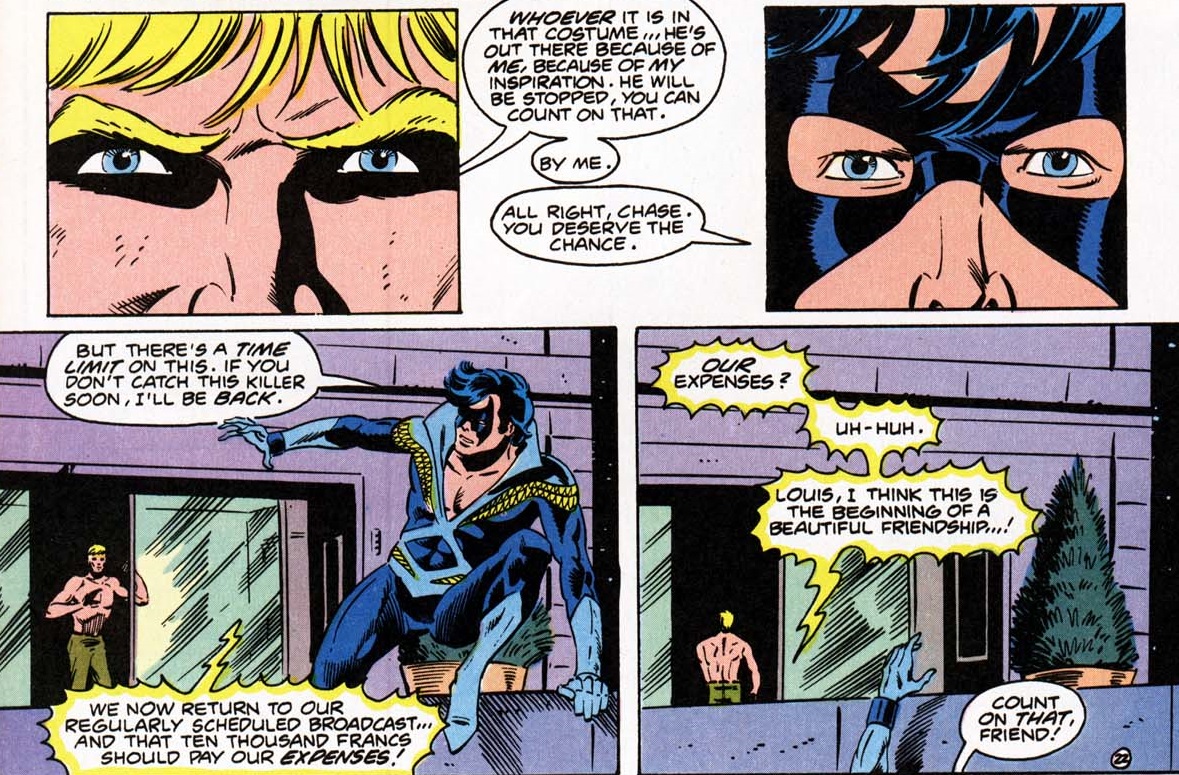
The scene goes on throughout the issue. At one point, the broadcast is interrupted by a special news report that clears up Adrian Chase’s involvement in the killings. As a result, the two heroes make up just in time for Casablanca’s famous closing line:

Vigilante 21Vigilante #21

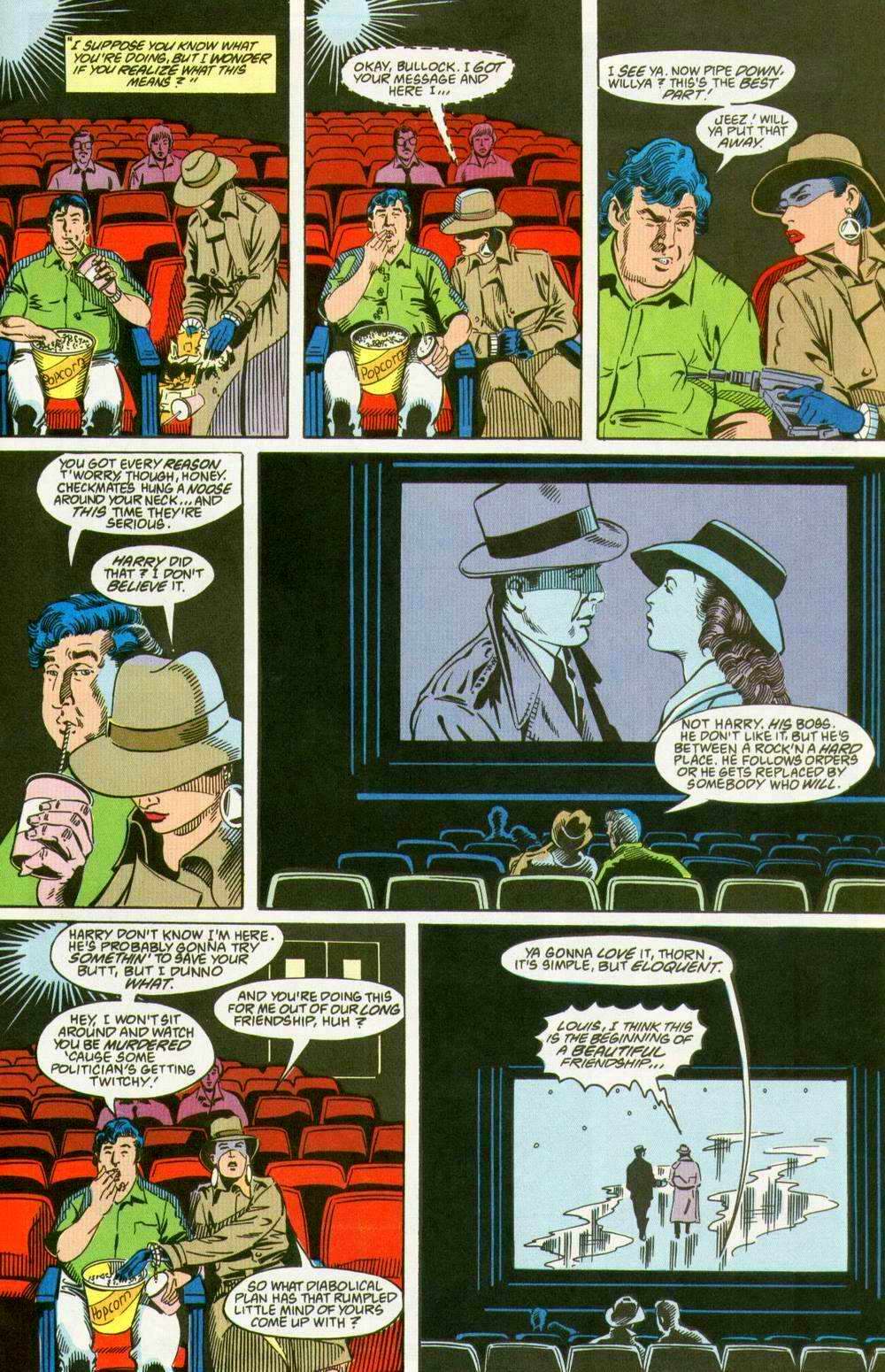
Paul Kupperberg pulled the same trick three years later in the spy series Checkmate!, about the titular secret agency run by Harry Stein. In the issue ‘A Thorn in Her Side’ (art by Steve Erwin and Al Vey, colors by Julianna Ferriter), the psycho vigilante Black Thorn meets up with Harvey Bullock – the former Gotham cop, at the time working for the feds – during a screening of Casablanca, once again mirroring the character dynamics of the film’s ending…

Checkmate 8Checkmate 8Checkmate! #8

(To be fair, it had already been established that Harvey Bullock was a Casablanca fan… We saw that he had a poster of the movie in his apartment, in Detective Comics #549, and he was shown singing ‘As Time Goes By’ in the very first issue of Checkmate! Years later, in Batman #547, Bullock claimed to have seen it seventy-three times.)

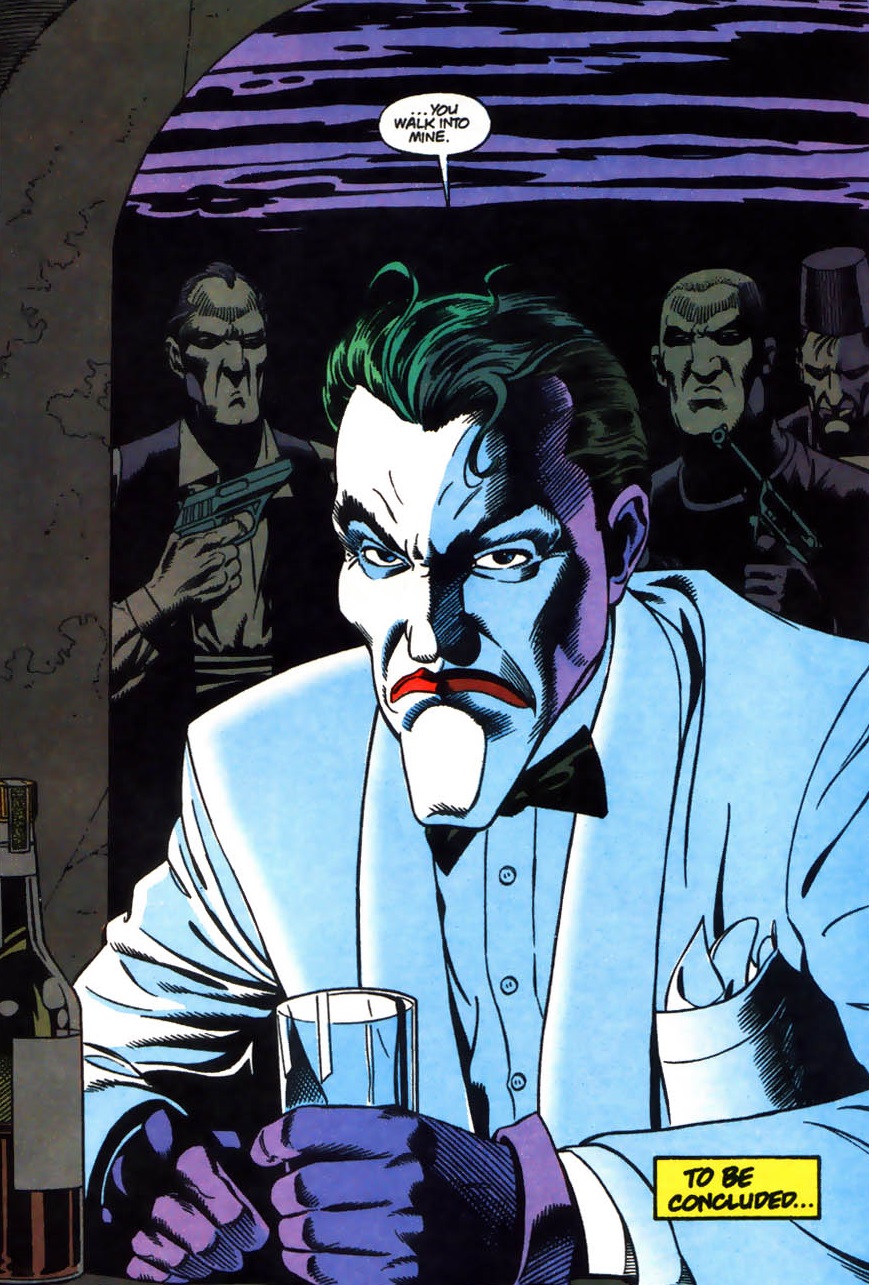
Another writer who referenced the film a couple of times was Chuck Dixon. In ‘Smash Cut/Losing the Light’ (Detective Comics #672-673) – art by Graham Nolan and Scott Hanna, colors by Adrienne Roy – the Joker sought to not just kill Batman, but to turn his death into a cinematic production. In line with the Hollywood theme of the plot, the Clown Prince of Crime temporarily adopted Humphrey Bogart’s persona:

Detective Comics 672Detective Comics #672

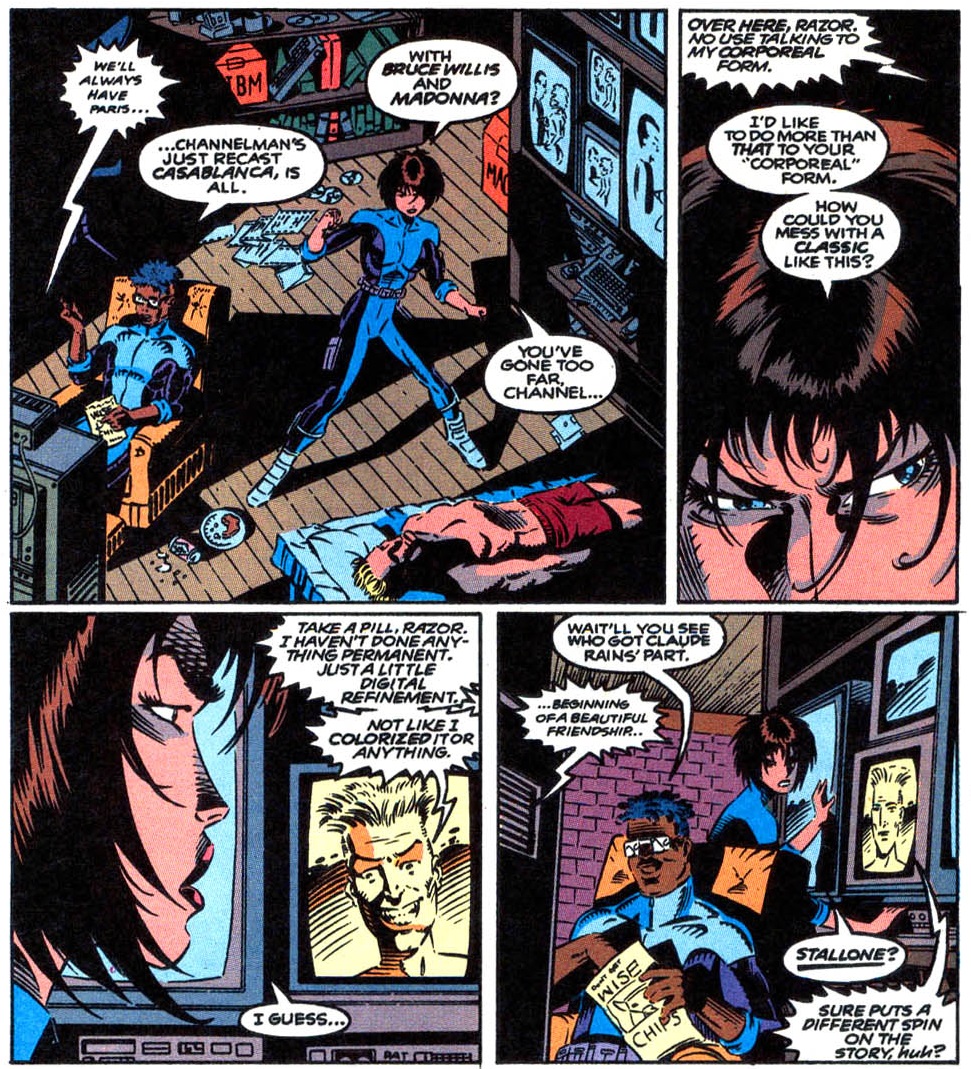
In 1994, Chuck Dixon played with Casablanca in a more amusing way, on the pages of a short story starring the Psyba-Rats. The Psyba-Rats were a fun trio of Gothamite thieves who unfortunately never really caught on… Dixon introduced them in Robin Annual #3, then brought them back in Showcase ’94 and in his run on Catwoman as well as in their own self-titled mini-series (all of these were pretty cool!). The gimmick was that two members of the team had odd, alien-induced mutations, with one of them – Channelman – being able to navigate through television airwaves.

In ‘What’s Your Twenty’ (pencils by Howard Porter, inks by Mark Stegbauer, colors by Greg Rosewall), guess what Channelman did with his weird powers…

showcase '94 #3Showcase ’94 #3

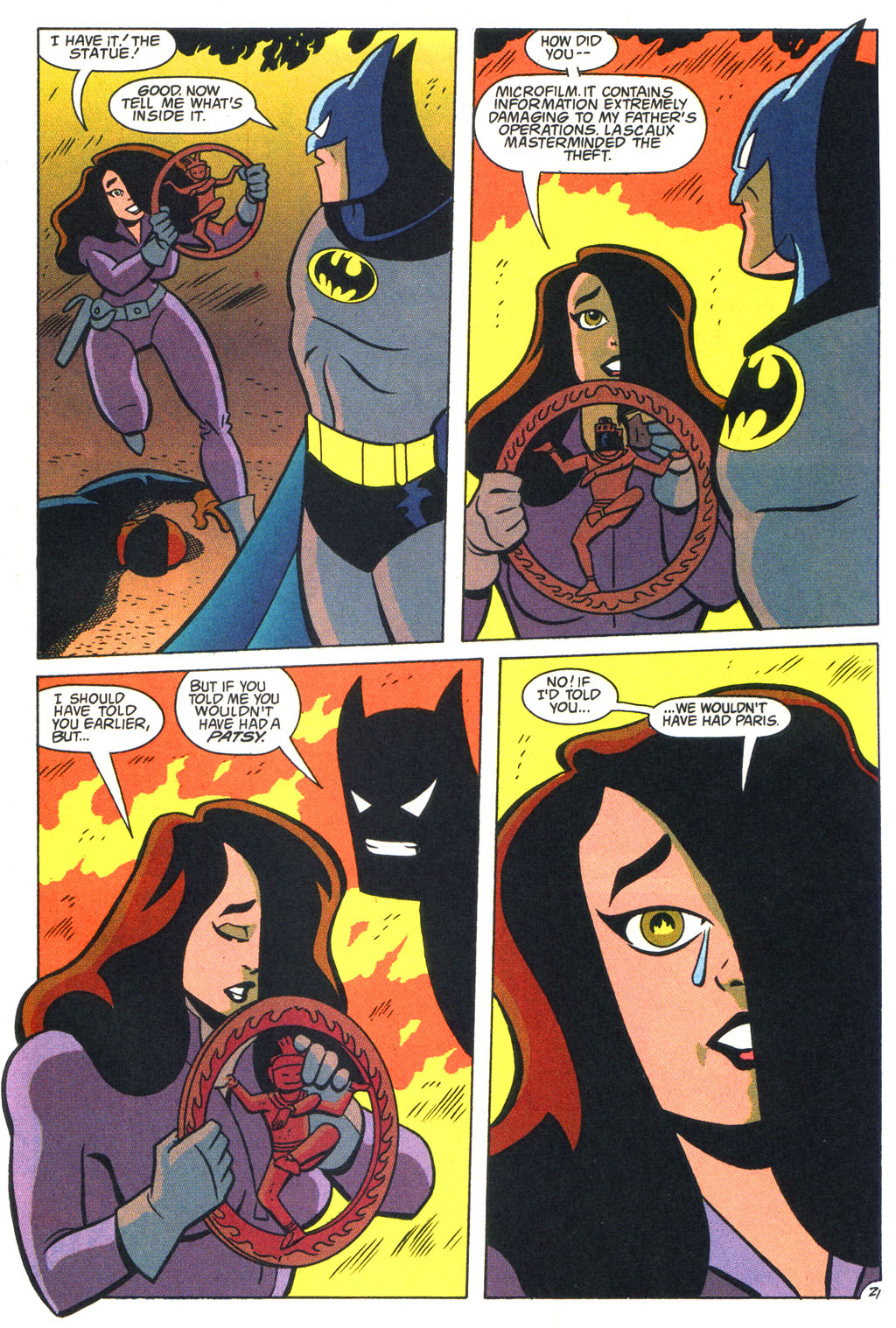
Finally, let me draw your attention to the Batman Adventures issue ‘Last Tango in Paris’ (written by Kelley Puckett, penciled by Mike Parobeck, inked by Rick Burchett, colored by Rick Taylor). During his opening run on this title, Puckett covered plenty of different subgenres, from capers to mysteries, from hardboiled crime to screwball comedy. ‘Last Tango in Paris’ is the series’ take on romantic adventure, with the Dark Knight and Talia al Ghul travelling to Paris in order to track down a valuable statue, only to find themselves captured by a villain who looks like a cross between Sydney Greenstreet’s characters in The Maltese Falcon and Casablanca.

What’s more, the tale ends with a twist on yet another classic line:

batman adventures #13The Batman Adventures #13


NEXT: Doug Moench unleashed.

Posted in WEBS OF FICTION | Tagged , , , , , , , , , , , , , , , , , , , , , , , , , , | Leave a comment

Have a Gotham 2017

batman 247Batman #247
Posted in GOTHAM INTERLUDES | Tagged , , | Leave a comment

Taking a break… (December 2016)

vigilante 47Vigilante #47
Posted in GOTHAM INTERLUDES | Tagged , , , , | Leave a comment

AzBats’ X-mas spirit

During this time of year, I usually address the holiday spirit of Gotham and its citizens. This season, I was going to play with AzBats’ sunny disposition by cracking jokes about how all his favorite Christmas movies are probably rather dark – you know, stuff like Jalmari Helander’s Rare Exports or Bob Clark’s Black Christmas or, more metafictionally, Andrew Ihla’s awesome silent film cut of Tim Burton’s Batman Returns. However, let’s face it, even this wouldn’t do justice to Jean Paul Valley’s misanthropic attitude.
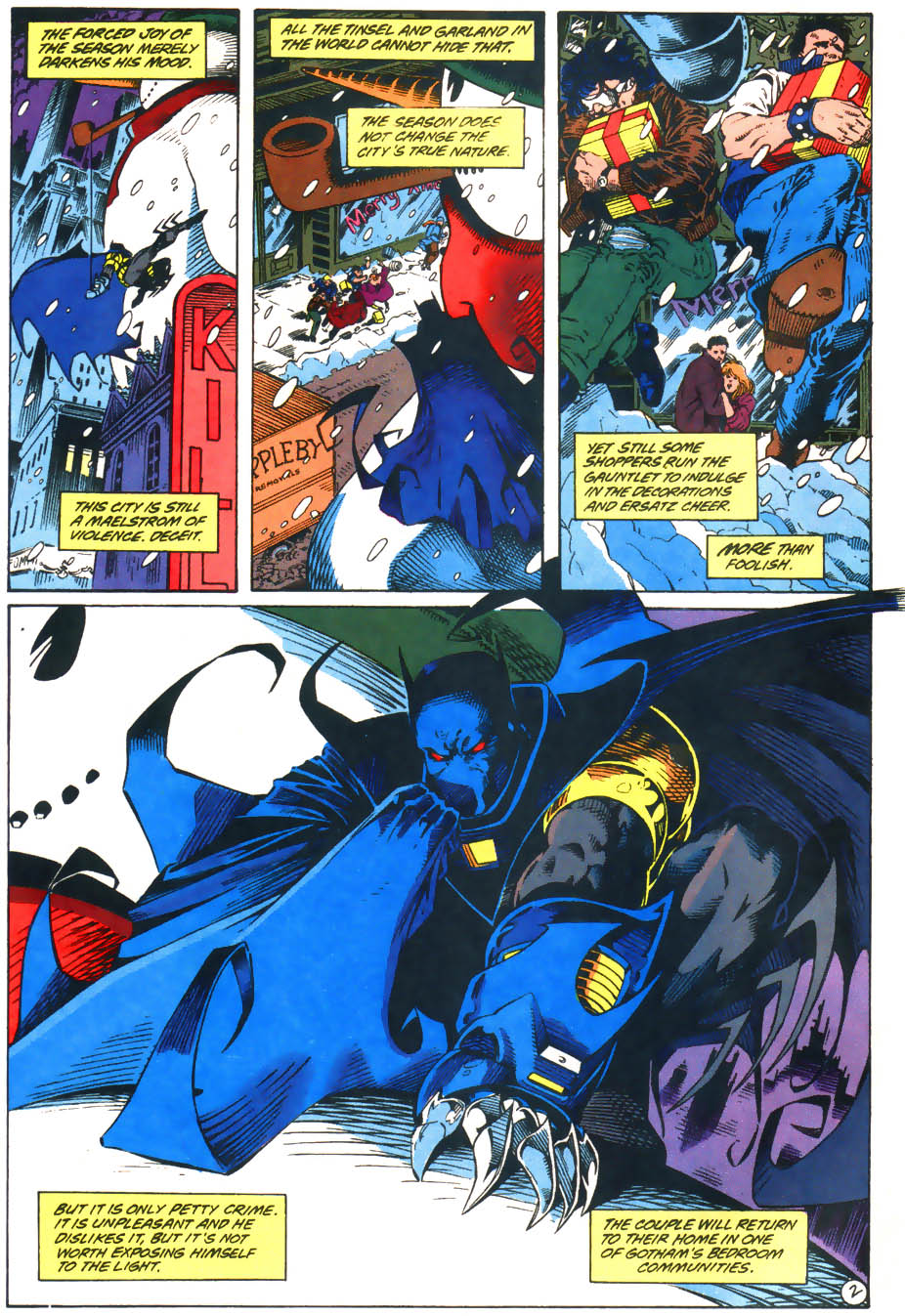
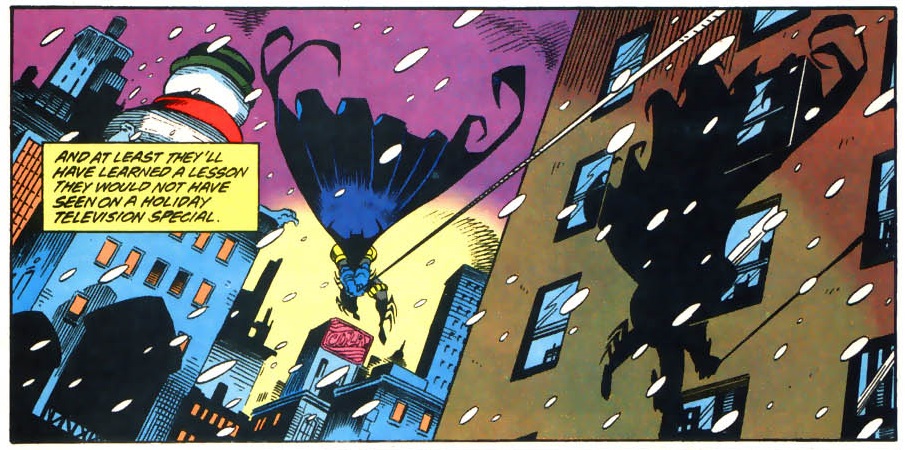
In fact, I don’t think anyone will be surprised to find out that AzBats considers the holiday spirit to be utter bullshit…

detective-comics-670detective-comics-670Detective Comics #670
Posted in GOTHAM CITIZENS | Tagged , , | Leave a comment

Futuristic war comics

While Rogue One: A Star Wars Story delivers a pretty solid aliens-on-a-mission yarn, its unpretentious blend of dirty action and brazen fan service is bound to split the critical opinion. So far, the film has at least stirred up some alt-right backlash, leading Disney’s CEO to claim that there is nothing political about the latest Star Wars prequel. Although perhaps commercially sound and a progressive way to re-frame the terms of public discussion, such a rejection of political readings means inviting viewers to miss out on a particularly stimulating way to approach this fictional universe, shaped as it is by tales of war and revolution. Surely part of the franchise’s lasting success has to do with how much fun it is discuss these stories’ various implications, the more farfetched the better (Kevin Smith built a whole career on it).

In their own nasty, messed up way, jerks raving against Rogue One for featuring a diverse, female-led team on a quest to bring down a white supremacist government appear more willing to engage with the movie’s themes than Disney. Their interpretation – just like finding a parable about radicalization in these stories of kids recruited to fight with all the religious zeal and murderous violence of a galactic Daesh, or drawing considerations on historical memory and propaganda in order to explain the series’ incongruities, or analyzing what the overarching narrative implies about corporate culture – further contributes to our collective examination of a mythology that, for once, is unlikely to get you killed for heresy in the real world.

In any case, even if you see in the films a celebration of multiculturalism or militarism or terrorism or any other ‘ism’ you righteously or unfairly oppose, I’m still not convinced this should automatically prevent you from enjoying them. For me, much of the appeal of the whole sub-genre of military science fiction is precisely the way in which it presents conflict from unusual perspectives. It can provide a new take on current and recent battles by framing them in a different context or, in turn, enable us to vicariously take part in the excitement and drama of armed struggle without the full weight of recognizable tragedies. In fact, filmmakers have a history of using outer space to explore provocative genre twists: Starship Troopers is basically a WWII story where the Nazis are the heroes; Ghosts of Mars is a colonialist western with the kind of anti-natives streak that largely fell out of use since the 1950s; conversely, Avatar is a blunt anti-imperialist fable.

That got me thinking about comics that have taken advantage of this sub-genre’s potential. As a result, the idea here is not to recommend stuff that emulates the *feel* of Star Wars (let’s face it, if you’re into that type of interplanetary adventure, you’re probably already reading Brian K. Vaughan’s and Fiona Staples’ beautifully illustrated Saga and you’ve already seen the fun if flawed Guardians of the Galaxy movie). Instead, I’ll suggest three comic series that approach the concept of futuristic warfare in interesting ways:


BAD COMPANY

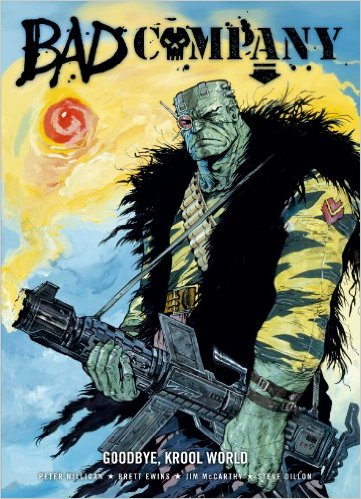
Bad Company

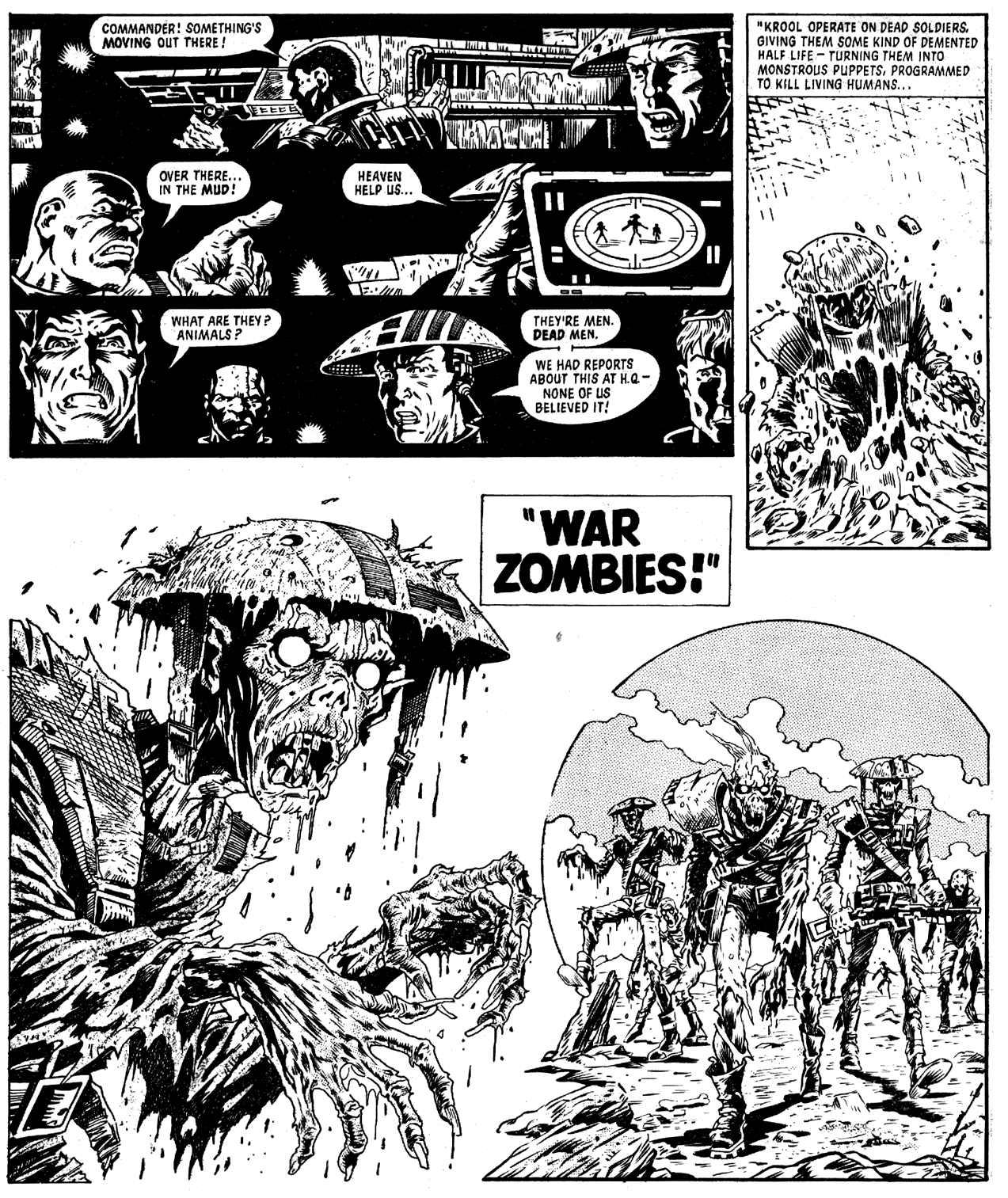
For the past four decades, the British anthology magazine 2000 AD has specialized in sci-fi/fantasy, albeit of a much edgier sort than Star Wars (the spectacular-looking Nemesis the Warlock feels like the trippy nightmare of a feverish Darth Vader, while Nikolai Dante could be the mischievous wet dream of a horny Han Solo). Of the magazine’s various ventures into martial territory, one of the most popular is Bad Company, the saga of a motley crew of renegades operating behind enemy lines in a war between humans and a sadistic alien species called Krool.

Written by Peter Milligan and illustrated by Brett Ewins and Jim McCarthy, this is a somewhat uneven series, but there is definitely a lot to like in here. In the first story-arc (originally published in 1986-1987), set in a hellish planet with hallucinogenic winds and alcoholic mud, young soldier Danny Franks is rescued by Bad Company, only to gradually realize they can be as terrifying as the enemy, especially the team leader Kano (a cross between Colonel Kurtz and Frankenstein’s monster). The second arc, ‘The Bewilderness’ (1987-1988), introduces other planets – each with a miserable name evoking ‘the lost nature of modern dislocated man’ – as well as an odd batch of new cast members to replace earlier casualties.

Among quirky concepts like mutant POWs and Mad Tommy Churchill (a soldier apparently convinced he is fighting in World War II), you’ll find a creepy depiction of the psychological effects of combat, namely the feeling of being stranded on an insane world, far away from home, increasingly dehumanized and surrounded by monsters.

2000AD 500

The third set of stories, ‘The Krool Heart’ (1988) – in which Danny Franks, after undergoing a psychedelic revelation, establishes an unexpected connection with the Krool – is probably the highest point, as Peter Milligan goes even further in terms of incorporating his usual fascination with questions of identity… As a fan of Milligan’s work, I’m also interested in how Bad Company compares to his other futuristic tales from this period – it’s less focused than Tribal Memories yet much more restrained than Freakwave (a surrealist apocalyptic surf comic).

The creators reunited in 1993 for a sequel focused on Kano, haunted by literal ghosts of war on yet another bizarre planet (where every day at noon time ran backwards for an hour), and again in 2001, for a face-off between Danny and Kano that sadly undid the powerful ending of ‘The Krool Heart.’ Last year, Milligan returned to the characters – now with Rufus Dayglo on pencils – for a story-arc about life as a Bad Company veteran which revised key elements of the series’ mythology.

GIVE ME LIBERTY

give me liberty

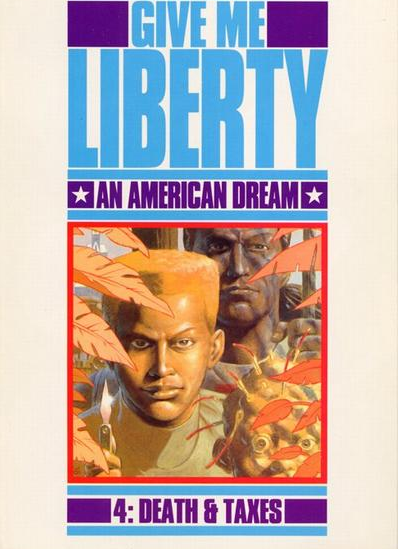
The 1990 mini-series Give Me Liberty is a relentless cyberpunk epic about Martha Washington, a girl from a rough housing project who joins the US Peace Force. Her missions include defending the Amazon rain forest from militarized hamburger companies and recovering a space cannon hijacked by militant gay neo-Nazis out to kill the United States president (a drunken liberal on the verge of a nervous breakdown). She also finds herself in the middle of a conflict with the Apache Nation and an expanding US civil war.

With the same gonzo, tongue-in-cheek spirit he brought to Elektra: Assassin and Dark Knight Strikes Again, Frank Miller spreads his satire far and wide, in all directions, coming up with such preposterous ideas as a media campaign rehabilitating the KKK, a sex scandal in the Vatican, and an ill-prepared, authoritarian leader in the White House (who is named ‘Man of the Year’ by a Time-like magazine, albeit with a less impressive cover than the latest version of the real thing). The dynamic art is provided by the brilliant Dave Gibbons, who is as skilled at framing vicious suspense and violence as at nailing deadpan comedy. This is the work of two creators who were at the absolute top of their game.

(Miller and Gibbons later brought back Martha Washington for a number of – increasingly objectivist – sequels over the years but, disappointingly, none of them came anywhere near the magic of the original series.)

give-me-liberty

As far as eighties’ over-the-top thrillers go, there are mostly three types of movies I enjoy… Some are fine examples of slick sci-fi action (Predator, Aliens, The Terminator, The Thing), some are offbeat works that nevertheless achieved broad recognition due to their visionary takes on the future (Akira, RoboCop, Escape from New York, Blade Runner, not to mention The Road Warrior and Mad Max beyond Thunderdome), and then there are the ones that, rather than transcend their schlockiness, embraced it in a fun and charming way (They Live, Highlander, Trancers, Streets of Fire). This comic, made at the tail end of the decade, oscillates between all of those tones – at times, it is as gripping and brutal as you can get, other times it dives head first into weirdness (one subplot concerns a conspiracy involving psychic schizophrenics wired into a computer software, another one concerns the Health Police led by a surgeon who declares a literal war on disease) while also getting chuckles out of campy names like Attorney General Sphincter and Colonel Crotch.

WE STAND ON GUARD

we stand on guard

Like I said in the introduction, I don’t think it’s worth delving too much on the smutty, pacifist alien fantasy series Saga, which doesn’t need my recommendation, as it has become one of those critical darlings with plenty of devoted fans, even outside the comics community. Sure, like everything that gets a lot of love, there’s a fair amount of backlash as well… Me, I like it just fine, although not as much as Brian K. Vaughan’s more overtly political sci-fi series Y – The Last Man and Ex Machina (even if Saga’s otherworldly setting does mean we get less encyclopedic factoids and pop culture references, restraining Vaughan’s most annoying writing tics).

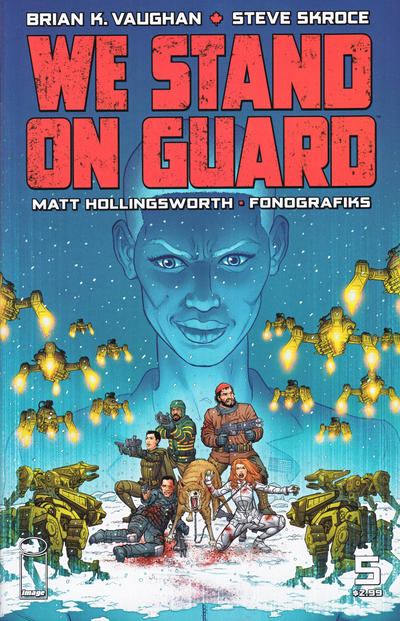
Instead, let me draw your attention to 2015’s We Stand On Guard, a hardcore dystopic tale set during a near-future US invasion of Canada, also written by Vaughan. With its focus on a fearless young woman joining a ragtag resistance guerilla with small odds of survival, this book anticipated many of the motifs of Rogue One, only with a lot more ruthless carnage and salty one-liners.

Securing the story’s adrenaline-charged pace and fist-pumping twists and turns, artist Steve Skroce and colorist Matt Hollingsworth seem to be having a field day, at least when it comes to conjuring up vast landscapes and intricate mecha war machines.

we-stand-on-guard

Besides delivering an exhilarating adventure romp, We Stand On Guard is unapologetically topical. It’s packed with allusions to military drones, terrorism, torture, and imperialism, eventually culminating in a compelling statement about the cycle of violence (all it’s missing is a Propagandhi soundtrack). Once again, Brian K. Vaughan proves that he is not only a master of cliffhangers and smart-ass banter, but also second to none in terms of coming up with clever high concepts and squeezing them for all their worth. Here, by placing stereotypically sympathetic Canadians as the targets of occupation, he imagines the War on Terror without the mantle of racial, cultural, and religious prejudice… and we are left to ponder how recognizable it still feels.


Posted in FANTASTIC ADVENTURES | Tagged , , , , , , , , , , , , , , , , , , | Leave a comment

Doug Moench’s literary Batman

Doug Moench is up there as one of the most prolific writers of Batman comics ever. From an unforgettable 1983 tale about tentacle sex until the 2009 mini-series Unseen – in which the Dark Knight battles the Invisible Man – Moench has churned out hundreds of stories, approaching Batman’s world in various ways over the years. I’ve been promising to discuss his work for quite a while and now it’s finally here: this week I will focus on Moench’s relatively grounded early stuff, from the eighties, and next month I’ll look into his more bonkers phase, from the nineties.

Picking up immediately where Gerry Conway left off, Doug Moench did a lengthy run on Batman and Detective Comics (plus a few issues of World’s Finest Comics) between 1983 and 1986, with storylines flowing back and forth between series and the kind of stress on character development that had been traditionally associated with Marvel. By then, Moench already had an impressive background as the writer of tons of horror comics, not to mention acclaimed runs on the adventure series Master of Kung Fu and the dark superhero series Moon Knight, so he adapted easily to the Caped Crusader’s corner of the DC Universe. The art was suitably gritty and atmospheric, the bulk of it illustrated by the eerie pencils of Don Newton, Gene Colan, and Tom Mandrake, served well by the noirish inks of Alfredo Alcala and Bob Smith, as well as Adrienne Roy’s muted colors. Notably, this run culminated in the epic Batman #400, the grand finale of Batman’s pre-Crisis continuity, right before the Frank Miller-shaped soft reboot.

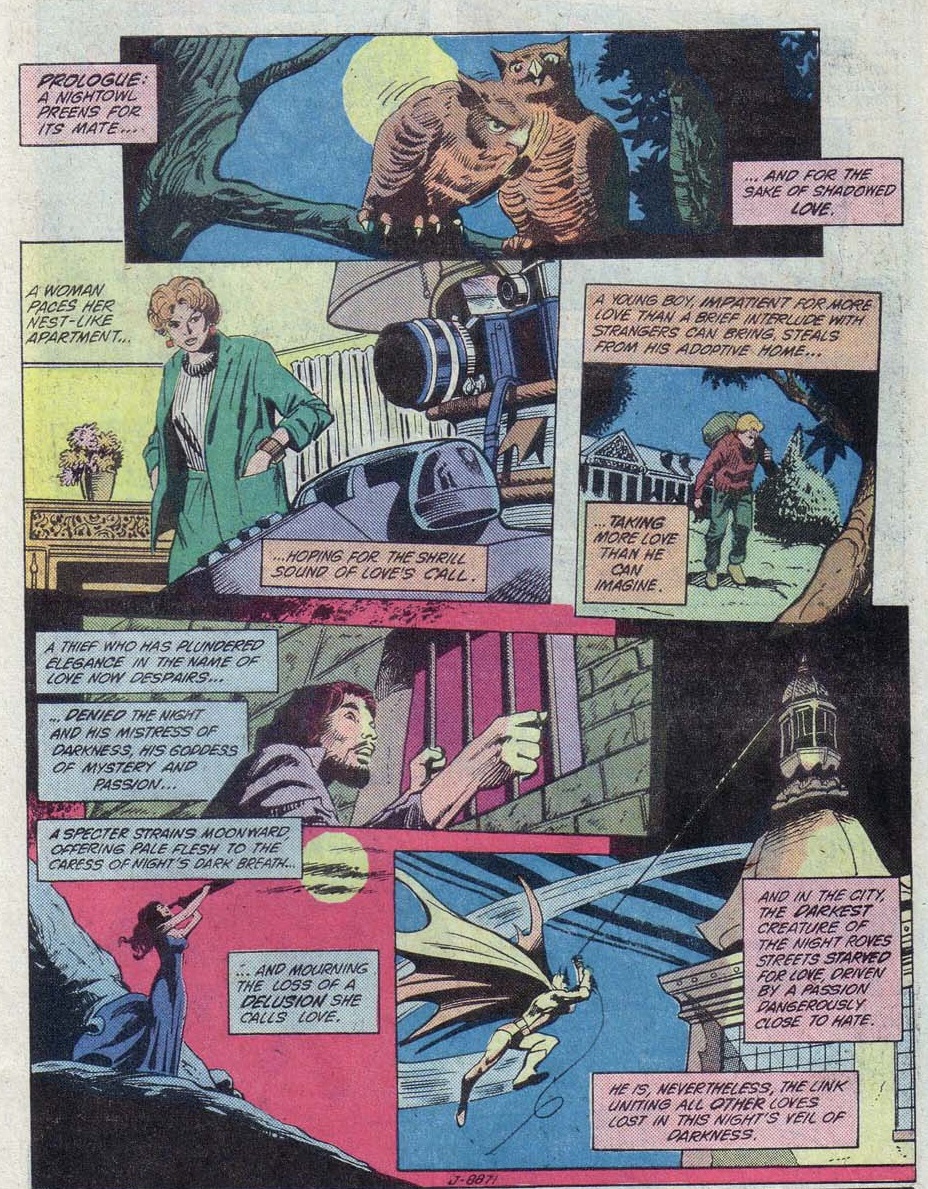
Moench built on Conway’s efforts to figure out how to make old concepts work in a mature, modern setting by infusing his comics with elements borrowed from more respected forms of literature. This was similar to what Alan Moore was doing in Saga of the Swamp Thing at the time. Although Doug Moench didn’t go nearly as far as Moore (his work essentially remained within the confines of the original genre), Batman comics, like Swamp Thing,  became full of visual puns, ornate narration, gothic motifs, and elaborate (if heavy-handed) symbolism…

detective-comics-530Detective Comics #530

(Yep, you can be sure those owls at the top – representing love and the night – will show up again in the comic, in the most symbolic way possible!)

I can see how some would find Doug Moench’s style cheesy and pretentious, but me, I can’t get enough of this stuff. There are so many layers in these books – this may not necessarily make them deep, yet it sure makes them a stimulating read, providing countless avenues to explore. Sometimes Moench plays with the form – in ‘The Glacier Under Gotham!’ (Batman #375), the framing is all done in rhyme (a cool twist later reveals the narration is actually being done by a character) – and sometimes he has fun with interwoven themes – like in the climax of ‘Facing the dark, blindly’ (Detective Comics #536), where all the characters have to take a chance while blinded, literally or metaphorically.

There is a particularly neat conceptual game in the tandem issues ‘Up above the sin so high’ (Batman #370) and ‘Down below’ (Detective Comics #537). In the former the Caped Crusader tries to bring down a gangster who lives in a skyscraper penthouse, in the latter he tries to convince a homeless man who lives in the sewer to come to the surface. The tales’ thematic connection is further built around both subtle and obvious parallels between the two characters Batman is dealing with (for example, each of them loses a tooth at some point in the story). Even the covers frame the Dark Knight from symmetrical perspectives.

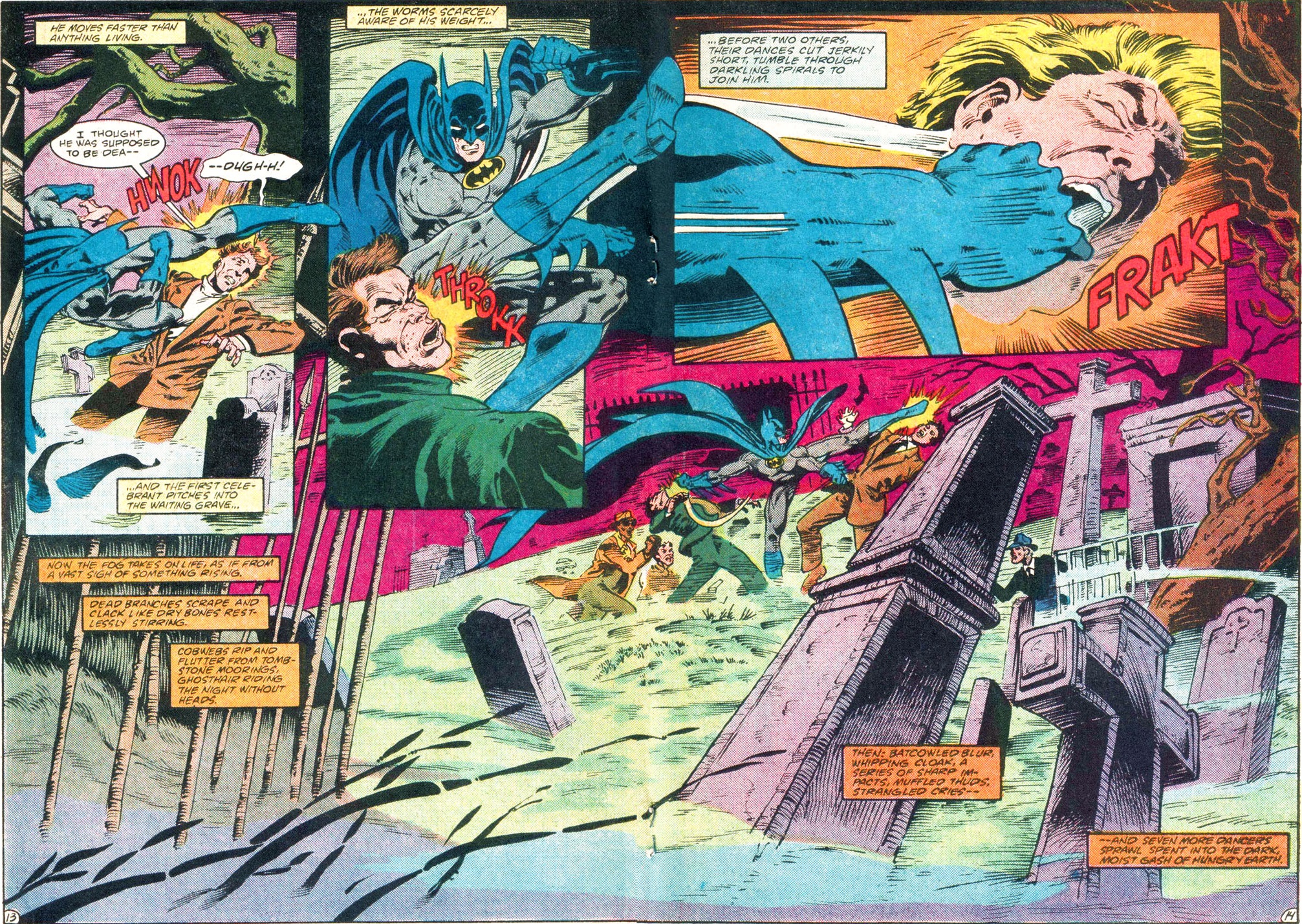
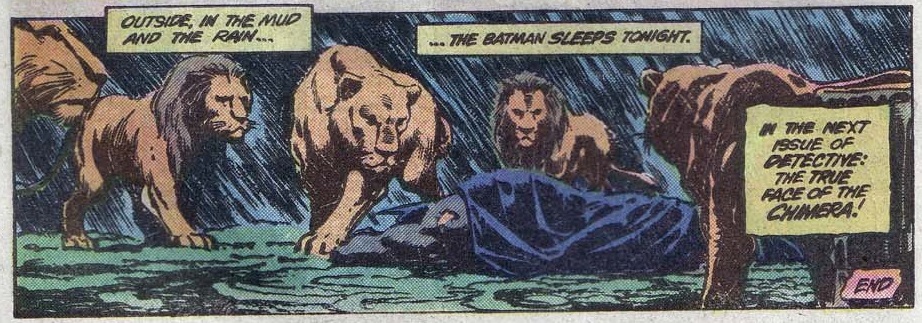
Perhaps the most on-the-nose slice of symbolism shows up in ‘A stump grows in Gotham’ (Detective Comics #552), which draws an obvious parallel between a beloved oak tree getting cut down and Batman seemingly dying at the hands of an outside hitman who promised a bunch of local criminals they could dance on the Dark Knight’s grave. Batman is almost buried in a coffin made from the tree’s wood, but reports of his death turn out to have been greatly exaggerated – just like the tree’s, whose stump is shown to be growing a new plant in the final panel!

The best bit of Moench’s playful use of metaphors and juxtapositions in this issue, though, takes place when Batman, breaking out from his coffin, actually does make criminals dance on his grave:

detective-comics-552Detective Comics #552

And trust me, you don’t want to get me started on the recurring cat-shaped stalagmite in the Batcave, which represents Batman’s attraction for Catwoman… Doug Moench takes this idea as far as he can and I love every bit of it. In ‘The Batman Nobody Knows’ (Detective Comics #560), Moench goes totally overboard, turning rats, bats, flies, and spiders in the Batcave into an elaborate representation of how the Caped Crusader is trying to manipulate Robin and Catwoman into getting along.

The thing is that these literary devices serve less to distract us from the fact that we are reading a superhero comic than to encourage us to experience the genre with a specific frame of mind, exploiting the allegorical potential of its surreal costumes and tropes. Make no mistake, this is still a lighthearted horror and crime saga (with a few soap opera subplots thrown in for good measure) in which the Dynamic Duo fights bizarre crooks like Calendar Man and Captain Boomerang. For all its flourishes, Moench’s writing doesn’t shy away from delivering the kind of thrills and eccentric criminal schemes one expects from a classic Batman adventure, with a steady balance between solemnity and quirkiness that is not too distant from the BTAS cartoon show of the following decade.

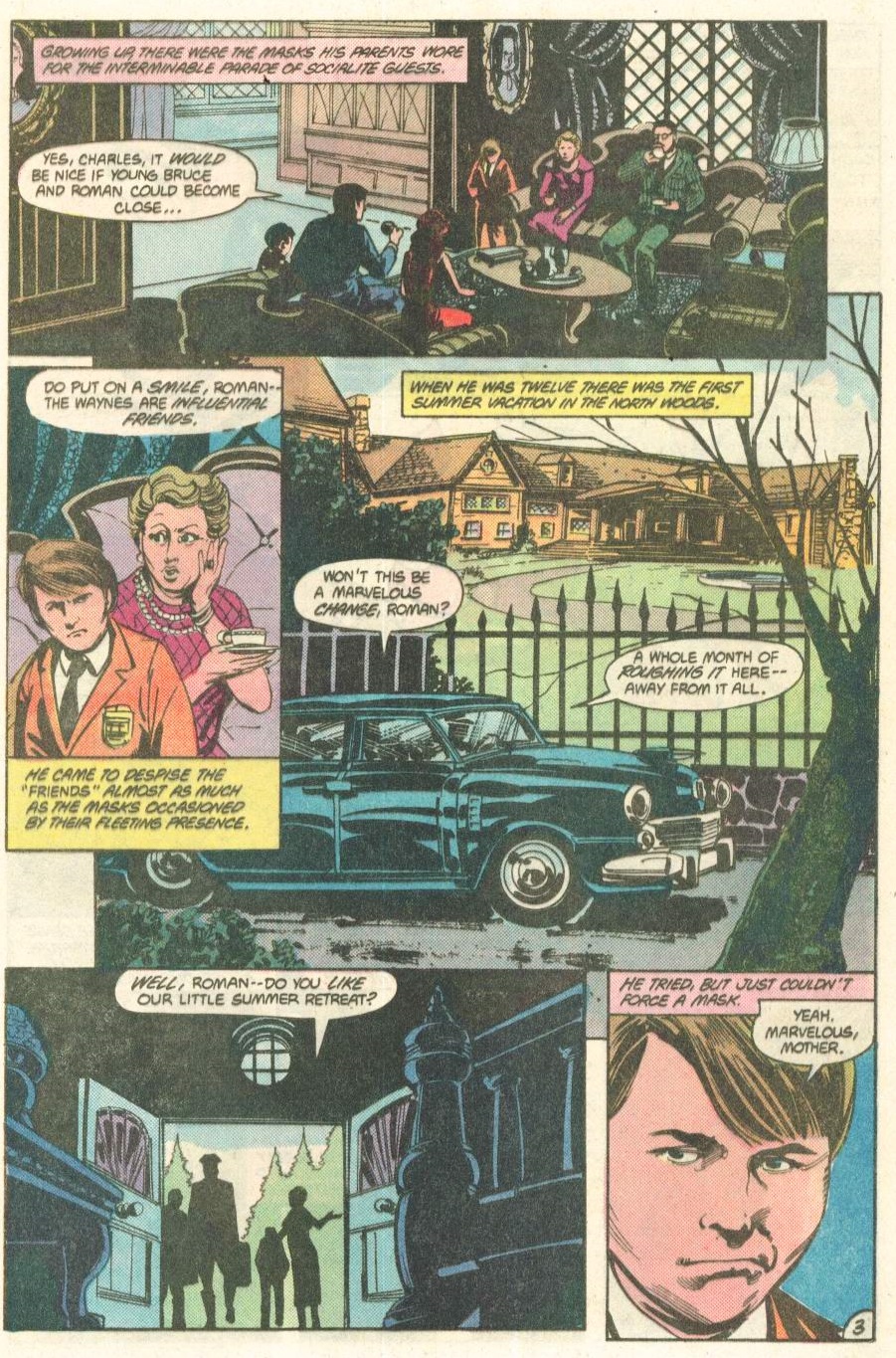
In fact, Moench’s knack for squeezing the most out of each metaphor blatantly informed his most famous villain creation: Black Mask (Roman Sionis) and his mob, the False Face Society of Gotham (introduced in the trilogy Batman #386 – Detective Comics #553 – Batman #387).  Absolutely *everything* about Roman Sionis revolves around masks and faces from day one:

batman-386batman-386Batman #386

(Masks, of course, are symbolic by definition – and Doug Moench can’t resist reminding readers of this, in quite explicit terms, at every turn.)

Besides Black Mask, Moench has been responsible for many contributions to Batman’s supporting cast. Notably, during this era he also introduces the underrated goth villain/love interest Nocturna and the fan-favorite dirty cop Harvey Bullock, who acts like an old-school  hardboiled detective and may or may not be as clumsy as he looks.

Bullock, in particular, had a great entrance into the series, starting out as a stooge appointed by the corrupt Mayor Hamilton Hill in order to screw with Police Commissioner James Gordon…

detective comics 528Detective Comics #528

Doug Moench’s run is full of strong characterization all around. For example, Commissioner Gordon feels weighed down by Hill’s and Bullock’s conspiracy to undermine him – in a moment of weakness, he even wishes Bullock gets killed – only to regain his motivation after a pep talk by Batman and later proving himself as a cop. In turn, Jim proves how important he is for the Dark Knight, who gets his own crucial motivational speech from Gordon at the climactic fight scene against the Savage Skull.

Harvey Bullock himself comes across as more than a one-note character. Sure, he looks crooked and buffoonish, but he also has enough of a detective instinct to track down the Savage Skull. Plus, Bullock seems to have a change of heart after being saved by Batman and Gordon… yet he then claims sole credit for the arrest in the end!

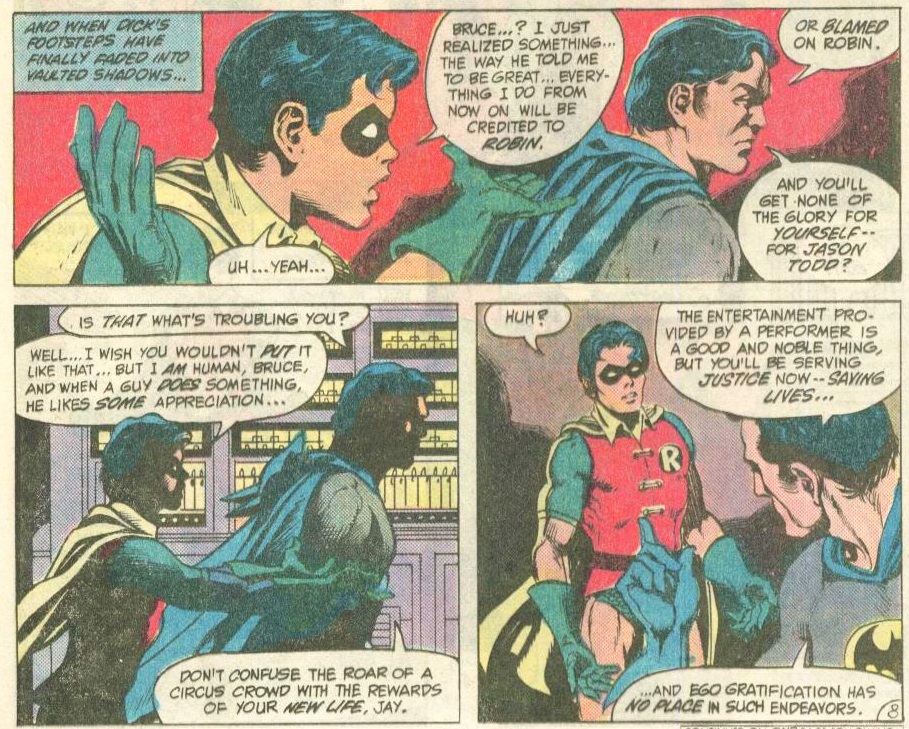
There are several other fine character moments. ‘Just as night follows day’ (Batman #383) humanizes the Caped Crusader by showing us a day and night in the life of an exhausted Bruce Wayne, who keeps trying to sleep but is always interrupted. Jason Todd’s insecurities get plenty of attention as well, like in this insightful scene right after Dick Grayson officially passes the title of Robin to Jason (who in the pre-Crisis version used to be a circus acrobat):

batman-368Batman #368

Doug Moench’s thoughtful exploration of the cast benefited from the fact he was the main writer shaping these characters at the time (Joey Cavalieri’s World’s Finest Comics and Mike W. Barr’s Batman and the Outsiders didn’t have nearly as much to say about daily life in Gotham’s city hall or police department or even in Wayne Manor). For the most part, Moench had the chance to develop strong internal continuity between his series without much interference from the rest of the DC Universe, despite the mandatory tie-in to Crisis on Infinite Earths.

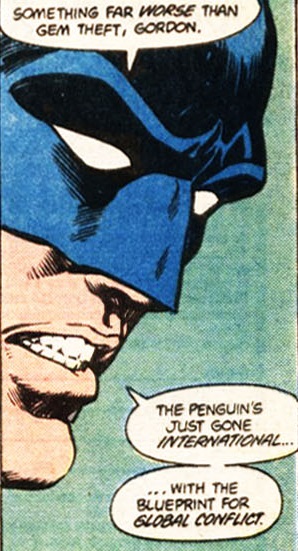
On top of the dark(ish) mood and character work, Moench’s stories were often informed by real world issues, thus anticipating to some degree the impending Frank Miller revolution. Not only did these comics explore the internal politics of Gotham City, they also entangled Batman’s adventures with the troubled politics of Central America and the Middle East. Moreover, at one point the Penguin drugged an investigative reporter into telling him everything about the US ‘Early Bird’ defense system and then tried to sell the info to the Russians!

batman-374Batman #374

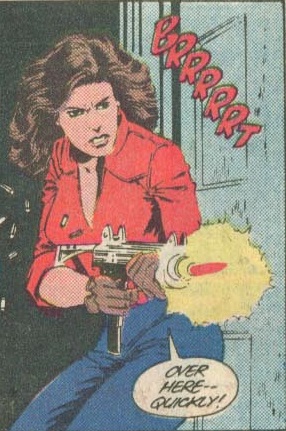
This was only one in a long line of Cold War Batman comics, albeit one with an especially satisfying ending. Doug Moench clearly had quite skeptical views about the need for the Cold War (he also addressed them in his crazy-ass Blackhawk run). The topic came up again in two of my all-time favorite Batman issues (#393-394), in which – three years before Red Heat – the Caped Crusader teamed up with a kick-ass Soviet agent, called Katia:

batman-393Batman #393

Rather than treating Katia as a proto-Bond girl or as a stereotypical Russian who surrenders to American materialism, Doug Moench established her as a richly nuanced character, who explicitly refused to act like Ninotchka. (Katia showed up again in Vigilante #46-47, having apparently quit the KGB and stuck around Gotham City. Unfortunately, Paul Kupperberg’s script ignored Moench’s interesting characterization and depicted her as just a slimy Russian villainess, manipulating the mob in order to smuggle classified material out of the USA.)

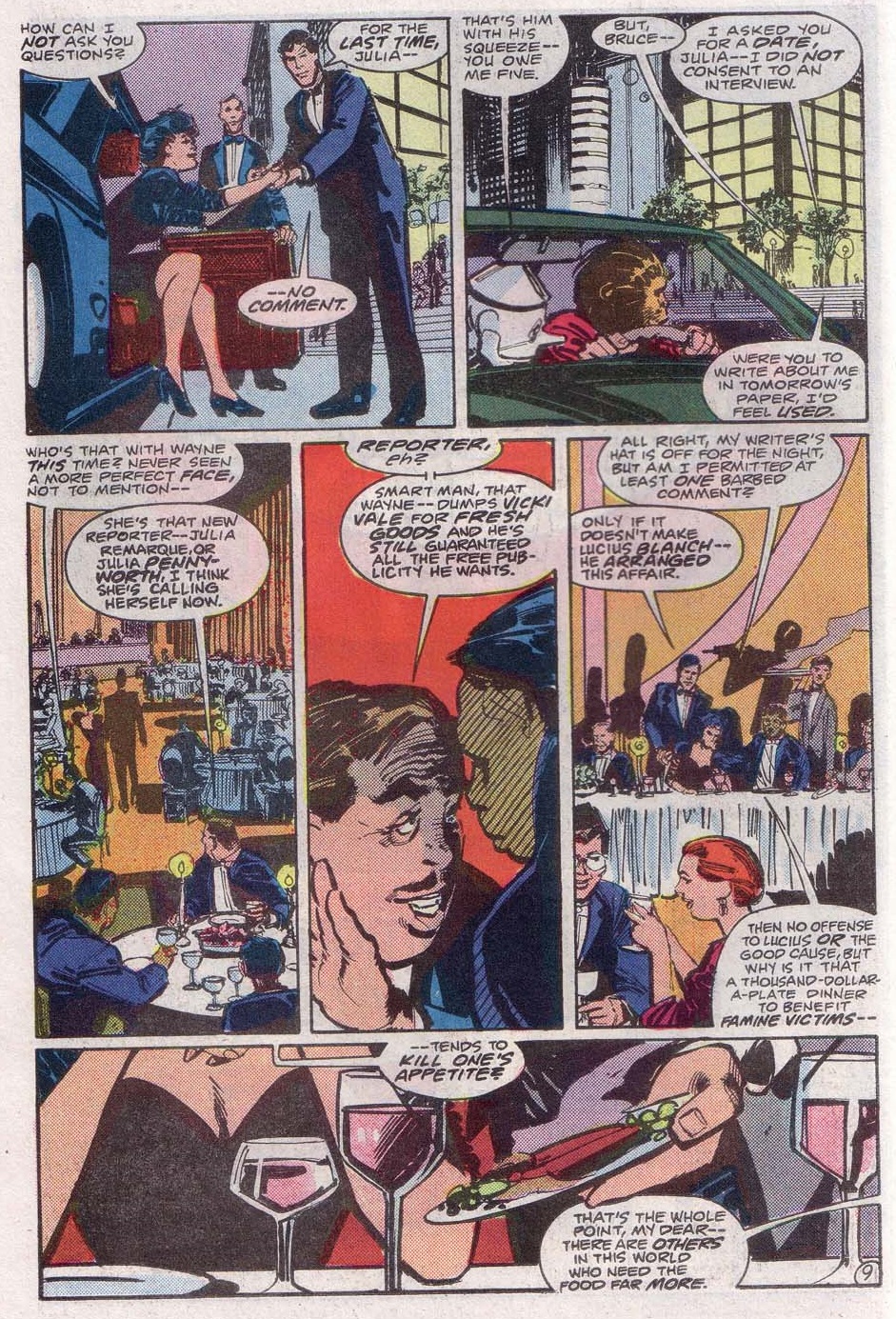
Another fascinating female character who repeatedly confronted Bruce’s politics was Alfred’s French daughter, Julia Pennyworth. She had been created by Gerry Conway (in Detective Comics #501-502), but Doug Moench brought her back into the series as a regular cast member. While turning Julia into a reporter wasn’t very imaginative (it made her look like a Vicky Vale knock-off), Moench cleverly imbued her with a leftist European touch. You can see it in this excerpt from a wonderful sequence that keeps alternating between, on the one level, the juvenile theatrics of masked villains (with simplistic plans and motivations) and, on the other level, an adult world of media negotiation, sexism, class awareness, and international affairs:

detective-comics-553Detective Comics #553

The Caped Crusader’s politics were also addressed in a team-up issue with Green Arrow (Detective Comics #559), in which Batman represented the pro-authority right and Green Arrow the anti-systemic left. That story was called ‘It Takes Two Wings to Fly’ (as in right and left wing, geddit?).

Finally, Doug Moench seemed to really enjoy sneaking pop culture references into his comics. They were crammed with little intertextual gags like this cute wink to Mbube:

batman-364Batman #364

Specifically, Moench channeled his predilection for old Hollywood into the character of Harvey Bullock, whose dialogue consisted mostly of references to classic movie lines. Moench took this to the extreme by introducing a cinephile villain called Film Freak, whose gimmick was precisely that his crimes were reminiscent of movie scenes, including a handful of Alfred Hitchcock ones.

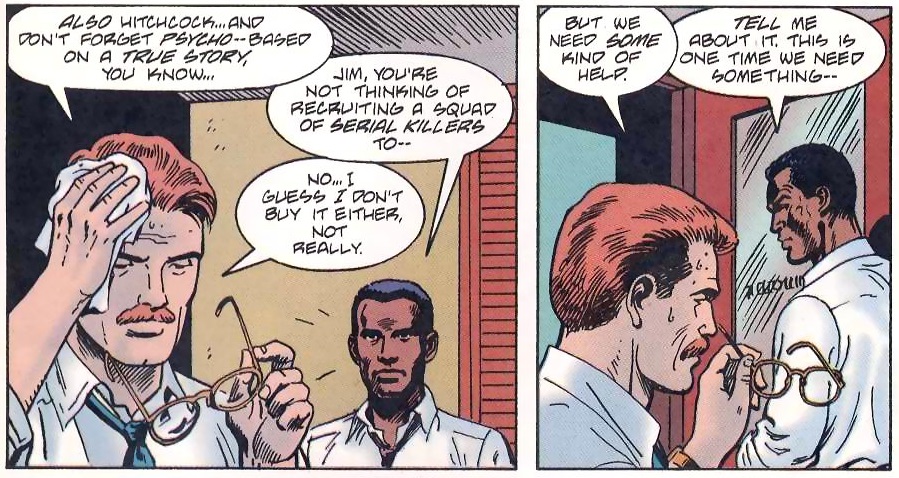
Years later, in 1993, Doug Moench would go back to Hitchcock. When the post-Crisis version of Batman started working together with Catwoman, James Gordon wondered if there could be something to the notion of working with a thief:

legends-of-the-dark-knight-48legends-of-the-dark-knight-48Legends of the Dark Knight #48

Indeed, some of Doug Moench’s motifs did carry over into the ‘90s. However, as we’ll see next month, they became much, much more unhinged…

Posted in WRITERS OF BATMAN COMICS | Tagged , , , , , , , , , , , , , | 4 Comments