Gotham City elections

For some reason, the electoral process has been on my mind. And so I turned, as I often do, to Batman comics in order to reassure myself that, as screwed up as politics appear to be at the moment in the real world, they’re still not as weird as in Gotham City.

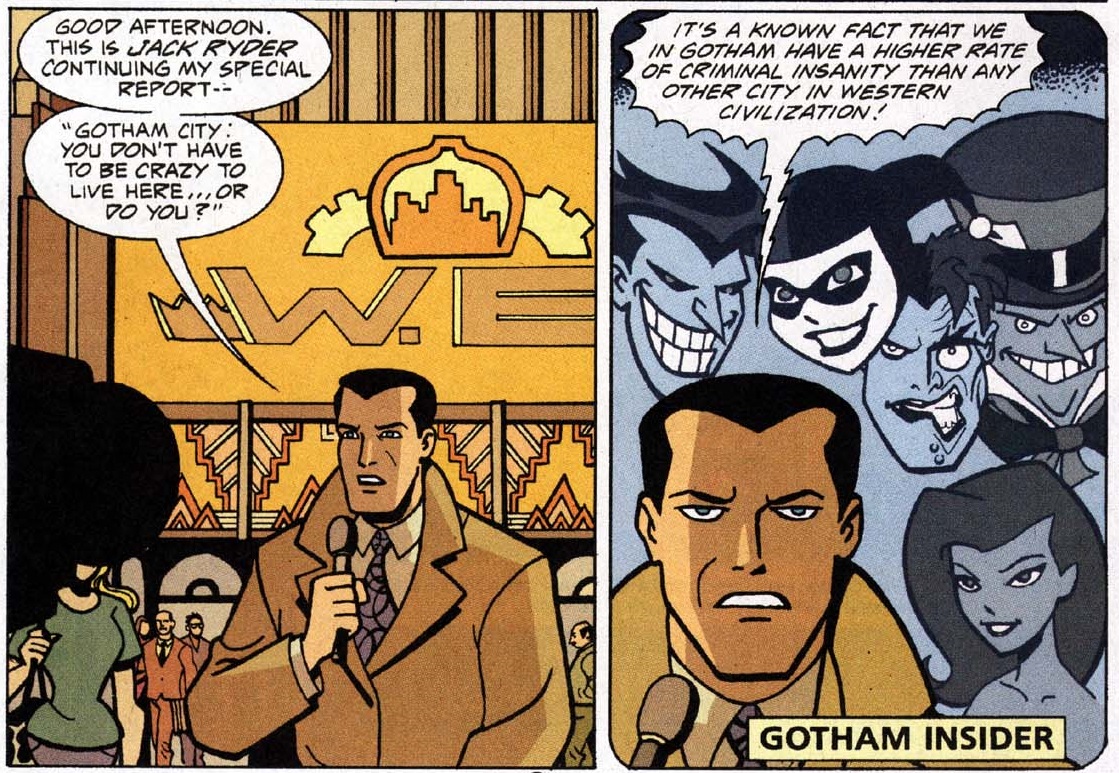
Gotham City is my favorite Batman character. I am fascinated by the notion of a city so preposterously intense and macabre that it drives most citizens off the edge. A city where if you lose your job or your loved ones, or if you find yourself upset with the direction society is heading, you’ll decide to dress up in a colorful costume and commit themed robberies faster than Howard Beale can shout ‘I’m mad as hell, and I’m not going to take this anymore!’
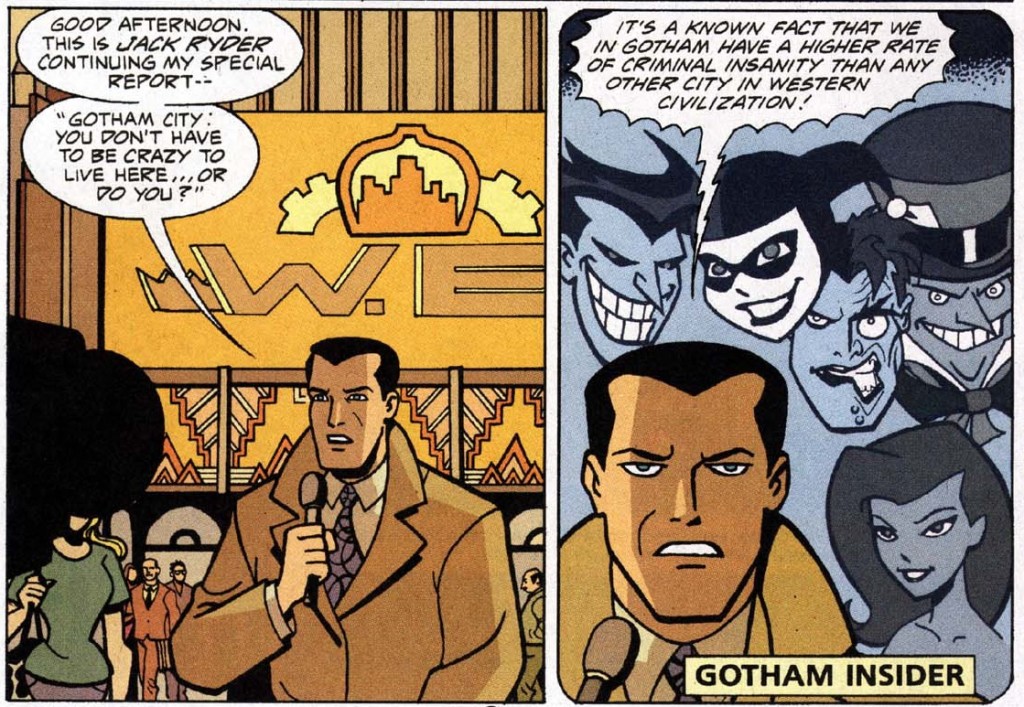
gotham-adventures-58Gotham Adventures #58

If we accept that the city as whole is a bit crazy, then it stands to reason that its elections would be quite off-the-wall as well. And they are. I mean, it says something that the Penguin has managed to become mayor of Gotham in at least three alternative continuities in the comics (he also came close in both a live-action movie and a TV show). And you bet your tail that one of the things Mayor Oswald Cobblepot did was to increase funding to the Novick County Bird Sanctuary by six hundred percent! (In the neat Batman Adventures (v2) #13.)

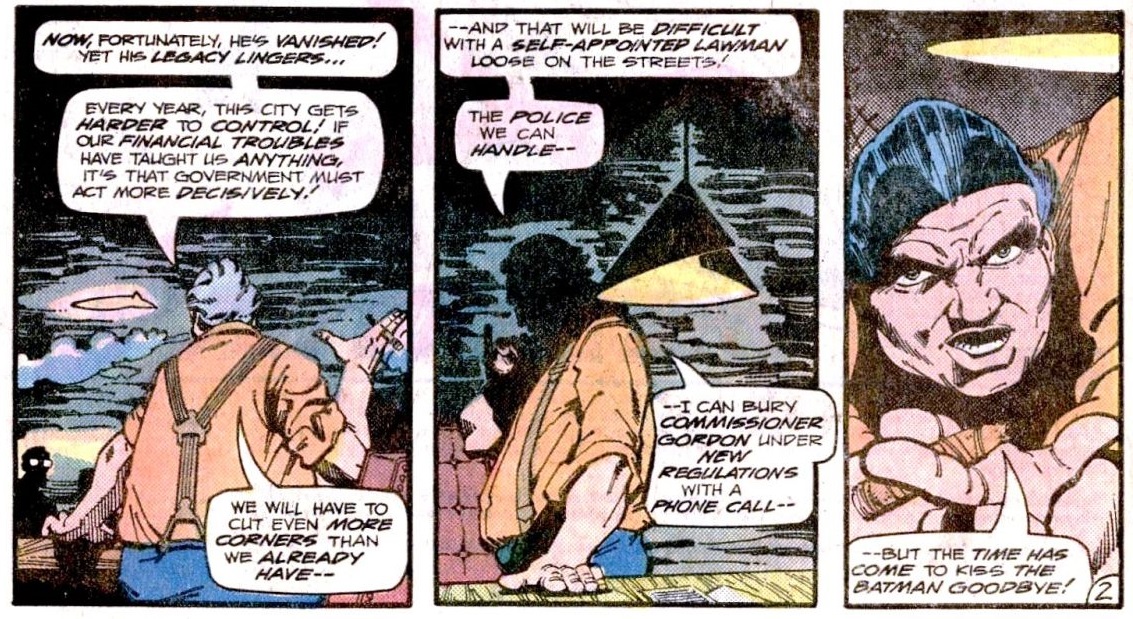
That the electoral process is corrupt goes without saying – pretty much every institution and proceeding in Gotham City are corrupt beyond New Jersey standards. From the Court of Owls to the Tobacconists’ Club led by Rupert Thorne, there is an endless tapestry of influential cabals, secret societies, and underground lobby groups pulling strings in smoke-filled rooms.

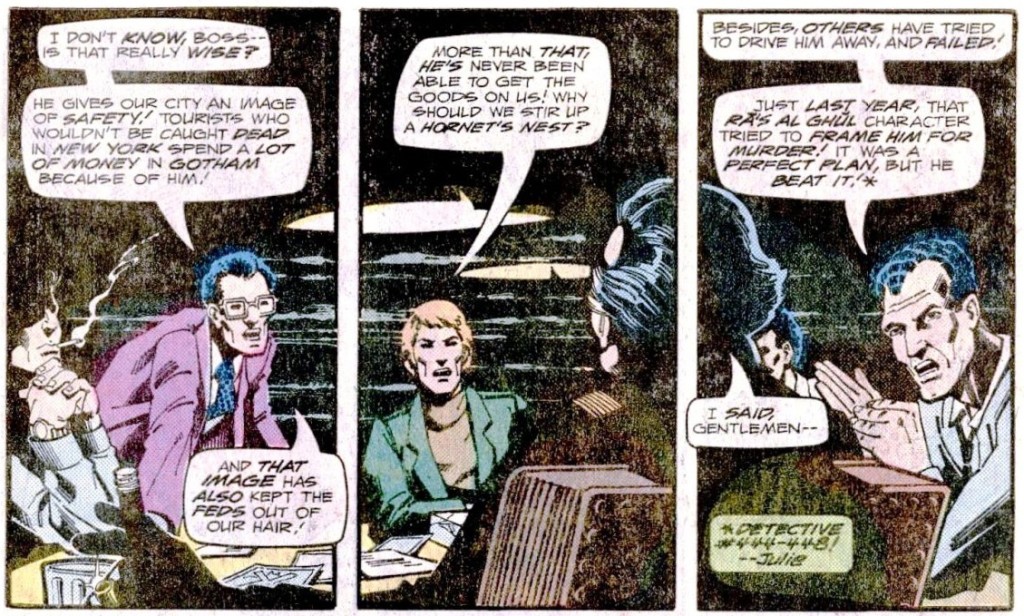
detective-comics-471detective-comics-471Detective Comics #471

That said, Gotham elections still manage to reach particularly ludicrous extremes. For one thing, the people behind the campaigns tend to make Malcolm Tucker look subtle and restrained in comparison. In the 1972 mayoral election, the political bosses for the two main candidates were so dishonest that even the least dirty one tried to slander his opponent by framing him for the murder of Bruce Wayne (who was not even dead!). In a 1980 recall election for police commissioner, a campaign manager orchestrated a city-wide crime wave and ended up shooting his own candidate. Hell, even in the more kid-friendly Batman Adventures universe, elections were almost as out-of-control, as shown in ‘Decision Day’ (Batman Adventures #18), in which Batgirl and Robin found out that a major candidate had sponsored an attempt to blow up police headquarters.

(And it’s not just the local elections that can get out of hand. When Evan Gregory ran for governor in 2005, the Joker electrocuted him with a joy buzzer, kidnaped his fiancée, and finally dismembered him… In the Joker’s defense, though, the Clown Prince of Crime was running against Gregory, so this turn of events wasn’t completely unexpected. In fact, the Joker was running with the populist slogan: ‘Vote for me or I’ll kill you.’)

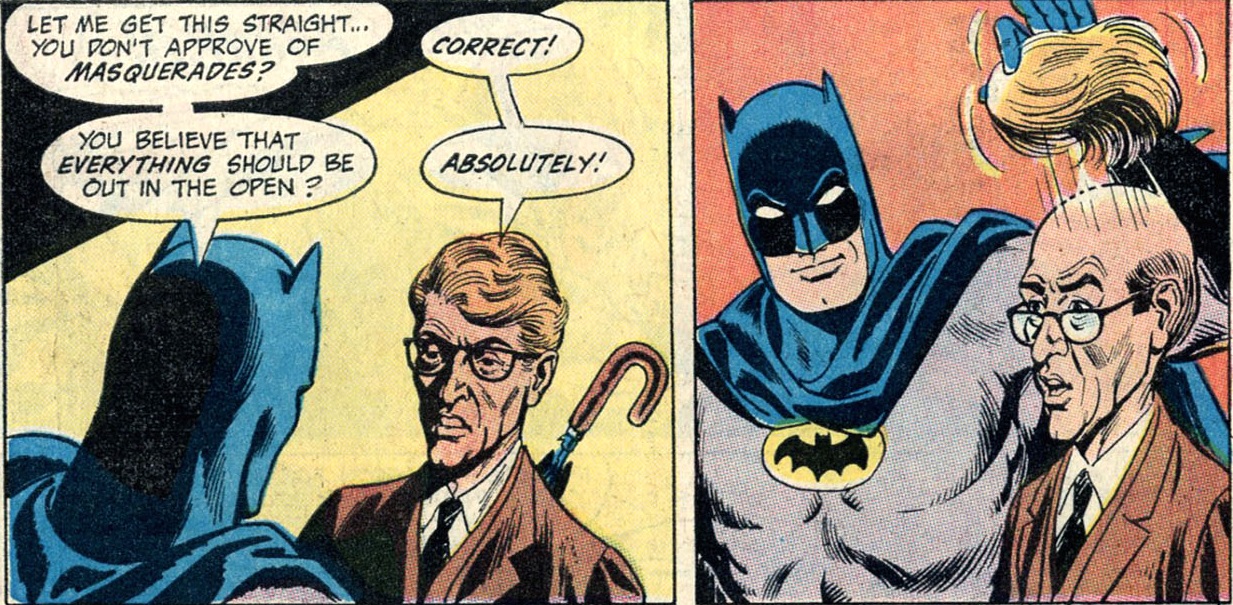
In terms of political debate, a recurring electoral topic concerns the fact that some local weirdo keeps disguising himself as a bat and beating up criminals with little regard for their civil rights. This used to be a pet cause of Arthur Reeves, who as the mayor’s public works commissioner spent his career demanding the Batman’s unmasking, all the way back to 1970:
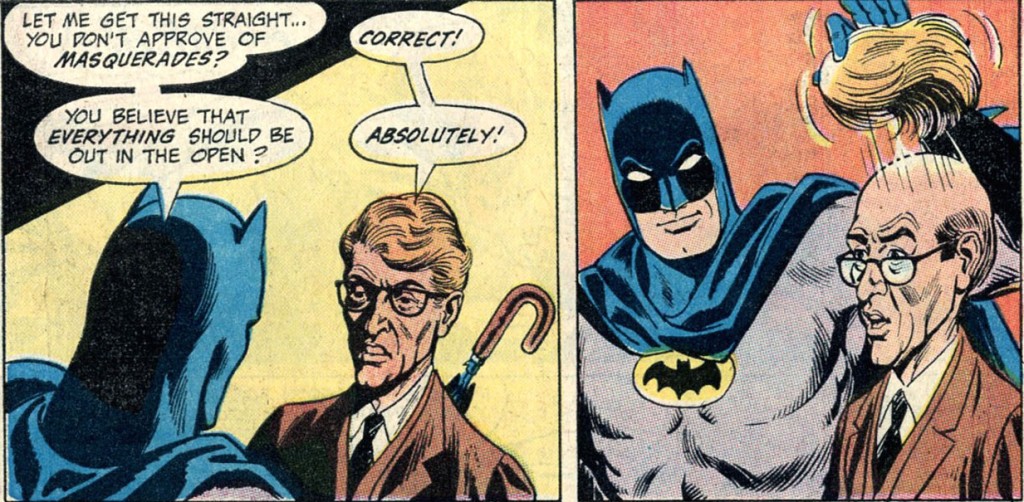
detective-comics-399Detective Comics #399

Reeves charged Batman with murder more than once (Batman #225, Detective Comics #419, Detective Comics #463) and for years he persistently lobbied against the police’s collaboration with the Caped Crusader:
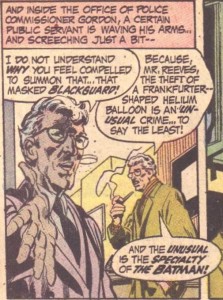
batman-234Batman #234

In 1981, Arthur Reeves finally ran for mayor on an anti-Batman platform, but lost against Reform Party candidate Hamilton Hill. Reeve’s campaign basically crashed and burned when he announced that he was going to expose the Dark Knight’s secret identity and gave the media photographs that supposedly showed Batman was a wanted mobster, but which were quickly proven to be forgeries. In fact, Arthur Reeves had obtained the photos from Rupert Thorne, who had framed Reeves in order to get his own man elected, i.e. Hamilton Hill.

As soon as he took office, Mayor Hill demanded the resignation of Police Commissioner James Gordon, replacing him with another Thorne stooge. Although Hamilton Hill was elected against the anti-Batman candidate, soon after the election Hill also declared war on the Dark Knight, giving the police shoot-to-kill orders. One of a long line of scumbag mayors, Hill remained in office until 1985, entangled in an expanding web of corruption and abuse of power.

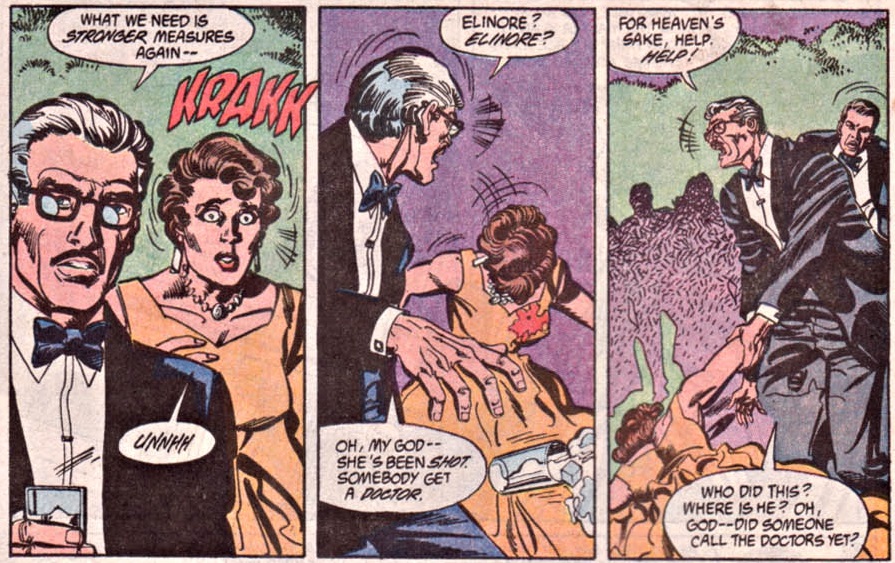
A few years later, another mayoral campaign went off the rails when the short-lived villain Abattoir (who used to strip his victims’ flesh in order to eat their souls, as you do) crashed into a fund-raiser for the candidate Henry Etchison, leading to this horrific scene:

detective-comics-625detective-comics-625Detective Comics #625

The most pathetic thing was that, Gotham being Gotham, it turned out Etchinson himself had released the mad killer in order to get rid of his wife Elinore, who wanted a divorce – after all, while a divorce wouldn’t be convenient in the polls, a recently murdered wife could sure help his tough-on-crime campaign!

Former District Attorney Armand Krol ran for mayor in 1992, also on a platform of law and order, invoking Batman’s crusade as proof that the police force was not doing enough by itself. He promised to keep James Gordon as commissioner, but only because of Jim’s privileged relationship with Batman. Having defeated his opponent (the corrupt judge Walter Liptic, as seen in Legends of the Dark Knight Annual #2), Krol soon got a taste of Gotham City’s mayoral life – shortly after getting elected, he was kidnapped and almost drowned by a gang of misfit villains, including Catman, Calendar Man, and Killer Moth. And not long after *that*, he was kidnapped once again, now by the Joker and the Scarecrow, who forced him to bring Gotham even closer to breaking point with a series of harmful phone calls, for example causing a firefighters’ strike and leading the police into a deadly trap!

After Batman saved him from this last stunt, Armand Krol became even more of an admirer of the Dark Knight, especially the more violent, gung ho AzBats version. Indeed, Krol decided to distance himself from the ineffectual police department and to publicly endorse Batman’s activities instead. This set the stage for my favorite Gotham City mayoral campaign in the comics.

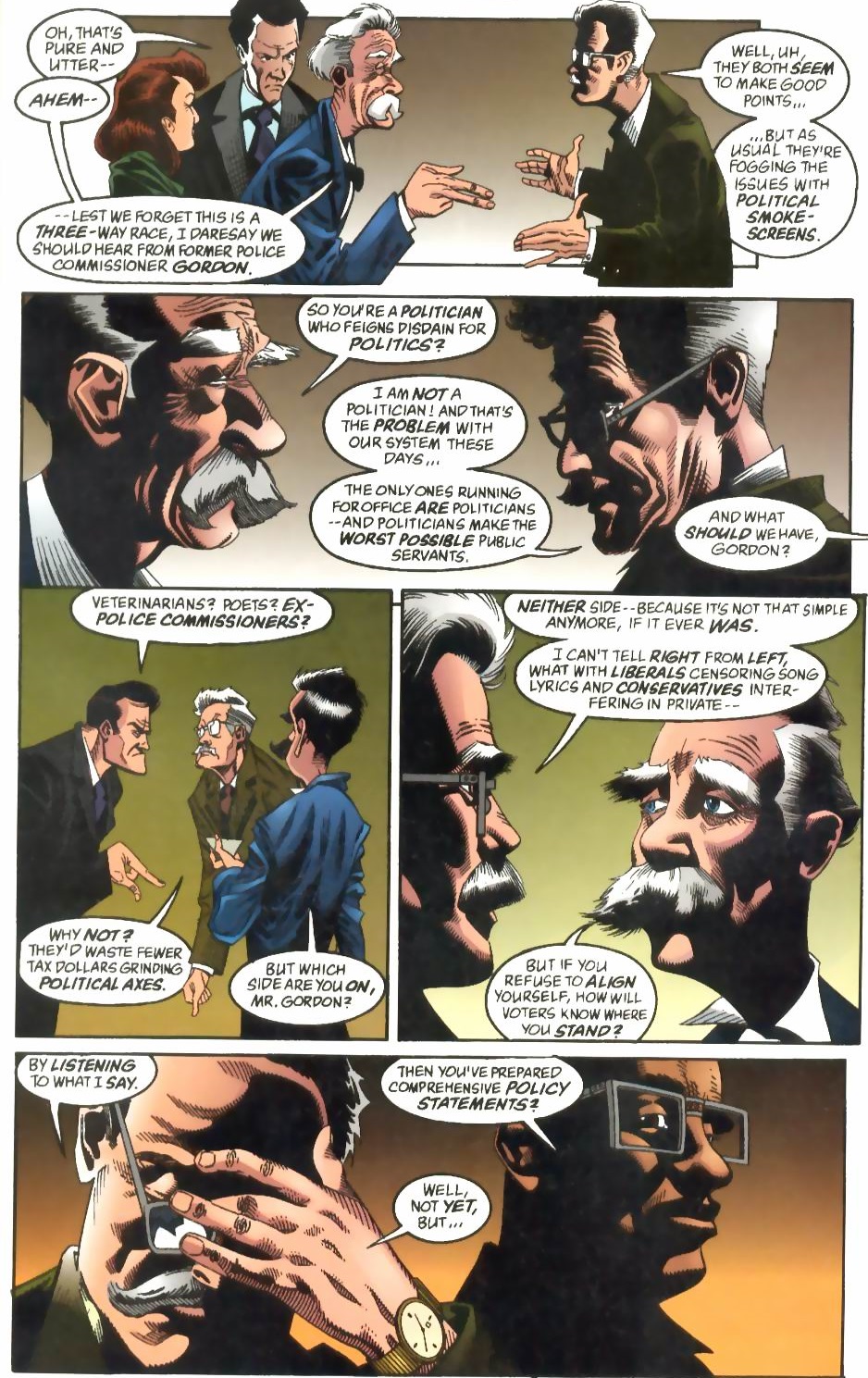
Basically, by 1995 Krol had pissed off pretty much everyone and began to fear his chances at reelection when faced with what he called ‘the latest fad – a squeaky-clean do-gooder woman candidate,’ namely District Attorney Marion Grange. To counteract Grange’s liberal appeal, Krol replaced Commissioner Gordon with Jim’s wife, Sarah Essen. A group of businessmen then decided to back James Gordon, who agreed to run as an independent candidate but was ultimately done in over charges of police brutality.

What I love about this was that, throughout 1995, there was political maneuvering taking place on the corners of almost every Batman comic, with evolving arguments and switching endorsements, just like in any real campaign. If you bought a random issue, between all the chase scenes and panels of the Caped Crusader kicking the Scarecrow in the face, you would find all these little slices of enduring political debate:

batman-523batman-523Batman #523

This months-long subplot culminated in one of Gotham City’s most close-run elections. After the result was announced, the ensuing chess moves and negotiations between the candidates for the roles of mayor, district attorney, and police commissioner were covered in the intertwined stories of Batman #527-528, Detective Comics #693-694, and Shadow of the Bat #46-47 (cover-dated January-March 1996).

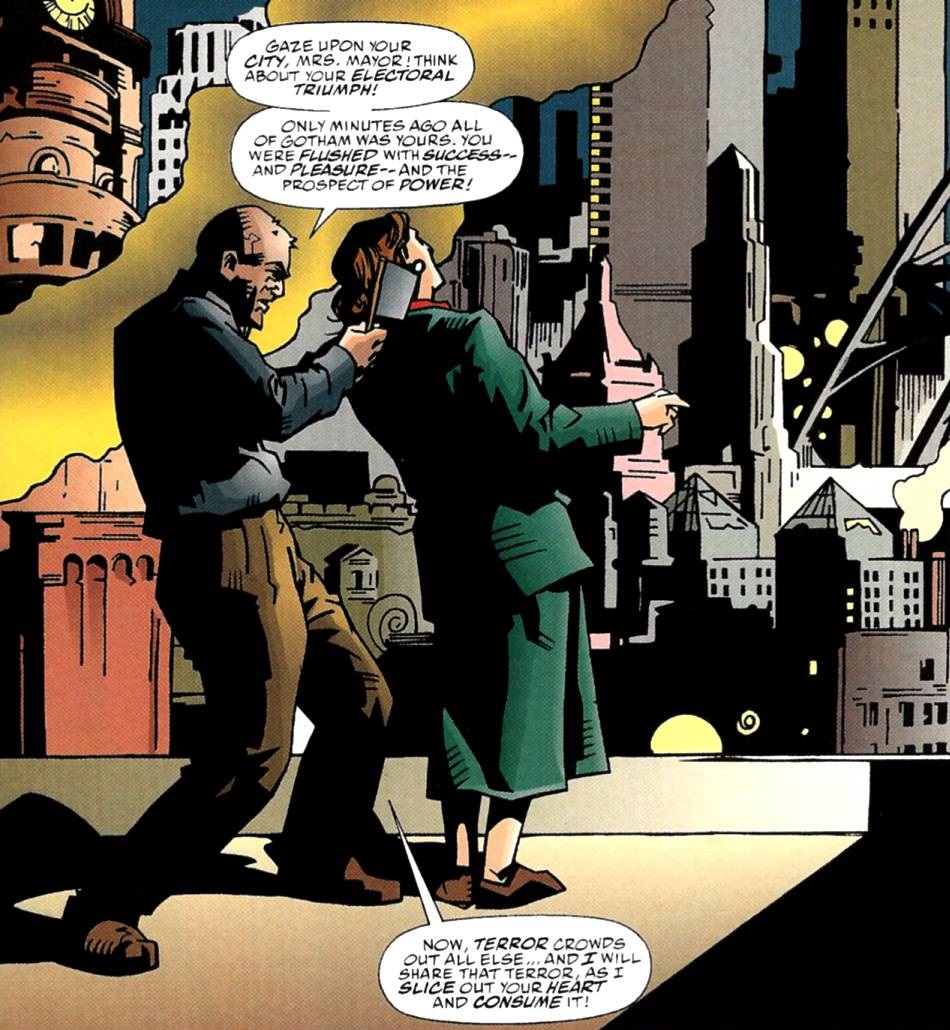
In the end, Marion Grange managed to secure her position as the new mayor, although – needless to say – not before she got a taste of the old Gotham City welcome by getting kidnapped by a lunatic serial killer…
shadow of the bat 47Shadow of the Bat #47
Posted in POLITICS OF BATMAN COMICS | Tagged , | Leave a comment

6 cool AzBats moments

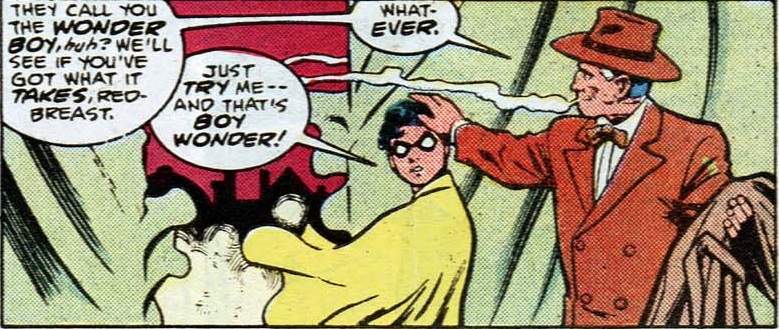
One of the most infamous Batman eras was that time Jean Paul Valley – a university grad student brainwashed by a sect of the Knights Templar into becoming the assassin called Azrael – temporarily replaced Bruce Wayne as the Dark Knight. With his psycho personality, tacky armored suit, and brutally violent approach to crimefighting, Valley’s Batman – known among fans as AzBats – was set up from the get-go to be an over-the-top awful version of the Caped Crusader, thus paving the way for Bruce’s glorious return at the end of the Knightfall story arc.

It’s hard not to see in AzBats a tongue-in-cheek parody of 1990s’ *extreme* attitude. One of the running gags was that he kept tweaking his costume’s design, incorporating endless accessories while making it progressively bulkier and cyborg-looking. What’s more, AzBats spent most of the time viciously tearing criminals to shreds and treating Robin like crap (although he still managed to act less like a dick than the protagonist of Frank Miller’s All-Star Batman and Robin, the Boy Wonder). He would go on to star in Azrael, easily the shittiest Batman spinoff of the nineties, often settled with laughably bad art, dialogue, plots, characters, you name it. Living up to Jean Paul Valley’s connotation with outrageous excess, that series pushed the savage man-child angle further, revealing him to be a product of centuries of deranged human-animal genetic engineering!

In the world of Batman comics, however, even loathed characters – like the second Robin, Jason Todd – occasionally get to rise above their alleged lameness, or at least prove themselves interesting in their own way. With that in mind, here are half a dozen moments from the Knightfall era in which creators actually did some cool stuff with this twisted version of the Dark Knight:

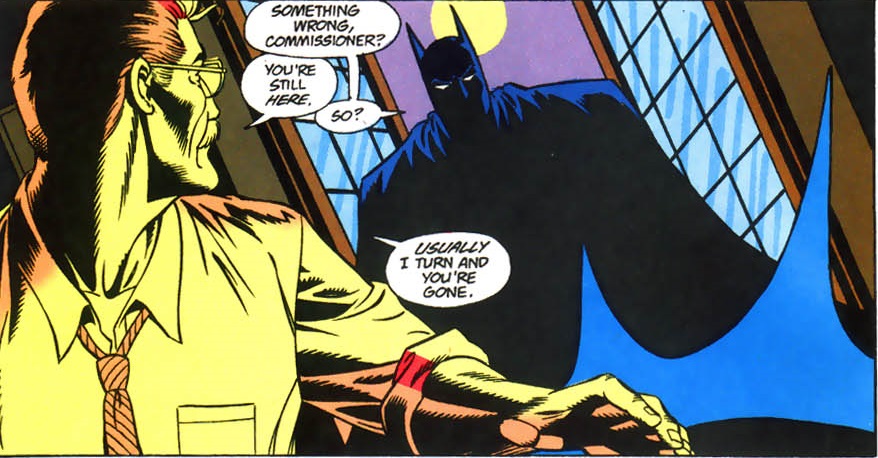
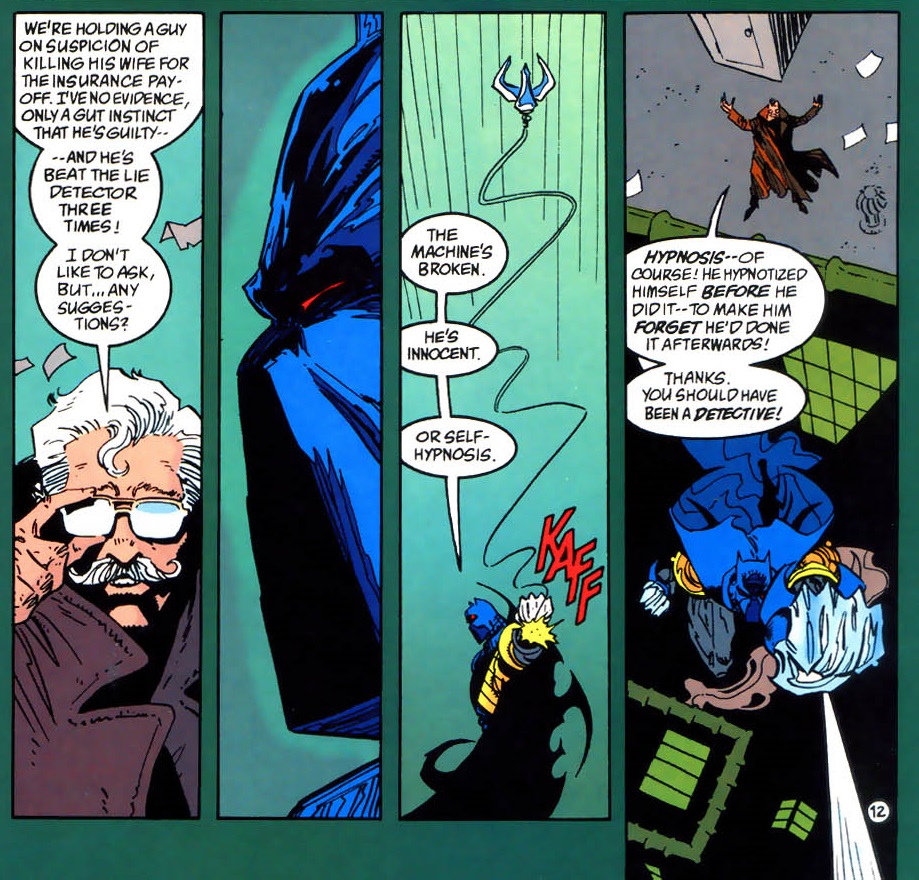
  1. AzBats screws up Batman’s signature vanishing act when talking to Commissioner Gordon…
detective-comics-666detective-comics-666Detective Comics #666

2. AzBats offhandedly solves a case because he is so damned used to weird brainwashing techniques…

shadow-of-the-bat-24Shadow of the Bat #24

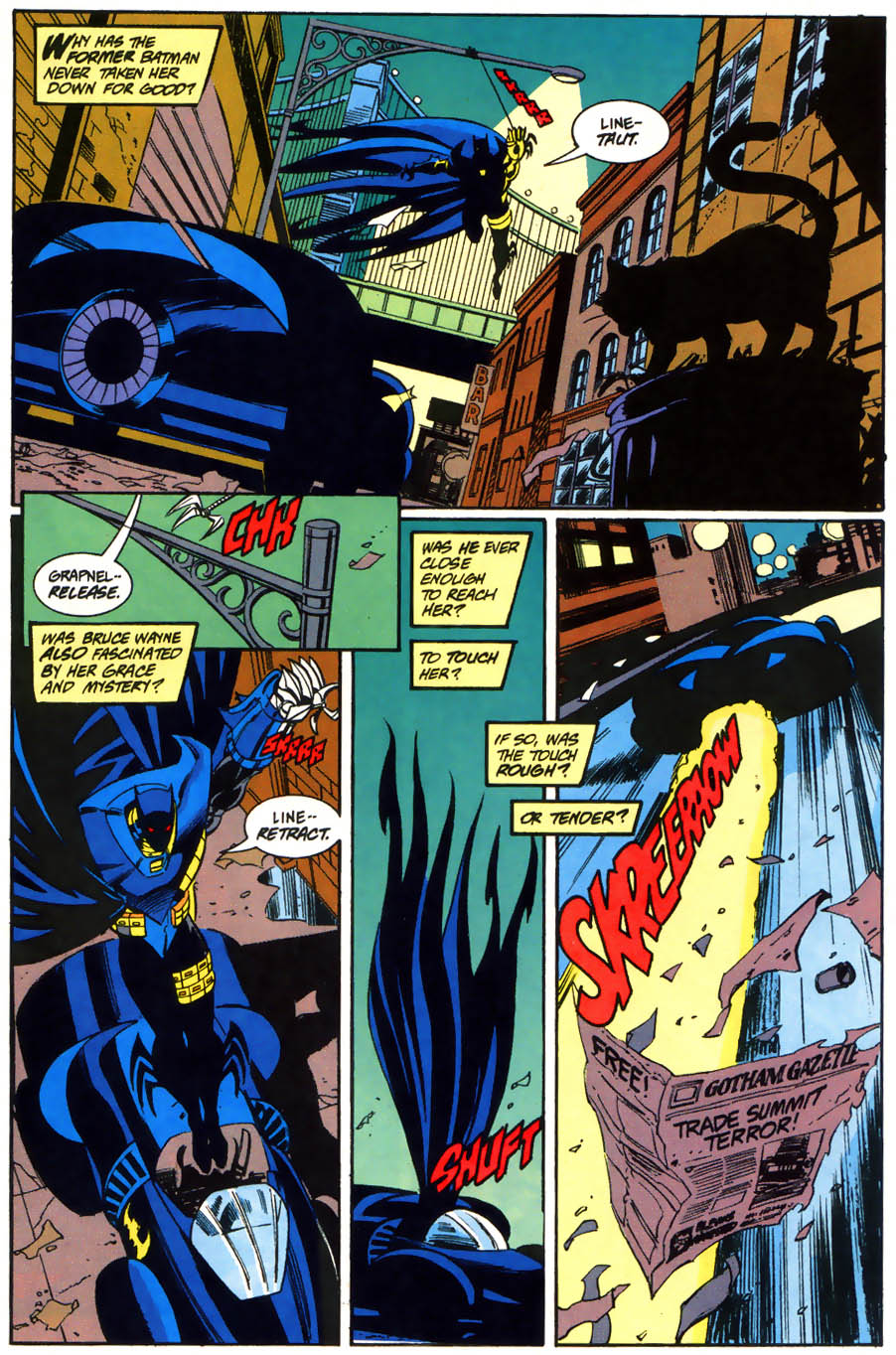
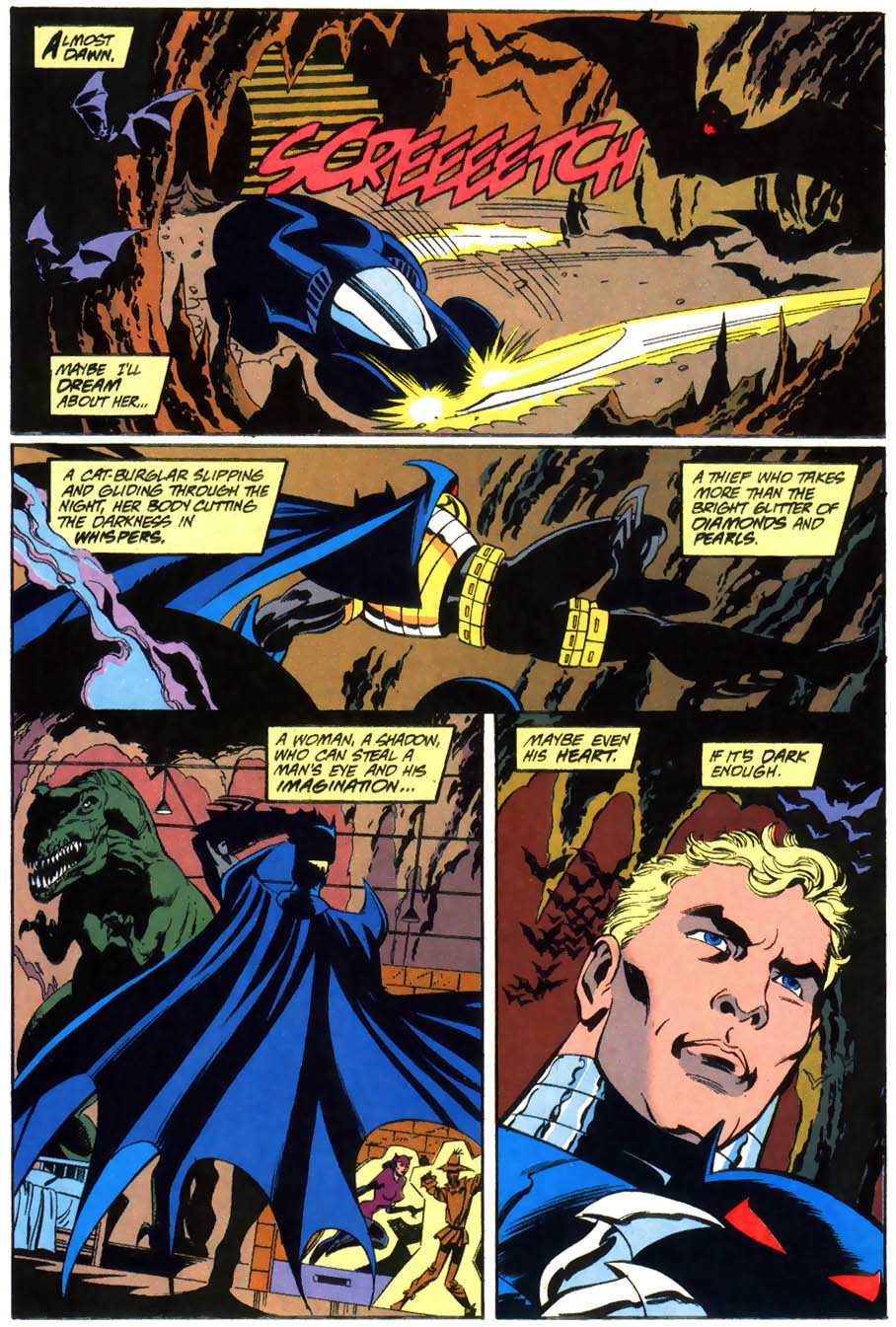
3. AzBats finds himself unexpectedly attracted to Catwoman (right before having a wet dream about her)…

batman-503batman-503Batman #503

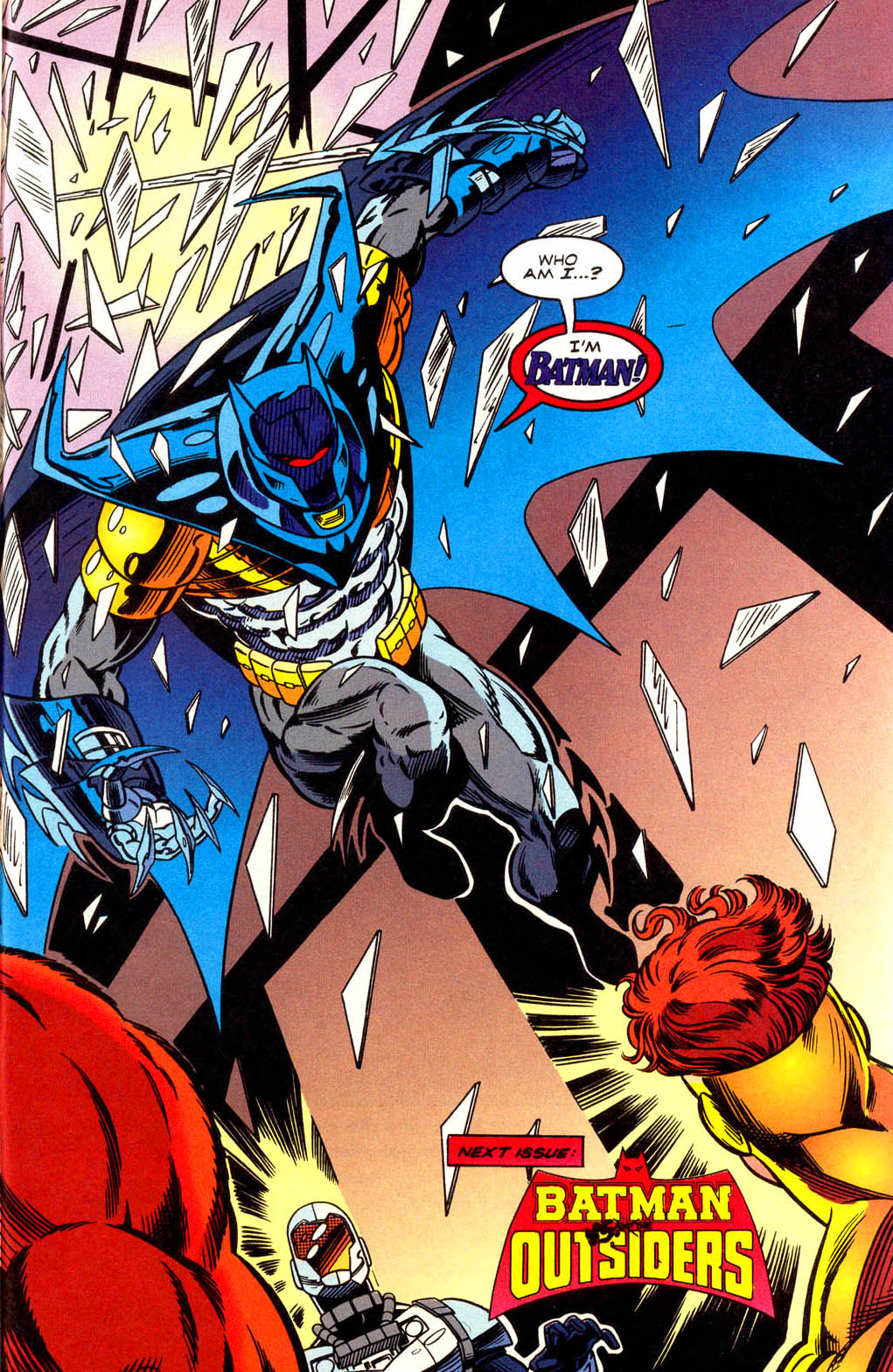
4. AzBats nails Batman’s traditional glass-shattering entrance style…

Outsiders 7Outsiders (v2) #7

5. AzBats takes things too far (as usual) by adding a completely gratuitous glass-shattering exit…

chain-gang-war-12Chain Gang War #12

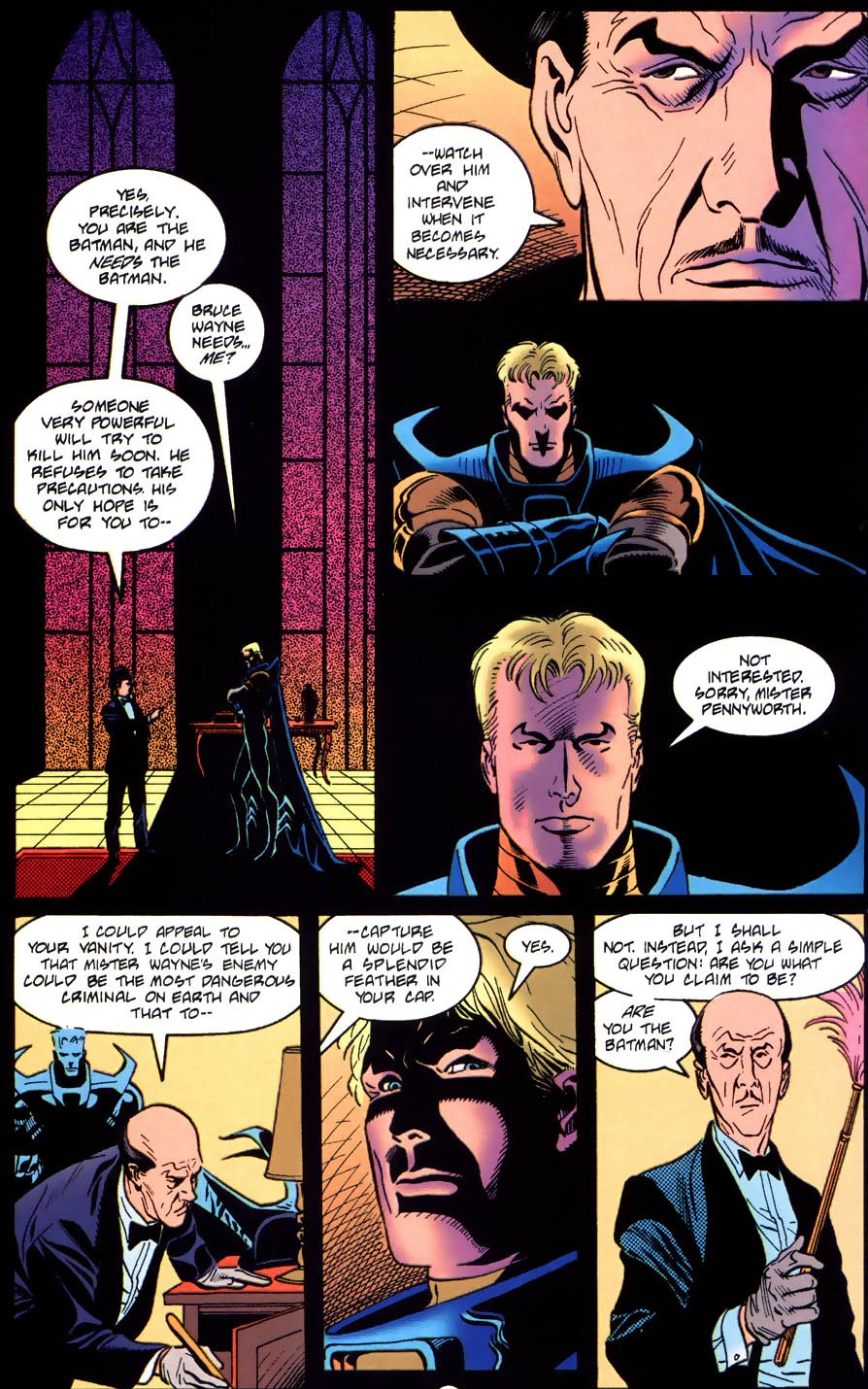
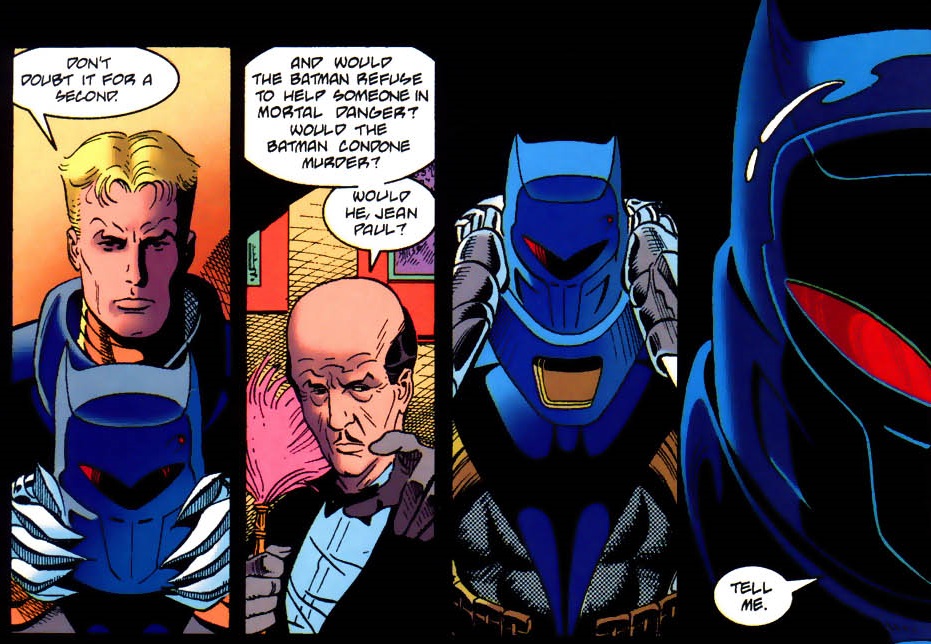
6. AzBats totally gets manipulated by Alfred into doing the right thing…

legends-of-the-dark-knight-060legends-of-the-dark-knight-060legends-of-the-dark-knight-060Legends of the Dark Knight #60

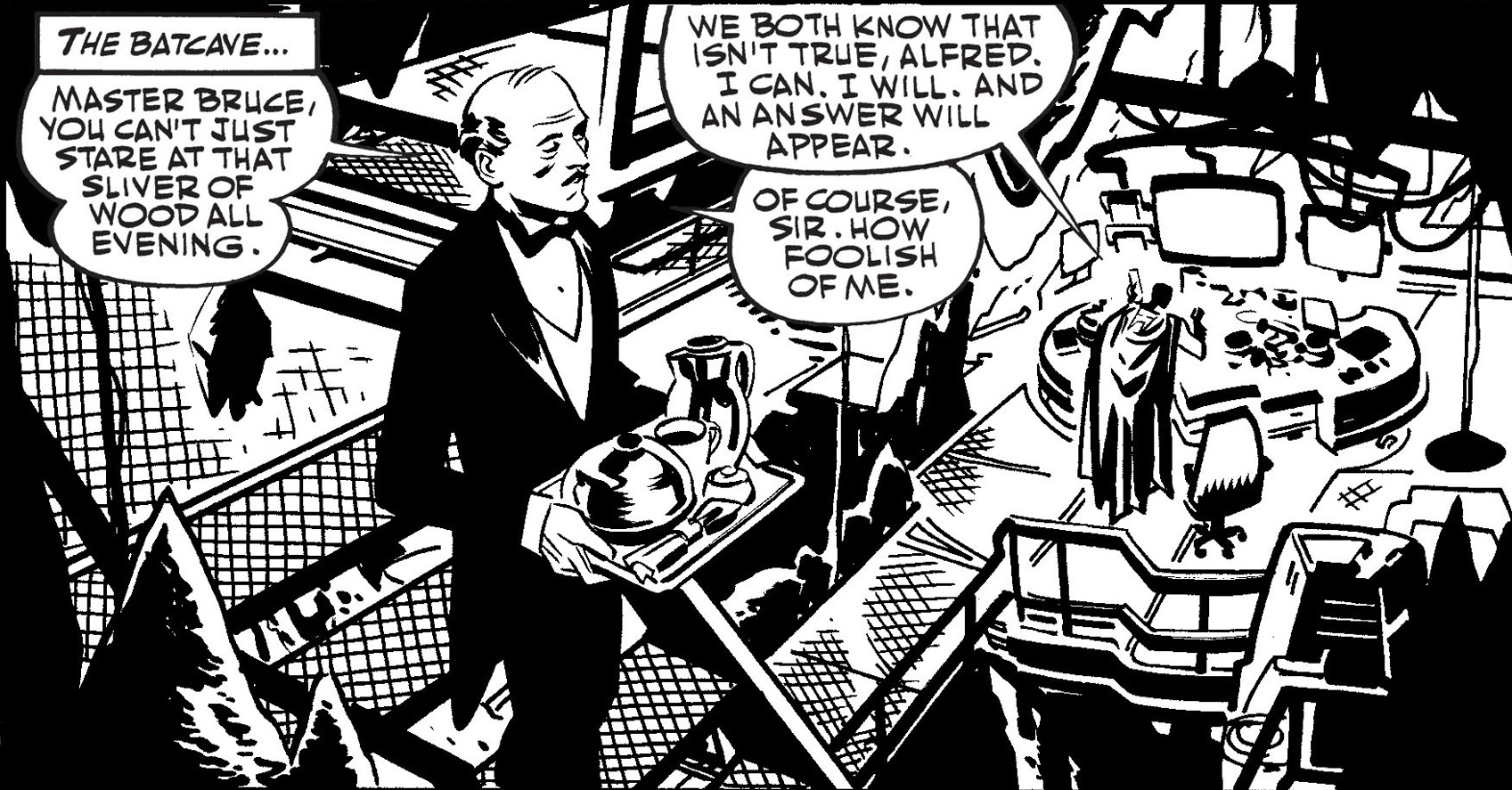
Oh, Alfred

Posted in GOTHAM CITIZENS | Tagged | 2 Comments

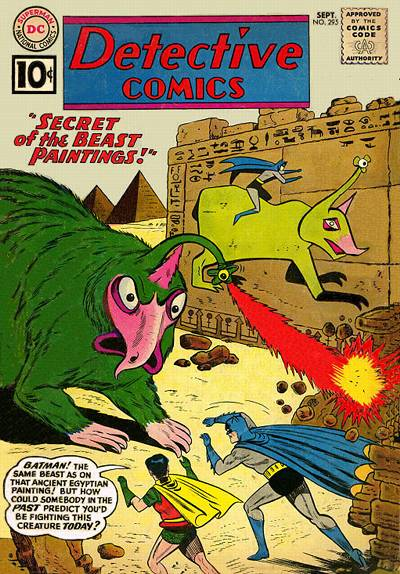
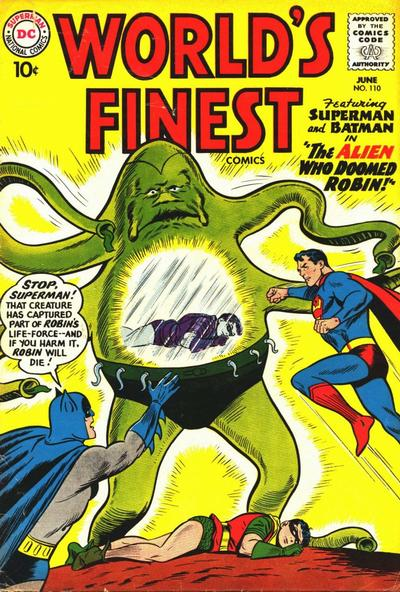
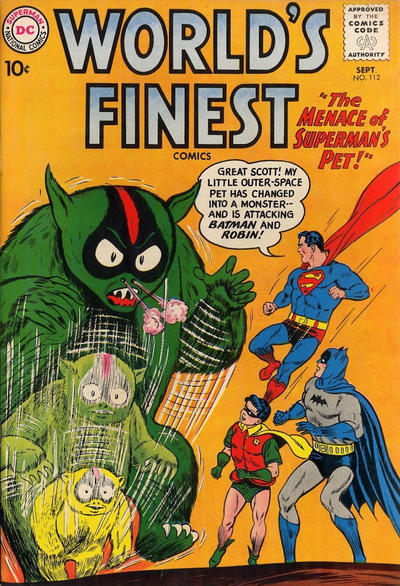
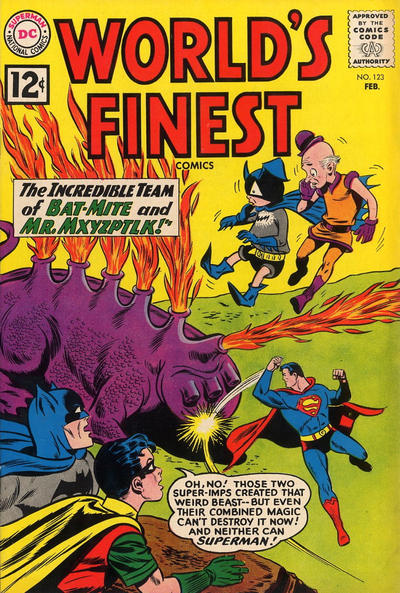
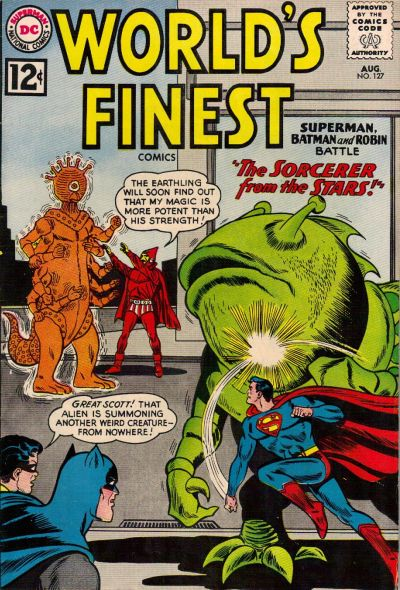
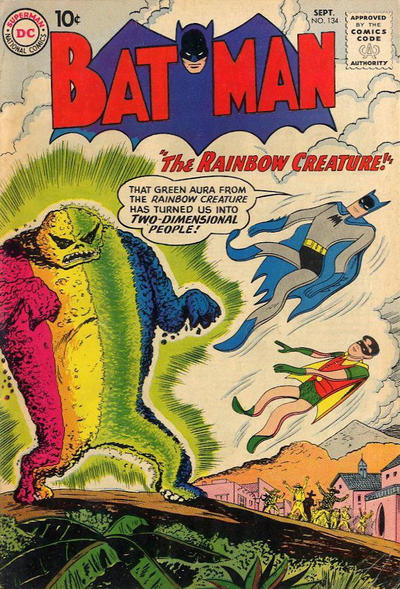
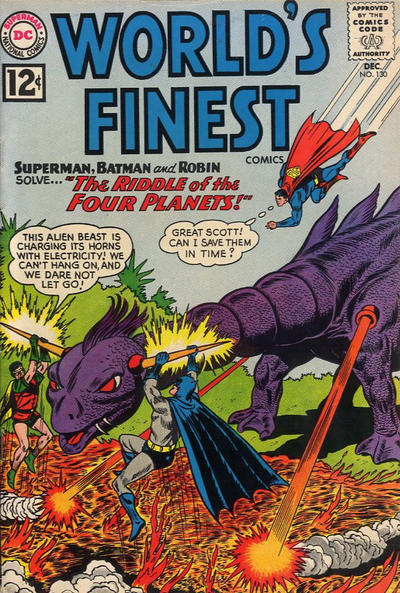
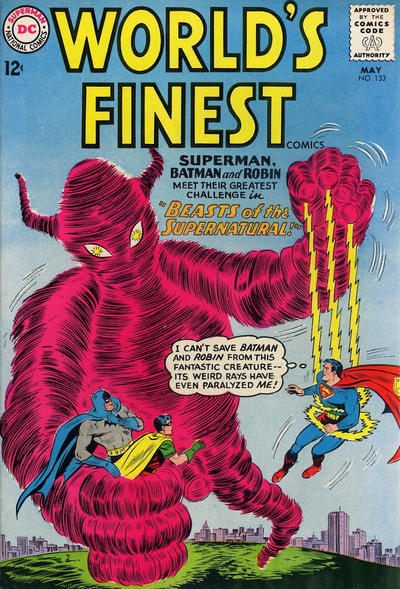
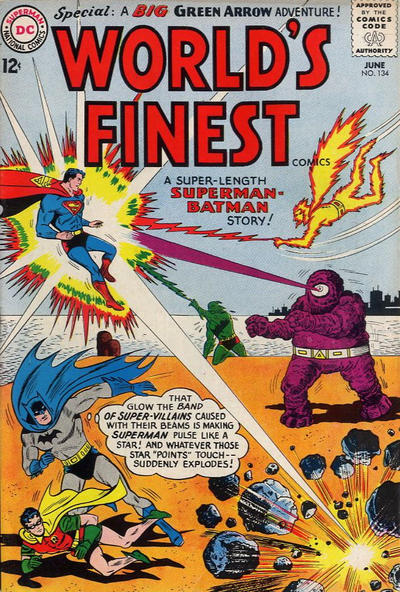
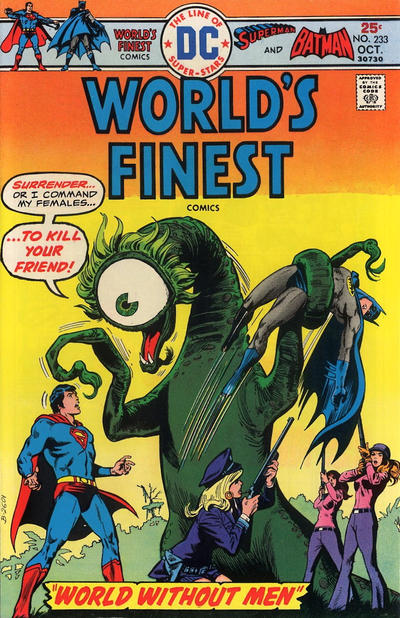
10 covers with seriously weird monsters

I’ve mentioned before how the Silver Age tended to produce strange, dream-like covers. There was a time when the best strategy to allure Batman readers seemed to be to give them colorful images that resembled the hallucinations of an euphoric mind obsessed with bizarre creatures. This obsession was probably linked to the popularity of 1950s’ sci-fi monster films, including such gems as Christian Nyby’s The Thing from Another World, Gordon Douglas’ Them!, and Nathan H. Juran’s 20 Million Miles to Earth.

As far as the Dynamic Duo was concerned, the resulting covers – drawn by artists like Curt Swan and Dick Dillin – were trippy as hell, featuring all kinds of fantastic beasts, as you can see in these ten amazing examples:

Detective Comics 295World's Finest Comics 110World's Finest Comics 112World's Finest Comics 123World's Finest Comics 127Batman 134World's Finest Comics 130World's Finest Comics 133World's Finest Comics 134World's Finest Comics 233

(This last one is actually from the Bronze Age, but it fits so well that I just couldn’t resist.)

Posted in COVERS OF BATMAN COMICS | Tagged , , , , | Leave a comment

Fun Batman stories

Despite being an unabashed fan of gritty film noir, moody gothic horror, and even some of the dark superhero sub-genre (so far, the Marvel Netflix shows have all kicked serious butt!), every so often I find myself ranting in this blog about the need for comics that tell wacky, rollicking stories, comics that make you smile and fill you with joy, comics that proudly appeal to all ages, comics that are not afraid to look silly while cramming each page with wild ideas and visuals. You know, fun comics. And, in particular, fun Batman comics.

Here are five wonderful tales that encapsulate the kind of cheerful, anything-goes attitude I’m talking about:

‘The Doomsday Book’ (1987)

detective-comics-572Detective Comics #572

This classic mystery adventure stars Batman and Robin (a happy-go-lucky Jason Todd) as well as the hardboiled private eye Slam Bradley and the stretchy superhero Ralph Dibney (the Elongated Man) in one of those yarns where the stakes keep escalating – it starts with a missing girl, then you find out the IRA is involved, then there turns out to be a conspiracy to assassinate the British royal family, and before you know it the Boy Wonder is riding a damn nuclear missile!

With ‘The Doomsday Book,’ writer Mike W. Barr seems to have crafted not just a celebration of the 50th anniversary of Detective Comics, but a celebration of the detective genre in general, with nods to different mystery formulas and archetypes, such as Sam Spade, Ellery Queen, and, of course, Sherlock Holmes. As if this wasn’t cool enough, the issue features the work of some of the most talented people in DC Comics at the time, including lively pencils and inks by Alan Davis, Paul Neary, Terry Beatty, Dick Giordano, Carmine Infantino, Al Vey, and E.R. Cruz, plus colors by Adrienne Roy and Carl Gafford.

Moreover, in its own way ‘The Doomsday Book’ is also a Christmas story, making this an ideal read for the upcoming holiday season.

’The Last Riddler Story’ (1993)

batman-adventures-10The Batman Adventures #10

In this laugh-out-loud issue, writer Kelley Puckett and penciller Mike Parobeck (vigorously inked by Rick Burchett) pit the Dark Knight against no less than four hilariously dysfunctional villains. There is Mastermind, whose planning is so meticulous that he even brings his own handcuffs just in case he gets caught, Mr. Nice, who is such a swell guy that he is guilt-tripped into sharing his loot with the people he is robbing, the Perfesser, who is more interested in lecturing pedantically to his accomplice than in completing the actual crimes, and the Riddler himself, for whom actually getting away scot-free is much less important than coming up with a riddle Batman cannot solve.

Besides the over-the-top comedy, chock-full of one-liners and sight gags, the issue deserves credit for telling a great Riddler story, one that has a lot of fun with this villain’s eccentric personality. Moreover – as a bonus for comic book geeks – there is a neat metafictional angle, as each of the remaining foes is based on a senior DC editor, namely Mike Carlin, Denny O’Neil, and Archie Goodwin.

‘The Impossible Escape’ (1974)

brave-and-the-bold_112The Brave and the Bold #112

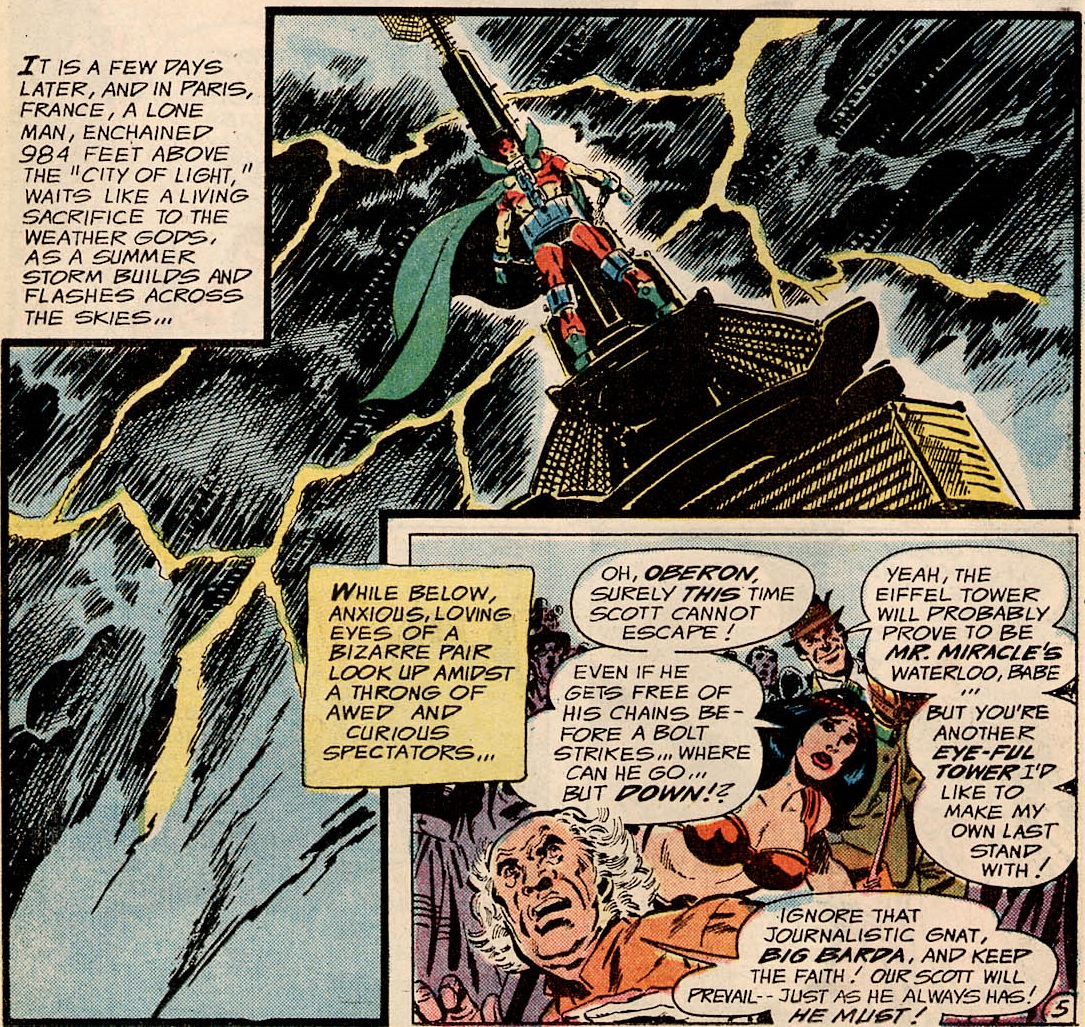
From the slam-bang opening in which Batman faces suicidal raiders at the Gotham Art Museum to the climatic chase in an ancient, maze-like Egyptian tomb, this comic never lets go. ‘The Impossible Escape’ keeps adding one off-kilter twist after another at a hell-for-leather, feverishly brisk pace, as is typical of Bob Haney’s and Jim Aparo’s exhilarating run on The Brave and the Bold.

Along the way, the Caped Crusader finds himself in a trap-filled pulp adventure that may lead him to the elusive secret of immortality. He also teams up with Mr. Miracle, the alien escape artist created by the legendary Jack Kirby. What a blast!

 ‘Final Christmas’ (2009)

braveandthebold_12Batman: The Brave and the Bold #12

Another holiday tale and another team-up, now with the jet pack-wearing, laser pistol-carrying interplanetary couple of Alana and Adam Strange. When an anti-matter wave generated by reptilian beings jeopardizes the cosmos on Christmas Eve, Batman takes his battle against injustice into outer space!

To say that this is the greatest Batman Christmas story is selling it short – this is one of the best Christmas books ever (it deserves a place on your shelf next to Terry Pratchett’s Hogfather). Landry Q. Walker and Eric Jones capture the relentless, playful style of the Batman: The Brave and the Bold animated show (the Earth actually blows up on the third page!) while spinning a brilliant sci-fi yarn bursting with wit and heroism and an absolutely killer ending.

‘The Mystery of the $1,000,000 Treasure Hunt’ (1963)

detective-comics-313Detective Comics #313

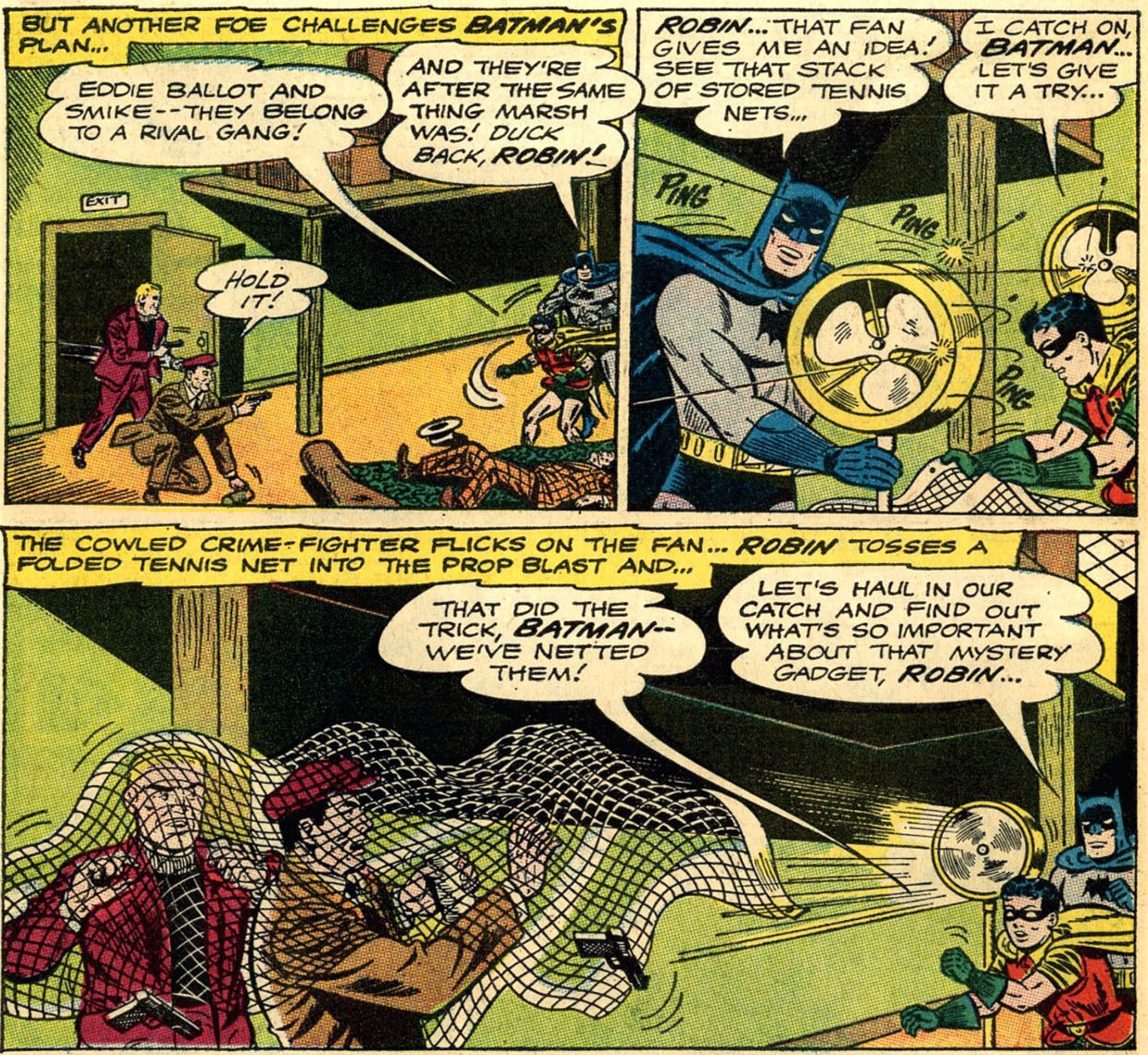
The thing about the era known as the Silver Age is that, although the art was crude, the dialogues goofy, and the plots as contrived as they come, there was a lot of creativity, both visually and narratively. People often point to the stories with aliens and thematic villains as examples of the period’s silliness, but even tales about the less colorful side of Gotham City’s underworld could turn into priceless madcap romps.

Take ‘The Mystery of the $1,000,000 Treasure Hunt,’ in which the Dynamic Duo try to outrun various gangsters in a treasure hunt for the loot of a recently deceased crime boss. On the surface, this story by Dave Wood and Sheldon Moldoff may sound like a classically constructed Batman adventure, with the Dynamic Duo beating up criminals (while exchanging groan-inducing puns), putting together riddle-like clues, and outsmarting the villain in a last-minute plot twist. Yet it is also full of delightfully ludicrous ideas, including a cuckoo clock trap, a showdown on a submarine, Robin (a young Dick Grayson) imprisoned in a giant bottle, the Caped Crusader caught in a flying music record-shaped electrified jail cell, and an exploding robot.

Posted in BATMAN COMICS FOR BEGINNERS | Tagged , , , , , , , , , , , , , , , , , , , , , , | Leave a comment

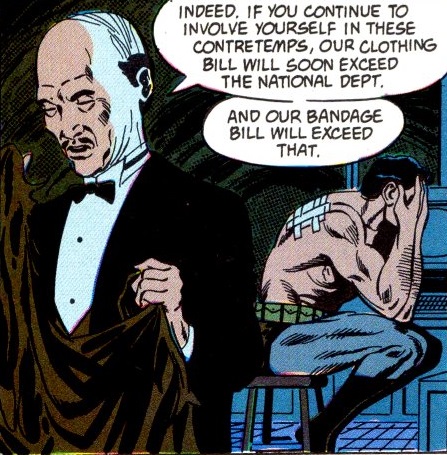
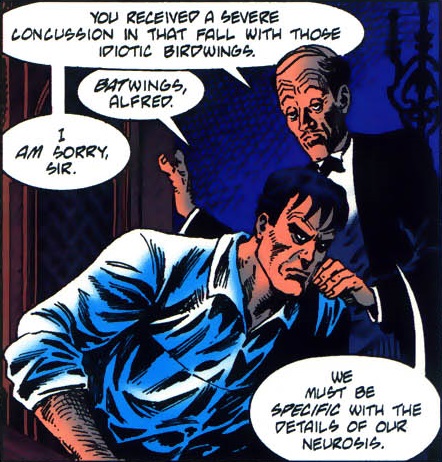
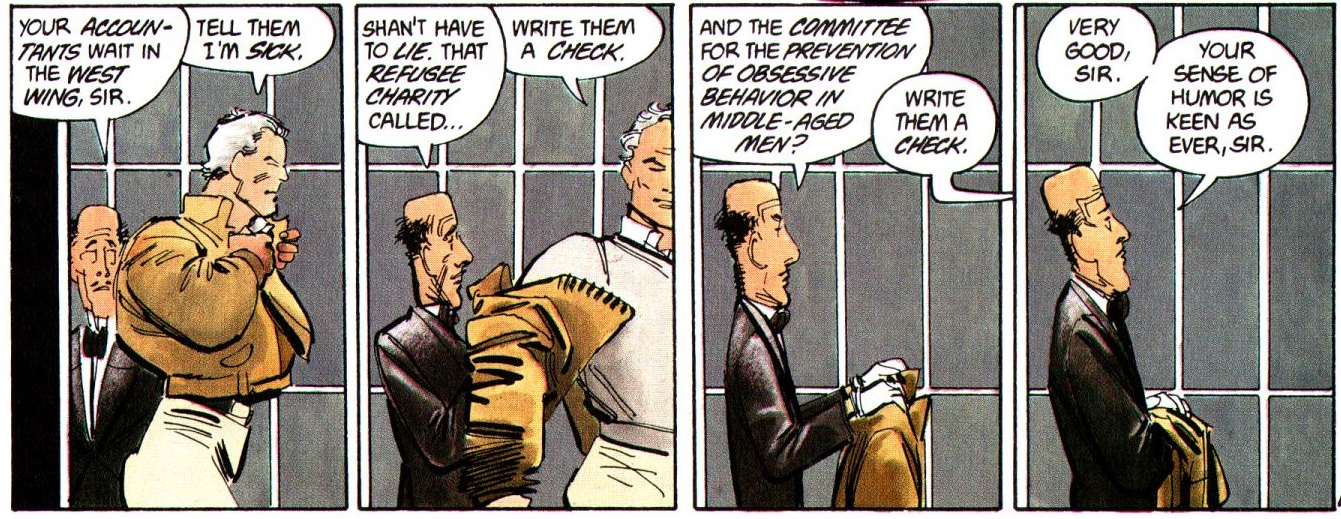
Alfred Pennyworth, passive-aggressive butler

Batman Black & White (v2) #1Batman Black & White (v2) #1


Legends of the Dark Knight #3Legends of the Dark Knight #3


Legends of the Dark Knight Annual #5Legends of the Dark Knight Annual #5


The Dark Knight Returns #3The Dark Knight Returns #3
Posted in GOTHAM INTERLUDES | Tagged | Leave a comment

Even more over-the-top adventure comics

With half the nation still recovering from last week’s events, Gotham Calling would humbly like to draw readers’ attention to the fact that not everything is terrible and depressing in the world – through our latest celebration of non-Batman zany adventure comics!

Here are six titles that, while not necessarily masterpieces, are all neat examples of explosive pulp and thrilling escapism (the highest form of art) and way more fun than any of the blockbusters playing in theaters at the moment:

AURORA WEST

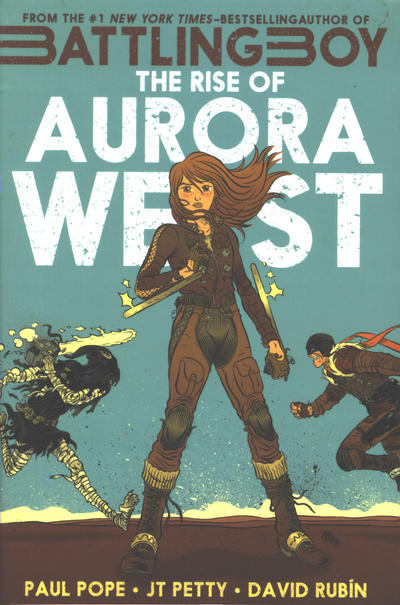
Rise of Aurora West

While Paul Pope doesn’t finish the second volume of the visual feast of delirious fights that is Battling Boy, he has written a couple of black & white prequels also set on Arcopolis, a sprawling, surreal city under constant attack by organized gangs of child-snatching ghouls. These spin-offs focus on Aurora, daughter of the square-jawed science hero Haggard West.

Aurora is herself training to be a monster hunter, alternating between classes on chemistry and martial arts as well as strange missions with her father. In The Rise of Aurora West, she investigates the mystery of her mother’s death and begins to suspect her childhood imaginary friend may have been behind it. In The Fall of the House of West, Aurora goes in search of vengeance and ends up unraveling her family’s darkest secret. These stories aren’t just fast-paced and imaginative, but also surprisingly touching in their depiction of the part of growing up that involves realizing that, no matter how heroic they may seem, your parents can be flawed after all.

The Aurora West books are co-written by JT Petty and frenetically drawn by David Rubín, who captures Pope’s flair for outlandish creatures and action-packed mayhem.

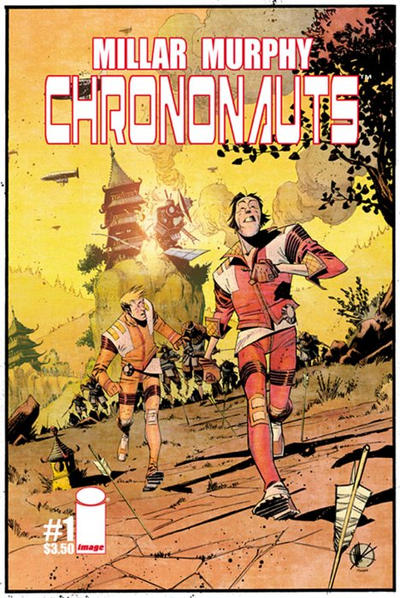
CHRONONAUTS

Chrononauts

When I feel like a heady time travel tale, I re-read Charles Yu’s How to Live Safely in a Science Fictional Universe or Michael Moorcock’s Behold the Man. If I’m in the mood for a more adventure-driven page-turner, I may settle for Ben Elton’s Time and Time Again or Chuck Dixon’s Bad Times novels. But when I want an absolute sensory overload, then I crack open my copy of Chrononauts and dive right in. This gorgeous comic about two douchey explorers on humanity’s first journey to the past is all about disregarding the mind-bending paradoxes and just taking in spectacular, temporally disjointed sights.

Sure, I could tell you about the slick character work and the countless amusing gags but, honestly, at the end of the day this high-energy extravaganza looks like little more than an excuse for Sean Murphy to draw the most epic chase scene ever, involving a sports car, gangsters, Roman chariots, tanks, dinosaurs, Victorian London, the Second World War, the Great Wall of China, and whatever else came to Mark Millar’s mind. Me, I’m fine with that.

HELEN KILLER

Helen Killer

Given how amazing Helen Keller’s actual life was, what is the point of coming up with crazy ‘untold’ tales about her? Did we really need a comic about a deaf-blind secret agent with deadly instincts going up against anarchists and deranged scientists at the turn of the nineteenth century? Well, it turns out we did, if nothing else because Helen Killer was too good a title to pass up… I admit I have a soft spot for pun-driven high concepts (yep, I did dig Ronin Hood of the 47 Samurai), although of course they’re not always enough to carry a story. This one is a blast, though!

Between the plot twists and the electrifying fight scenes, Andrew Kreisberg and Matthew JLD Rice have crafted something that works beyond just a goofy title and premise. If the thought of treating Helen Keller as a steampunk amalgam of Daredevil and Black Widow – with a little bit of Hulk thrown in for good measure (‘You wouldn’t like me when I’m irate.’) – doesn’t automatically put you off, then give this mini-series a chance because it sure is the coolest possible take on that idea.

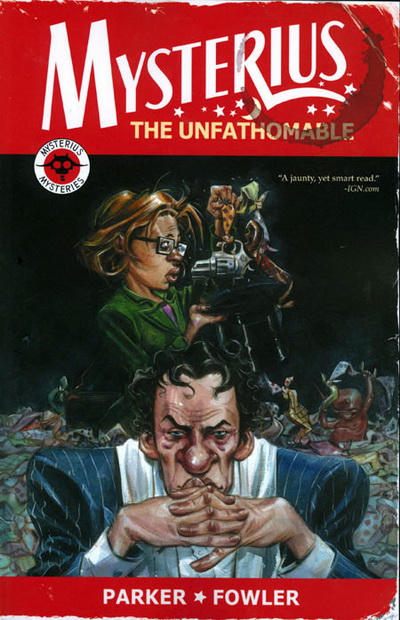
MYSTERIUS THE UNFATHOMABLE

Mysterius the Unfathomable

If you found yourself disappointed over the fact that the Doctor Strange movie is mostly a bland, grimdark action flick with uninspired villains and a bad case of originitis, then Mysterius the Unfathomable is just the thing you need. Genuinely funny and inventive, with no time wasted on pointless origins, this mini-series also revolves around an arrogant sorcerer battling occult forces from other dimensions, but instead of Mads Mikkelsen with lame makeup and confusing CGI, Mysterius faces bizarre demons conjured by the rhymes of an ersatz Dr. Seuss, culminating in a manic magical showdown at a Burning Man mud orgy.

As always, you can count on writer Jeff Parker to keeps things witty (including in a delicious bonus prose story). Meanwhile, artist Tom Fowler and colorist Dave McCaig give the book a cartoony look reminiscent of classic Eurocomics, which really works for this kind of material. The overall tone is not unlike Terry Pratchett’s screwball fantasy novels – lighthearted yet peppered with dark, naughty comedy and some damn exciting set pieces.

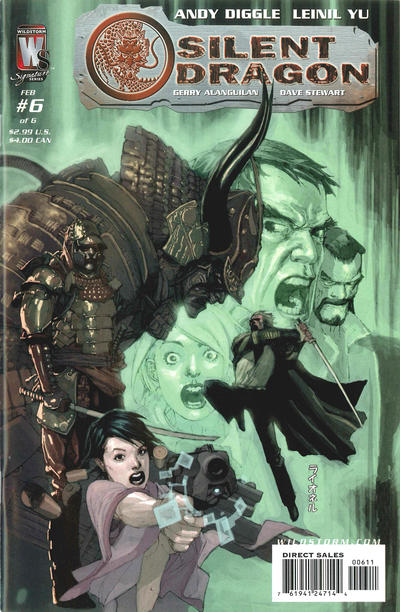
SILENT DRAGON

Silent Dragon

It’s 2063 AD. After a global economic meltdown, communist military machines took over Japan. Now it’s up to Renjiro – a cyborg enforcer back from the dead – and Suki Suziki – a terrorist biker from a gang called Super-Sexy Razor-Happy Girls – to choose whether to side with the regime’s techno-ghosts or with a powerful yakuza clan as they go to war armed with samurai androids.

Silent Dragon is junk fiction at its most riveting. Andy Diggle’s script merges a dozen influences from manga and cyberpunk into a serpentine tale, with snappy dialogue that lets the reader steadily figure out this odd sci-fi future and its slang (‘tarantulas’, ‘mil-cops’, ‘cyb-aug’), while Leinil Yu’s pencils make the whole thing jump off the page!

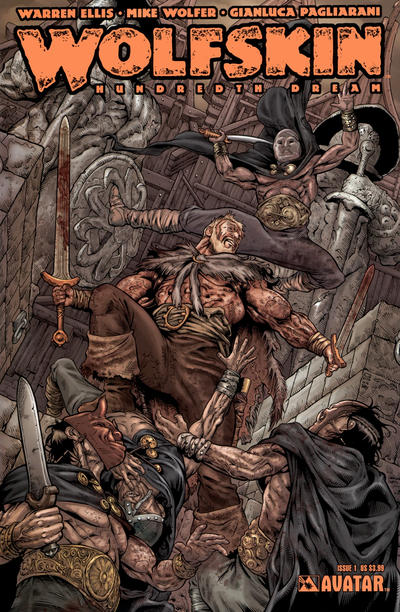
WOLFSKIN

Wolfskin

Take your favorite sword & sorcery epic, whether it’s Lord of the Rings, Conan the Barbarian, Michael Powell’s The Thief of Badgad, or Cecil B. DeMille’s The Ten Commandments. Now imagine it plastered with extravagant profanity, nudity, and hardcore ultra-violence – and you’ll begin to approach the glorious excess that is Wolfskin.

OK, because it’s a product of the warped mind of Warren Ellis, it’s not as dumb as I make it sound… Ellis manages to quickly establish a fantastical world and an intricate mythology by borrowing from recognizable tropes in fiction and history while enlivening each exchange with quaint turns of phrase. Set at a time of magic, when ‘man still conversed with the gods,’ Wolfskin is an original way to revisit Ellis’ recurring debates about humanity’s relationship with technology. Also, because they are drawn by Juan Jose Ryp and Gianluca Pagliarani, these comics are an absolute wonder to look at, full of shameless gore and elaborate designs.

The first mini-series, which saw the titular barbarian wander into a Yojimbo-esque adventure, was an uproarious celebration of what the folks at the Radio vs. the Martians podcast call ‘absurd macho bullshit’ (the last line in the first issue: ‘I will eat my enemy’s flesh and consider your problem.’). This was followed by an annual and a six-issue sequel – both written by Mike Wolfer, from a story by Warren Ellis – that kept the same bodacious spirit as they expanded Wolfskin’s fascinating version of Earth.

Posted in FANTASTIC ADVENTURES | Tagged , , , , , , , , , , , , , , , , , , , , , , , , | Leave a comment

Seeking some consolation in comics (as usual)

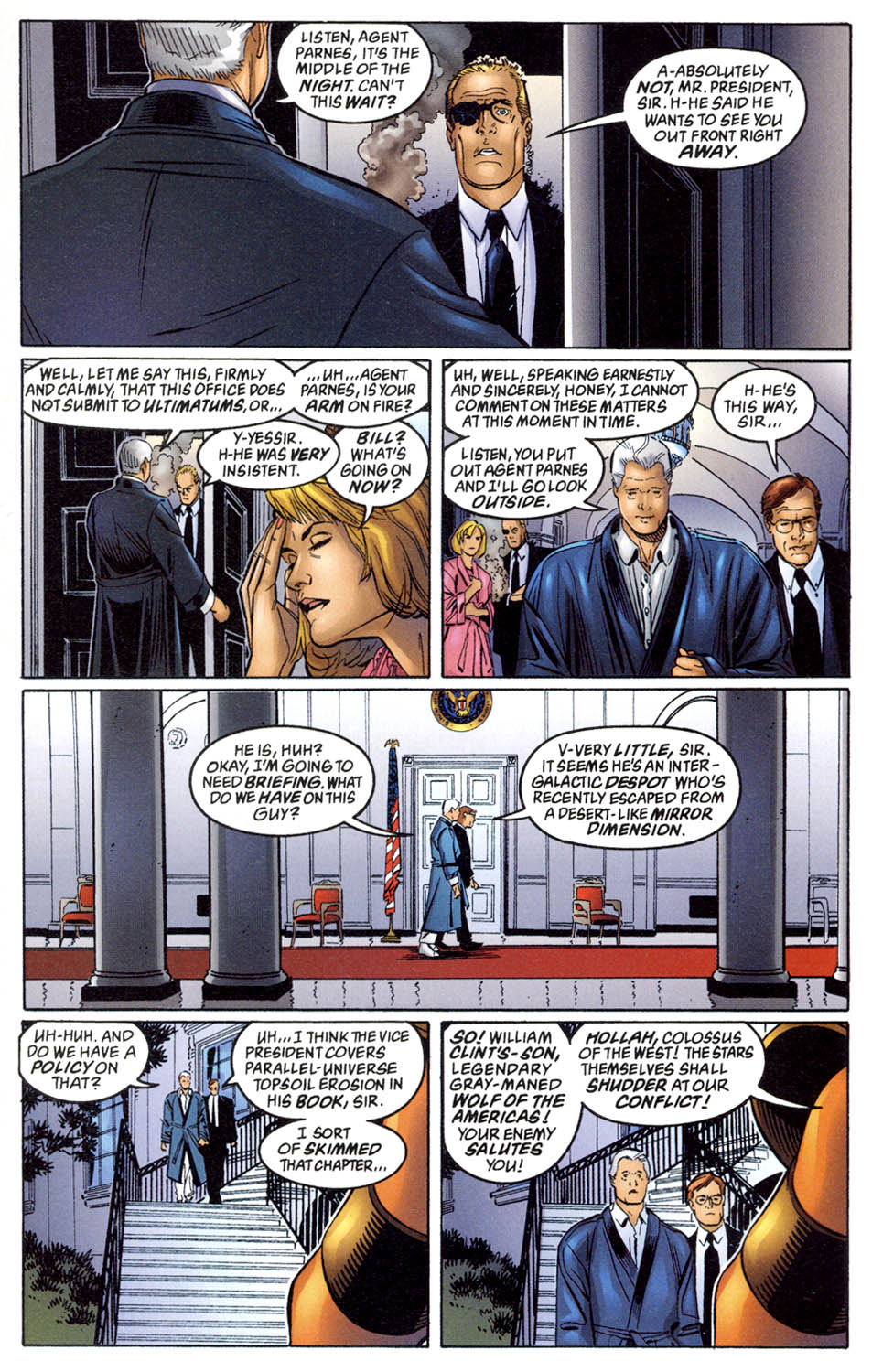
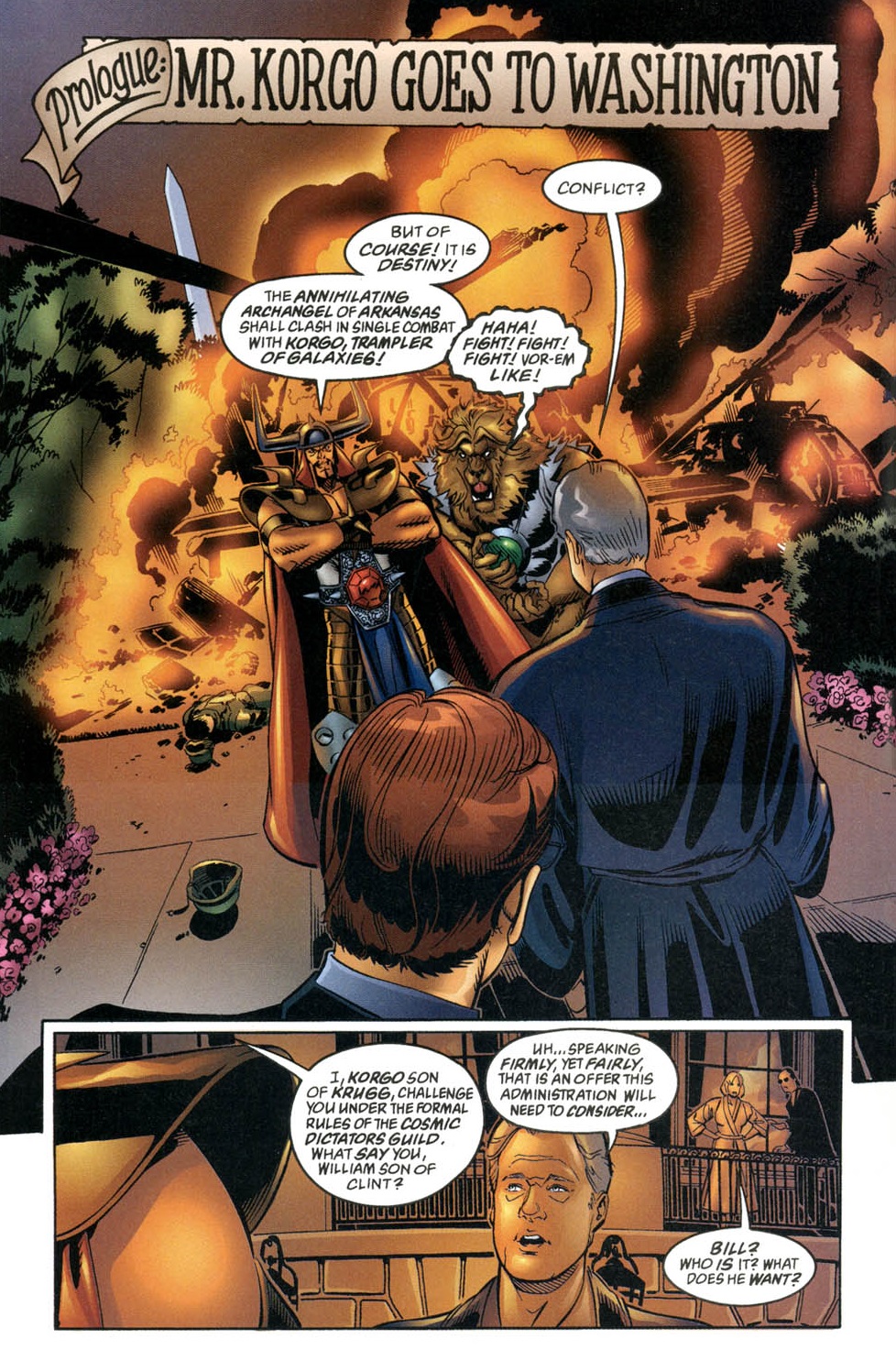
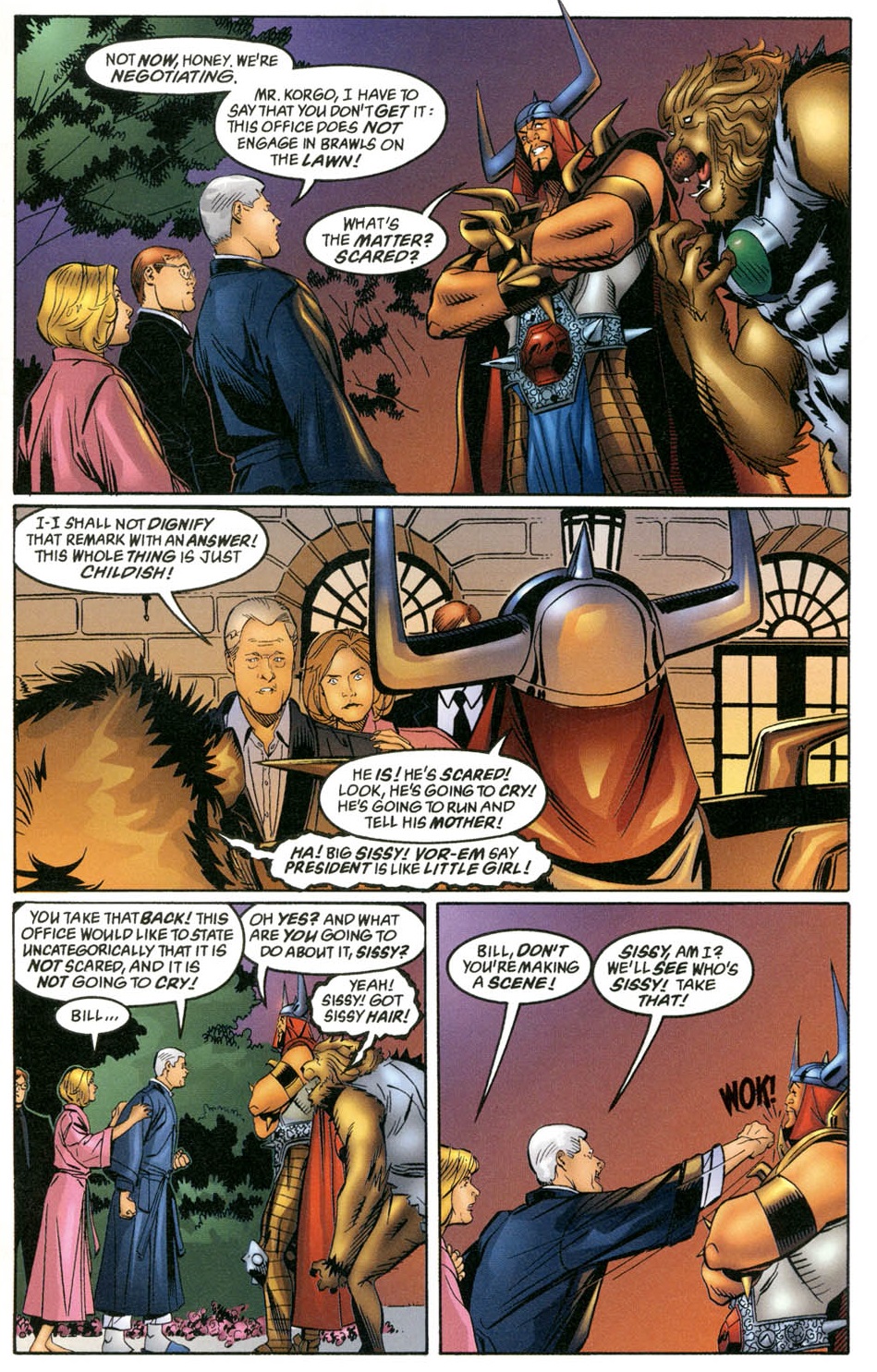
Last Tuesday’s election wasn’t the first time Hillary Rodham Clinton faced an extravagant creature with despotic tendencies. In 1999, back when she was First Lady of the United States, the White House received an uninvited guest:

supreme the return 01supreme the return 01supreme the return 01supreme the return 01Supreme: The Return #1

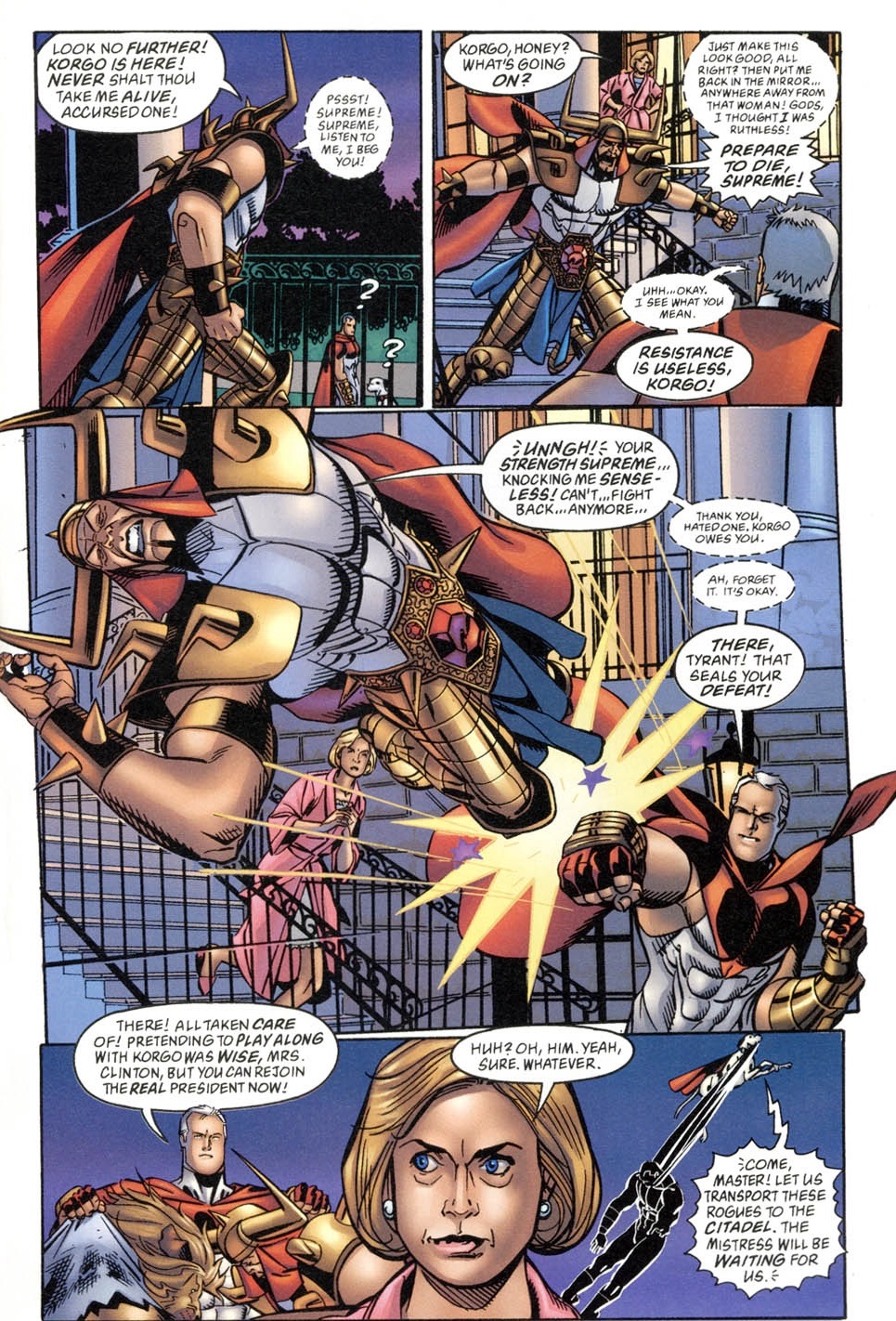
Comics being comics, though, things turned out quite different back then. Korgo, Cosmic Dictator and Trampler of Galaxies, may have conquered several worlds and imposed his will upon all kinds of species but, like many macho assholes before him, the one thing he was not prepared to deal with was a strong, emancipated woman:

supreme the return 01Supreme: The Return #1

Ah, superhero comics… If only.

Posted in GLIMPSES INTO AWESOMENESS | Tagged , | 2 Comments

3 blackout sequences by Adrienne Roy

Much of this blog has been devoted to writers and artists of Batman comics but, like many other fans, I don’t talk nearly as much about colorists. With that in mind, this week Gotham Calling pays homage to Adrienne Roy, who did the colors for most of the Batman line throughout the 1980s and 1990s. Specifically, I wish to highlight slightly different ways in which she played with the lighting during blackout scenes.

Adrienne Roy’s style went through many stages and ranged from fairly naturalistic to highly expressionist. The three examples I’ll focus on in this post are all taken from the excellent Detective Comics run written by Chuck Dixon in the early ‘90s. Dixon’s storytelling usually had a firm sense of geography and managed to create grounded set pieces (even when they involved super-athletes in circus costumes), which allowed Roy to try out some neat visual effects.

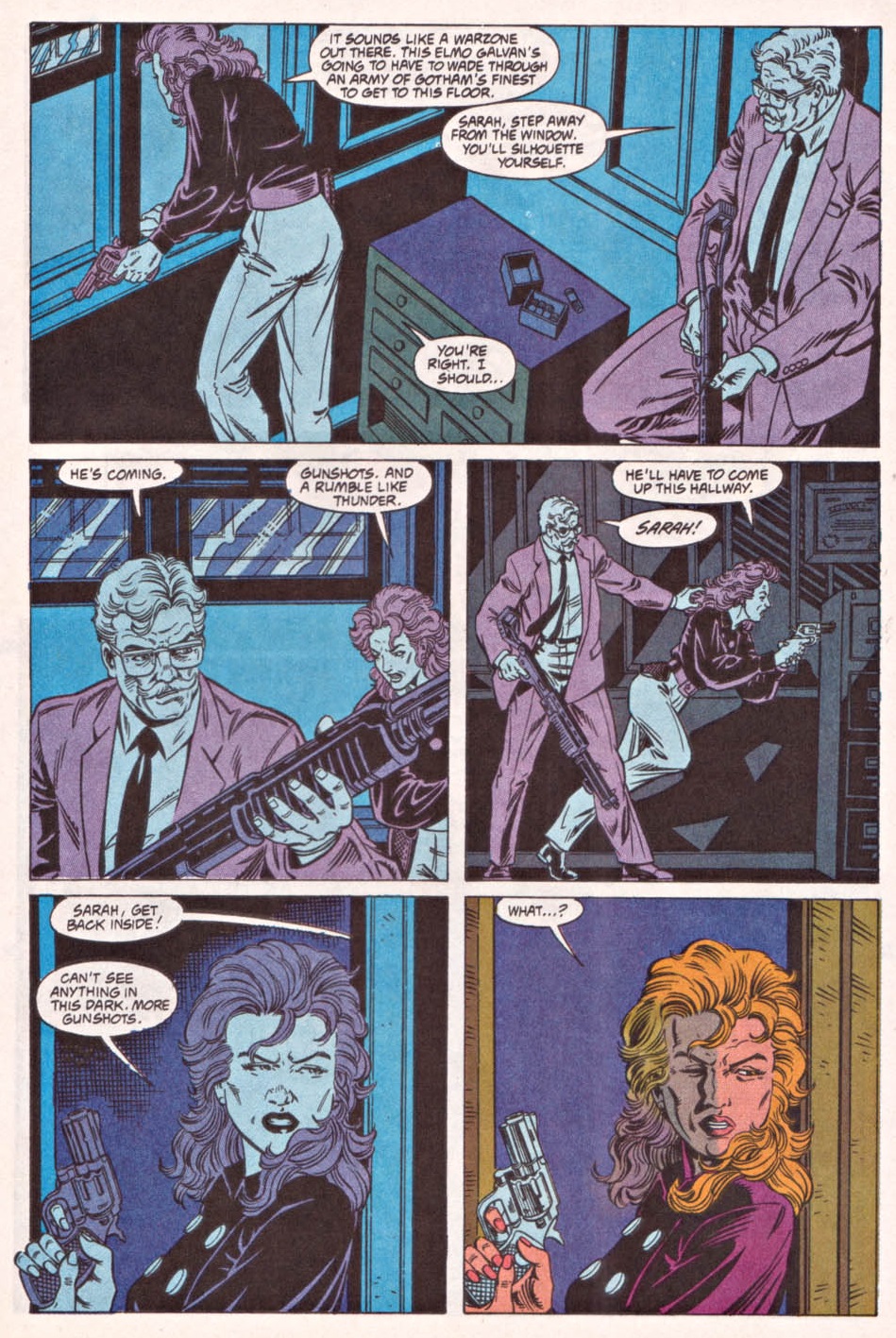
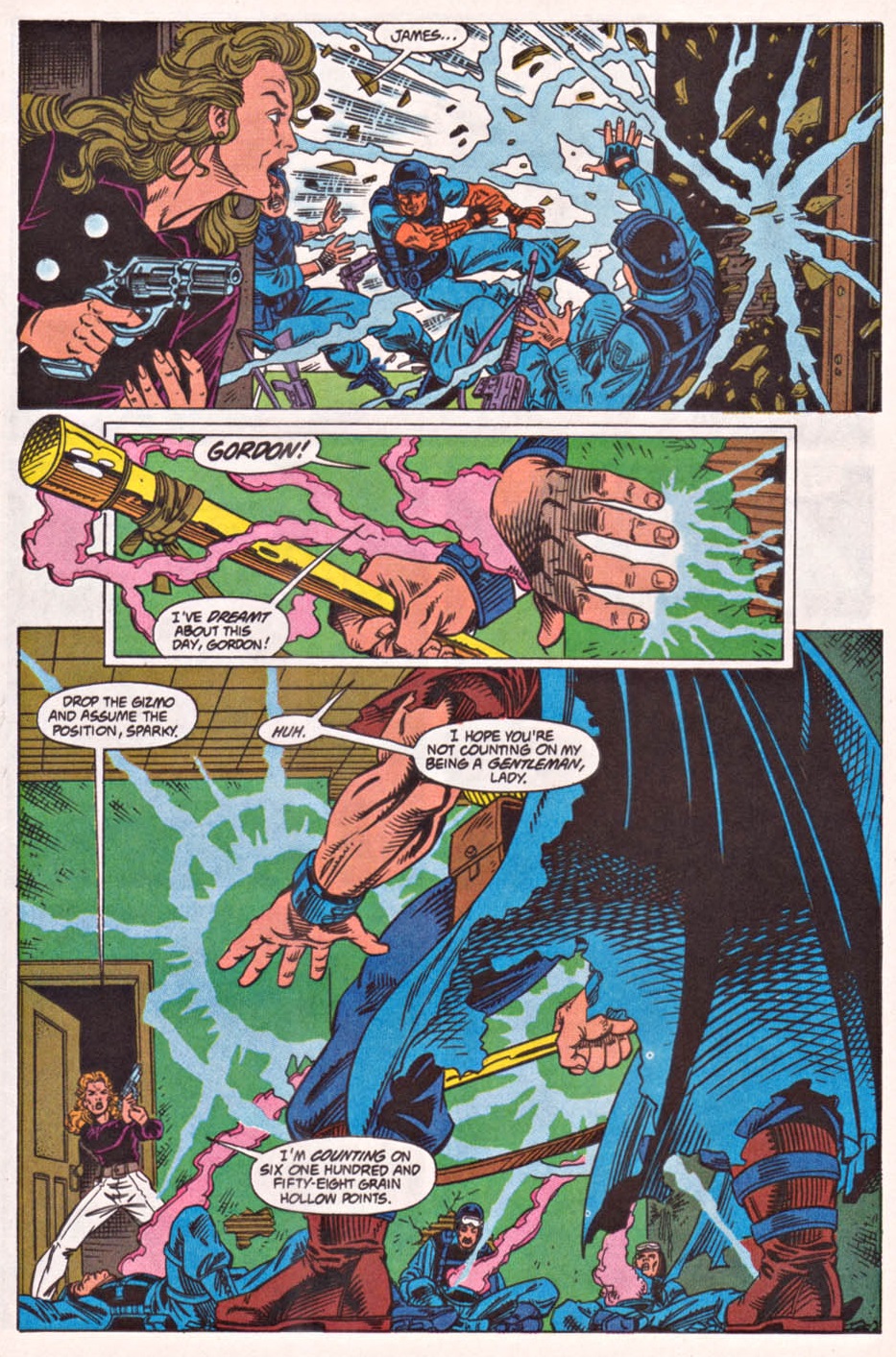
I’ll begin with a sequence from 1992’s ‘Electric City’ (Detective Comics #644-646, with art by Tom Lyle and Scott Hanna). In this scene, the electricity-powered killer Elmo Galvan comes to a police station in order to murder Commissioner James Gordon, who is waiting for him alongside the awesome Lieutenant Sarah Essen. Galvan cuts the station’s power, so the scene opens in the ‘dark,’ conveyed by shades of blue, black, and purple. Because Galvan emanates electricity, however, his approach leads to a stellar transition halfway through, from muted colors to bright ones:

detective_comics_646detective_comics_646Detective Comics #646

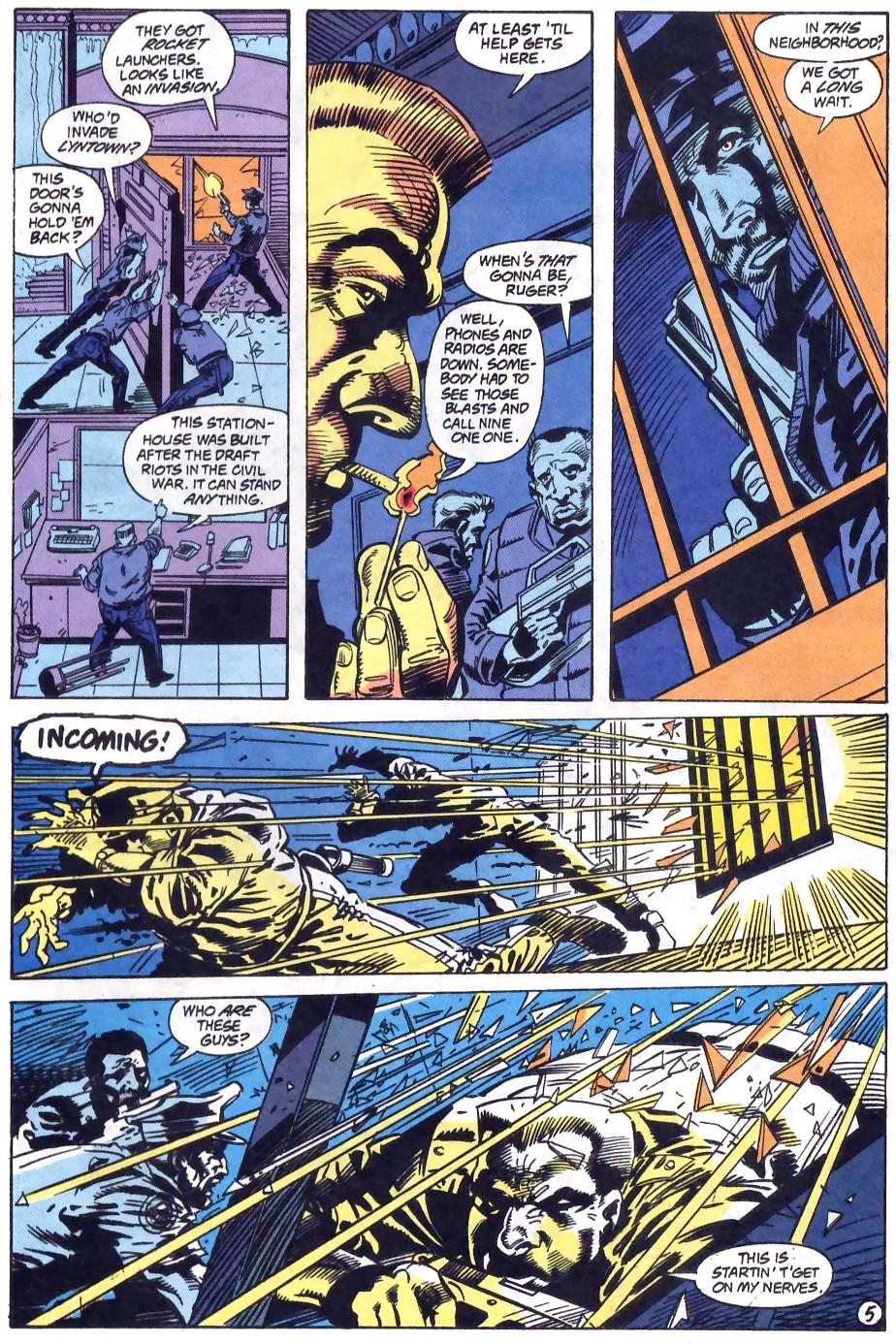
1992 was actually quite a bad year for Gotham City’s police headquarters, which were also attacked in the climax of the nifty crossover ‘The Destroyer’ (Batman #474, Legends of the Dark Knight #27, Detective Comics #641). As if that wasn’t enough, the following year Chuck Dixon wrote yet another riveting attack on police facilities, this time against the 43rd precinct, in the rotten neighbourhood of Lyntown. ‘Besieged’ (Detective Comics #656, with art by Tom Mandrake) is the culmination of a three-part story arc about a kid genius who unites the Gotham gangs by using military tactics before going after the ‘toughest gang in town,’ i.e. the police. Basically, what starts out as a twist on The Warriors turns into a riff on Assault on Precinct 13 (showing that Dixon has great taste in flicks from the ‘70s).

If in the previous excerpt Adrienne Roy delivered a vivid transition from a page set in darkness to a page set in the light, this time around she produces a stark clash within each panel:

detective-comics-656Detective Comics #656

As you can see, in addition to the darkness – once again represented by blue and purple – there is a kind of orange light coming from the outside and a yellowish glow emanating from the match and the gunfire, spreading to the cops it illuminates. This minimalist, high-contrast use of color, combined with Mandrake’s dynamic art and Dixon’s effective and somewhat sardonic dialogue, creates one hell of a moody scene!

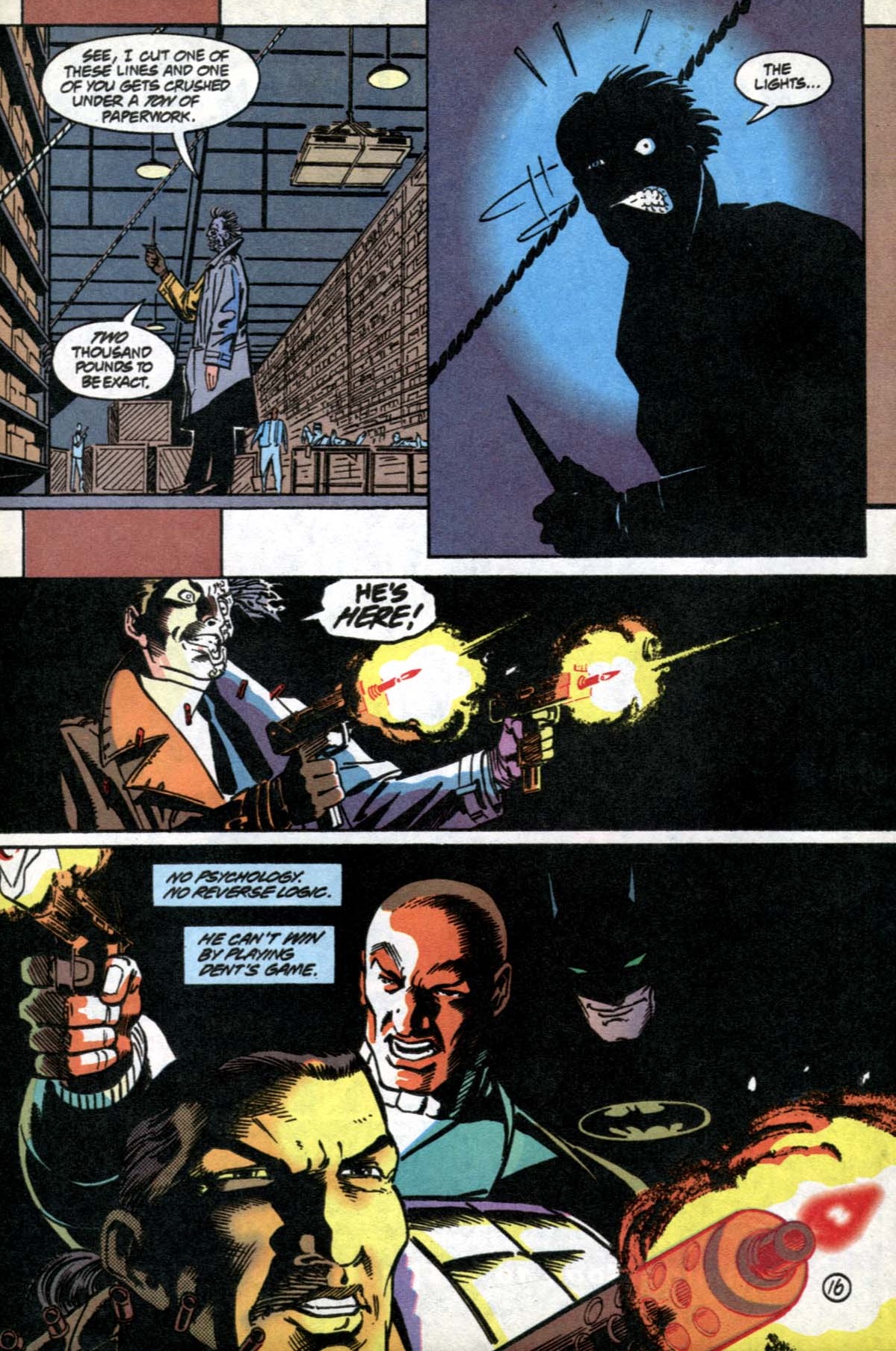
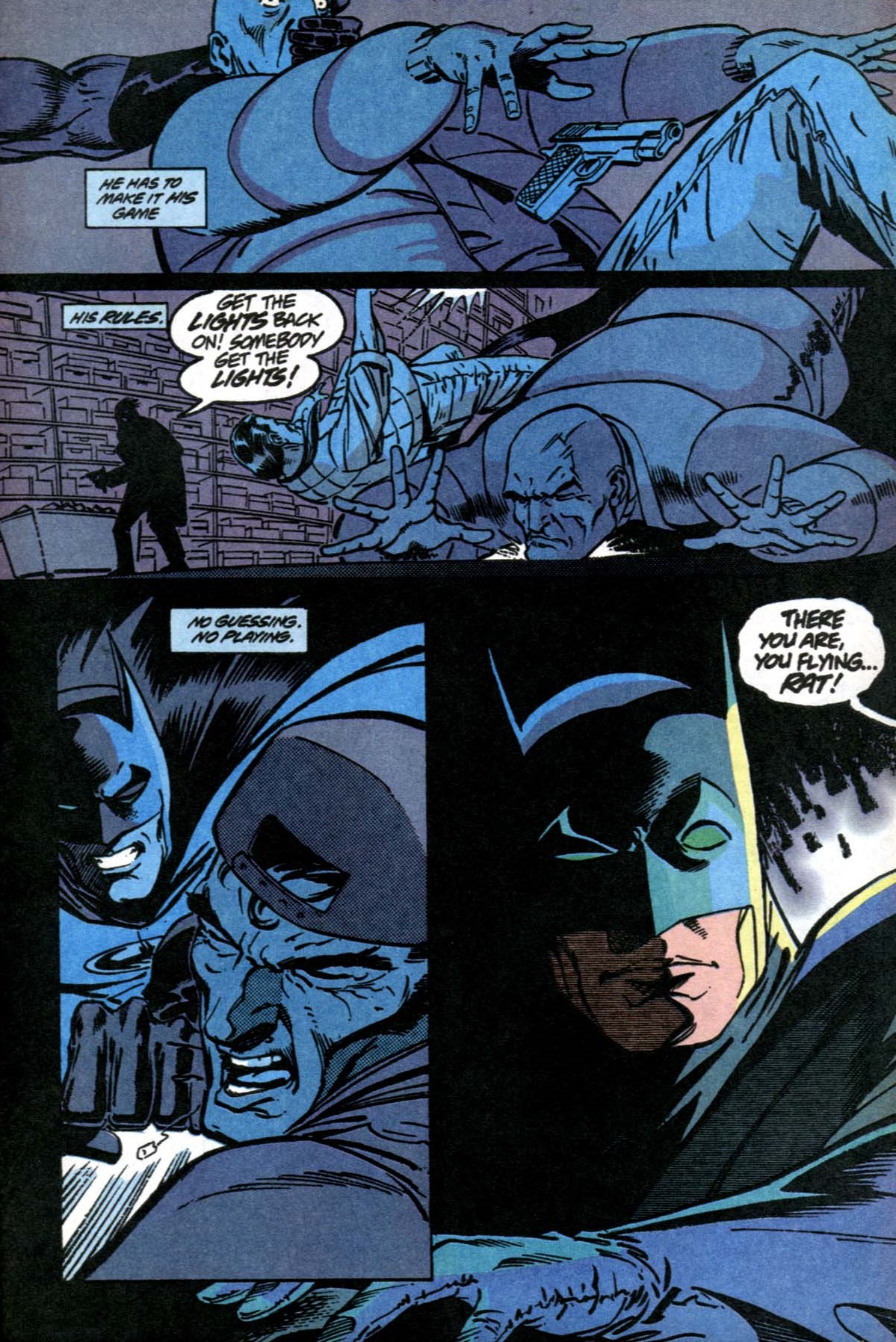
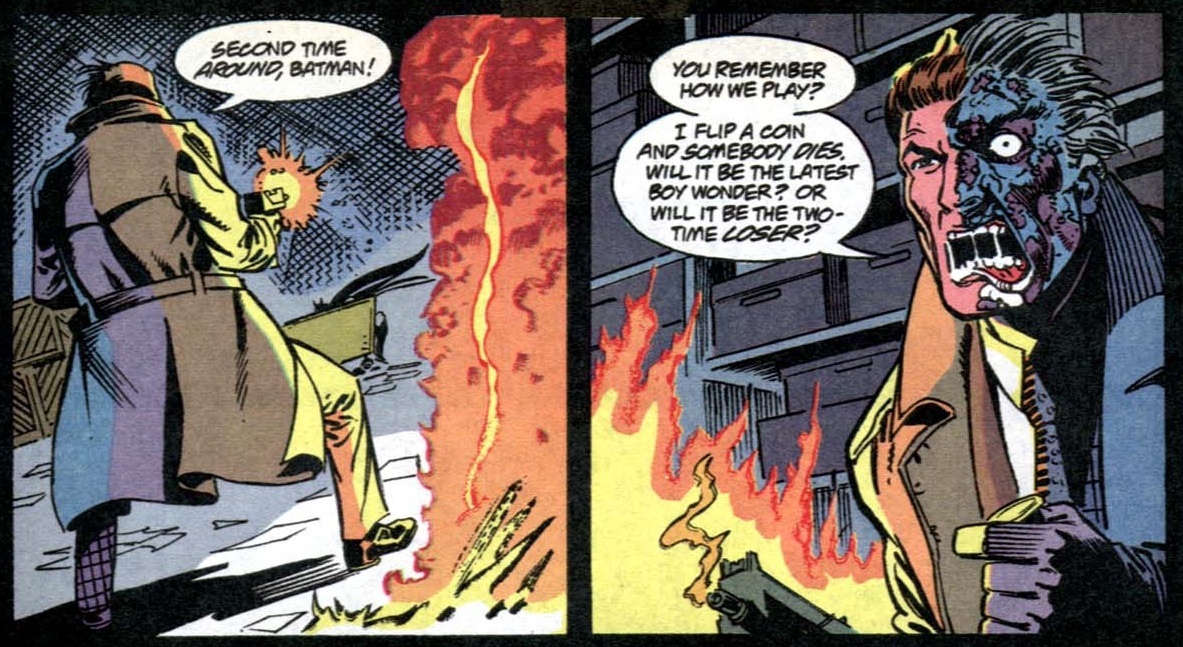
Let’s finish with a sequence from 1994’s ‘A Twice Told Tale’ (Detective Comics #680, with art by Lee Weeks, Graham Nolan, and Joe Rubinstein), set in Gotham’s hall of records, where Two-Face is about to literally drop tons of paperwork on Robin. In order to get an edge, Batman (Dick Grayson at the time, equipped with night vision) kills the lights, thus forcing his opponents to fight him in the dark:

detective-comics-680detective-comics-680detective-comics-680Detective Comics #680

Like in the basement scene from Fede Alvarez’s Don’t Breathe, even though this sequence is supposed to take place in total darkness, we can still see what’s going on – instead of pitch-black, Adrienne Roy colors the second page with blues and grays. Besides the decrease of purple, Roy further tweaks her approach to this type of set piece by having the flashes of light – from the gunshots and Two-Face’s pyre – partly illuminate the nearby characters with a more colorful palette than just a yellowish hue. This works especially well in that last panel, as it emphasizes the division within Two-Face between the part of him that is more connected to reality and his darker, scarier side.

All in all, these examples are just a small sample of how Adrienne Roy played with the lighting in Batman comics. Notably, her colors helped shape other elements of the stories as well, such as movement and temperature, which I’ll explore in future posts.

Posted in ART OF BATMAN COMICS | Tagged , , , , , , , | 1 Comment

Elseworlds’ gothic homages

When coming up with alternative takes on Batman – usually as part of DC’s Elseworlds line – many authors have looked for inspiration in classic works of gothic literature and film. The reason this tends to work so well, I suppose, is not just because the Dark Knight is such an adaptable character, but because even the regular Batman comics owe a clear debt to this type of fiction. As the examples below demonstrate, it is therefore relatively easy to transpose gothic tales into a formula built around a mysterious figure donning a cape and cowl, an old mansion, nocturnal escapades, citywide gargoyle-adorned architecture, and a rogues gallery made of monsters and disfigured lunatics.

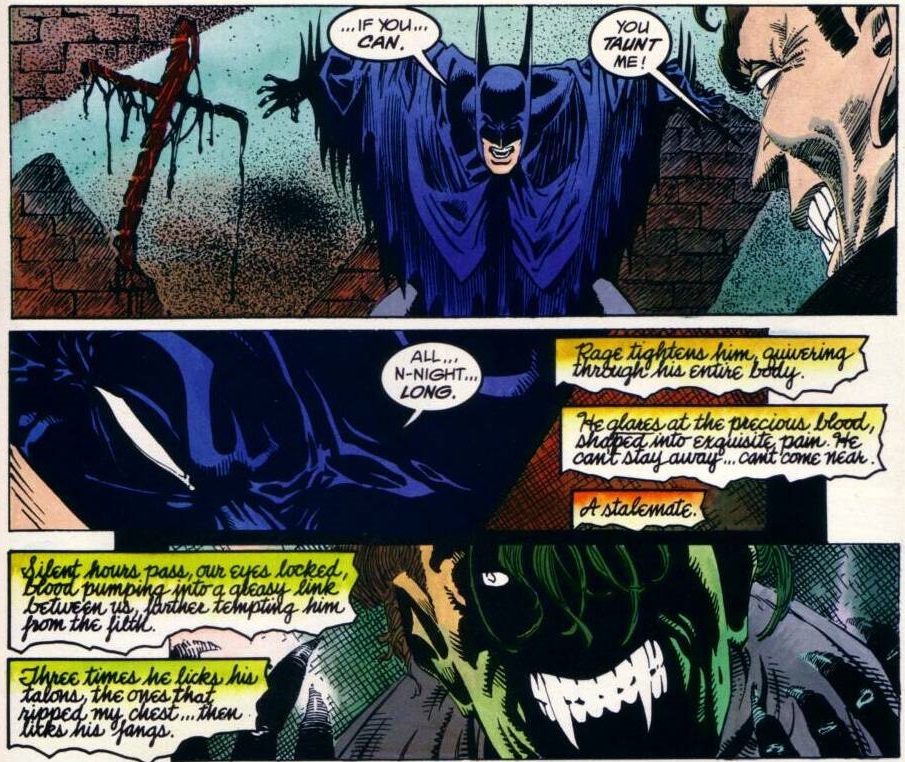
The most well-known case is probably Red Rain, in which the Dark Knight memorably battles Dracula. This comic was written by Doug Moench and drawn by Kelley Jones (with inks by Malcolm Jones III, colors by Les Dorscheid, and letters by Todd Klein), so of course it’s the most over-the-top gothic thing you can imagine…

red_rainred_rainRed Rain

As extreme as Red Rain is, however, it doesn’t feel entirely out of place in terms of either mood or aesthetics as far as Batman comics go. Indeed, the team of Doug Moench and Kelley Jones actually ended up doing tons of similar work with the Dark Knight, including not only two sequels to Red Rain and a couple of further Elseworlds tales, but also over thirty issues of the canonical Batman series.

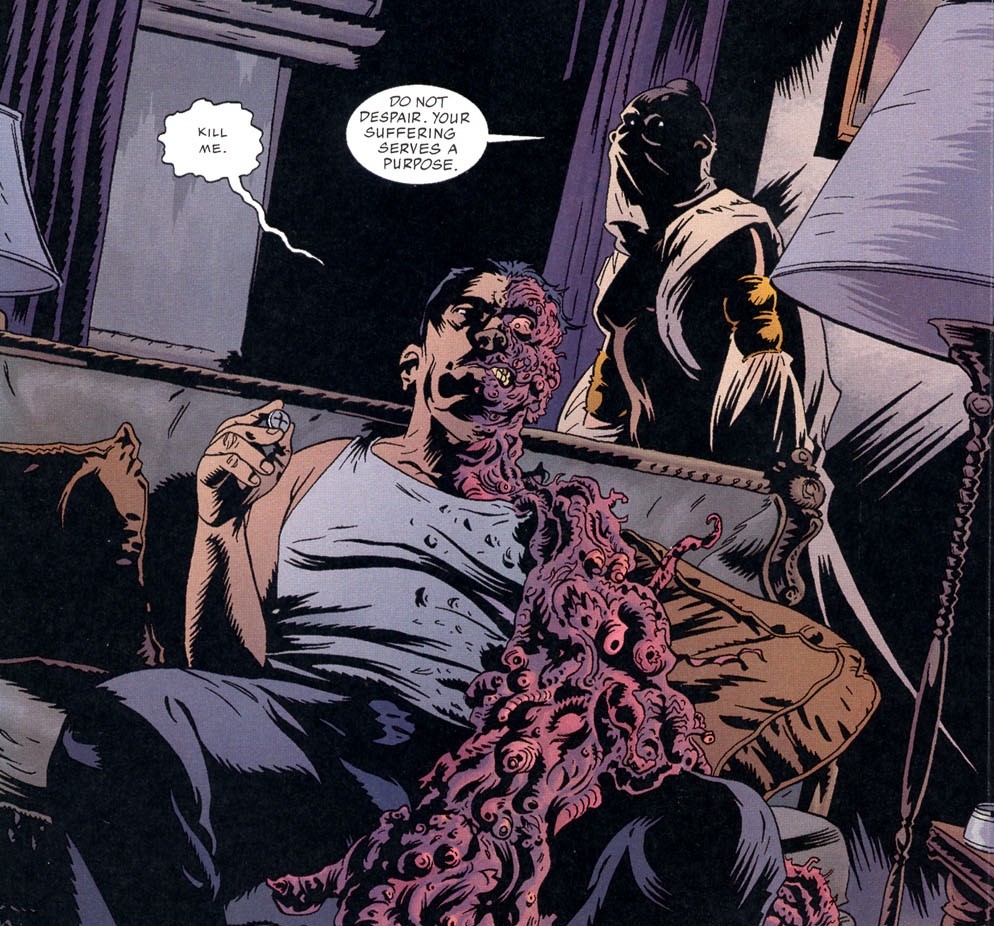
Similarly, apart from the fact that it’s set in 1928, The Doom That Came to Gotham (written by Mike Mignola, who co-plotted it with Richard Pace) does not come across as a particularly strange yarn, since it pits the Caped Crusader against baroque mystical creatures that are taking over his city, which is something we’ve seen before. That said, the comic does share much of the sensibility and style of Mignola’s Hellboy and, above all, it is a clear homage to the writings of H.P. Lovecraft. The real star, though, is the art team of Troy Nixey, Dennis Janke, and Dave Stewart, who have a field day putting a Lovecraftian twist on the designs of familiar characters…

the-doom-that-came-to-gothamThe Doom That Came to Gotham

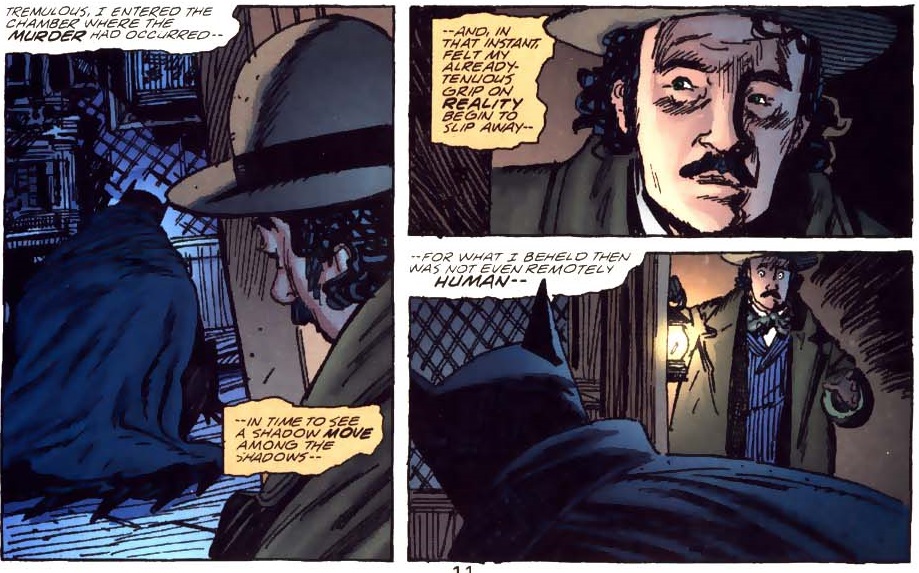
Another horror author who got the Elseworlds treatment was Edgar Allan Poe. This homage was even more explicit: an apprentice reporter for the Baltimore Sun, Edgar Allan Poe himself is the protagonist of the enjoyable mini-series Nevermore, where he teams up with Batman to solve a macabre mystery that inspires his future writings. Len Wein captures Poe’s ornate prose while appropriately filling the story with black cats, ravens, and orangutans (and you get no points for guessing which deathtraps the heroes find themselves in). The art by Guy Davis, a master of the period piece, is further elevated by Jeromy Cox’s beautiful coloring and John E. Workman’s elegant lettering.

nevermoreNevermore

To be sure, Batman’s peculiar rogues gallery encourages these intertextual games. For example, consider Harvey Dent (aka Two-Face), a tragic madman with a horrific appearance and an obsession with duality – these are all typical gothic motifs! Notably, Mike Grell cast Harvey Dent as the Phantom of the Opera in Masque while Dan Abnett and Andy Lanning made Dent a key villain in Two Faces (a vicious take on The Strange Case of Dr Jekyll and Mr Hyde). In turn, Batman Chronicles #11 reimagines Selina Kyle in a noirish short story called ‘Curse of the Cat-Woman’ (courtesy of John Francis Moore and Kieron Dwyer). It owes its central idea to the 1942 horror film Cat People (although, curiously, not as much to the more similarly titled sequel, The Curse of the Cat People). And while the comic doesn’t do justice to the movie’s subtext about sexual repression, at least it ends on a neat twist!

Likewise drawing on classic cinema, writer Jean-Marc Lofficier and artist Ted McKeever did a trilogy of comics based on German expressionism. Their first collaboration, Superman’s Metropolis, is quite faithful to the source material – it reworks the Man of Steel and his supporting cast as part of Fritz Lang’s 1927 surrealist epic about an art deco dystopia in which the working class has been reduced to cogs operating at the mercy of a distant elite. In this version, Superman (Clarc Kent-Son) saves the revolting workers from a flood of molten metal unleashed by the city’s ruler and becomes the messianic mediator between the two classes – the ‘heart’ between the capitalist ‘brain’ and the proletarian ‘hands.’

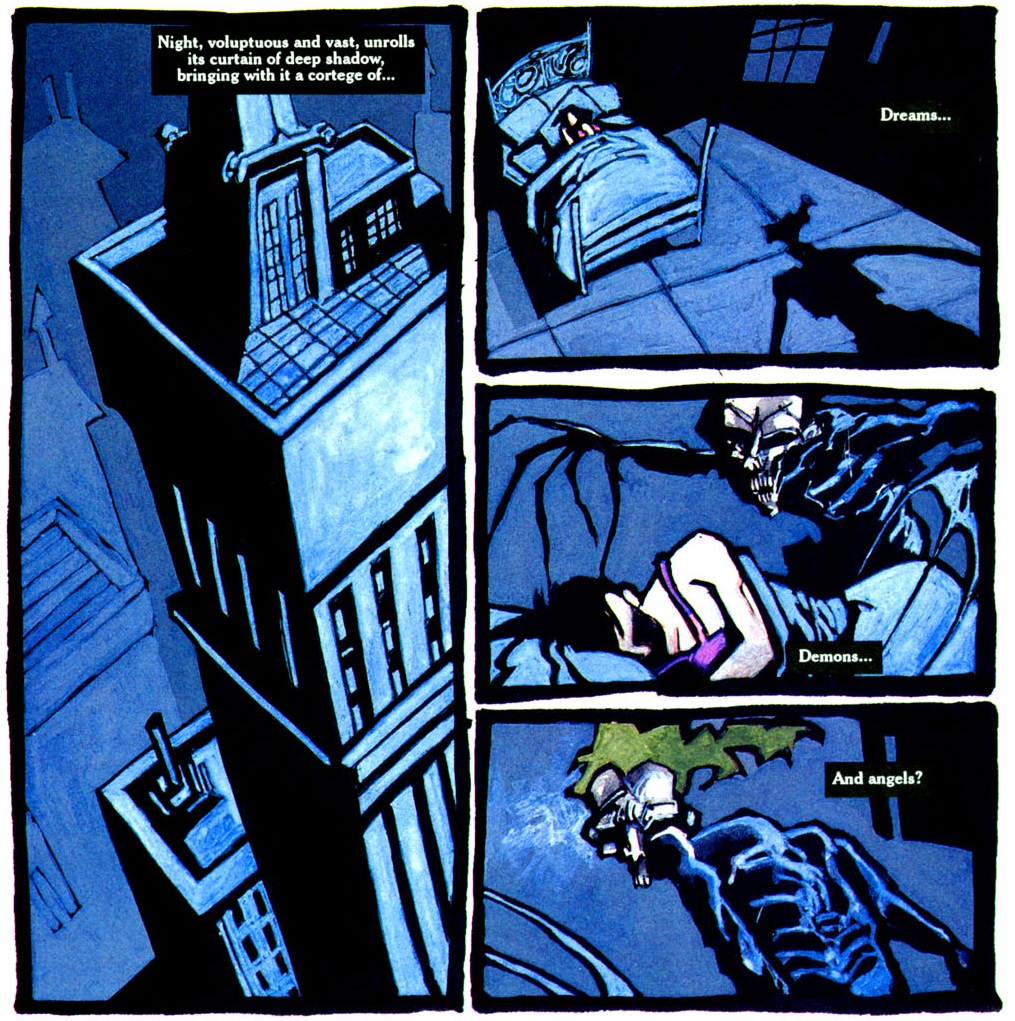
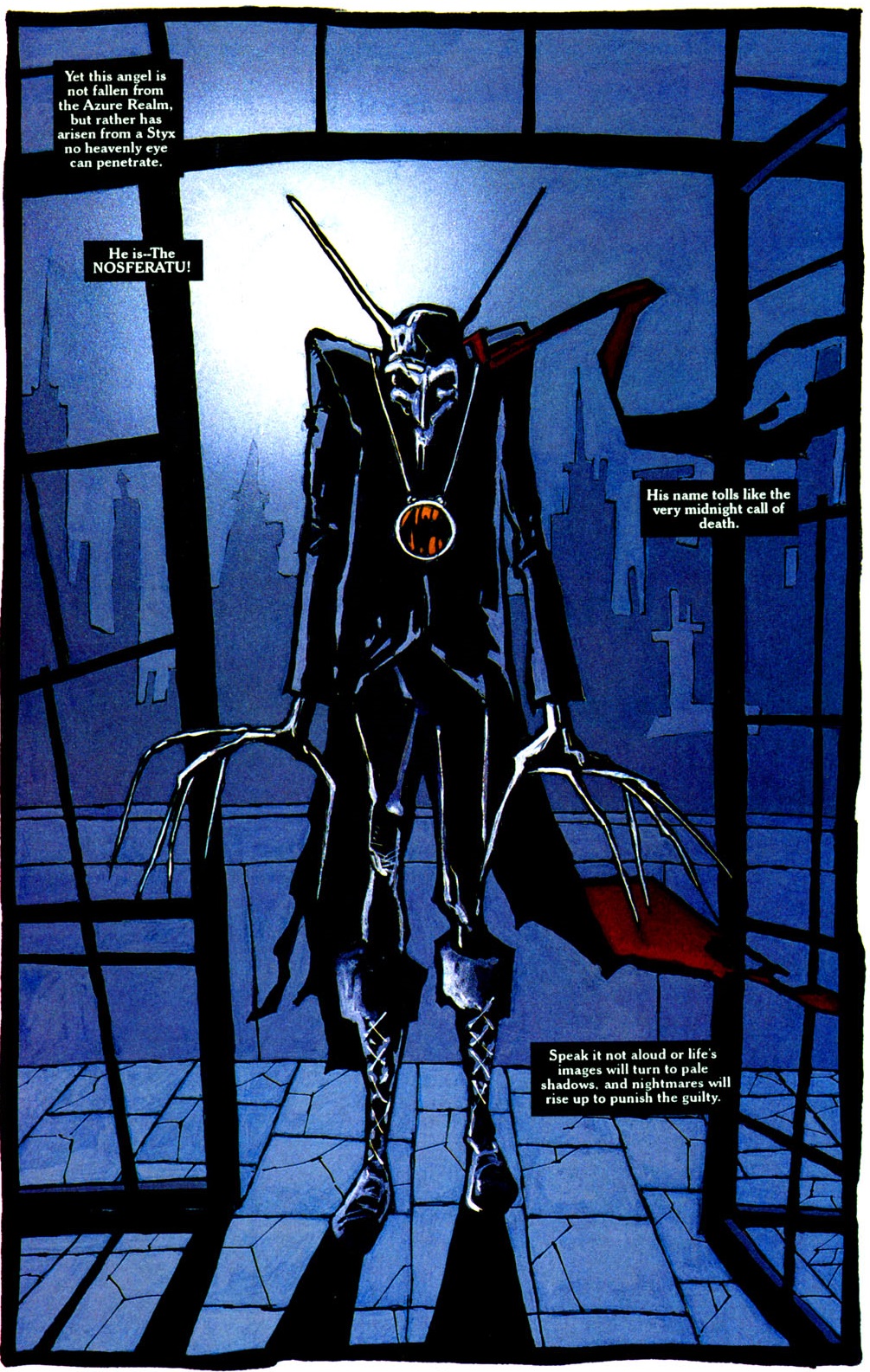
In the sequel – which Lofficier co-wrote with his wife, Randy – the eminent Doktor Bruss Wayne-Son becomes a scary vigilante who resembles the titular character from F.W. Murnau’s Nosferatu (itself a distorted retelling of Bram Stoker’s Dracula).

batman-nosferatubatman-nosferatuBatman: Nosferatu

Compared to Superman’s Metropolis, this is a much more muddled work. For one thing, despite a handful of visual callbacks – Batman’s Orlok-ish features, silhouettes on rooftops, stretched shadows on the walls – the plot of Batman: Nosferatu has barely any connection to the eponymous film, owing more to Robert Wiene’s The Cabinet of Dr. Caligari and Paul Leni’s The Man Who Laughs. (The third installment in the series, Wonder Woman: The Blue Amazon, is an even looser mishmash of nods to Josef von Sternberg’s The Blue Angel and Fritz Lang’s Dr. Mabuse, the Gambler.)

Batman: Nosferatu also sounds slightly confused about its politics. Superman turns out to be less a ‘mediator’ than a new ruler, somewhat contradicting the point of the previous volume. Indeed, the initial premise here is that the city needs a vigilante to avenge the murders of aristocrats which have escaped the notice of Superman, who is only obsessed with the conditions of the lower class. Bruss justifies his actions by claiming that there will always be flaws in Clarc’s sunny utopia which can only be addressed through a dark brand of justice. The two heroes then proceed to violently fight until some weird underground machines bring up the old metaphor about shadows and light defining each other, which I’m not sure makes that much sense in the context of their bloody argument but it’s enough for them to reach an ambiguous settlement… Still, as a deus ex machina for a Batman vs Superman slugfest, it’s way more convincing than the one in Zack Snyder’s movie!


Posted in WEBS OF FICTION | Tagged , , , , , , , , , , , , , , , , , , , , , , , | Leave a comment

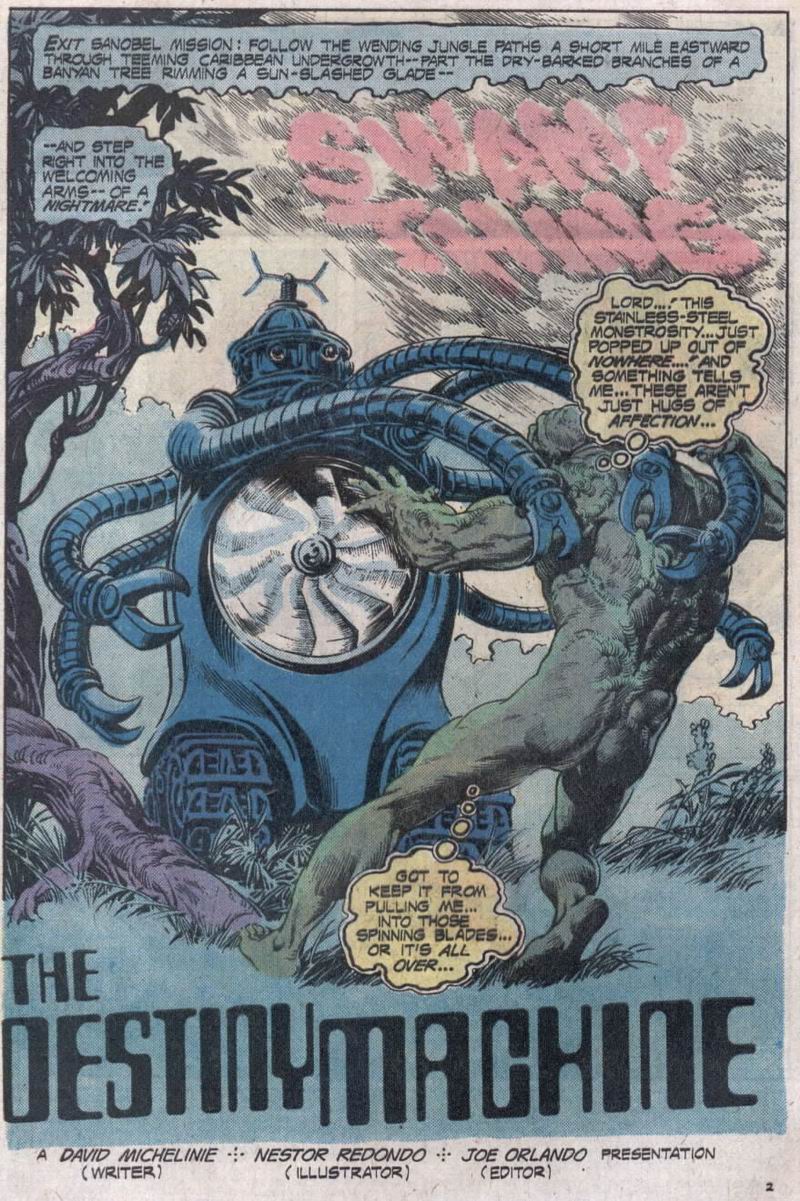
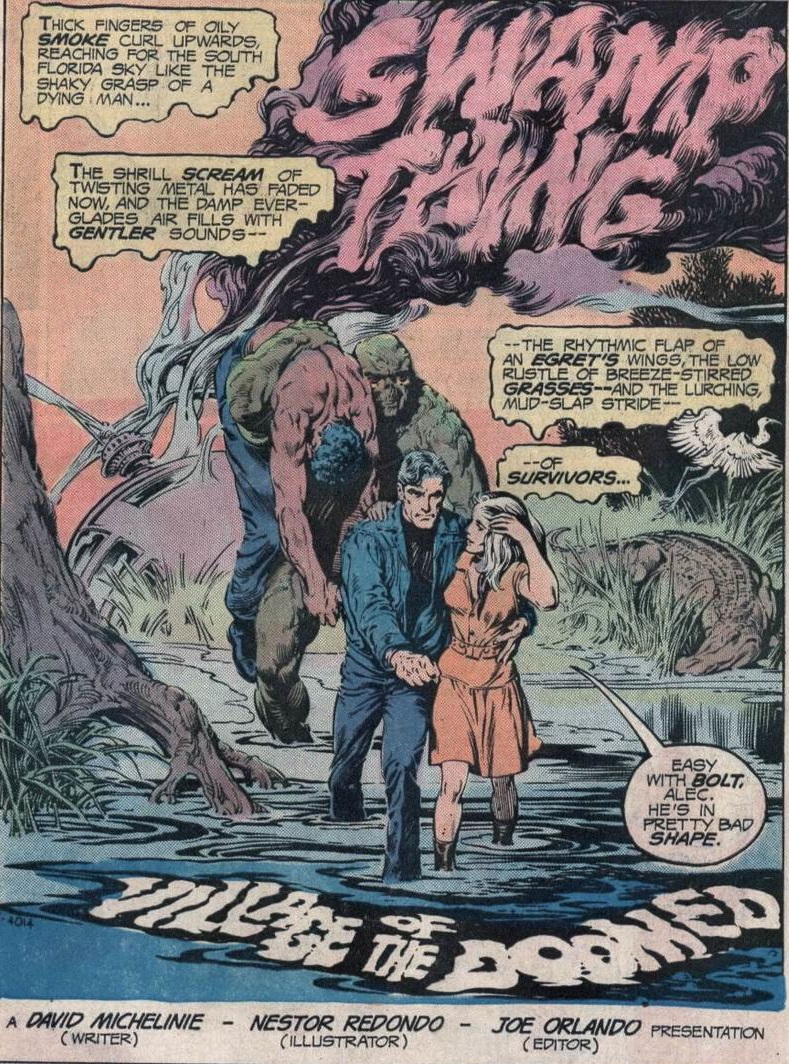
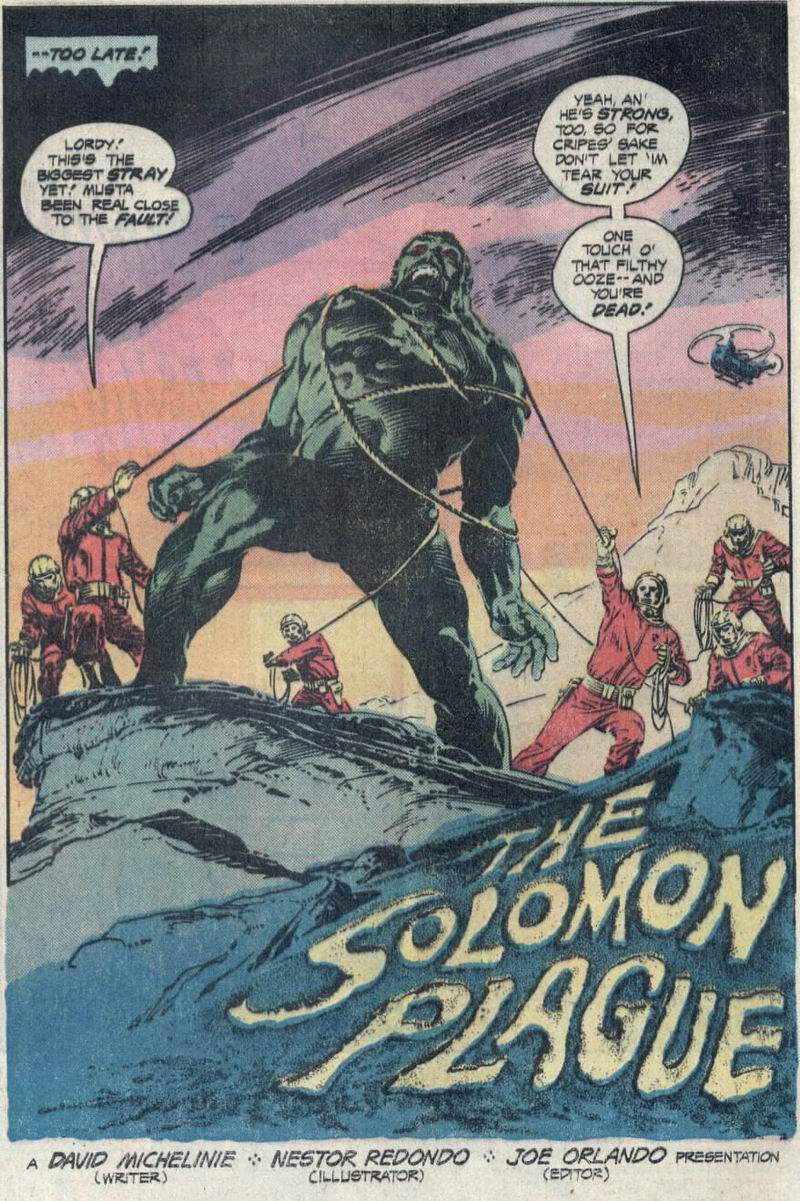
Awesome Swamp Thing splashes by Nestor Redondo

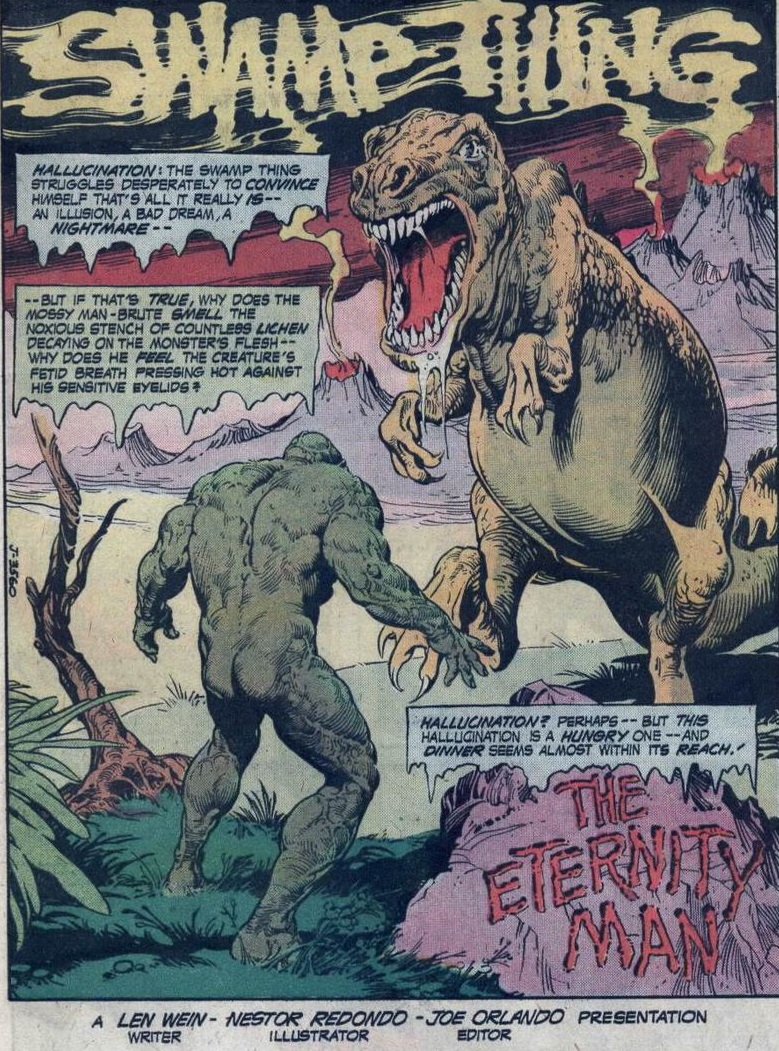
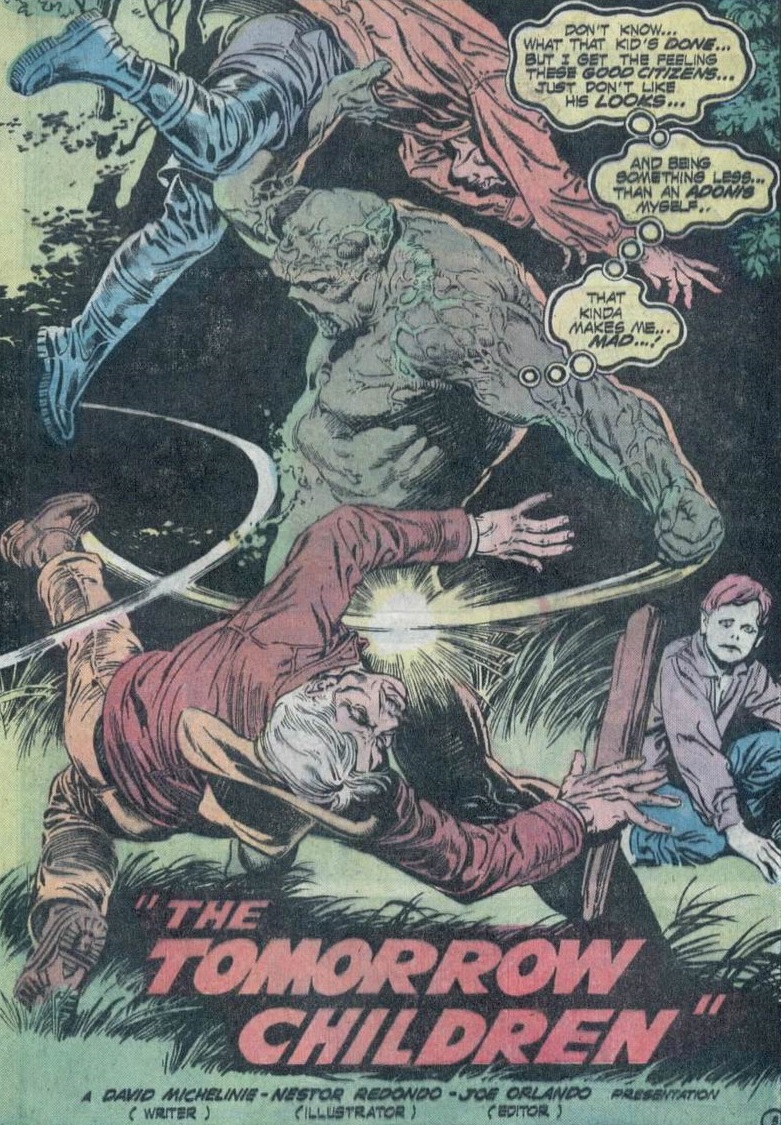
Taking a break from Batman comics for a moment… Artist extraordinaire Bernie Wrightson deservedly gets a lot of praise for his work on the original Swamp Thing series – a true horror/fantasy classic! – but his successor, Nestor Redondo, did a remarkable job as well, in his own way. In particular, Redondo churned out some title pages that are worthy of pulp magazine illustrations or cult movie posters, not least because of Marcos Pelayos’ lettering and Tatjana Wood’s colors.

Here are 5 awesome ones:

swamp-thing-12Swamp Thing #12
swamp-thing-14Swamp Thing #14
swamp-thing-17Swamp Thing #17
swamp-thing-18Swamp Thing #18
swamp-thing-22Swamp Thing #22
Posted in ART OF HORROR COMICS | Tagged , , , , , , | Leave a comment