It has been a year since ABC cancelled its witty adventure show Agent Carter and I’m still looking for something with the same jazzy panache and the ability to conjure that old-school type of silly, joyful escapades.
Don’t get me wrong – lately we’ve been spoiled for high quality genre television with fantastical elements. Luke Cage was a stylish love letter to Harlem with a bulletproof protagonist and larger-than-life villains, but it owed more to smooth Blaxploitation crime flicks like the original Shaft and Cotton Comes to Harlem (albeit with more of a millennial sensibility) than to the titular hero’s quirky source material. Game of Thrones remains an engrossing mix of debauched, gory sword & sorcery with a cynical take on international relations, but the stronger bits tend to take place on the edges of the high adventure set pieces, exploring the fucked up morals and backroom politics of this alternative world. And the first season of Westworld managed to take one of my favorite techno-thrillers and turn it into a chilling, thought-provoking labyrinth of a show, but it was as bleak as you can get.
When I’m craving breezy, fast-paced, globetrotting excitement, I still turn to comics. Very often, these are comics starring the Caped Crusader (the classic Tales of the Demon, the underrated Legacy, the bombastic Batman Incorporated), but not necessarily. Here are some adventure series that make me pumped up and giddy even though they have nothing to do with Gotham City:
DESCENDER
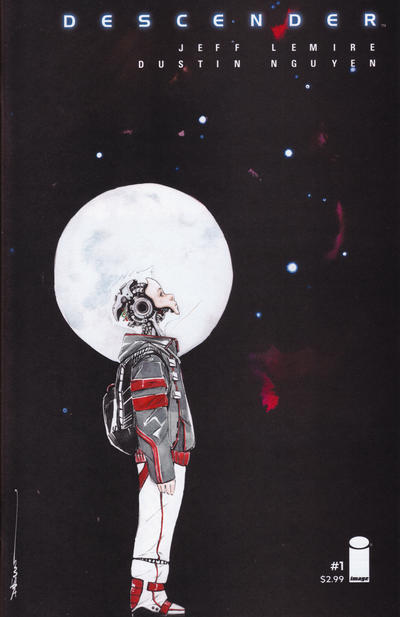
Tim-21 is a robot boy whose AI codex may hold the key to explaining the brutal attack that devastated the galaxy ten years ago, so now everyone in the universe seems to be after him, from terrorist androids to alien bounty hunters to the forces of the United Galactic Council. Descender is a swift-moving space opera full of strange worlds and an ever-expanding cast of captivating characters, like the snarky Queen Between (who is the leader of a cyborg cult) or the simple-minded droid Driller (‘Driller a real killer’). Along with a few cliches and the non-stop twists and turns of the plot, we get solid characterization all around, as the ensuing cosmic saga deals with loyalty, heroism, and compassion (or lack thereof).
Jeff Lemire has previously shown he can write science fiction with a resonant emotional core – particularly with 2014’s Trillium – but in Descender he operates on a wider scale than usual, giving all these eccentric life forms their own individual voices (each distinctly lettered by Steve Wands). High points so far include a whole issue devoted to following a robot dog around and another one where two mining droids forge a sweet bond, despite their basic programs.
The main attraction, though, has got to be Dustin Nguyen’s gorgeous painted artwork, which flows seamlessly from endearing character moments to ominous facial expressions to breathtaking planetary vistas.
EVANGELINE
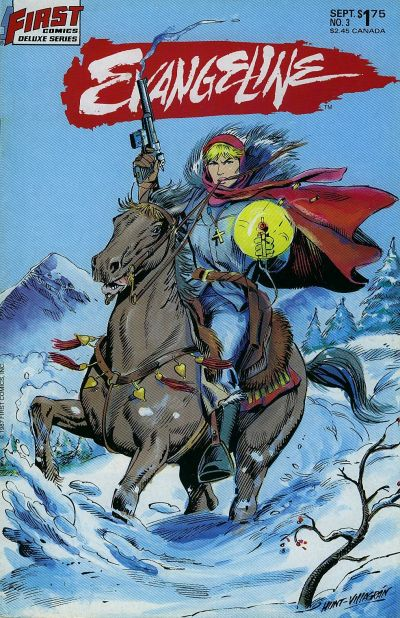
Created by Judith Hunt and Chuck Dixon in the mid-1980s, the short-lived series Evangeline followed the exploits of a two-fisted killer nun on dangerous missions for the Catholic Church at the turn of the 22nd to the 23rd century. It was a gripping, violent comic that went on to inspire a rock ballad by Matthew Sweet (and, I would like to believe, this catchy Bad Religion track).
Although the series initially drew on revenge-driven spaghetti westerns, it soon settled on a cross between of nuns-with-guns grindhouse and futuristic James Bondian action with a gender flip and a religious twist. Evangeline’s assignments were pretty diverse and all over the world (hell, all over the universe!), although wherever they took place at some point they usually involved knocking down sleazebags trying to force themselves on her… The stories became more connected towards the end, once Evangeline began investigating a company engaged in genetic experimentation (condemned by the Vatican) and uncovered a secret plot to somehow use the latent powers of autistic children to improve interstellar navigation. In the final arc, our hero found herself on the Vega system, where a gang of criminals was holding an entire planet hostage!
Judith Hunt, who did Evangeline’s pencils and colors (the inks were by Ricardo Villagran), gave the comic a nifty hand-painted look. It was a shame that she left the series after only six issues (later artists included Cara Sherman-Tereno, John Statema, and Jim Balent). Curiously, in 2009 Hunt announced she was planning to relaunch Evangeline as a webcomic, picking up where she’d left off, thus creating an alternative continuity to Chuck Dixon’s subsequent stories, with a renewed emphasis on the character’s feminist credentials – however, the project has yet to materialize.
PAPER GIRLS

In the last half-dozen years or so, there has been a whole wave of fiction trying to recapture the magical feel of eighties’ cinema… I don’t mean just the countless sequels, reboots, and remakes, but also stuff like Super 8 or Stranger Things, which pay homage to the early works of Steven Spielberg and John Carpenter. In a way, the still-ongoing series Paper Girls is Brian K. Vaughan’s and Cliff Chiang’s cool contribution to this retro-infused subgenre.
Initially set in 1988, the comic follows a group of teen newspaper delivery girls from Cleveland who one night find themselves in over their heads as their neighborhood gets invaded by outlandish monsters and mysterious mutants. The book soon turns into a mind-bending time travel thriller with plenty of heart underneath pop culture savvy R-rated banter. I won’t spoil any specific twists, though, since the barrage of surprises is definitively part of the appeal… Suffice it to say that the result is an irresistible sci-fi epic about inter-generational conflict.
Chiang’s sharp lines – served well by Matt Wilson’s ultra-moody colors – provide both low-key expressive characterization and a number of majestic splash pages. Between that and Vaughan’s skill at evoking a contagious spirit of youthful exuberance (has it really been over a decade since he co-created Runaways?), Paper Girls is an absolute treat. As of writing, 12 issues have come out already, so track them down – or get your hands on the two paperback collections – and join the ride!
THE RED SEAS
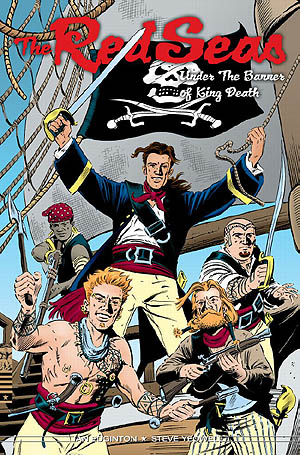
Published intermittently between 2002 and 2013 on the pages of the anthology 2000 AD (and partially collected in one book, so far), Ian Edginton’s and Steve Yeowell’s The Red Seas is a ripping swashbuckler packed with good-humored roguery and mayhem. The comic revolves around Captain Jack Dancer, an 18th century pirate with a penchant for dangerous sea-faring quests, although the focus sometimes shifts to side characters, like a posthumous Sir Isaac Newton or Mistress Meryl, landlady of The Jolly Cripple pub (‘I got clean sheets, clean girls an’ the wine ain’t watered – come and make y’self at ‘ome!’).
While an obvious blueprint are old Hollywood crowd-pleasers like Robert Siodmak’s The Crimson Pirate, the series revels in wild fantasy, combining disparate legends and classic literature – from Greek myths to The Tempest, from Christian lore to One Thousand and One Nights – while carving out its place in Ian Edginton’s own expanding steampunk multiverse (which also includes the neat horror series Stickleback, Leviathan, and Ampney Crucis Investigates). It all adds up to a beautiful testament to – as well as an interesting comment on – the power of the tales humanity has spun over the centuries, as Captain Dancer’s voyages take him and his diminishing yet loyal men (plus a two-headed dog) in search of all sorts of arcane wonders, whether it’s the flying island of Laputa or the eighth sea, beneath the earth. Ultimately, The Red Seas seems to imply that religion is just one more narrative, but narratives are a force to be reckoned with, giving shape to our ideas and beliefs, solidifying fears and hierarchies.
The dialogue is the usual hodgepodge of faux-old English witticisms (after getting shipwrecked on a bushy island: ‘We’re becalmed in green hell, with naught but doom and damnation for company!’). Edginton and Yeowell also have fun with such whimsical creations as the intriguing sorcerer Alhazred, with his bronze vessel propelled by rowing automatons, and the sinister Doctor Orlando Ignatius Maximillian Herodetous Doyle, an Oxford don who travels with a crew of rotten undead sailors trying to put together the secret history of the world in order to kill God.
Yep, it’s a hoot.
TOM STRONG
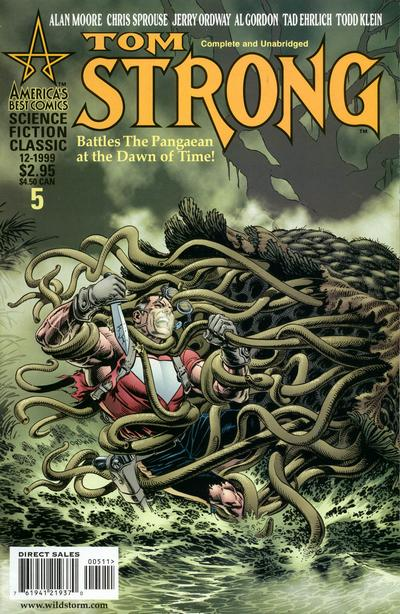
A tribute to pre-superhero archetypes (especially Doc Savage), launched among Alan Moore’s broader 1999 effort to reinvigorate a field that seemed to have lost its sense of playfulness. Tom Strong imagined modern adventure comics through the lenses of early pulp fiction, as visualized by the graceful designs of Chris Sprouse, inked by Al Gordon.
Born on New Year’s Day 1900 – a fulfillment of the era’s positivist (and eugenic) ideals, with a longevity prolonged by the exotic Goloka root – Tom Strong is a ‘science hero’ operating out of Millennium City, an awe-inspiring metropolis of staggering skyscrapers connected by high-altitude cable-cars. When he is not exploring Venus or testing an autogyro that can travel to the afterlife, Tom Strong is holding off an inter-dimensional invasion by ultra-technological Aztecs (‘When Cortez landed, we were waiting for him with machine guns.’), facing the unexpected return of his flirty WWII foe Ingrid Weiss (‘Don’t delude yourself, Weiss. If I wanted to embrace some cold, perfect, heartless product of the Third Reich, I’d hug one of Albert Speer’s buildings.’), or teaming up with an anthropomorphic bunny version of himself in order to save the whole of spacetime from his egomaniac arch-nemesis. While each adventure is serviceable on its own, the comic’s strength lies in world-building, from the extended cast (besides Tom’s multiracial family and fan club, he has two bickering sidekicks – a mechanical butler and a talking gorilla) to the rich background history that readers can put together through spread-out flashbacks and offhand allusions (for example, apparently in this world the USSR did not collapse).
There have been plenty of comics about Doc Savage (I’m quite the fan of Doug Moench’s run in the seventies), but leave it to Alan Moore to take the same ingredients and come up with something as clever and amusing as Tom Strong. Sure, the material doesn’t always transcend its origins… Pneumatic robots, intelligent apes, time-travelling paradoxes, crazy parallel realities, aerial battles with muscular Nazi babes – none of this is new or approached in a completely innovative way (in fact, some of the joy comes from recognition, like in the case of the send-ups of old DC and EC comics). Tom Strong just feels like a masterclass in how to do this kind of throwback, alliterative puns and all. This is Moore in full swing reconstructionist (rather than deconstructionist) mode, blissfully pushing the buttons of nostalgia and childlike wonder, even if he doesn’t refrain from his brand of caustic humor (an in-house ad starts with a little kid mumbling to his friends: ‘Holy socks, guys! Collecting comic books just isn’t fun anymore! We may as well turn to hard drugs!’).
To top it all off, the final issue, which came out in 2006, is a surprisingly touching crossover with Promethea, featuring cameos from other series in the America’s Best Comics line, such as Top Ten and Greyshirt. On the surface, those books have fairly little in common (except for a fondness for sex jokes), but one thing the original Tom Strong series and the spin-off anthology Tom Strong’s Terrific Tales do share with other ABC titles is a delightful dose of metafictional experimentation: it isn’t always clear when we are reading a canonical story or merely a tale about Tom Strong produced by the media in his world, including pastiches of Mad magazine and Hanna-Barbera Saturday morning cartoons. Hell, at one point we even get a whole adventure told through bubblegum cards!
Besides Moore, Sprouse, and Gordon, several other talented creators worked on the characters, with mixed results. The flashbacks were usually handled by different artists (among others, Arthur Adams, Jerry Ordway, Dave Gibbons, and Gary Gianni) aping old-fashioned drawing styles, with letterer Todd Klein adjusting the fonts accordingly. There were nice fill-in issues by fan-favorite writers Brian K. Vaughan and Ed Brubaker. The bulk of Tom Strong’s Terrific Tales was penned by Steve Moore. Moreover, Peter Hogan has written a bunch of sequels and spin-offs, mostly forgettable except for the hilarious one-shot The Many Worlds of Tesla Strong.
THE UNKNOWN
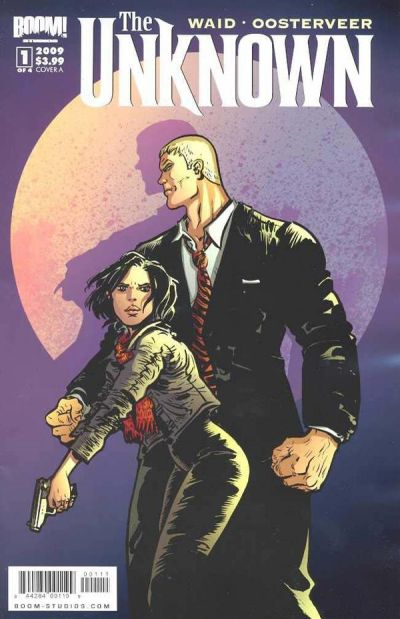
America’s foremost detective, Catherine Allingham, has only six months to live, so she is using them to frenetically solve the most challenging mysteries she can find. In this rollicking 2009 mini-series, Cat investigates the world’s first ‘quantum crime’ – the locked-room disappearance of a machine to measure the human soul – with the assistance of ex-bouncer James Doyle (who has an uncanny talent for reading body language). Cue a deranged Orthodox priest, a murderous Asian golem, and a masterful action scene on a train, all lusciously illustrated by Minck Oosterveer.
Not only did Mark Waid write a smart comic that never lost its breath as it jumped around from light comedy to hair-raising terror, he rooted The Unknown in characters you could not help but care about, crafting an all-too-rare male/female duo whose bonding suggested friendship rather than romance. To quote Gail Simone’s introduction to the collected edition: ‘It’s a story that’s part classic chase, part detective, part speculative science, part metaphysical, part crime drama, part buddy flick, and oh, hell, let’s just throw in the damn kitchen sink while we’re at it and God knows how he did it but it all works.’
Waid and Oosterveer re-teamed for a sequel, titled ‘The Devil Made Flesh,’ delivering another ingenious supernatural whodunit (although the ending raised more questions than it answered). What’s more, they later collaborated on the enjoyable 2011 mini-series Ruse: The Victorian Guide to Murder, which also featured a genius detective, albeit in the 19th century.