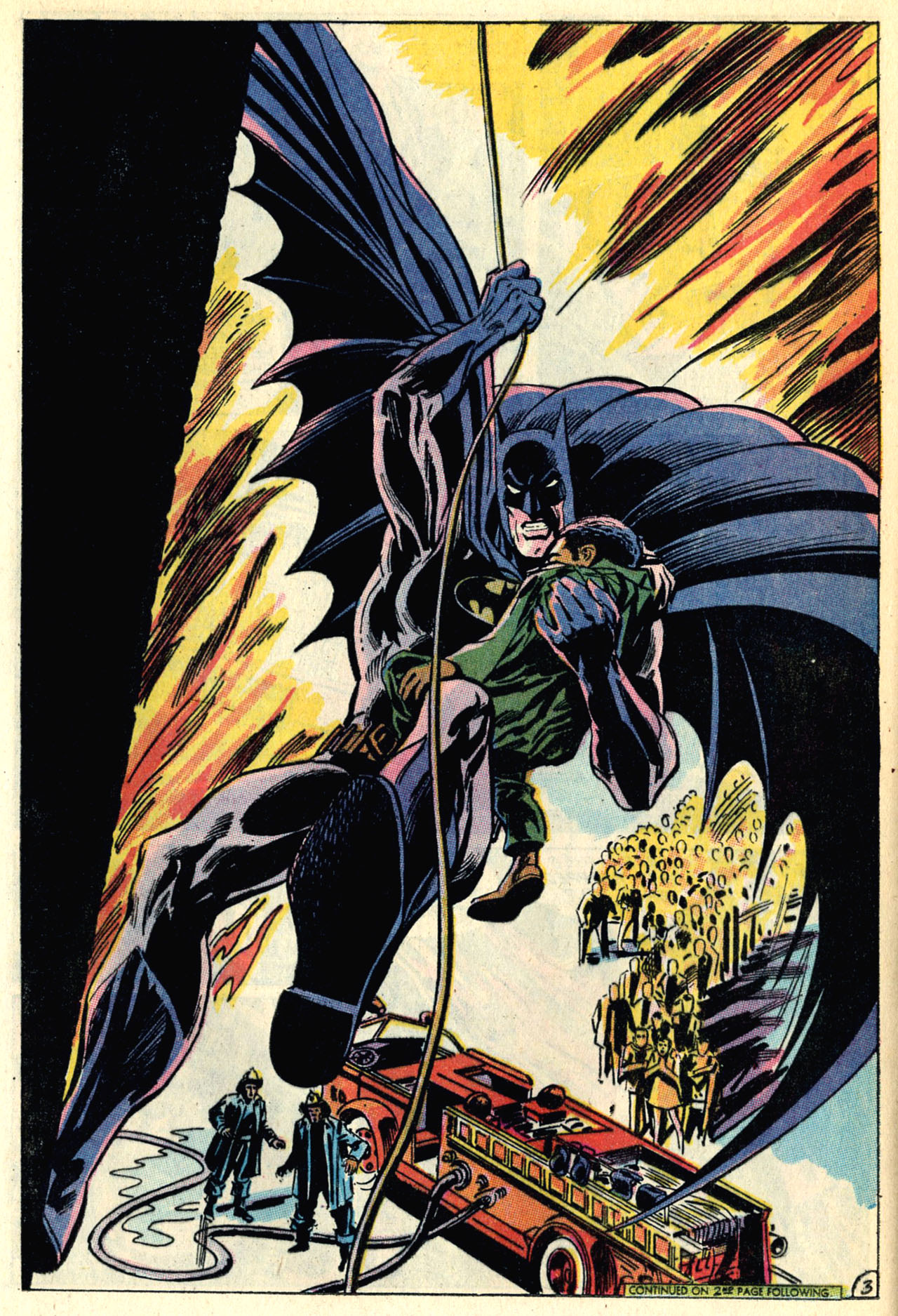
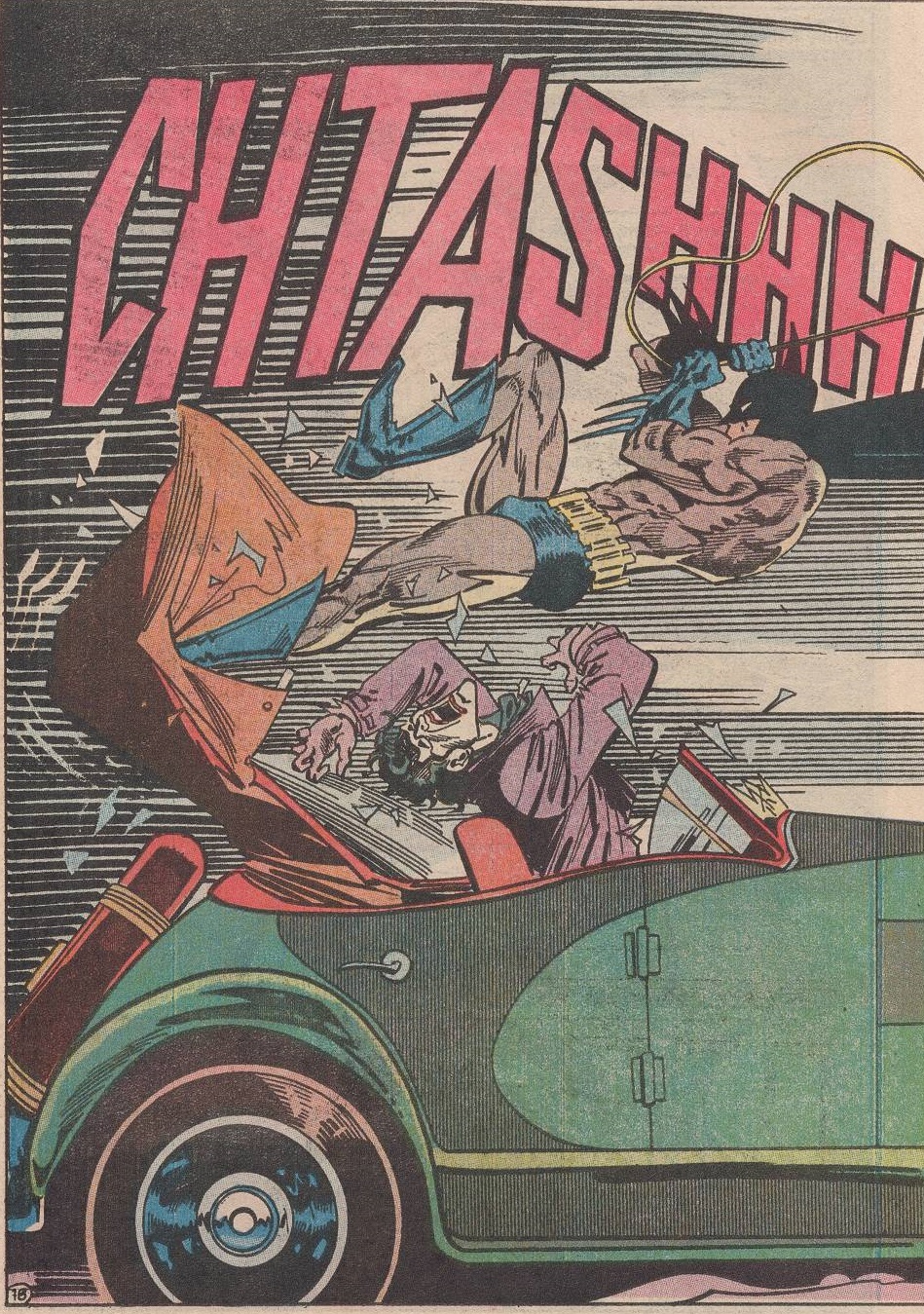
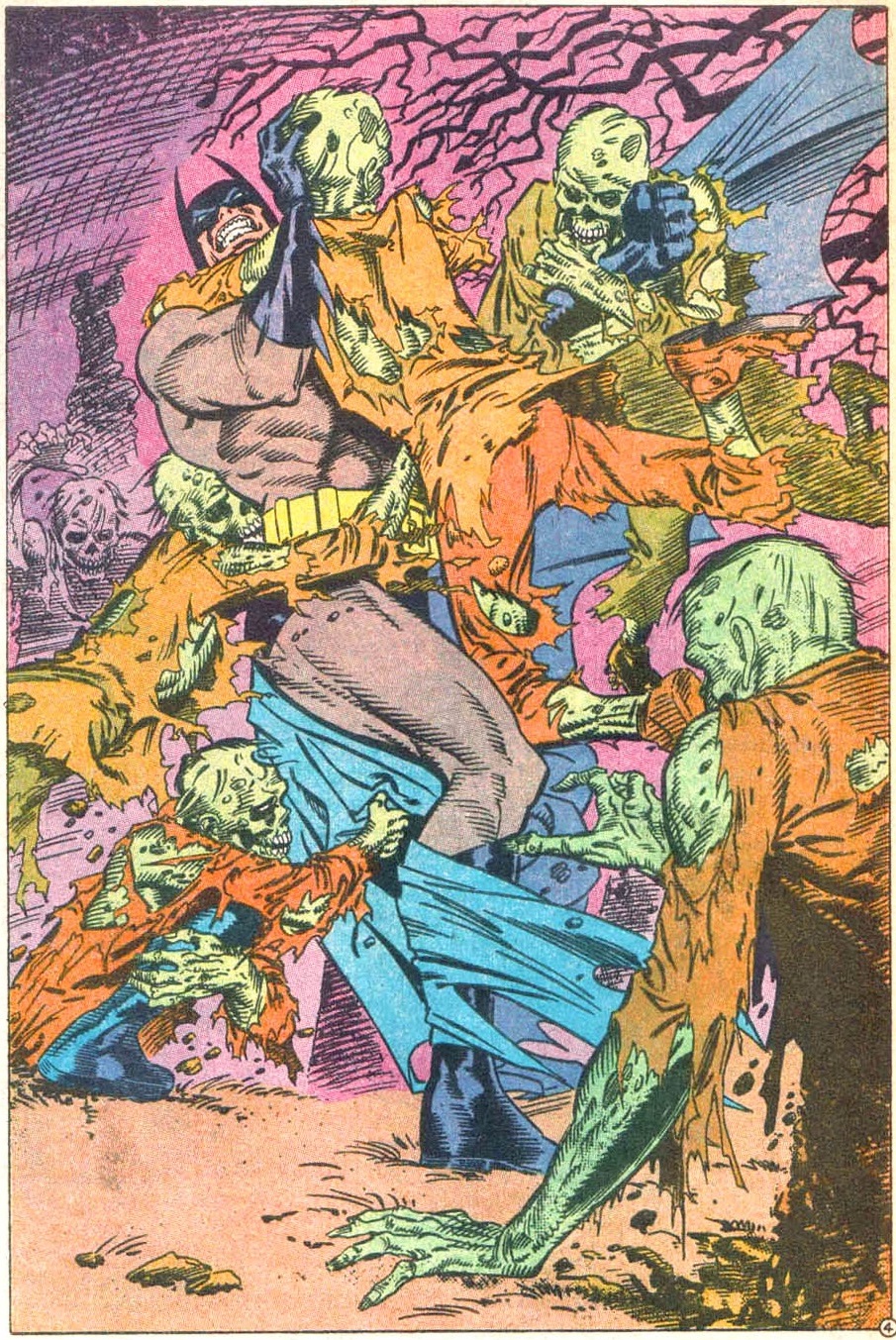
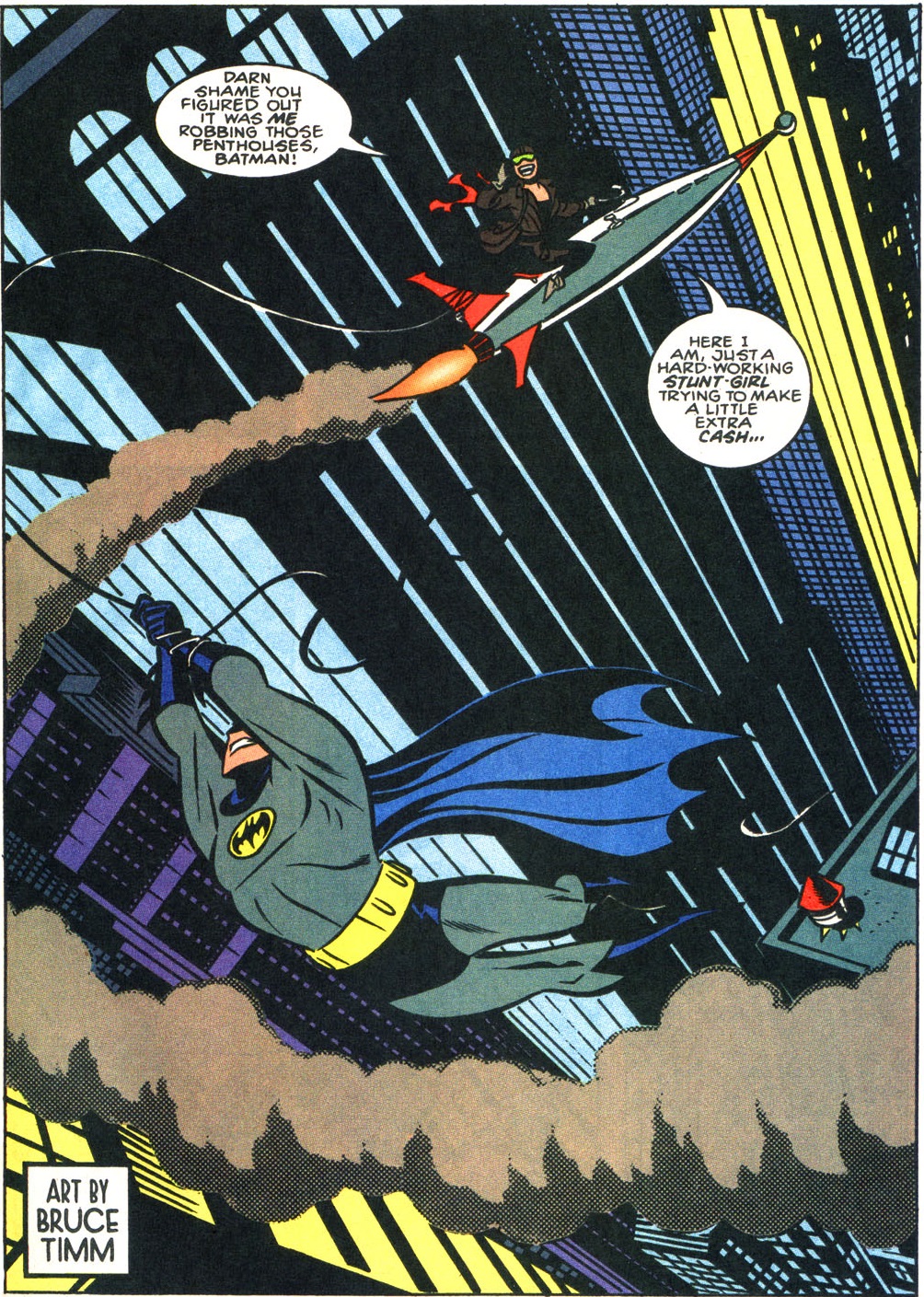
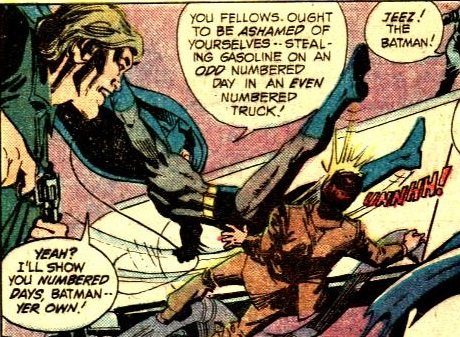
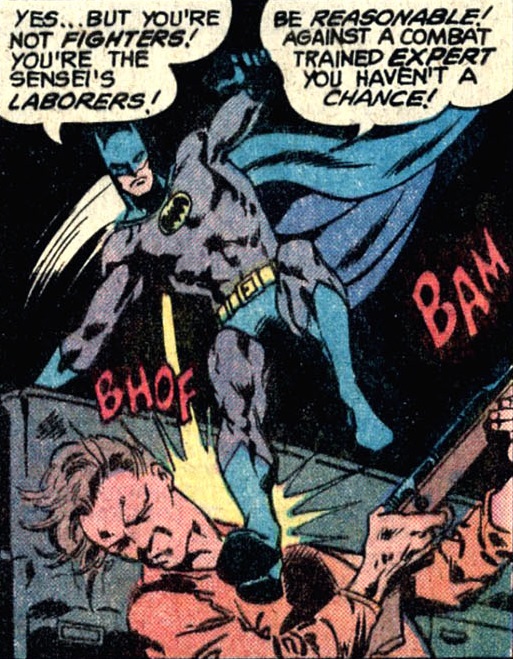
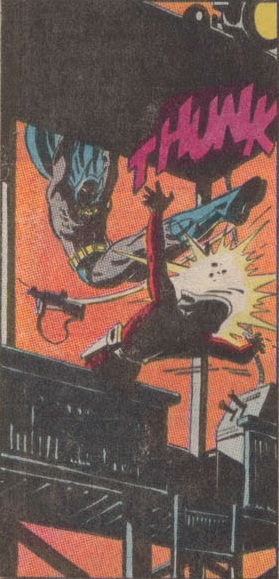
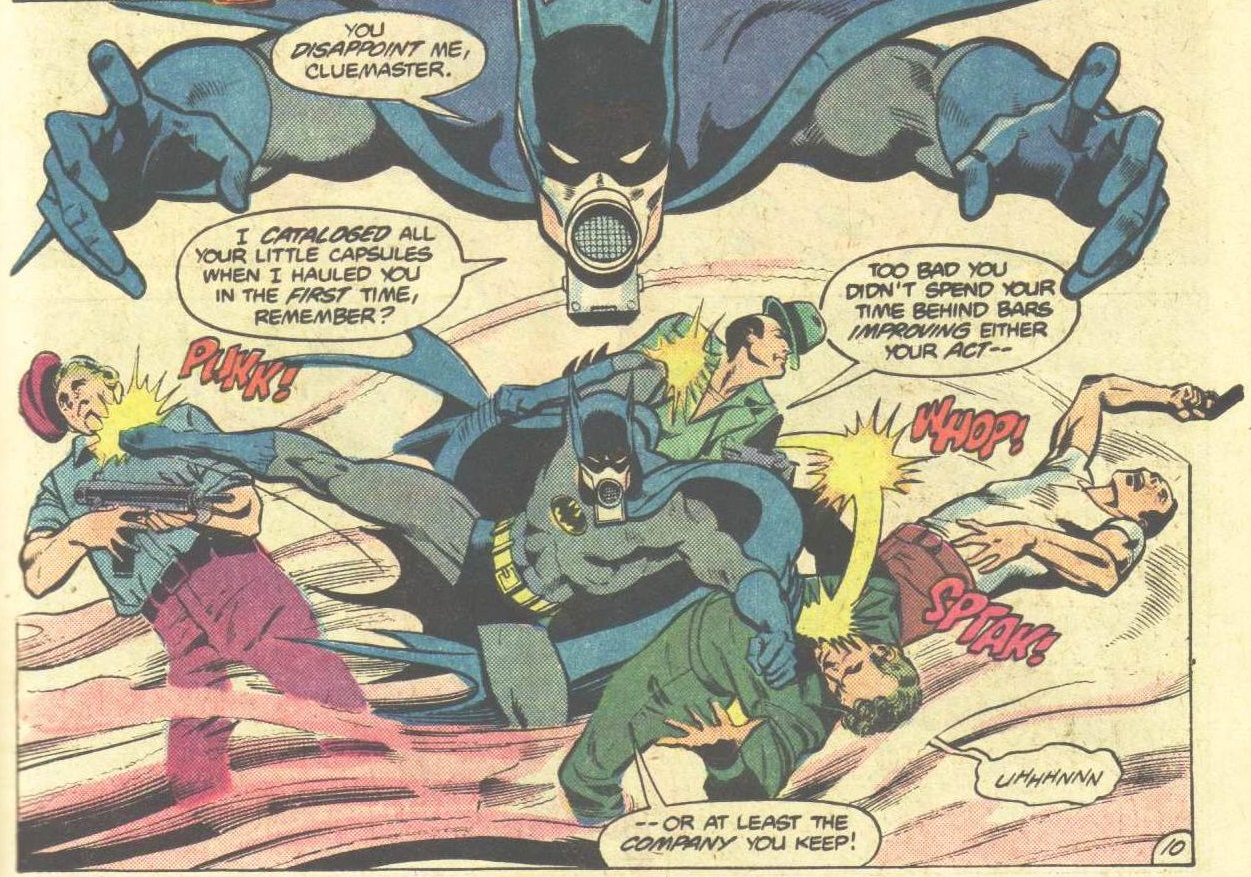
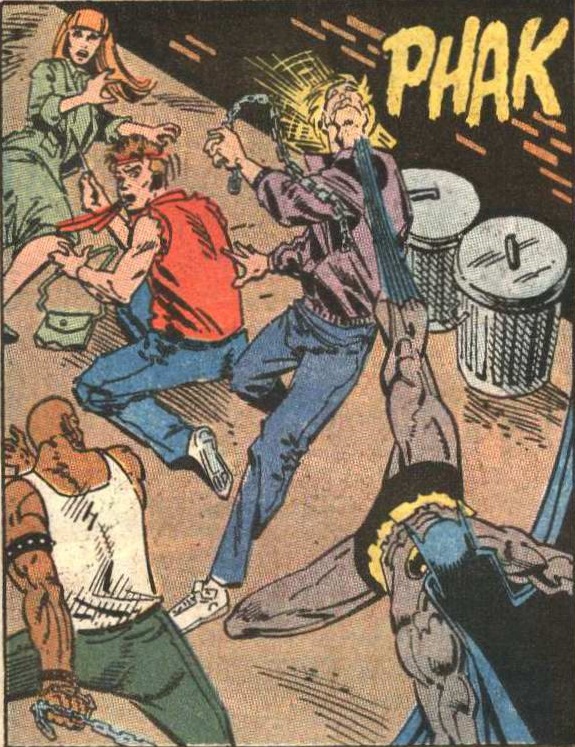
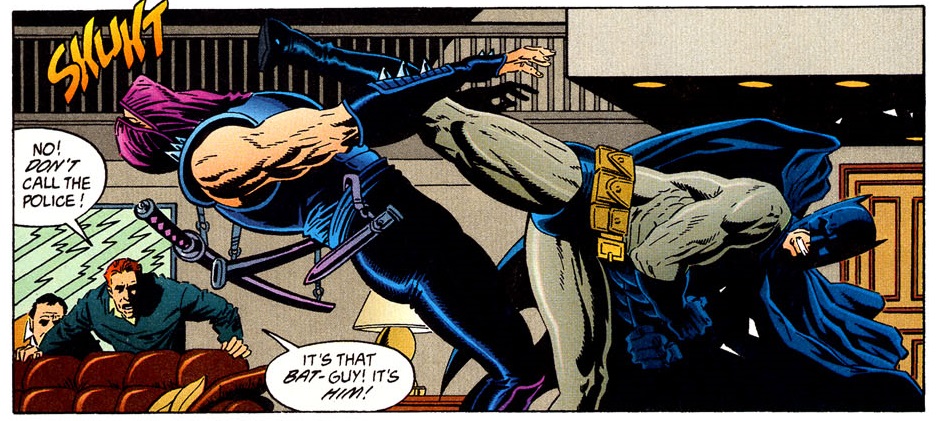
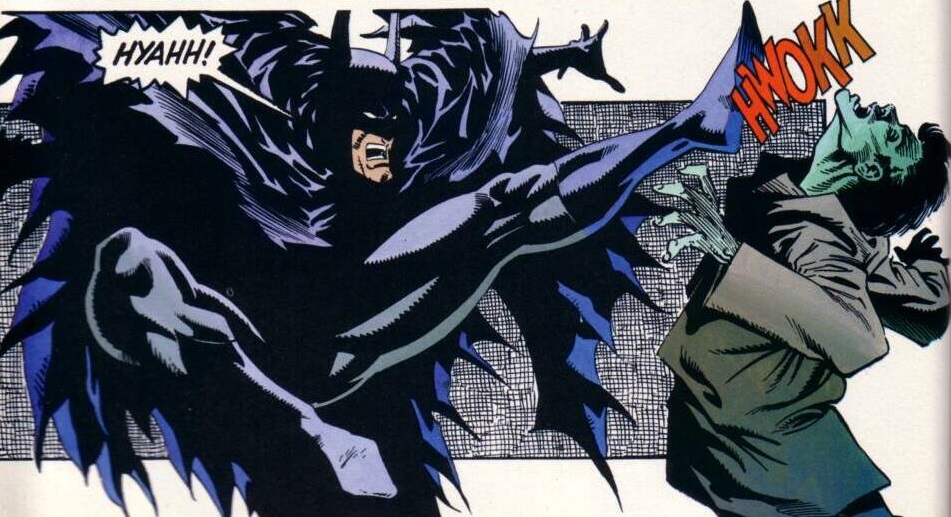
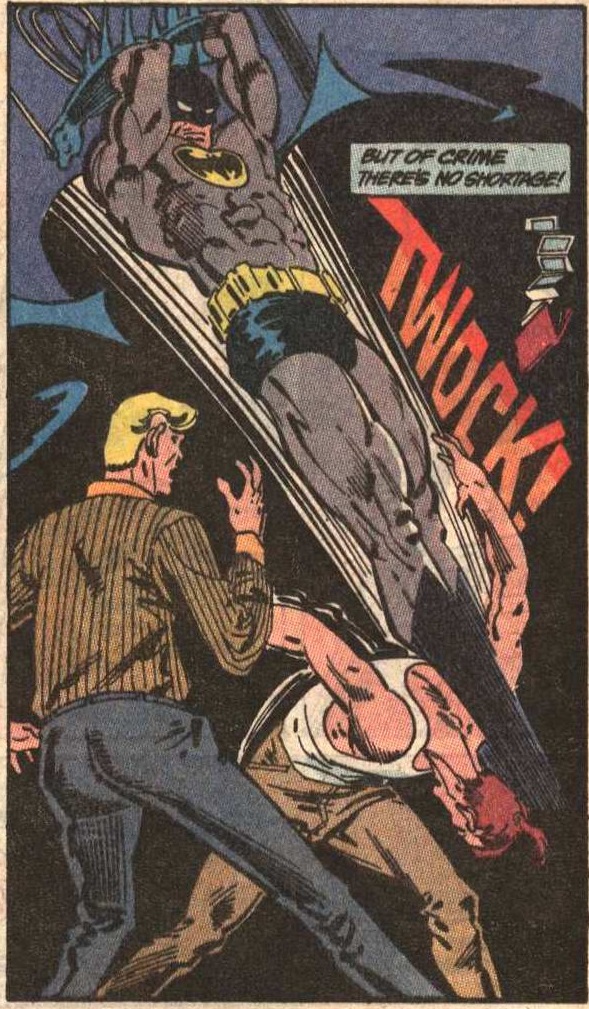
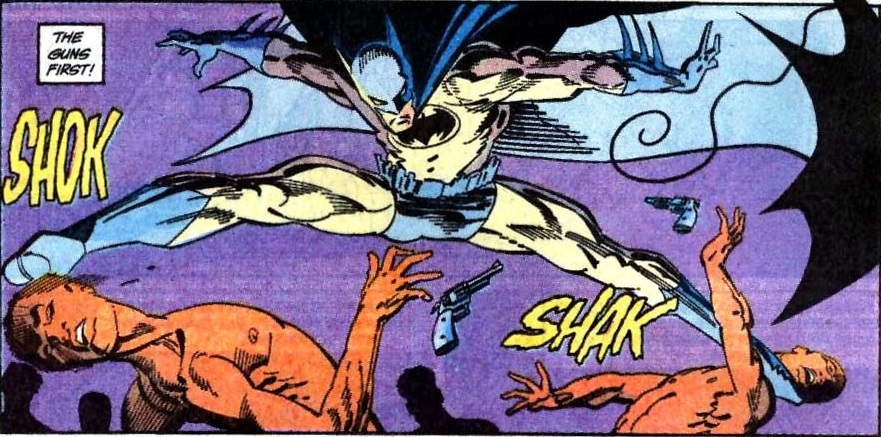
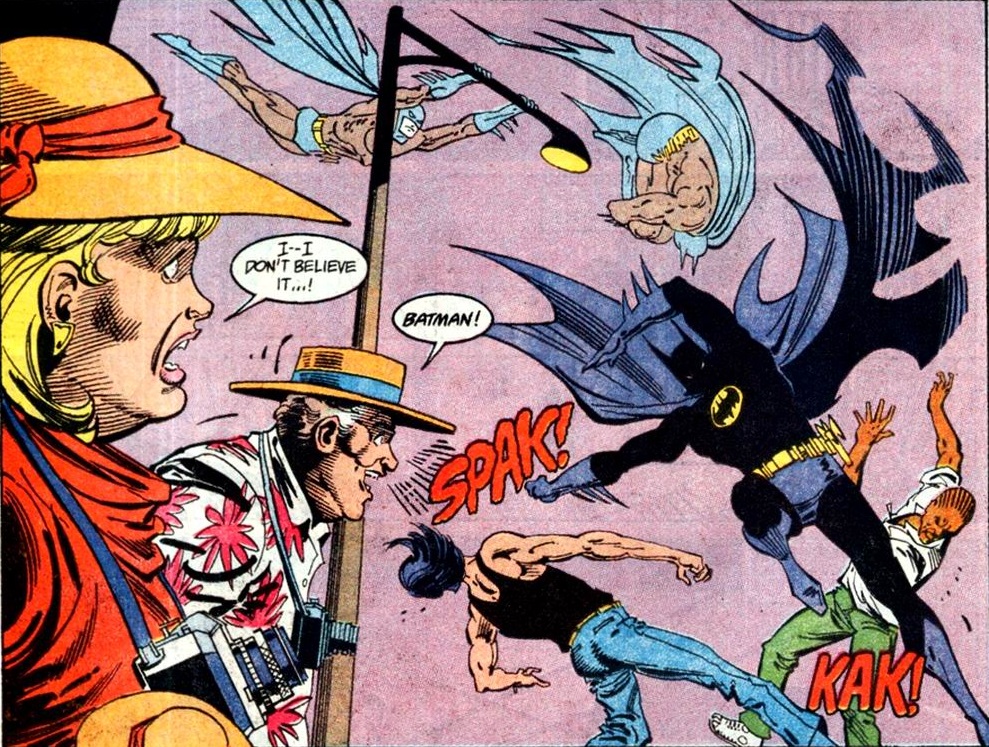
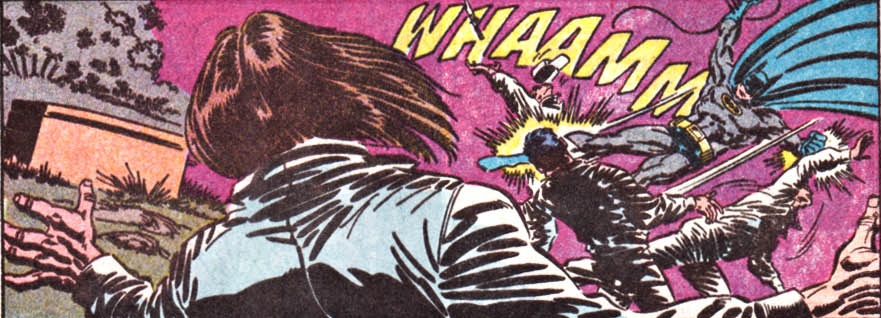
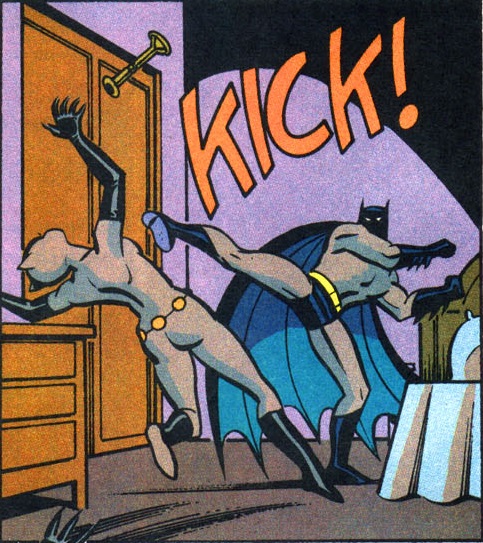
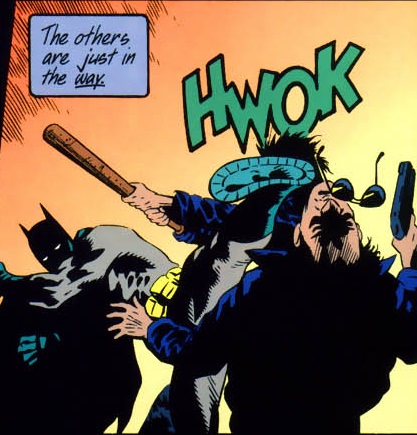
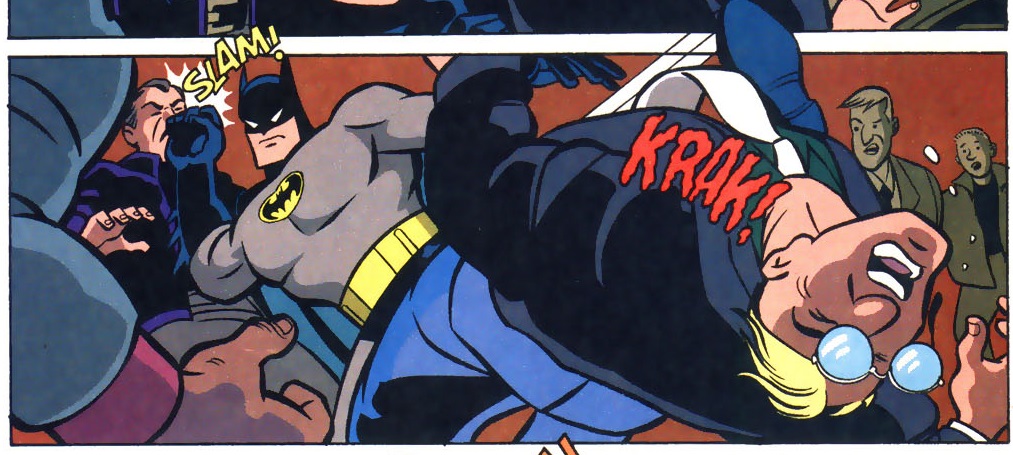
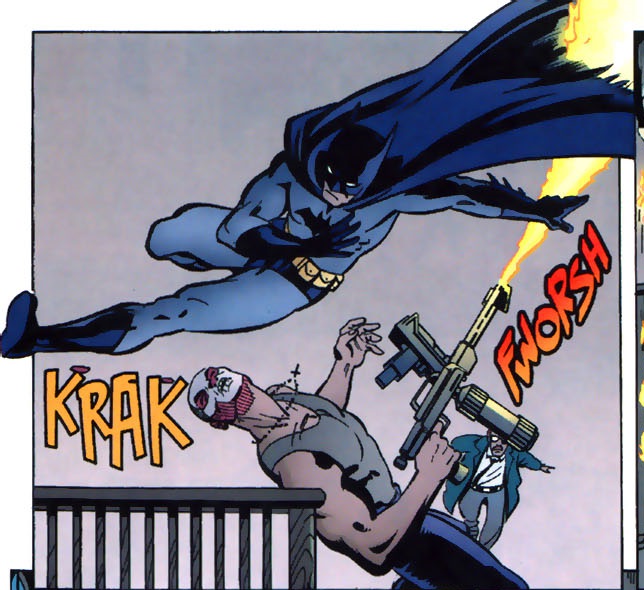
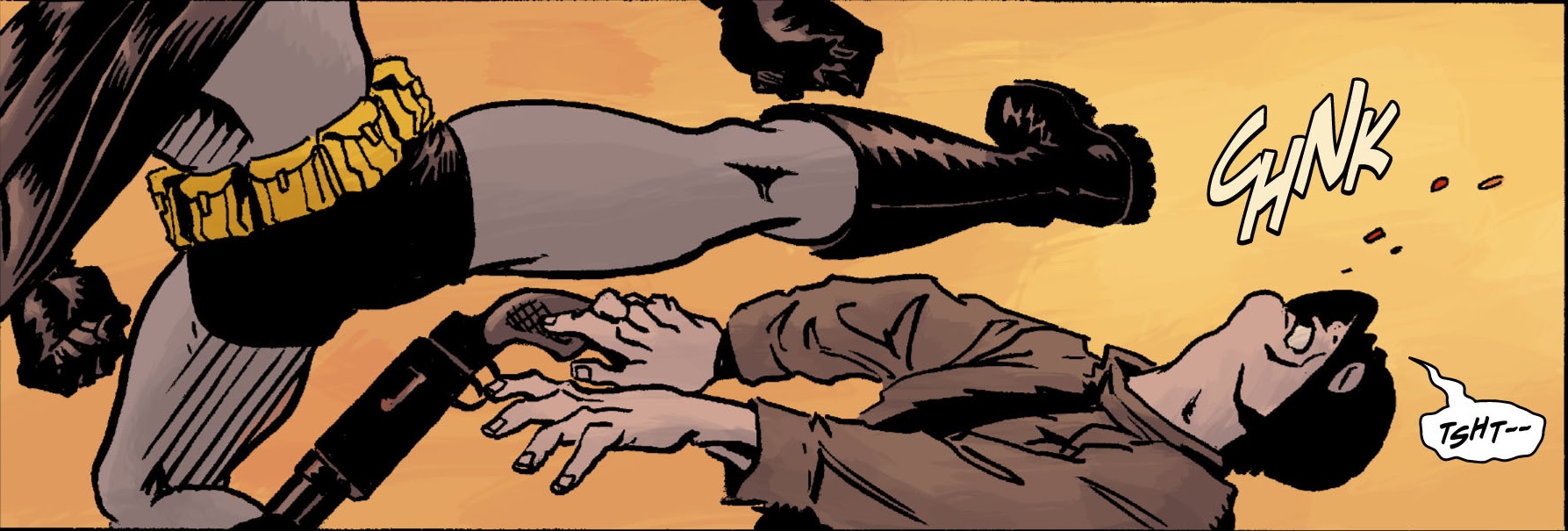
Collections of Batman stories – part 2

If you read the last post, you know what’s going on. Here are another five compilations of Batman stories worth seeking out:
TALES OF THE DEMON (1991)

tales of the demon

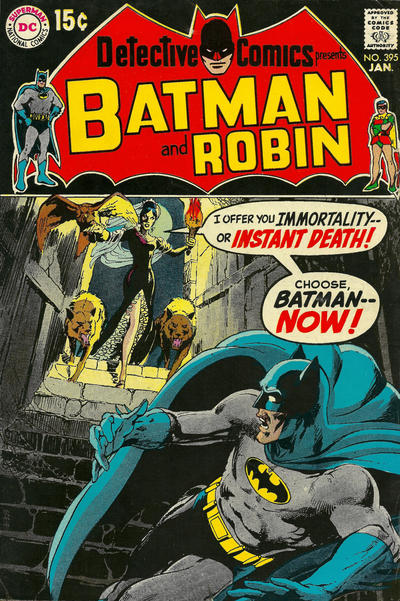
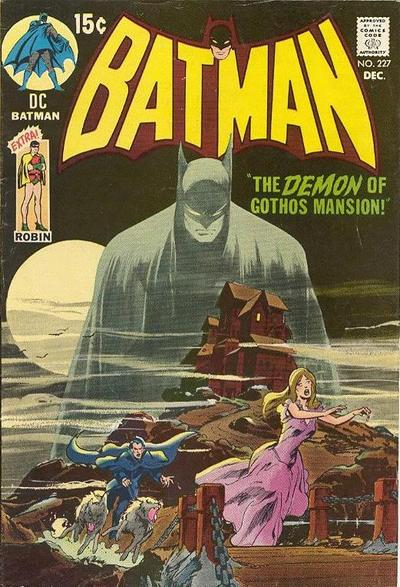
Tales of the Demon collects the first handful of stories Denny O’Neil wrote about Batman’s notorious (if somewhat tragic) eco-villain Ra’s al Ghul and his deadly daughter Talia, in the seventies. The mysterious al Ghul clan was a formidable creation, constantly forcing the Dark Knight out of his comfort zone both geographically and emotionally. Indeed, these are absolute classic comics that have influenced countless creators and storylines over the past decades.

Denny O’Neil, whose early work vigorously reinforced the Caped Crusader’s pulp credentials, instilled the tales with a spirit of go-for-broke adventure reminiscent of old serials (the kind that would later inspire the Indiana Jones franchise). Within the pages of this book, Batman travels around the globe, fights dangerous animals and assassins, escapes from deathtraps, has a doomed romance, and ultimately saves the world – all magnificently rendered by the elegant pencils of Bob Brown, Neal Adams, Irv Novick, Michael Golden, and Don Newton.

EGO AND OTHER TAILS (2007)

batman ego

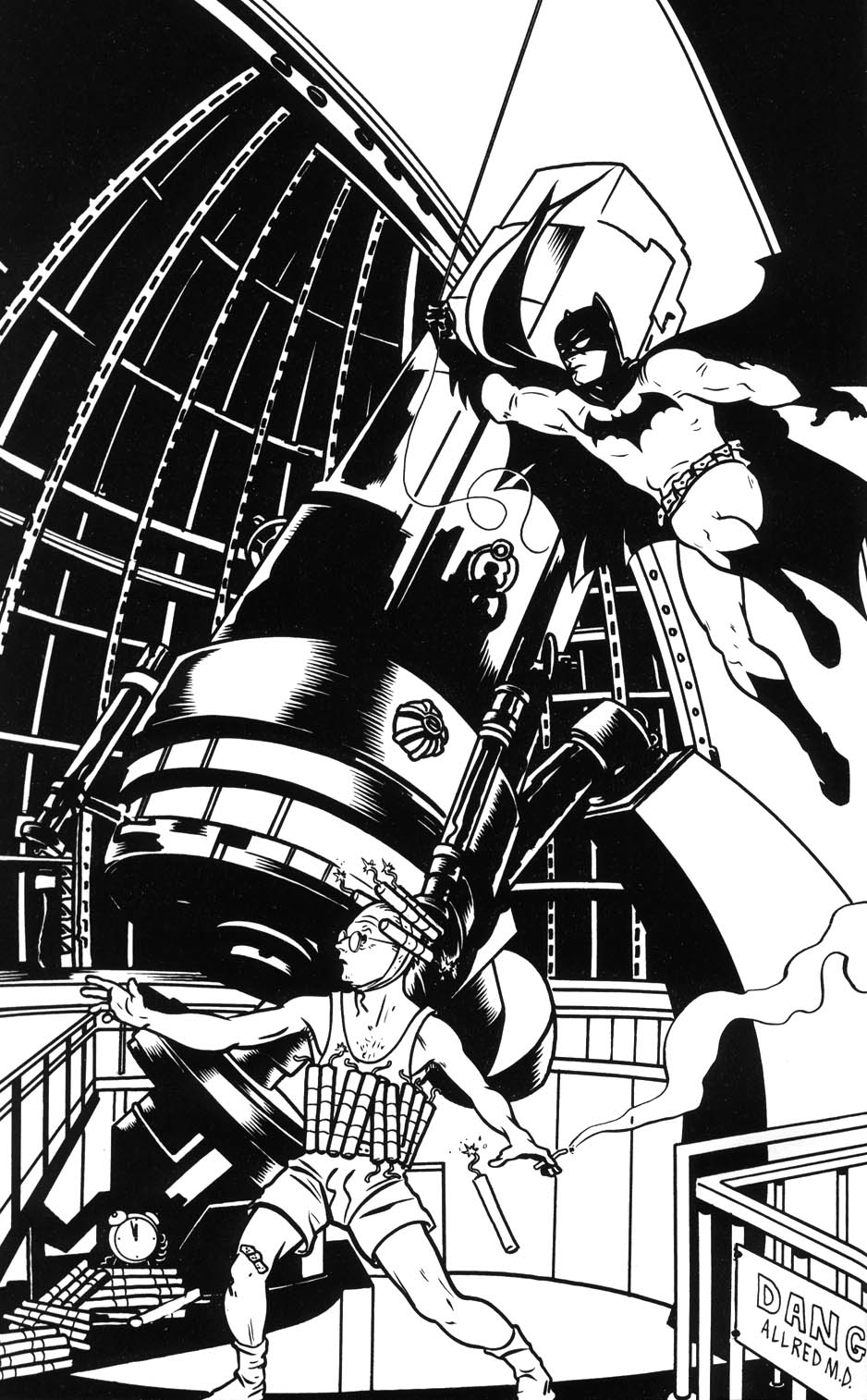
Spotlighting one of the industry’s greatest talents, Ego and other tails collects half-dozen dynamic stories written and/or drawn by Darwyin Cooke. Given his signature proto-noir style and unmatched sense of pace, it’s tempting to call these stories ‘cinematic,’ but that wouldn’t do them justice – this is pure comics magic!

Although less ambitious than Cooke’s DC: The New Frontier, the book is full of gems. The title story is a compelling character study in which Batman has an existential discussion with his own dark side. Other high points include ‘Selina’s Big Score’ (one hell of a heist thriller and a kick-ass Catwoman tale to boot) as well as ‘Déjà vu’ (Cooke’s awesome remake of ‘Night of the Stalker!’).
LEGENDS OF THE DARK KNIGHT: ALAN DAVIS (2012)

batman alan davis

Collecting all the Batman comics illustrated by Alan Davis (except for his work on Batman and the Outsiders), this colorful book bursts with joy and energy channeled through humorously-designed expressions and eye-catching set pieces. Since every tale is written by Mike W. Barr, this also works as a showcase for Barr’s paradoxical mix of nostalgic playfulness and twisted undercurrents.

During their fan-favorite eighties’ run on Detective Comics (featuring an upbeat Jason Todd as Robin, the Boy Wonder), the team of Davis and Barr was behind such beloved stories as ‘Fear for Sale’ and ‘The Doomsday Book,’ which by themselves are worth half of this collection’s cover price. The completist among you may also appreciate the inclusion of the first chapter of Batman: Year Two and its sequel Full Circle.

LEGENDS OF THE DARK KNIGHT: NORM BREYFOGLE (2015)

detective comics 592

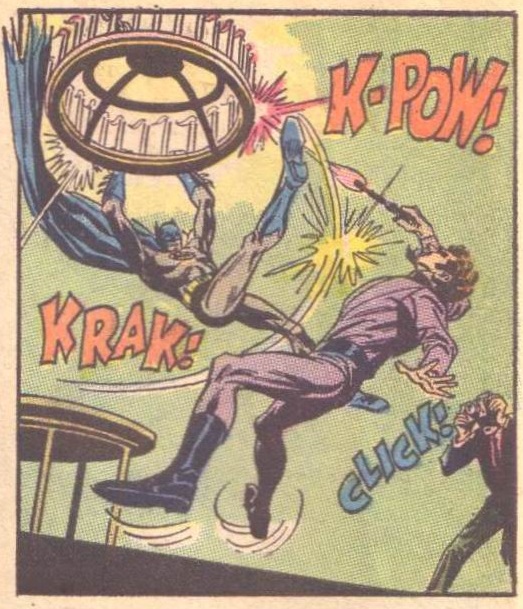
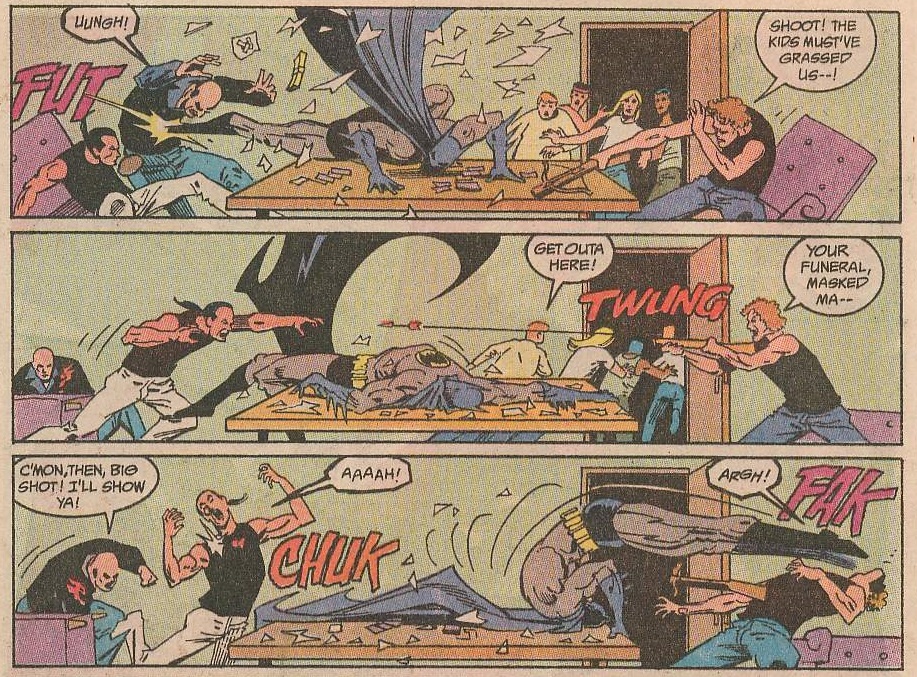
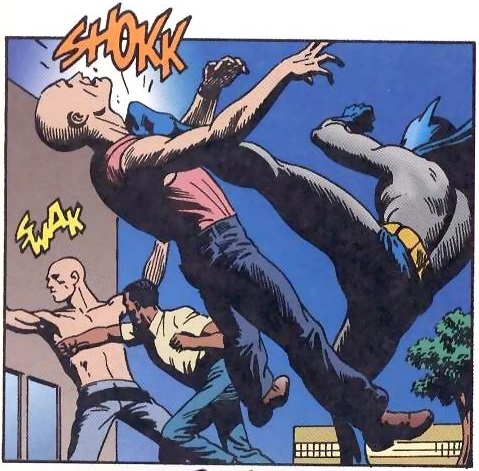
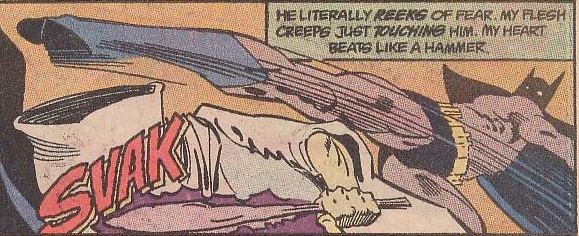
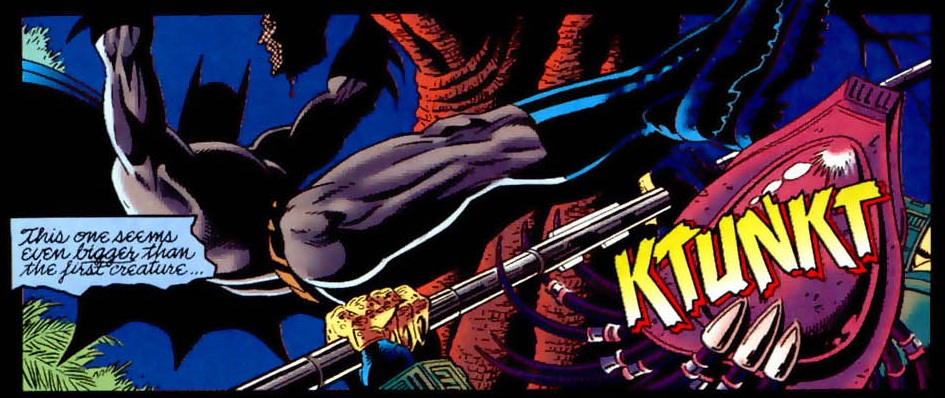
This collection devoted to the Batman artwork of Norm Breyfogle – the only one so far, but hopefully the first of many – is a breathtaking display of fluid layouts, vibrant lines, and freaky character designs. It opens with an uneven compilation of extremely diverse tales by Mike W. Barr, Max Allan Collins, Robert Greenberger, and Jo Duffy (including a crossover with 1988’s Millennium, DC’s intercompany event about a widespread alien robot conspiracy), before settling on almost twenty issues of hardcore Dark Knight goodness written by Alan Grant.

Breyfogle is the perfect partner in crime for Grant’s brand of badass, fist-pumping action and sick sense of humor… Their Batman keeps jumping around across the pages like a hyperactive athlete. Their Gotham is a city of outrageous psychopaths lurking among the sprawling urban decay – kind of like the New York of The Warriors or After Hours.

Seriously, this Detective Comics run by Norm Breyfogle and Alan Grant – initially in collaboration with writer John Wagner – is easily one of my favorite Batman runs of all time. Just their first dozen issues together introduced gloriously deranged villains such as the Ventriloquist, the Ratcatcher, the Corrosive Man, Mortimer Kadaver, and Cornelius Stirk… and that was before they unleashed their long-lasting takes on Etrigan and Clayface into an unsuspecting world!

DARK KNIGHT, DARK CITY (2015)

dark knight, dark city

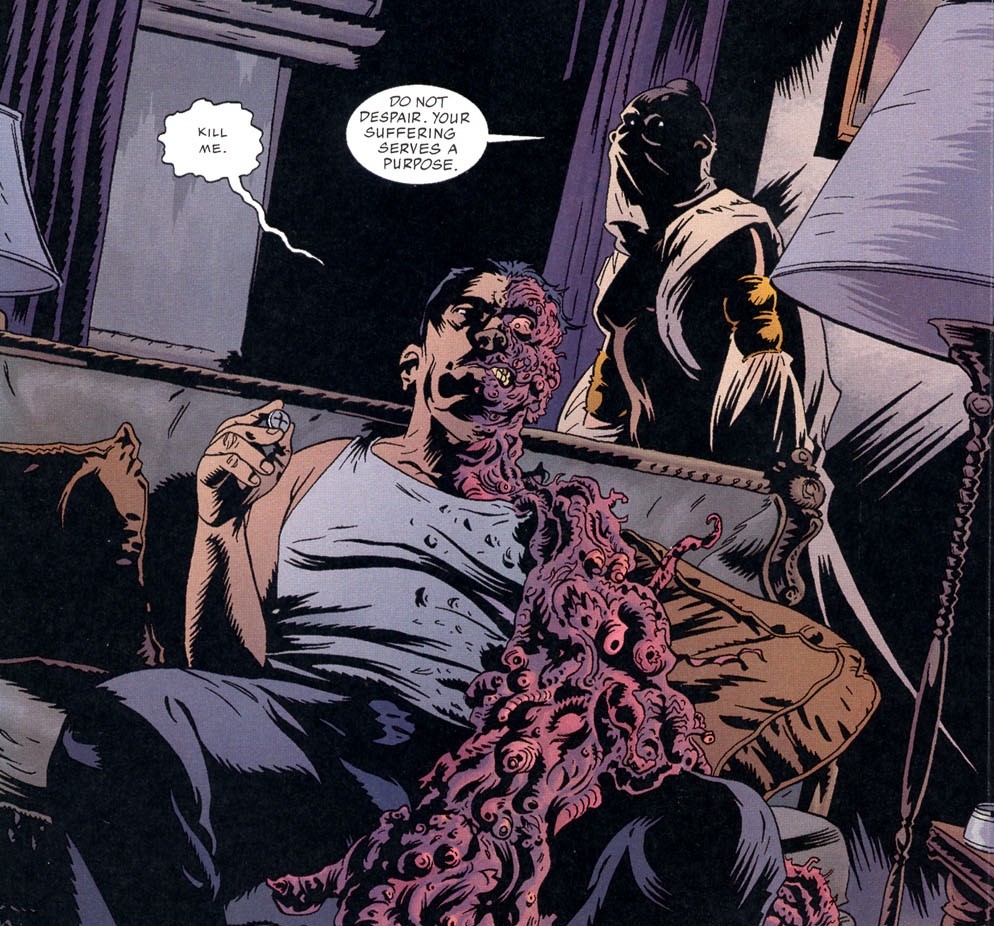
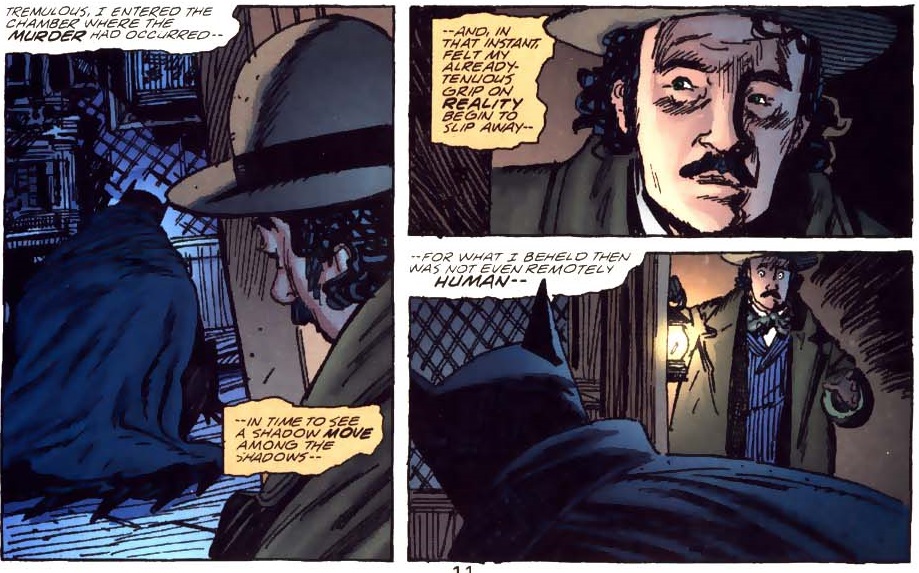
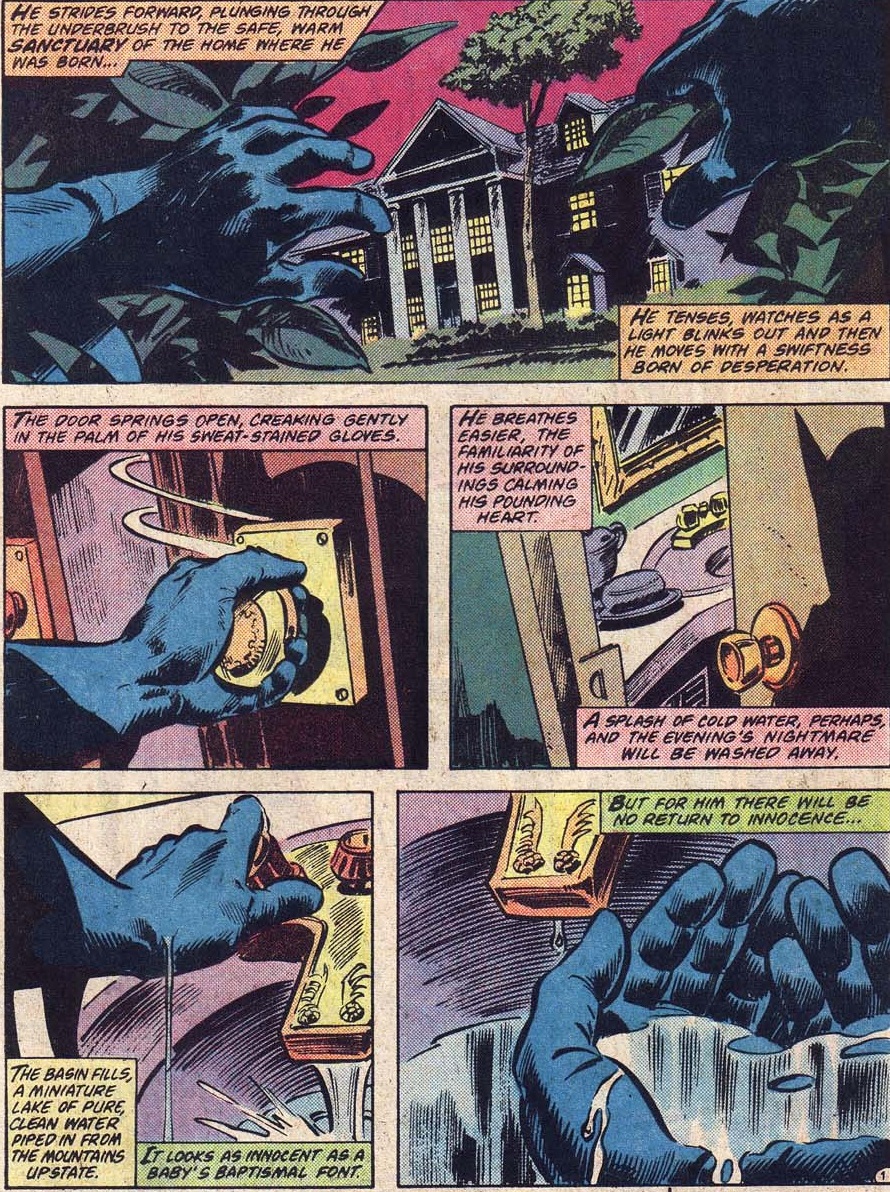
Finally, here is a suggestion for those who like their Batman adventures weird and unsettling and with a dash of the supernatural. Dark Knight, Dark City collects five haunting tales written by Peter Milligan, with art by Kieron Dwyer, Jim Aparo, and Tom Mandrake. In the titular horror story, narrated by Gotham City itself, the Riddler tries to raise a demon by manipulating the Caped Crusader into doing all sorts of black magic rites – such as performing a tracheotomy on a baby! That story became a Batman cult classic (especially after Grant Morrison incorporated it into The Return of Bruce Wayne) but it’s not the only reason to get this book.

Milligan imbues each tale with the notion that Gotham is a city haunted by ancient evils and messed up memories. For example, the second longest story is a thoughtful two-parter about an old Holocaust survivor who brings a golem to life – and it’s damn well-executed, even if the topic is hardly unique (Gotham’s streets have seen at least one other golem, in Ragman, and there have been a number of great post-Holocaust stories, most famously ‘Night of the Reaper’).

Now, if only DC would get around to collecting the rest of Peter Milligan’s Batman comics

Posted in BATMAN COMICS FOR BEGINNERS | Tagged , , , , , , , , , , , , , , , , , , , , | Leave a comment

Collections of Batman stories – part 1

Among the countless Batman books out there – old and new, classic or disposable – there is a whole subsection that strikes me as an ideal gateway for those who have heard of this Bruce Wayne fella but are still wondering what all the fuss is about. I’m talking about books that, rather than focus on one story or story-arc, collect a whole set of self-contained comics unburdened by complicated continuity, thus giving you plenty of bang for the buck.

These collections are great if you like your Dark Knight in digest form, with accessible one-and-done tales. They often include short stories in which the Caped Crusader acts as a supporting player in someone else’s journey as well as more straightforward adventures in which Batman’s awesomeness is not just the premise but the whole point. Anthologies can also allow you to sample the versatility of this character and his world in order to find out which version you prefer, since the Dark Knight has historically starred in various types of comics, from gritty crime yarns to superhero fantasy, from campy comedy to globetrotting epics, from grounded mysteries to crazy action romps in which the hero overcomes larger-than-life challenges (because Batman, motherfucker!).

That said, as it happens with all kinds of Batman publications, there is so much to choose from that you are at least as likely to find something utterly lame as to find something genuinely cool. With this in mind, I would recommend starting with one of the following collections:

BATMAN BLACK AND WHITE: VOLUME 1 (1997)

batman - black & white

Collecting twenty Batman short stories – with barely a stinker in the bunch – this first volume of the Batman Black and White anthology series is mandatory reading for anyone who is into the psychological, film noir-influenced side of the Dark Knight. I’ve mentioned before that this series seems to bring out the best in all creators involved, so imagine what you can get when that applies to the most awesome artists and writers in the medium, like Ted McKeever, Bruce Timm, Archie Goodwin, and Walt Simonson, among many others.

As the title suggests, all stories are illustrated in moody black & white, which still leaves room for a wide range of art styles, from Matt Wagner’s deco pointillism in ‘Heist’ to Brian Bolland’s eerie photorealism in ‘An Innocent Guy,’ from Teddy Kristiansen’s childlike scratchy lines in ‘A slaying song tonight’ to Kevin Nowlan’s elaborate gothic designs in ‘Monsters in the Closet.’ What’s more, while many entries revolve around hardboiled crime fiction – including a contribution by Chuck Dixon, a master of the genre – there’s also a quirky tale about a vigilante who punishes petty acts (like jumping ahead in line or talking during a movie), a melancholic meditation on street gangs, and a funny bit about Batman and the Joker rehearsing their lines while complaining about the script.

THE GREATEST BATMAN STORIES EVER TOLD (1988)

greatest batman stories

There have been quite a few attempts at digging through the rich history of Batman comics and selecting the must-read ones – or at least selecting the most representative one-off tales – but 1988’s The Greatest Batman Stories Ever Told comes the closest to perfection (not to be confused with 2005’s Batman: The Greatest Stories Ever Told, which isn’t as wide-ranging).

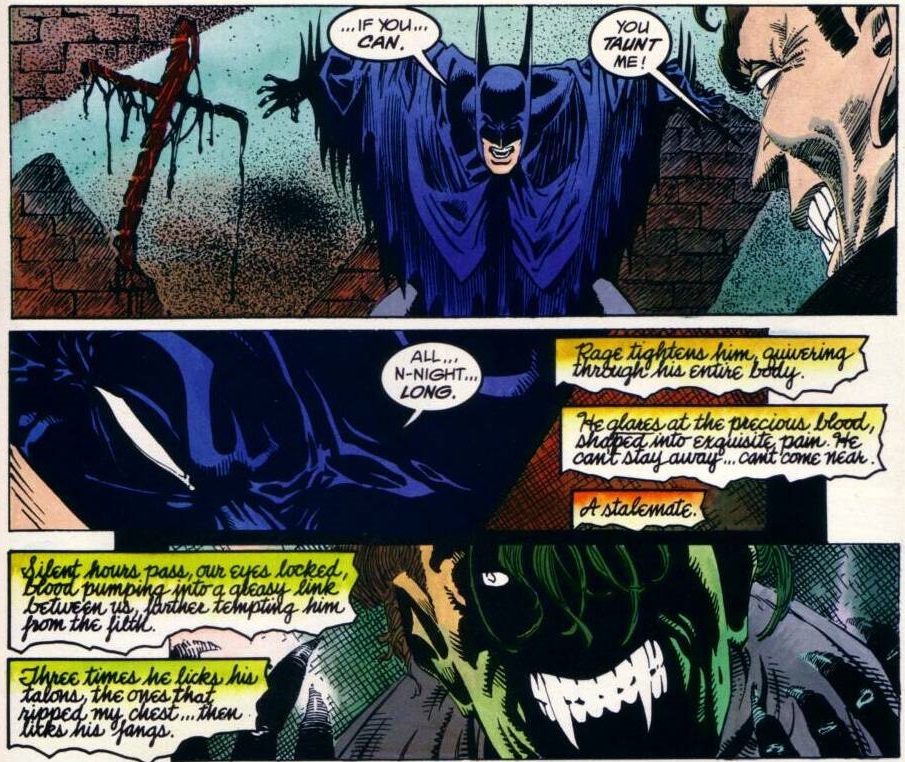
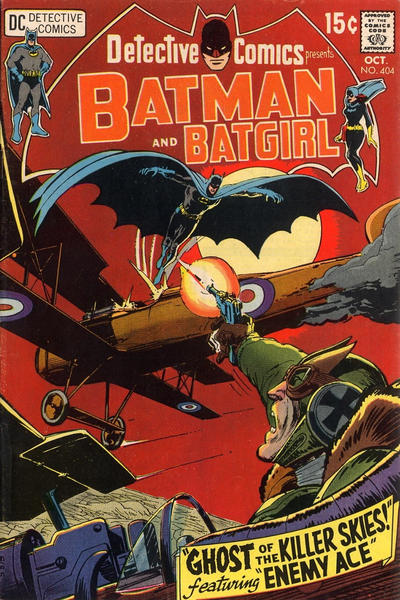
Between the opening pages of ‘Batman versus the Vampire’ (a slice of horror pulp in which the Dark Knight follows his hypnotized fiancée to Hungary) and the bittersweet ending of ‘The Autobiography of Bruce Wayne’ (a coda to Earth-2 Batman, written with Alan Brennert’s skill for insightful characterization), there are literally dozens of stories full of colorful rogues, angry gorillas, and inventive escapes from deathtraps. Bona fide classics include the trippy ‘Robin Dies at Dawn’ (a key inspiration for Grant Morrison’s later Batman run), the whodunit ‘Ghost of the Killer Skies!’ (one of no less than three separate tales where Batman has to face villains armed with aircraft), the badass ‘Death Strikes at Midnight and Three’ (technically an illustrated prose piece), and the powerful ‘There Is No Hope in Crime Alley!’ Best of all, the book has all the installments of the wonderful Joe Chill trilogy – ‘The Origin of the Batman,’ ‘The First Batman,’ ‘To Kill a Legend’– an amazing example of myth-building across the decades.

Sure, not *all* of these comics have aged well, but even the ones that didn’t can provide interesting glimpses into the Caped Crusader’s publication history. The most obvious example is 1940’s ‘Hugo Strange and the Mutant Monsters,’ a crude riff on Frankenstein and King Kong that spotlights a time when Batman still lived in New York City and shot people with a machine gun attached to his Batplane.

HAUNTED KNIGHT (1996)

haunted knight

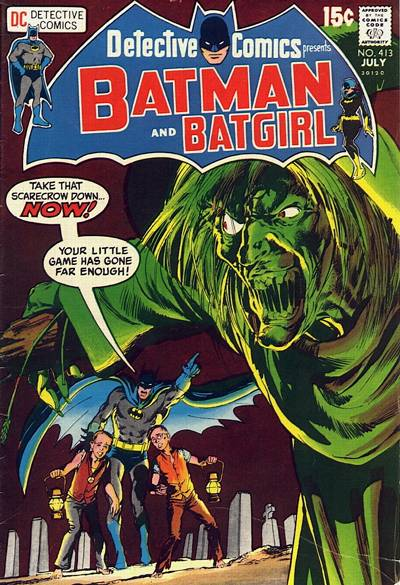
For a while, back in the nineties, it seemed like the wonder team of Jeph Loeb and Tim Sale could do no wrong. Before going on to do the acclaimed series The Long Halloween, they first left their mark on Batman with the trio of comics collected in Haunted Knight. These stories – three of the best Batman Halloween stories of all time – offer neat insights into Bruce Wayne’s insecurities early in his crime-fighting career. In ‘Fears,’ while going after the Scarecrow, Bruce wonders if he actually has a choice about being Batman. In ‘Madness,’ featuring the Mad Hatter, we learn that Batman uses Alice’s Adventures in Wonderland to cope with the loss of his mother. ‘Ghosts’ is a take on A Christmas Carol with Poison Ivy and the Joker as guiding spirits, showing Bruce that he shouldn’t limit his existence to the role of Dark Knight (fifteen years later, we got another great variation of A Christmas Carol in the form of Lee Bermejo’s gorgeous and shamelessly schmaltzy graphic novel Batman: Noël).

For all the strong character work done on Bruce Wayne (and Jim Gordon), the villains in Haunted Knight are reduced to psychotic abstractions, which gives the whole thing the feel of distorted memories. This is intensified by the dreamy artwork, with Tim Sale’s pencils, Gregory Wright’s colors, and Todd Klein’s lettering creating a stylized look that smoothly shifts from uncanny to exciting to touching to uplifting (including a beautiful, cameo-filled splash page of a costume party early on where you can tell Sale and the others are having a ball).

FEATURING TWO-FACE AND THE RIDDLER (1995)

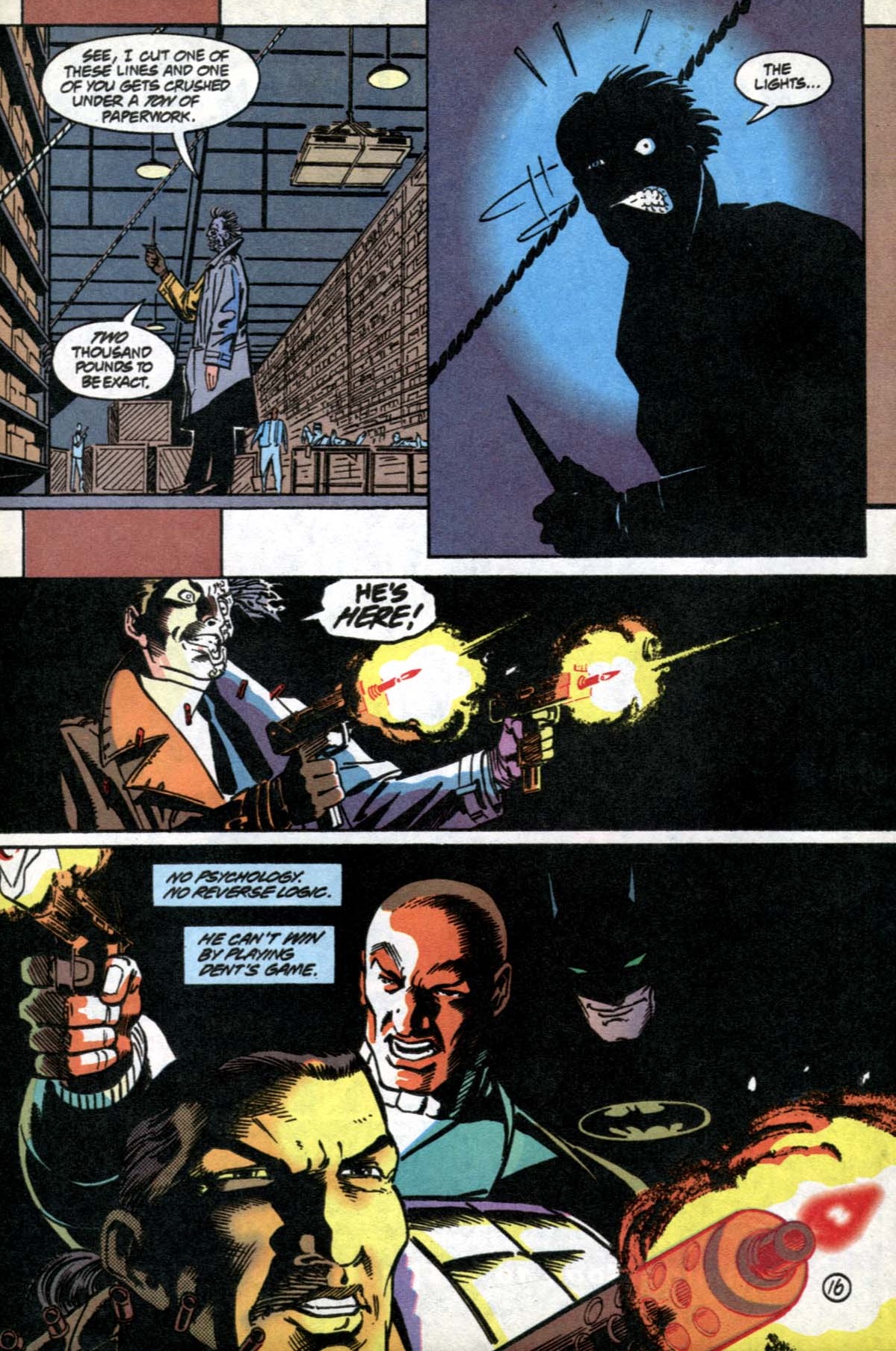
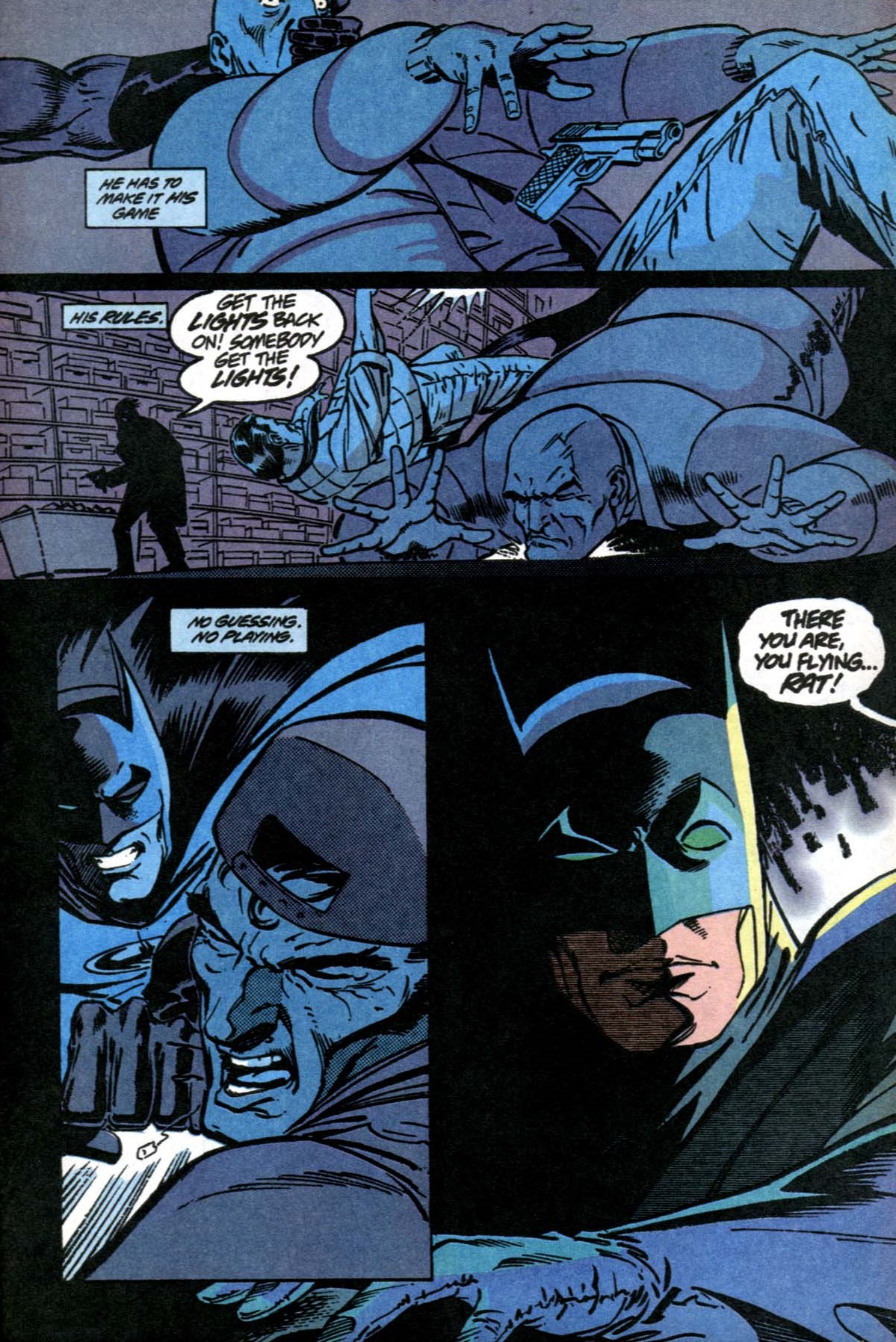
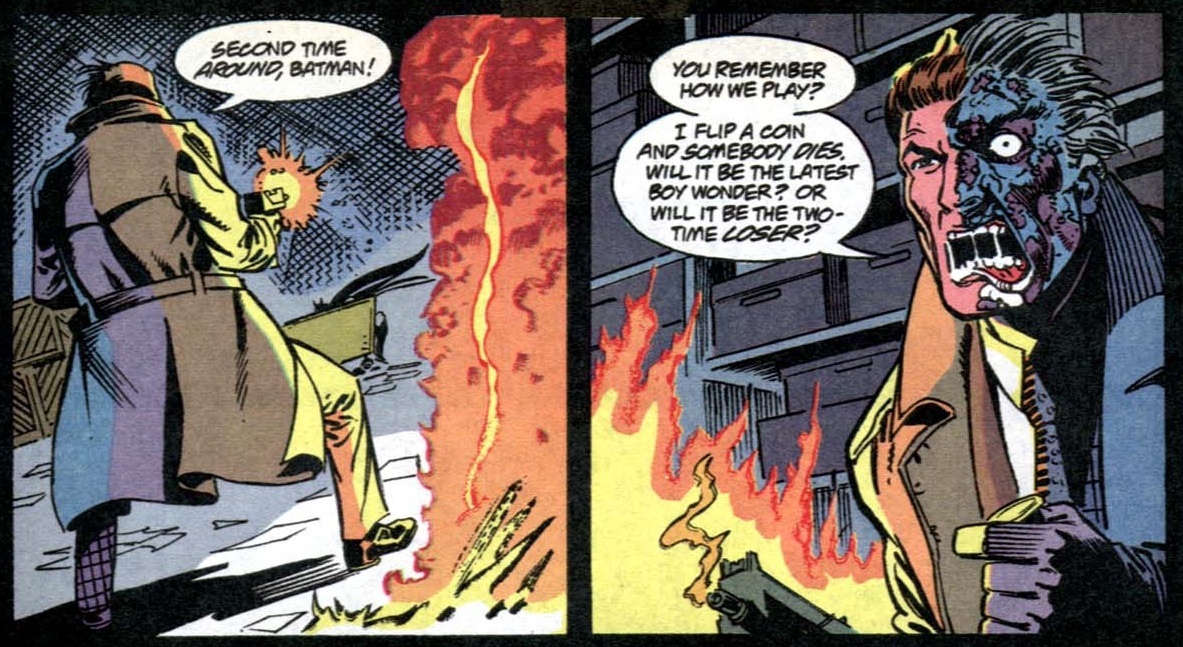
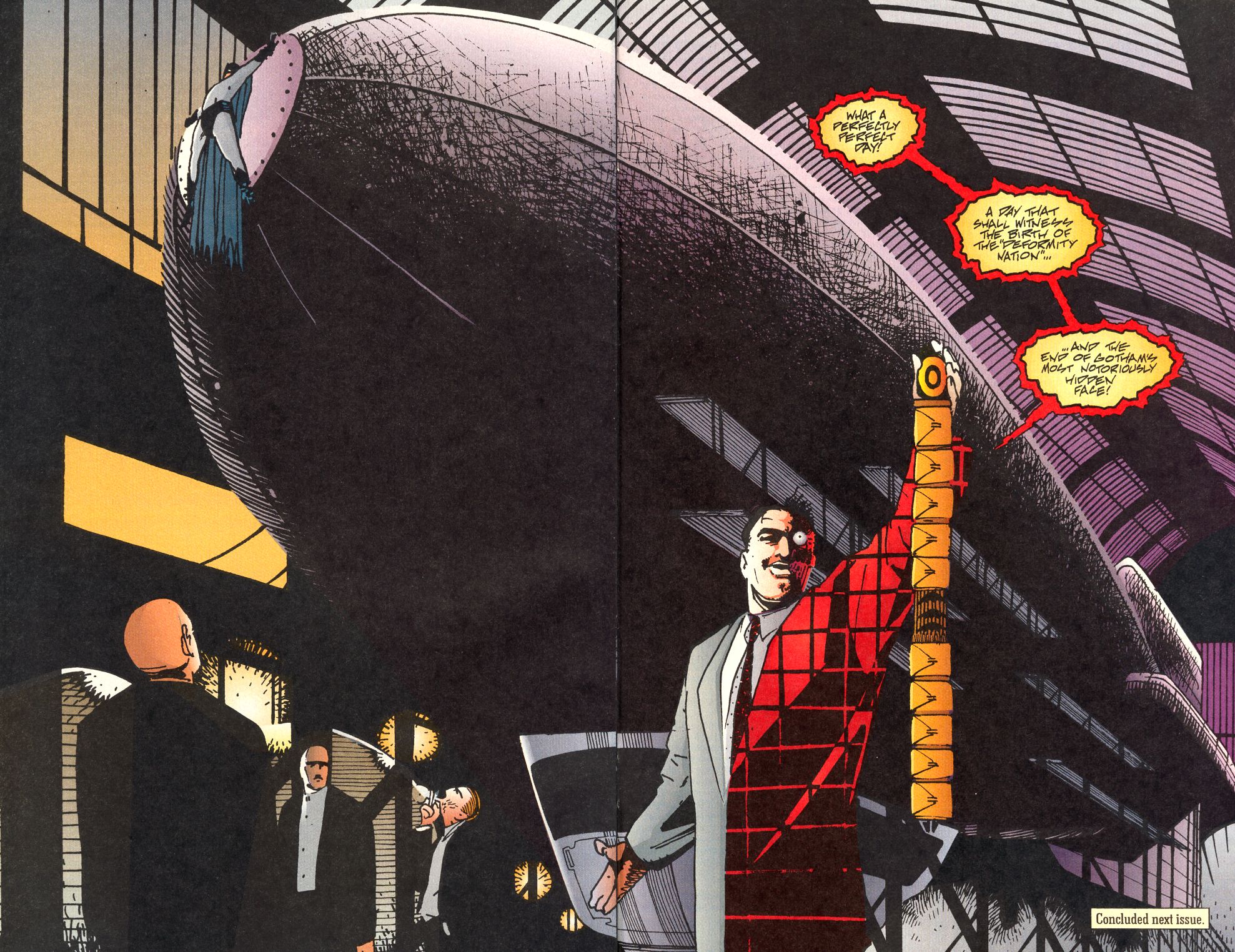
detective comics 377If there was one positive thing to come out of Joel Schumacher’s kitsch blockbuster Batman Forever, it was DC’s decision to release a collection of comics featuring the movie’s villains: Two-Face and the Riddler. These are two of the best creations in the Caped Crusader’s rogues’ gallery, not least because they come with neat built-in story designs. Two-Face, a district attorney-turned-criminal whose disfigurement (literal and figurative) split his personality in two and who now has to flip a coin in order to decide whether to act morally or not, invites tales with duality as a theme and  symmetry as a motif. Likewise, the Riddler, a thief who sends the Dynamic Duo riddles hinting at his next heist in order to prove his intellectual superiority, is a charmingly simple story-making concept – if traditional Batman comics are all about the World’s Greatest Detective unraveling mysteries and ingeniously overcoming physical obstacles, the Riddler, with his compulsion to provide clues in the form of small puzzles that build up to a large trap, seems almost metafictionally doomed to act as a plot facilitator.

The book includes five imaginative tales from the forties and sixties. As you’d expect from comics written by Bill Finger and Gardner Fox, they are chock-full of slightly surreal sequences, like the robbery at a double-feature screening in which Two-Face replaces the reel of a Superman cartoon with a film of him threatening the audience, or an absurdly giant jigsaw puzzle that Batman puts together by assembling a team of cops in a stadium and radioing in instructions from a distance.

The modern era is represented by two exquisite comics. One is 1989’s Secret Origins Special #1, in which writer Neil Gaiman has an ageing Riddler nostalgically mourn the loss of whimsical capers in lieu of viciously violent crimes (this issue also revisits the origins of Penguin and Two-Face). The other is the brilliant ‘The Eye of the Beholder,’ in which the team of Andrew Helfer and Chris Sprouse give Two-Face’s origin a mature psychological treatment.

BATMAN ADVENTURES: VOLUME 1 (2014)

batman adventures

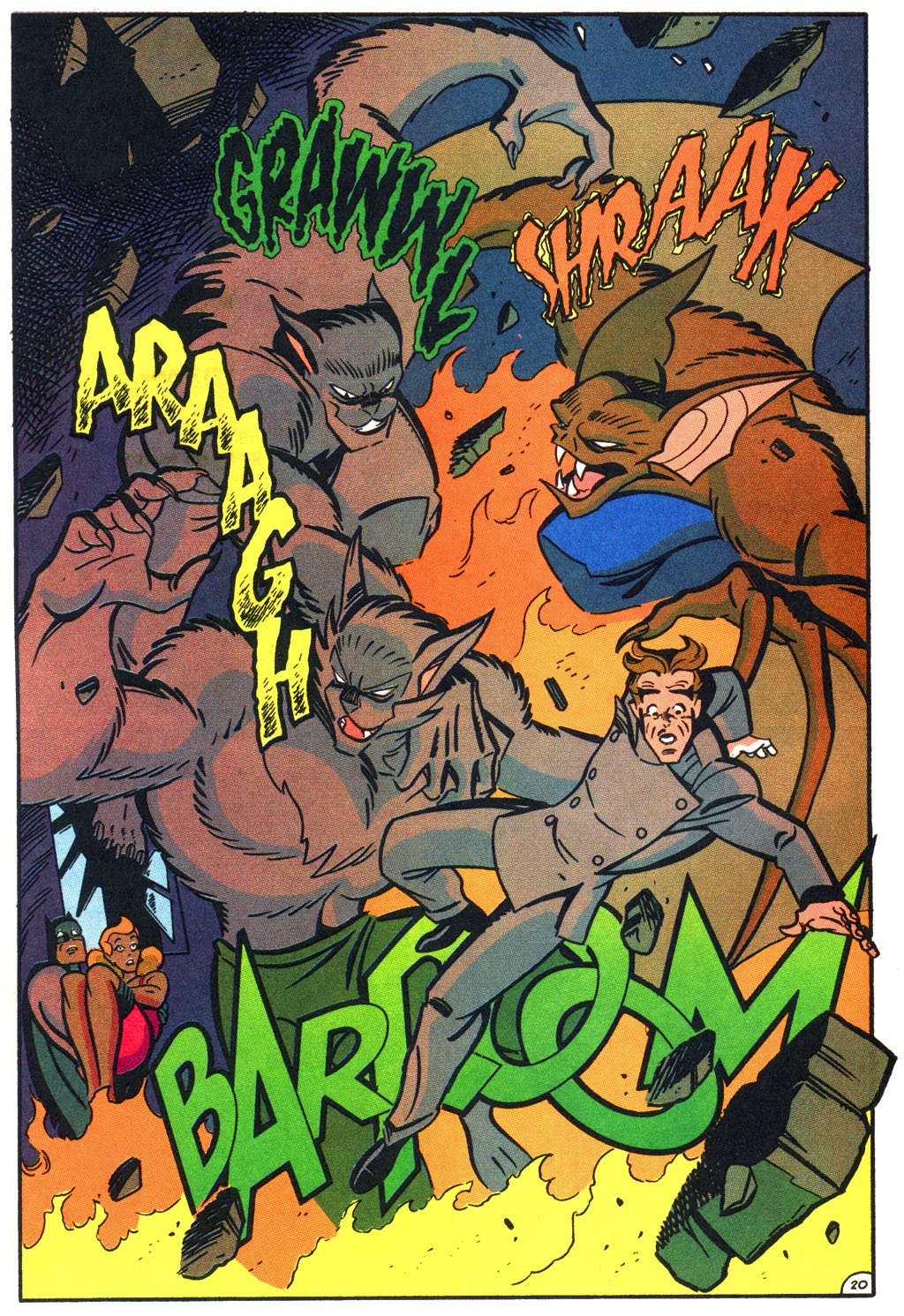
Whenever you see me complain about recent Batman comics or the current DC cinematic universe, this is the platonic ideal I am comparing them to. Batman Adventures is tight, sleek storytelling at its finest. Plus, it’s fun, it’s smart, it’s suited for all ages, and it actually features a likable Caped Crusader who doesn’t have to kill anyone to prove he’s cool! Borrowing the designs and spot-on, streamlined characterization from the amazing Animated Series, these comics deftly balance lighthearted antics and noirish aesthetics (including chapter titles that call back to old Hollywood, such as ‘Top of the World, Ma!,’ ‘A Star is Born!,’ and ‘Panic in the Streets’), with Batman battling retro-looking gangsters as well as his usual rogues’ gallery.

In 2014, DC started putting out collections of this series with 10 issues per volume. The first one, written with impressive pizzazz by Kelley Puckett and Martin Pasko, hits the ground running thanks to the super-stylish work of artists Ty Templeton, Brad Rader, Mike Parobeck, and Rick Burchett, as well as colorist Rick Taylor and letterer Tim Harkins. And amidst all the capers and mysteries and breakneck thrills, the book also delightfully takes a stab at less obvious genres like sports and slapstick comedy.

Posted in BATMAN COMICS FOR BEGINNERS | Tagged , , , , , , , , , , , , , , , , , , , , , , , , , , , , , , , , | Leave a comment

Taking a break… (August 2016)

batman 383Batman #383
Posted in GOTHAM INTERLUDES | Tagged | Leave a comment

Peter Milligan’s heady Batman

Peter Milligan has written some of my all-time favorite comic series, including the surrealist fantasy Shade, the Changing Man, the existential crime thriller Human Target, and the superhero pop satire X-Statix. However, as even his biggest fans will point out, the quality of his output is highly inconsistent… At his worst, Milligan has churned out notoriously lame work (like his infamous run on Elektra), but that’s a small price to pay for his genius. After all, when he’s on fire he can deliver densely multilayered, mind-blowing masterpieces that stand side by side with those of other acclaimed authors of the early British invasion. Seriously, Alan Moore, Grant Morrison, and Neil Gaiman would have been proud to create comics as witty and original as Enigma, Skreemer, or Rogan Gosh!

Shade, the Changing Man     Skreemer     Rogan Gosh

From a thematic perspective, Peter Milligan is actually quite reliable, as practically all of his books are about identity crises in one way or another – sexual identity, national identity, religious identity, etc. With a droll, insightful writing style, Milligan has found several imaginative ways of exploring this issue, making him a spiritual descendant of Italo Calvino and a precursor of Charlie Kaufman, albeit with the puckish Britishness of Douglas Adams’ Dirk Gently books. His dialogue is also very characteristic, with people talking in either dry quips (‘All we have, all we are, are clichés.’) or amusingly unrealistic outbursts of sincerity (‘Even when I’m about to die I like to sound interesting and special.’). And even though he has been at it for almost four decades, Milligan hasn’t lost his touch, as seen recently in the sadly truncated New Romancer, an entertaining sci-fi farce featuring Lord Byron in Silicon Valley.

So how to explain such a wildly inconsistent range of quality? Sometimes I wonder if it’s a matter of Peter Milligan not settling for his corner of cult fandom and therefore occasionally sacrificing what makes him special in order to seek mainstream appeal. For example, after writing a smart, funny take on Punisher comics with Wolverine/Punisher, Milligan awkwardly tried to nail the testosterone wish-fulfilment angle in that Happy Ending special a few years ago, with awful results. Then again, perhaps he was just feeling uninspired that day. Or it might have been an attempt at irony.

Surely a lot of this comes down to the fact that Milligan finds some projects artistically stimulating and takes on other assignments with a more mercenary attitude (hell, he also did a by-the-numbers adaptation of Jonathan Hensleigh’s Punisher movie). Writers like Warren Ellis or Brian K. Vaughan have pulled off the whole gun-for-hire thing while mostly retaining their authorial voices, but with Peter Milligan you never know whether or not his quirkiness is going to shine through. Fortunately, it normally does in Milligan’s forays into Gotham City… Although he clearly didn’t put as much soul and creativity into his Batman comics as he did into his masterworks, many of them are nevertheless quite fun and interesting!

That said, you probably wouldn’t guess it just based on the pretty yet generic covers:

Detective Comics 629     Detective Comics 630     Detective Comics 632

Alongside his labyrinthine plotting, eccentric characterization, and postmodern sensibility, one of Milligan’s most distinctive trademarks is his gift for the alluringly bizarre. You can definitely find the latter in his Animal Man comics, which had the thankless job of following Grant Morrison’s groundbreaking run on the title – a run that had finished with Animal Man meeting Morrison and realizing his condition as a fictional character! Milligan’s strategy for dealing with this narrative dead-end was to take the series’ hero into further strange adventures, as Animal Man woke up from a coma in a parallel world where he had to protect the US President from three psychic eight-year-old triplets.

Batman had a small cameo in that story: at one point, the Dark Knight tried to face the evil triplets, but they put him six weeks in traction. So, as an alternative, Animal Man teamed up with Nowhere Man, a molecularly displaced CIA agent who mixed segments of William Burroughs’ writings into casual conversations:

Animal Man 28Animal Man #28

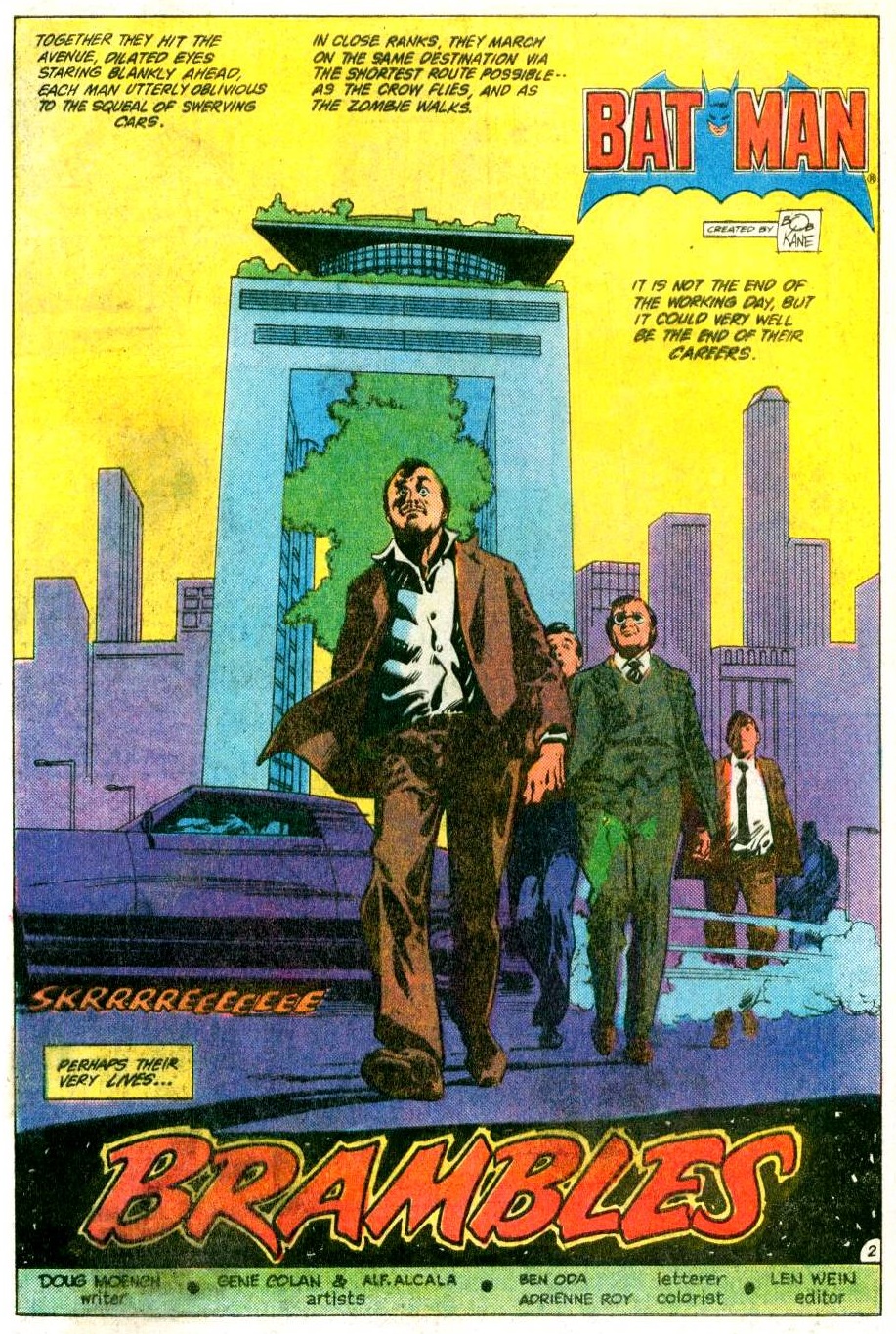
To a lesser degree, Peter Milligan’s earlier full-on Batman stuff – namely the ‘Dark Knight, Dark City’ story-arc in 1990 (Batman #452-454) and his run in Detective Comics the following year – also displayed this penchant for weirdness.

It is there from the start: in the first issue of Milligan’s run – the brilliant ‘The Hungry Grass’ (Detective Comics #629) – a criminal holds Gotham City for ransom with the help of a magical grass, only instead of money he demands that all citizens wear shirts inside out and blue mascara, that they say ‘Frank Sinatra sucks’ every ten minutes, and that they carry around pornographic books! (To be fair, given their history, Batman comics can withstand this level of surrealism better than many other superhero titles.)

Peter Milligan is usually paired with vibrant artists that keep up with his wild imagination (this is taken to a psychedelic extreme in his various collaborations with Brendan McCarthy). However, his initial issues of Detective Comics were illustrated by Jim Aparo, who had an old-school figurative style. Aparo’s deadpan approach created quite a curious – and sometimes creepy – contrast with Milligan’s odd little touches, like when the Caped Crusader fought a couple of sociopathic, multiracial conjoined twin hitmen called Two Tone:

Detective Comics #630Detective Comics #630

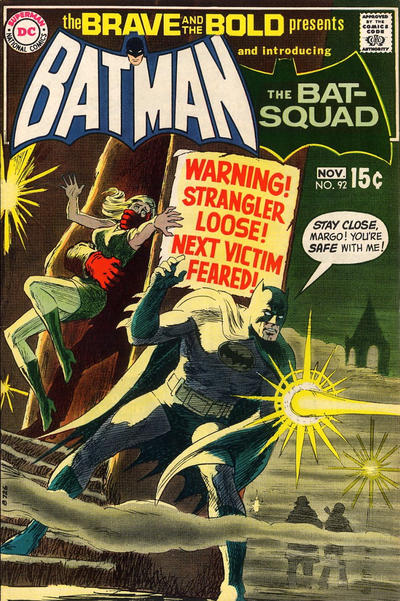
Jim Aparo’s art also evoked the Bronze Age of Batman comics, in the 1970s, when Aparo had drawn a ton of similarly outlandish tales written by Bob Haney, for the long-running series The Brave and the Bold.

This Bronze Age vibe was appropriate, since Peter Milligan wrote a fairly classical take on the Caped Crusader, uncontaminated by the trend towards depicting Batman as a dark, brooding psycho in the aftermath of Frank Miller’s The Dark Knight Returns and Tim Burton’s 1989 mega-blockbuster. Milligan’s Batman was certainly not trying to pass off as a mysterious urban legend (in fact, in Detective Comics #629 he even spoke on CBS News).

Moreover, over the years Milligan has joyfully played along with the notion that Batman is the World’s Greatest Detective and basically a Renaissance Man, or at the very least a versatile polyglot:

Batman 472Batman #472
Batman Confidential #32Batman Confidential #32

The relatively grounded, cavalier, and cerebral version of the Caped Crusader was ideal for the type of supernatural and/or psychological challenges Peter Milligan prepared for Batman. That said, the only time Milligan fully unleashed his brand of madness was in the mini-crossover ‘The Idiot’ (Batman #472-473, Detective Comics #639-640).

In this nightmarish saga, the hidden subconscious of four mental patients, bound together after consuming an Amazonian root, telepathically conjures a fifth personality – the titular Idiot, who tries to become more real by going on a mind-sucking rampage in Rio de Janeiro (and you thought things were bad enough in the lead-up to this year’s Olympics). In order to fight the villain on his terms, Batman eats some hallucinogenic root himself and enters the so-called Idiot Zone, with predictably trippy results:

Batman 473Batman #473

More recently, Batman made a couple of brief appearances in Justice League Dark, where Peter Milligan once again sought to work his typically twisted ideas into a recognizable superhero narrative. This was an OK series about a team of idiosyncratic heroes, but it suffered from too many characters and it didn’t live up to its initial promise of unhinged strangeness (in a single page of the first issue, a shower of books killed six people, cows gave birth to mechanical meat-slicers, and a power station was suddenly imbued with consciousness).

Still, it was worth it for moments like John Constantine’s entrance into a devastated Gotham City:

Justice League Dark 07Justice League Dark #7

I’ve stressed Peter Milligan’s knack for creating surreal, dream-like visions, but it would be unfair to imply that he is purely into bizarreness for bizarreness’ sake. In many of his best works, Milligan uses absurd fantasy or magical realism as a thought-provoking way to engage with his pet theme of identity crisis. For example, he did this in the wonderful – and shamefully overlooked – Vertigo mini-series Girl, London, and Egypt (he also did it, less successfully, in Terminal Hero and The Programme).

His Batman work is no exception. For christsake, one of Milligan’s stories is actually called ‘Identity Crisis’ (Detective Comics #633)! It’s the one where Bruce Wayne wakes up and finds out that the Batcave is no longer there and that he has never been Batman after all. When he realizes someone else is kicking butt as the Dark Knight, Bruce starts to wonder what being Batman even means at the end of the day… And yes, it’s the same premise as in the episode ‘Perchance to Dream’ from the Animated Series, but the final twist is much more of a mindfuck here. (Officially, the comic was an inspiration rather than the main basis for that episode, whose story is credited to Laren Bright and Michael Reaves. The final teleplay was by Joe R. Lansdale, who – it’s always worth remembering – besides having written his share of Batman prose short stories and novels, is also responsible for a novella about Elvis and a black JFK fighting a mummy.)

Peter Milligan even managed to shove the whole identity motif into the 2007 crossover The Resurrection of Ra’s al Ghul, a mindless adventure with all the manic energy and tongue-in-cheek orientalism of Carpenter’s Big Trouble in Little China. After co-writing the main story with Grant Morrison, Fabien Nicieza, and Paul Dini, Milligan did an epilogue called ‘The Suit of Sorrows’ (Detective Comics #842) about a suit that brought up the most violent instincts in those who wore it, forcing Batman to confront his own dark impulses.

The most memorable meditation on this topic, however, takes place in ‘Dark Knight, Dark City.’ This story-arc suggests that Gotham was modeled by the demon Barbatos, who was trapped underneath the city after an aborted ritual sacrifice in 1765 (in which one of the participants was Thomas Jefferson).

Batman 453Batman 453Batman #453

The notion of Gotham being *literally* demonic would show up time and time again – Garth Ennis played with it in The Demon, Grant Morrison revisited it in The Return of Bruce Wayne (once again linked to Barbatos). Yet ‘Dark Knight, Dark City’ also explores what this means for Batman, since his origin and personality have themselves been shaped by the city… The story culminates with Bruce, near the tombs of his parents, having the following internal monologue about determinism:

Gotham shaped me, in that it was on Gotham’s streets that you were killed… But was it the city or the demon? Accident or design? Environment? Zeitgeist? Biology? Demons?

I shake my head, breathe deeply, try to forget it. You’re born, and your history, your time, your place, is a mold into which you’re thrown… Does it make any difference if a few demons are behind it also? My parents are still just as dead. Gotham is still Gotham.

I am still… still whatever I am…

Peter Milligan’s existentialist musings were not limited to Batman himself, but to those around him. The sadly forgotten graphic novel Catwoman: Defiant featured a villain called Mister Handsome, obsessed with destroying beauty, in a clever tale about the significance of beauty in defining a person (for others as well as for oneself). In the New Year’s Evil one-shot ‘Mistress of Fear’ – which, like many of Milligan’s coolest comics, had lively art by Duncan Fegredo – the Scarecrow went after a girl who had been bullied, like him, but who refused to let it define her in the same way that he did. In ‘The Golem of Gotham’ (Detective Comics #631-632), Batman found himself between a Holocaust survivor and a gang of white supremacist kids – and, as usual, Milligan supplied plenty of twists, with each side’s motivations being less clear than what at first seemed. (It would be silly to compare ‘The Golem of Gotham’ to powerful graphic novels about the memory of the Holocaust like Art Spiegelman’s Maus or Rutu Modan’s The Property, but at the very least it reminds me of a biting issue of Martin Pasko’s and Rick Burchett’s pulpy Blackhawk run, called ‘The Needle Hand’).

Furthermore, in the terrific story-arc ‘Kid Amazo’ (JLA Classified #37-41), Frank Halloran, a philosophy student at Berkeley, had the mother of all identity crises when he found out that he was a cyborg programmed by the supervillain Amazo to destroy the Justice League of America.

JLA Classified 037JLA Classified #37

Leave it to Peter Milligan to pepper superhero slugfests with discussions about Nietzsche and Oedipus complex… In a neat turn, Frank’s inner conflict fed into the Justice League’s own internal crisis, as there was much arguing over whether to give Frank a chance to assert his human side or to just assume that his evil robotic legacy would inevitably take over. (Milligan’s humanist Batman took the former position.) And that was before they realized that not only did Frank have all the superpowers of the JLA, he also had all of their personalities, leading to a fascinating climax!

Finally, another aspect that is often present in Peter Milligan’s most accomplished – and, ironically, most timeless – works is a direct link to their social and political zeitgeist. Shade, the Changing Man burst with the fluid fears of early ‘90s America. Human Target channeled the post-9/11 paranoia. X-Statix captured reality TV culture and the cult of celebrity that enveloped everything from Princess Diana to Élian González. Milligan’s run on Hellblazer explored the contradictions of British history and society.

It is tempting to say that this dimension isn’t as prominent in Milligan’s Batman comics, with a few exceptions. I guess one could argue that 1991’s ‘The Bomb’ (Detective Comics #638), in which the military bring in the Caped Crusader to help them track down an escaped human bomb, is ultimately a metaphor for the disarmament debate at the end of the Cold War… However, there are a couple of more obvious examples.

One of them is ‘The Bat and the Beast’ (Batman Confidential #31-35), in which the Dark Knight traveled to early-2000s Russia (and no, despite the title and the setting, the story didn’t feature the KGBeast). After the initial culture clash, Batman seemed to gradually realize that Moscow was not that different from Gotham City after all…

Batman Confidential 31Batman Confidential #31

And, of course, there was 2013’s Legends of the Dark Knight arc ‘Return of Batman,’ in which we found out that Waynetech’s property portfolio was decimated by the company’s exposure to the sub-prime mortgage crisis. Hit by the economic downturn, the Caped Crusader now had to become much more cost-conscious.

Too bad that at the same time he also had to prevent Ra’s al Ghul’s latest attempt to unleash biological Armageddon upon Gotham City…

Legends of the Dark Knight 034Legends of the Dark Knight (v2) #34
Posted in WRITERS OF BATMAN COMICS | Tagged , , , , , , , , , | 3 Comments

Spotlight on The Shadow Strikes!

The mid-to-late ‘80s were the true golden age of comic books. For a few years, the industry was set on trying out all kinds of ideas and outright bombarding readers with one memorable comic after another, featuring both new and classic characters… For instance, take the Shadow, the big-nosed vigilante with a hypnotic girasol ring and a network of underground operatives at his command. After a having a go at an iconoclastic, cartoony present-day version of this crimefighter, DC shifted gears in 1989 and put out a series that was, essentially, the polar opposite of that.

And yet, in its own way, The Shadow Strikes! can be just as satisfying as its predecessor.

The Shadow Strikes! #1

The first obvious difference between the two takes is that the earlier one, launched in 1986 and written by Howard Chaykin and Andrew Helfer, was mostly set in the eighties, whereas The Shadow Strikes! went back to the Shadow’s roots in the Great Depression, rebooting the old property as a straightforward period piece.

The 1930s weren’t just a decor, but the very soul of the comic. It looks as if, before he sat down to work on TSS!, writer Gerard Jones came up with an extensive list of all the tropes and recognizable references related to this decade (later, he appears to have done the same regarding the 1950s for the mind-bending mini-series Martian Manhunter: American Secrets). Jones really mined the social turbulence of the Depression era for all its worth… Besides the usual stories about gang wars and racial intolerance, there was the whodunit ‘Crimson Dreams,’ which zoomed in on the politics of Hollywood’s old studio system, and the riveting ‘The Strike,’ which addressed the labor struggles of construction workers with the verve of a rocking unionist anthem.

(Not that it’s possible to completely escape your own time – after all, for all of The Shadow Strikes!’s commitment to immersing readers in a pre-Cold War past, I can’t help but detect in the thirties’ debates about military readiness and US-USSR rapprochement a distorted reflection of the concerns of the late eighties… And later on, a grand-scale storyline about oil business was clearly a nasty jab at the Gulf War!)

The list of cameos included Amelia Earhart, Mao Tse-tung, and even Gerard Jones’ own father. Moreover, Jones reverse-engineered nods to various works of fiction, from Chinatown (Jake, the cop in ‘Fireworks’) to Sullivan’s Travels (Sinclair Beckstein, the author of the play Oh Brother, Where Art Though?, in ‘To Cloud Men’s Minds’). In issue #29, guest writer Don Kraar and guest artist Dan Spiegle got in on the action as well, with a visual homage to the climax of Raiders of the Lost Ark.

Above all, Jones paid tribute to The Shadow’s pulps and to the radio drama voiced by Orson Welles, including a team-up between the violent, no-nonsense vigilante and a lively version of the future director of Citizen Kane… The joke was that the ersatz-Welles openly identified himself with the Shadow, given that they were both masters of disguise, surprise, and choreographed misdirection. The issue (#7) even culminated in a transparent riff on the hall of mirrors’ scene from Welles’ The Lady from Shanghai (a film that looks gorgeous but whose plot doesn’t make a lick of sense).

The Shadow Strikes #7     Shadow Strikes #17     The Shadow Strikes #16

In fact, just like the recent Fargo TV show has expanded beyond its initial influence and become a love letter to the Coen brothers’ entire oeuvre, The Shadow Strikes! also feels like it went way beyond Orson Welles’ radio show, bringing to mind many of his greatest works from later decades. There’s Mr. Arkadin’s frenetic, globetrotting intrigue, The Immortal Story’s orientalist tinge, F for Fake’s metafictional games, The Trial’s breathtaking visuals, Touch of Evil’s hypnotic trifecta of film noir, gothic motifs, and psychological horror…

Touch of Evil seems particularly suited for comparison. After all, on paper, that project probably sounded like just another hardboiled 1950s’ crime flick, with subplots about dirty cops (Where the Sidewalk Ends, Shield for Murder, Rogue Cop), racism (Odds Against Tomorrow, Bad Day at Black Rock, The Killing), and threats to the hero’s family (The Big Heat, The Desperate Hours, Crime Wave), but Welles’ baroque direction created an unique masterpiece. Likewise, while The Shadow Strikes! might sound like just another potboiler, the series was significantly lifted by its ‘director’ – artist Eduardo Barreto, who drew most of the early issues.

Ed Barreto drew inspiration from 1930s’ adventure comics by the likes of Milton Caniff and Noel Sickle, adopting a luscious style that couldn’t be farther from the exaggerated, whimsical art of Bill Sienkiewicz and Kyle Baker in the previous Shadow series. Credit for TSS!’s panache should also go to the palette of colorist Anthony Tollin (an unabashed fan of the Shadow who provided text pieces about the character’s various media adaptations in the back matter).

For a sense of the vicious gravitas of Barreto’s art, check out this sequence where the Shadow beheads Rasputin (with chilling sound effects courtesy of letterer David Cody Weiss):

shadow strikes 04shadow strikes 04The Shadow Strikes! #4

(Halfway through the series, Rod Whigham took over the pencils, mostly inked by Gerry Fernandez. Their storytelling wasn’t quite as strong as Barreto’s, but they nailed the moody feel of the comic.)

The gritty visual style speaks to another, more general contrast between The Shadow Strikes! and its immediate predecessor. While Howard Chaykin and Andy Helfer had approached the material as a wacko comedy (Chaykin was just off the satirical American Flagg! and Helfer was the editor of the bwahaha era of Justice League International), Gerard Jones seemed to be consciously avoiding any sense of irony. His take on the Shadow was as earnest as it gets – a two-fisted yarn packed with desperate people scheming and stalking and double-crossing each other at every turn. Notably, not only did Jones treat the protagonist’s different alter egos (high society snob Lamont Cranston, WWI pilot Kent Allard) with respect, he also did a fine job of humanizing the Shadow’s agents, especially the plucky socialite Margo Lane, whose mysterious past kept providing interesting twists almost until the end.

All in all, TSS! was one mean, unashamedly dark series, featuring brutal thrills, cynical political intrigue, and more than a couple of instances of implied sexual abuse. Unlike other revamps from this era (like Green Arrow), however, this was less a mature reimagining of a juvenile franchise than a return to its grim origins, sharing much of the spirit of Walter B. Gibson’s vintage stories.

That said, The Shadow Strikes! was not entirely devoid of humorous touches:

Shadow Strikes AnnualShadow Strikes AnnualThe Shadow Strikes! Annual #1

In terms of pure fun, one of the coolest tales – and a fairly obvious editorial move – involved The Shadow Strikes! crossing over with DC’s reboot of another pulp hero from the ‘30s. Denny O’Neil had revamped the muscular scientist Doc Savage, first in a neat 1987 mini-series and then in an ongoing that opened with a no-holds-barred saga about moon aliens manipulating the Cold War. By the time TSS! debuted, Mike W. Barr had taken over the writing chores from O’Neil. Barr’s run wasn’t as remarkable – much of it just focused on bringing back old characters – but there were a few inspired moments (I quite enjoyed the annual about the 1936 Olympics).

Co-written by Gerard Jones and Mike Barr, the four-part ‘The Conflagration Man’ brought together the two adventurers and their respective teams in a quest to prevent a powerful ray-gun from falling into the hands of a megalomaniac arms manufacturer. Jones and Barr crafted an elaborate chess game of a story, with the plot twisting and turning as the large cast moved on multiple fronts. And, naturally, much was made of the contrast between the leading heroes – indeed, shortly after crossing paths, Doc Savage tried to lobotomize the Shadow!

After the obligatory initial clash, the two characters began to bond, although not without a degree of one-upmanship:

shadow strikes 06shadow strikes 06The Shadow Strikes! #6

To be sure, not all stories were equally engaging, but even when the plotting grew more uneven the pulpy ‘30s atmosphere was still enough to carry the comic (the same thing applies to Dave Stevens’ The Rocketeer – which includes a Shadow guest-appearance – and to Matt Wagner’s Sandman Mystery Theatre).

There have been other Shadow comics since then (the best-looking being ‘Hell’s Heat Wave,’ illustrated by Gary Gianni), but my curiosity was particularly prickled four years ago, when I heard that Garth Ennis was going to write the latest relaunch of the character, for Dynamite. Given that Ennis is just as comfortable doing racy slapstick as doing straight-faced grit, I wondered which version we were going to get, the ’86 one or the ’89 one… Well, his version (collected as ‘The Fire of Creation’) sure felt like a worthy heir of The Shadow Strikes!, albeit way more hardcore. Set in occupied China in the late 1930s, the comic benefited from Ennis’ flair for historical insight. It also indulged in many of his favorite tropes, like the long stretches of witty repartee or the inclusion of unredeemably despicable villains that just make you root for their bloody comeuppance after every page. And just in case you have any doubts about the comic’s ruthlessness, you get one of those typical Ennis moments when a supporting character realizes that he’s not in your run-of-the-mill escapist fiction:

The Shadow 05The Shadow #5
Posted in HARDBOILED CRIME | Tagged , , , , , , , , , , , , , , , , | Leave a comment

Spotlight on Greyshirt

If you read the last posts, you know that this month I’ve been discussing eccentric vigilante comics.

Hence Greyshirt.

Greyshirt Indigo Sunset

I have little doubt that the seeds for Greyshirt grew from Alan Moore’s contributions to The Spirit: The New Adventures, in which Moore became one of the many creators that tried to revive Will Eisner’s The Spirit. Except for the sake of nostalgia, this was a pointless exercise, since what made the original comic so amazing wasn’t the Spirit himself or his world, but rather Eisner’s willingness to play with the medium’s potential for storytelling. Either because Moore acknowledged this or because The New Adventures was cancelled and he could no longer work directly with Eisner’s hero, in the late 1990s the bearded British genius decided to create his own version of the character in the form of Greyshirt.

A masked vigilante whose secret identity (Franky Lafayette) was left for dead and who now operates out of the retro-futuristic Indigo City, Greyshirt is a blatant knockoff of the Spirit, but like I said the point isn’t the character – it’s the type of stories he finds himself in. And sure, there is a clear element of pastiche (the way Greyshirt is often a background player in the narrative, the way each first page integrates the credits into the art). However, Moore and Greyshirt’s artist/co-creator Rick Veitch pull off what most official revamps of The Spirit have failed to achieve, which is to deliver comics that push the techniques of storytelling in ways that are as original, smart, and entertaining as what Will Eisner did. In that sense, Greyshirt transcends the mere pastiche, thus truly paying tribute to Eisner’s legacy.

For example, take ‘Hit and Run!’ (Tomorrow Stories #7), drawn entirely with the same POV, from the back of a taxi cab. Or take ‘How Mel Got Down With Science Hero Style!’ (America’s Best Comics 64 Page Giant), which tells a hardboiled yarn through clothing advertisements. Or better yet, take the phenomenal ‘How Things Work Out’ (Tomorrow Stories #2), in which each page shows you the inside of a building owned by gangster Spats Katz, with each floor corresponding to a different time period:

Tomorrow Stories 02Tomorrow Stories #2

It’s ingenious enough that one can pretty much read ‘How Things Work Out’ in various directions – for instance, you can read the saga of each floor at a time, flipping back and forth to the first page, perhaps starting with the ground floor and then moving up chronologically. Yet if you do follow the conventional reading order the narrative is even more rewarding, not only because panel transitions are structured around wordplay, but also because you get a greater sense of the characters looking back (down) to the past, which further deepens the comic’s theme. And all this in eight pages! (Well, nine if you count the issue’s cover.)

Greyshirt’s early adventures were all similarly short (again, like Will Eisner’s The Spirit). They came out in America’s Best Comics’ awesome anthology Tomorrow Stories, alongside series with completely different styles, including the experimental erotica The Cobweb and three hilarious variations of Mad-like, anything-goes absurdity: Jack B. Quick, The First American, and Splash Brannigan.

In the case of Greyshirt, the overall tone oscillated between film noir and The Twilight Zone. If you’re into the former, look no further than Greyshirt’s very first story, told from the perspective of an amnesiac who realizes he is a hunted serial killer (amnesia is, of course, a classic noir trope and I suspect Eisner himself must have been visually influenced by films like Crack-Up and Spellbound). For the latter, check out the knockout twist ending on ‘Day Release’ (Tomorrow Stories #6). And for something more outside the box – and proof that Moore’s off-color comedy was never far behind – have a look at the insane production number in ‘Greyshirt the Musical!’ (Tomorrow Stories #9):

Tomorrow Stories 09Tomorrow Stories #9

Greyshirt spun off from Tomorrow Stories into his own mini-series, Greyshirt: Indigo Sunset, now fully written by Rick Veitch (except for the goofy 6-page ‘The Butt Kicks Back!’ by Dave Gibbons). Veitch is an interesting writer with an encyclopedic knowledge of old comics, a knack for the macabre, and the courage to pursue bafflingly strange story ideas. And while his dream diaries and truther one-shot may not appeal to everyone, Veitch has produced his fair share of cult classics, including The One and his run on Swamp Thing, as well as unsung gems like the poetic post-9/11 graphic novel Can’t Get No or the War on Terror satire Army@Love.

In Indigo Sunset, Veitch built upon the short origin story told in ‘The Making of Greyshirt’ (Tomorrow Stories #3), expanding Franky Lafayette’s pre-Greyshirt background while also developing several supporting characters who had popped up in the regular series. This was basically a gangster saga, but with an eerie horror threat in the form of the Lure – a hypnotic tentacle monster that haunted Indigo City’s mine shafts.

The mini-series was a narrative tour de force, as each issue featured tales and vignettes from different eras that were gradually woven together into one massive tapestry. Even the misleading covers were cleverly integrated into the whole. Moreover, Rick Veitch, in full command of his craft, drew on the aesthetics and tropes of multiple comic traditions, such as children’s strips, romance comics, and down-and-dirty crime tales. Hell, he even included a takeoff of Scott McCloud’s Understanding Comics!

Indeed, Indigo Sunset was ultimately a metafictional love letter to the rich history of the medium, from Tijuana bibles to comics’ ironic appropriation by pop art. Not only that, but Veitch also sneaked in quite a few nods to other series published by America’s Best Comics (Top Ten, Promethea, Tom Strong) as well as to earlier Greyshirt adventures. Notably, the second issue was packed with winks to the above-mentioned ‘How Things Work Out,’ including a page that revisited that story’s layout of the interior of Spats Katz’s building:

greyshirt - indigo sunset 2Greyshirt: Indigo Sunset #2

In yet another meta move, each issue finished with a bunch of pages from the local newspaper Indigo City Sunset, including news stories, gossips, an opinion section, a sports page, adverts, horoscopes, entertainment news, an amusing advice column, and, of course, a number of old-school comic strips. Not only did these newspaper excerpts help provide exposition, they also developed the various subplots (especially if you read between the lines) and rewarded fans with Easter Eggs. Plus, they further fleshed out the history and everyday life of Indigo City – it is not going too far to say that in six issues Rick Veitch managed to give the place as distinctive a personality as that of comic cities like Astro City or Opal City (not to mention Gotham!).

Neatly, Greyshirt shared Indigo City with another masked vigilante from the pages of Tomorrow Stories – the Cobweb. Created by Alan Moore and Melinda Gebbie, the voluptuous Cobweb and her sidekick Clarice were a couple of adventuresses whose tales apparently span centuries (later, a couple of gorgeous specials written by Steve Moore explained that they belonged to a long lineage of parthenogenetically-produced daughters). As such, this duo were the most versatile characters in Tomorrow Stories, starring, for example, in the noirish ‘Eurydice: A Retrospective’ (Tomorrow Stories #3), with its purple prose worthy of an old pulp mag; in the existentialist ‘La Toile dans le Chateau des Larmes’ (Tomorrow Stories #5), with its surrealist collage; in the newspaper serial pastiche ‘Brand New Adventure Starts Today!’ (Tomorrow Stories #8), with its cartoonish humor; and in the underground comix spoof ‘Ye Head Shoppe’ (Tomorrow Stories #7), with its over-the-top satire of the limits of women’s liberation in the 60s’ counterculture.

Such a wide range of styles benefitted from the fact that the talented Melinda Gebbie was involved in most Cobweb stories, providing incredibly diverse art to suit each particular type of comic:

Tomorrow Stories 05Tomorrow Stories #5
tomorrow stories 08Tomorrow Stories #8

It was all written with a naughty tongue in cheek, especially the twisted ‘Li’l Cobweb’ (Tomorrow Stories #4), which wickedly pushed the subgenre of kid comic strips like Little Lulu into the fucked up world of grown-ups. (That said, Alan Moore and Melinda Gebbie didn’t go nearly as far as they did in their critically acclaimed sex comic Lost Girls.)

Given the Cobweb’s kinky promiscuity and Greyshirt’s habit of falling for the wrong dame, you get no points for guessing what happened when those two finally crossed paths under the Indigo moon…

But let me finish by returning to Will Eisner, whose groundbreaking work on The Spirit was an acknowledged inspiration for Greyshirt. In the last comic they did together with the character, Alan Moore and Rick Veitch fully blurred the line between the two universes – ‘A Greyshirt Primer’ (Tomorrow Stories Special #1), published after Eisner’s death, was a moving homage to the master, done in the style of one of his primer stories and featuring a ton of references to his works:

tomorrow stories specialTomorrow Stories Special #1
Posted in HARDBOILED CRIME | Tagged , , , , , , , , | Leave a comment

Spotlight on Foolkiller

As I explained last week, this month is all about vigilantes operating outside of Gotham City. Last July, I addressed obvious series about street justice like The Punisher and Vigilante, but this time around I’m focusing on more off-kilter comics.

Well, they don’t come much more off-kilter than Foolkiller.

Foolkiller

Cult favorite writer Steve Gerber first introduced the concept of Foolkiller in 1974, during his trippy run on the horror series The Man-Thing. It started out as one more drop in Gerber’s endless flood of wild ideas – a throwaway villain amusingly riffing on the era’s trend of reactionary vigilante fiction.

In ‘Day of the Killer, Night of the Fool!’ and ‘The Making of a Madman!’ we met a religious crusader who felt compelled by the Lord to drive around in a red convertible and incinerate anyone he considered a ‘fool’ with his weird ray gun. Artists Val Mayerick and Jack Abel illustrated his epic entrance:

man-thing 03The Man-Thing #3

Typically, Gerber soon adorned the character with all sorts of outlandish touches. The Foolkiller – later identified as Ross Everbest – was a military enthusiast (he idolized his parents, who had died in World War II and Korea) and his secret origin involved going berserk over the hippie protests against the Vietnam War. What’s more, Everbest had been born a cripple and had been healed by the evangelist Reverend Mike Pike, who became his mentor. One day, Everbest found Reverend Mike with a prostitute, so he beat the preacher to death and built him a shrine. He now consulted Mike’s corpse (preserved in formaldehyde) for guidance.

As if this wasn’t idiosyncratic enough, the Foolkiller’s modus operandi involved giving his intended victims a card, allowing them 24 hours to stop being foolish:

the man-thing 03The Man-Thing #3

After trying to kill the cast of The Man-Thing, this version of the Foolkiller met his end when a blast from his purification pistol shattered Reverend Mike’s tomb and a plexiglas shard pierced his heart. Irony!

Three years later, Steve Gerber briefly revived the concept in the classic superhero series Omega, the Unknown, in which a poet called Greg Salinger tracked down the original Foolkiller’s weapons and costume. Salinger secularized the Foolkiller’s mission, now going after those who didn’t share his poetic sensibilities. It was a delightfully kooky concept, but sadly the series was soon cancelled.

Yet the best was still to come. In 1990/1991, Gerber finally had the chance to fully develop Greg Salinger when he did a brilliant 10-issue Foolkiller comic…

foolkiller 02foolkiller 02Foolkiller #2

Like all of Steve Gerber’s greatest works, Foolkiller has an offbeat vibe that defies easy characterization. There are elements of blatant parody and the protagonist’s strange disguises are clearly played for chuckles, but this is spliced with very dark overtones and an earnest engagement with social and existential questions. In a way, this is Gerber’s version of the ‘gritty reboot’ trend taking place in the aftermath of The Dark Knight Returns, with deadly serious takes on even the most ludicrous characters. Or maybe the project started out as a satire of this trend, but Gerber is so good at writing about alienation that he couldn’t help himself (a decade later, he would go on to successfully mix high school angst and prison drama in Hard Time).

I cannot stress enough how unique and captivatingly odd the whole thing feels. To make matters even more ambiguous, J.J. Birch’s moody art – inked by Tony DeZuniga and Vincent Giarrano, colored by Greg Wright – plays it completely straight. The result is compelling as hell!

More than Greg Salinger (who had been committed to a mental institution), the real star of the series was Kurt Gerhardt, an average guy downtrodden by society who was inspired by a televised interview with Salinger into becoming the next Foolkiller. At first, Kurt’s forays into vigilantism only managed to make him even more miserable: he either botched his attacks or spent time agonizing because the media didn’t understand his peculiar mission. Kurt eventually grew into the role, although not before a memorable training montage:

Foolkiller 04Foolkiller #4

And certainly not before he started donning a freaky S&M mask:

Foolkiller 05Foolkiller #5

As you can tell from the passages above, especially the war diary, there was more than a wink at the wave of Punisher comics coming out at the time. Indeed, it’s cool that Marvel put out what was in many ways an anti-Punisher series, as Foolkiller took a similar concept yet removed most of the action, preferring to focus on deeper issues and touching slices of life (the scenes where Kurt loses his job and marriage are genuinely heartbreaking… and a whole subplot at the Burger Clown fast food joint creates a relatable, lived-in microcosm).

Not that Gerber’s comic was a straightforward, moralistic rebuttal of vigilante fiction. It didn’t shy away from rubbing our faces in the genre’s primordial appeal (for example, when Kurt took down a wife-beater), but it problematized it in a thoughtful manner, making the most out of the vague and ultimately silly nature of the word ‘fool’. Unlike Frank Castle, who is always resolute and clear-minded about his war on crime, Kurt Gerhardt was in a permanent state of crisis. He gradually realized that most people were fools in one way or another – from drunk drivers to employees of credit card companies – and that, once he accepted the possibility of killing them, it was hard to draw a clear line about who did or did not deserve his punishment… It didn’t help that at one point he was attacked by a child and had to figure out at what age people changed from victims into fools.

And just when you thought things couldn’t get more morally complicated, this happened…

Foolkiller 8

In the wonderfully mystifying ‘42 Days’ (Foolkiller #8), the Foolkiller tries to wrap his head around society’s frustration with the Gulf War. He finds fools on all sides of public debate, vaporizing demonstrators and pundits – and also going after anti-toy activists!

This fed into the series’ momentum towards increasingly uncertain political territory. Not only did Kurt expand his targets from street gangs to Trump-like corporate fat cats, he kept branching out – at one point, he even decided to deal with the issue of political correctness in college campuses. Between all this and the early nineties’ socio-economic concerns, Foolkiller serves both as an interesting time capsule and as a depressingly resonant work in today’s world. In fact, in many ways you can easily make the case that the series was well ahead of the curve, uncannily anticipating the themes of more popular, recent comics.

To be sure, you can make that claim about much of the output of Steve Gerber, who produced some of the most fascinating comics out there. While other creators have told fine stories with the Foolkiller, so far none has taken the concept into such unexpected and challenging directions!

Amazing Spider-Man 225     Foolkiller MAX     Deadpool 4

Posted in HARDBOILED CRIME | Tagged , , , , , , , , , | Leave a comment

Spotlight on The Shadow

Every once in a while, I like to shift gears and spotlight comics or films set outside Gotham City that Batman fans should nevertheless enjoy because they are close to the mood of the world of the Dark Knight. Once a year, I take this one step further and devote a whole month to comics about vigilantes who don’t dress as bats yet also kick plenty of ass!

Despite some overlap with superhero stories, vigilante fiction is its own little beast, rooted in specific fictional rules, political ideals, and a viscerally satisfying (yet highly problematic) appeal. With this in mind, this year I want to take a look at what happens when this brutish subgenre is taken up by some of the quirkiest comic book authors out there

Let’s get things started with DC’s deranged revamp of The Shadow in the ‘80s.

The Shadow

Created by Walter B. Gibson in 1930, the Shadow is a remorseless vigilante who wages war on criminals with all guns blazing (literally), assisted by hypnotic abilities as well as a network of agents working for him. Besides being a huge influence on the original conception of Batman, this character has left a direct mark on pop culture, with his stylish look, his ominous laugh, and signature lines such as ‘Who knows what evil lurks in the hearts of men?’ or ‘The weed of crime bears bitter fruit. Crime does not pay… The Shadow knows!’

In the 1970s, Denny O’Neil wrote a Shadow comic series, breathtakingly illustrated by Mike Kaluta, Frank Robbins, and E.R. Cruz. O’Neil also worked the Shadow into the DC Universe by having him cross paths with the Caped Crusader in a couple of Batman issues These were spiffing adventure yarns whose tone was unabashedly pulpy (with a dash of noir), paying homage to the feel of the character’s earlier prose and radio tales.

the shadow 1      the shadow 10      Batman 253

A decade later, DC took a risk and let Howard Chaykin loose on the property, resulting in an unforgettable 1986 mini-series, later collected as Blood & Judgment. The 35-year-old Chaykin had just reached a career high point with the cyberpunk critical darling American Flagg! and seemed determined continue blowing the minds of anyone who dared read his stuff. As he explained to The Comics Journal at the time, Chaykin was not a big fan of the political and moral attitudes associated with the Shadow, so he set out to reinterpret the character through tongue-in-cheek myth-debunking, taking advantage of DC’s carte blanche to go wild.

It should therefore come as no surprise that Blood & Judgment was fairly controversial. When it debuted, the series was DC’s biggest hit (next to The Dark Knight Returns), but it drew a lot of flak for its violence, sex, and iconoclastic approach to the franchise. Howard Chaykin radically revised the Shadow’s origin and established that, even though he had been around since the pre-WWII era, by the eighties this sardonic vigilante still looked as young as ever as he viciously fought crime with a pair of Uzi submachine guns (instead of the usual pistols).

And just to make sure he pissed off as many fans as possible right off the bat, Chaykin devoted most of the first issue to killing off the Shadow’s former agents, dispatching beloved characters in gruesome ways:

shadowThe Shadow (v2) #1

Howard Chaykin’s free-for-all iteration of the Shadow made no apologies for his bloodthirstiness or male chauvinism. This was not a retcon as much as a logical extrapolation: after all, although he had preserved his youth, in the story the Shadow was still a product of the early 20th century… That, plus the fact that he had been isolated from the world (in the mystical scientific utopia of Shambala) since 1949, meant that he had hardly kept up with the times, including the latest views on heroic justice and sexism.

In fact, one of the themes running through the mini-series – indeed, through many Chaykin comics – was precisely the contrast between old values and modern times…

shadow 3The Shadow (v2) #3

So yes, Blood & Judment is a very Chaykin kind of comic, for better or worse. There is incredibly convoluted plotting, with the megalomaniac villain carrying out an elaborate plan that at one point involves threatening to nuke New York City as part of a quest to achieve eternal youth. The series has loads of characters and plenty of stuff taking place at the same time, creating a deliberately disorienting reading experience. With its sharp visuals and dazzling compositions, however, it does look terrific (although Chaykin definitely has to share credit for this with colorist Alex Wald). And, needless to say, the whole thing is gleefully raunchy… Hell, one of the subplots concerns the old, wheelchair-bound villain’s habit of having sex with a lunatic trophy wife via his laboratory-created congenital idiot son, whose body he controls via telekinesis!

While Howard Chaykin moved on to his next project (a similarly provocative revamp of Blackhawk), the editor of Blood & Judgment, Andrew Helfer, took the comic’s concepts and churned out an ongoing series set in the same over-the-top reality. Now edited by Mike Carlin, the series was written by Helfer and, at first, illustrated by Bill Sienkwiewicz, who delivered the kind of eccentric art such a comic deserved…

shadow 1The Shadow (v3) #1

Andy Helfer threw everything at the reader, kitchen sink and all. The first arc, ‘Shadows and Light,’ included at least four interlinked major villains, each with a different evil agenda, ranging from personal revenge against the Shadow to an attempt to prevent the return of Taiwan to communist China. Sure, it was a confusing mess – the pages were wordy and cluttered, the plots were overcrowded, meandering, and not always easy to follow… Still, I have a soft spot for this type of surrealist chaos!

Besides sticking to Blood & Judgment’s darkly comedic spirit, Helfer brought back Chaykin’s creations such as Lamont Cranston’s half-witted clone, the Shadow’s super-powered sons Hsu-Tei and Ching Yao Chang (with their nifty flying car), and the manager of his new network of operatives, Lorelei (who was connected to an iron lung and assisted by trained monkeys). Best of all, Helfer continued to develop the mini-series’ depiction of Inspector Joe Cardona as an uproariously cranky, hard-bitten old cop.

The large and often grotesque supporting cast was more fascinating than the titular hero, whom Andrew Helfer never bothered to make all that relatable or even likable… One of the subversive running gags was precisely the fact that the Shadow ran his network of agents like a despotic boss who just happened to be in the business of slaughtering criminals. And as if that wasn’t mean enough, the Shadow died in the second half of the series and spent the last handful of issues as an increasingly mutilated corpse.

What’s more, starting in issue #8, Kyle Baker became the regular artist. This was a smart move: Baker is one of the funniest comic creators out there, both as an artist and as a writer (for example, he did the hilarious You Are Here and The Cowboy Wally Show, not to mention his masterpiece Why I Hate Saturn). As The Shadow’s own credits put it, Baker brought ‘a healthy dose of perverse enthusiasm’ to the project.

the shadow 08The Shadow (v3) #8

To be fair, the series did lose some steam after a while, although it picked up momentum again towards the end. More than the flaws, however, it’s the high points that stick in my mind…

I’m particularly fond of ‘Fragment of the Sun,’ the prologue to the first arc, which was published in The Shadow Annual #1, with pencils by Joe Orlando. Set in the late ‘40s, this issue has a lot of fun with the paranoia of the early atomic era, as the Shadow and his crew go up against a religious cult of nuclear power that tries to subliminally spread its gospel through television. The second annual is quite strong as well – it’s an amusing pastiche of Citizen Kane, dedicated to Orson Welles (who voiced the Shadow in the 1937 radio show).

Also cult-worthy, ‘Harold Goes to Washington’ (issue #7), drawn by the wonderful Marshall Rogers, tells the twisted story of a schoolkid who wants so badly to become a war hero that he is willing to assassinate Ronald Reagan just because the president promised to usher in world peace. And in ‘A Town Called Malice’ (issue #15), the Shadow’s bumbling sons stumble into a town on the outskirts of China that serves as a haven for all sorts of criminals yet has its own peculiar brand of justice:

the shadow 15the shadow 15The Shadow (v3) #15

Andy Helfer and Kyle Baker went on to do the underappreciated mini-series Justice, Inc., where they gave the same cartoonish treatment to another classic pulp hero: in this mini, the Avenger (a master of disguise who had also shown up in a couple of issues of The Shadow) starts working for the US secret services, impersonating and toppling third world leaders, and ends up trying to shift the whole paradigm of Cold War politics. It’s a poignant, gonzo satire (even though it’s final punchline doesn’t go as far as the similar Elektra: Assassin) that remains criminally uncollected.

Between Justice, Inc., The Shadow, and Denny O’Neil’s revamp of Doc Savage (which also brought the titular character into the eighties), this was a fun era in which DC seemed willing to let creators drastically tear apart and rebuild old properties, nostalgia be damned.

justice, inc     the shadow 10     doc savage 1

Almost thirty years after his first take on the Shadow, Howard Chaykin returned to the character with the mini-series Midnight in Moscow, an international adventure set in 1949. Clearly a product of an older, melancholic author, this is a more uninspired, clichéd tale that lacks the manic energy of Blood & Judgment, even if it does feature a number of beautiful passages.

Meanwhile, the kind folks at Dynamite Entertainment have collected the two Chaykin minis as well as Helfer’s run, labeled The Shadow Master Series (although sadly without the annuals). So if you ever tire of portentous stories about whiny and brooding heroes, you can now easily get your hands on a crime comic that, refreshingly, doesn’t take its protagonist all that seriously…

the shadow 12The Shadow (v3) #12
Posted in FANTASTIC ADVENTURES | Tagged , , , , , , , , , , , , , | Leave a comment

Batman HATES guns

I’ve explained before why I don’t think Batman should use firearms. Given how much attention the gun debate has been getting of late, however, perhaps it is a good time to take a closer look at how strongly the Dark Knight feels about this issue.

Batman hates guns. It’s not just that he objects to lethal force… He passionately loathes handguns and the people who carry them, especially when they’re pointing the darn things at him:

The Untold Legend of the Batman #2The Untold Legend of the Batman #2
Detective Comics 457Detective Comics #457

Given Batman’s origin, this hatred is a key aspect built into the blueprint of the character. After all, here is someone who is above all motivated by the tragedy of seeing his parents gunned down in front of him. Every time the Caped Crusader punches out a crook with a gun, you can tell he is somehow also fighting back against the man who shot his parents.

One writer who is particularly fond of using Batman’s trauma as subtext is the reliably great Ty Templeton:

Batman & Robin Adventures 04Batman & Robin Adventures #4
Batman & Robin Adventures 07Batman & Robin Adventures #7
Batman & Robin Adventures 14Batman & Robin Adventures #14
Batman & Robin Adventures 20Batman & Robin Adventures #20

These are pure Batman moments. And that’s the thing: I can root for cowboys and vigilantes who shoot everyone that get in their way (more on this next week!) and I sure can get a huge kick out of a grim crime flick like the original Get Carter, with its relentlessly violent, gun-wielding anti-hero… But when I’m reading Batman comics, I want to see the protagonist rise above his enemies and prove that he is way cooler than some jerks who assert their power with deadly weapons.

Most of all, like I said, this stuff works because it is true to the character. Indeed, after hinting at it for years during his peerless run on the Adventure books, Ty Templeton finally delved into the guns’ deeper meaning for the Dark Knight in an issue where Batgirl decided to start carrying a pistol. (Oh Barbara, if only you knew what happened to your counterpart in the regular DC Universe…)

Gotham Adventures 9Gotham Adventures #9

This is such a powerful scene, not only because Templeton nails Batman’s intense tone, but also because of the close-up on his somber expression (by the artistic dream team of Rick Burchett and Terry Beatty) and the super-moody coloring (by Lee Loughridge and Zylonol).

John Ostrander also wrote a similar scene in Seduction of the Gun, a deftly handled slice of agitprop focusing specifically on gun violence (with looser art, by Vince Giarrano):

seduction of the gunSeduction of the Gun

To be fair, one of the reasons the Dark Knight doesn’t use firearms is because he doesn’t really need them anyway. After all, he is a scary, virtually infallible badass ninja! Also, he has a whole arsenal of sci-fi gadgets at his disposal… So yeah, I’m willing to admit it’s a bit disingenuous to say that Batman ‘uses only the decent weapons of outrage and indignation,’ even if it does make for a pretty neat line:

detective comics 417Detective Comics #417

Still, this doesn’t erase the fact that a dyed-in-the-wool aversion to guns is an important dimension of the Caped Crusader.

In the mid-1980s, Michael Fleisher built on that side of the character in a fascinating way. The completely unhinged series Hex told the wild exploits of bounty hunter Jonah Hex after he traveled from the 19th to the 21st century, landing smack in the middle of a post-apocalyptic dystopia. This version of New York City was home to a new Batman who didn’t allow firearms of any kind in his town… He fought a local crime syndicate called the Combine and you bet your ass his headquarters were in the goddamned Statue of Liberty:

Hex #11Hex #11Hex #11

The new Batman had been a world-class gymnast and a doctoral candidate in criminology at the John Jay College of Criminal Justice who idolized the original Caped Crusader and had been researching a thesis on his career when thermonuclear war broke out (he was actually doing research down in the Batcave when the bombs went off, killing one hundred and fifty million people). Readers didn’t learn his full name, but it was clear that his last name was Cohen and he was Jewish.

Cohen’s mother had been a rabbi who campaigned tirelessly for handgun control and his father had served as a top-level disarmament negotiator. They had been killed by an organization of fanatics – the National Reconstruction Alliance (yep, NRA) – who had focused their hatred on advocates of gun control and Jews. So their son had taken the mantle of Batman ‘to help bring back the civilized values they’d believed in.’

Hex #11Hex #11

When doing alternate versions of the Dark Knight, creators such as Brian Azzarello or Zack Snyder have gone with the uninspired twist of making him a gun-packing mean bastard, but Michael Fleisher went in the opposite direction, giving us a Batman that not only hated guns, but was thoroughly defined by that hatred. Sadly, Fleisher never got around to telling us much about this Batman’s adventures, although at least we got to see him team up with Jonah Hex to fight gargantuan killer robots in a futuristic New York City…

And speaking of comics that are totally bonkers, let me finish by saying that, while the sight of Batman holding a gun can often suck the fun out of a comic, I’m obviously willing to open an exception for old school goofy covers. In my book, those can get away with anything….

World's Finest 240         World's Finest 195

Posted in GOTHAM CITIZENS | Tagged , , , , , , , , , , | 3 Comments

3 sleek fights by Bret Blevins

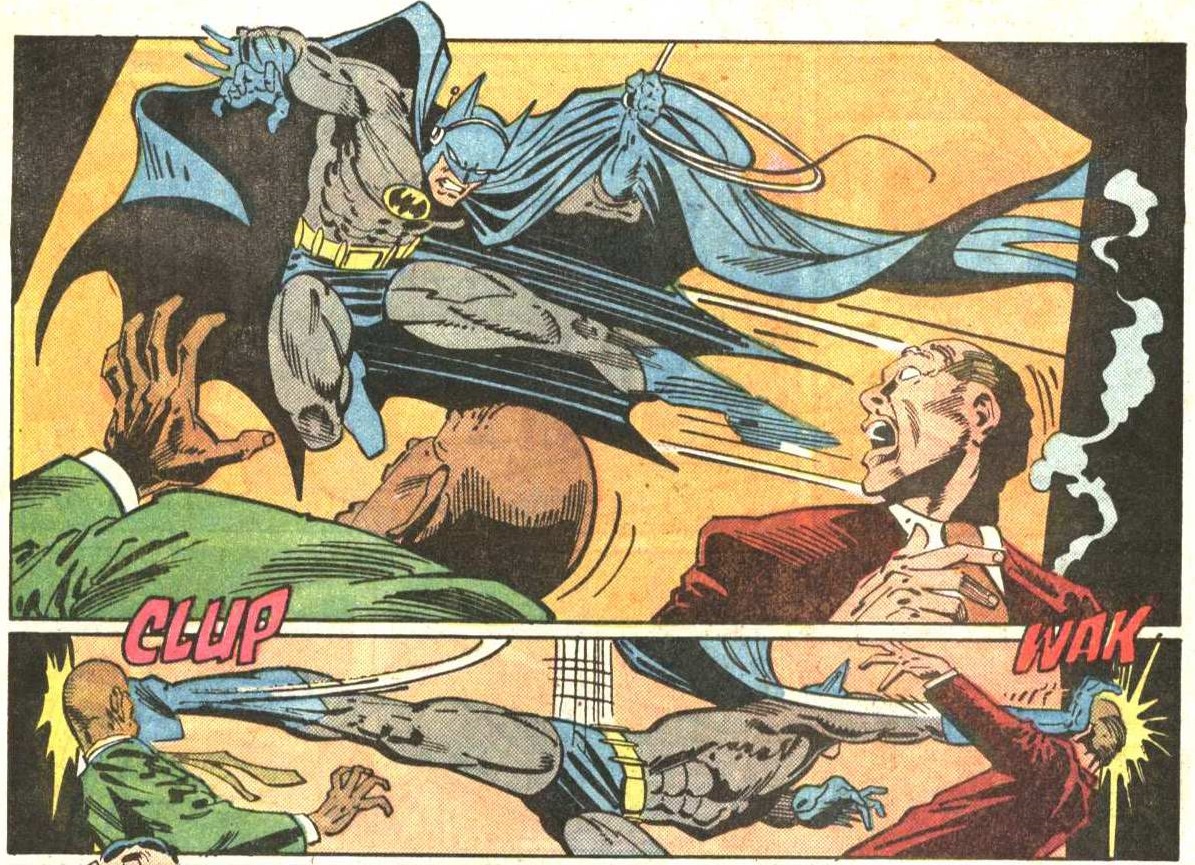
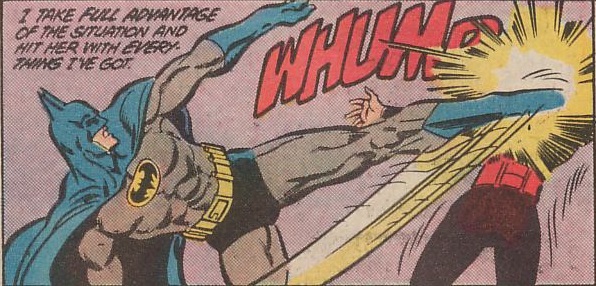
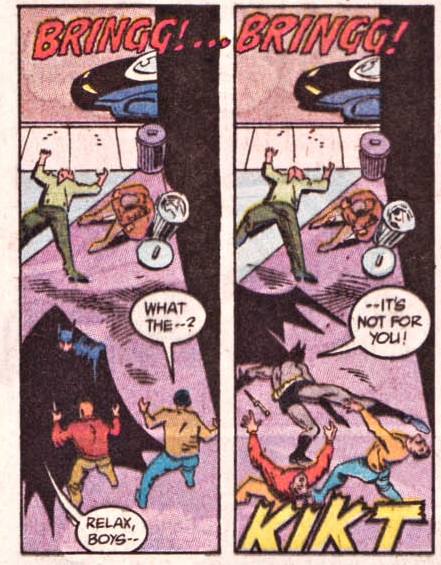
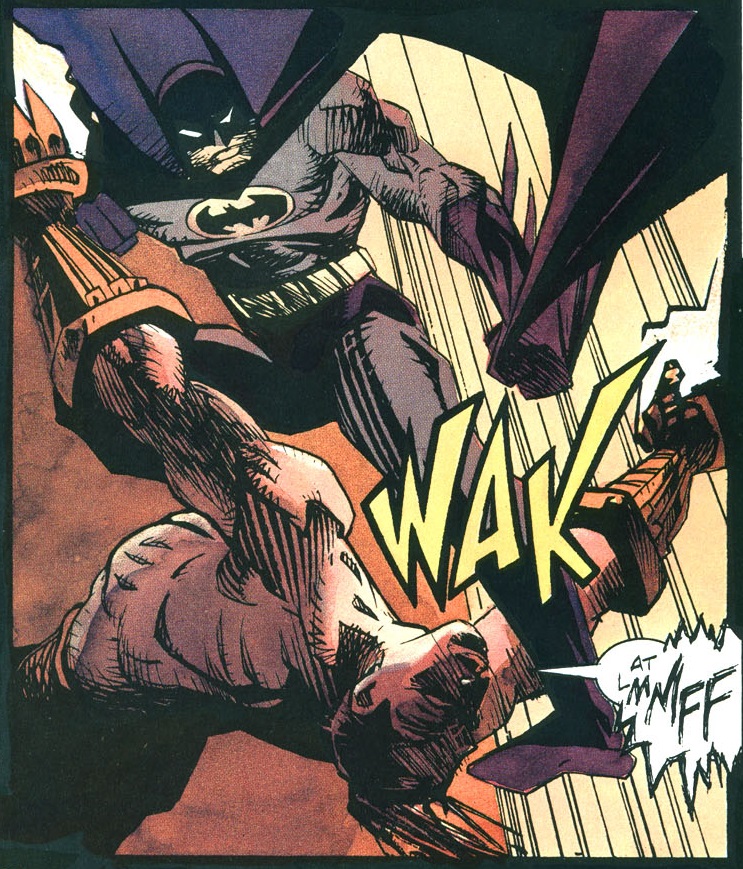
Bret Blevins has drawn a bunch of cool Batman comics and, in the process, delivered some truly rousing fight scenes. Although Blevins doesn’t always hit the mark (especially when working with inkers or colorists that screw up his crispy pencils), at its best his art has a strong sense of geography and sleekly choreographed movements, making these slugfests a joy to behold!

Here is an excerpt from ‘Images’ (script by Dennis O’Neil, colors by Digital Chameleon) the best story about the first confrontation between Batman and the Joker (yes, better than The Man Who Laughs). This one is a doozy, not least because of the amusing asides by the Clown Prince of Crime:

Legends Of The Dark Knight 50Legends Of The Dark Knight 50Legends Of The Dark Knight 50Legends of the Dark Knight #50

Notice how each attack flows from a previous panel establishing Batman’s spatial relationship with his opponents. Also, the Caped Crusader tries out different moves, showing off his versatility while keeping things interesting for the readers!

Later, in Shadow of the Bat, Bret Blevins gave us the chance to have a clearer look at Batman’s technique (this time with less murky colors, by Adrienne Roy), as the Dark Knight fought a couple of military-trained hitmen on a rooftop. Once again, we get a commentary track, now courtesy of Alan Grant’s characteristically pulpy narration…

Shadow Of The Bat 00Shadow Of The Bat 00Shadow Of The Bat 00Shadow of the Bat #00

That is some Fist of Fury shit right there, yes it is.

Last but not least, in another issue of the same series, Bret Blevins crafted a great sequence in which Nightwing and Robin worked as a team to bring down a bunch of hooligans at a playground. The issue was also colored by Adrienne Roy, although it’s unclear how much of it was inked by Blevins himself and how much of it was inked by Bob Smith… Regardless, it’s quite a nifty fight scene, as Dick Grayson and Tim Drake make a fun use of the props around them, Jackie Chan-style:

Shadow Of The Bat 29Shadow Of The Bat 29Shadow Of The Bat 29Shadow of the Bat #29

The best, indeed!

Posted in ART OF BATMAN COMICS | Tagged , , , , , | Leave a comment