Batman’s X-mas spirit

By all accounts, the Dark Knight should seriously hate Christmas. It’s bad enough having to put up with that annoying alternative version of ‘Jingle Bells,’ but the worse part is that, as eccentric as Gotham City’s criminals tend to be, they certainly don’t stop for the holidays!

Dealers continue to deal, robbers continue to steal (and, for some reason, to leave pun-based clues), themed serial killers continue to serial kill…

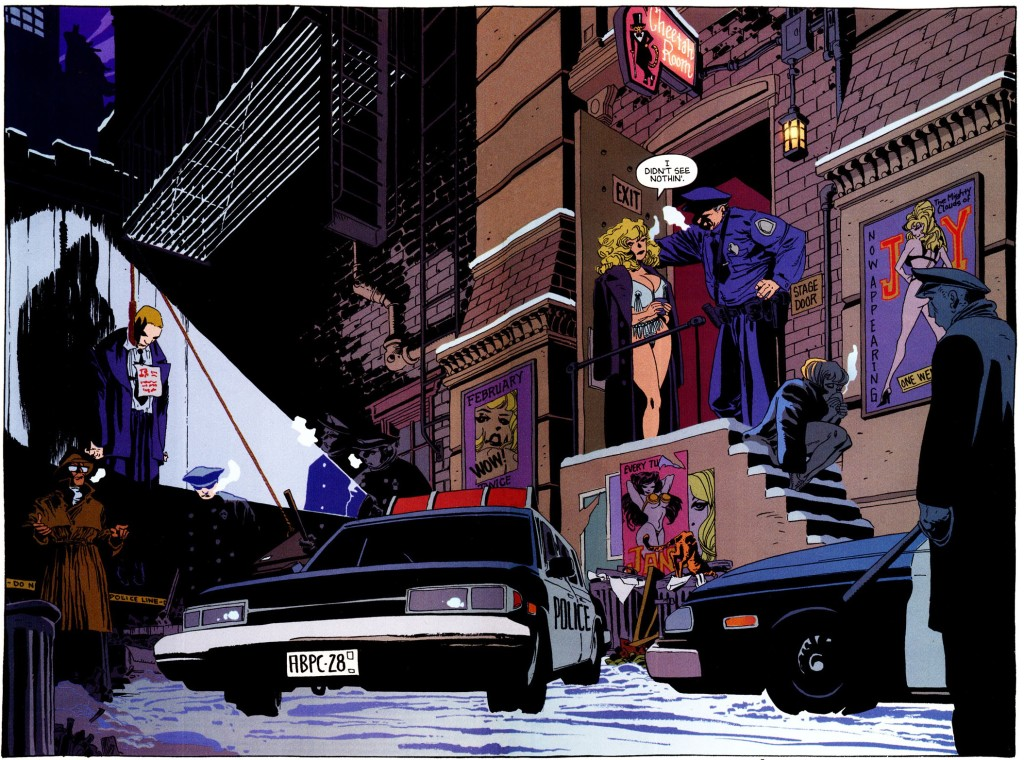
batman dark victoryDark Victory #3

To be sure, when you think of the greatest Christmas stories ever told (Die Hard, Gremlins, Nightmare before Christmas), it becomes clear this is a holiday that lends itself to all sorts of twisted tales. But leave it to Gotham to take things to berserk extremes: name any crime that comes to mind and you can bet it’s probably taking place somewhere in or around the city…

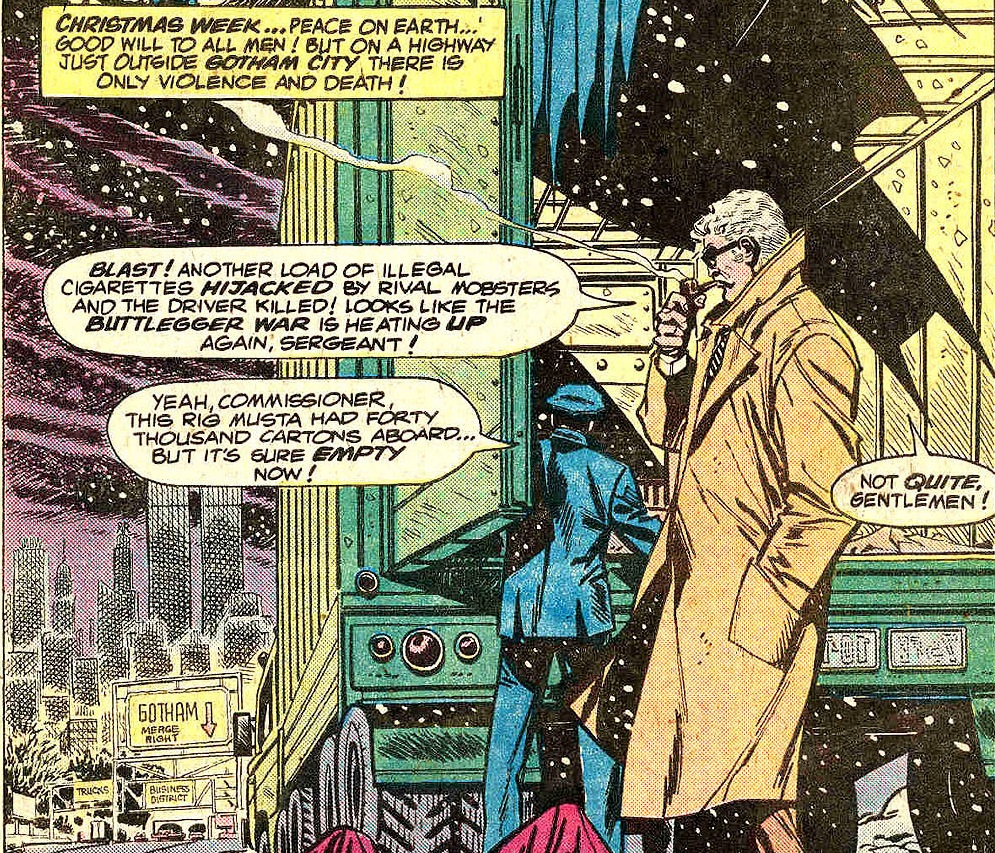
Brave and the Bold 148The Brave and the Bold #148

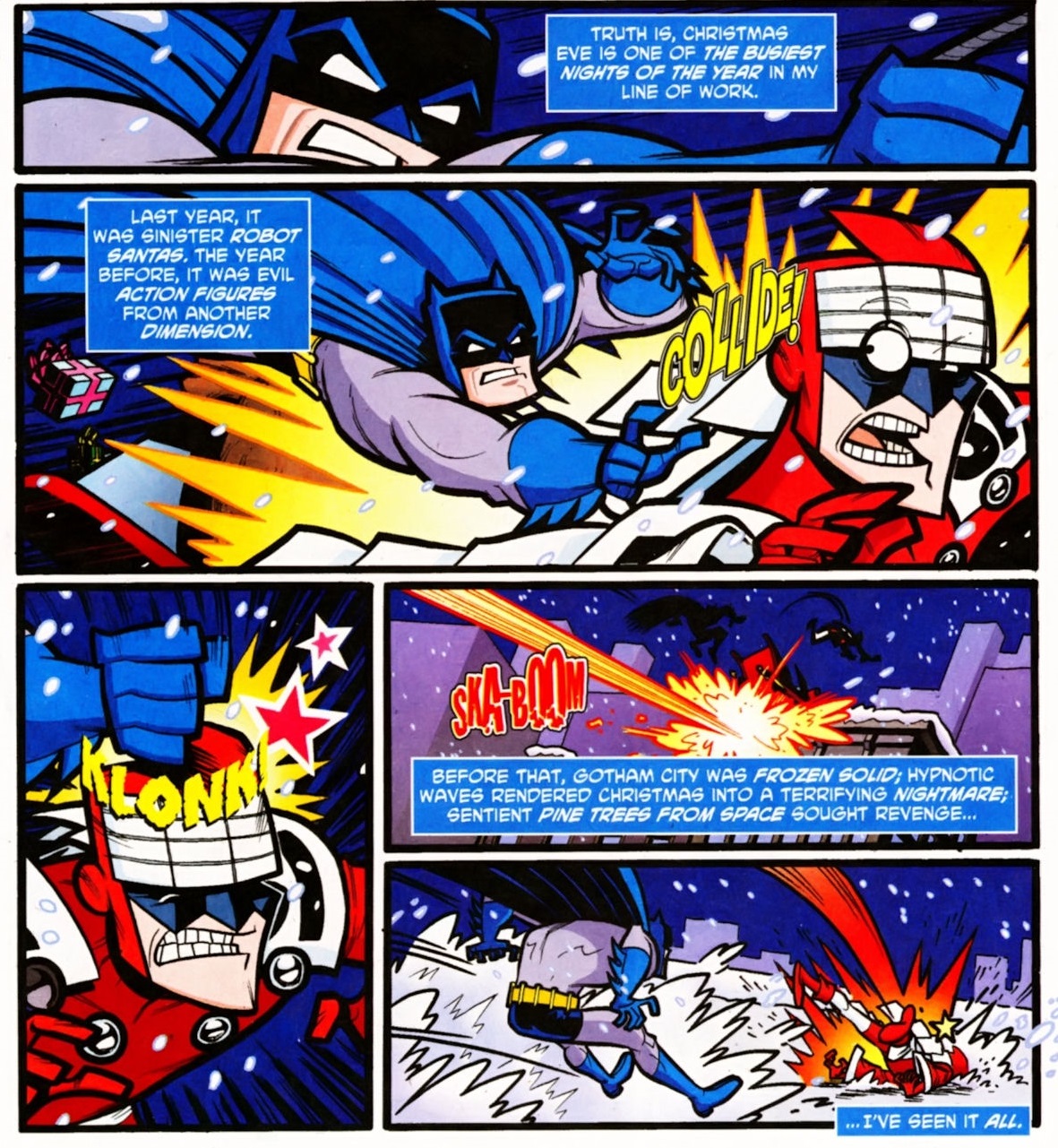
Hell, even crimes that *don’t* come to mind:

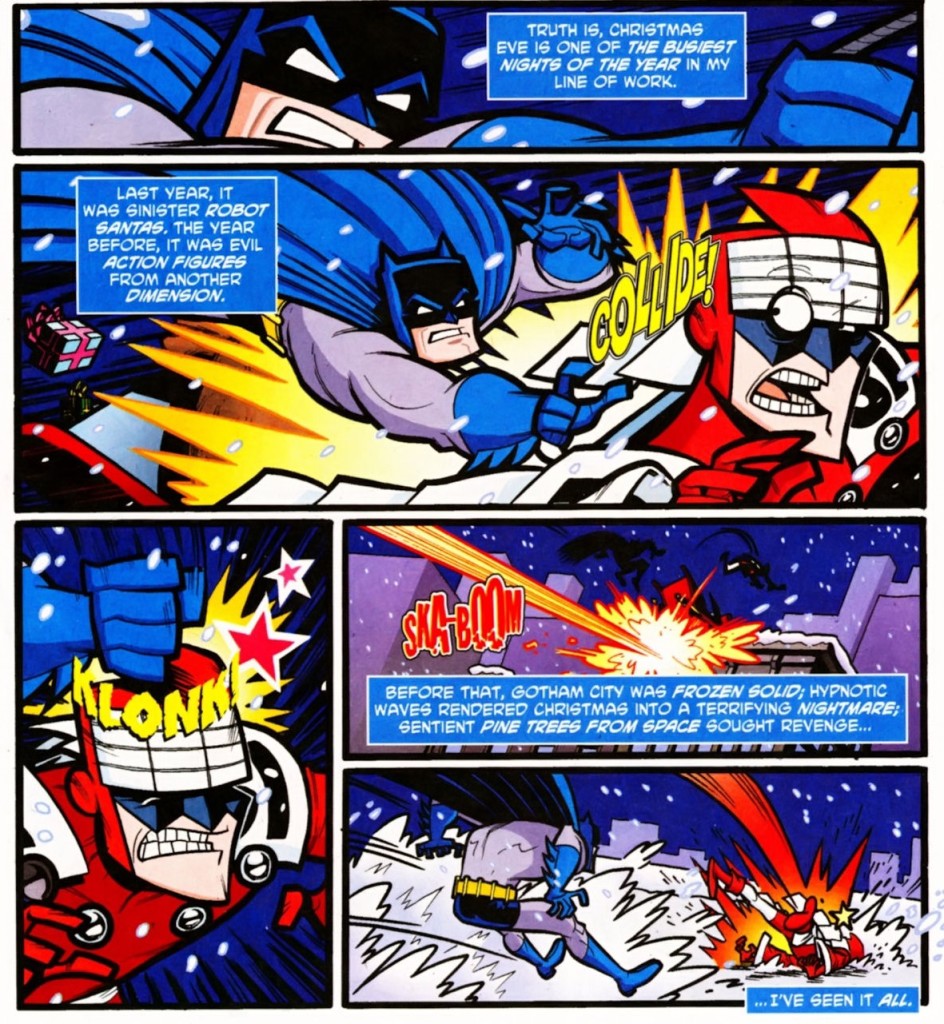
Batman Brave and the Bold 12Batman: The Brave and the Bold #12

(And I’m not even counting whatever the Penguin’s confusing evil scheme was supposed to be in Tim Burton’s Batman Returns!)

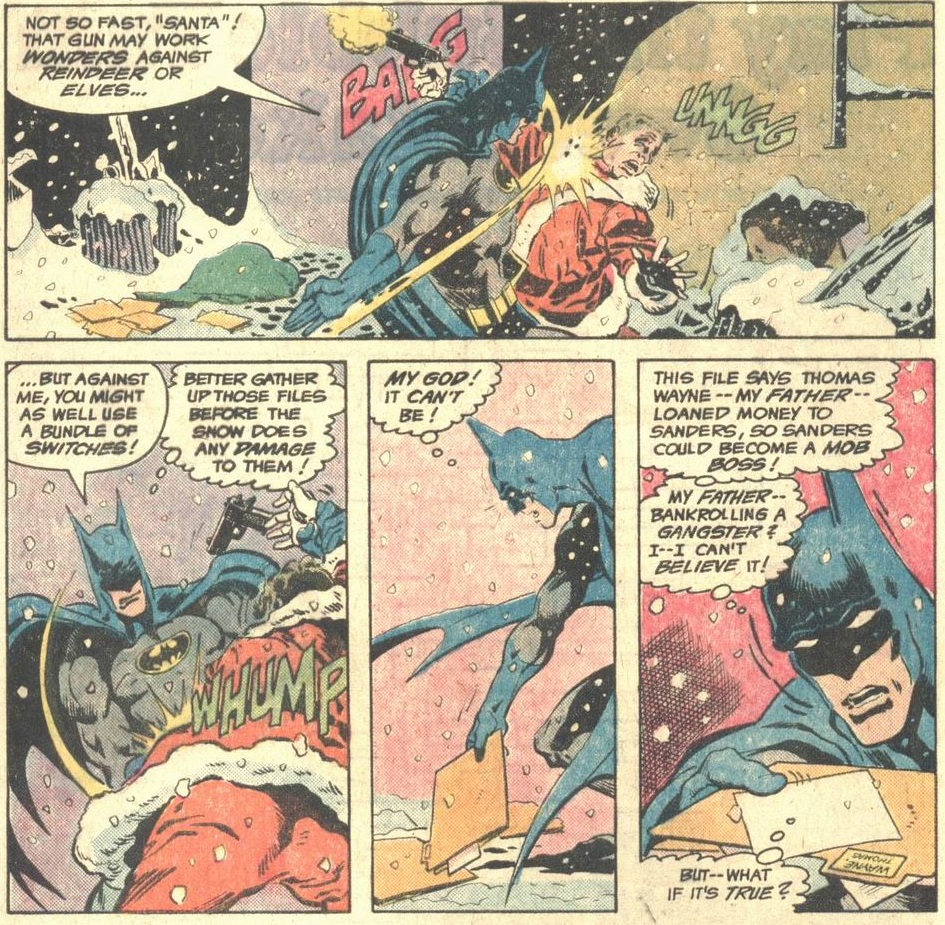
Plus, you know, if by themselves Christmas rituals make this a depressing time of year, things can always be made worse by some family drama:

Brave & Bold 184The Brave and the Bold #184

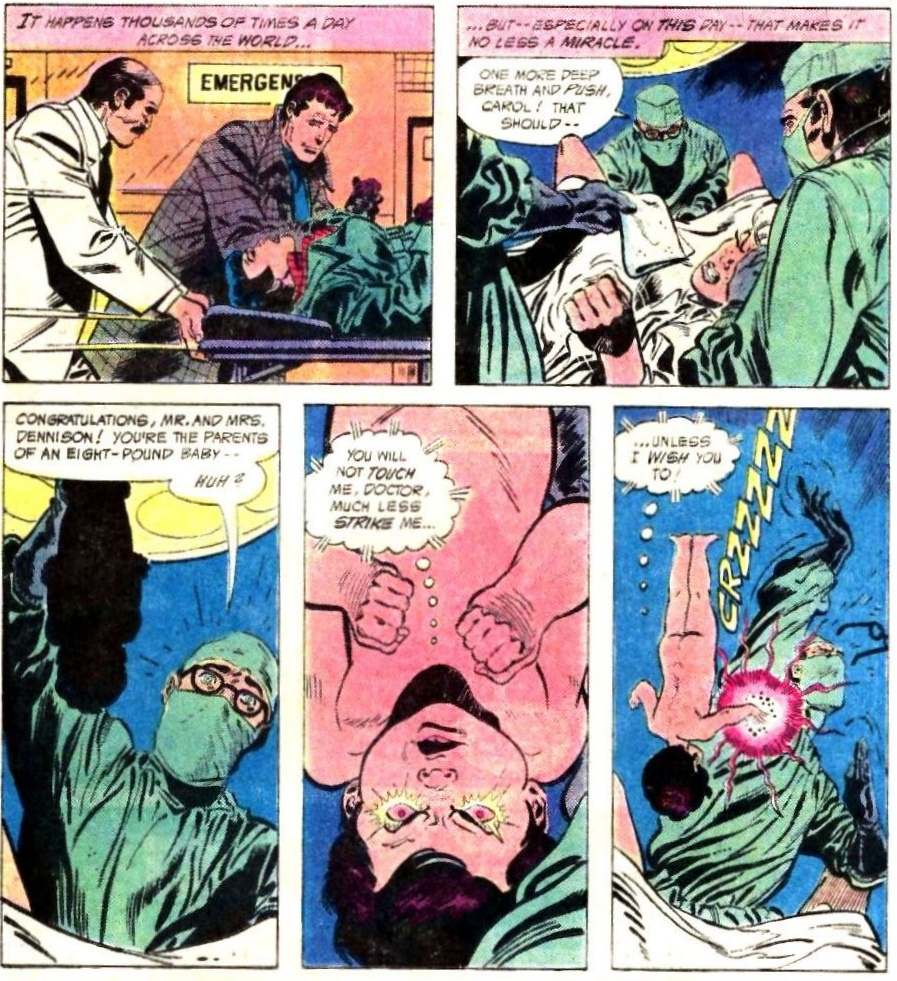
There is just no limit to all the weird ways in which even happy moments can suddenly get spoiled in Gotham City:

Batman and the Outsiders 8Batman and the Outsiders #8

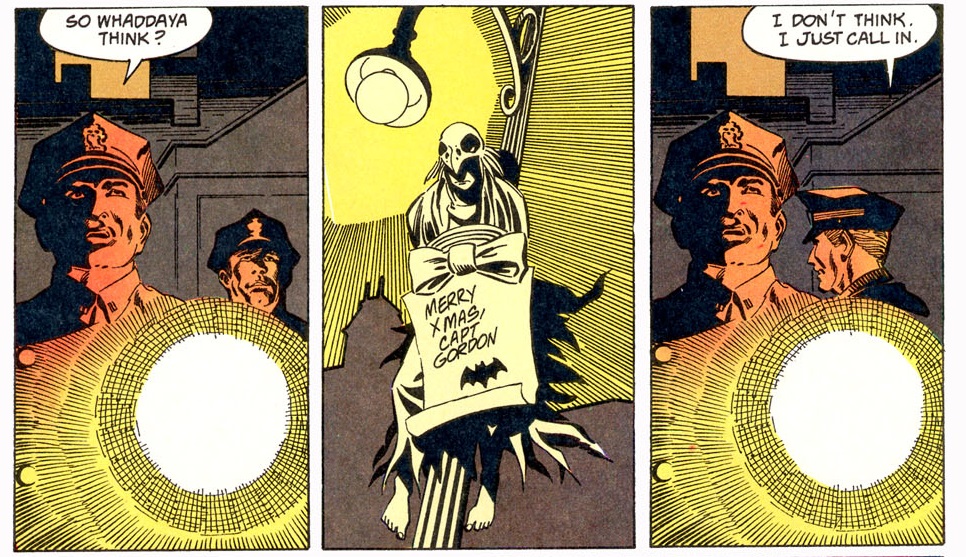
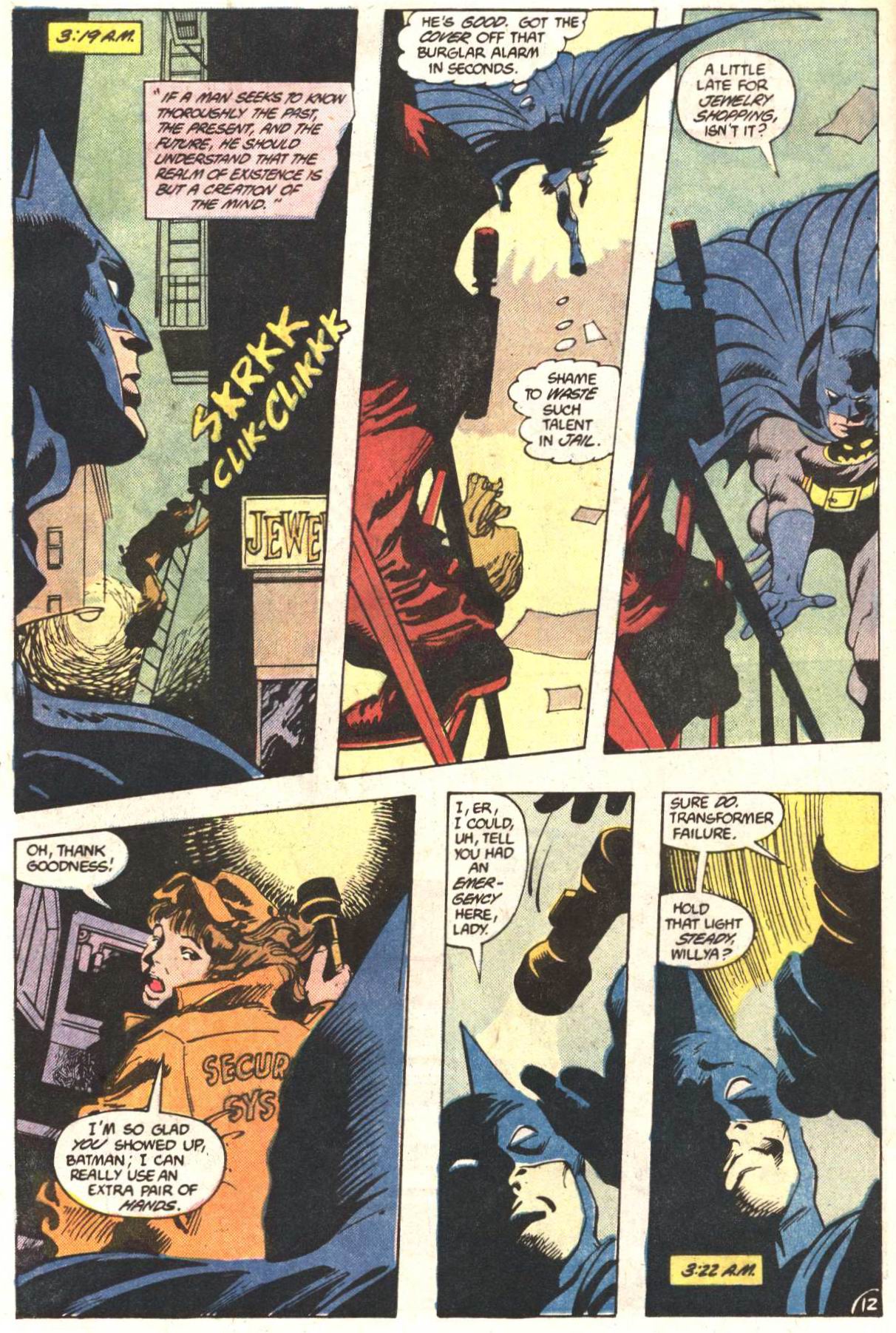
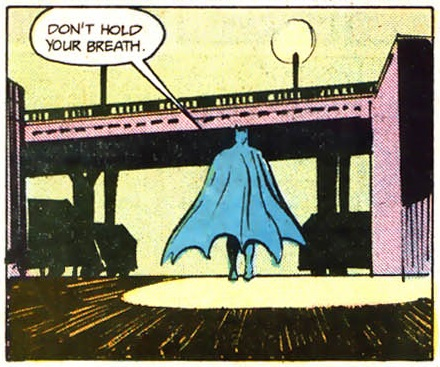
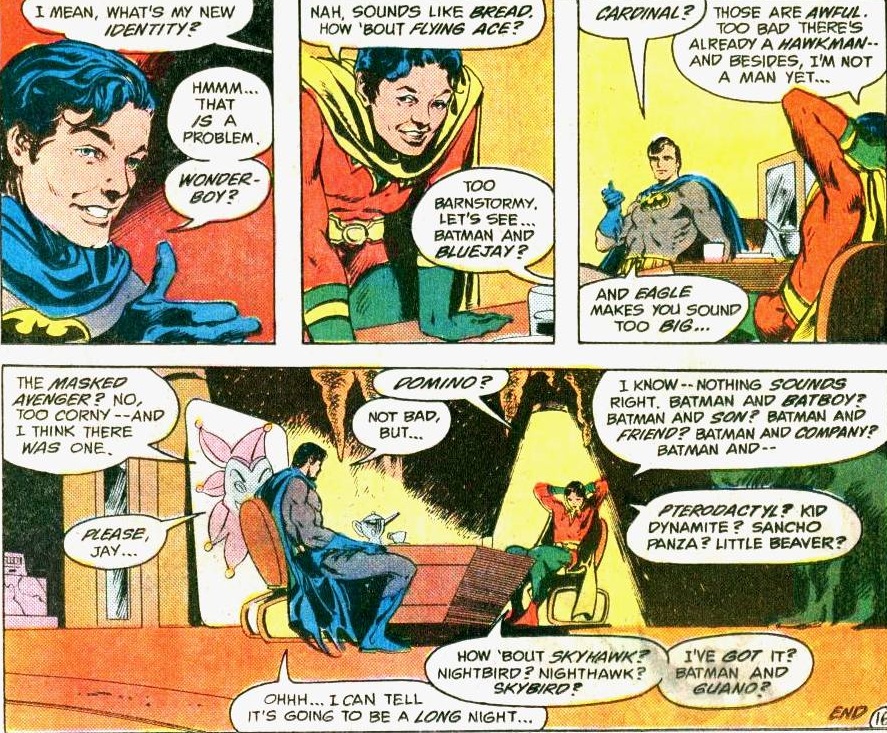
And yet, whether dealing with a sorcerer who can possess babies or punching out the Calendar Man for having erased every Christmas card in Gotham, not even Batman manages to fully escape the spirit of the season…

Legends Of The Dark Knight 005Legends of the Dark Knight #5

NEXT: Jason Todd strikes back.

Posted in GOTHAM CITIZENS | Tagged , , | Leave a comment

More over-the-top adventure comics

Given how bombastic and out-of-control the Batman series has become of late, I figure the time is right to revisit the concept of comics as manic, trippy escapades. When I suggested a bunch of Non-Batman balls-to-the-wall adventure comics earlier this year, I focused on recent books, but of course there is a long tradition of ambitious and exciting stories that mix wild action with genuinely mind-blowing ideas!

Here are some of the most over-the-top classics:

ELEKTRA: ASSASSIN

Elektra Assassin

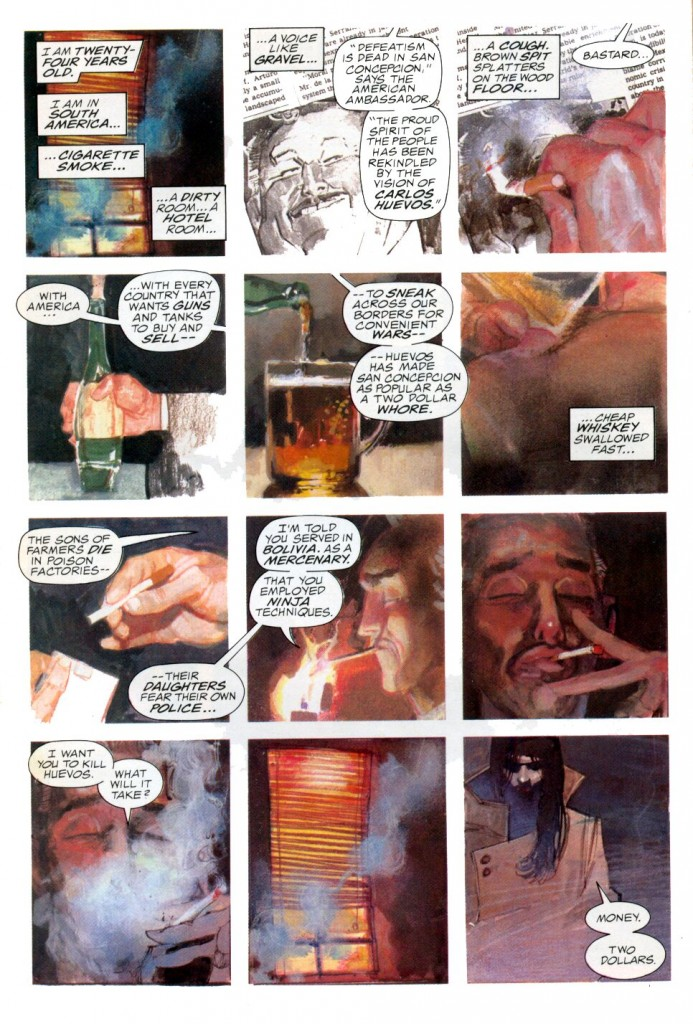
To sum up the plot of 1986’s Elektra: Assassin would be to do it a disservice. Surprising as it may seem, it’s not really the orgiastic combination of ninjas, spies, demons, cyborgs, mind control, ultra-violence, and Cold War politics that makes this comic such an incredible ride. It’s mostly the way the story is told, with overlapping stream-of-consciousness narration and flashbacks frantically discharged onto the page by Bill Sienkiewicz’s unmistakable, impressionistic watercolors. If Frank Miller’s aggressive writing style has always bordered on parody, Sienkiewicz’ caricatural art nails the series’ extravagant satire while making every page a delight to look at.

In a way, Elektra: Assassin is the high point of the explosion of creativity its authors underwent in the ‘80s – there are traces of Miller’s Ronin and hints of Sienkiewicz’s Stray Toasters, but it outmatches any of those works in terms of freewheeling experimentation. Hell, as far as sheer exuberance goes, this book makes Frank Miller’s Batman comics from that era appear tame and uninspired in comparison!
Elektra AssassinElektra: Assassin

Sadly, the adventures of Elektra Natchios never reached the same heights again. Frank Miller returned, with his own impressive pencils, in Elektra Lives Again. Chuck Austen, Scott Morse, and more recently Mike Del Mundo have all approached the character with relatively unconventional art. In the early 2000s, Greg Rucka wrote his signature hardass-broken-woman type of yarn. Robert Rodi and Sean Chen did a fun run after that. Yet no one has been able to beat Assassin’s awesome closing punchline.

GRIMJACK
Grimjack 01

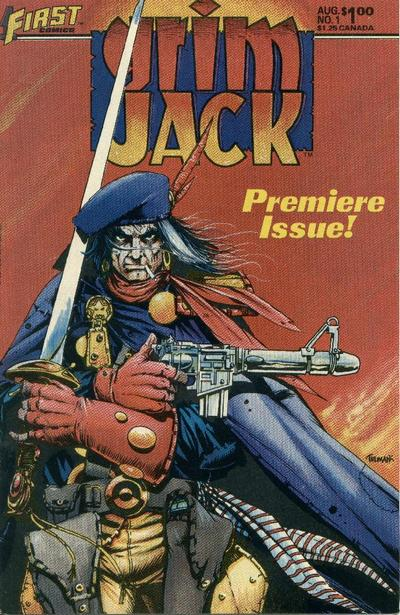
Name your favorite pulp genre and you’re likely to find it somewhere on the pages of this comic. Not only is John Gaunt, aka Grimjack, a mercenary/hardboiled detective/war veteran/ex-cop/ex-gladiator, he operates out of the pan-dimensional city of Cynosure, an intersection between all dimensions where each block has a distinct atmosphere (complete with its own physical laws). This formula allows the series to freely combine all sorts of tropes and aesthetics, from cyberpunk to western to sword-and-sorcery mayhem. There is even some subversive comedy around Cynosure’s ultra-capitalist system in which, at one point, the only ones with legal rights are corporations! (‘An individual had rights if the family could afford to incorporate – the parents were CEO and Chairperson and the children were considered assets. Marriages were as much mergers as anything else.’)

Created by John Ostrander and magnificently brought to life by Tim Truman’s stark designs, it’s hard to believe GrimJack was one of their first professional comic works. Ostrander and Truman hit the ground running, already displaying the bravado that would make them the masters of smart action stories, thanks no doubt to editor Mike Gold, the man behind some of the eighties’ most badass runs, including Grell’s Green Arrow, O’Neil’s The Question, and Kupperberg’s Vigilante (not to mention indie classics like Jon Sable Freelance, Badger, and American Flagg!). Indeed, I wonder why this series isn’t as widely remembered as some of those…

In particular, fans of Ostrander’s tough-as-nails dialogue will have a field day:
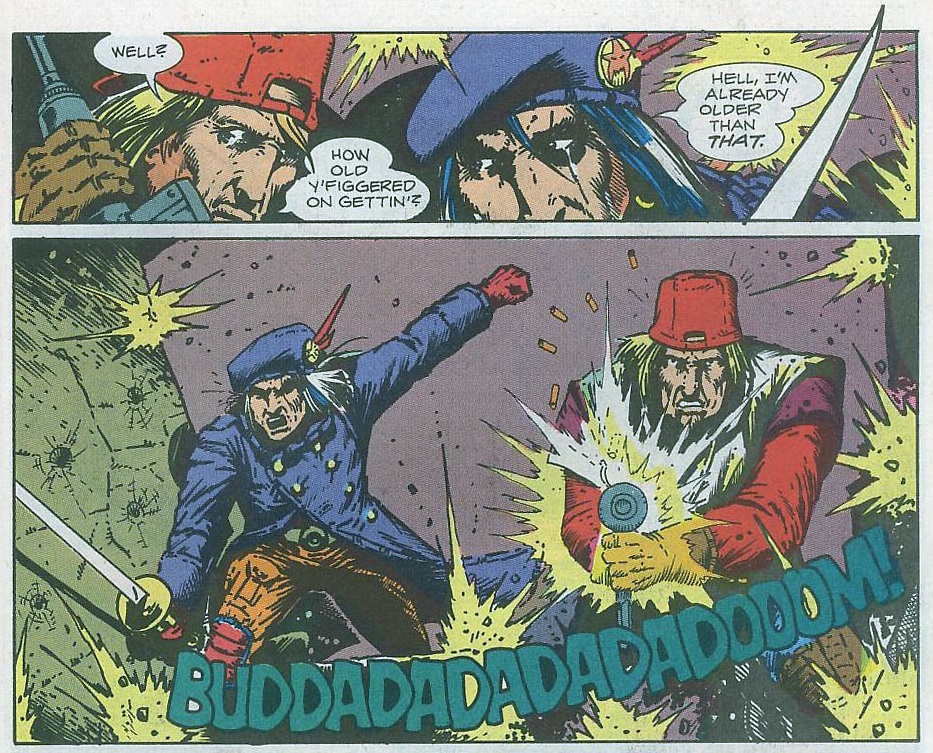
Grimjack 007 Grimjack #7

As usual with John Ostrander, he was not afraid to drastically shake up the status quo every once in a while, including radical changes to the protagonist and his city. The changes were mirrored by visual shifts – starting in issue #31, art duties were taken over by Tom Mandrake (who would go on to illustrate many other great series written by Ostrander) and then in #55 by Flint Henry, whose wonderfully detailed draftsmanship was quite a contrast to Mandrake’s sketchy artwork.

To top it all off, Grimjack owned Munden’s Bar, a surreal joint for lowlifes of all species (think Mos Eisley cantina), and hung there between missions. This bar got its own quirky, long-running backup feature, mostly co-written by Ostrander and Del Close, with art by a veritable who’s who of cartoonist geniuses (plus a barrage of background cameos and sight gags). In fact, looking at each issue’s credits section, it’s amazing how much first-rate talent was involved in this series across the board.

THE INVISIBLES
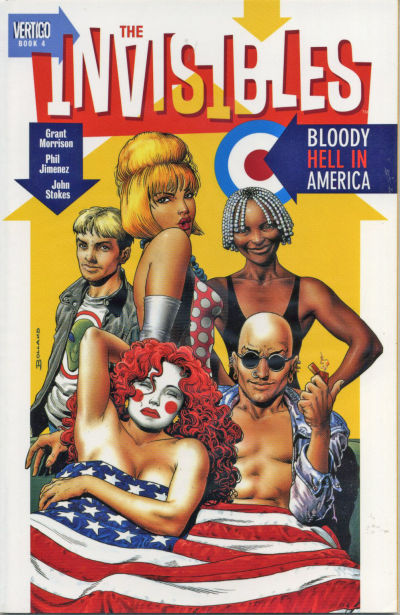
The Invisibles: Bloody Hell in America

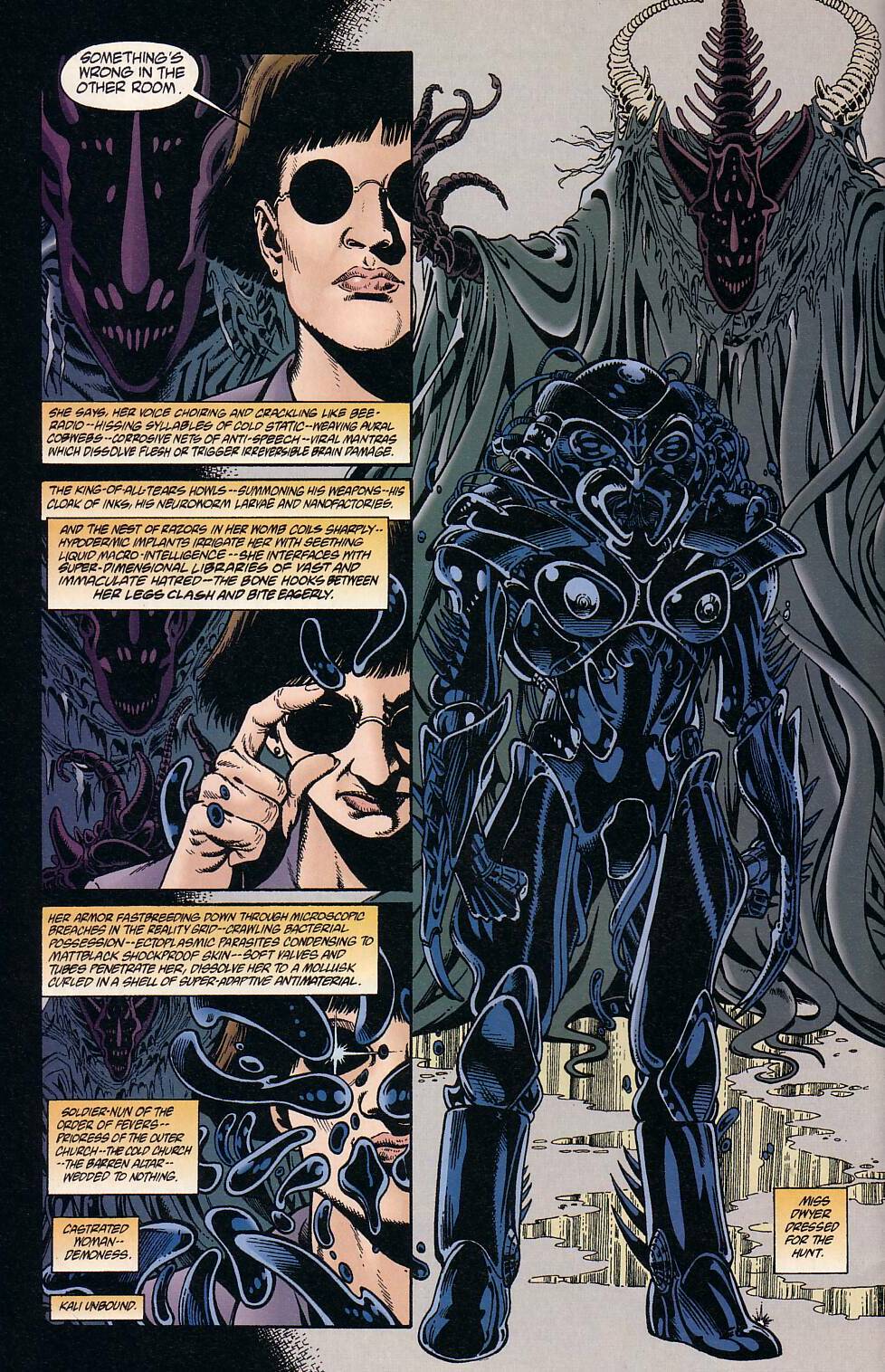
The Invisibles seems to have a mixed reputation as both one of the coolest comics ever and as a confusing, esoteric acid trip that’s largely impenetrable even by Grant Morrison’s standards. In fact, for all the crazy magic, sex, sci-fi, and metafiction, this can be seen as quite a straightforward series about a secret organization struggling against the forces of oppression. It’s just that the villains happen to be inter-dimensional alien gods who have enslaved humanity. And the heroes are a ragtag team made up of a teen vandal, a futuristic witch, a transgender Brazilian sorcerer, and a former policewoman called Boy, initially led by the charismatic super-assassin King Mob. Oh, and parts of the story hinge on time-travelling, the ghost of the Marquis de Sade, and the severed head of John the Baptist.

A cult comic if there ever was one, Morrison’s magnum opus is a fascinating modern fantasy saga full of poetic, existential musings. Early on, one character lays it out: ‘Your head’s like mine, like all our heads; big enough to contain every god and devil there ever was. Big enough to hold the weight of oceans and the turning stars. Whole universes fit in there! But what do we choose to keep in this miraculous cabinet? Little broken things, sad trinkets that we play with over and over.’

To be sure, The Invisibles is tonally all over the place, but the fact that it’s such a disjointed mess actually fits in with the series’ rebellious themes. The first book features a beautifully written conversation between Lord Byron and Mary Shelley that wouldn’t look out of place on the pages of The Sandman. The series then turns into a terrific horror title in line with the Vertigo house style of the time, before going full throttle into apocalyptic science fiction mode and culminating in a transcendental mindfuck. As if this wasn’t enough, the artists kept changing, each with a wholly distinct style, ranging from Jill Thompson’s elegant pencils to Philip Bond’s adorably blocky linework, with a huge chunk done in Phil Jimenez’ glossy hyper-realism.
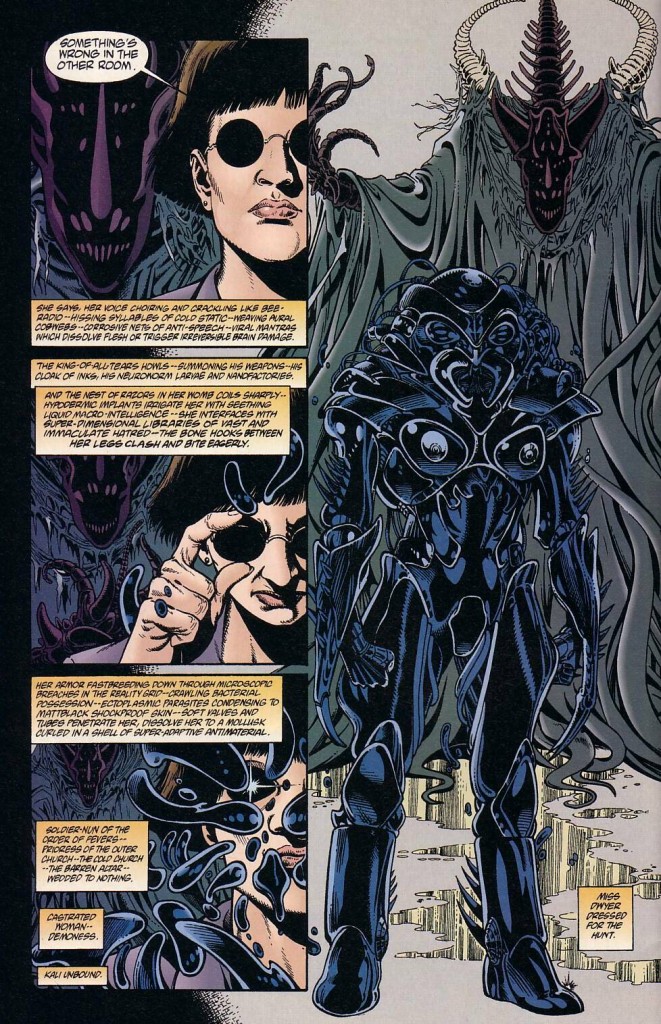
The Invisibles V1 19The Invisibles #19

With its in-your-face, anti-authority attitude and violence and energy and drugs, this is also one goddamn punk comic. Although spliced with New Age mystical mumbo-jumbo, The Invisibles’ anarchist spirit of conspiracy theories and counter-culture terrorism channels the Sex Pistol’s rage-against-whatever posturing and Banksy’s street art while anticipating Anonymous’ technoactivism. At the same time, the series still combines enough thought-provoking layers to encourage multiple readings and ambiguous interpretations, as Morrison sneaks in touching character moments and subplots – like in the brilliant issue ‘Best Man Fall,’ which zooms in on a henchman’s complex, multifaceted life before he’s killed by King Mob.

THE ADVENTURES OF LUTHER ARKWRIGHT
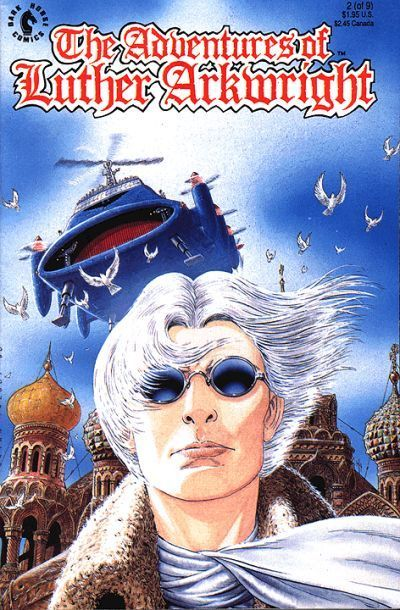
The Adventures of Luther Arkwright

Only slightly less psychedelic and messed up than The Invisibles, Bryan Talbot’s The Adventures of Luther Arkwright follows a secret agent with psychic powers who fights the sinister Disruptors across parallel universes. It’s above all a work of gritty speculative fiction, as most of the action takes place in an alternate Earth where the monarchy lost the English Civil War, so Talbot designs a detailed dystopia ruled by Puritan dictatorship. The first chapters are a bit rough, with fragmented flashbacks and non-linear storytelling illustrated by experimental black & white artwork, but the narrative gradually becomes more focused towards the end (although not before a series of brain-melting splashes where the main character dies and apparently fucks all of creation before being resurrected, more powerful than ever).

As dense and challenging as The Adventures of Luther Arkwright can be, it’s also an absorbing read. During the climax, in Cromwellian London, Talbot throws everything at us, including a bloody revolution, a ticking time bomb, a childbirth, a military invasion by the Russians and the Prussians, a trans-dimensional invasion by the Disruptors, and an ancient cosmic doomsday device that threatens the entire multiverse.

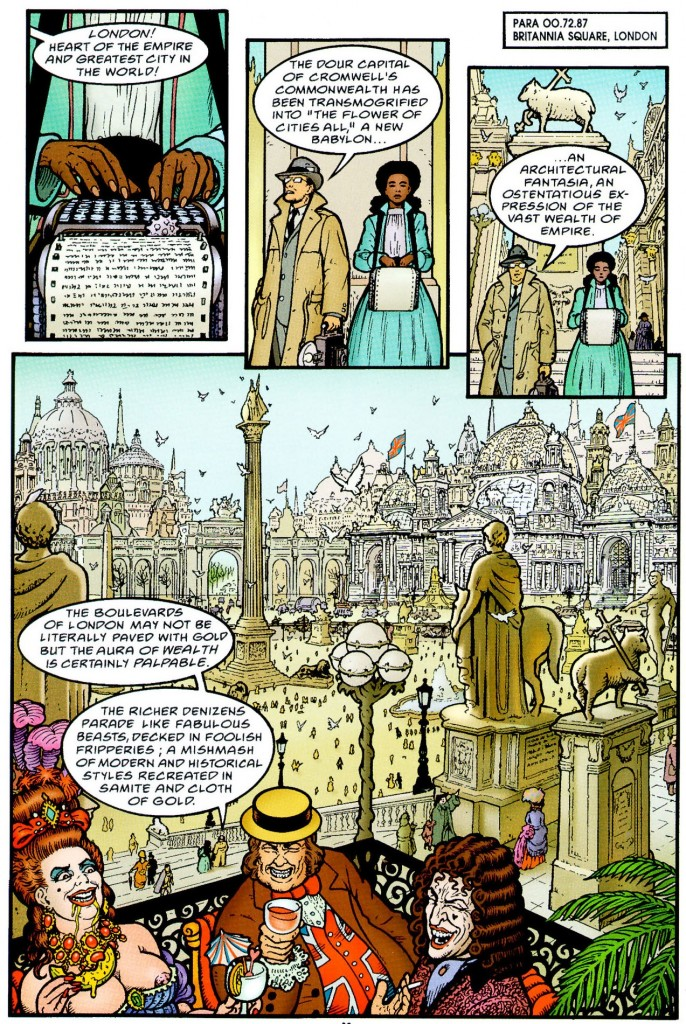
That said, I think I still prefer the sequel, Heart of Empire or The Legacy of Luther Arkwright, which is a deranged take on imperial epics like Quo Vadis and Star Wars:
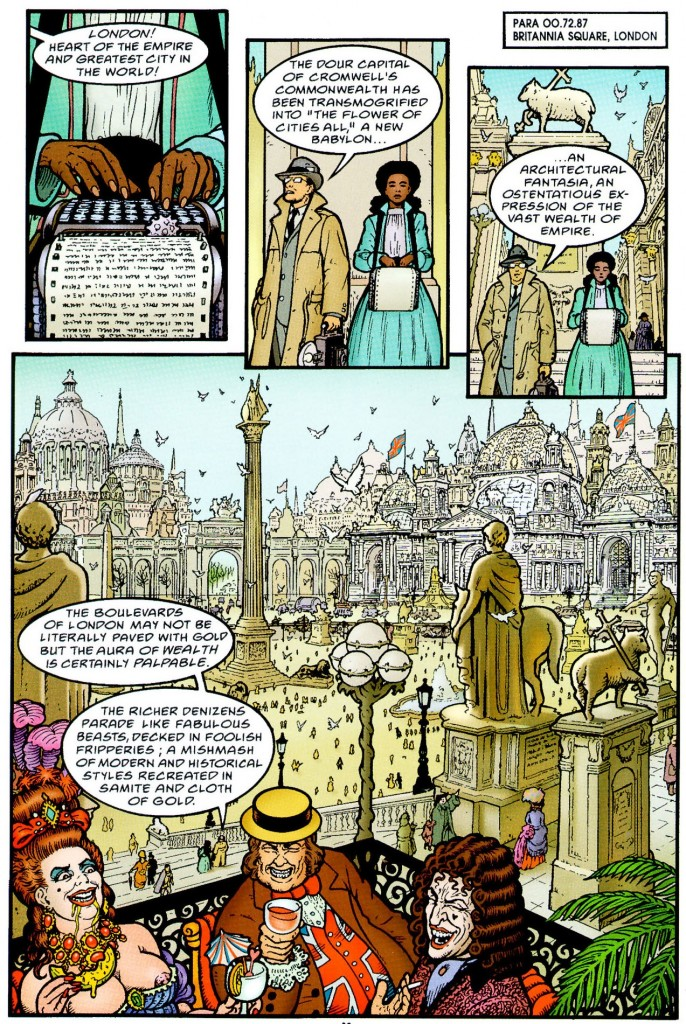
Heart of EmpireHeart of Empire

Set two decades after the events of the original and focusing on the surviving cast, Heart of Empire paints a complex tapestry of political and telepathic intrigue over a luscious-looking proto-steampunk world ruled by debauched royalty. Bryan Talbot thus secures his place in the long line of sci-fi comics writers who have ingeniously reimagined British imperialism, such as Peter Milligan in Tribal Memories, Warren Ellis in Ministry of Space, and Ian Edginton in Scarlet Traces (a neat sequel to H.G. Wells’ War of the Worlds).

OMAC: ONE MAN ARMY CORPS

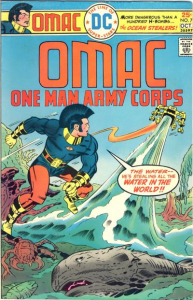
OMAC 6

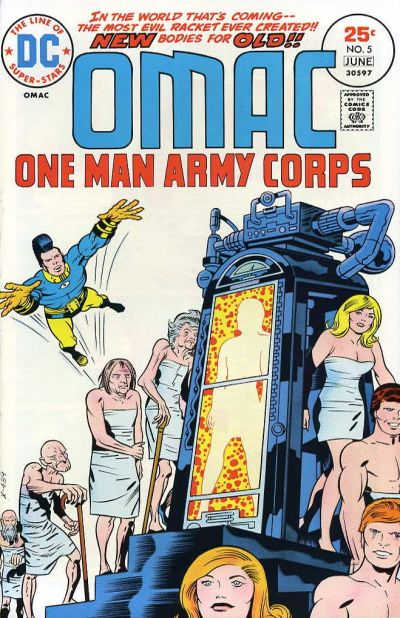
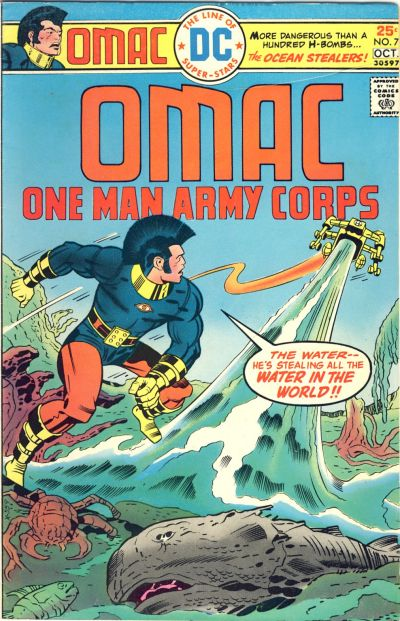
First published in 1974, the short-lived OMAC: One-Man Army Corps takes place in what the typically hyperbolic narration keeps calling ‘THE WORLD THAT’S COMING!’ On the one hand, these are nightmarish visions of the future by an artist engaging with issues like war, technology, alienation, and consumerism. On the other hand, that artist is Jack Kirby, so the result revolves around Buddy Blank, a harmless employee of Pseudo-People, Inc. who is transformed into a super-soldier with a blue mohawk via remote-controlled hormone surgery done by a sentient space satellite called Brother Eye. Also, at one point he fights with a monster that looks like a flying octopus on top of Mount Everest.

This series allegedly came about in order for Jack Kirby to fulfill his quota of 15 pages per week at DC. (Yes, 15 pages per week!) Kirby wrote, penciled, and edited the comic, which means it’s packed with bizarre visuals, awkward dialogue, and all sorts of throwaway ideas springing from his notoriously effervescent mind. In the first pages alone, we are introduced to the nameless officers of the Global Peace Agency, who conceal their faces with cosmetic spray so that they can represent any nation, and to the Psychology Section of Buddy’s company, where employees can take out their frustration by burning cars or kicking lifelike mannequins in the butt. And that’s all before our hero is assigned ‘test parents’ by the computer of the Social Engineering Division…

Make no mistake: reading OMAC is a far-out experience. Seriously, the only reason this isn’t the most insane futuristic comic ever is because at the same time Kirby was also working on the post-apocalyptic Kamandi: The Last Boy on Earth, which is essentially a feverish version of Planet of the Apes!
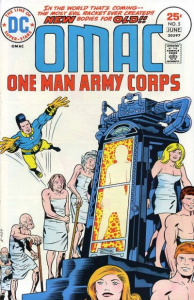
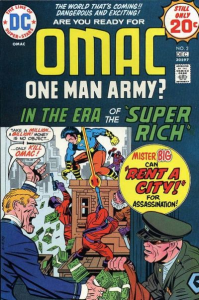
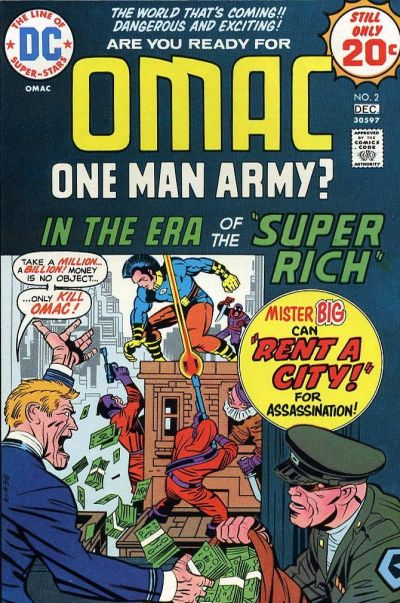
OMAC 5     OMAC 2     OMAC 7

OMAC’s initial run lasted for only 8 issues, but it was of course a matter of time before someone revisited Kirby’s baffling creation. In 1991, a prestige mini-series expanded Buddy Blank’s saga, further cranking up the science fiction by adding serpentine time-travel paradoxes. This project was handsomely written and illustrated by John Byrne, who approached it with straight-faced restraint and grit yet didn’t resist the chance of throwing the storyline into high gear by pitting OMAC against Adolf Hitler (because comics).

In 2011, Dan Didio and Keith Giffen fully rebooted OMAC and placed it in DC’s New 52 continuity. They tried to recapture the same feel of riotous action, but while Giffen’s art could match the dynamism of the King of Comics, the series’ uninspired stories sadly remained quite far from the surrealist spark of the original. To be fair, not even the folks at Batman: The Brave and the Bold managed to do justice to Jack Kirby’s imaginative concepts, although they sure came closer.


NEXT: Batman beats up Santa Claus.
Posted in FANTASTIC ADVENTURES | Tagged , , , , , , , , , , , , , , , , , , , , , , , , , , , , , , , , , , , | Leave a comment

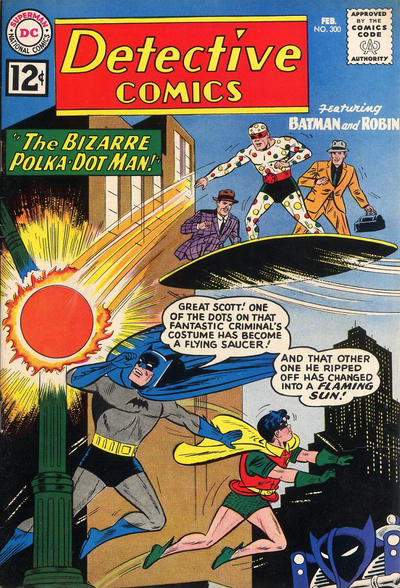
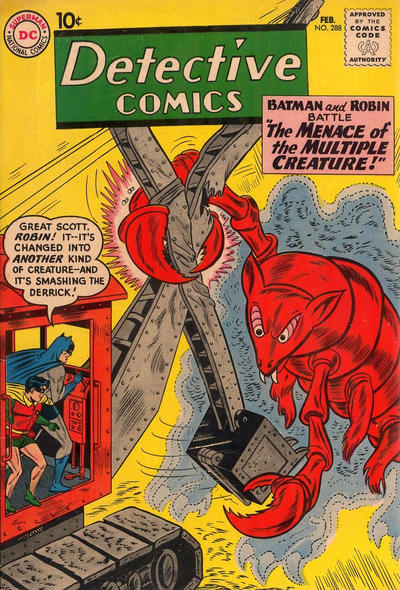
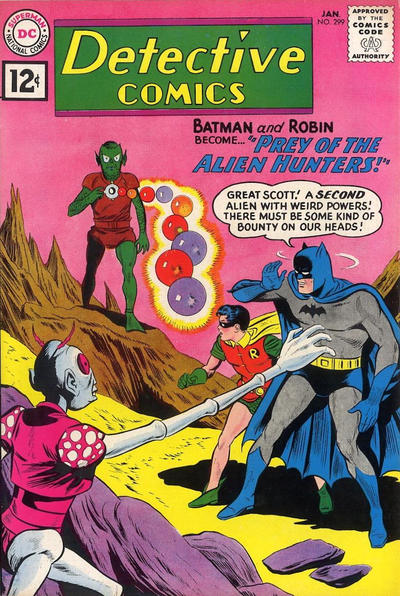
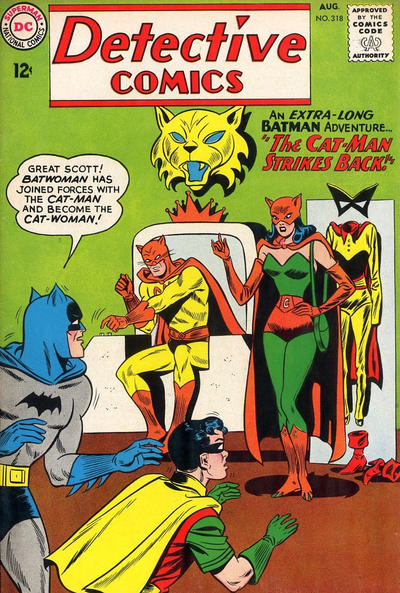
10 Silver Age Batman covers

The so-called Silver Age of Comic Books, starting in the mid-1950s and lasting until around 1970, was a deliriously fun era. It produced plenty of odd, colorful stories with simplistic yet creative visuals just begging to become pop art fodder.

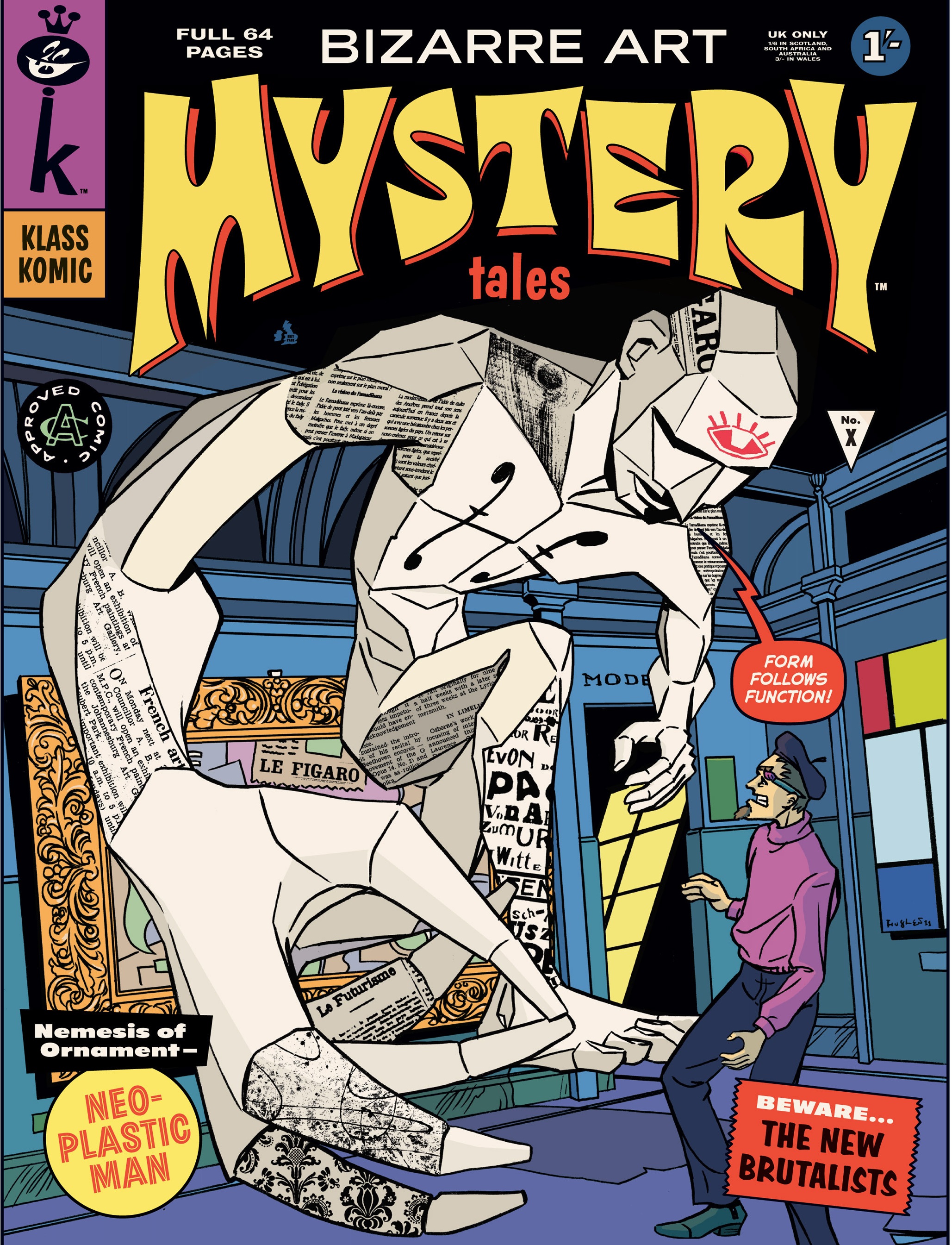
Since then, artists like Rian Hughes have had a great time trying to emulate the  mesmerizing weirdness of Silver Age covers…

Tales From Beyond ScienceTales From Beyond Science

…but few of these pastiches can beat the charming feel of the original comics, especially the ones involving the Caped Crusader. After all, there is a reason virtually every episode of the awesome The Brave and the Bold cartoon drew on Silver Age imagery (perhaps none more than the geekgastic ‘Legends of the Dark Mite!’).

To be clear, Silver Age Batman tales aren’t the freakiest sci-fi stories of that time (those can be found in Philip K. Dick’s collection Beyond Lies the Wub). They’re not even the era’s freakiest sci-fi comics (for that, check out 50 Girls 50 and Other Stories). But they were this unbelievably strange assault on the senses that, much like the torture scene in Sidney J. Furie’s The Ipcress File, seemed to be using purple colors and disorienting logic in order to induce a trance-like brainwash.

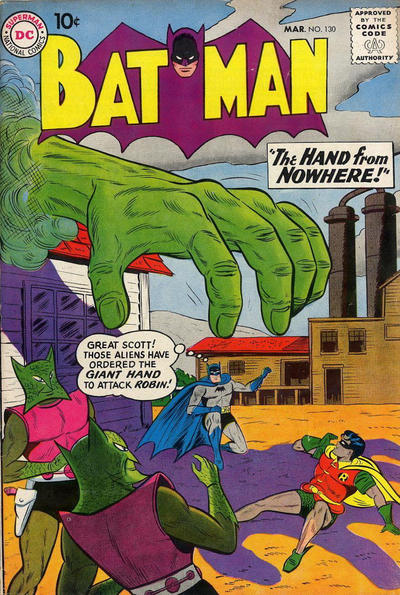
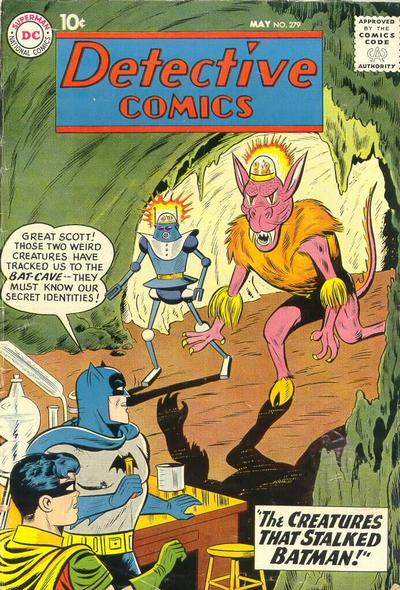
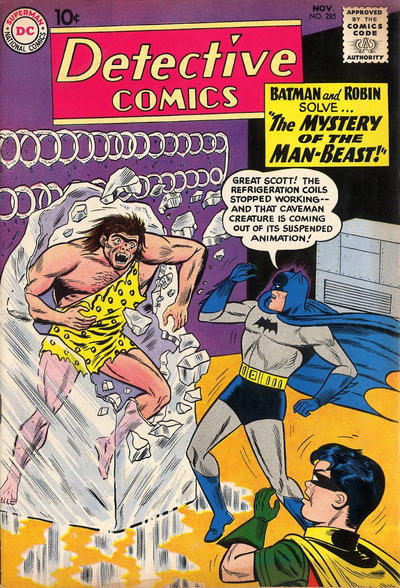
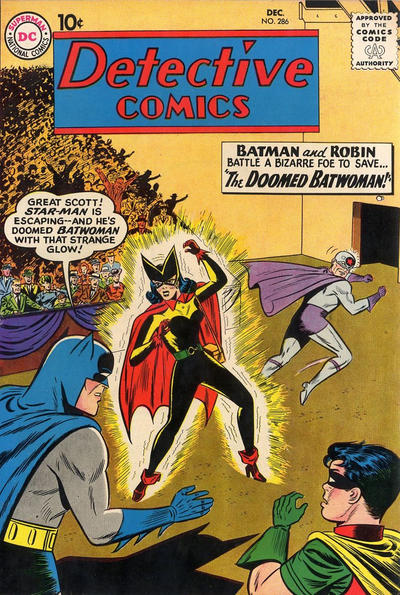
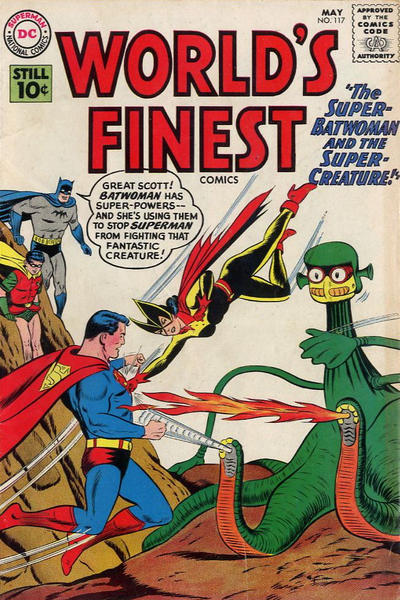
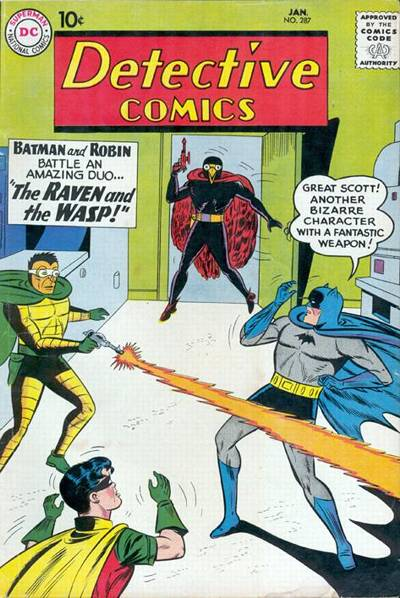
Indeed, when you consider the kind of zany adventures the Dynamic Duo had during those years, it’s no wonder so many covers feature Batman, puzzled by what’s going on around him, shouting ‘Great Scott!’ in front of a flabbergasted Robin:

Batman 130Detective Comics 279Detective Comics 285Detective Comics 286World's Finest Comics 117Detective Comics 287Detective Comics 300Detective Comics 288Detective Comics 299Detective Comics 318

Great Scott, indeed.


NEXT: Over-the-top assassins and spies.

Posted in COVERS OF BATMAN COMICS | Tagged , , , | Leave a comment

Batman, the urban legend?

There have been many wrongheaded decisions in the history of Batman comics (often involving the use of guns). A particularly puzzling one was the notion, in vogue in the late 1990s and early 2000s, that the Dark Knight is perceived by the Gotham public as an urban legend whose actual existence is neither officially recognized by the local authorities nor taken for granted by the media outside of sensationalist tabloids. This editorial guideline, imposed in the aftermath of 1994’s company-wide reboot Zero Hour, is preposterous even by the high standards of suspension of disbelief (also known as ‘belief’) required by mainstream comics.

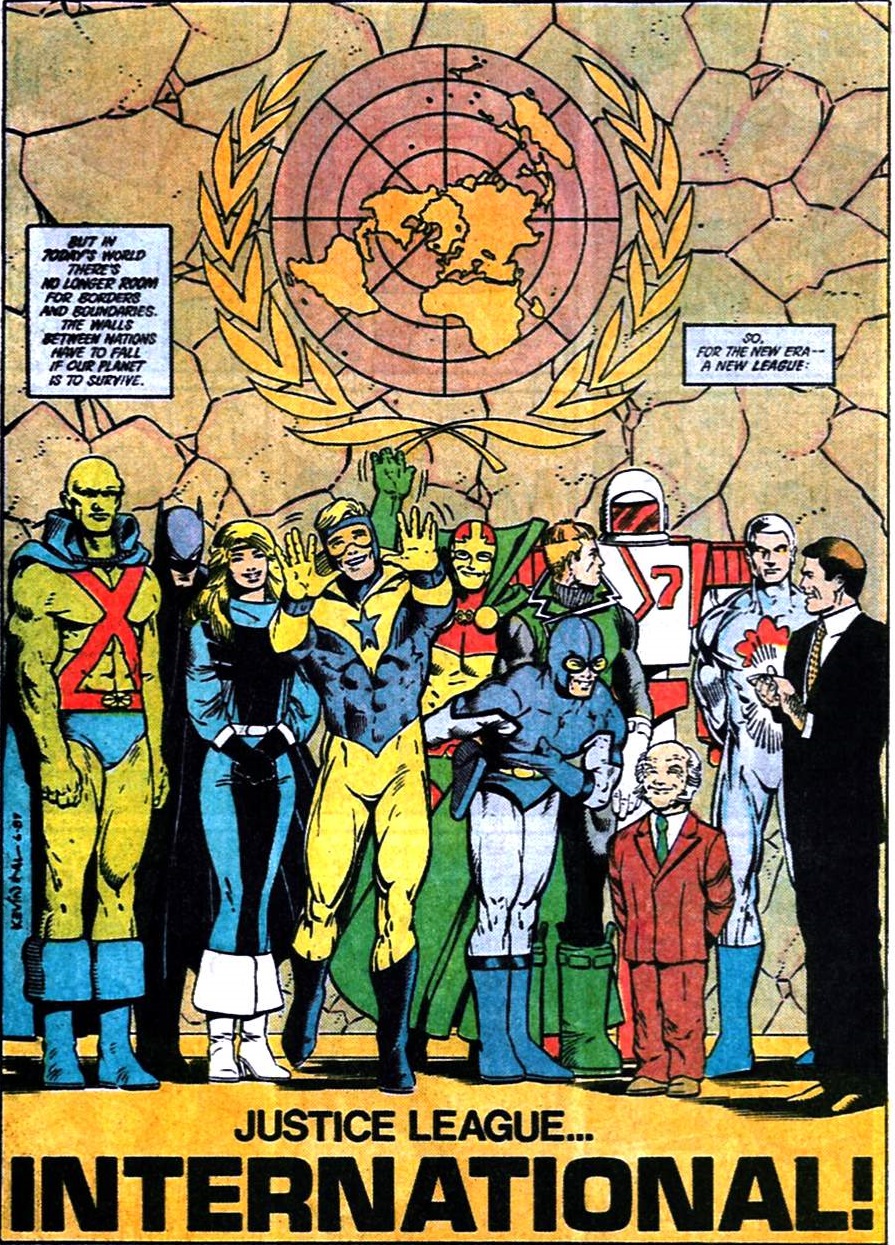
For one thing, if Batman’s existence is so ambiguous in the public’s mind, how come Gotham seems to descend into chaos every time he disappears or is rumored to have died? Also, while you can perhaps reimagine all the old stories where the Caped Crusader shows up on the news and on TV, it is harder to disregard how much time he spends hanging out with the highest profile heroes of the DC Universe. For Pete’s sake, even those who defend this approach admit it doesn’t fit comfortably with the fact that the Dark Knight has been a member of virtually every incarnation of the very public Justice League, even if he prefers to stay in the background of group photos:

Justice League International 007 Justice League International #7

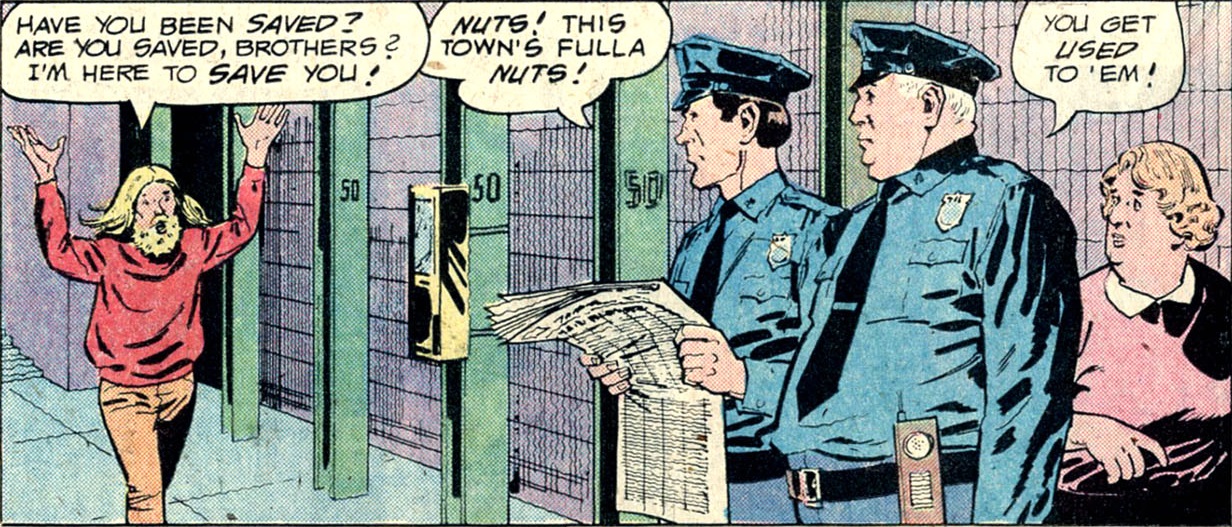
Granted, the notion that a half-man, half-bat creature of the night is considered as much of an urban legend as the tale of the poor bastard who woke up in a bathtub without a kidney after a one-night stand may work for the early years of Batman’s career. After all, the Gotham authorities must be so used to dealing with delusional people…

detective comics 488 Detective Comics #488

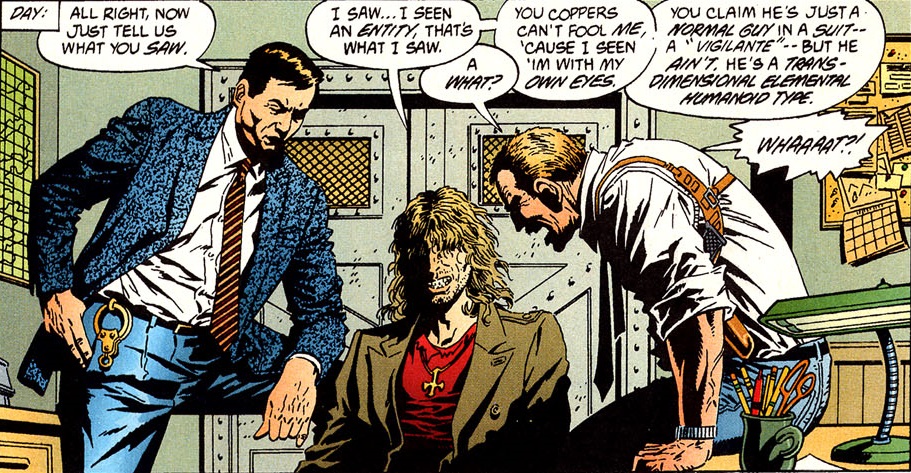
…that the reports of a winged bogeyman may have been dismissed as some sort of bat dream at first, with the police taking some time to realize what exactly was going on:

Legends of the Dark Knight 012Legends of the Dark Knight #12

Yet there is only so long you can stretch this. Once you’ve introduced all sorts of kooky villains and outlandish superheroes flying and running around Gotham City, how can you make the case that accounts of the Dark Knight would strike anyone as far-fetched?

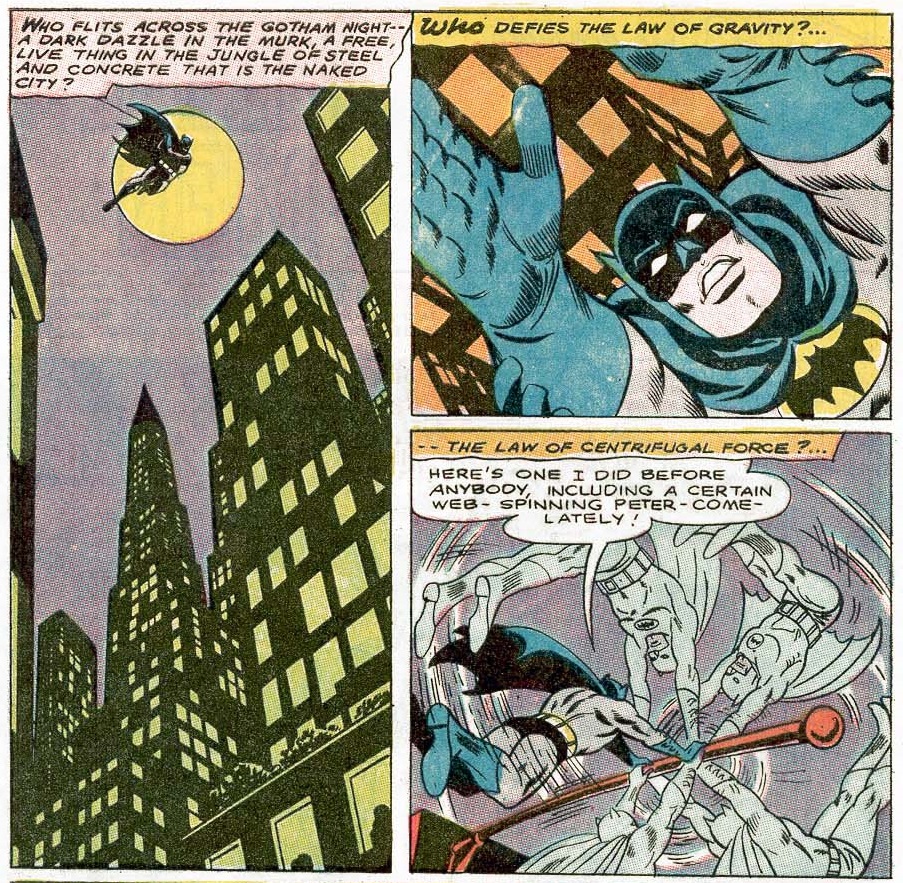
Moreover, I don’t care if Batman mostly sticks to the shadows – his years of fighting crime must have taken a toll on his mystic image. Seriously, the Caped Crusader cannot be such a rare sighting, since he is out there pretty much every night, right outside your window, jumping from building to building, sometimes even taking jabs at the competition:

Brave and the Bold 74The Brave and the Bold #74

And it’s not just Gotham. Over the past 75 years, Batman has traveled to each and every one of the 50 States in the Union!
I get why the GCPD wouldn’t officially acknowledge Batman’s work, since they wouldn’t want to admit to resorting to the help of a violent outlaw with a thing for bats. But in some comics the Dark Knight himself goes out of his way to keep the public uncertain about his existence. In Batman #584, Ed Brubaker has him arguing that ‘there’s more power in rumors and fear than in publicity.’ However, it’s one thing for Batman to let his reach and powers become the stuff of legend (and therefore exaggerated by superstitious minds) and another one for him to actually throw doubt on the fact that he is real at all.

Surely Batman’s impact relies precisely on the criminals’ awareness that he is very much real:

Batman 339Batman #339

In fact, much of the fun of decades-old shared universes like the ones at Marvel and DC has got to be figuring out how all those masked vigilantes would unavoidably shape society. Acclaimed comics such as Watchmen and Astro City have a blast exploring how superheroes could be integrated into the media, politics, or even academia (like in Jonathan Lethem’s neat short story ‘Super Goat Man’). I’m fascinated by this kind of alternate history world-building, which is why I dig the idea that after a while people would take the Caped Crusader’s presence for granted, as just another weird facet of Gotham City:

Detective Comics #567 Detective Comics #567

For a long time it used to be pretty much established that Batman and Robin were not only public figures, but pop icons. The anniversary of the Caped Crusader’s first case was enthusiastically celebrated by thousands of Gothamites and there were countless public service campaigns featuring the Dynamic Duo as well as entire industries set up around their merchandise.

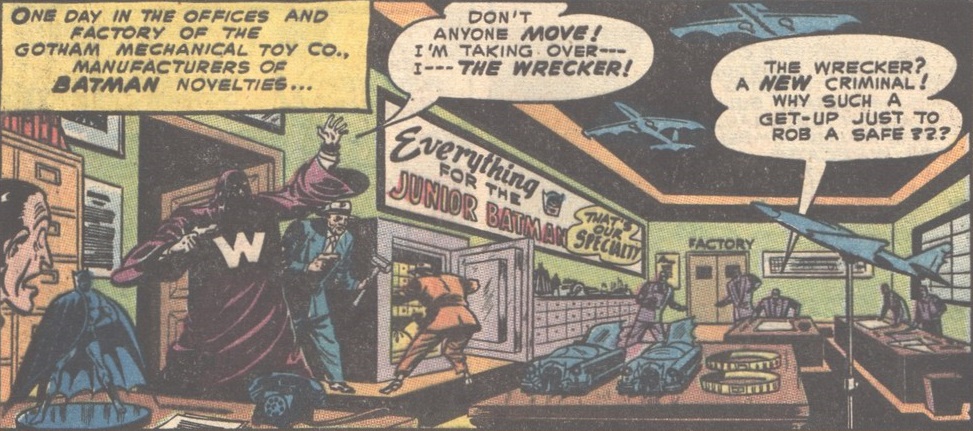
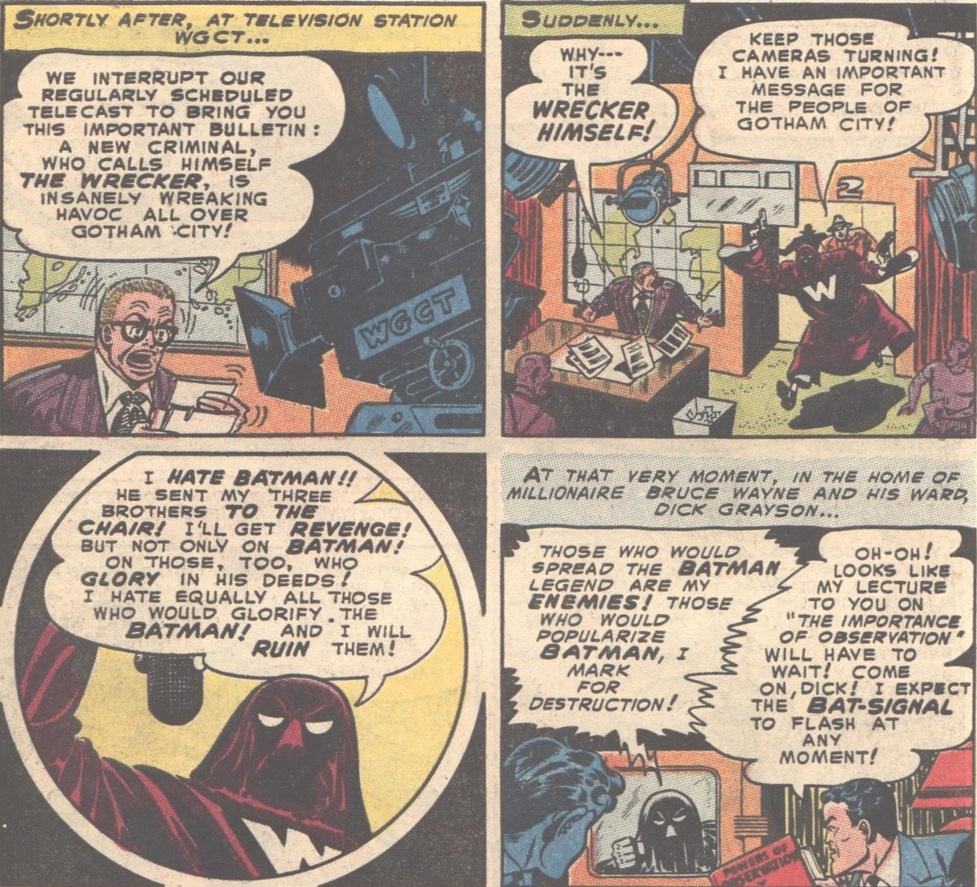
Which brings us to ‘The League Against Batman!,’ the 1953 story in which David Vern, Dick Sprang (ghosting for Bob Kane), and Charles Paris introduced the Wrecker:

Batman 218Detective Comics #197

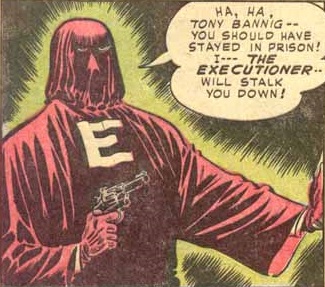
Now, I know what everyone is thinking. That dude looks just like the Executioner, with a different letter on his KKK-style hood…

detective comics 191 Detective Comics #191

But nope, this is a different guy – take it from Gotham’s most histrionic anchorman:

Batman 218Detective Comics #197

The Wrecker is a villain out to destroy anything and anyone who has ever glorified Batman: from toy lines to parade balloons, from fan clubs to some guy who once wrote a song dedicated to the Caped Crusader.

As you can tell from the excerpt above, this delightfully goofy story is paced like a Marx Brothers comedy (minus the musical numbers and romantic subplots). I particularly like the showdown at the studio of sculptor Rolf Baglund, where the Wrecker captures the Dynamic Duo and proceeds to lock them up in a giant, automatic oven. (A henchman asks: ‘Hey, Wrecker- how about takin’ off Batman’s mask, so’s we kin get a look at him?’ Yet the Wrecker, frenetic like everything else in this comic, doesn’t pause for a moment: ‘We’ve no time! Not a second to lose! The police may be outside right now!’) And then there’s the scene at Ben Mosser Films studio, where there happens to be a real space rocket, because why would a studio use a cheap prop when they could build a huge, expensive, functional rocket? So the Wrecker tries to get rid of Batman by literally sending him out into the stratosphere!

What’s more, on top of all the hijinks, David Vern still manages to craft a detective story – one where the villain’s plan is over-elaborate (as usual) but nevertheless one where the Caped Crusader (and astute readers) solves a mystery through genuine deductive reasoning.

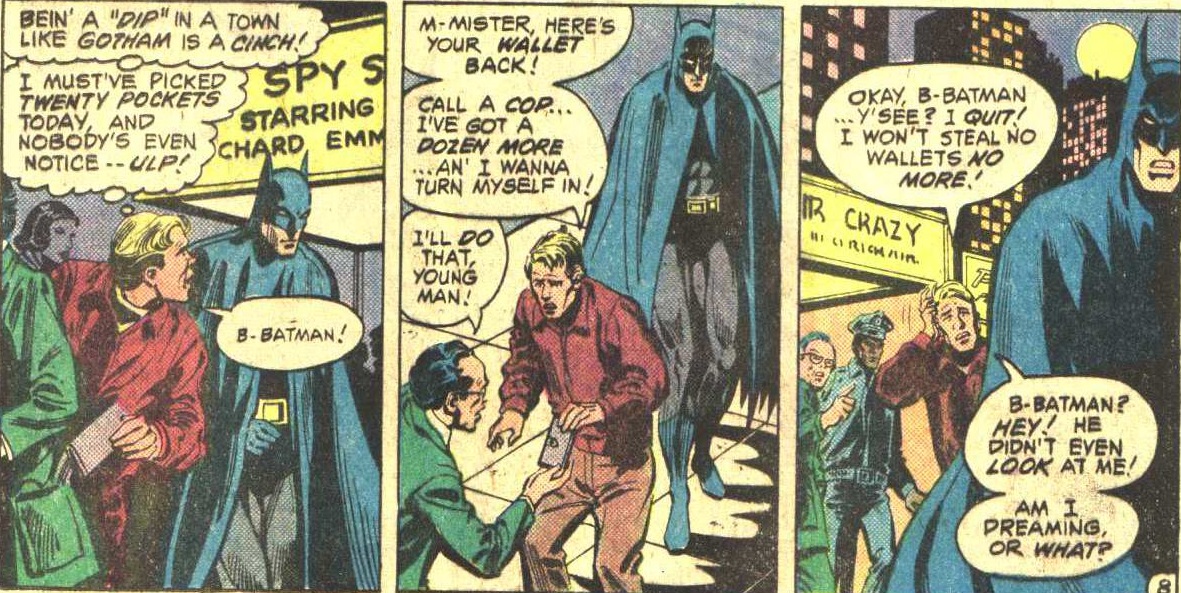
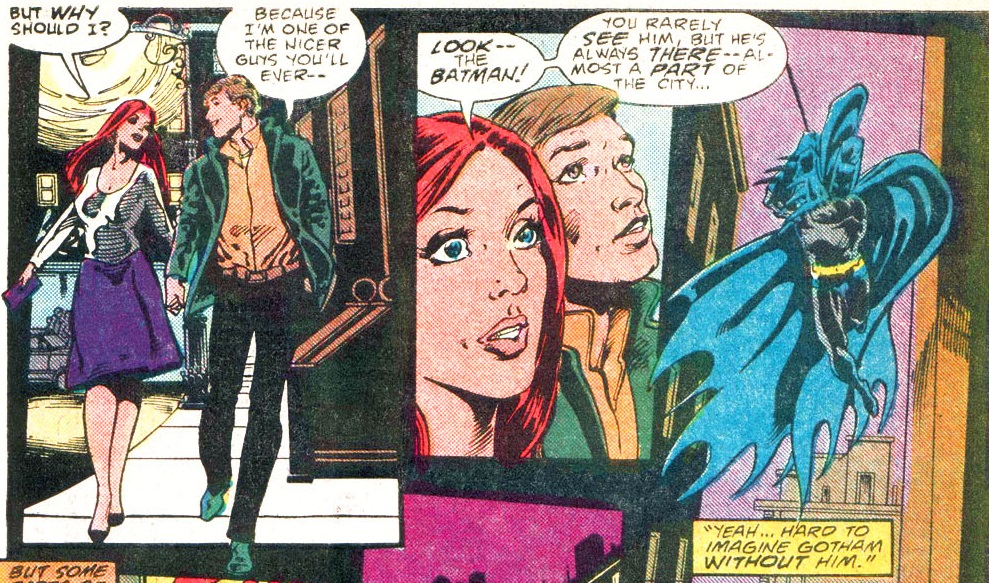
Sure, I admit that giving Batman such a public figure status may be taking things too far… I’m not saying his existence should be treated as absolutely mundane, but I love the notion that most Gotham citizens have their own story of that one time they bumped into the Dark Knight…

detective comics 552Detective Comics #552

NEXT: Great Scott!

Posted in GOTHAM CITIZENS | Tagged , , , , , | 2 Comments

The Dick Sprang challenge

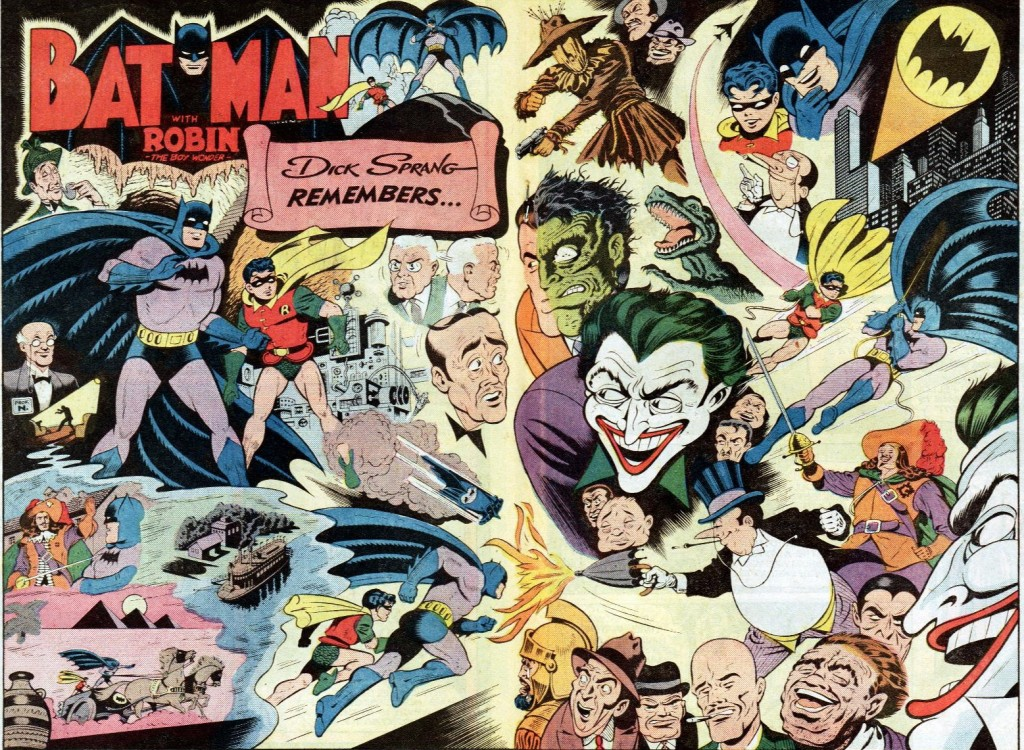
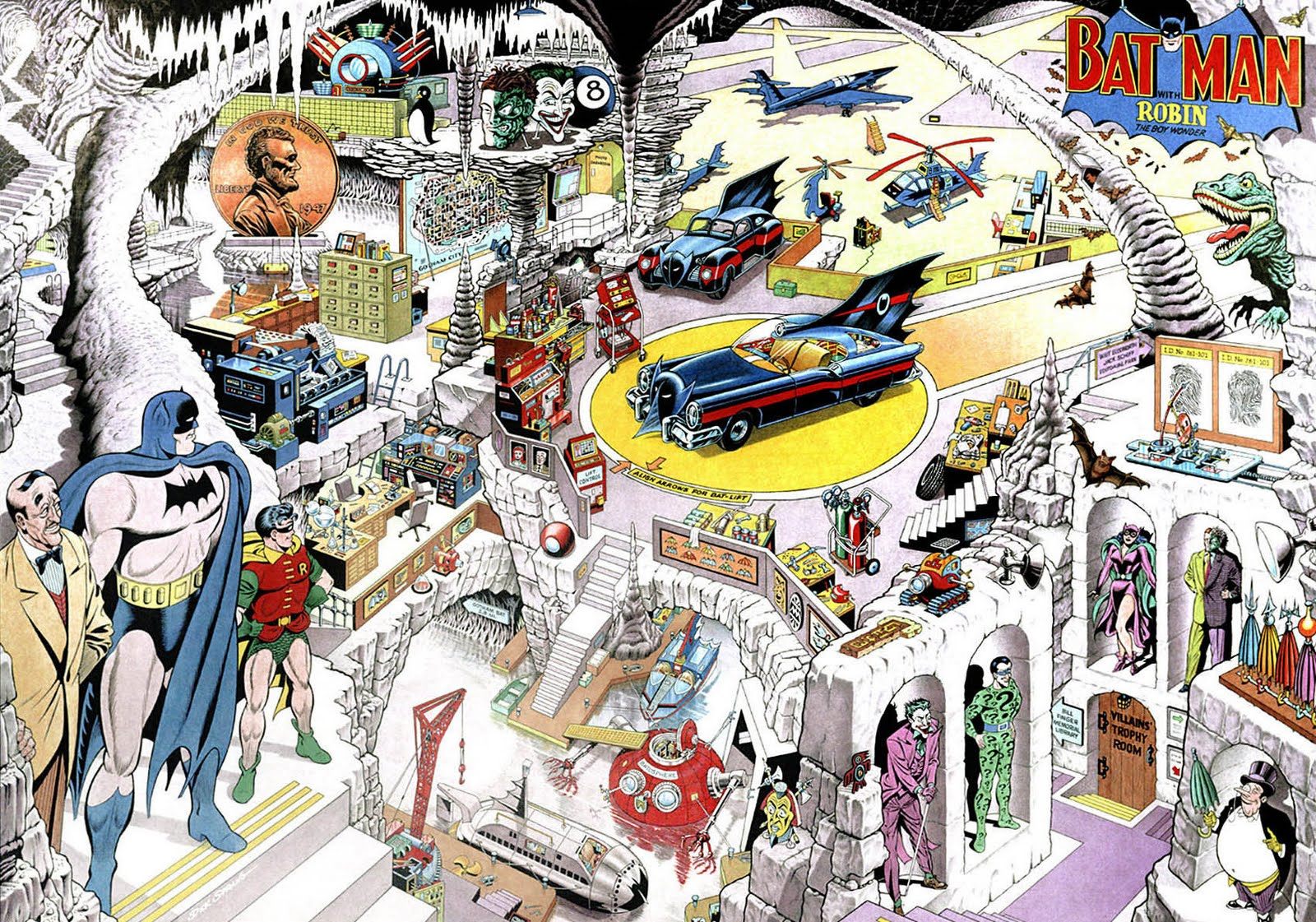
Of Bob Kane’s various ghost artists, probably none was more defining than Dick Sprang, with his bold, clean-cut, upbeat, square-jawed, barrel-chested, Chester Gould-ish depiction of the Caped Crusader. But besides being  one of the most recognizable and stylish Batman artists of the Golden Age and Silver Age, Sprang later produced a number of luscious, hyper-detailed, Where’s Waldo-esque drawings paying homage to several classic adventures of the Dynamic Duo. Check out these three and see how many references you can spot…

(Needless to say, Chris Sims has a head start.)

Detective Comics #572Detective Comics #572


Secrets of the BatcaveSecrets of the Batcave
Guardians of GothamGuardians of Gotham

NEXT: Batman mocks Spider-Man.

Posted in ART OF BATMAN COMICS | Tagged , | Leave a comment

Bruce Wayne’s political career

Despite spending much of his life terrorizing the criminal underworld or stuck in deathtraps while exchanging puns with a dude dressed as a question mark, Batman has found the time to take up a number of political jobs. With that in mind – and given candidates’ recent attempts to invoke nerd culture in their campaigns – I figured it’d be fun to take a close look at Bruce Wayne’s various ventures into institutional politics.

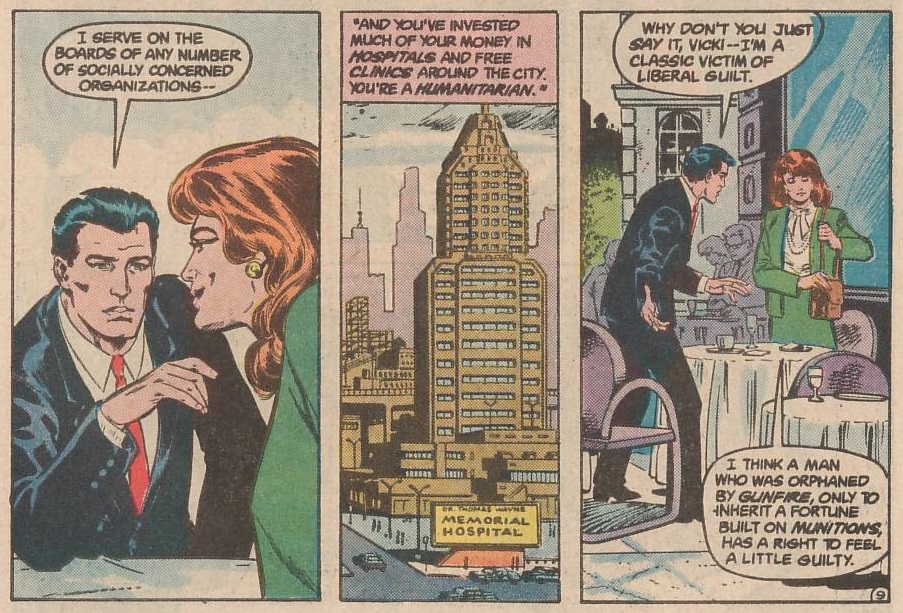
Regardless of what you may think of the Dark Knight’s politics, Bruce Wayne is often presented as socially engaged:

Batman #408Batman #408

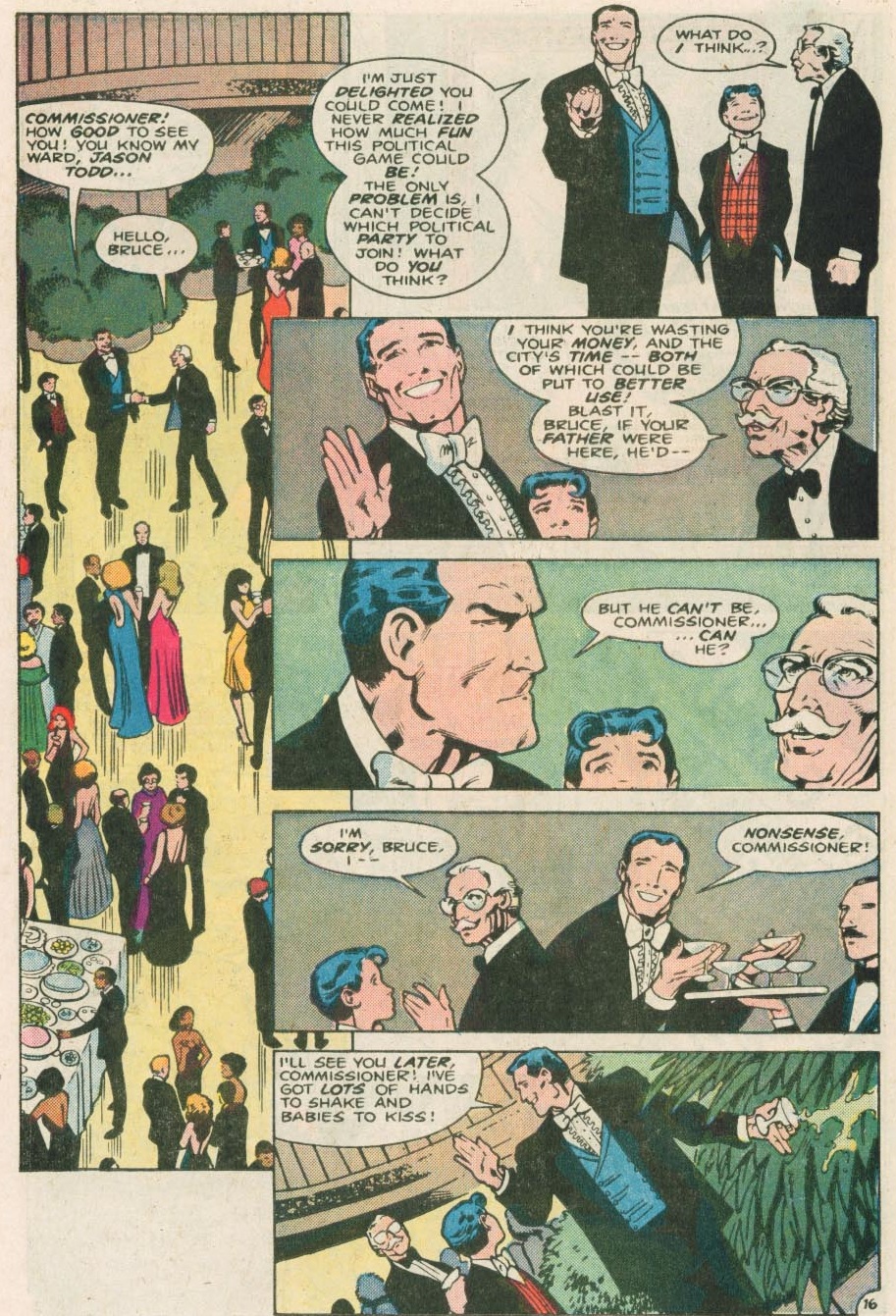
That said, Gotham City’s favorite billionaire didn’t seem to take things very seriously when he ran for councilman, in 1987:

detective comics #573Detective Comics #573

As far as comics about politics go, this isn’t exactly a sharp satire in the mold of Weapons of Mass Diplomacy (or even Ex Machina), but I just love the way Bruce wears that smile like a mask, while discreetly throwing the alcohol away… Also, in his defense, he wasn’t interested in winning anyway. In fact, Bruce’s whole bid for City Council was only a ploy to lure the hat-obsessed villain Mad Hatter by metaphorically throwing a hat into the political ring (the same reason Jim Webb ran for president, I assume).

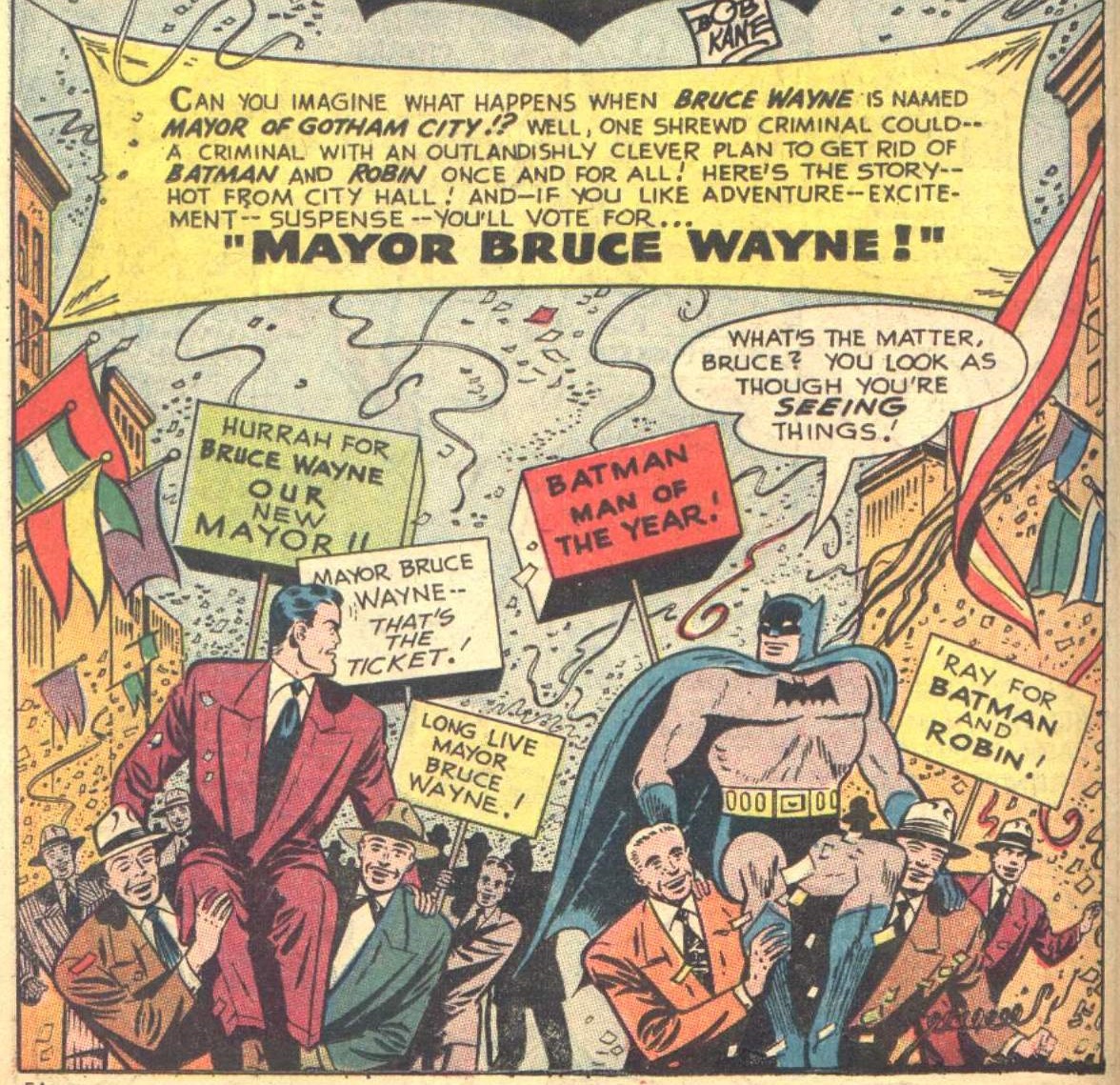
Before that, there was the time Bruce Wayne became Mayor of Gotham City (always a dangerous career move). I’m not even talking about the hilarious 1960s’ TV episodes where Batman ran against the Penguin (needless to say, he literally put up a fight!), but about the comic in which Gotham’s elected mayor went on vacation for a week and appointed his replacement through a raffle… By sheer chance, Bruce’s name was drawn, so he became temporarily in charge of City Hall. You know, democracy.

Bruce didn’t do much while in power though, since he kept obsessing over the fact that, in the exact same week, a criminal had decided to start impersonating the Caped Crusader:

detective comics #179Detective Comics #179

In a classic political move, Bruce hypnotized his secretary into believing that he (the secretary) was Mayor Bruce Wayne, thus providing an alibi while the real Batman went after the impersonator. In the end, the Dark Knight caught the bad guy and prevented a profitable kidnapping, although I still think he should’ve used those hypnotizing powers to renegotiate the city’s public debt.

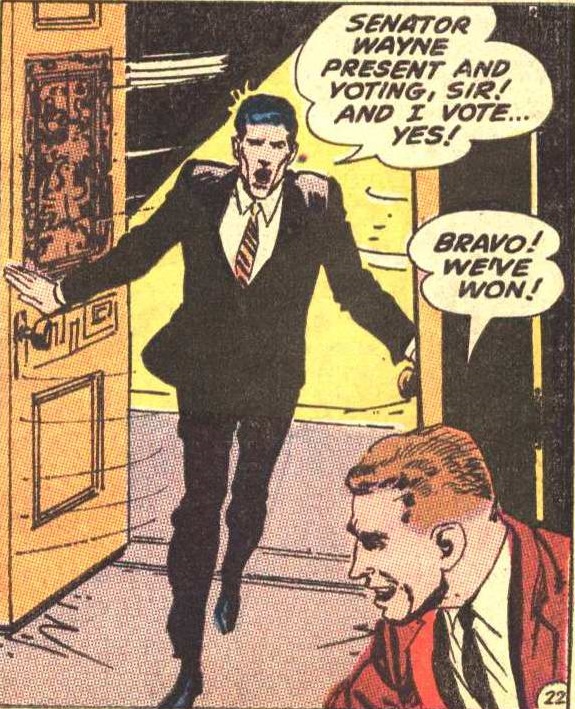
At a more national level, Bruce became senator for a few days back in the sixties. And while he only participated in one vote, he sure did it with typical passion:

Batman Brave And The Bold 085The Brave and the Bold #85

(Yep, it was an Anti-Crime Bill.)

Probably impressed by this display of red-blooded fervor, the following year Washington appointed Bruce Wayne as ambassador to an ill-defined South American country, in ‘The Striped Pants War!’ (The Brave and the Bold #96). Bruce was sent to sign a security treaty after the previous ambassador had been abducted by a terrorist group sinisterly called Compañeros de la Muerte. Luckily, the Caped Crusader happened to show up in the country at the same time – what a fortunate coincidence!

Because it was written by Bob Haney, this story was a go-for-broke thrill ride that included Batman bullfighting for his life and a badass Alfred saving the day. Also, at one point Sgt. Rock got crushed under a Spanish Inquisition torture device, leading to the great line ‘Remember, old soldiers never die – they just re-enlist!’

Still, this wasn’t even the most ludicrous diplomatic mission in the DC Universe:

Batman 428 Batman #428

Then again, in the year when Donald Trump took such a long-lasting lead in the polls, the politics of the DCU are looking more and more reasonable in comparison.

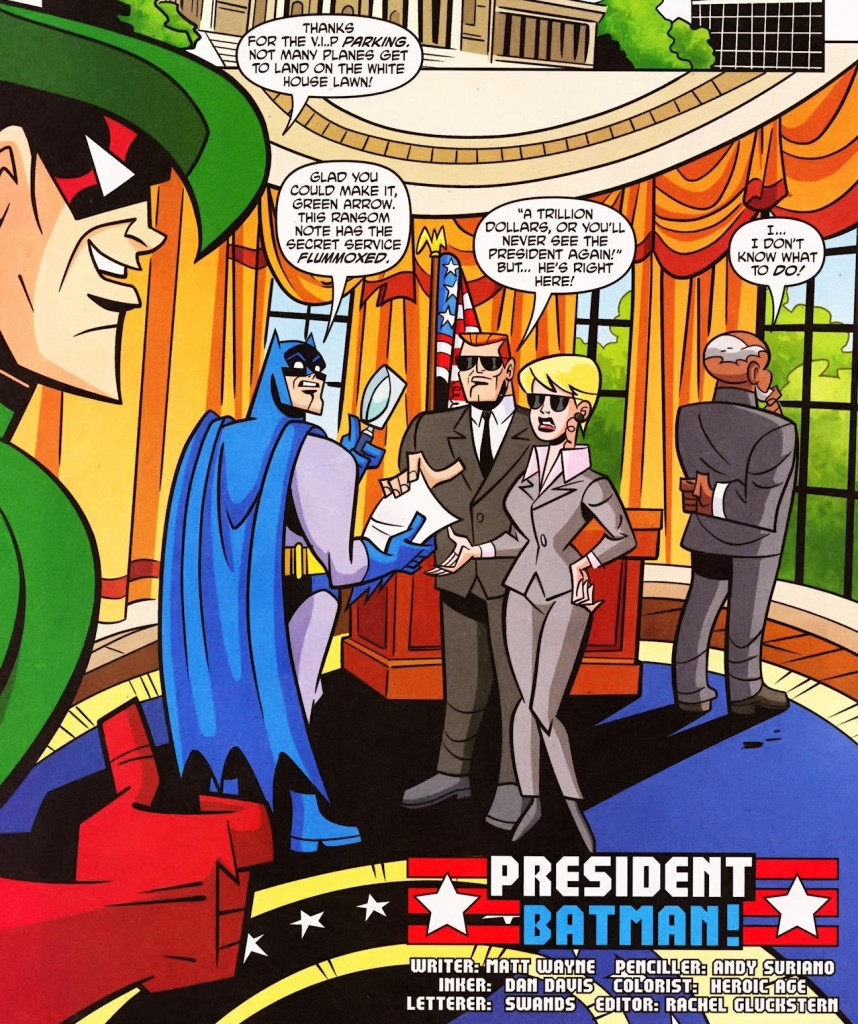
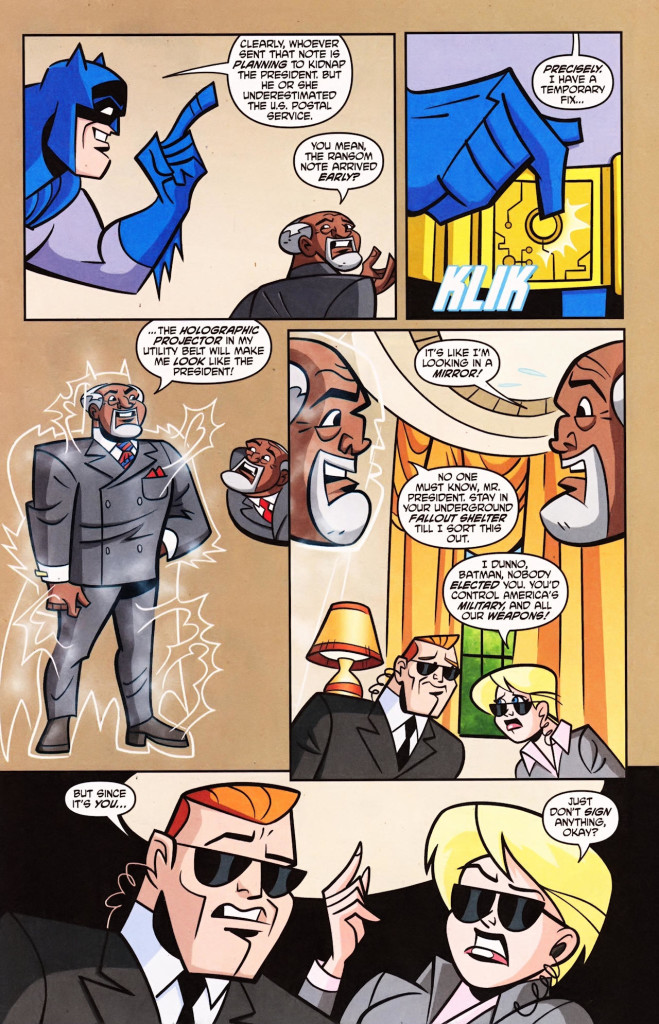
All in all, these are not the most insane political comics ever (if nothing else because last year the world gave us Joe Sacco’s Bumf), but there is something inherently amusing about watching Bruce Wayne apply his unorthodox approaches to crime-fighting in the political arena… Of course, sooner or later someone had to take the premise to its logical extreme. And so, in one of the coolest comics of the last 10 years, Batman finally took over the White House:

Brave and the Bold 03Brave and the Bold 03Batman: The Brave and the Bold #3

NEXT: Batman and Robin ride a chariot, Quo Vadis-style.

Posted in POLITICS OF BATMAN COMICS | Tagged , , | Leave a comment

Taking a break… (November 2015)

Detective Comics Annual 1Detective Comics Annual #1
Posted in GOTHAM INTERLUDES | Tagged | Leave a comment

Classic gothic horror films

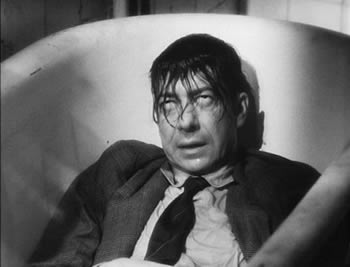
If it’s true that Batman fans should enjoy other gothic comics, then of course the same goes for gothic movies. In the first film list I did for this blog, I suggested Dead of Night and The Unknown as examples of the kind of old school horror that is bound to appeal to those who dig the darkest corners of Gotham City.

Here are another 10 recommendations:

FRANKENSTEIN (1931)

FRANKENSTEIN (1931)

‘It moving… It’s alive. It’s ALIVE!’

Frankenstein is the most gothic-looking film this side of Murnau’s Faust and Cocteau’s Beauty and the Beast. With a gloomy, poetic tone, this loose adaptation of Mary Shelley’s fascinating seminal sci-fi novel about a scientist who creates a sentient monster set the visuals for most other versions of the material in popular culture, including a ton of comics (by the way, fans of the original book should definitely check out Frankenstein’s Womb, by Warren Ellis and Marek Oleksicki). The movie also spun a bunch of sequels – and while the quirky Bride of Frankenstein has a reputation for being the best of the follow-ups, for my money Young Frankenstein is the true masterpiece!

I WALKED WITH A ZOMBIE (1943)

I WALKED WITH A ZOMBIE

This mesmerizing tale of a white nurse encountering voodoo rituals in a Caribbean sugar plantation, directed by Jacques Tourneur (who also did the chilling Night of the Demon and The Leopard Man), couldn’t be farther from our current idea of zombie horror, as defined by the likes of Night of the Living Dead, Evil Dead, 28 Days Later, or The Walking Dead. There are no brain-eating corpses, no gore, not even a clear commitment to whether or not the magic should be accepted literally… Instead, well placed shadows and the somber sound of the wind are enough to make I Walked with a Zombie the most eerily atmospheric movie ever released.

THE UNINVITED (1944)

THE UNINVITED 1944

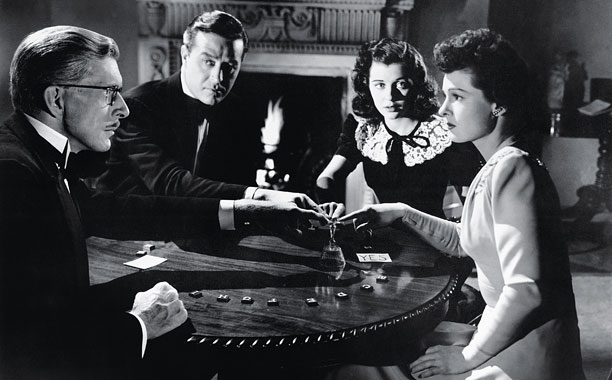
Less ambiguous about its take on the supernatural, The Uninvited is a clever, good old-fashioned ghost story. Who doesn’t love those? The plot is devious and provocative but, like in many of the other movies on this post, ultimately immaterial. It’s all about the sinister ambience and there sure is plenty of that!

THE BODY SNATCHER (1945)

The Body Snatcher

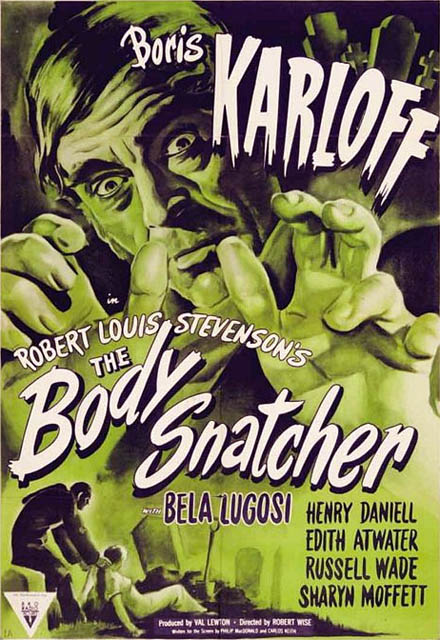
Robert Wise’s morbid mood piece bleakly adapts a short story by Robert Louis Stevenson inspired by the Burke and Hare murders (and written in the same dark prose as The Strange Case of Dr Jekyll and Mr Hyde).

On the surface, this movie has little to do with Don Siegel’s similarly titled science fiction classic Invasion of the Body Snatchers. What the two have in common is that, like subsequent versions of the latter, they serve as perfect metaphors for their decades… 1956’s Invasion of the Body Snatchers reeks with the anticommunist paranoia of McCarthyism, 1978’s surprisingly good remake taps into the post-hippie culture of individualism, 1993’s Body Snatchers is dumb and full of explosions, 2007’s The Invasion aims for War on Terror poignancy (but fails miserably), 2013’s The World’s End is a smart satire of small town homogenization and alienation.

As for 1945’s The Body Snatcher, its tale of grave robbing and medical experiments feels like a distillation of late WWII concerns over the intersection between ethics and science. Also, it has a genuinely macabre ending!

THE SPIRAL STAIRCASE (1946)

The spiral staircase

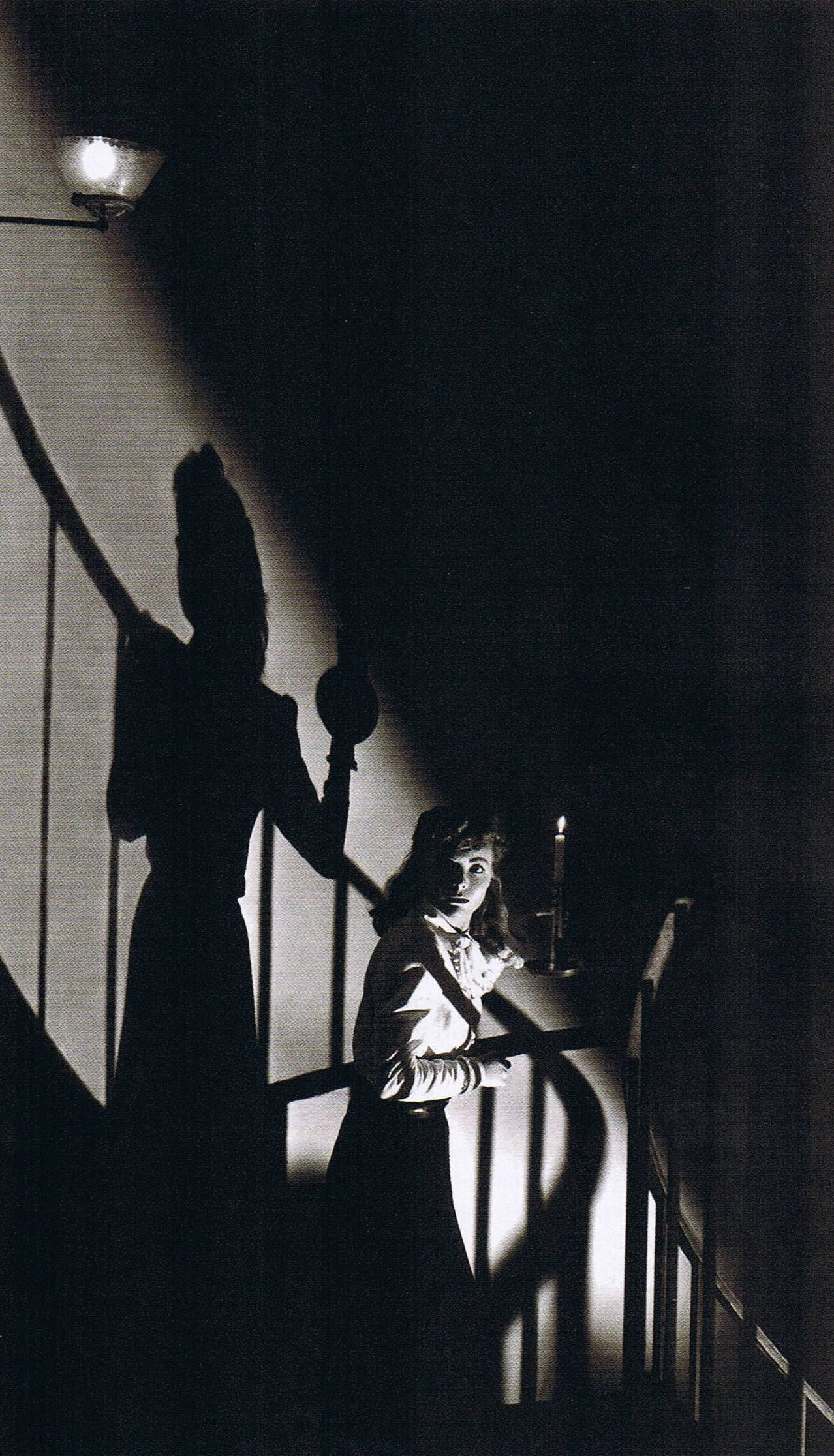
I’ve mentioned before that Robert Siodmak was an awesome director of film noir, but he could also do horror better than most. Set in the turn of the century, The Spiral Staircase is an intense, spellbinding thriller about a mute girl trying to avoid a serial killer who targets disabled young women.

Scary and effective.

DIABOLIQUE (1955)

Diabolique

This suspenseful masterpiece was directed by Henri-Georges Clouzot, often referred to as the French Alfred Hitchcock (although Clouzot’s movies were even crueler than Hitchcock’s and with a less flashy style). Les Diaboliques begins with a mundane story of infidelity and murder, then it slowly but surely evolves into horror, culminating in one of the most terrifying final sequences I’ve seen on film… (And yet, it’s still not as grim or warped as Clouzot’s earlier crime flicks Le Corbeau and Quai des Orfèvres.)

VILLAGE OF THE DAMNED (1960)

Village of the Damned (1960)

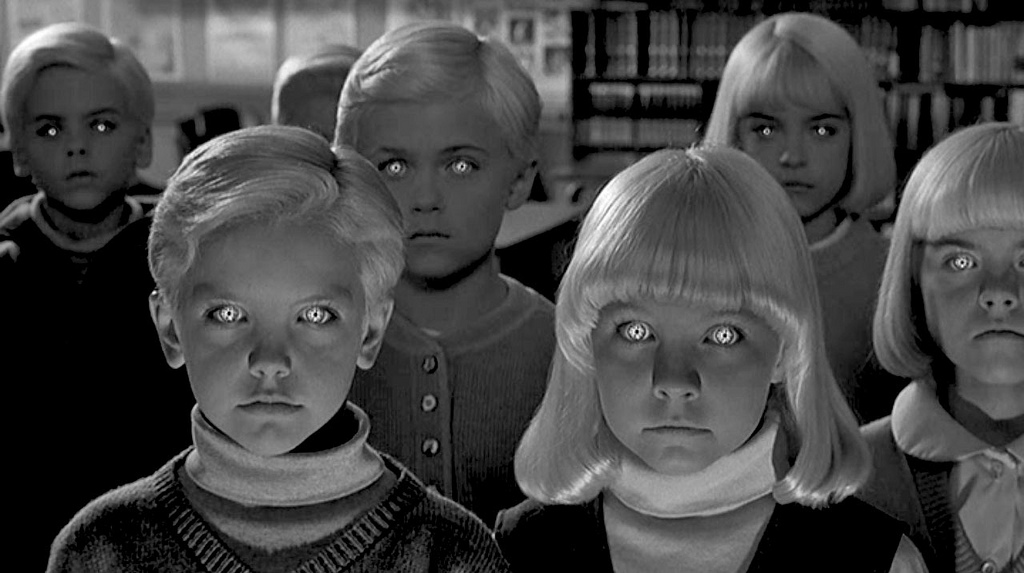
It all starts when the inhabitants of a whole village suddenly fall unconscious, even the animals… Closer in spirit to the best episodes of the brilliant The Twilight Zone than to John Carpenter’s pointless remake, this British sci-fi chiller keeps throwing viewers one enthralling idea after another, including twisted deaths, Cold War fears, and those unforgettable hypnotic children!

(Hardcore Bat-fans may also dig the fact that the lead role is played by George Sanders, who went on to play Mr. Freeze in the first season of the Batman TV show.)

PSYCHO (1960)

Psycho 1960

Although Alfred Hitchcock’s most perversely gothic movie is Rebecca, I had to go with this later classic about a woman on the run who makes the mistake of checking into a motel where the creepy Norman Bates lives with his even creepier mother. After decades of spoofs, spoilers, and rip-offs (and Batman homages), it’s easy to forget just how sleazy a thriller Psycho is, packed with tension and disturbing twists and a hell of a soundtrack.

THE INNOCENTS (1961)

THE INNOCENTS 1961

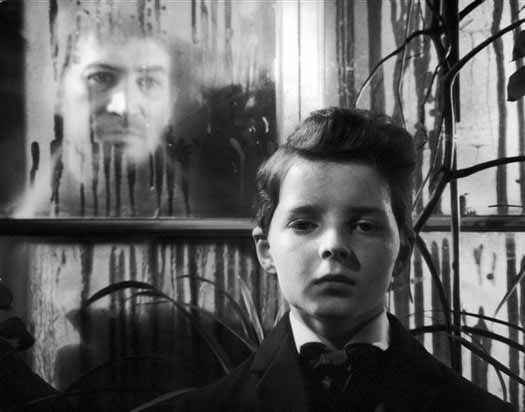
By contrast, The Innocents is all suave atmosphere and psychological sophistication… which is not to say that things don’t get seriously frightening in this taut, stylish tale of a governess who suspects that the children she is taking care of are being possessed. Nightmarish.

THE HAUNTING (1963)

The Haunting (1963)

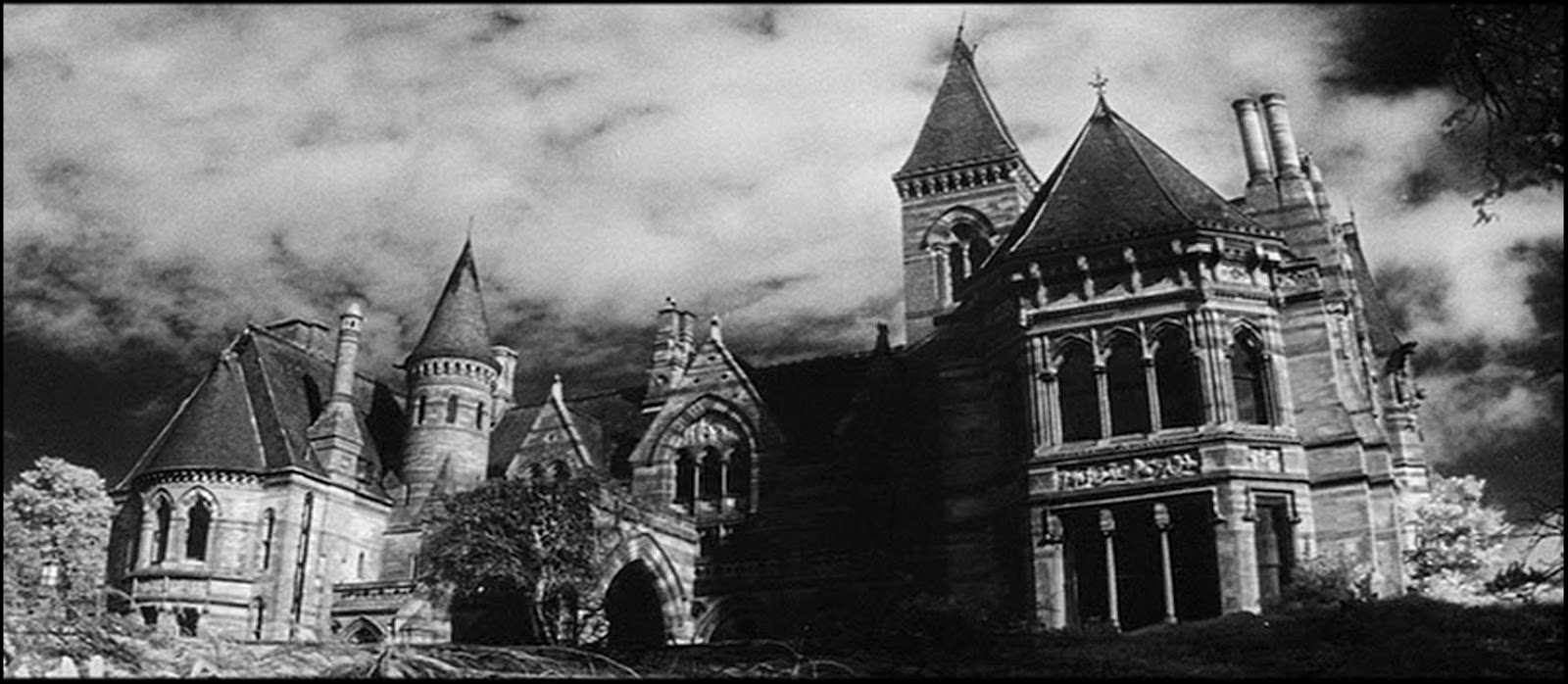
Almost 20 years after The Body Snatcher, Robert Wise returned to his gothic roots with this gorgeous-looking haunted house extravaganza. The story of four strangers brought to an old mansion to determine whether or not the rumors of ghosts are true, The Haunting is at times delightfully tongue-in-cheek, with some hammy interior monologues and lesbian undertones, but when it wants to it’s as expressionist and spooky as anything else on this list.


NEXT: President Batman.

Posted in FANTASTIC ADVENTURES | Tagged , , , , , , | Leave a comment

On Jason Todd, Robin

One way to look at the second Robin, Jason Todd, is that he started out as a well-executed bad idea and ended up as a poorly executed great idea. Another way to look at the character is that DC at first tried to recreate the Golden Age but then it realized it was the 1980s, so it threw any vestiges of innocence out the window in a coke & ecstasy-fueled fit during a synth-scored rave party.

To be sure, the notion of replacing Dick Grayson as the Boy Wonder was not bad in itself, certainly not in 1983, when Dick had clearly outgrown the part. But rather than coming up with a new concept of Robin, their idea was to just blandly remake the original – so we were given another son of circus trapeze artists (‘The Flying Todds’) orphaned by crime while Bruce Wayne was around. It was a pretty lame way to finish Gerry Conway’s underrated run on the Bat-books… Fortunately, Conway was followed by Doug Moench, whose stellar writing also deserves great praise and close observation (I’m working on it, guys!).

Jason Todd struggled to earn his place, as Moench took his time to complete the switch, showing Batman’s hesitations and Jason’s insistence for months. This made Batman seem less like an asshole who endangered kids willy-nilly while also building up Jason’s personality. Neatly, even when the Dark Knight agreed to commit to their partnership, it wasn’t immediately taken for granted that Jason would wear the same suit as Dick Grayson and call himself Robin:

detective comics 534Detective Comics #534

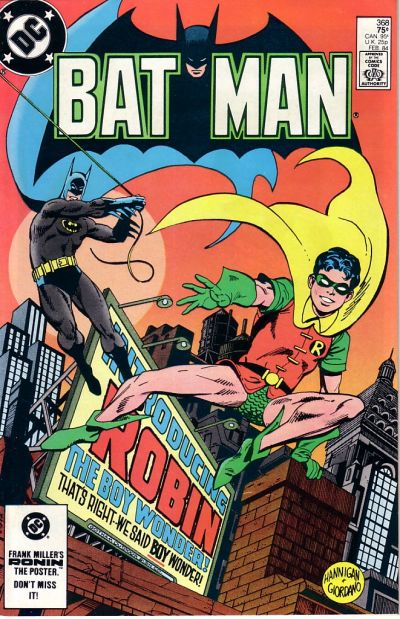
Dick eventually showed up to pass the torch. Having moved on to his Nightwing persona, he gave Jason his blessing to become the new Boy Wonder. This was a big step – by then the title of Teen Wonder had been so firmly established that the issue cover felt the need to make a big fuss about the change:

Batman 368

Doug Moench nailed the potential of the new status quo, as Batman once again got to hang out with a bright, enthusiastic young sidekick. That said, Bruce was often more of a father figure than a crime-fighting partner. Already at the time, much of the characterization in these comics involved Batman continuously holding back, telling Robin to stay away from cases that looked particularly dangerous, and Jason impetuously disobeying him. Unlike what happened in later stories, however, this version of Jason was clearly a nice kid, whose flaw was over-eagerness, not vindictive sadism.

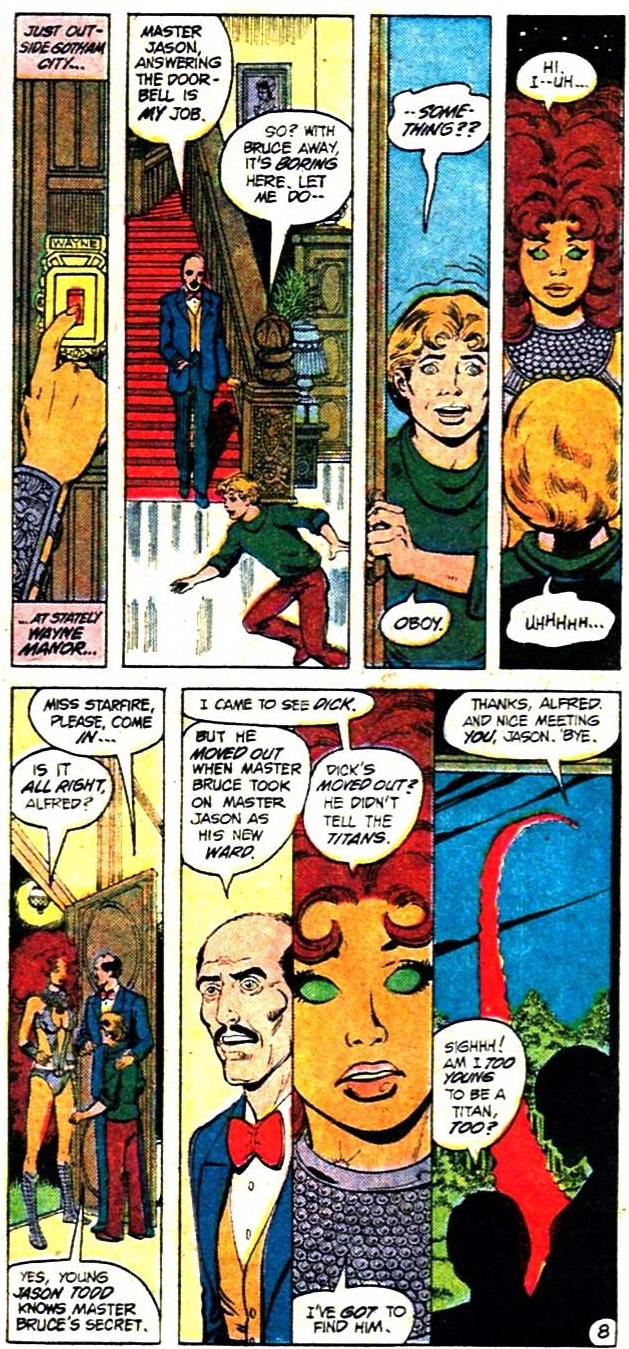
Not only was pre-Crisis Jason Todd damn likable, he also became more and more integrated in the wider DC Universe. For example, in an unintentional foreshadowing of their later relationship in Red Hood and the Outlaws, the lucky rascal got to meet Starfire:

New Teen Titans 33The New Teen Titans #33

Impressively, in the classic ‘For The Man Who Has Everything,’ the new Boy Wonder even saved the asses of Batman, Wonder Woman, and Superman!

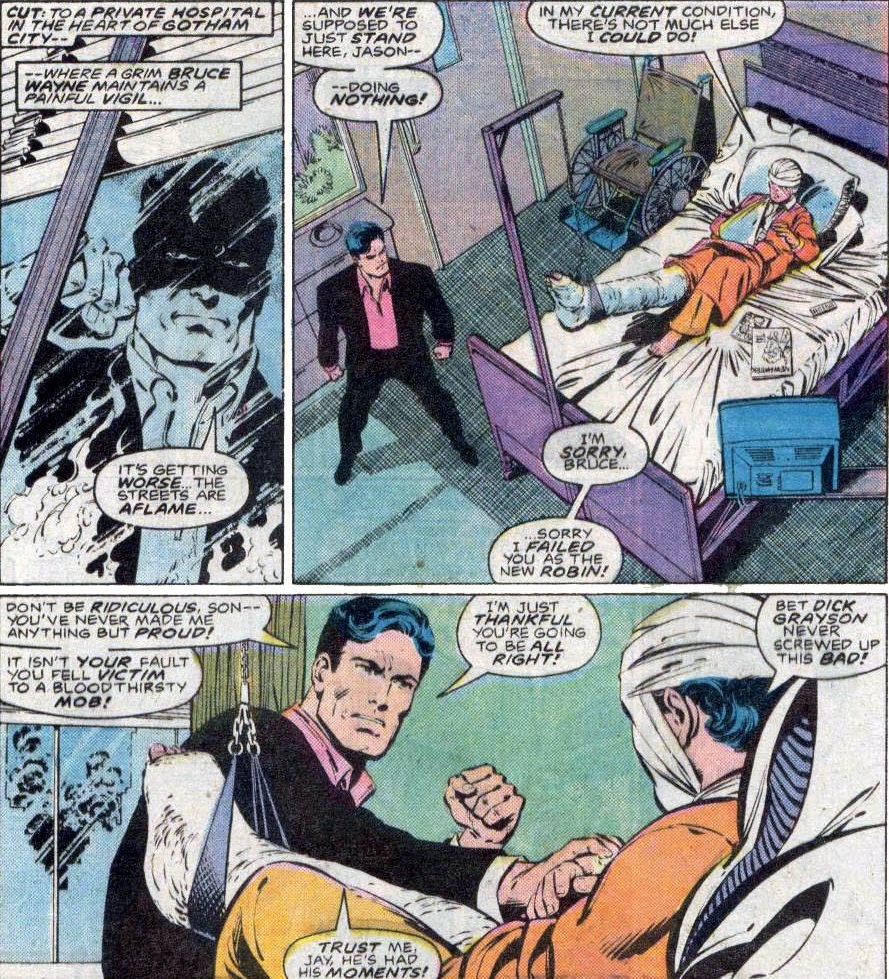
Then again, he got seriously beaten up by an angry mob in the crossover Legends, where public opinion turned against superheroes across the DC Universe:

Legends 03Legends #3

The most important crossover of the era was, of course, Crisis on Infinite Earths, which led to a soft reboot of Batman continuity. DC took the opportunity to give Jason Todd a more interesting background: he was now a street kid whose father had died while working as a flunky for Two-Face. In the revamped origin, Batman actually caught Jason in Crime Alley trying to steal the tires of the Batmobile!

I think this was a keen idea. It made Jason Todd a very different character from Dick Grayson by giving him street smarts, a problematic childhood, and ultimately his own reason to appreciate Bruce as a surrogate-father and crime-fighting mentor. Instead of the clean-cut, wholesome Boy Wonder of yesteryear, Robin was now closer to the irreverent image of modern youth. At the same time, this also gave Batman a different kind of relationship with his sidekick, since he had to tame Jason’s rebellious instincts.

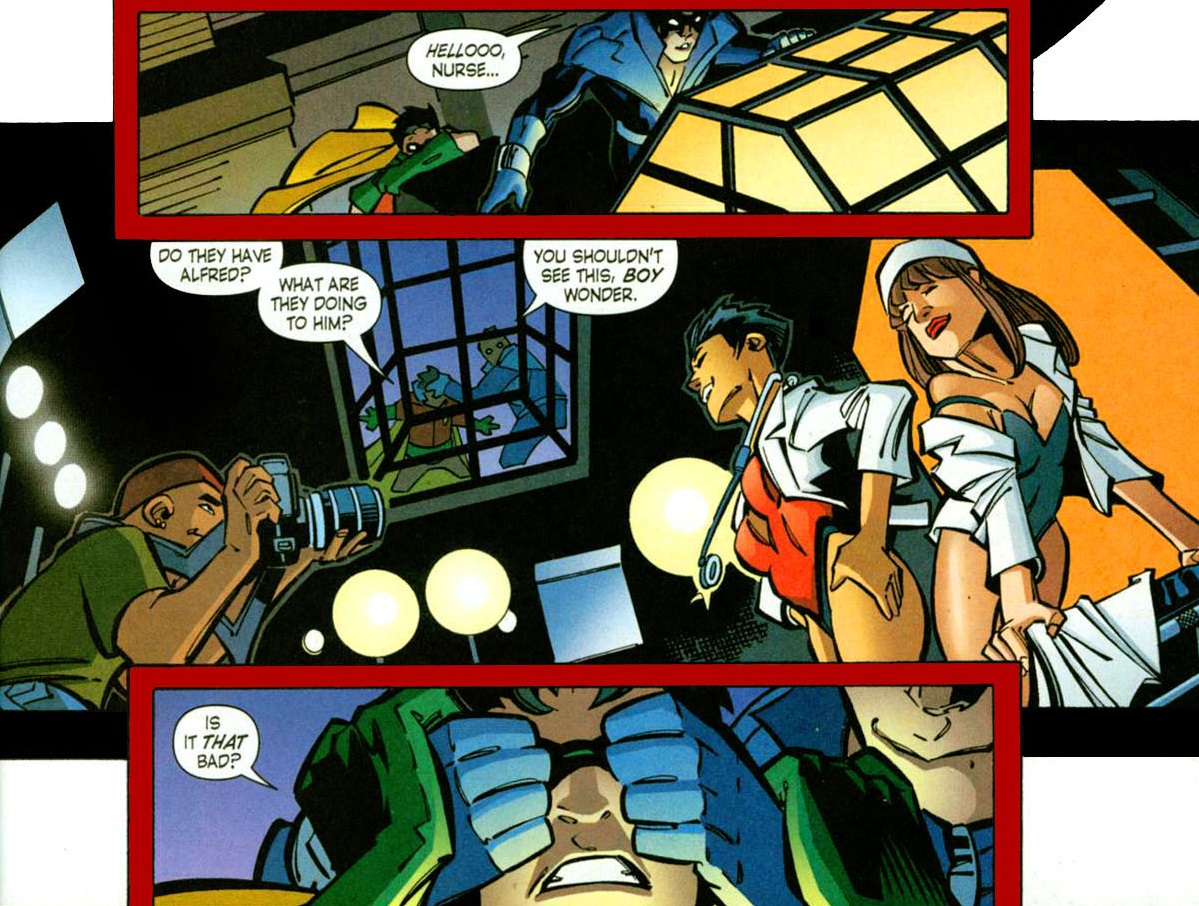
I’m not a huge fan of the comics that introduced these changes (written by the otherwise dependable Max Allan Collins). Luckily, later they were awesomely retold from Dick Grayson’s perspective in Nightwing: Year One, where Dick and Jason got to bond while looking for a missing Alfred:

nightwing 106Nightwing #106

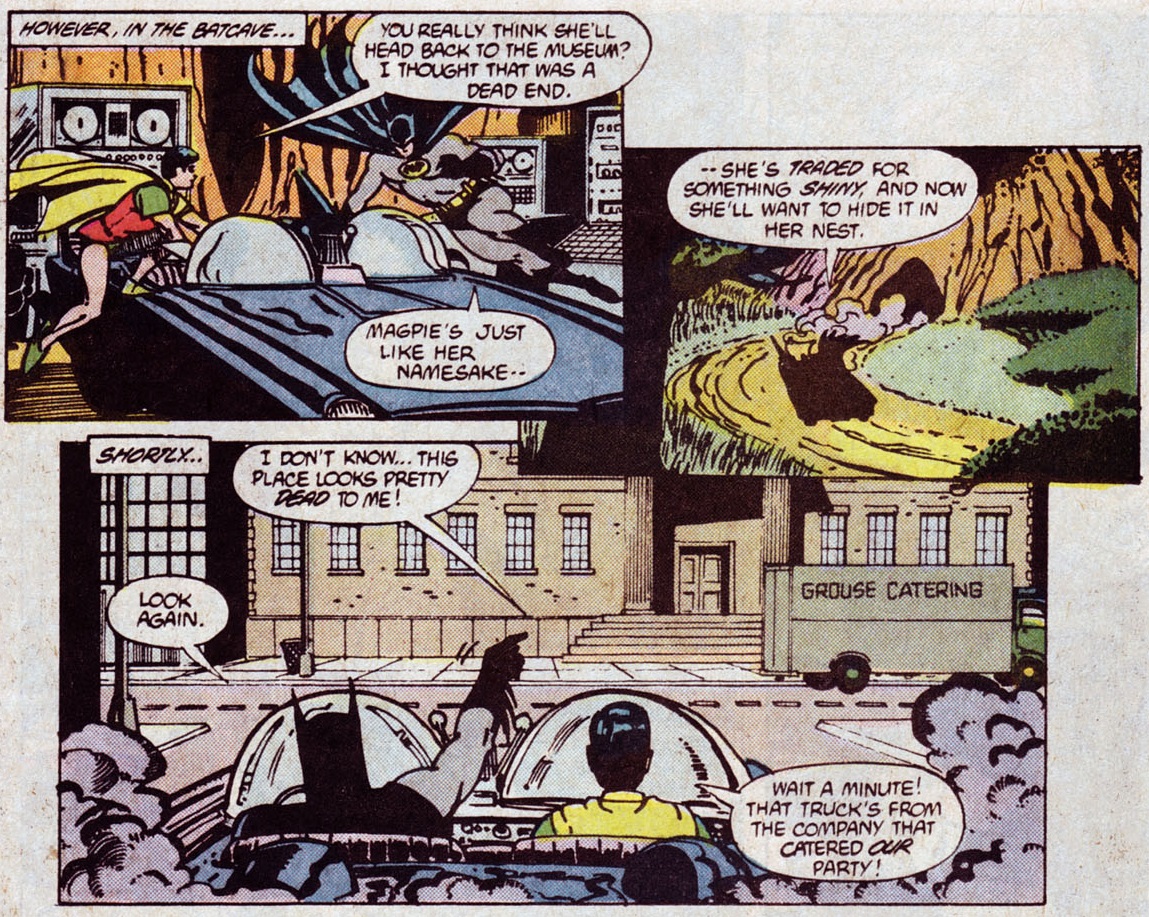
It’s worth pointing out that, even after Crisis on Infinite Earths, many of the earlier stories featuring Jason Todd as Robin had quite a Batman ’66 vibe:

Batman #401Batman #401

This was most notable in Mike W. Barr’s fan-favorite run in Detective Comics, which featured one of the neatest depictions of Jason Todd. Barr wrote Robin as an impulsive wiseass, but was careful not to turn him into a douchebag. Instead, Jason came across as peppy and plucky and, you know, as someone who generally seemed to be having a blast hanging out with Caped Crusader!

detective comics #570 Detective Comics #570

Things changed dramatically once Jim Starlin started to write Batman, in late 1987. Grimly steeped in sexual violence and terrorism, Starlin’s run was as eighties as it gets. The Dark Knight even fought a Soviet agent named KGBeast, in what was possibly the most preposterous Cold War fanfic since Rocky IV!

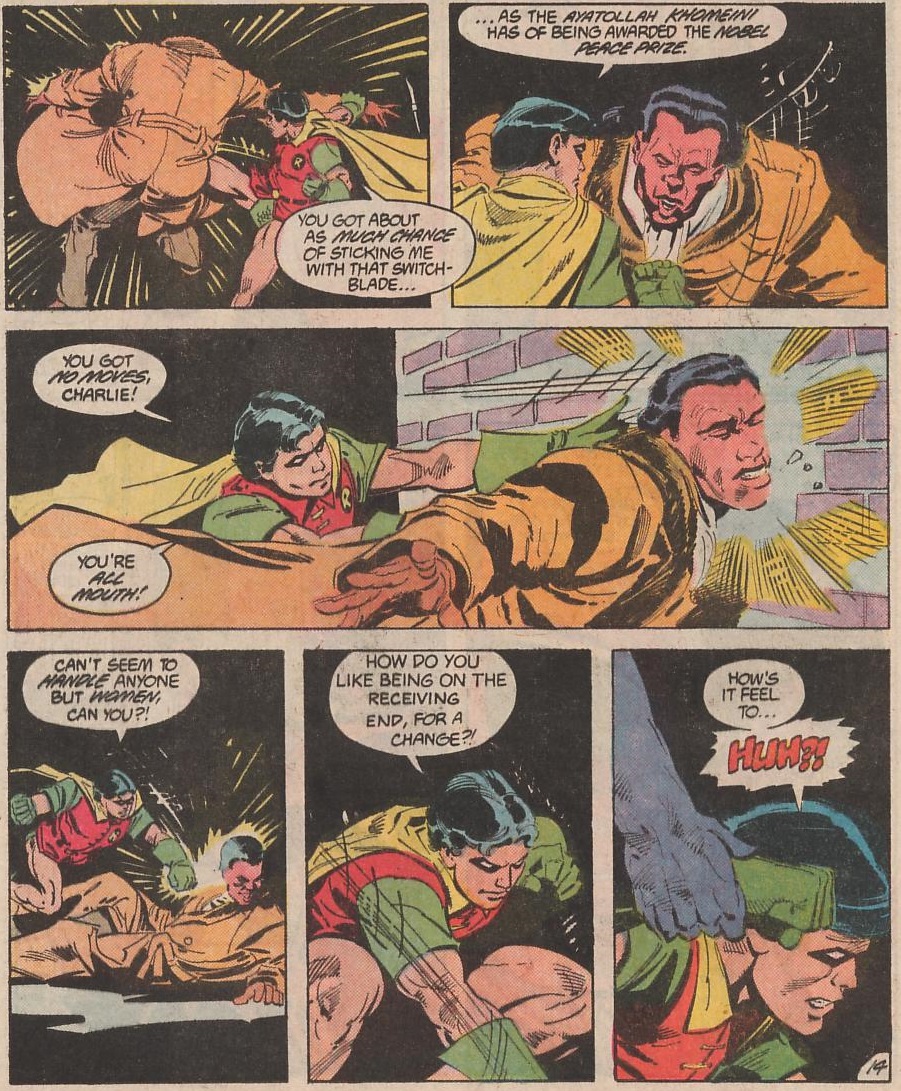
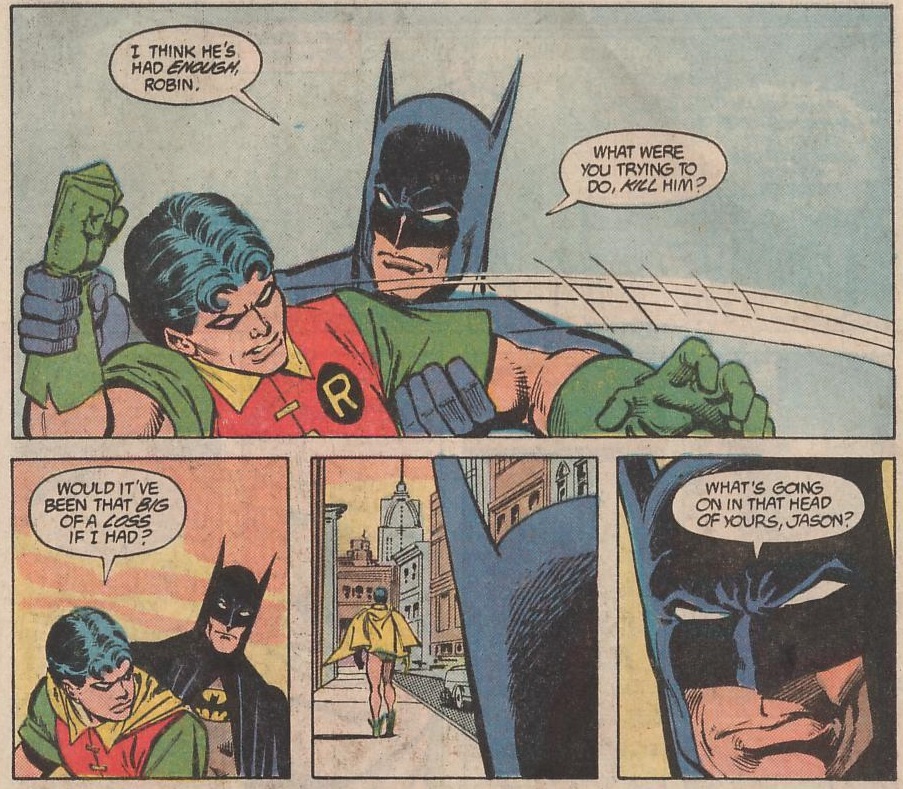
Starlin gave Jason Todd a makeover, turning him from a charmingly reckless kid into an edgy, angry teenager who apparently killed a criminal at one point (in ‘The Diplomat’s Son’). If Jason’s arc had first been treated as a straightforward success story, his growing pains now became a serious challenge for Batman. Here he is beating up a pimp:

Batman 422 Batman 422 Batman #422

Talk about attitude.

To be fair, it was the eighties. While the recent wave of nostalgia for ‘80s pop culture has given us some cool movies (the latest being Turbo Kid), the fact is that, between the politics, crime, and socioeconomic wreckage, this was a pretty fucked up time to be a teen (as captured in the kickass Deadly Class comic series).

Still, as much as Robin got caught up in the zeitgeist, Jim Starlin seemed to be deliberately making Jason more and more unlikable in order to prep him to die. As soon as he came aboard, Starlin started lobbying to kill off the brat – and although DC didn’t let him give Robin AIDS, editor Denny O’Neil gradually found himself considering the dramatic potential of offing the Boy Wonder.

It must have helped that the shadow of The Dark Knight Returns loomed large over the Batman comics of the time. This tale, which was still being teased as a possible future for the world of the Caped Crusader, implied that Jason Todd was to meet a terrible fate. Whether planned or coincidentally, two of Mike Barr’s stories (‘Fear for Sale’ and ‘…My Beginning… And my Probable End.’) had already foreshadowed the significance of Jason’s death for Batman.

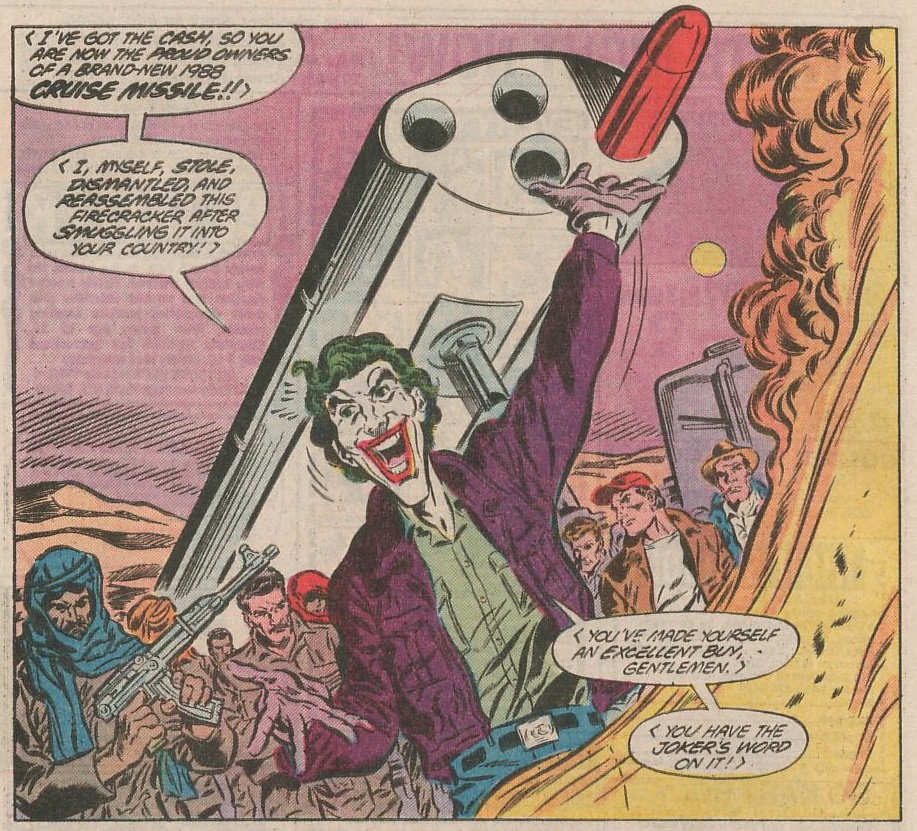
And then came ‘A Death in the Family.’ This is the book where Jason Todd ran away from Wayne Manor to go looking for his birth-mother and ended up in Beirut. In an amazing coincidence, Jason bumped into Batman, who had also come to Lebanon yet for completely unrelated reasons. The Dark Knight had followed the Joker to the Middle East, where the Clown Prince of Crime was trying to sell a nuclear rocket to Arab terrorists who wanted to bomb Tel Aviv.

Batman 426Batman #426

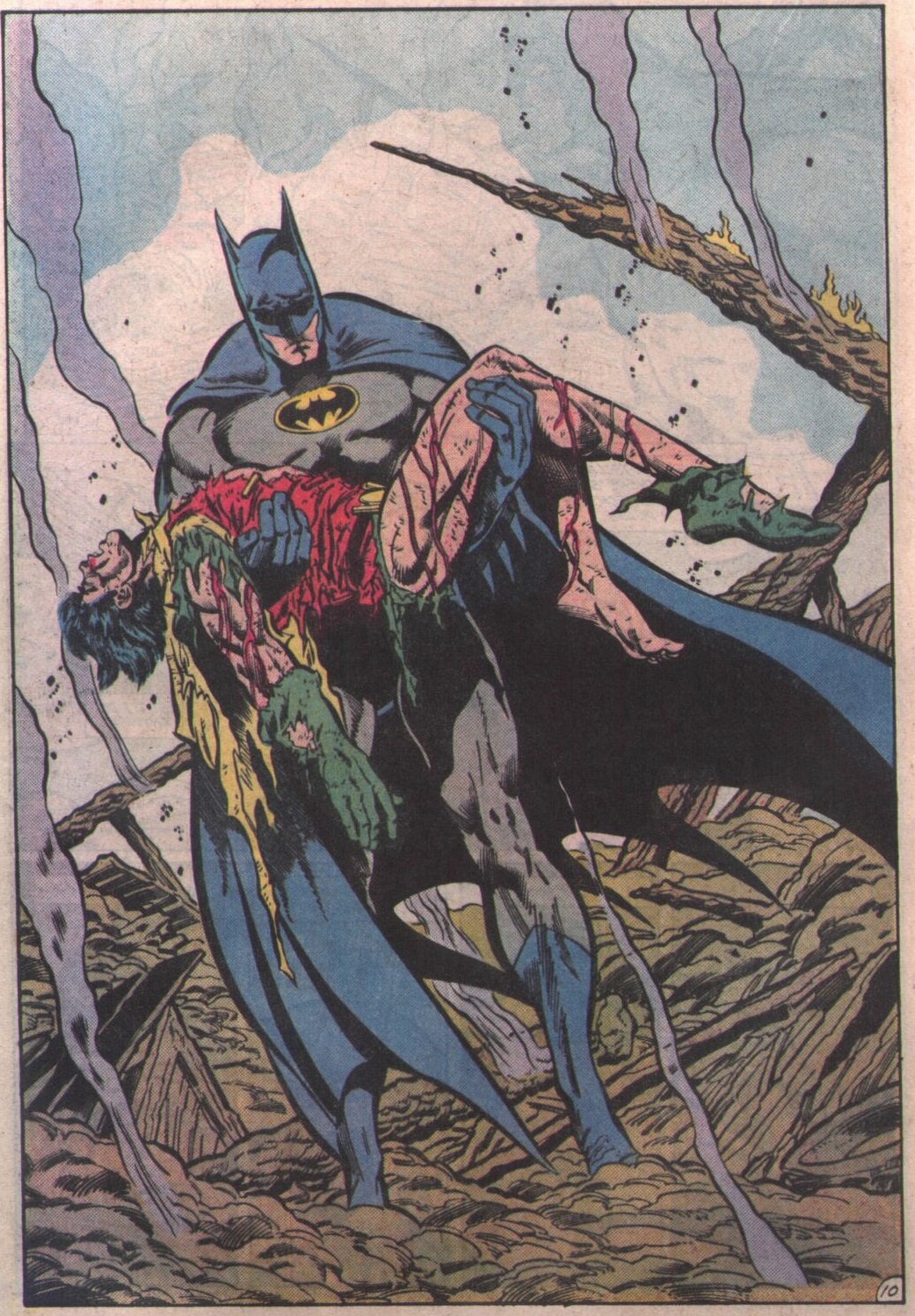
The Joker escaped to Ethiopia and, in another not-at-all-convoluted plot twist, Jason’s search for his mother took him there as well… in fact, it took him to the exact same spot, at the exact same time! So the Joker, that wacky fella, beat the shit out of Robin with a crowbar and left him to die in an explosion.

DC then infamously set up a pair of 1-900 phone numbers where people could vote as to whether the young hero survived the explosion or not. He didn’t.

Batman 428Batman #428

There is still some speculation over whether or not DC planed on killing (or at least retiring) Jason Todd regardless of the result of the poll. After all, the story title was ‘A Death in the Family’ for crying out load! I trust Brian Cronin on this (and on pretty much everything).

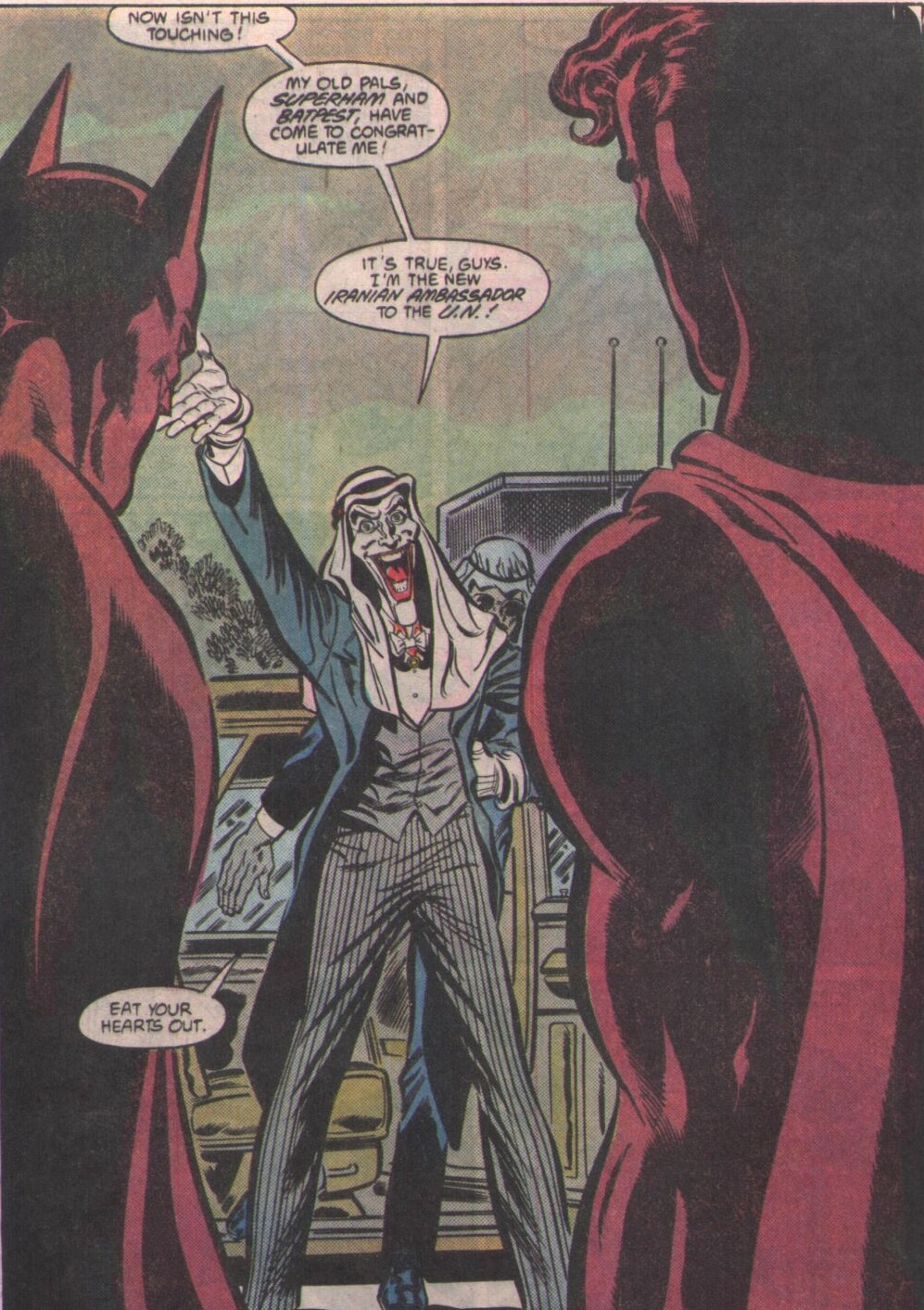
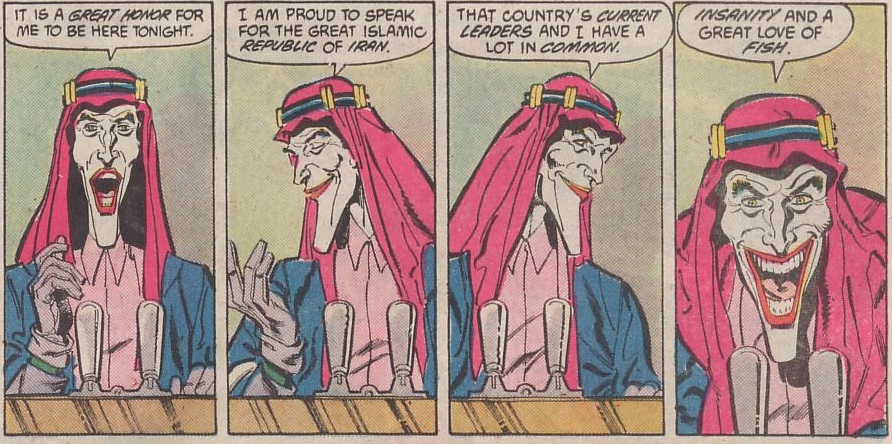
The truth is that, even if you don’t agree with the final decision, several good things came out of DC’s sadistic stunt (besides the evidence-based confirmation that comic fans are seriously twisted). First of all, ‘A Death in the Family’ continued to go in odd directions after Robin’s murder, the most surprising of which being the Ayatollah Khomeini hiring the Joker to be the Iranian representative to the United Nations:

Batman 429 Batman #429

More generally, ‘A Death in the Family’ was the culmination not only of Jim Starlin’s so-gritty-it-hurts run, but of a broader dark cycle that included the likes of Batman: Year OneThe Killing Joke, and Arkham Asylum… and I think one of the consequences of hitting rock bottom was that the Bat-books bounced back by mostly moving away from such an extremely bleak mood for a while.

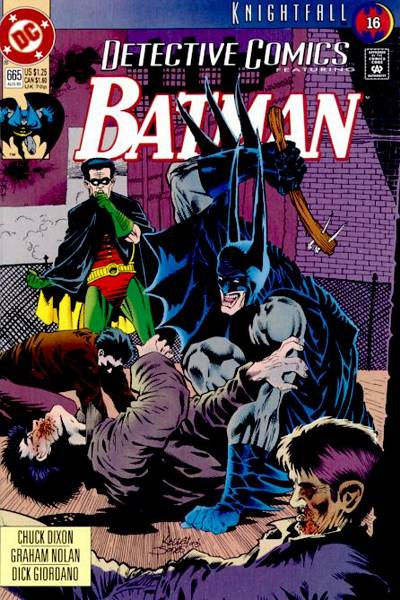
The nineties have a reputation as a time when Batman comics lost their sense of fun, but it was actually in the late 1980s and early 2000s that things got really depressing (both times culminating in the deaths of a Robin). As far as I’m concerned, even though the Caped Crusader himself became quite serious, the ‘90s produced tons of fun adventures set in Gotham City, many of which featured a well-adjusted Robin (Tim Drake). Even Bruce Wayne’s temporary replacement with a madman in Knightfall was more critique than celebration of the notion of a dickish, über-violent Dark Knight…

detective comics 665

Finally, for better or worse, Jason Todd’s death became a defining moment in Batman’s history. It was Bruce’s biggest failure and, naturally, it haunted his relationship with the Joker and with subsequent Robins. Writers sparingly tapped into this trauma to bring in a sense of gravitas to their stories. For example, in the crossover Underworld Unleashed, written by Mark Waid, the demon Neron exploited the Caped Crusader’s guilt in order to tempt him into a Faustian bargain.

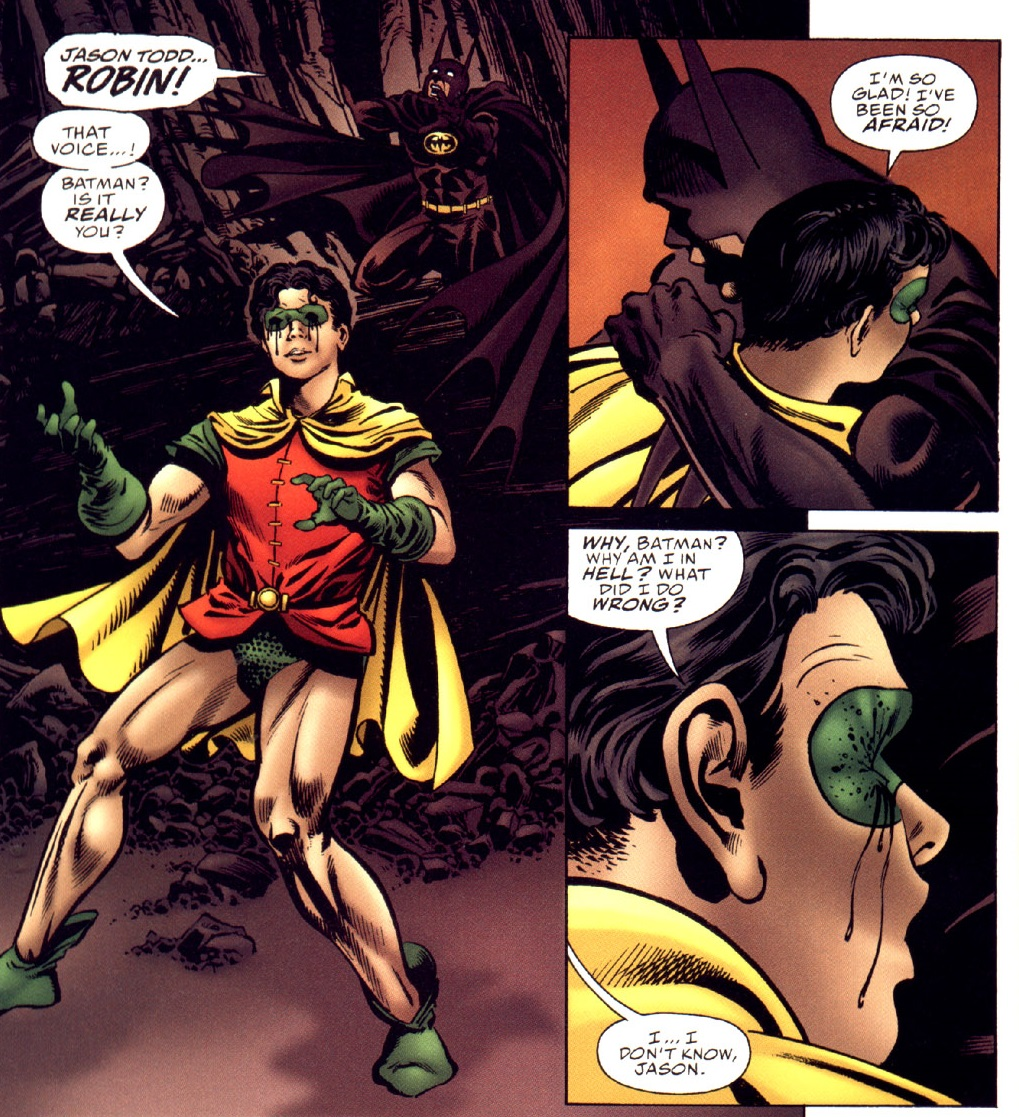
In 1996, Batman actually visited Hell:

Batman DemonBatman/Demon

These nods helped keep Jason’s memory alive. Thus, Robin’s demise remained a powerful and unique moment that resonated throughout the ages.

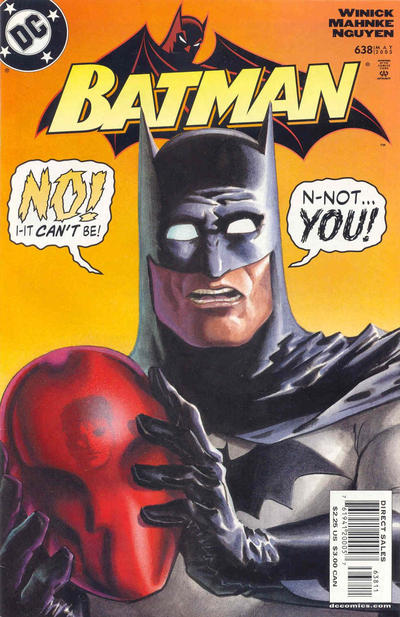
Well, at least until 2005:

Batman 638

NEXT: Be afraid. Be very afraid.

Posted in GOTHAM CITIZENS | Tagged , , , , , , , | Leave a comment

Lying in Batman’s arms

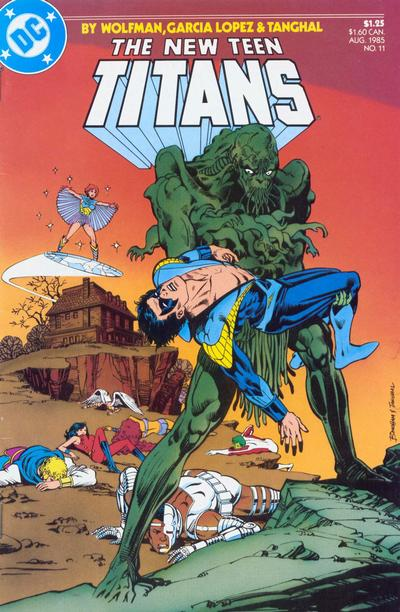
Last month, I suggested that this New Teen Titans cover, with Dick Grayson lying unconscious in some monster’s arms, was probably one of many movie poster homages done by Batman-related comics:

New Teen Titans 11

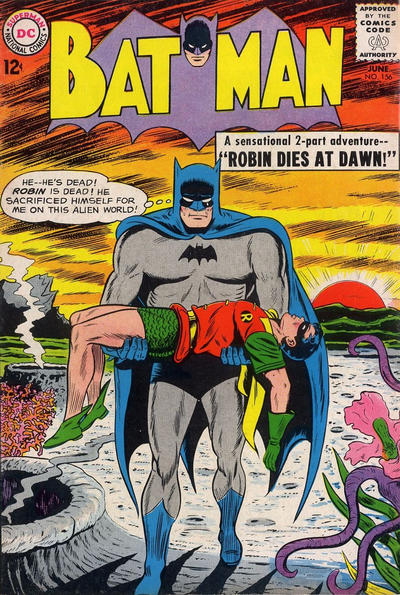
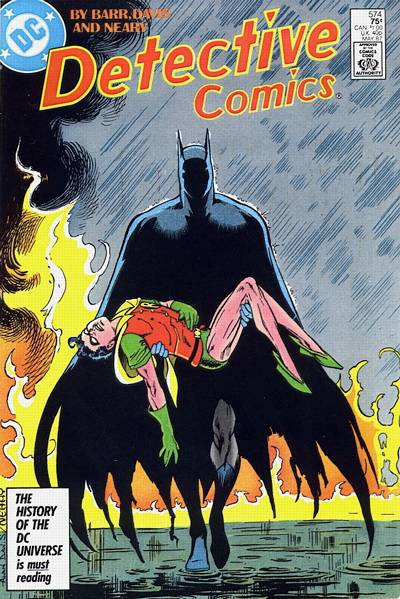
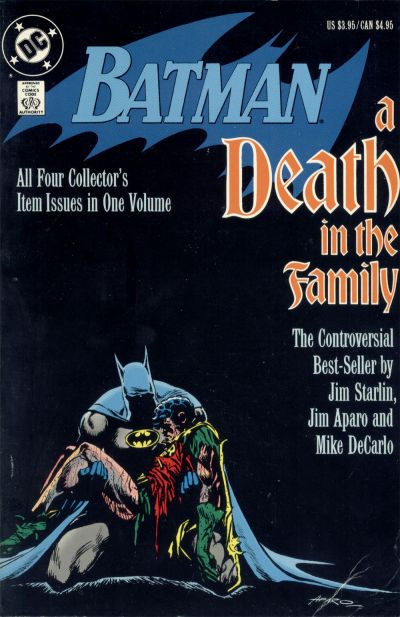
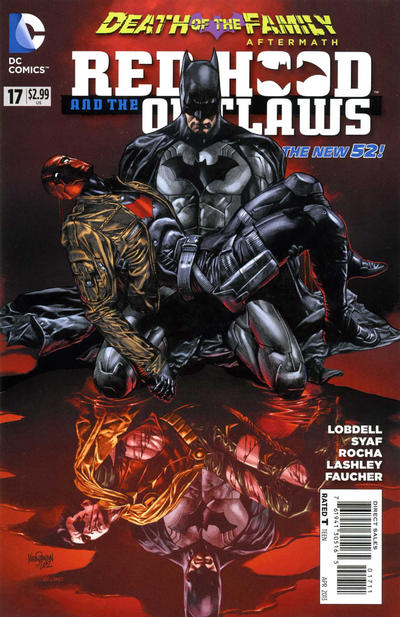
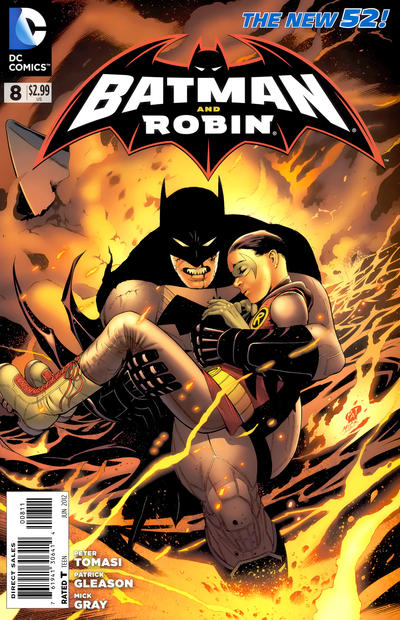
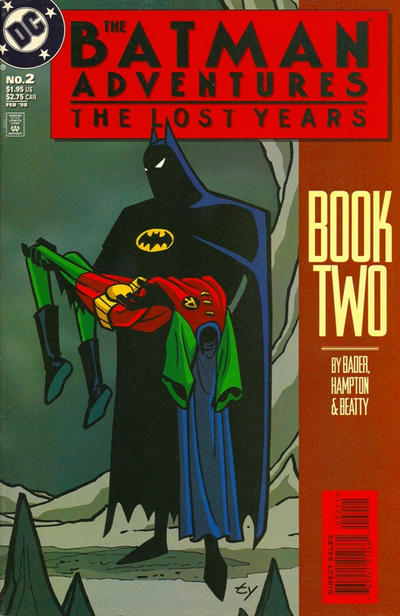
Regardless of what truly inspired artist Jerry Bingham, however, I can tell you this much: it was neither the first nor the last time a Robin found himself in a pieta-style cover…

Batman 156          Detective Comics 574

Batman Death in the Family          Red Hood and the Outlaws

Batman and Robin 08          Batman Lost Years 2

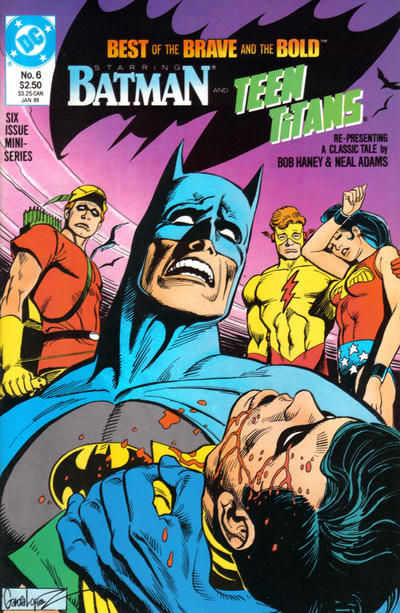
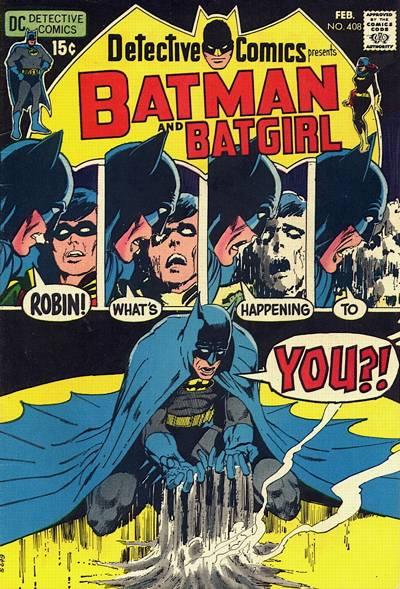
Oh, Boy Wonder, you’re worse than South Park’s Kenny… And it begs the question: How many ways can a Robin die?

Best of the Brave and the Bold 6          Detective Comics 408

But hey, I guess if they kill enough Robins, sooner or later they’ll end up with the greatest Batman story ever told!

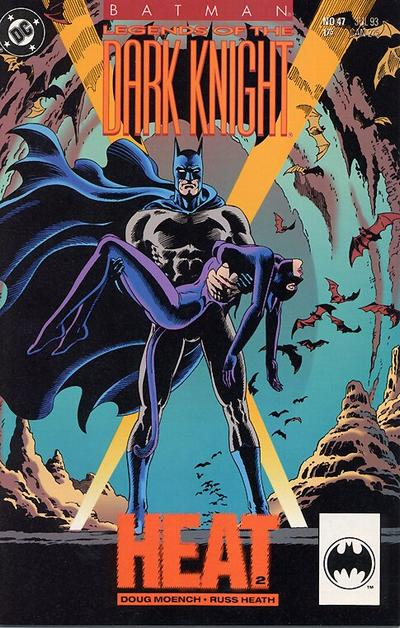
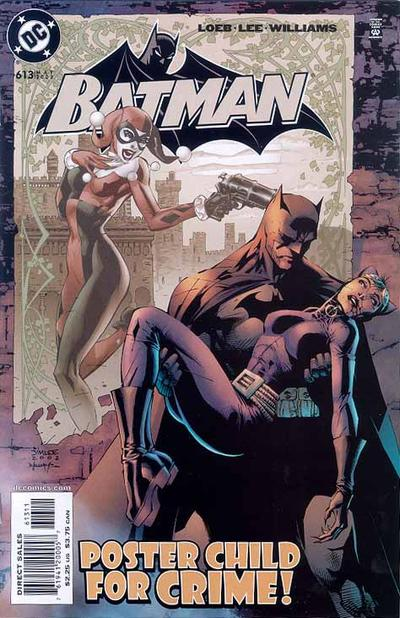
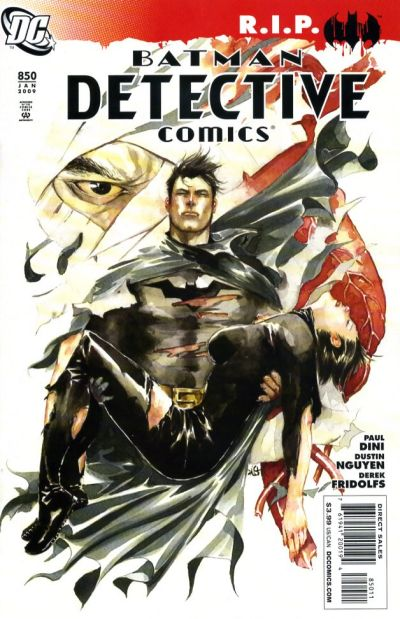
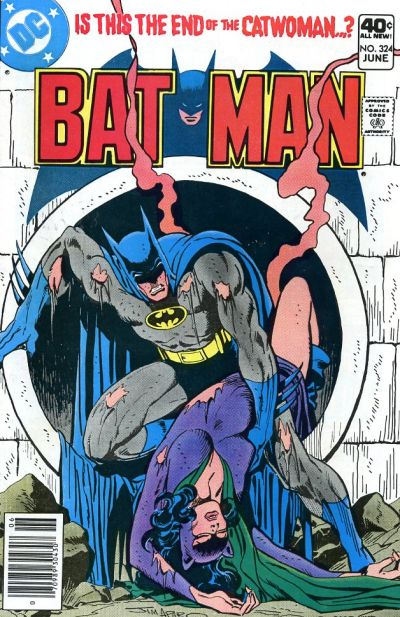
In fairness, it’s not just the Boy Wonder. Catwoman has also tragically found herself in the Dark Knight’s arms multiple times:

Legends of the Dark Knight 47          Batman 613

Detective Comics 850          Batman 324

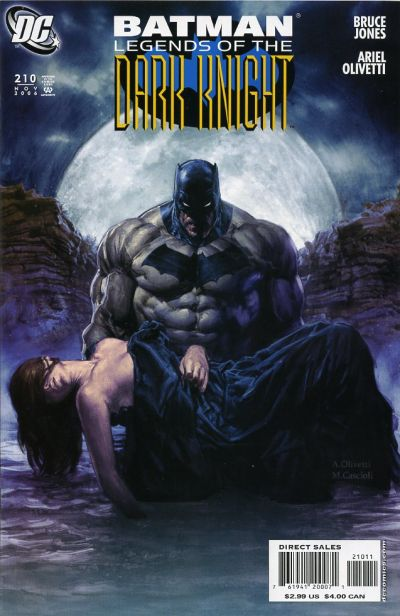
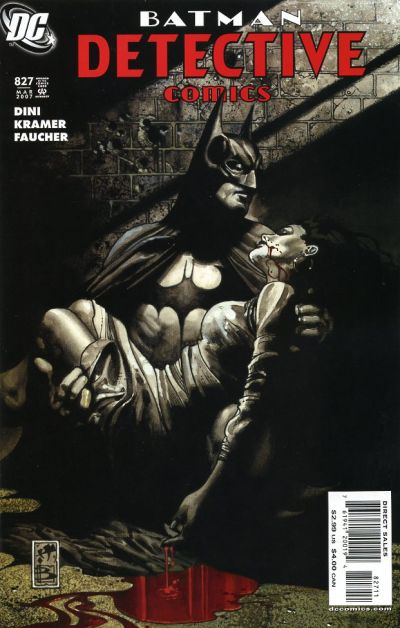
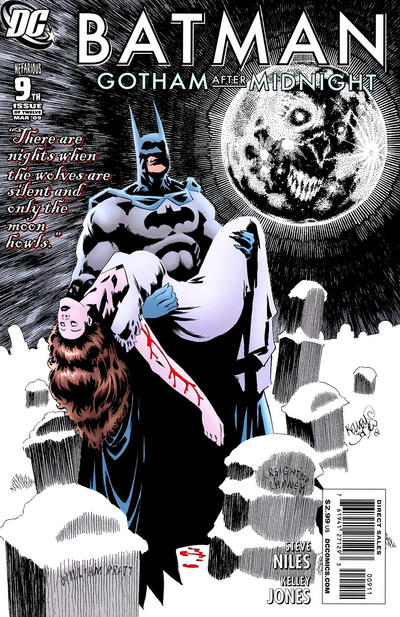
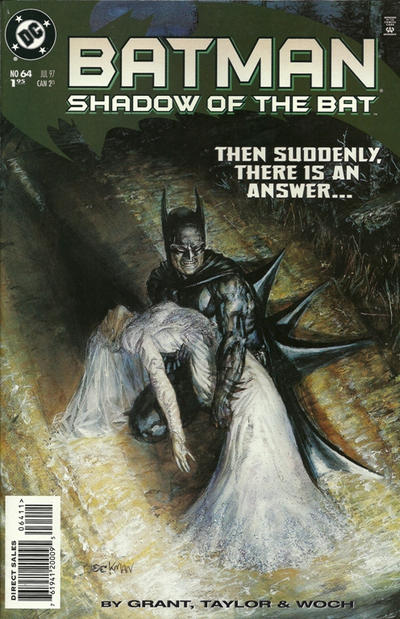
And so have various other women, for that matter:

Legends of the Dark Knight 210          Detective Comics 827

Gotham After Midnight 9          Shadow of the Bat 64

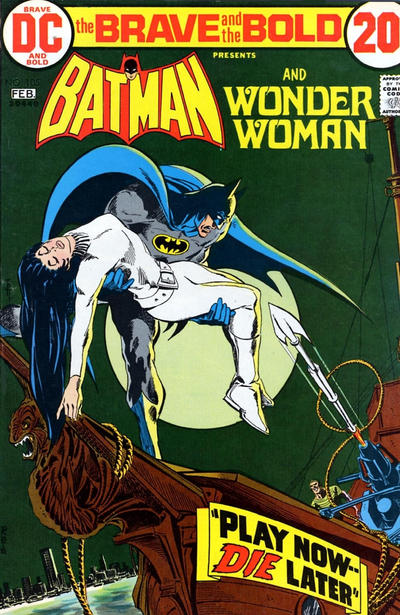
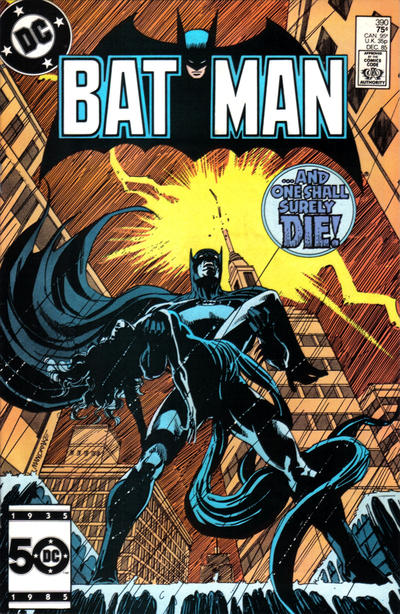
Brave and the Bold 105          Batman 390

No wonder the Caped Crusader has such impressive biceps.

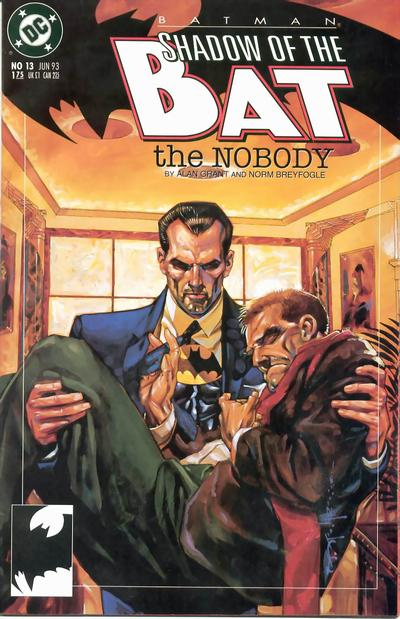
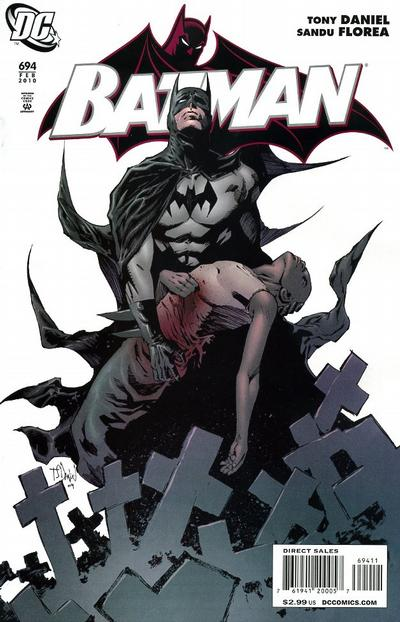
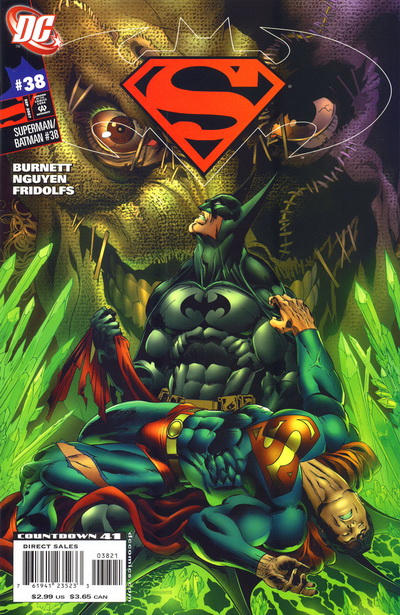
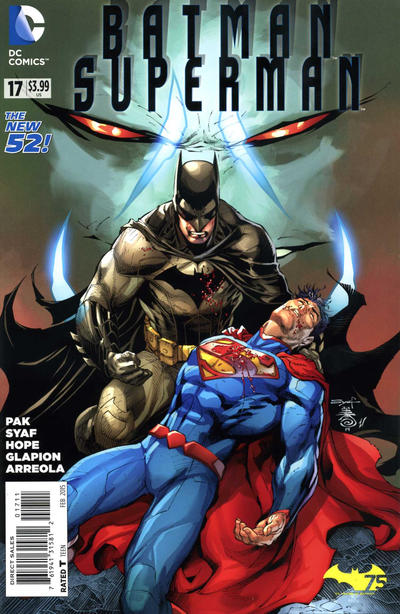
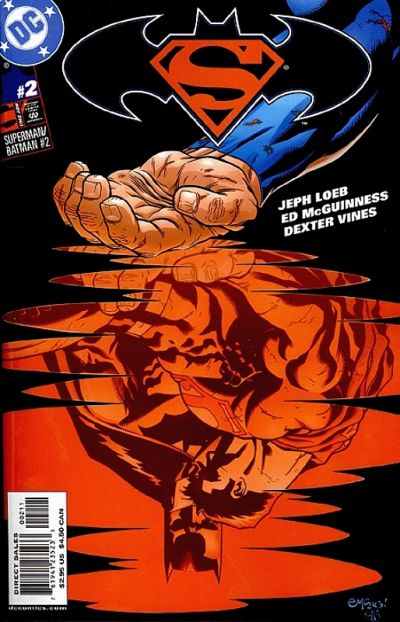
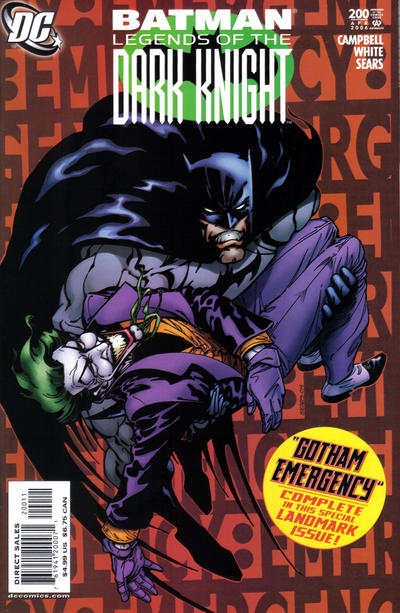
Of course, Batman comics being what they are, it doesn’t stop there…

Shadow of the Bat 13          Batman 694

Superman Batman 38          Batman Superman 17

Superman Batman 02          Legends of the Dark Knight 200

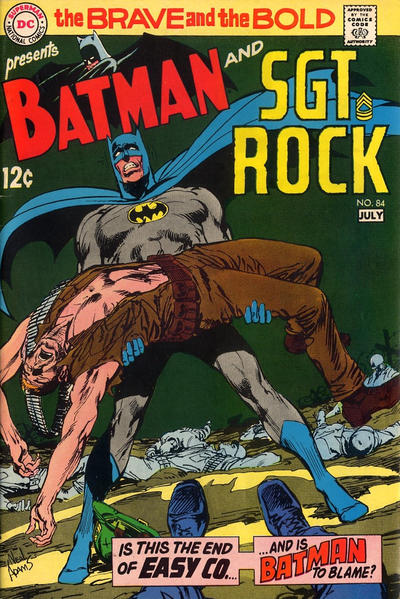
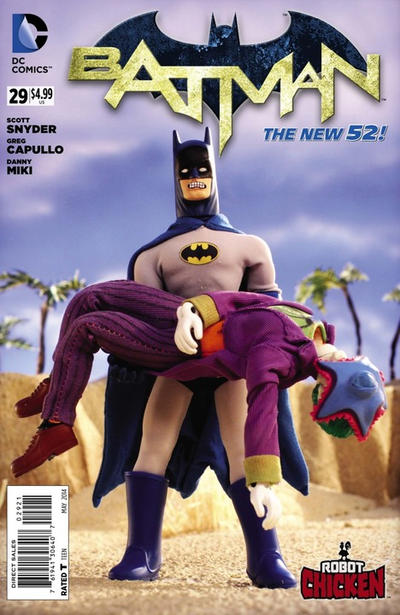
Brave and the Bold 84          Batman 29

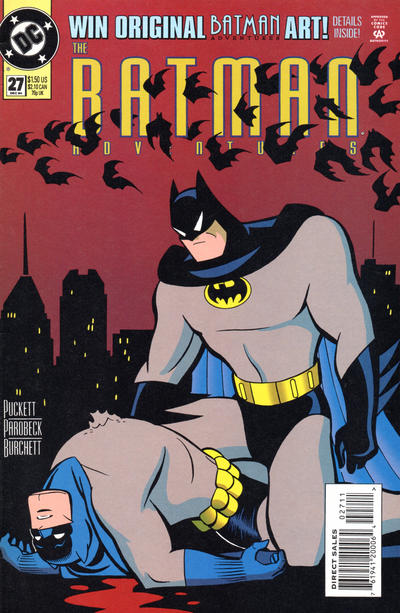
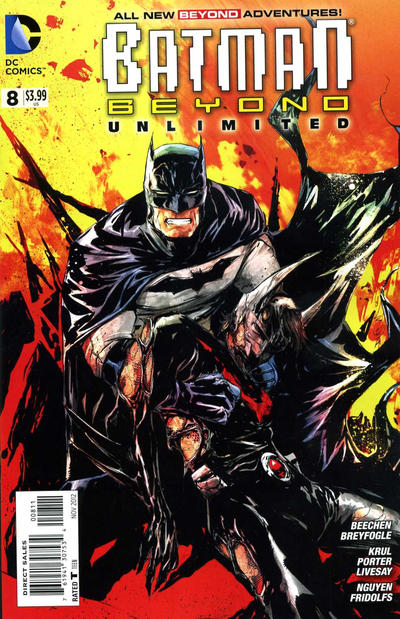
So much angst! Man, it must suck to be Dark Knight sometimes. Seriously, there have even been a couple of Batman-mourning-Batman moments:

Batman Adventures 27          Batman Beyond Unlimited 8

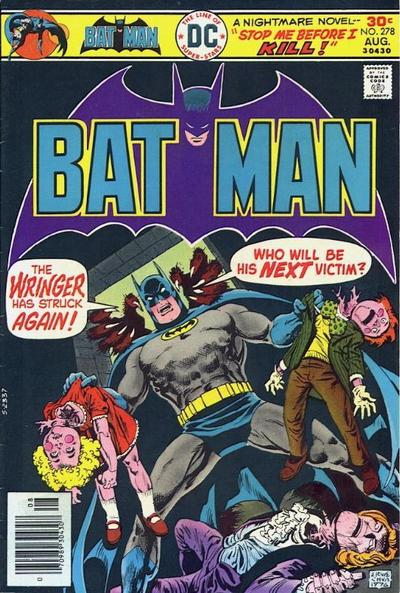
That said, as far as covers go, I guess this one is the most bizarre instance of the Caped Crusader agonizing over inert bodies:

Batman 278

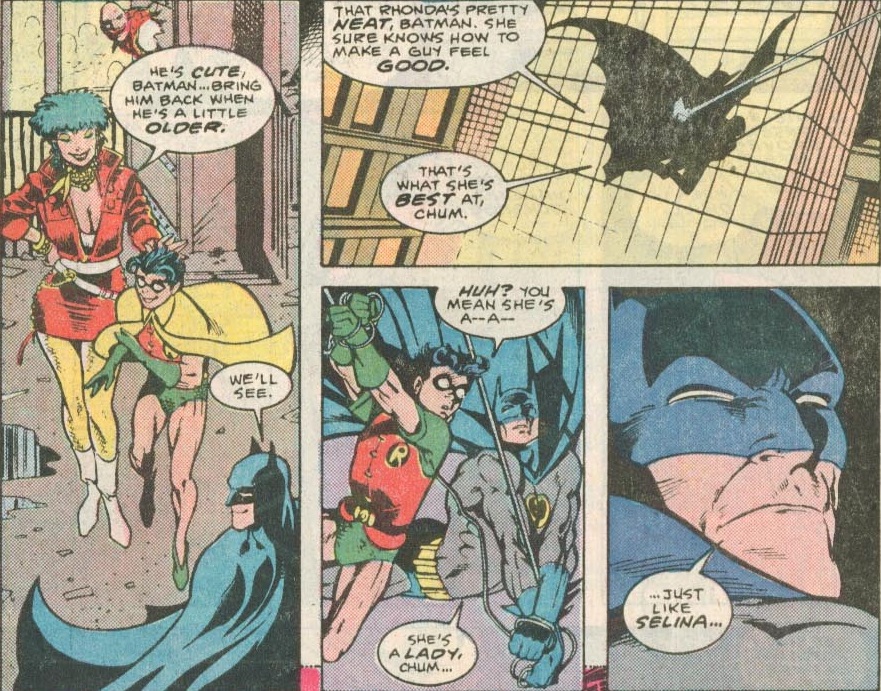
NEXT: Robin encounters Gotham’s sex industry.

Posted in COVERS OF BATMAN COMICS | Tagged , | Leave a comment