A couple of years ago, I started picking a Gotham Calling Book of the Year, spotlighting recently published comics that best engaged with this blog’s passions. To compensate for the lengthy silence, though, this time around I’ll do a longer list of twenty 2020 books!
Contrary to what many analysts are saying, 2020 wasn’t such a bad year for reading comics. I’m not super-enthusiastic about most of the recent Batman series, but at least fans of Gotham Calling can now get their hands on plenty of previously uncollected – or long out-of-print – Dark Knight classics by Marv Wolfman (Tales of the Batman: Marv Wolfman, vol.1), Alan Grant & Norm Breyfogle (The Caped Crusader, vol.4), and Chuck Dixon & Graham Nolan (Knight Out). If you’re into Daredevil, the closing issues of Ann Nocenti’s cult run have finally been collected (Last Rites). Visually, we got to feast our eyes on tour-de-forces by Terry and Rachel Dodson (Adventureman) as well as Erica Henderson (Dracula, Motherf**ker!). Meanwhile, several nifty works used fantasy to engage with the world (for instance, the Justice League three-parter ‘The Rule’ reimagined the fallout of the Arab Spring in outer space), even if the ongoing pandemic still hasn’t been fully incorporated into the medium’s narratives (one of the few notable exceptions was J.H. Williams III’s amazing-looking tale in Batman: Black & White #1) and neither has the ongoing political thriller in the US (which became more violent as I was wrapping up this post…). So, yes, there was less output than usual and more difficulty in accessing it, but – as the list below will hopefully demonstrate – if you managed to safely reach a store or library in between quarantines, lockdowns, and curfews (or if you’ve made the transition to digital comics), at least there were some very nice books out there.
A few clarifications on what qualifies for the list. Each book must be in English, since that is the blog’s language, and it must be a relatively self-contained work (even if it’s part of a franchise or a long-running series). It can be a one-shot, an original graphic novel, or a collection of previously uncollected comics, whether they first came out in the previous year or seven decades ago… There are a bunch of the latter, which means that the list is less of a state-of-the-art of what is currently being created than a glimpse into what is currently being published. It’s not that I don’t think there’s plenty of young, exciting talent out there putting out new stuff that is definitely worth your time, but the choice to include a bunch of reprints of older material is a reflection – and a recognition – that this type of volumes has become the main way I enjoy comics nowadays. We are living in the golden age of comic book collections, providing fans with unprecedented access to the rich history of the medium, which informs a large part of what I read and, consequently, a large part of what this blog is about.
Finally, I usually kick off these posts with an honorary mention of some comic I find pretty outstanding but which doesn’t really fit into the kind of genre-geared material covered in Gotham Calling. This year I have to go with The Man Who Shot Chris Kyle: An American Legend, by Fabien Nury and Brüno (the phenomenal duo behind the crime series Tyler Cross and the slave epic Atar Gull). This comic – published as a single graphic novel in French and released in two English volumes by Europe Comics – starts out as a ‘true murder’ exposé chronicling, through registered statements and TV footage (mostly from The O’Reilly Factor), the killing of the author of the best-seller American Sniper. Yet it soon becomes clear that there is a more meta, provocative gesture at play, responding to Clint Eastwood’s film adaptation of that book with a typically European mix of fascination and irony towards US politics and celebrity culture. The result is both movingly sober and, at times, more perversely entertaining than it had any right to be – a balancing act carried along by Brüno’s deadpan geometric minimalism. The ending is a punch in the gut.
If it’s fiction you want, though, check out the books below:
20. SECOND COMING
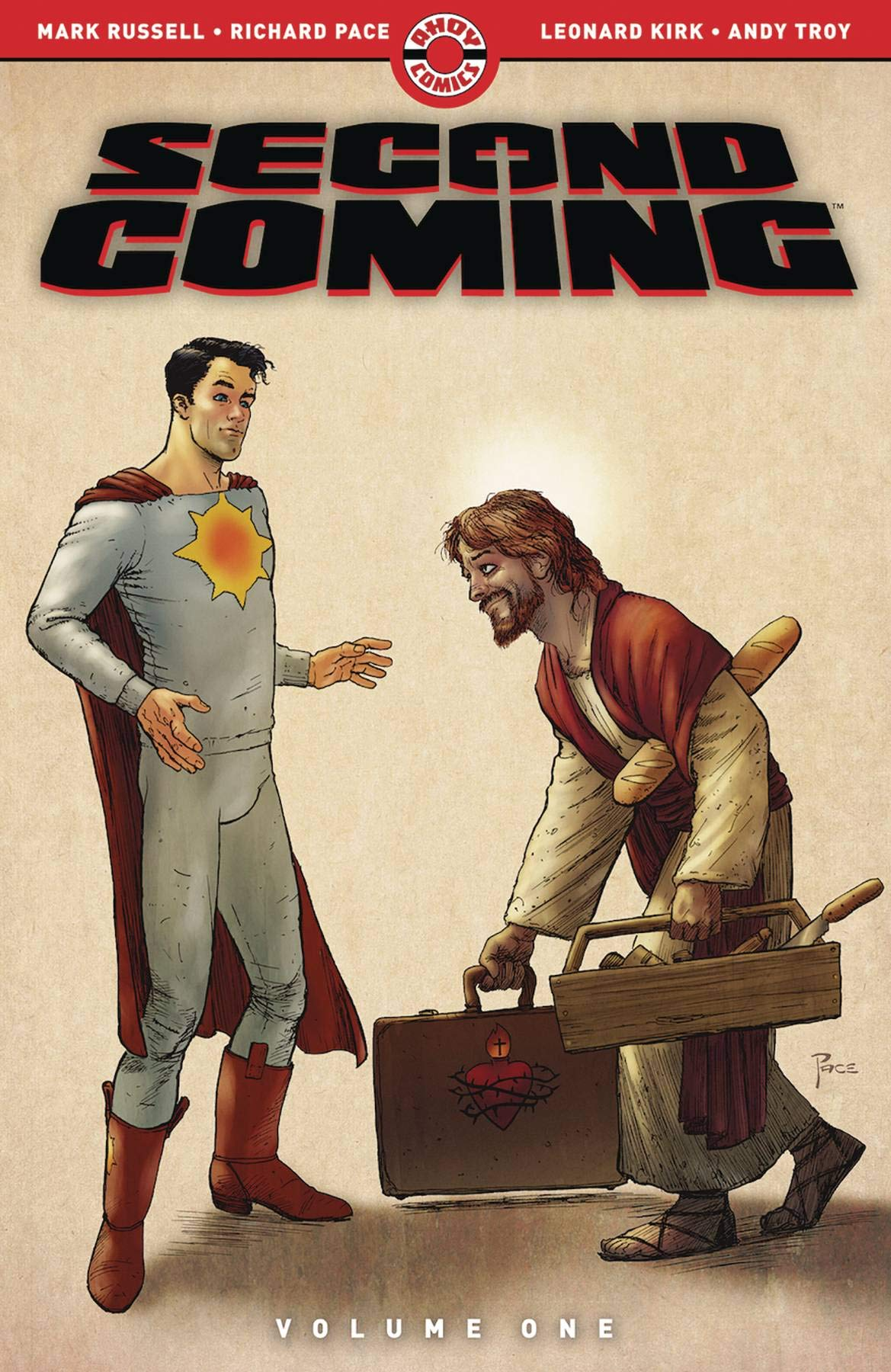
This book (collecting a 2019 series) about a team-up between Superman and Jesus Christ was the object of some – not entirely surprising – notoriety a while back, when DC dropped out of the project for fear of stirring up a conservative backlash (Second Coming thus joined a lineage of similar reluctance concerning potentially blasphemous creative choices in Rick Veitch’s Swamp Thing and Brian Azzarello’s The Authority). I won’t go into this whole debate now, so just assume the usual arguments apply: yes, if your approach to religion means you find the notion of Jesus starring in a superhero comedy (with a handful of dick jokes) offensive, then you have a reason to be offended; no, it’s not the same as with those cartoons mocking Muhammad, if nothing else because Second Coming isn’t attacking its society’s underdog; yes, most public reactions involved a double standard, with many who typically rant against ‘cancel culture’ now praising DC’s position and vice-versa.
Assuming you’re open enough to this premise to check out the comic, what will you find inside? After a sarcastic retelling of the Old Testament, most of the humor derives from the contrast between the ersatz-Superman’s emphasis on violent punishment and Christ’s advocacy of compassionate alternatives. Mark Russell’s script provides a thoughtful – as well as funny – take on Christianity that doesn’t devolve into stale caricature. The same goes for Richard Pace’s and Leonard Kirk’s artwork, whose style is mostly low-key (thus securing the grounded, old-school sitcom feel), except for the scratchy biblical flashbacks. This isn’t a mean-spirited ‘fuck you’ to religion, a la Garth Ennis – while Second Coming’s God is a hilarious douchebag, Jesus actually comes across as a sympathetic figure. Even his apparent naiveté is less a punchline than a set-up for Russell’s amusing meditations on the human condition.
Seriously, the comic is much more scathing when it comes to poking fun at superheroes’ underlying assumptions about exercising power through physical force…

Second Coming eventually found a place at Ahoy Comics, where it fit like a glove next to other quirky titles reimagining Superman or religious mythology, such as Penultiman and High Heaven. A young publisher whose output is mostly edited and/or written by Tom Peyer and Stuart Moore, Ahoy is one of the most interesting editorial projects in recent times, leaning heavily towards social satire and clever spins on genre tropes while filling each issue with substantial extra material. Indeed, things worked out so well over there that a second volume of Second Coming is already coming out – and it’s even funnier!
19. JOHNNY DYNAMITE: EXPLOSIVE PRE-CODE CRIME COMICS – THE COMPLETE ADVENTURES OF PETE MORISI’S WILD MAN OF CHICAGO!
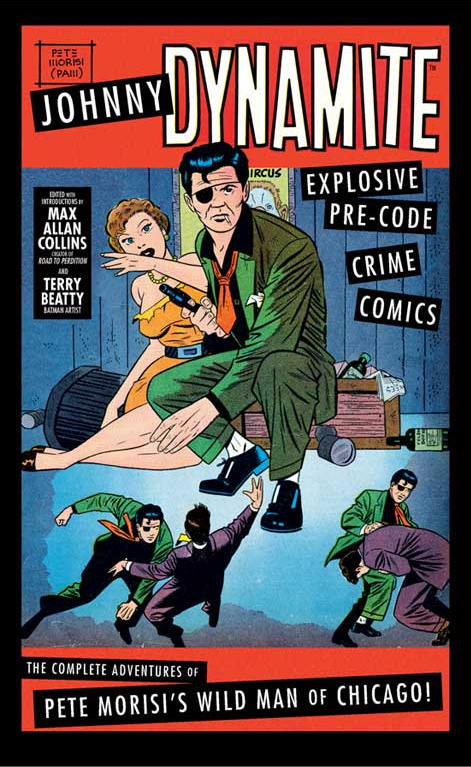
And now for a brutal vigilante who does not wear a cape…
This beautiful IDW collection reprints the original adventures of bloodthirsty private eye Johnny Dynamite, first serialized back in 1953. Like I mentioned above, when it comes to reprints of Golden Age material, my fascination with history (of the world in general and of the comic book medium in particular) plays a big role… Reading these vintage comics is like travelling to another era, more often than not challenging whatever preconceptions I bring along. However, with the best of the lot, the reward isn’t purely academic. Case in point: because Johnny Dynamite belongs to the tradition of detectives who are less about cerebral games than about gut instinct, street smarts, and fisticuffs (and driven less by a sense of justice than by vengeful hatred), he lends the book a truly compelling, raw energy. Moreover, as highlighted by the ridiculously lengthy title, these are pre-Code comics (i.e. originally published before the medium was subjected to strict censorship) and, oh boy, does it show: each lurid tale is packed with violence and dubious morals (including the protagonist’s), often peppered with a sprinkle of sex and drugs.
Granted, most stories are relatively similar, except for a couple of ones where Johnny Dynamite goes off to fight commies in Germany and Vietnam (while it was still a French colony). If you’re into film noir, though, this is the book for you. At his best, artist Pete Morisi perfectly channels the genre’s mood, with its virile anti-hero, vicious gangsters, and luscious femmes fatales (usually former prostitutes). And while the artwork is frequently drowned by wordy text boxes (which carry the bulk of the storytelling), fortunately the prose – by Ken Fitch and, later, Morisi himself – is written in a dead-on hardboiled style, complete with the obligatory explosive metaphors (hell, the protagonist himself is called Dynamite!).
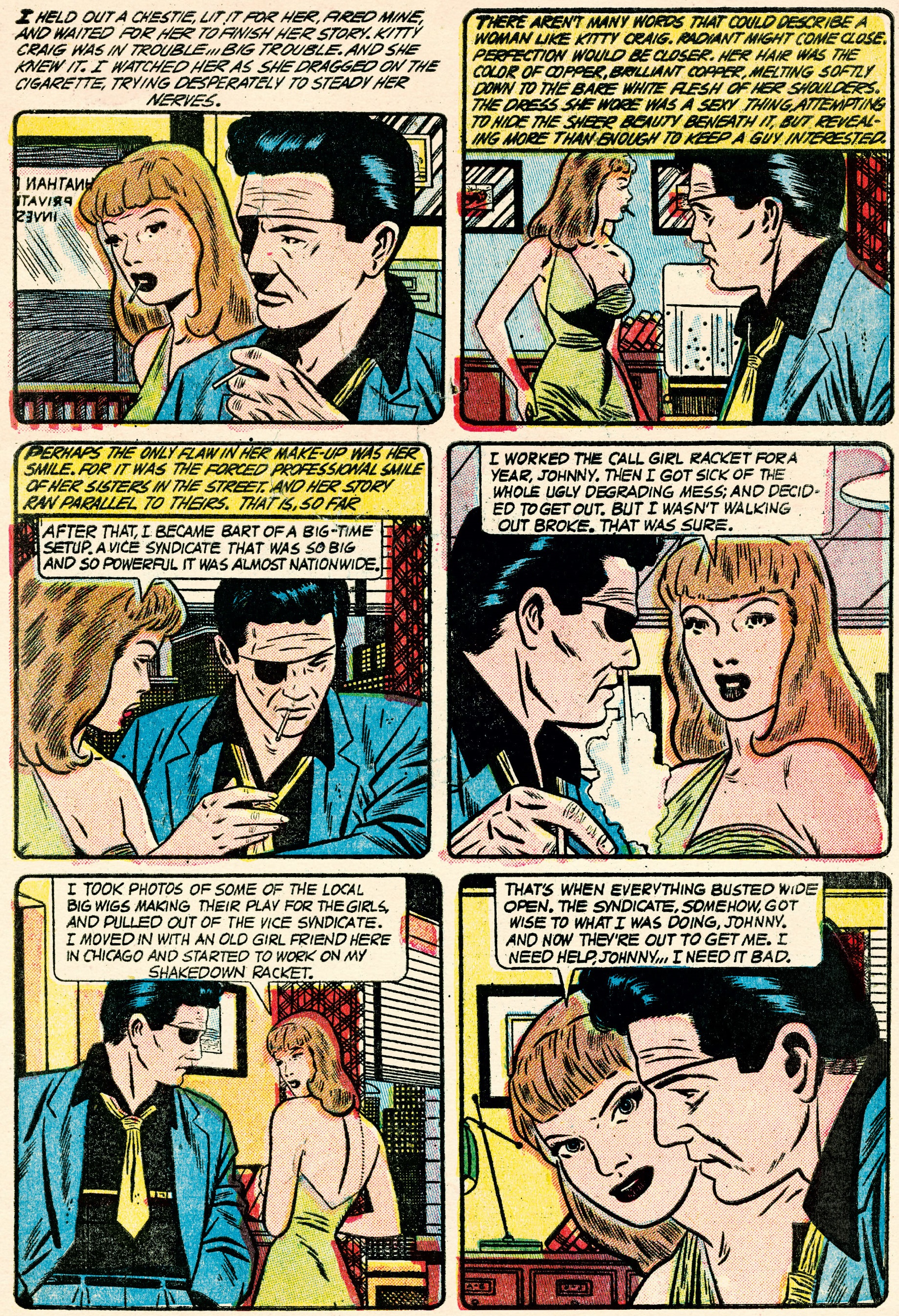
Besides the original comics and a couple of punchy prose stories, this collection includes an extensive essay by Max Allan Collins, who contextualizes the strip by discussing not only its creators, but also the major influence of Mickey Spillane’s Mike Hammer. It finishes with a short crossover with Ms. Tree, written by Collins and drawn by Terry Beatty and Gary Kato.
18. BOG BODIES
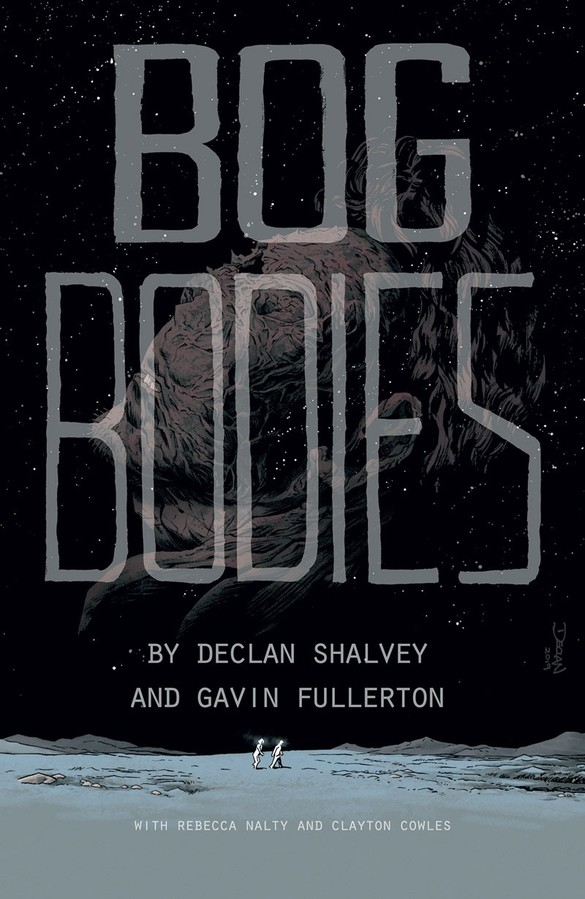
Another sly crime thriller!
This one is about a low-ranking gangster who falls out of favor with his bosses, with deadly consequences. He finds himself on the run, for the best part of a night, in the countryside outside Dublin, where the bodies of their victims are usually buried. There are a couple of twists to the story, but it mostly boils down to the chase. There is something satisfying about a tale this taut, keeping the narrative pared-down and focused in order to squeeze the most tension out of a simple situation. It brings to mind movies like Jon Watts’ Cop Car, Jerzy Skolimowski’s Essential Killing, and Ben Wheatley’s Free Fire (the last one, admittedly, because it also contains some Irish-themed dark comedy).
While Declan Shalvey’s script keeps things moving along, a lot of the success for the way Bog Bodies keeps you involved relies on Gavin Fullerton’s deep linework (including some suitably rough-looking faces) and clear mise-en-scène (including the sinister silhouettes of tree branches and bushes), not to mention Rebecca Nalty’s moody, mostly blue-and-red-based palette. I love how they use negative space, with a starkly black, starless sky framing the whole thing in a somber atmosphere.
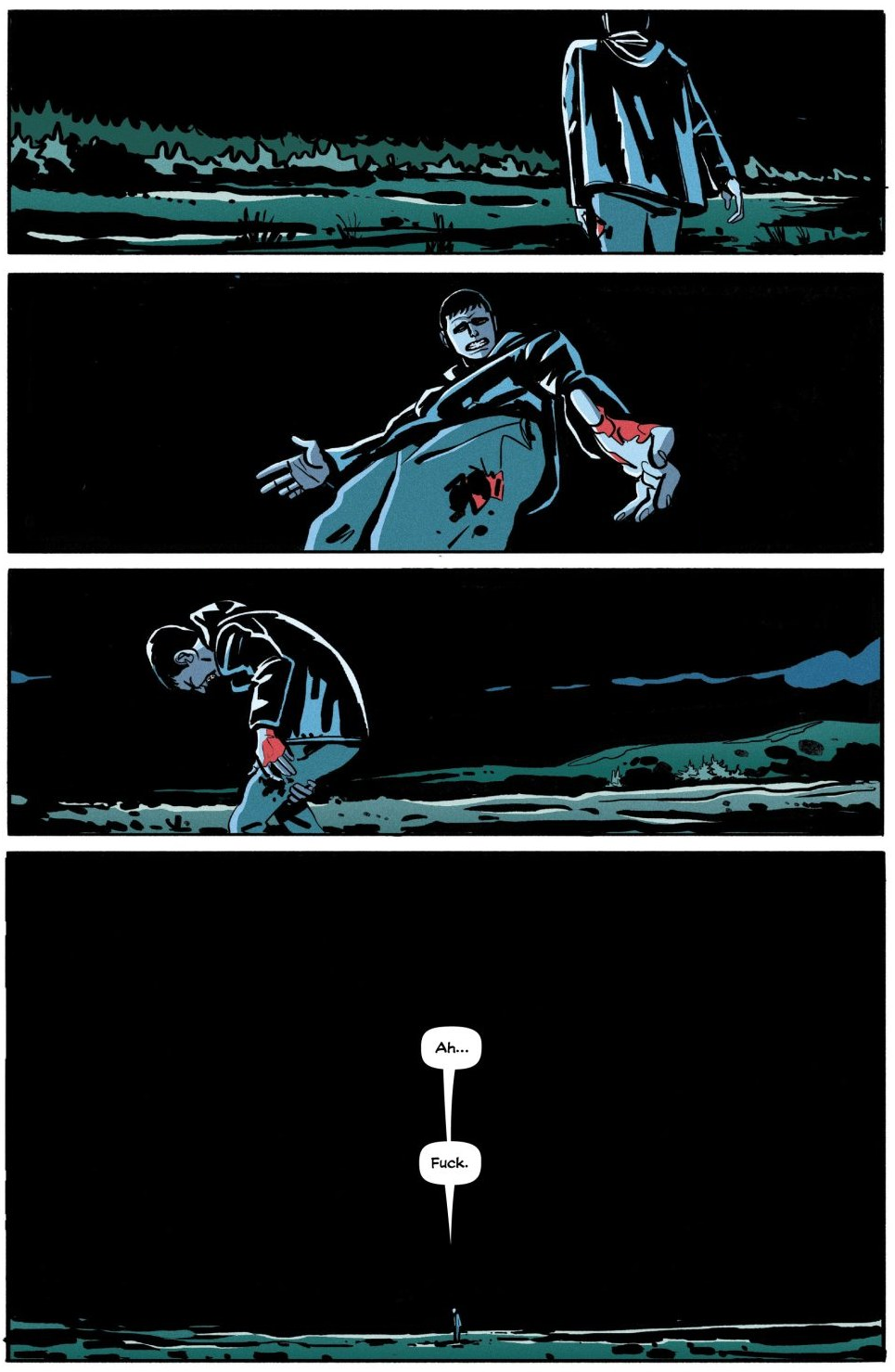
Not that the writing doesn’t deserve its share of praise. Underneath Bog Bodies’ deceptive minimalism, Declan Shalvey sneaks in both evolving characterization and existentialist musings. There are also some intriguing ambiguities and hinted mysteries – for instance, a couple of images near the end open the door for you to read the subplots concerning the two female characters as a rather different, perhaps horror-tinged kind of story (even before that, the fact that the protagonist picks up a companion in the woods and, after getting lost, finds a rickety house with an old lady inside evokes a twisted version of Hansel and Gretel).
Like the titular bogs in the dark, this comic may be hiding much more than what you first see.
17. JOKER: KILLER SMILE
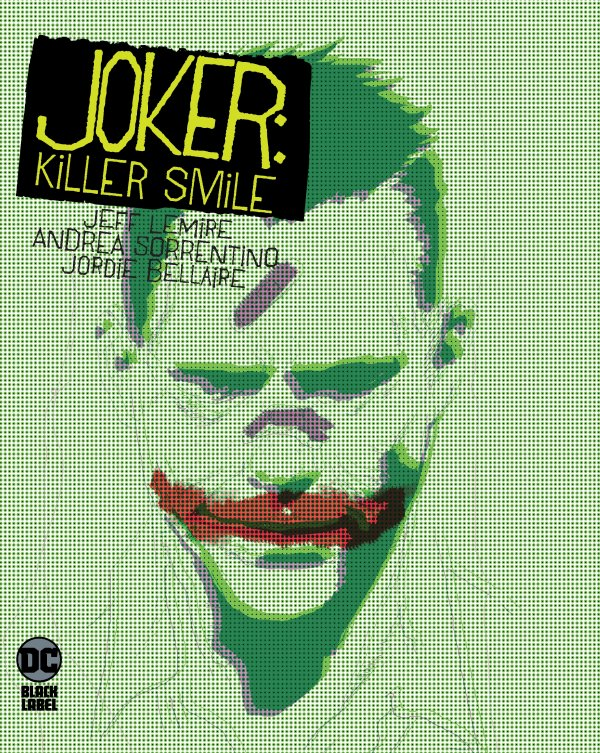
DC’s regular efforts to put out ‘serious’, ‘mature’ takes on the Dark Knight and his supporting cast tend to awkwardly bump against the fact that Batman’s world is inherently silly, not to mention the fact that most creators fall back on superficial clichés (especially about mental illness) to convey psychological depth and tend to reduce thematic scope to self-referentiality. Every once in a while, though, some works try so hard to fit an ‘adult’ square peg into the bat-shaped hole that the result is, if not entirely successful, at least fascinatingly off-kilter, whether it’s Grant Morrison’s and Dave McKean’s Arkham Asylum: A Serious House on Serious Earth or Todd Phillip’s Joker. Combining the former’s shameless pretentiousness with the latter’s willingness to pillage previous material that brilliantly handled the same themes, Joker: Killer Smile is the latest addition to this tradition.
This collected mini-series follows Dr. Ben Arnell, a psychiatrist who tries to cure the Clown Prince of Crime, only to find himself gradually losing his own mind. The result is a horror tale magnificently brought to the page by the powerhouse duo of artist Andrea Sorrentino and colorist Jordie Bellaire, who excel at crafting a suitably ominous vibe that projects menace even in mundane gestures or small exchanges. The shifting tones and layouts (including one of my favorite gimmicks: turning sound effects into actual panels) conjures the kind of disorienting blend of reality and psychotic imagination that is at the core of the story. Indeed, while the Joker’s mind games aren’t particularly clever or original, the same can’t be said about the striking ways Sorrentino and Bellaire depict the various hallucinations and Arnell’s encroaching mental confusion.
To illustrate my point, I thought about sharing an impressive double-page spread with laughter-shaped panel borders, but that would spoil a major revelation. Instead, you have to settle for one of the many moments in which Killer Smile oppressively uses the negative space of Arkham Asylum’s empty-ish walls, just like Bog Bodies did with the nightly sky:
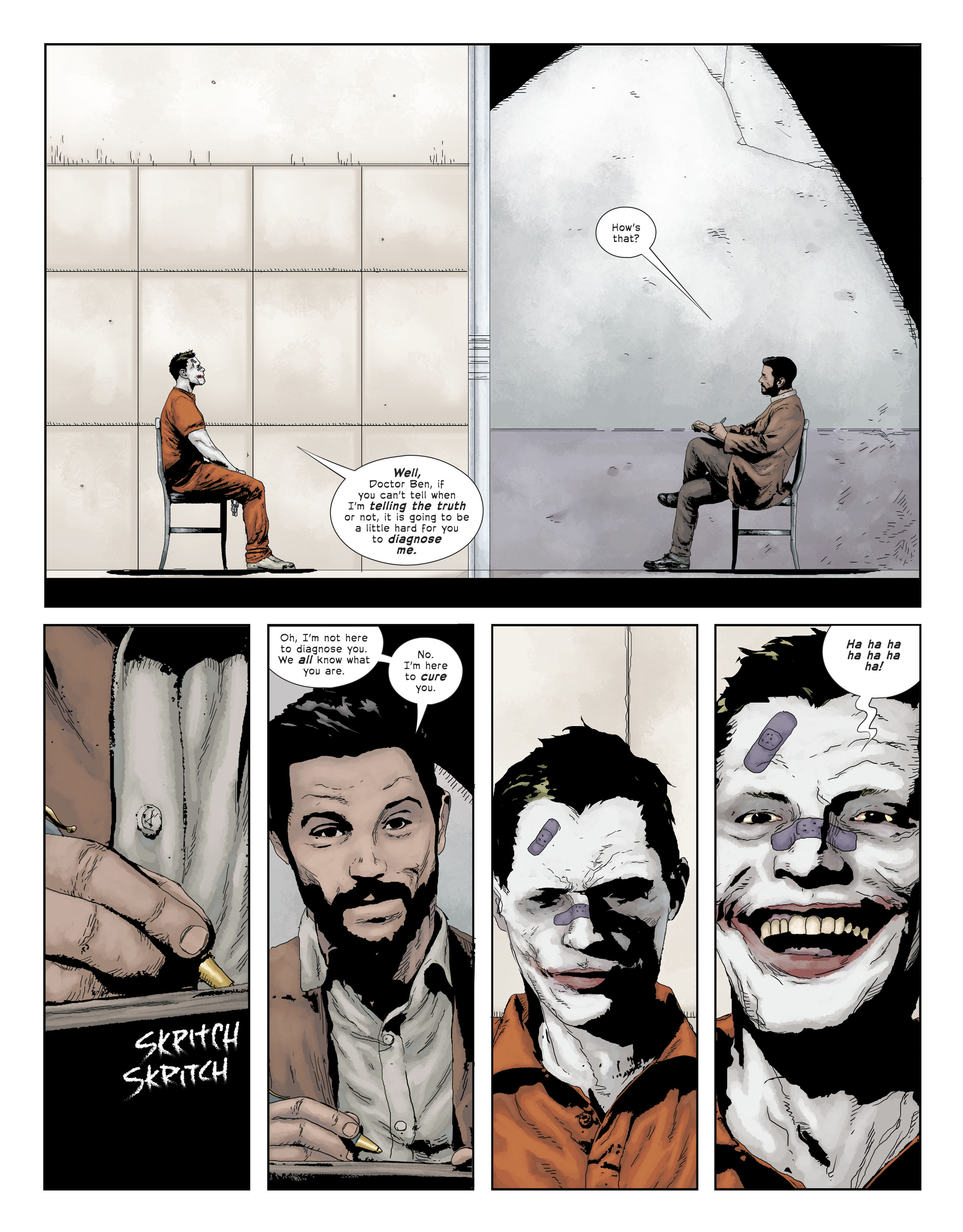
There isn’t a lot underneath the shiny surface. Just like Phillips’ movie reappropriated Martin Scorsese’s flicks, Killer Smile isn’t coy about remaking ‘The Abyss Gazes Also,’ the phenomenal sixth issue of Watchmen (yes, Rorschach inkblot tests are a recurring motif…), with a dash of Mad Love thrown in there. Thematically, the book doesn’t add much to those classics, but it does use them as an effective springboard for a dirty, eerie trip to Gotham City, complete with some neat black humor (a lot of the dialogue consists of jokes about Arkham inmates).
One of the most prolific writers around, Jeff Lemire has penned plenty of cool comics in recent years, yet you can tell he doesn’t invest in all of them the same way. More often than not, the key merit belongs to the incredible artists he has worked with (or to his own artwork, when he illustrates his own projects). This is not to call Lemire a hack – the truth is that he is quite skilled at providing enough of a high concept and gripping pace to let the artists’ talent shine, creating comics that, while not always memorable in terms of plot, at least provide a visually engaging reading experience. It was the case with Lemire’s previous collaborations with Sorrentino (Green Arrow and Old Man Logan, although there’s more juice in Gideon Falls…) and it’s definitely the case with Joker: Killer Smile.
The sequel one-shot, Batman: The Smile Killer, is what really elevates this collection. Sure, questioning Bruce Wayne’s sanity has been done to death (including in the recent Last Knight on Earth mini-series), but the execution here is especially open-ended about what is real and what is not, leaving you with a genuinely unsettling sensation (up to and including the very last page, whose bottom panel may contradict the top one). DC probably intends to expand the story into one of its countless crossover events, but I think it works even better as an ambiguous work that readers can explore and interpret on its own…