
-
Recent Posts
Categories
- ART OF BATMAN COMICS (36)
- ART OF HORROR COMICS (36)
- AWESOME COVERS (63)
- BATMAN COMICS FOR BEGINNERS (37)
- BOOKS OF THE YEAR (22)
- COLD WAR CINEMA (12)
- COVERS OF BATMAN COMICS (53)
- FANTASTIC ADVENTURES (49)
- GLIMPSES INTO AWESOMENESS (98)
- GLIMPSES INTO THE FUTURE (24)
- GLIMPSES INTO THE PAST (90)
- GOTHAM CITIZENS (37)
- GOTHAM INTERLUDES (87)
- HARDBOILED CRIME (38)
- HEADSHOTS (14)
- IF YOU LIKE THE COEN BROTHERS… (11)
- MANIFESTO (3)
- POLITICS OF BATMAN COMICS (21)
- SPYCRAFT & WARFARE (47)
- SUPER POWERS (16)
- WEBS OF FICTION (57)
- WILD WEST (8)
- WRITERS OF BATMAN COMICS (20)
- WRITERS OF SUPERMAN COMICS (4)
Drop me a line at
imbaytor@yahoo.com
COMICS CAN BE AWESOME (December 2019)
And here is your December reminder that comics can be awesome:
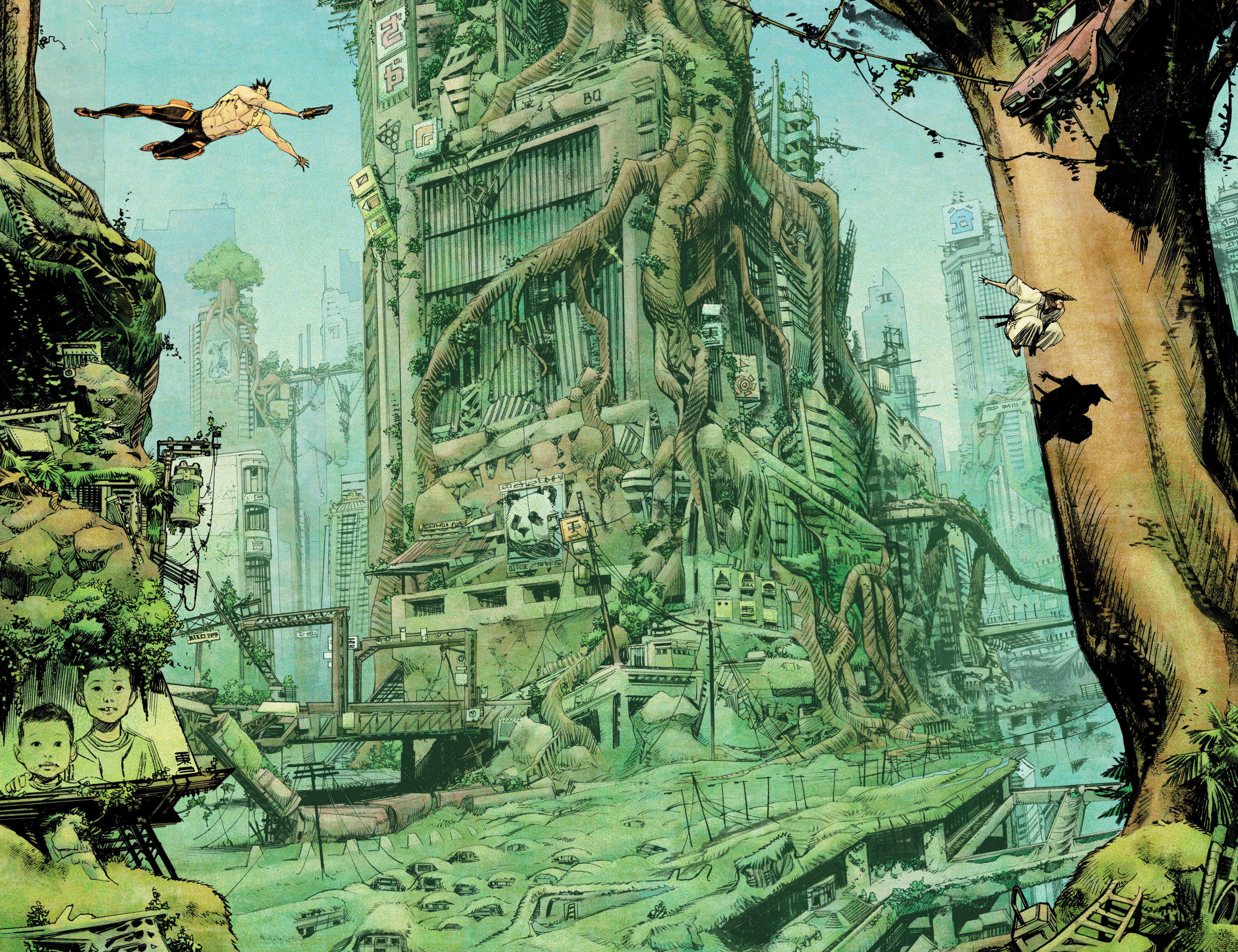 Tokyo Ghost #2
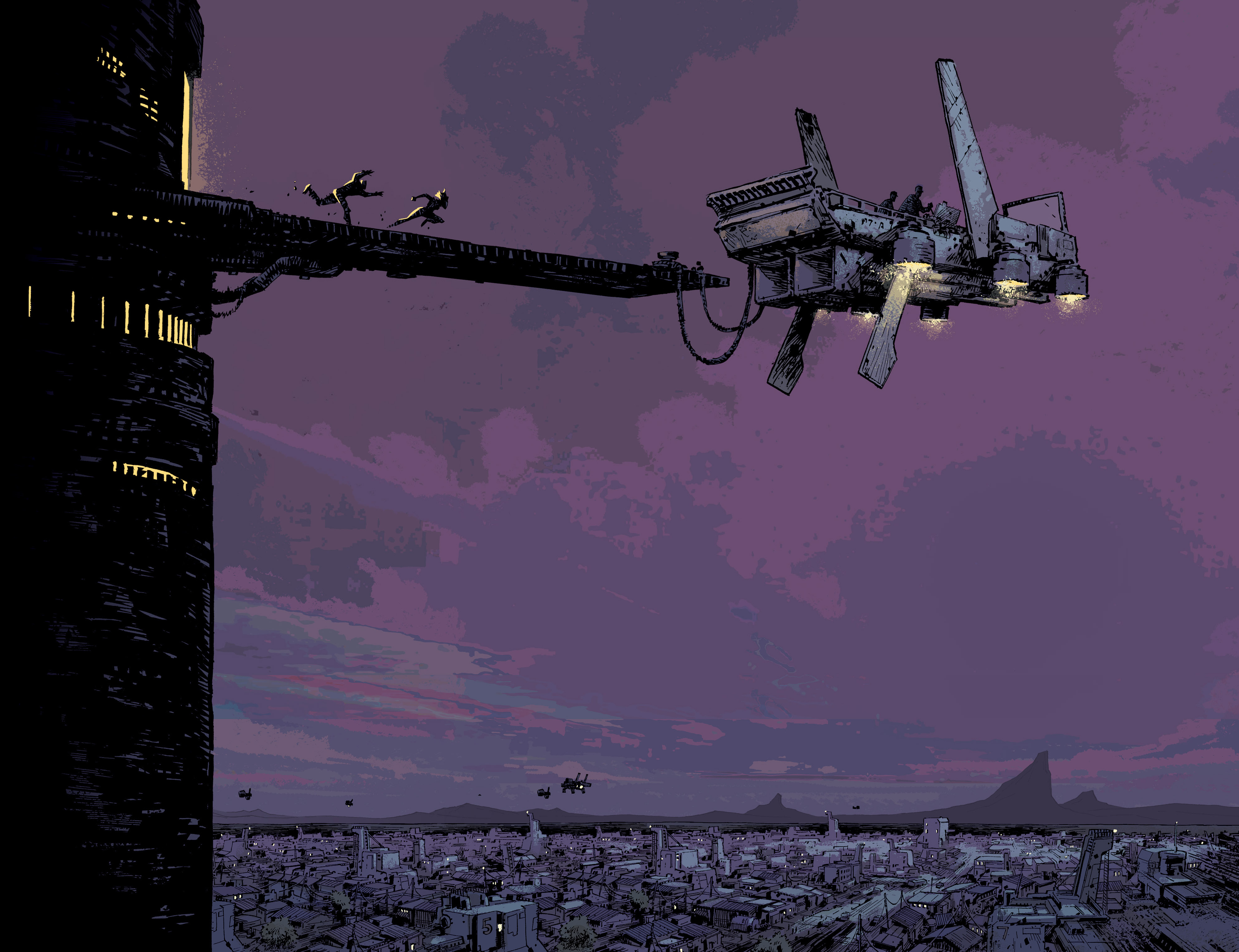 Cemetery Beach #1
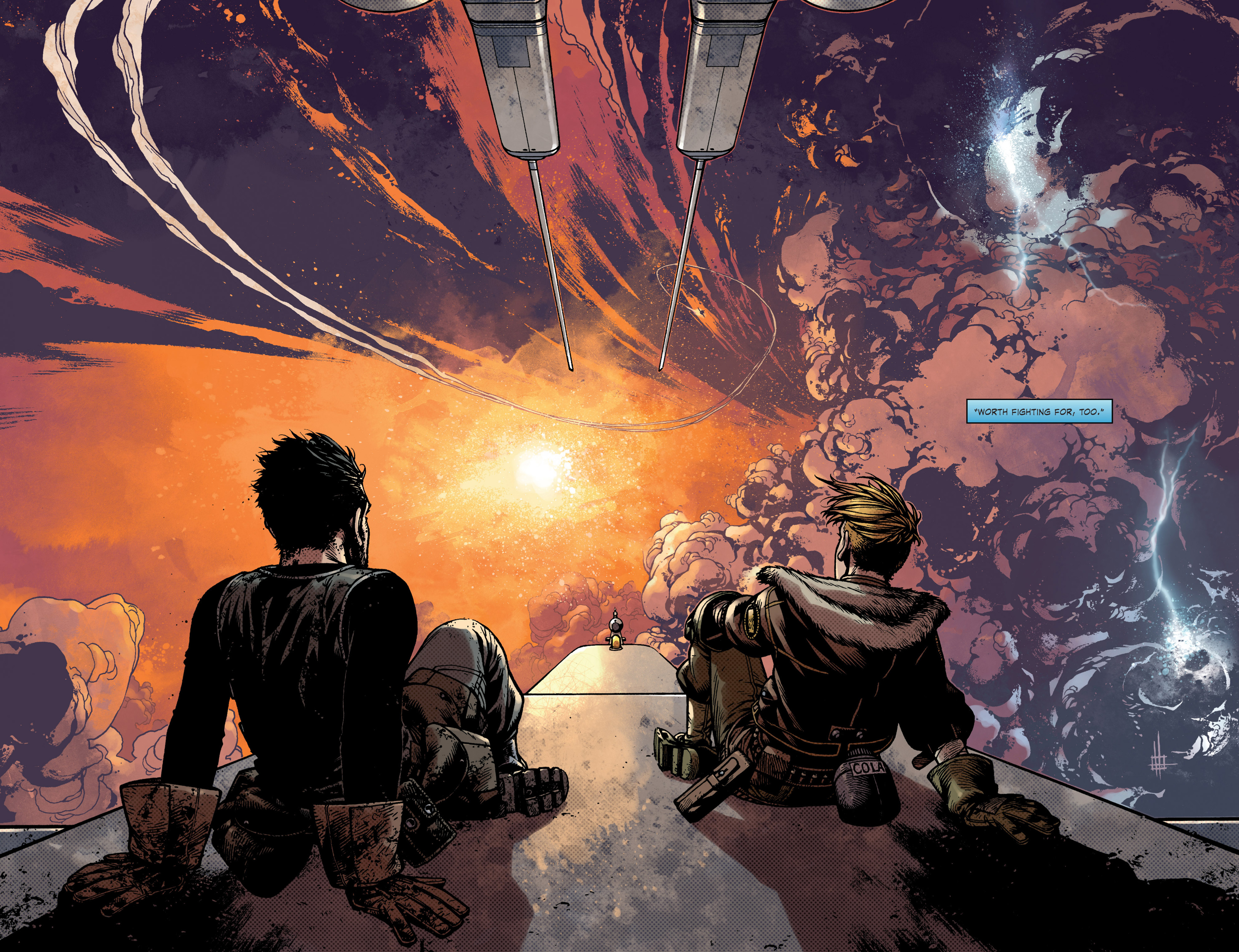 Wild Blue Yonder #3
Spotlight on Fury: My War Gone By
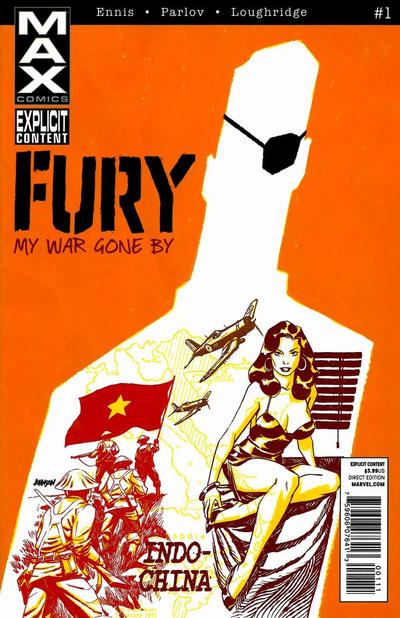
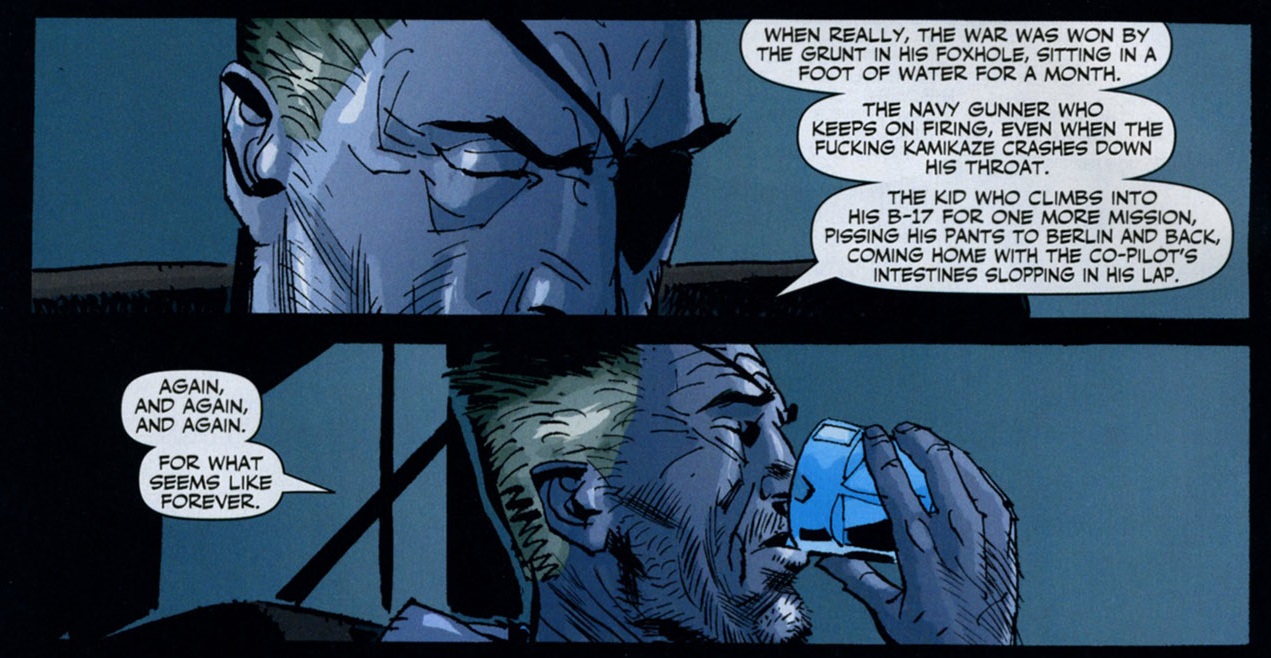
2012’s limited series Fury: My War Gone By is the kind of idiosyncratic, fascinating beast you get in the field of comics, bizarrely merging auteurism-ran-loose with a popular corporate franchise in the form of provocative historical fiction. It’s not just that writer Garth Ennis chose to explore the Cold War through the version of Colonel Nick Fury he had crafted ten years earlier, it’s also that he indulged in so many of his disparate interests and tastes that the ensuing tone is all over the place, appealing to a relatively specific combination of sensibilities (which I happen to share), as My War Gone By veers between sentimentality, detailed military discussion, high politics, and lowbrow comedy, including plenty of explicit language and graphic sexuality.
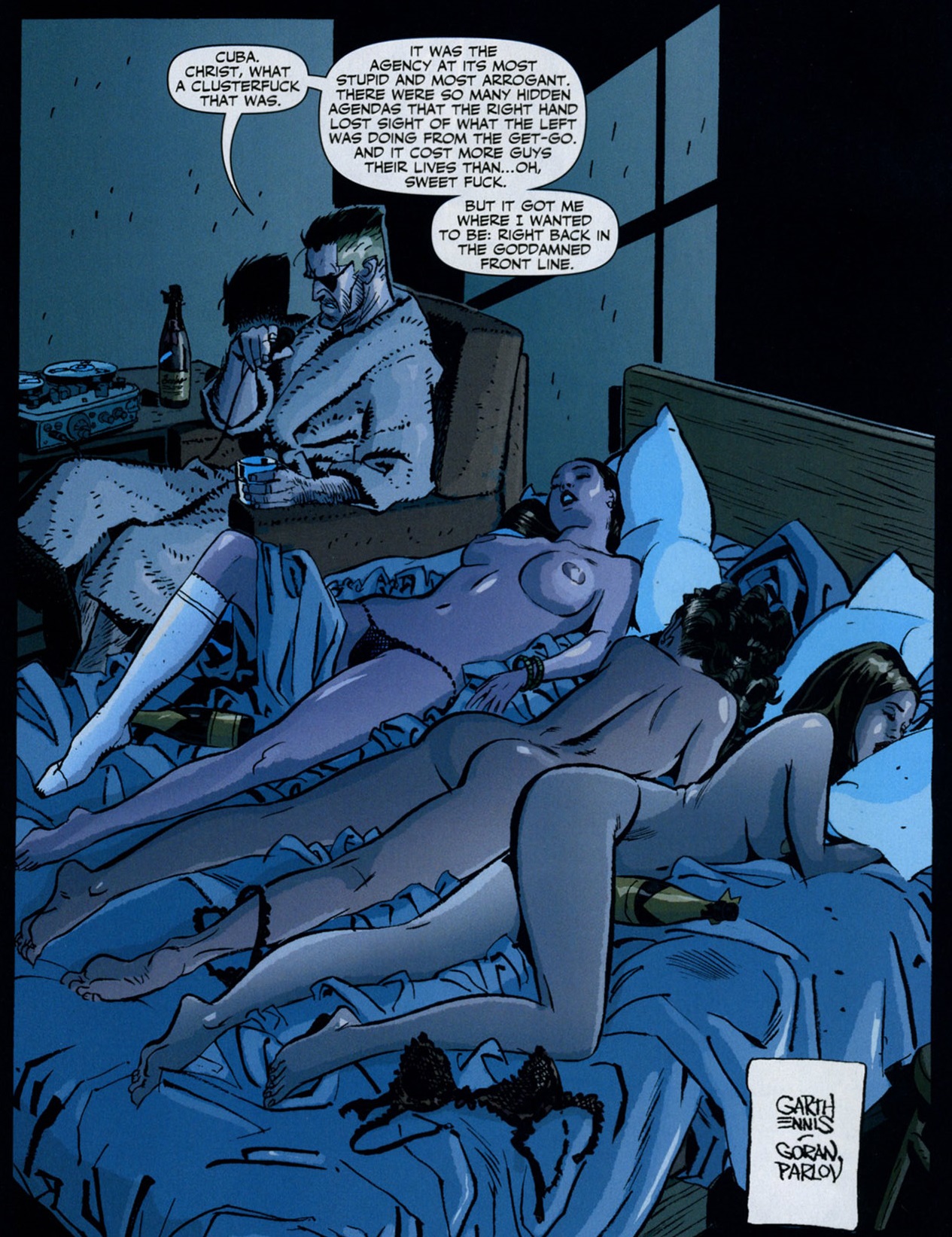 Fury: My War Gone By #4
It helps that the whole creative team seems to be on the same page. Artist Goran Parlov always has a nice rapport with Ennis, his page-wide horizontal panels and his exuberant, not-quite-cartoony lines perfectly matching the Irishman’s caustic scripts. The colors are by the great Lee Loughridge, who gives the light in each corner of the world a specific texture, nailing the series’ wide range of moods. Moreover, Dave Johnson’s super-stylish, conceptual covers give off just the right hint of James Bond while making it increasingly clear that this is a separate breed of Cold War fiction. (The issues’ titles are likewise based on intertextual winks, calling back to lines from a variety of thematically-related works, such as poems, novels, films, and even a couple of kickass Pogues tracks… The title of issue #9 ironically alludes to the lyrics of the theme-song from The Spy Who Loved Me.)
It’s a bleak, ferocious series (if you’re just looking for a breezy romp set in a revised version of Marvel’s Cold War, go look for it in Kathryn Immonen’s and Rich Ellis’ Agent Carter: Operation S.I.N. instead). The structure is rather episodic, each three-part arc engaging with a crisis from a different decade. The first arc takes place in 1954 Indochina, around the time of the Battle of Dien Bien Phu. It introduces the main recurring characters (who represent distinct attitudes towards the Cold War), namely the hawkish congressman Pug McCuskey, his cynical bombshell secretary Shirley Defabio, and idealist C.I.A. operative George Hatherly – the latter, I assume, being a nod to Alden Pyle in Graham Greene’s classic novel The Quiet American (which, notoriously, was quite different from the character in 1958’s noirish film adaptation).
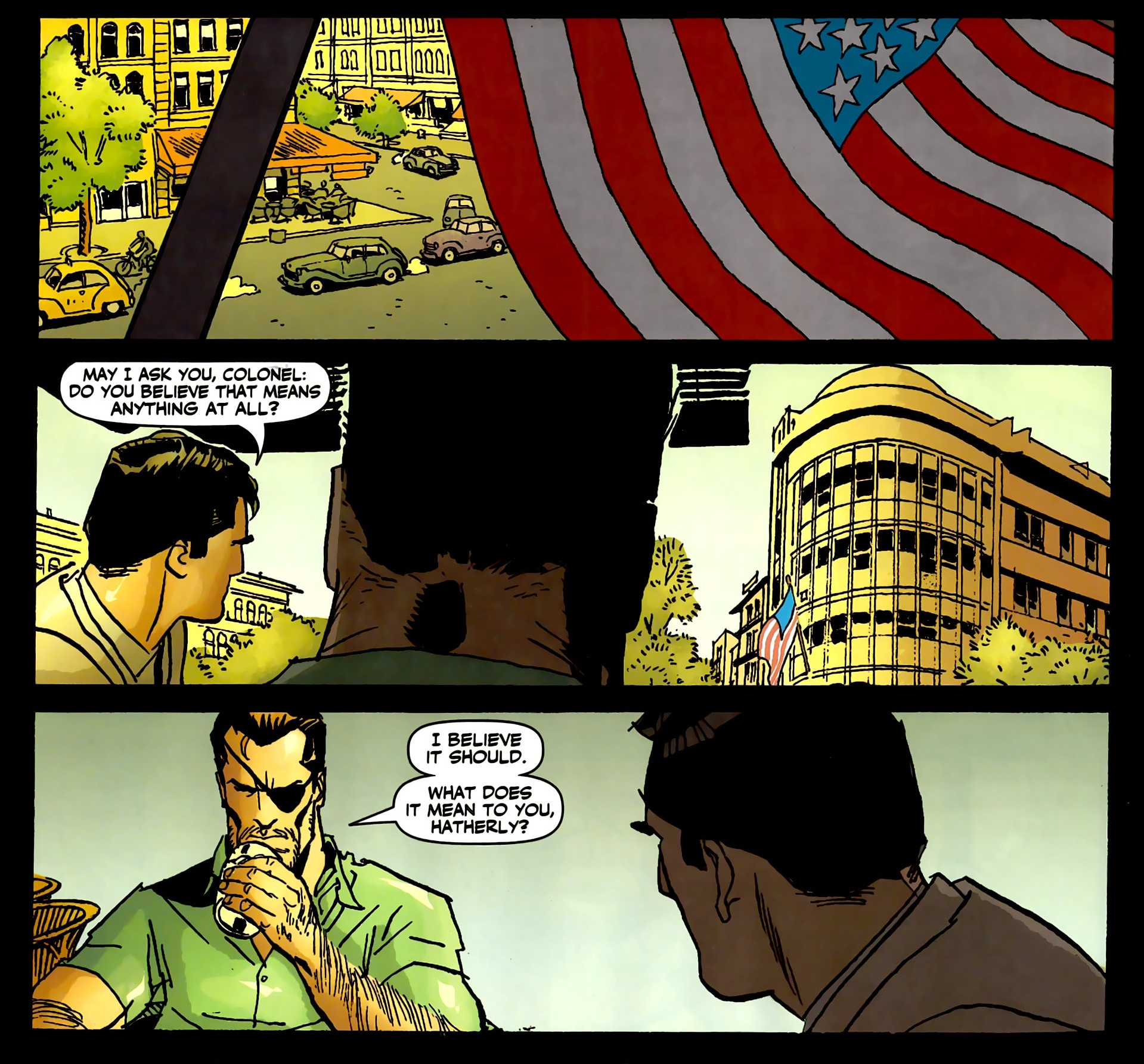
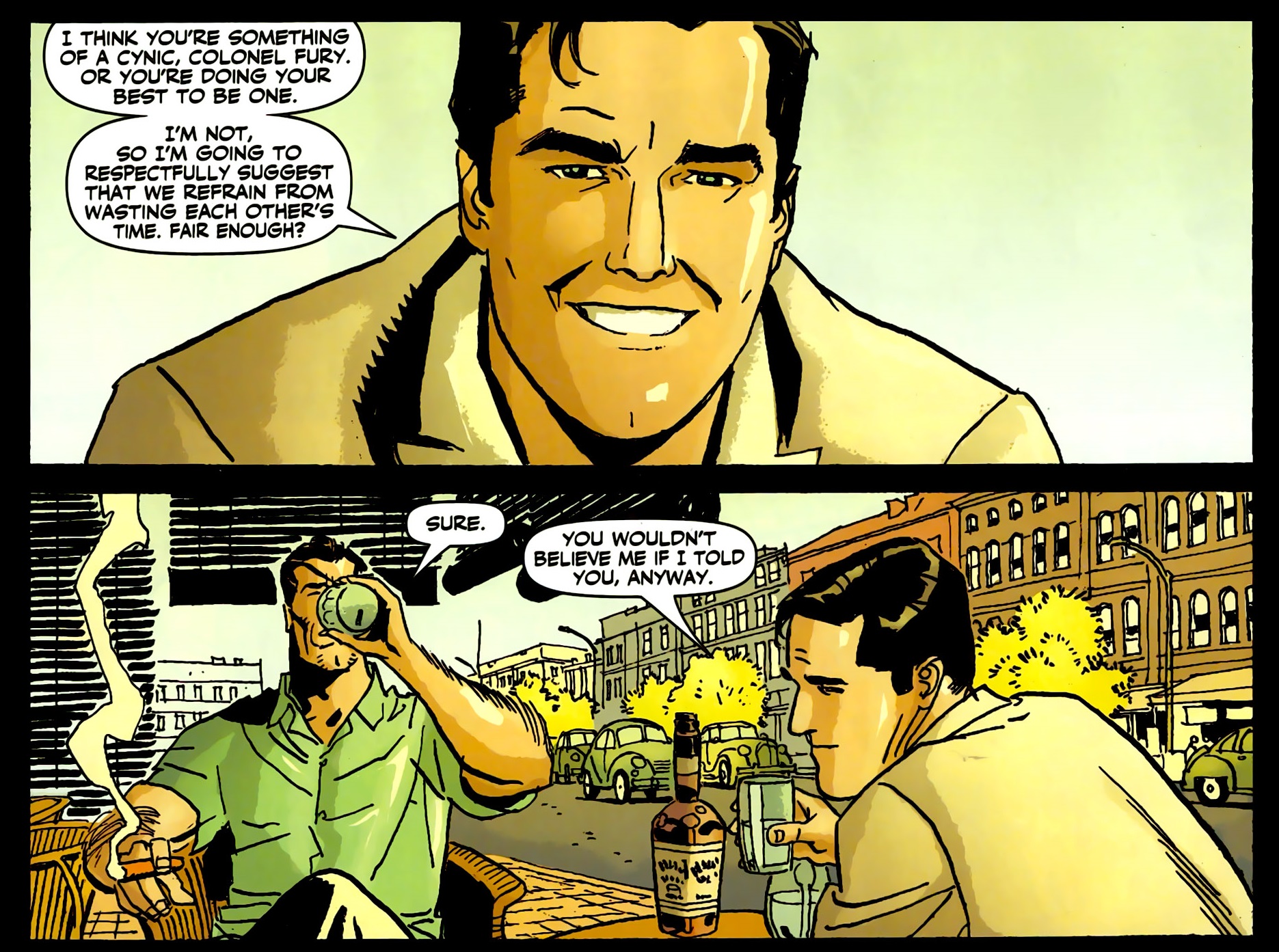 Fury: My War Gone By #1
This arc sets up the series’ themes, most notably the notion that the so-called Cold War was made up of plenty of hot conflicts, with dead bodies piling up all over the Third World as the U.S. embarked in morally and strategically questionable foreign interventions (in this case, supporting French colonialism) in the name of global anti-communism. It also neatly sets up a later arc, with the look on Nick Fury’s bloody face during the climactic battle suggesting his precocious realization that the West doesn’t stand a chance in the region (which of course doesn’t stop him from fighting in Vietnam in the following decade). The ending of issue #3 powerfully conveys that this is a whole new type of warfare with a fiercer enemy than the one in WWII.
Leaving little doubt about the spirit of moral compromise to come, Fury teaches Hatherly ‘the facts of life’ as they literally fight side-by-side with a Nazi.
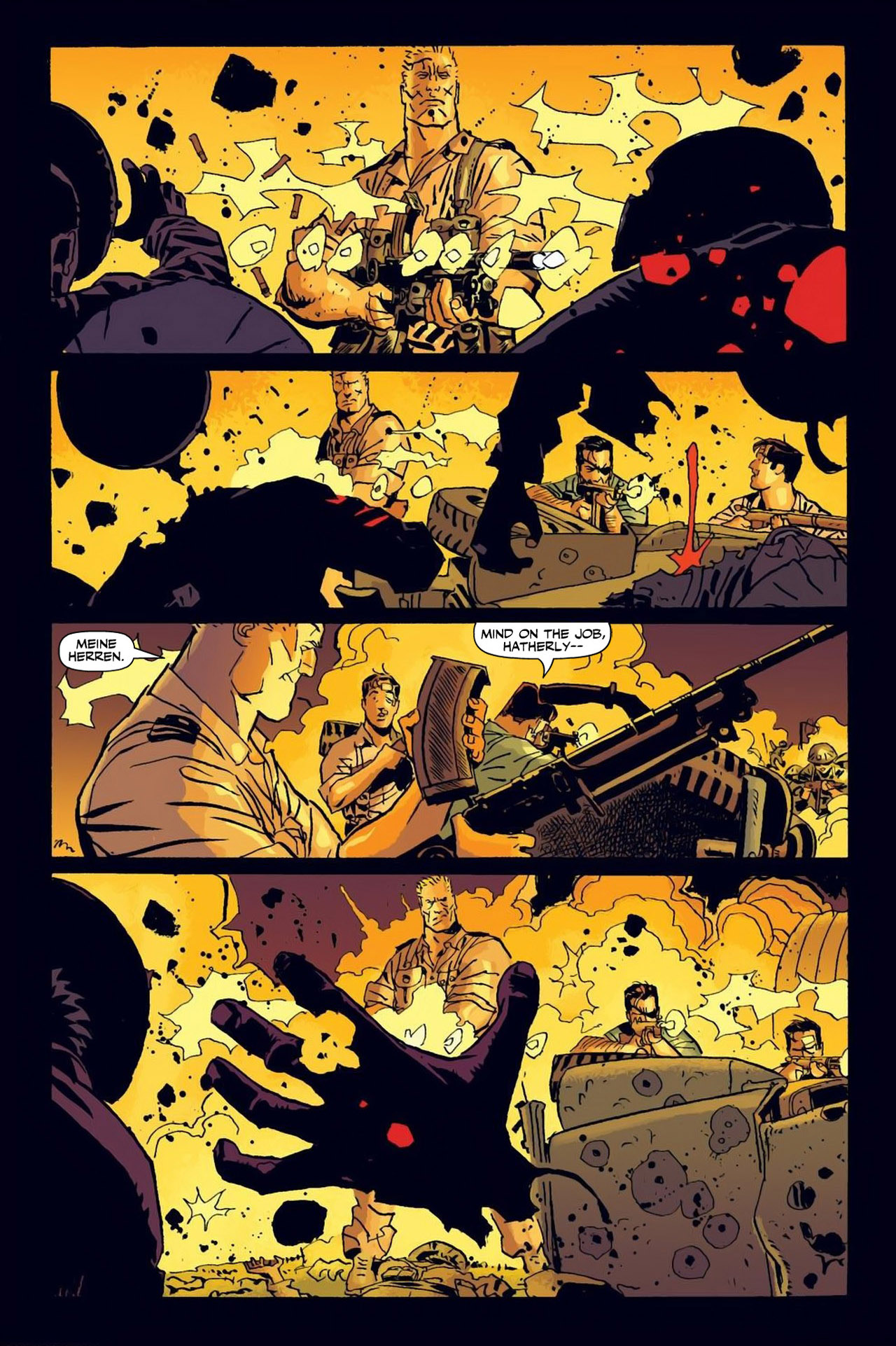 Fury: My War Gone By #2
The second arc finds Colonel Fury in 1961, training troops for the Bay of Pigs invasion. If you know this version of Fury, you know he doesn’t like staying away from the battlefield (‘I keep training men I never see again for wars I never fight in.’), which is why he jumps at the chance of heading a secret mission to Cuba. His team arrives there just in time to witness first-hand the C.I.A.’s infamous clusterfuck … (Issue #6, which deals with the operation’s aftermath, is one of the most brutal ones in the whole series.)
We then skip to 1970 Vietnam, where Nick Fury goes on a covert operation with Frank Castle (years before the latter became the Punisher), i.e. the one guy who is just as addicted to combat as him. Garth Ennis has a long history of writing Castle and he has a firm, captivating grip on the character (‘He seems to come from that time in America when things were made just to work.’). Plus, Vietnam war comics are exactly the sort of thing Ennis and Parlov seem born to do (fortunately, they went on to collaborate again in the excellent Punisher: The Platoon).
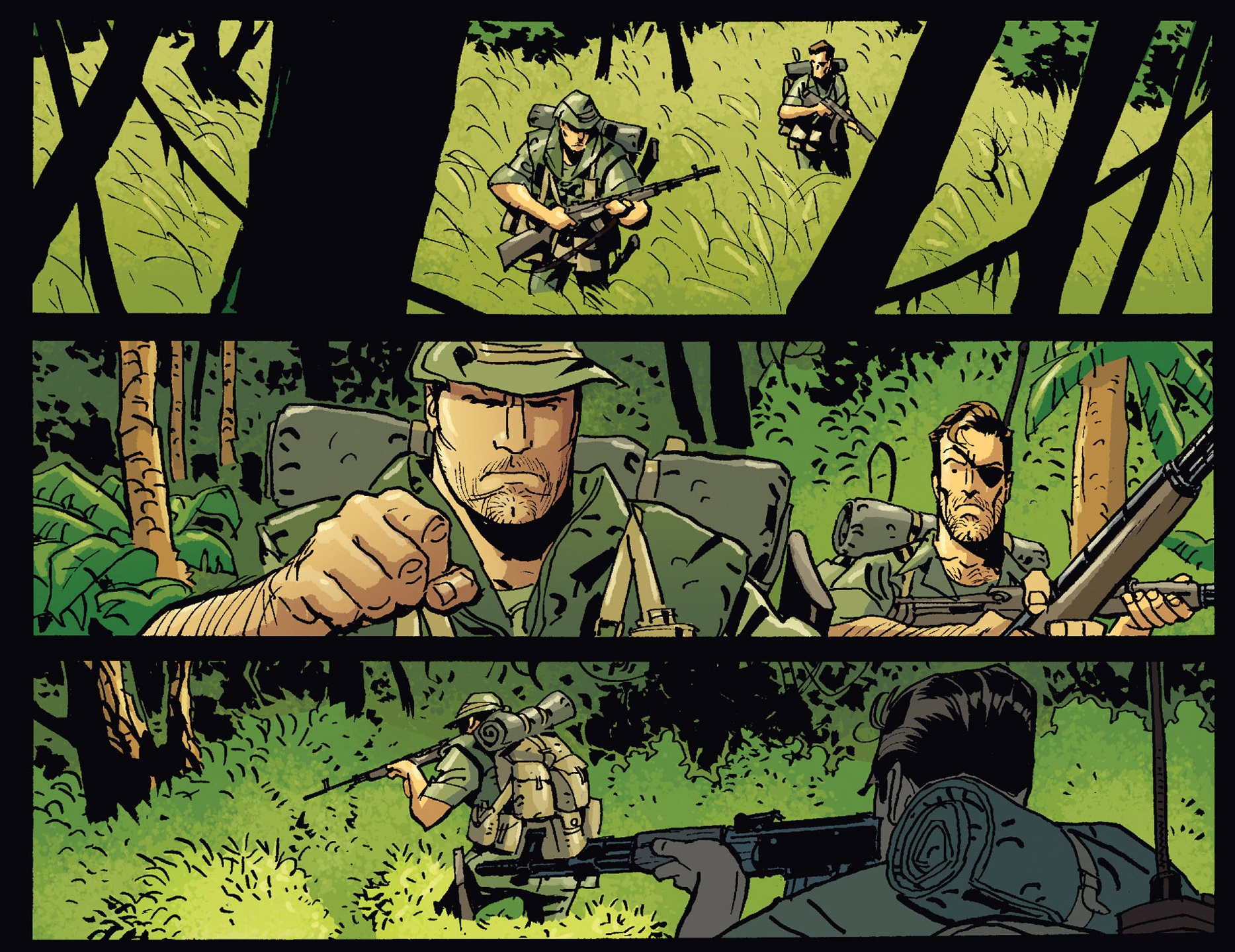
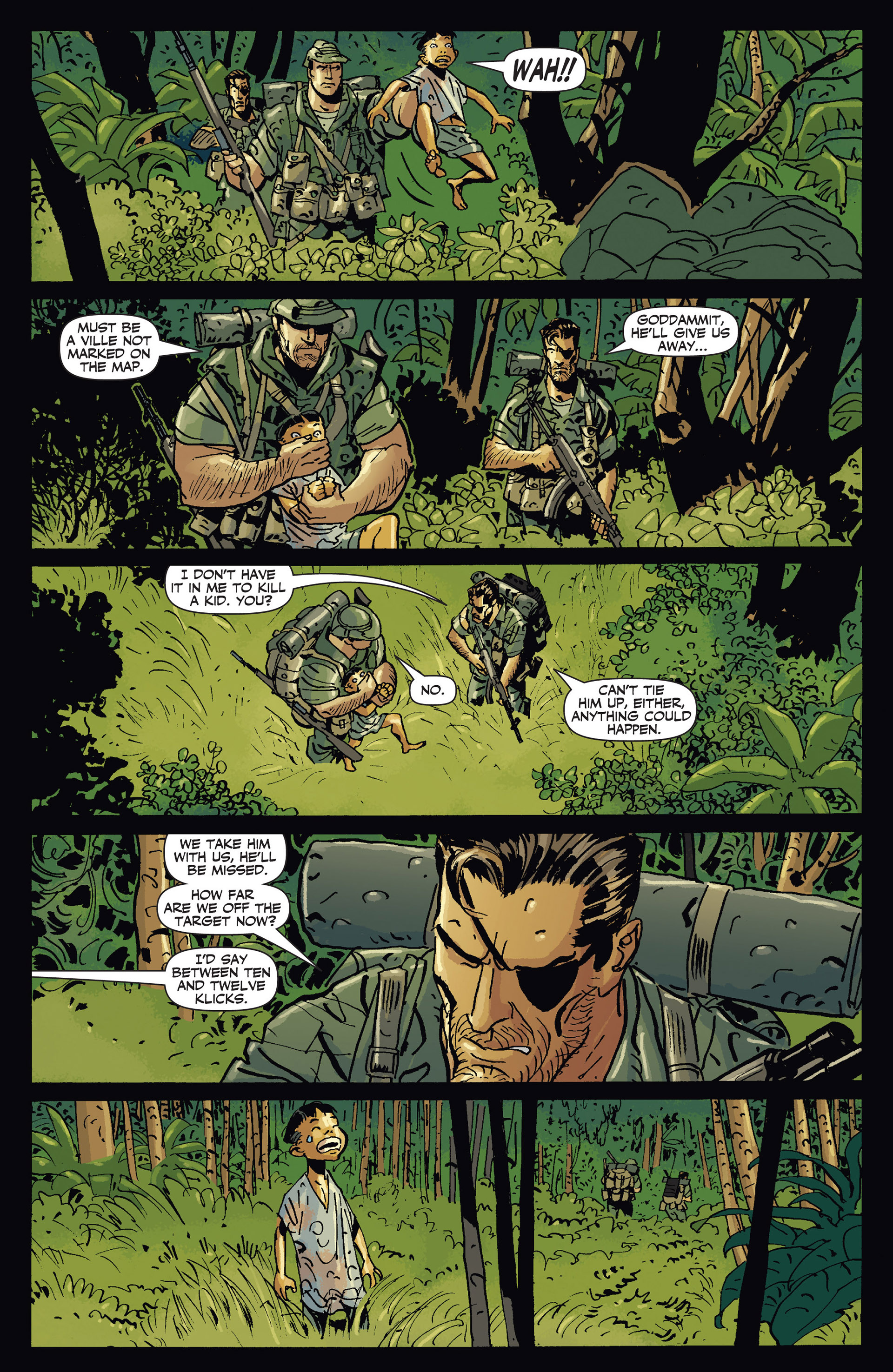 Fury: My War Gone By #7
If you don’t count the one-issue epilogue, the final arc takes place in 1984 Nicaragua, where Colonel Fury investigates the charge that the C.I.A. is involved in drug-smuggling in order to fund the Contra rebels against the Sandinistas (besides training them to carry out unspeakable atrocities). This leads Fury to Barracuda, the cunning S.O.B. Ennis and Parlov introduced years earlier in The Punisher MAX and who starred in their spin-off mini-series Punisher Presents: Barracuda (a failed attempt at a Blaxploitation action comedy that isn’t nearly as cool or as fun as the original Blaxploitation action comedies, like Truck Turner or Foxy Brown).
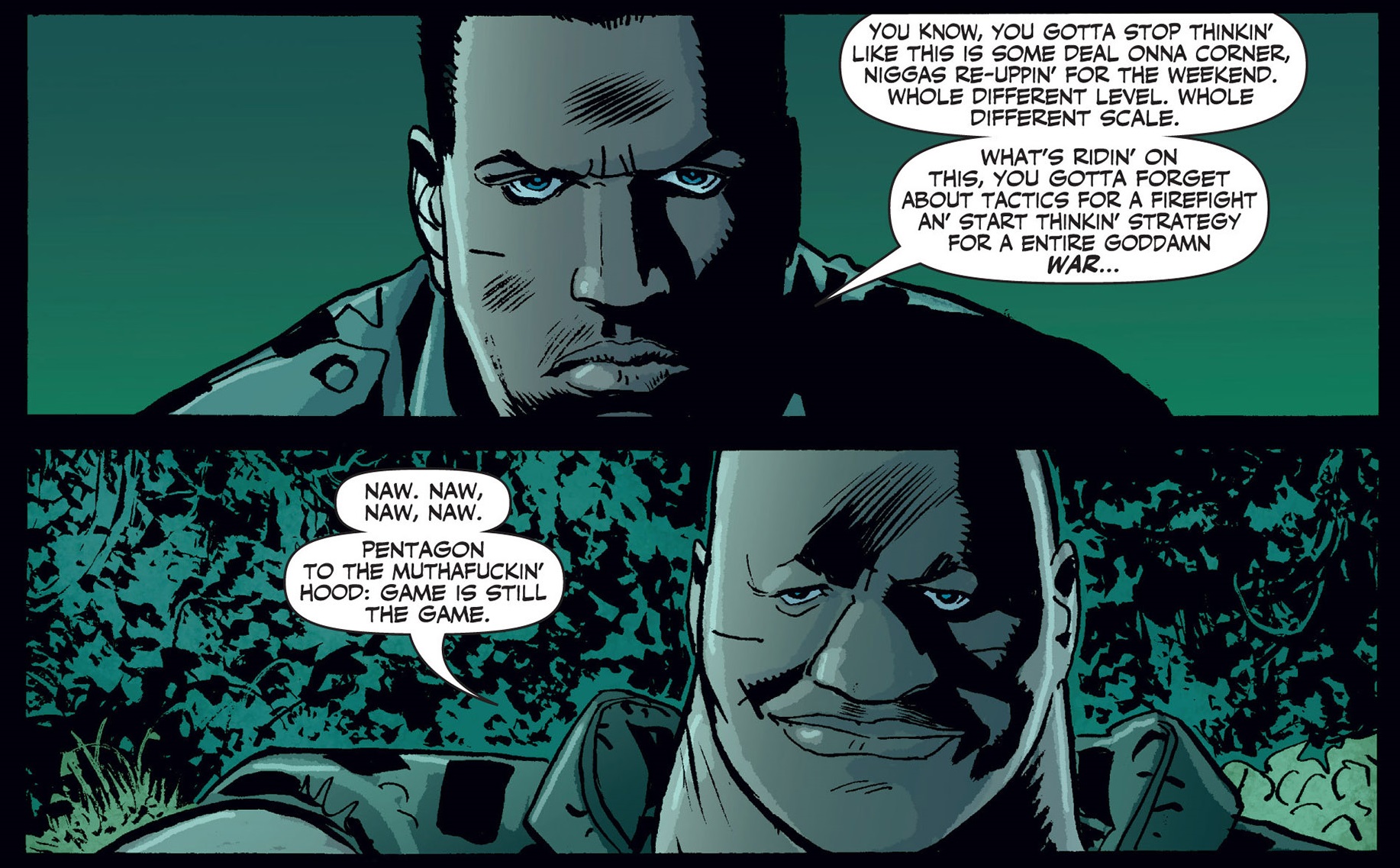 Fury: My War Gone By #11
It’s hard to deny Barracuda comes across like a particularly outrageous racist stereotype, but his function in My War Gone By is, I suppose, to drive home the point that the line between black ops and organized crime can get increasingly blurry. As one character puts it, Barracuda is the embodiment of the kind of unchecked power that comes with fighting secret wars.
The indictment of the ascent of covert operations is, of course, at the core of the book, along with the idea that some entities – be they the intelligence community, the military-industrial complex, or Fury himself – are willing to find any pretext to carry on fighting. At one point, a Vietnamese general tells the protagonist: ‘Don’t pretend that this is your old war, your European cataclysm wherein Good triumphs over Evil. Be honest: you are here because for Nick Fury, any war will do.’
That is one of many fine passages in a book with a lot of memorable Garth Ennis dialogue, especially between characters who can closely understand and see through each other. Ennis also trusts readers to pick up when the cast betrays their narrow views in light of what we now know about how history panned out…
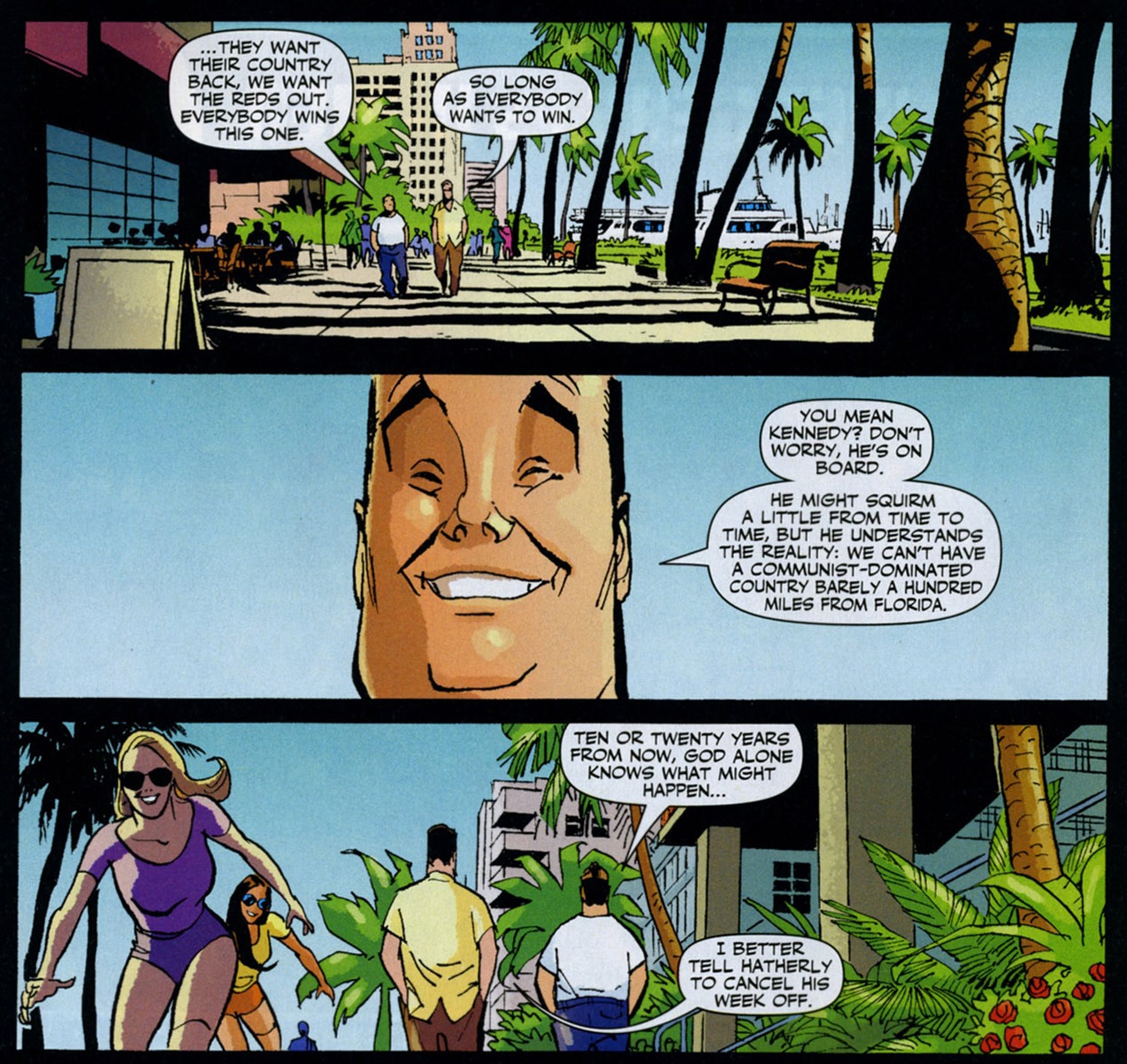 Fury: My War Gone By #4
In part, Shirley Defabio steals the show. A force of nature who grows gradually disenchanted with what’s going on, her relationship with Nick Fury starts off as preposterous male fantasy wish fulfillment but gains depth along the way…
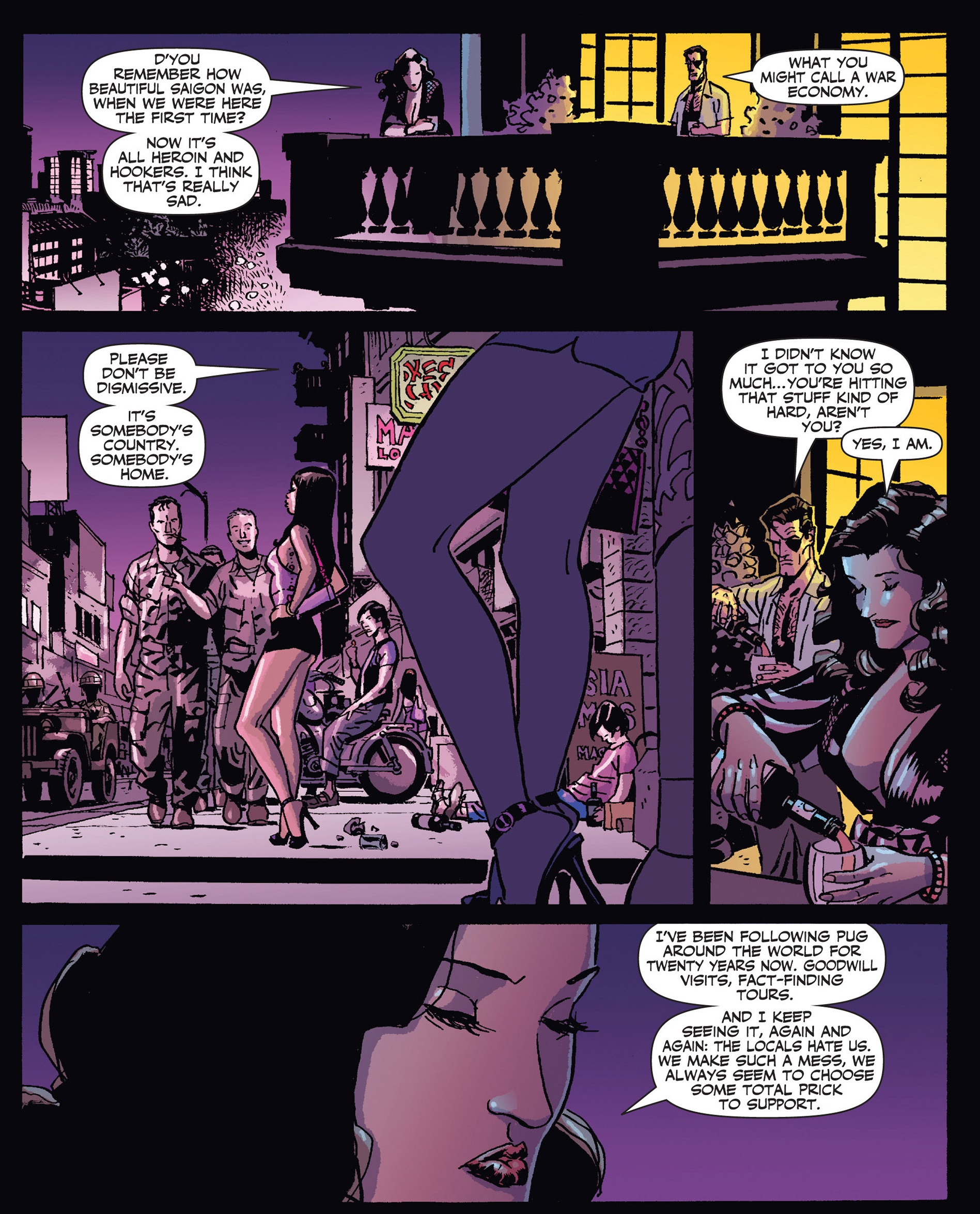 Fury: My War Gone By #7
(This is one of a couple of touching scenes involving Shirley Defabio on a balcony… Perhaps they can be seen as giving a new, retroactive meaning to Nick Fury’s own balcony scenes in the initial Fury MAX mini-series.)
With characterization playing such a central role, My War Gone By gets significant mileage out of sharing some of its cast with other Ennis comics, which is both fan-pleasing and a way to elevate the impact of Nick Fury’s saga by placing it in a large meta-narrative. At the same time, though, the book removes Fury from the even larger meta-narrative of the canonical Marvel Universe, as it outright contradicts the original Nick Fury, Agent of S.H.I.E.L.D. comics, replacing them as the true past of this version of the character (for one thing, this Fury spent the 1960s-1980s working for the C.I.A., not for S.H.I.E.L.D.).
I have no problem with that, even if I think the gesture takes away some of the edge of the first Fury MAX mini… Much like Frank Miller’s The Dark Knight Returns, that series was not meant to present a fully alternative version of its protagonist. Rather, the idea was to build on the contrast with each hero’s campy history by showing us an older, darker, and twisted version of a previously colorful world – much of the fun of DKR and Fury MAX hinges precisely on the notion that this is supposed to be the same Batman who had all those goofy adventures and the same Fury who used all those weird-looking gadgets back in the day. However, in both cases the comics’ success eventually led to prequels that recreated the past, making it more consistent with their new depictions (the Caped Crusader was unluckier than Fury, because he got settled with the dreadful All-Star Batman & Robin, the Boy Wonder). Ironically, introducing more revision reduced the original revisionism.
Regardless, this version of Nick Fury is such a strong character that his memoirs do serve as a great springboard to unleash Garth Ennis’ acidic take on the Cold War.
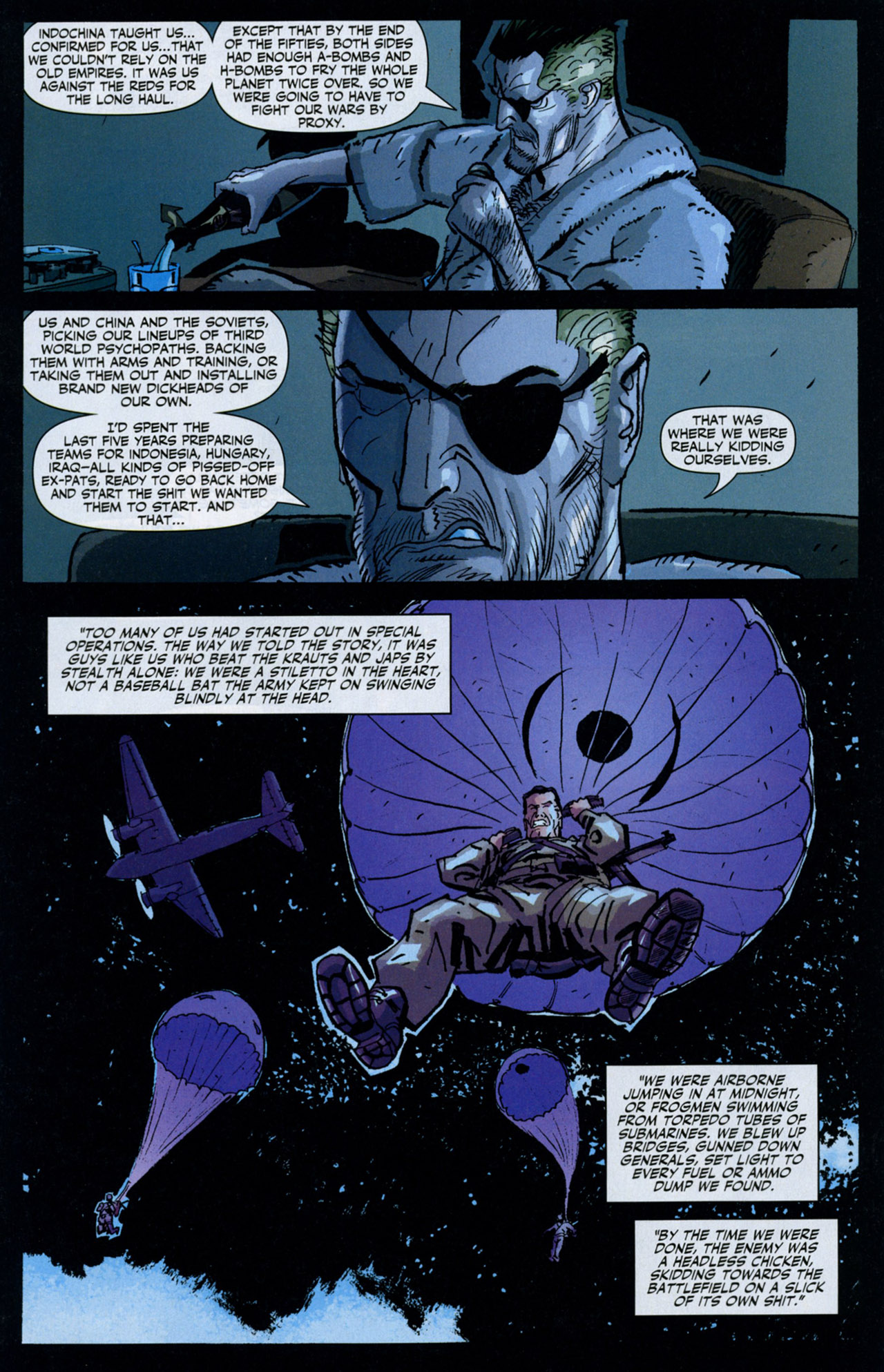
 Fury: My War Gone By #4
Posted in SPYCRAFT & WARFARE
Tagged Cold War, Dave Johnson, espionage, Garth Ennis, Goran Parlov, Kathryn Immonen, Lee Loughridge, Nick Fury, politics, Punisher, Rich Ellis
Leave a comment
Chuck Dixon’s mordant Batman
Last week I mentioned that Chuck Dixon is an old-school pro whose work in Batman comics (especially during his most prolific period, in the 1990s), rather than blow up the status quo, was all about gripping narratives that stayed true to the characters. Yet it can be misleading to think of him as a mere journeyman who has mastered meat-and-potatoes storytelling. There is also a caustic side to Dixon’s authorial voice, including a penchant for corrosive comedy and biting social commentary. This has enabled him to engage with personal idiosyncrasies like his film tastes and political views.
 Catwoman (v2) #29
I’ve written before about Chuck Dixon’s key contribution to our ability to imagine Gotham City’s cinema culture. This no doubt stems from the fact that Dixon is a film buff – one who not only borrows plenty of ideas from the movies, but who also infuses that passion into the world he creates. In Robin Annual #1 (the coolest issue of the lame Bloodlines crossover), Dixon introduced the Psyba-Rats, a team of teen techno-thieves that included the mutant Channelman, who enters television systems and tweaks Hollywood classics. One of the best friends of Tim Drake (Robin’s civilian identity) was a geek called Sebastian Ives who loved schlocky sci-fi flicks (leading to a fun sequence at a drive-in, in Batman versus Predator III). Detective Harvey Bullock’s obsession with old movies played a role in the one-shot Bullock’s Law. Plus, although it’s not explicit, I’m convinced the characters in Bane: Conquest keep quoting one-liners from Commando…
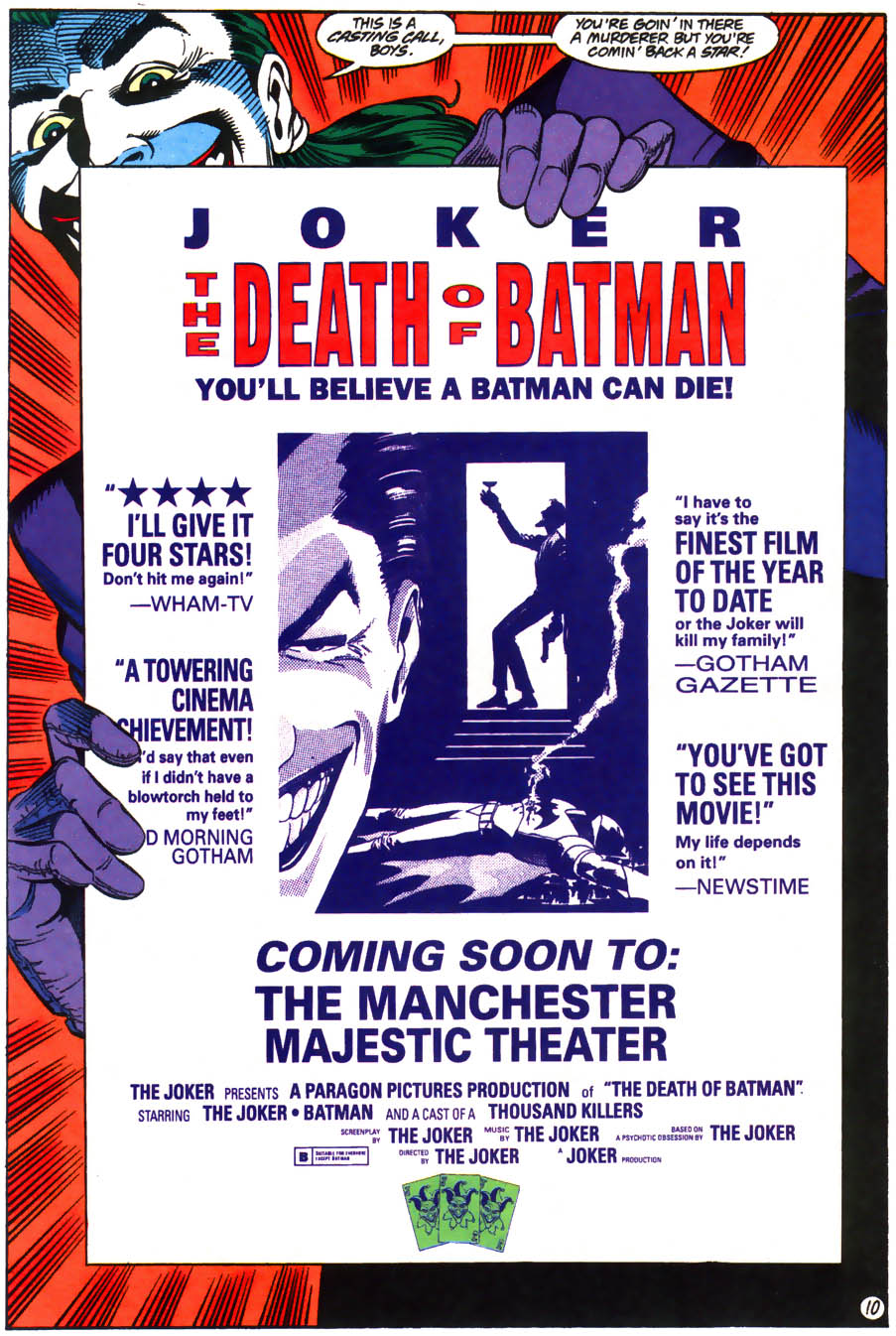
And then there is Detective Comics #671-673, where the Joker gets funding to do a film in which he actually kills Batman (because Hollywood producers are almost as insane as he is).
 Detective Comics #672
(Did I mention Dixon is one of greatest Joker writers?)
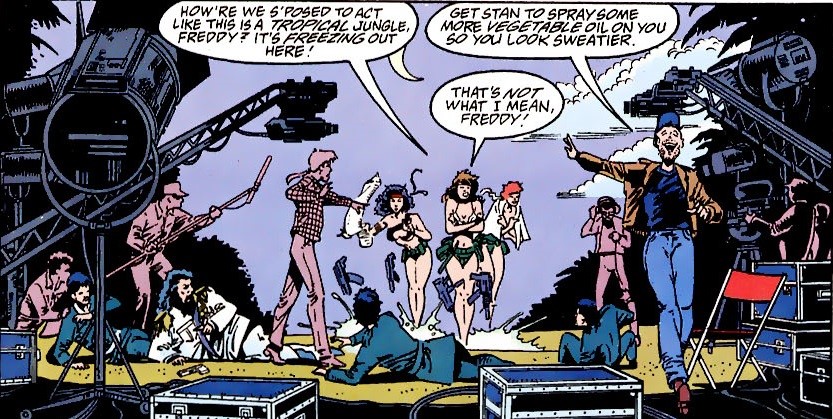
Another madcap satire, ‘More Edge More Heart’ (Catwoman #20) opens with a shot of the film Lethal Honey III, full of busty, bikini-clad babes shooting automatic weapons, framed by Catwoman’s quip: ‘Movie people are always saying that their industry is almost a hundred years old. So why is it still in puberty?’
It only gets better from there.
 Catwoman (v2) #20
In this hilarious story arc, a sleazy producer hires Catwoman to steal a screenplay from the successful competition in order get a knock-off production ready in time for the blockbuster’s release. This leads to a wonderful payoff in the second part, ‘Box Office Poison.’
By repeatedly having fun at the expense of the film industry, Chuck Dixon isn’t just displaying his interest and knowledge regarding the inner workings of the movie business. He is also partaking (deliberately, I assume) in a long tradition of love/hate parodies of this milieu – a subgenre that’s part of the industry’s own history, as seen in films such as Victor Fleming’s Bombshell, Robert Altman’s The Player, David Mamet’s State and Main, and the Coen brothers’ Hail, Caeser!, not to mention Quentin Tarantino’s uneven Once Upon a Time… in Hollywood.
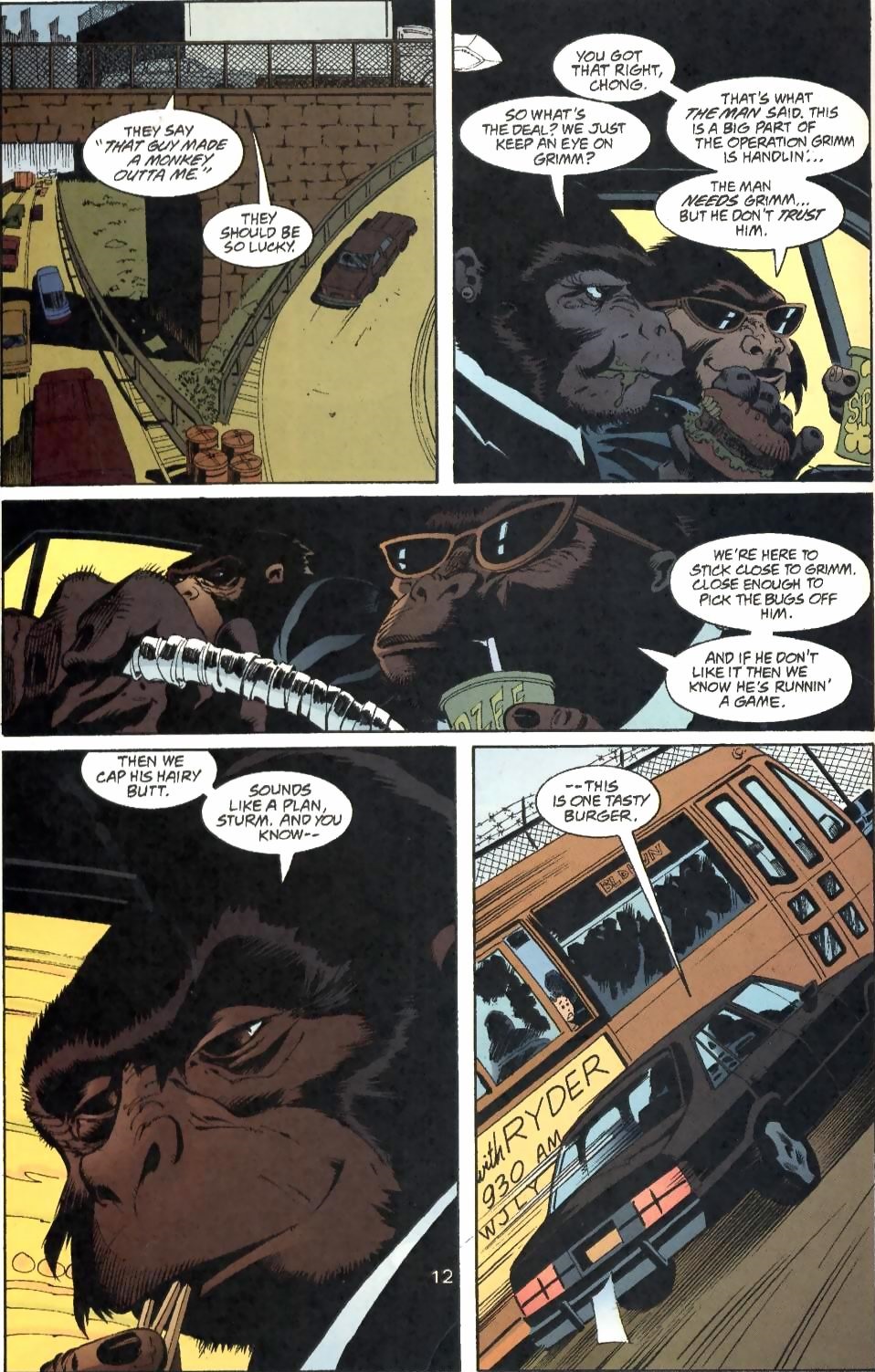
Speaking of Tarantino, Dixon penned one of the weirdest riffs on Pulp Fiction, starring a couple of talking gorillas:

 Batman Annual #23
(Naturally, there was also a Planet of the Apes joke in this issue.)
While Chuck Dixon’s cinephilia is probably shared by most of his colleagues, the same doesn’t necessarily hold true for his political leanings. Dixon is an increasingly outspoken conservative who seems to support Donald Trump (even though I assume there is something tongue-in-cheek about the fact that he wrote a Trump’s Space Force comic).
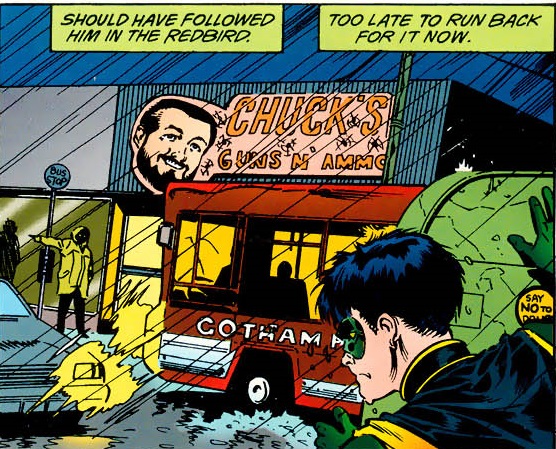
I’ve seen him downplay the influence ideology has on his comics because they’re allegedly not political, in the sense that they deal with escapist fiction about heroes with broad, universal values. I’m quite wary of this understanding of politics, but even if you go with a relatively narrow definition you have to admit Dixon has tackled a number of hot topics, especially in Robin, which dramatized teen issues such as gun violence, sexual assault, school bullying, unwanted pregnancy, and alcoholism.
What you can argue – and many have – is that Dixon tends to respect each franchise’s history and themes, hence he has written Batman stories that are ultimately geared against the death penalty or in favor of gun control, despite being a member of the NRA…
 Robin (v4) #43
There is no doubt that the Chuck Dixon who showed up for work at DC was first and foremost a storyteller, not a polemicist. For the most part, his scripts served the narrative without preaching. After all, despite his flair for gung-ho action, Dixon has always understood that moral complexity and nuance are the grist of compelling drama. You can see this, for instance, in ‘The Villain’ (Birds of Prey #7), where Black Canary tries to save an exiled Latin American dictator, only to realize that the world of international politics can be way more complicated than good guys versus bad guys.
Overall, I’d say his comics aren’t likely to upset liberal Batman fans, except for those who find it hard to engage with work on its own terms when it’s done by creators who have said or done problematic things – an attitude that does seem to be spreading, as seen in the recent controversy over Roman Polanski’s An Officer and a Spy (although in that case the alternative is pretty easy: if you’re interested in the story but don’t want to watch the film because of its director, get your hands on Robert Harris’ original novel, which is a fine read).
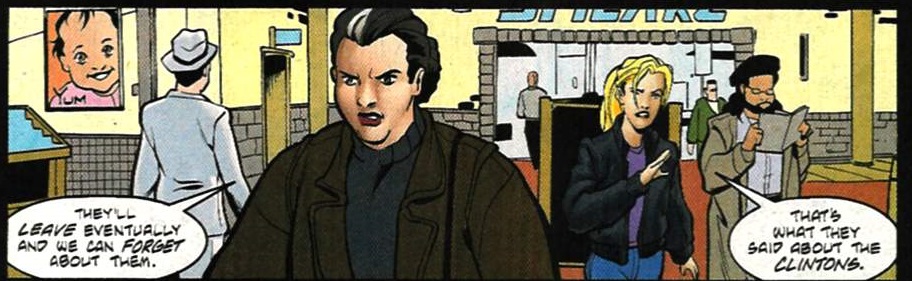
Even when Dixon occasionally indulged in right-wing tropes such as mobbed up unions, ethnic gangs, and eagerly pro-abortion planned parenthood counsellors, or when he took small jabs at the Democrats (for example, in Detective Comics #708 and Birds of Prey: Revolution), these didn’t distract from the main story.
 Robin (v4) #94
Mostly, though, I think what makes it work isn’t that Dixon kept his politics out of comics, but that he integrated them in smooth, satisfying ways that didn’t feel forced. While he played along with the progressive elements of the Batman narrative (his Caped Crusader kept going out of his way to save the Joker’s life), he also embraced its more reactionary side (like the constant indictment of the system’s leniency towards criminals). He wisely left the most anti-PC jabs for Harvey Bullock. And when his Robin expressed a concern with traditional family values (while talking to Spoiler about the possibility of her becoming a single mother) or his Batman showed respect and admiration for religious faith, these scenes didn’t come across as ham-fisted. They didn’t clash with the characters or the stories…
For example, check out this nice little moment after Gotham City was devastated by an earthquake:

 Detective Comics #724
(The one exception is the underwhelming one-shot The Chalice, a contrived Christian tale in which it turns out Bruce Wayne descends from a long line of protectors of the Holy Grail… Even the usual cameos feel clunky in this one. I wouldn’t mind a Batman version of Indiana Jones and the Last Crusade, but sadly The Chalice isn’t it.)
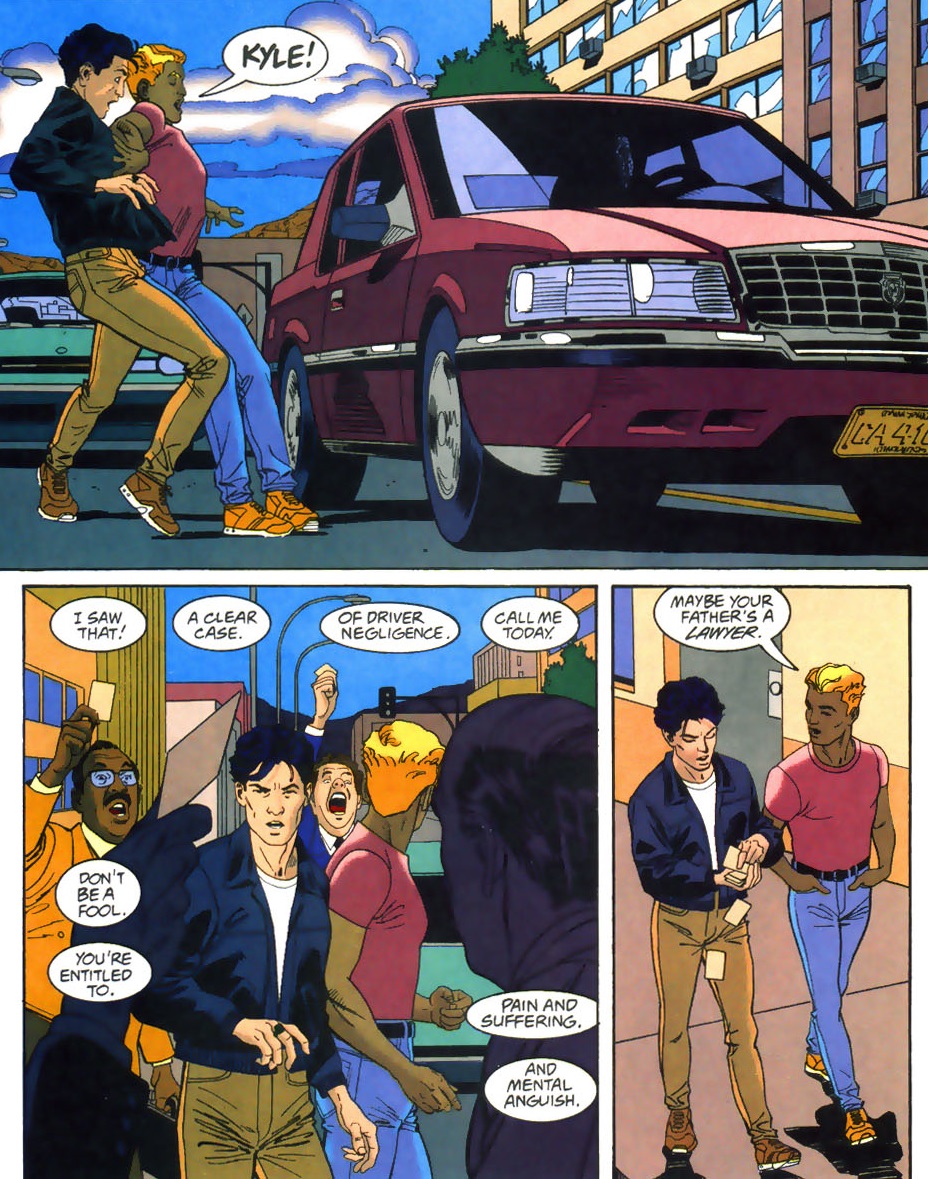
I’ll make a similar case for Chuck Dixon’s underrated forays into slapstick: it’s not that they were apolitical, it’s that the way they incorporated politics was often pretty funny. The most remarkable example is ‘Desolation Again’ (Green Arrow #110), in which the latest versions of Green Lantern and Green Arrow went looking for the former’s father in the town of Desolation, where their predecessors had fought for social justice in defense of exploited miners back in 1970 (in the classic Green Lantern #77, by Denny O’Neil and Neal Adams). The joke was that they now found an affluent Desolation, which had become ‘the lawsuit capital of America.’ As a local explained to them: ‘Lots of folks in town sued the mining company and got major cash rewards. Almost everybody in the county hit the litigation jackpot.’ Suing each other had thus become the basis of the local economy.
 Green Arrow (v2) #110
Mocking a culture of excessive litigation is typically associated with the Right – and there is definitely something provocative about doing it in a story that explicitly calls back to one of the most famous leftist runs in the history of comic books. Yet the caricature is so amusingly over-the-top that I can’t help laughing along!
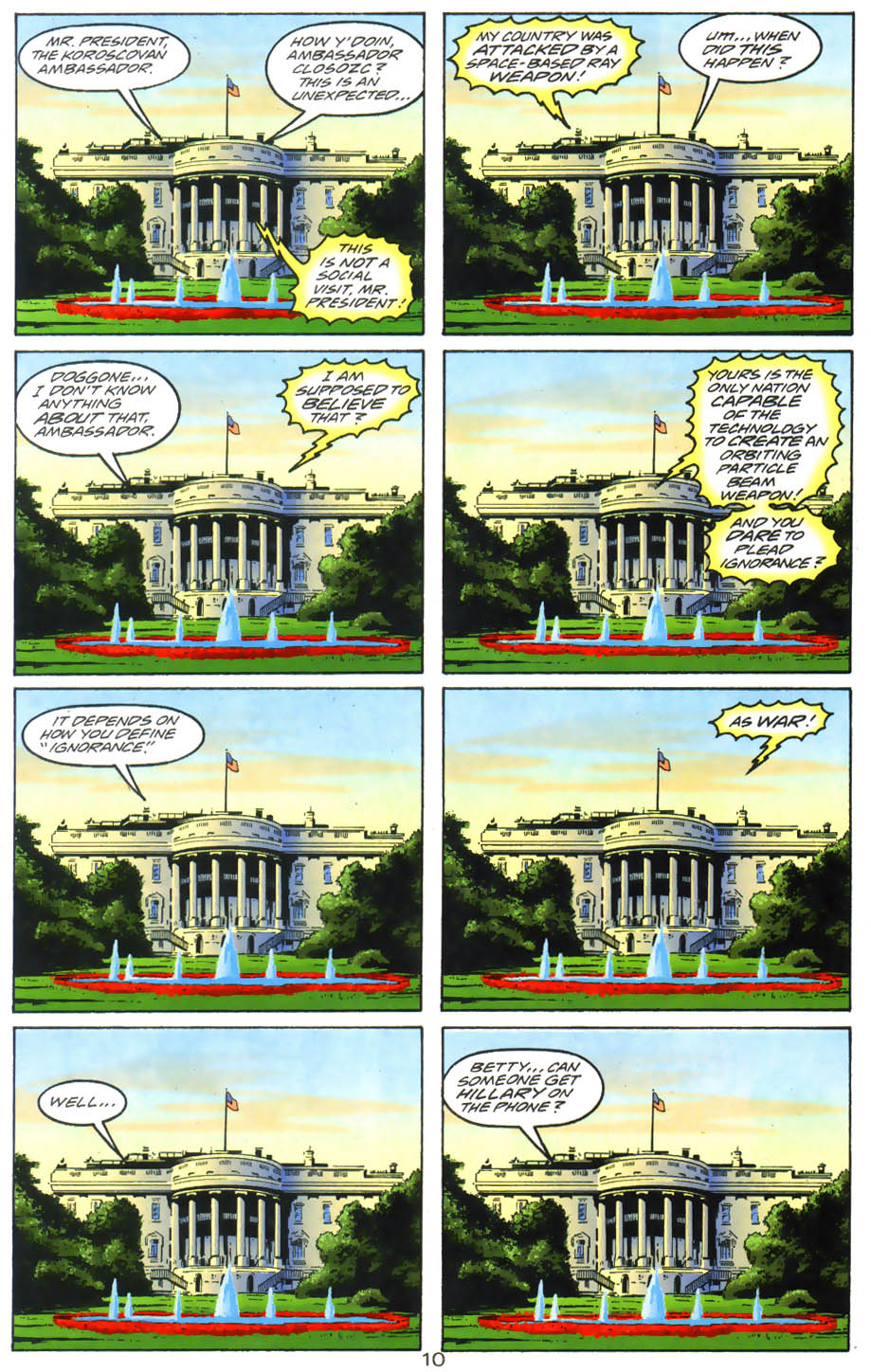
The same goes for several gags in Chuck Dixon’s more Batman-related work…
 Birds of Prey #10
(You can see why Dixon went on to write Simpsons comics!)
The one area where Chuck Dixon felt comfortable addressing politics more thoroughly was in the international arena – in part because his views in this field weren’t as out-of-step with the mainstream, and in part because there are so many fictitious countries in the DCU that you have a pretty wide leeway to play around. Most notably, Birds of Prey starred a globetrotting Black Canary who kept travelling to places with names like Markovia and Koroscova. There was even an arc set against the background of a Middle Eastern crisis (#15-17) which revisited an old storyline about the Joker being a former diplomat from Qurac (originally Iran).
Several of Dixon’s comics engaged with the fallout from the breakdown of the Soviet Union, going back to the 1993 mini-series Robin: Cry of the Huntress, which introduced Ariana Dzerchenko, a teen of Ukrainian descent who went on to become Tim Drake’s girlfriend. Her father owned a printshop in Little Odessa, Gotham’s Russian neighborhood, and was attacked by the Commissar, a mobster who wanted him to forge EU money before the original currency actually went into circulation!
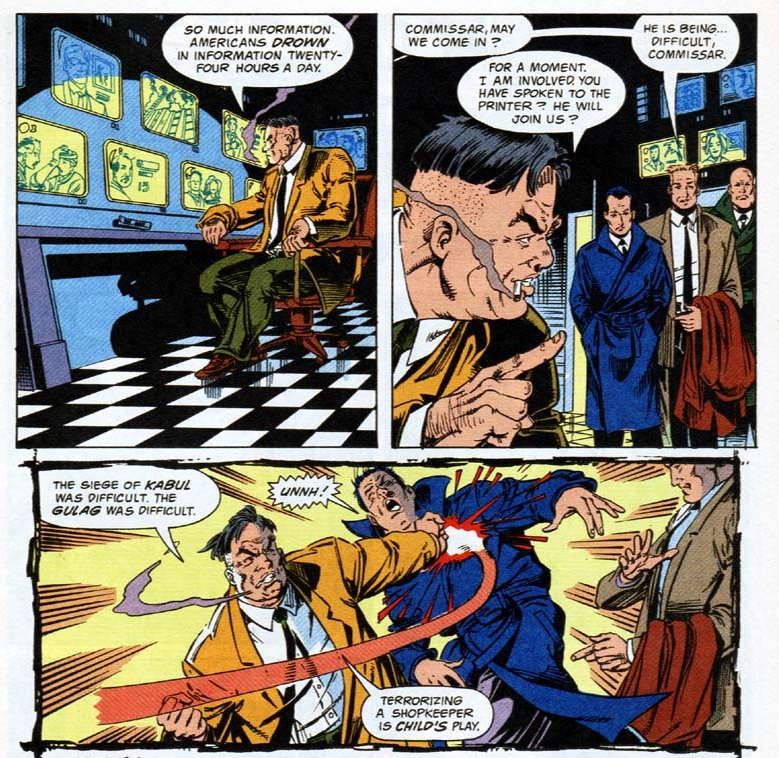 Robin (v3) #1
The Commissar was part of The Hammer – the USSR’s secret services branch that had created the master assassin KGBeast. The Hammer had gone criminal after the Soviet collapse and was now involved in heroin smuggling, gambling, extortion, and murder for hire.
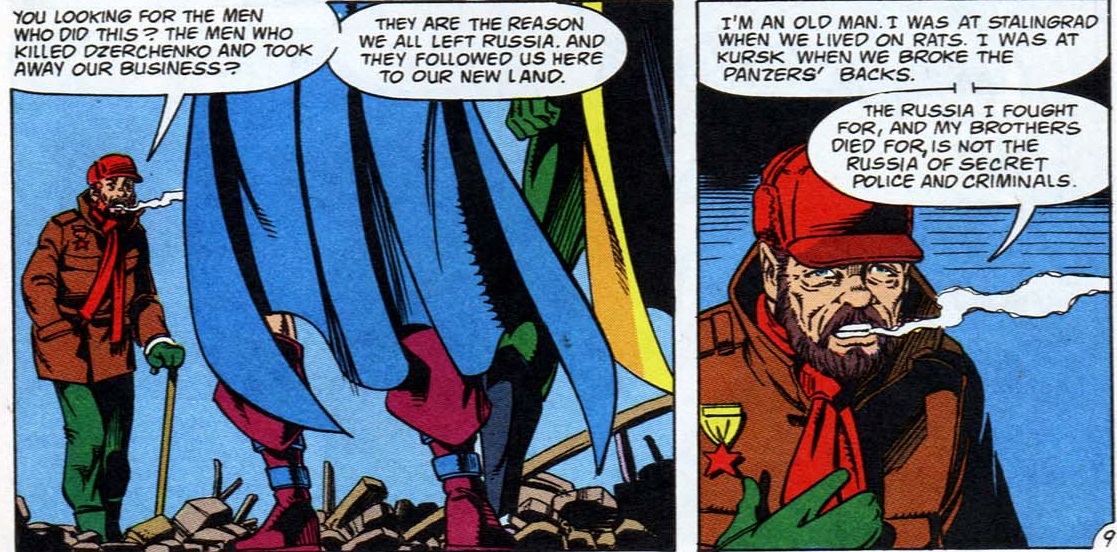 Robin (v3) #3
Indeed, Chuck Dixon’s comics typically displayed quite a cynical view of the messy post-Soviet transition – like in 1994, when he brought together a group of ex-communists-turned-criminals:

 Robin (v4) #12
This group went on to threaten Gotham City with a small nuke in the thrilling crossover ‘Troika’ (Batman #515, Shadow of the Bat #35, Detective Comics #682, Robin #14), half of which was written by Dixon. It turned out they all had different views on how to adapt (or not) to capitalism and ended up spending almost as much time double-crossing each other as fighting the Dynamic Duo!
Dixon often took his characters to the post-Soviet side of the world. For example, in the neat mini-series Birds of Prey: Manhunt, Black Canary chased an ex-KGB agent into a criminal hideout in Kazakhstan (also a setting in Bane: Conquest). On the pages of Catwoman, the titular thief was hired by the US government to steal the crown of Prinz Willem Augen Kapreallian, heir to the no longer existent throne of Transbelvia, ‘one of the micro-republics left over when the Soviet Union broke up.’ The Americans hoped to return the crown to the Transbelvian Cultural Ministry and secure at least one ally in the former Eastern Bloc, but, after many twists and turns, the prince captured Catwoman and tried to force her to marry him, culminating in a ceremony bursting with mayhem, as the bride, the groom, US spies, and Corsican mobsters all shot at each other (Catwoman #15-18). Later, Robin travelled to Transbelvia as well, trying to prevent a military conflict (Robin #50-52), and so did Black Canary, who found herself in the DC version of the Yugoslav Wars (Birds of Prey #18).
Some of these comics can get pretty grim (not unlike Dixon’s similarly themed The Punisher: River of Blood), but you can also find in them Dixon’s acerbic wit. In particular, he got a fair bit of mileage out the playful clash of cultures and ideologies…
 Robin (v3) #3
Chuck Dixon’s grounded Batman
Chuck Dixon has written hundreds of Batman comics. On top of his lengthy run in Detective Comics (1992-1999), he penned his fair share of Catwoman and Legends of the Dark Knight issues, having also pioneered the ongoing series Robin and Nightwing, as well as the most awesome Batman spin-off from the ‘90s, Birds of Prey. Dixon created fan-favorite characters like Spoiler and Bane. Plus, he did a ton of fill-ins, specials, and mini-series, including the knockout crime yarns GCPD, Gordon’s Law, and Blackgate. Between this and his stint on Green Arrow (which often shared characters and plotlines with the Bat-titles), it was not uncommon for Dixon to have half-a-dozen Batman-related comics out each month for much of the ‘90s. He went on to relaunch Batman and the Outsiders in 2007 and, after a hiatus, recently returned to DC with the limited series Bane: Conquest.
Despite this impressive track-record and a loyal fanbase, Chuck Dixon doesn’t usually make the cut in debates about the best Batman writers. In part, I suspect his work isn’t more acclaimed because it’s not as show-offy as Frank Miller’s or Grant Morrison’s – Dixon is more of a gun-for-hire who prefers no-fuss storytelling rather than trying to reinvent the wheel (Howard Hawks, Leigh Brackett, David Mamet, and Donald E. Westlake are obvious influences). This approach may strike some as lacking ambition, but I think it’s an art in itself: Dixon has a talent for figuring out each franchise’s primordial appeal and delivering it in spades, perfecting the formula to maximum effect. As far as 1990s’ Batman comics go, if Alan Grant’s issues were punk and Doug Moench’s were heavy metal, then Chuck Dixon’s were reliable pop-rock hits with catchy guitar riffs.
Dixon’s attitude harkens back to his proud pulp background, having honed his craft in the 1980s with straight-up adventure titles like Airboy, Evangeline, Winter World, and Savage Sword of Conan.
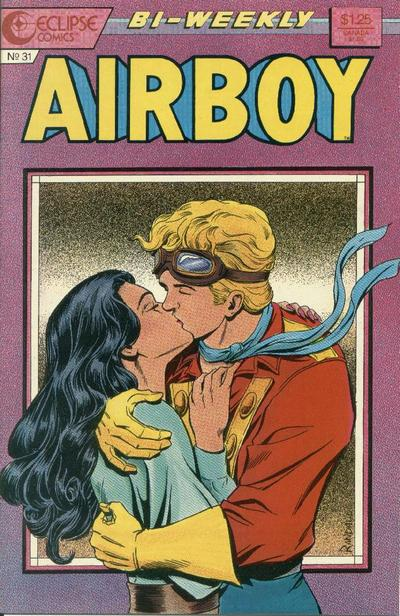
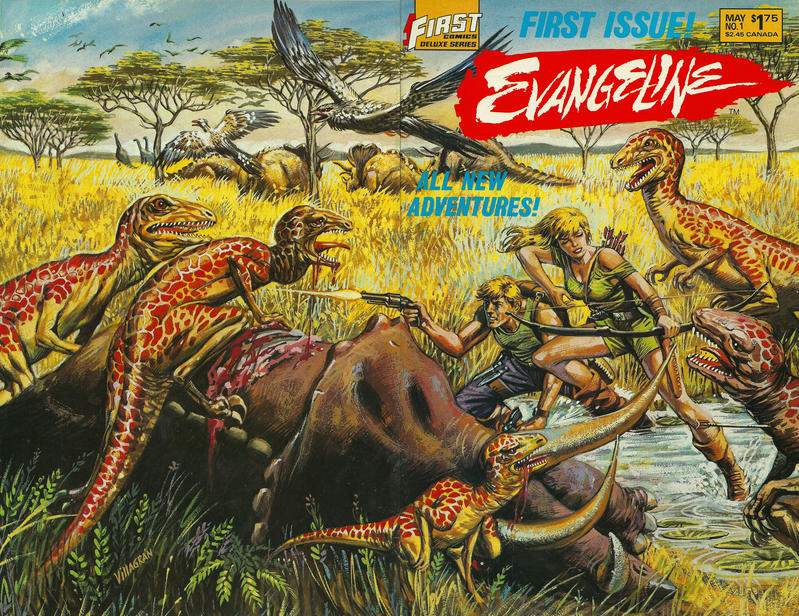
So, when I describe Chuck Dixon’s Batman comics as ‘grounded,’ I don’t mean to say they’re bland or hackneyed. In fact, he rarely phones it in: even a gig that could’ve been mere a cash-in, like Batman versus Predator III: Blood Ties, turns out to be highly entertaining (in contrast to Doug Moench’s and Paul Gulacy’s godawful Batman versus Predator II: Bloodmatch, which was an insipid mercenary work lamely padded to fill the page count). What I mean is that Dixon’s comics tend to be anchored in fleshed-out characterization and cohesive world-building – although his stories aren’t exactly ‘realistic,’ they operate through very recognizable rules and follow a solid internal logic.
But let’s start at the beginning. Understandably impressed with Chuck Dixon’s hardboiled scripts for The Punisher, in 1990 editor Denny O’Neil hired him to write the first solo Robin mini-series, with art by Tom Lyle (who had already worked with Dixon on Airboy and Strike!). The duo fit into the Dark Knight’s corner of the DC Universe like a glove, spitting out solid thrillers that were unapologetically escapist yet did not condescend to the readers. Soon, Dixon and Lyle took over Detective Comics and their efforts together come very damn close to my platonic ideal of Batman stories. In a move that’s not as obvious as it may seem, Dixon – who went on to helm Detective Comics for years (mostly in collaboration with artist Graham Nolan) – made sure to justify the series’ title by featuring plenty of detective work. Fortunately, the man can spin a mystery and churn out a damn compelling investigation.

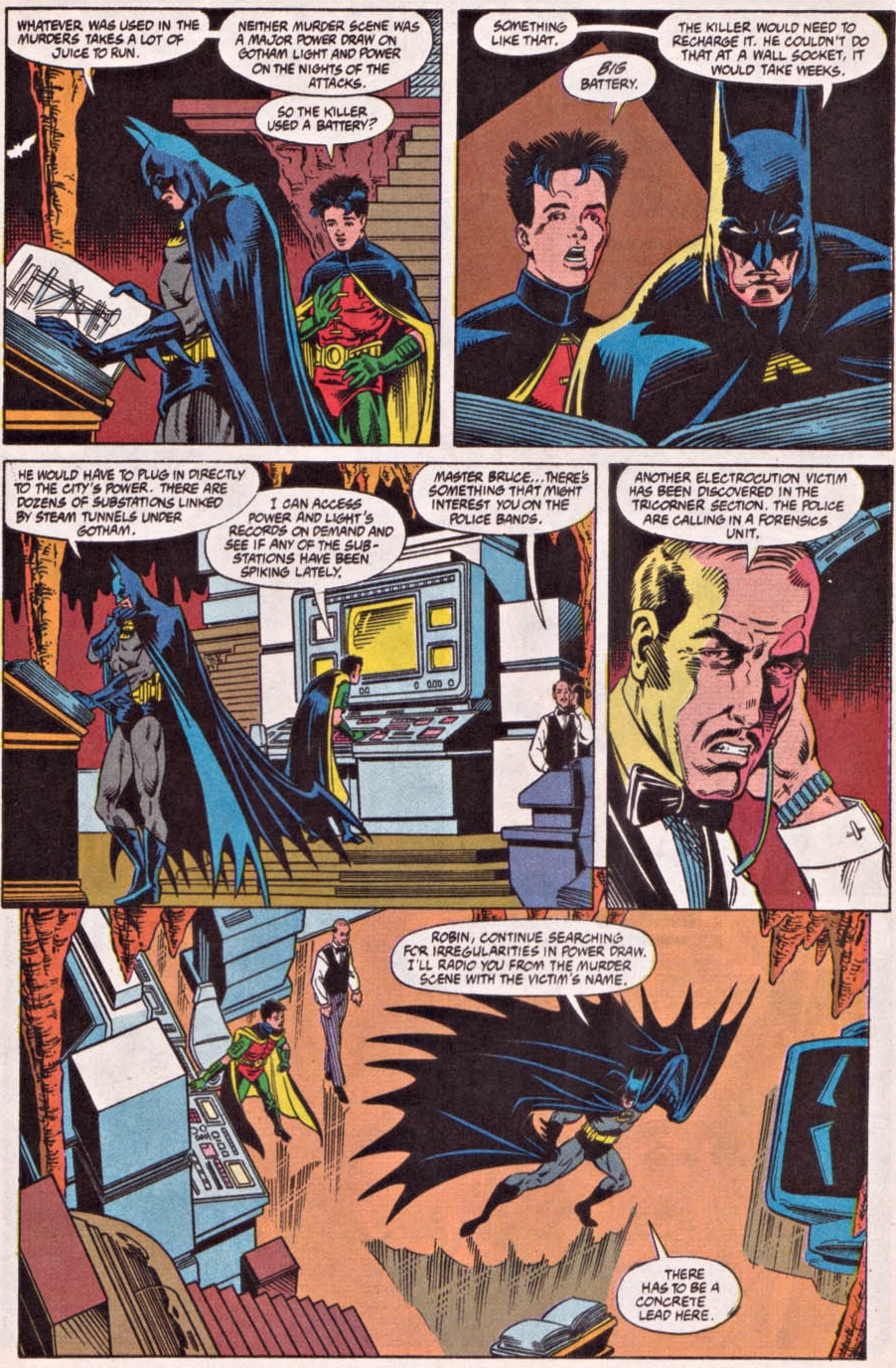 Detective Comics #644
The Dynamic Duo wasn’t the only one doing the detecting… Chuck Dixon devoted a lot of space to the GCPD, developing several of its officers. The result really felt like a detective book. For example, in ‘Shifting Ground’ (Detective Comics #721), set during the Cataclysm crossover, Dixon had three separate groups of characters investigating the identity of Quakemaster – the villain holding the city for ransom – and each was able to track him down through different processes of deduction (the disparate strands then came together in Robin #53). Other cool mystery tales included the classic ‘A Bullet for Bullock’ (Detective Comics #651) as well as ‘The Forgotten Dead’ (Nightwing #24) and ‘The Obtuse Conundrum’ (Robin #81).
Indeed, Dixon often made a point of challenging the heroes’ intellect. A central aspect of his version of Bane was precisely the fact that this villain should be a match for Batman on every level, including his brilliance. In Bane of the Demon, he commits an ancient text to memory eidetically. In Bane: Conquest, the two characters temporarily join forces and are able to plot an escape underneath their captors’ noses by constantly switching languages (including Portuguese, Dhari, and Latin).
It wasn’t all cerebral games, either. A consciously visual storyteller, Chuck Dixon usually scripts thrillers with clear geography and relentless forward momentum. In particular, he tends to write tense, claustrophobic set pieces revolving around people trapped in confined spaces. Also helping with the fast pace is his knack for snappy dialogue:
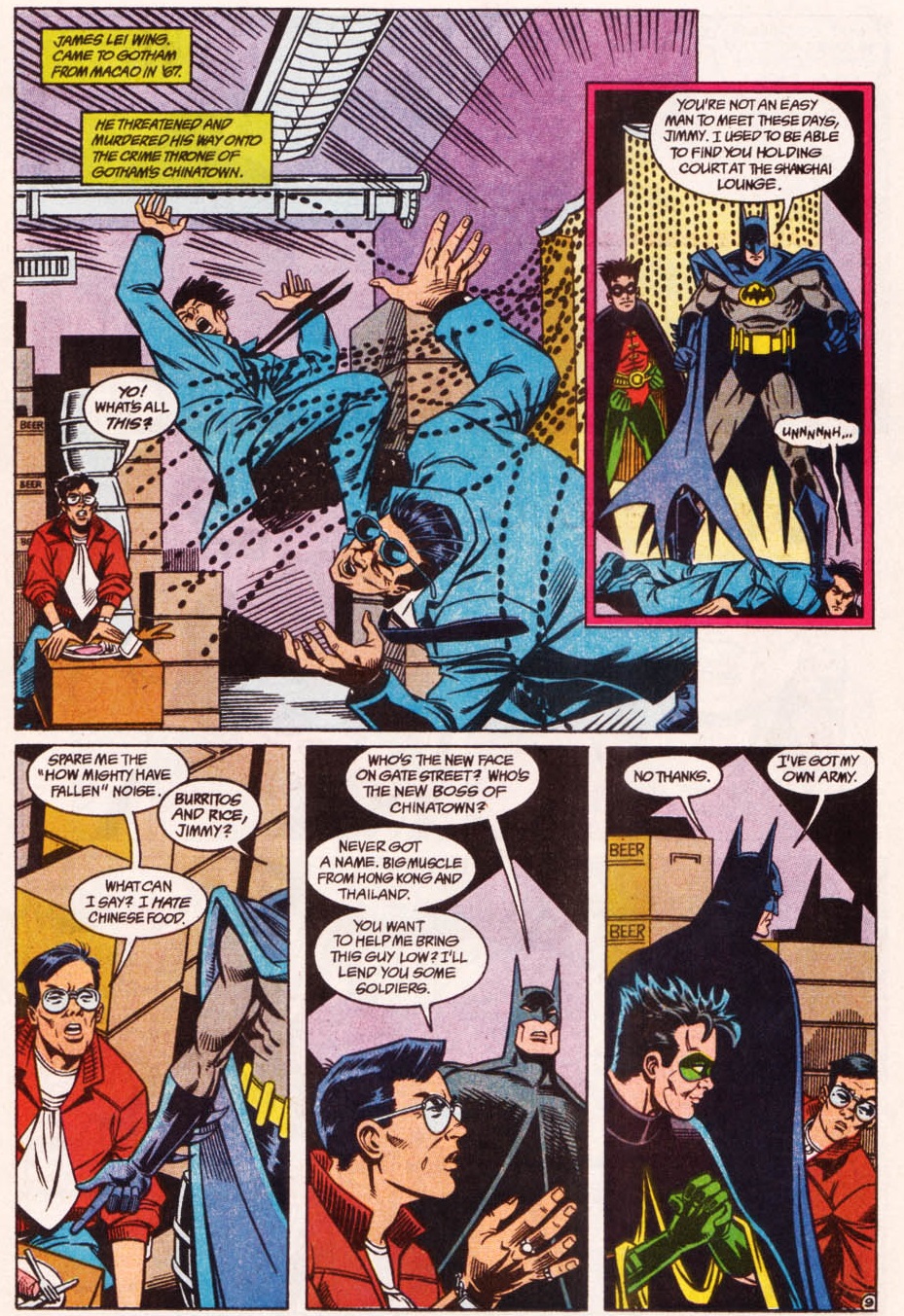 Batman #467
We are very far from the kind of superhero deconstructionism that tears the genre apart by exposing its inconsistencies and uglier subtext. Chuck Dixon seems more interested in imagining how it could work, integrating pseudo-realistic elements – like the street-level perspectives of the police and small-scale criminals – without going too far in terms of breaking the required suspension of disbelief.
For a particularly fun way to go about it, check out the issue he did with the price tags for the Dynamic Duo’s various expenses…
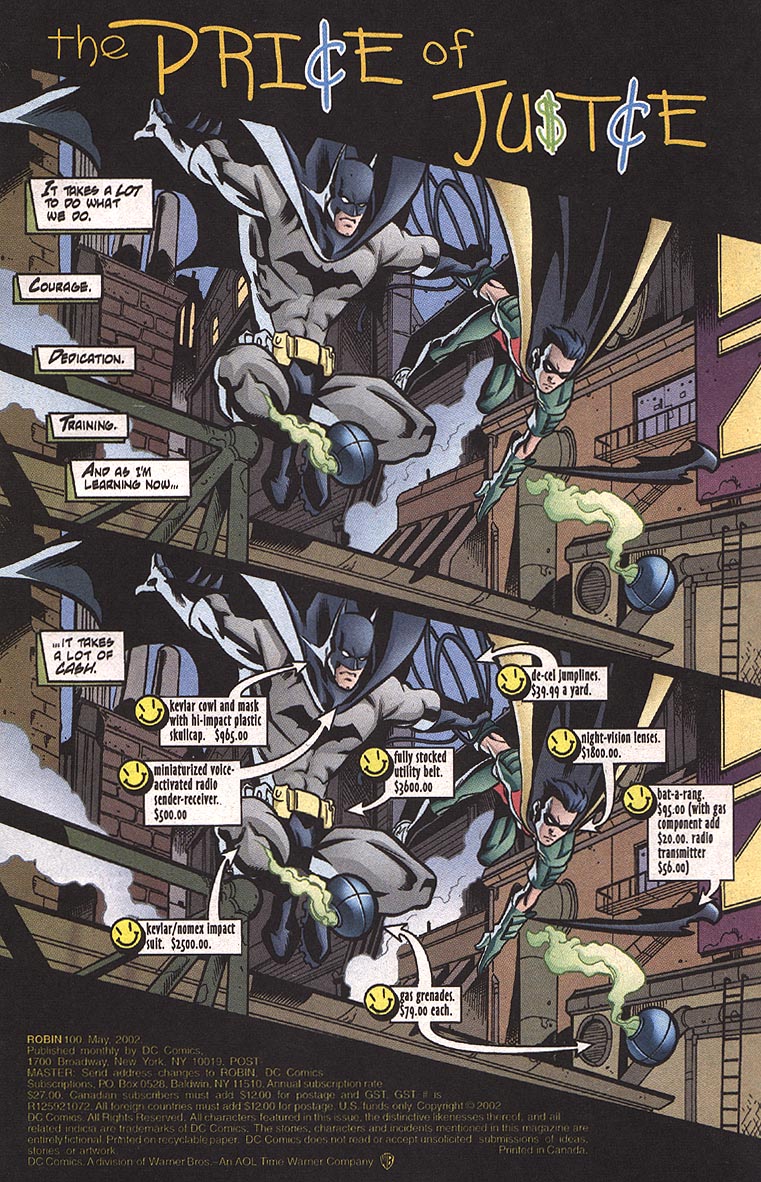 Robin (v4) #100
What brings it all together, though, is Dixon’s way with characters. He always made sure to get a firm take on what made each cast member tick. Check out how, in this career interview, he efficiently synthesized his understanding of the Caped Crusader and the Punisher: ‘Batman is the zealot driven by childhood trauma. Thus, a costume and all the toys and the sense of the romantic. He also has a code of fair play and strict rules of engagement. Punisher was traumatized as an adult, so he becomes an exterminating son-of-a-bitch using any weapon that will get the job done. He recognizes no rules.’
Besides getting to the heart of characters, Dixon is a master at organically conveying that heart to the readers, whether it’s through actions or through poignant intimate moments. Take the story he did for Batman Chronicles #1 about a gang hijacking a train with James Gordon inside. It was a taut little yarn, but behind its apparent simplicity we gained access to Jim’s thoughts about how it felt to be out of the police force (he had temporarily quit at the time), about his doubts over trusting Batman (this was after Knightfall), and about how the Huntress reminded him of his daughter (Batgirl). Those eighteen pages turned out to be a touching, well-executed piece of characterization. Similarly, back in 1999 Dixon did three memorable issues that may seem like little more than Nightwing bonding with Robin (Nightwing #25), Oracle (Birds of Prey #8), and Batman (Detective Comics #725) but are misleadingly superb, drawing on the characters’ shared history and wonderfully nailing each of their personalities. (Robin #67, in which Nightwing and Robin travelled together to No Man’s Land’s Gotham City, was also an excellent character study about their brotherly relationship.)
Bear in mind that that I’m not just talking about your usual macho voices. Robin was a series about adolescence, oozing with self-doubt and a healthy dose of lighthearted humor. Most of Birds of Prey’s main characters (heroes and villains) were women. Dixon also sought to establish a neat friendship between Stephanie Brown and Cassandra Cain (they first met in Robin #88 and later developed their relationship in Batgirl #20). Hell, one of the strongest candidates for Dixon’s most enjoyable book ever, Batgirl: Year One (co-written with Scott Beatty), closely followed the point-of-view of a young Barbara Gordon…
 Batgirl: Year One #1
In terms of characterization, one of the few missteps I can think of is when Alfred left – in the aftermath of Knightfall – and Bruce Wayne proved utterly inept at household chores, screwing up everything, from making a tuna sandwich to doing the laundry (come on, he’s Batman, if anything he would’ve overcompensated by approaching each task with too much zeal!). Overall, though, hardly a note ever rang false in Chuck Dixon’s stories.
The other aspect that makes these comics ‘grounded’ is their tight cross-continuity. As a fanboy, Dixon clearly has a blast with this stuff. There are all sorts of interconnections, even when they don’t call attention to themselves (like the overlap between the Dynamic Duo’s cases in Detective Comics #683 and Robin #15, or the subplot from Robin #93-94 that gets resolved in Birds of Prey #40, or the guest-appearances by Blue Beetle in Nightwing #63, Robin #96, and Birds of Prey #37, all of which dealing with the fallout of Dixon’s Joker: Last Laugh crossover).
I especially like how this moment from the mini-series Robin: Year One (about Dick Grayson’s debut as Robin)…
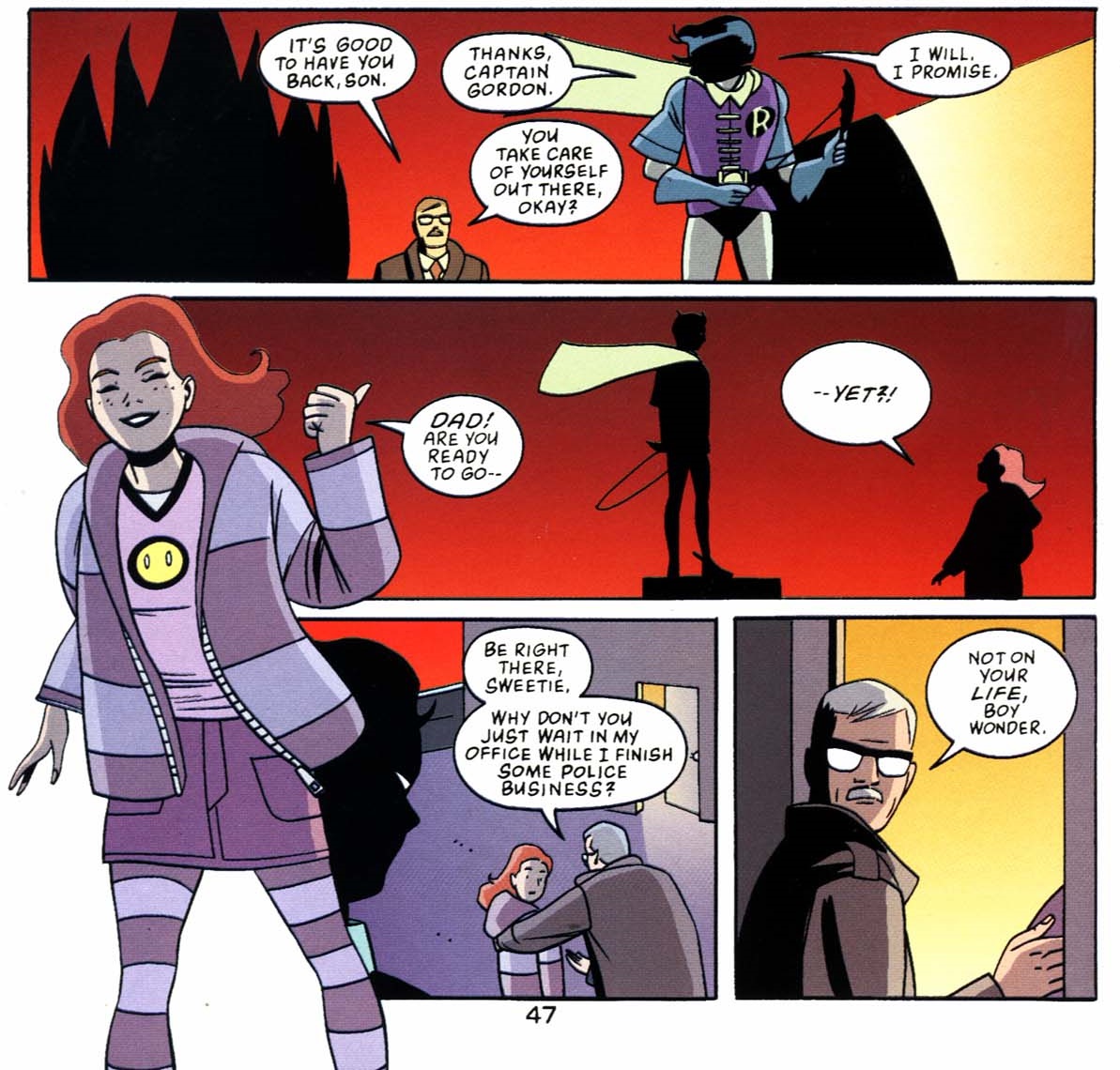 Robin: Year One #4
…was riffed on years later, in the story arc ‘Nightwing: Year One’ (about Dick Grayson’s debut as Nightwing):
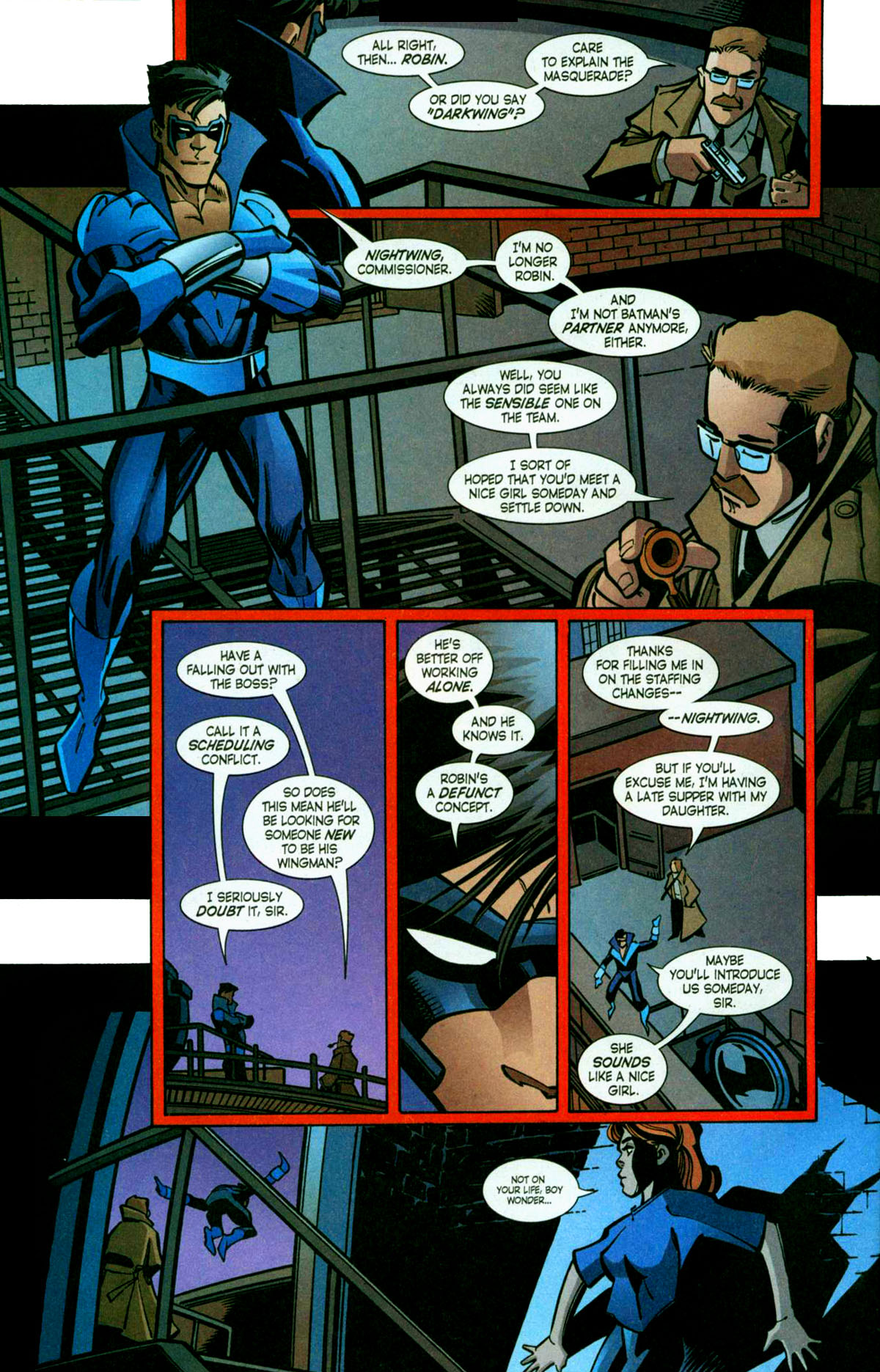 Nightwing #104
Chuck Dixon went out of his way to develop a discernible geography for Gotham City and its surroundings (Tricorner Island, the fancy Gotham Heights neighborhood, the chaotic nearby town of Blüdhaven…), repeatedly visiting places like the striptease joint Stripping Post (Batgirl: Year One #5, Nightwing #65 and #104…). There were also recurring brands (some created by him, some borrowed from other DC comics), including the Irish fast food chain O’Shaughnessy’s (which shows up, for example, in Robin #20, Batman Annual #23, Nightwing #10, and Green Arrow #110) as well as the soda drink Zesti Cola (Detective Comics #645-646, Catwoman #19, Robin #61, and Joker: Devil’s Advocate, among many others).
In the case of Zesti Cola, it became more than a generic ersatz-brand – Dixon made it pay off with a couple of entertaining storylines exploring the company behind the drink, in the Psyba-Rats mini-series and the Birds of Prey: Revolution one-shot. Likewise, after gradually establishing the children’s franchise Crocky the Crocodile (Detective Comics #668 and #682, 1996’s Man-Bat mini-series…), Dixon made it the main focus of Robin #42.
The more you read, the more you felt like you understood this world. You knew that Zesti and Soder Cola were popular drinks and you got used to thinking of Curtains as the DCU’s version of Windows. You were thus able to share the characters’ specific pop culture references, like in this scene where Nightwing and Oracle travel to the future:

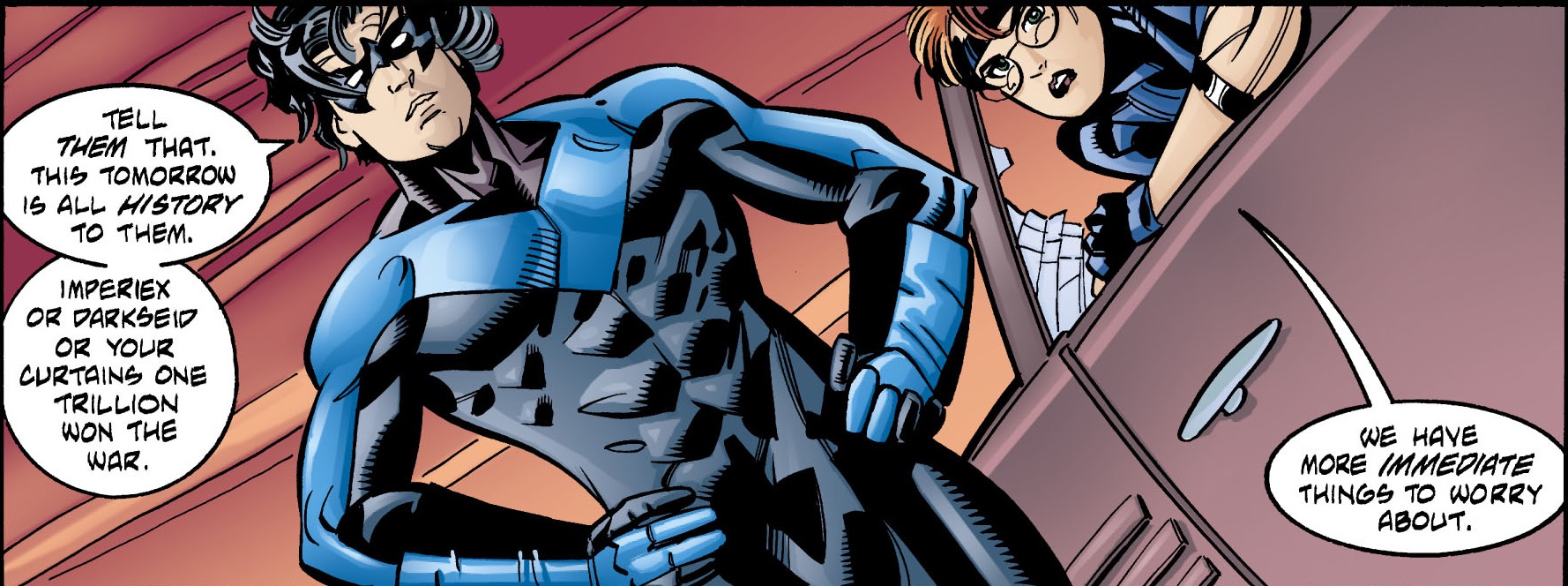 Nightwing: Our Worlds at War
This is exactly the kind of approach that appeals to me. These comics were populated by tons of people whose names and histories became familiar, giving the impression that they continued to live their own personal sagas between appearances, on the sidelines of the Dark Knight’s adventures.
Remarkably, a whole range of small-time players kept showing up again and again throughout the years, like the crooked informant Jimmy Wing…
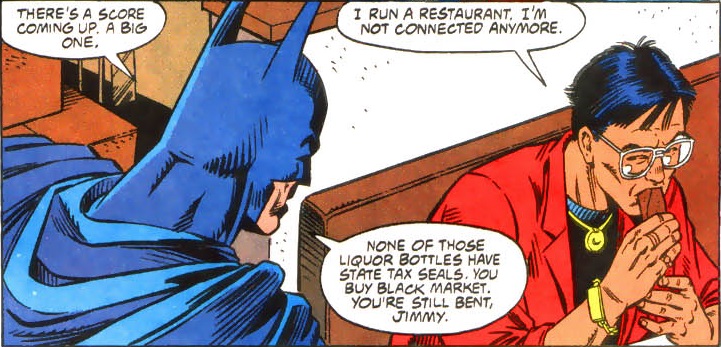 Detective Comics #648
…or Homicide detectives Moses and Murphy, whose banter was always a feast of gallows humor…
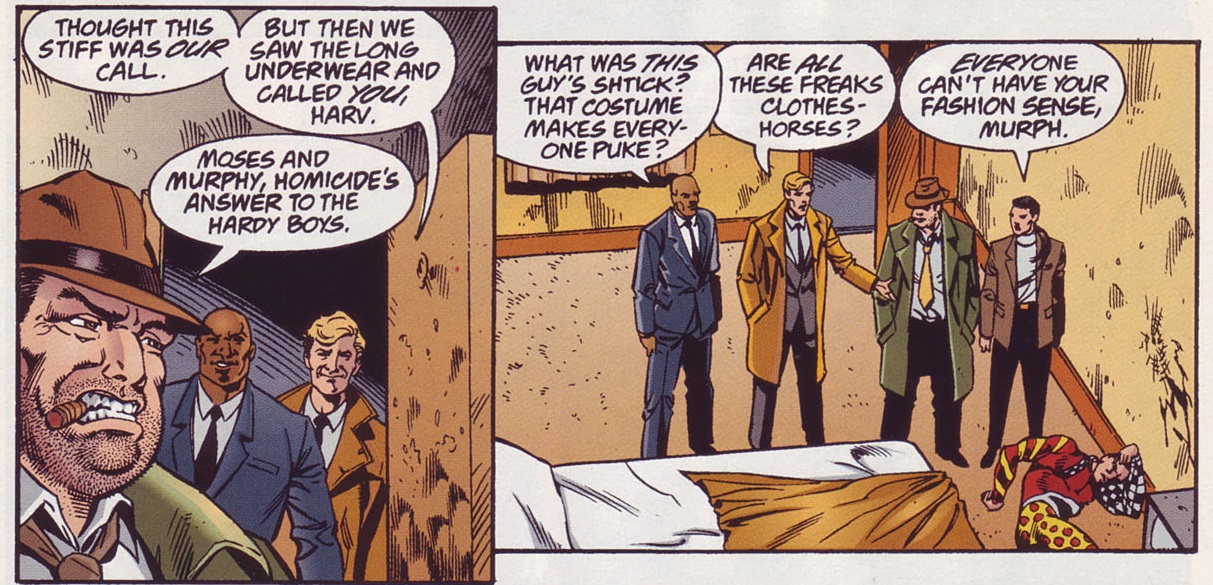 Detective Comics #691
…or the Arkham Asylum psychologist Simpson Flanders (yep), who started out as a mean-spirited satire of liberal pop psychology (albeit an amusing one since almost by definition Arkham inmates are an unredeemable murderous lot) reminiscent of Doctor Bartholomew Wolper in The Dark Knight Returns.
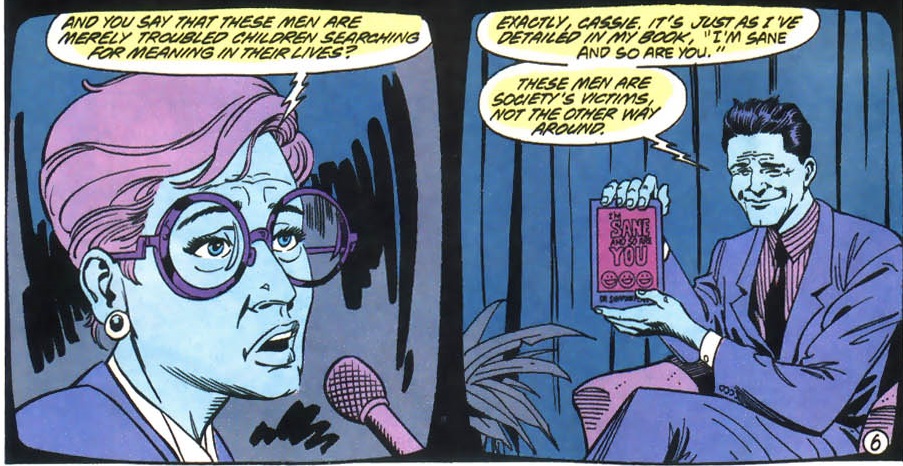 Detective Comics #662
(In line with this joke, Flanders kept being viciously abused by different villains, until he was eventually eaten by Killer Croc!)
As you can tell by these last examples, Dixon’s comics were not devoid of a certain iconoclastic sense of humor. I will talk more about that next week.
COMICS CAN BE AWESOME (November 2019)
Your monthly reminder that comics can be awesome…
 Bloodshot Reborn #14
 Astro City: The Dark Age – book four #1
 Superman/Batman #69
Brilliant horror short stories
In theory, horror shouldn’t be an easy fit for stories of ten pages or less. For a narrative to be truly scary or disturbing, the stakes should be painstakingly set up, the atmosphere should breathe, the fearful anticipation should be allowed to build up, and each shock should be earned.
In practice, comic books perfected this type of short story several decades ago, with horror anthologies becoming a staple of the medium…
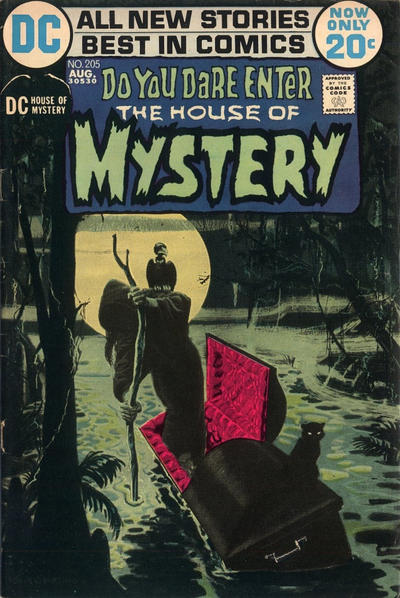
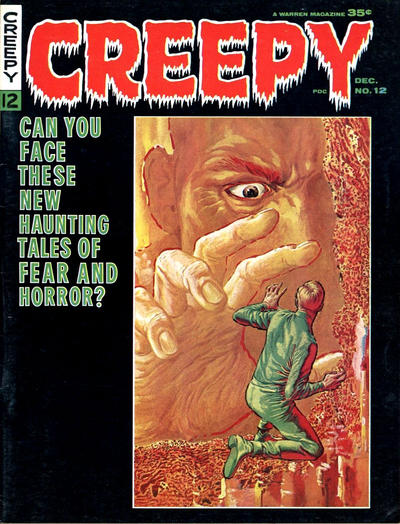
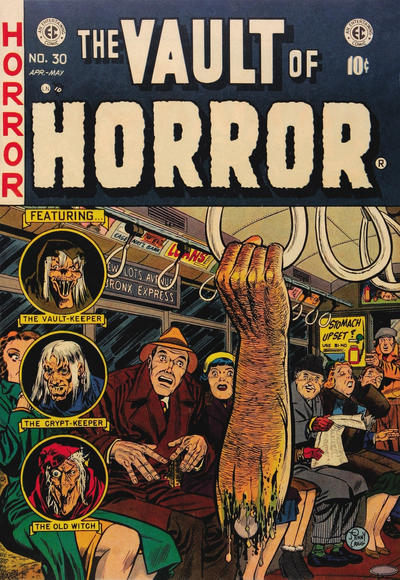
For this Halloween, here are ten tales that brilliantly assault readers with striking images while using text to stretch out the tension as much as possible:
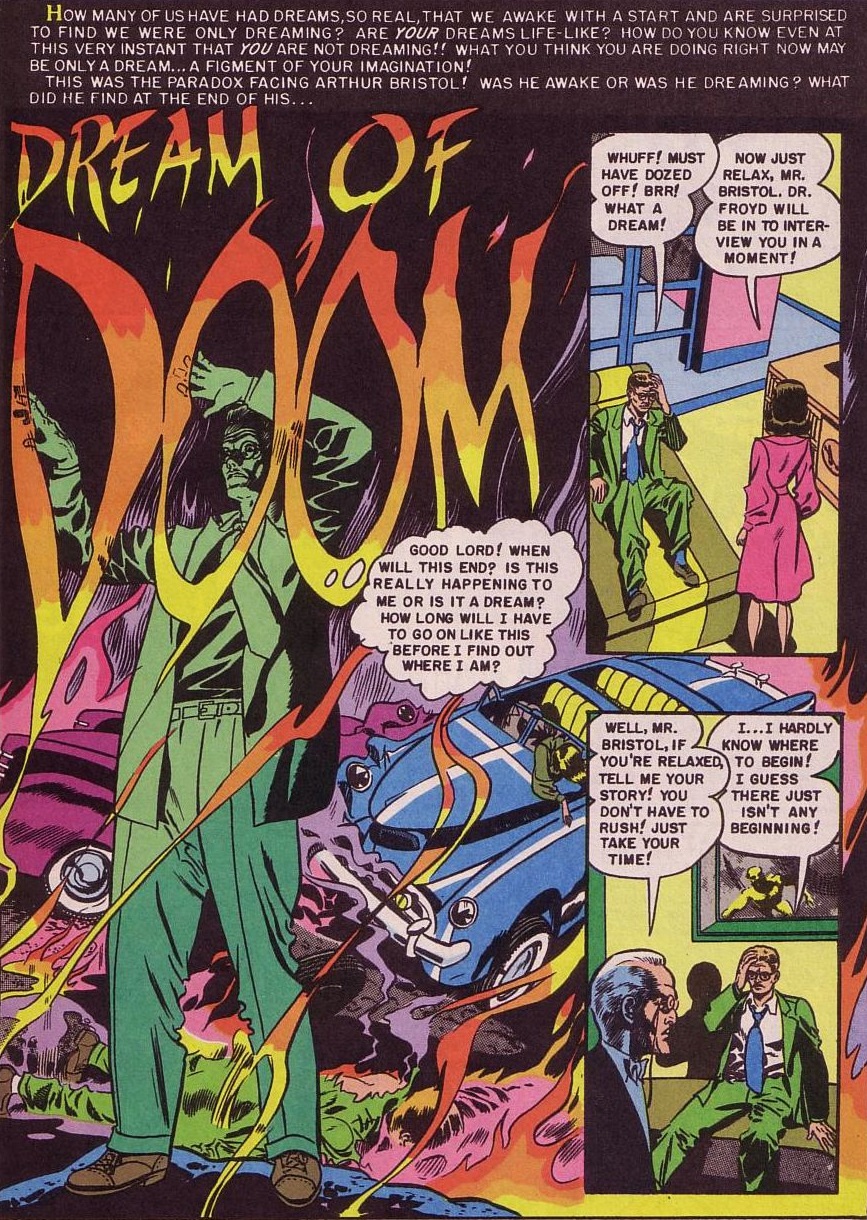
‘Dream of Doom’ (originally published in Weird Science #12, cover-dated May-June 1950), by Harry Harrison (script, pencils), Wally Wood (inks), Marie Severin (colors), and Jim Wroten (letters)
I’ll try not to overuse the adjective ‘nightmarish’ but in this case it fits like a glove. ‘Dream of Doom’ plays with a recognizably eerie sensation as it follows Arthur Bristol, an artist who is never quite sure whether he is dreaming or awake. We share his anxiety, as he is constantly jerked into new realities (including a meeting at a clear stand-in for the EC offices – one of several in-jokes in the story). Adding to the unsettling mood, the art is full of surreal, disconcerting touches, like the panel where the protagonist’s face is drowned by phantasmagorical phone ringing or the mise en abyme moment when a character holds a comic book page that looks like the one we are holding ourselves… Even Jim Wrotten, whose lettering tended towards bland typeset fonts, gets in on the act by conveying some inspired moments of shouting.
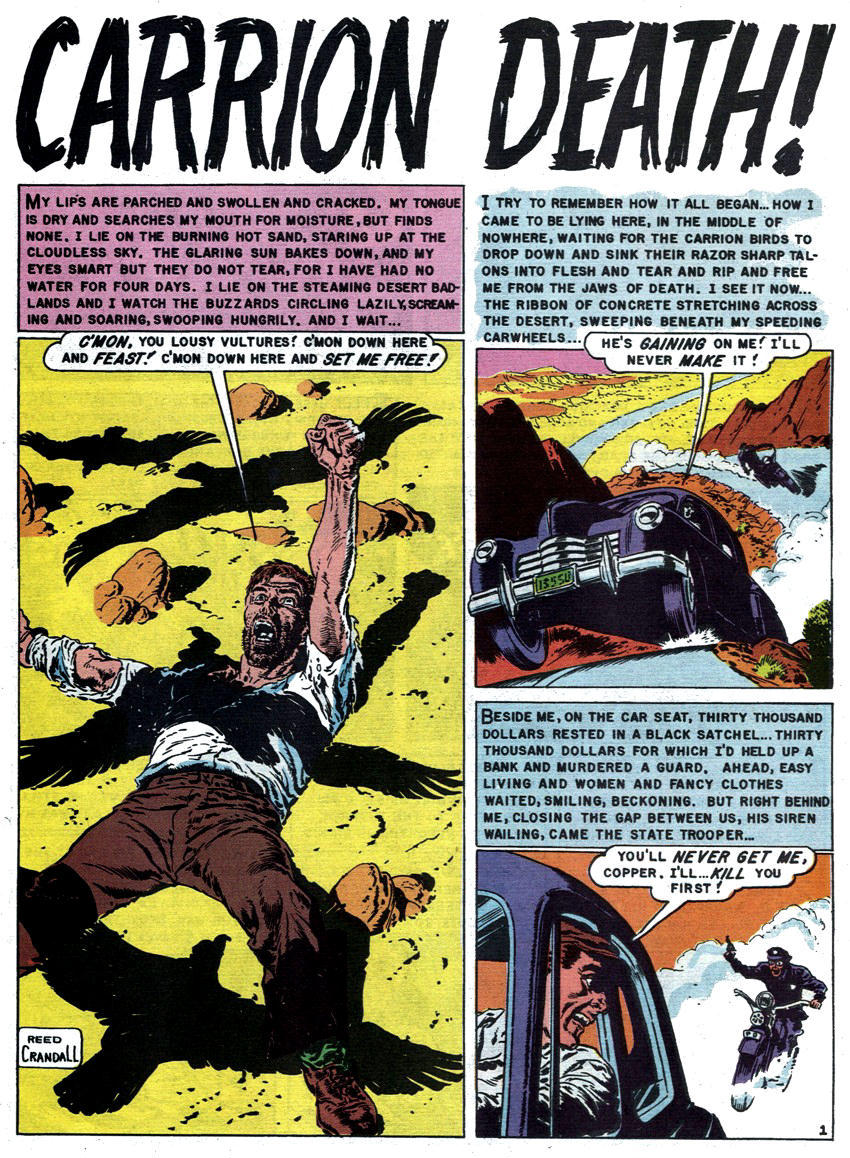
‘Carrion Death!’ (originally published in Shock SuspenStories #9, cover-dated June-July 1953), by Bill Gaines, Al Feldstein (plot), Al Feldstein (script), Reed Crandall (art), Marie Severin (colors), and Jim Wroten (letters)
Reed Crandall’s first story for EC Comics is a brutal, gruesome affair, even by today’s standards. With a tinge of noir, ‘Carrion Death!’ follows a crook on the lamb for whom things just keep on getting worse. The comic spirals through various kinds of violence, from a car crash to a strangling, from corpse mutilation to starvation, from the aggressive heat of the sun to the threat of flesh-eating vultures… Crandall’s meticulous attention to detail makes the whole thing look unbearably realistic, so that your face reading it probably mirrors the protagonist’s own panicked expression. To top it all off, Marie Severin’s colors conjure up the desert’s bleak aridness and shifting temperatures while Al Feldstein’s narration is almost poetically macabre.
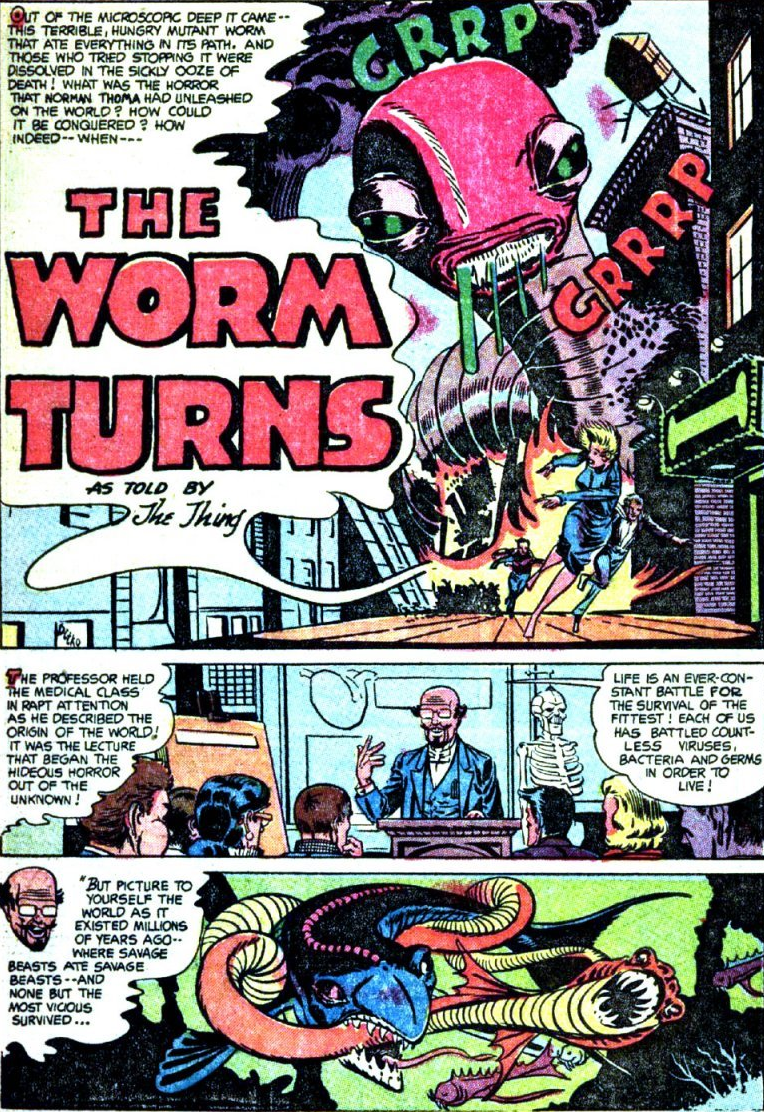
‘The Worm Turns’ (originally published in The Thing #15, cover-dated July-August 1954), by Steve Dikto (art) and Charlotte Jetter (letters)
I don’t know who wrote this beauty, but it was clearly someone in tune with the 1950s’ wave of sci-fi horror, where giant, destructive creatures and scientific experiments gone awry acted out the worst fears of the early atomic era (although the idea of a mad doctor playing god goes back to Frankenstein, name-checked halfway through). ‘The Worm Turns’ is full of sick moments and a shockingly expanding body count, culminating in a resolution that somehow feels both hopeful and frightening. Yet the big draw is a young Steve Ditko’s artwork: not only does Ditko make the protagonist look truly menacing and twisted, but his rendition of the genocidal worm’s callous eyes, drooling mouth, and tubular, starkly inhuman body almost makes one afraid of even touching the drawings on the page…
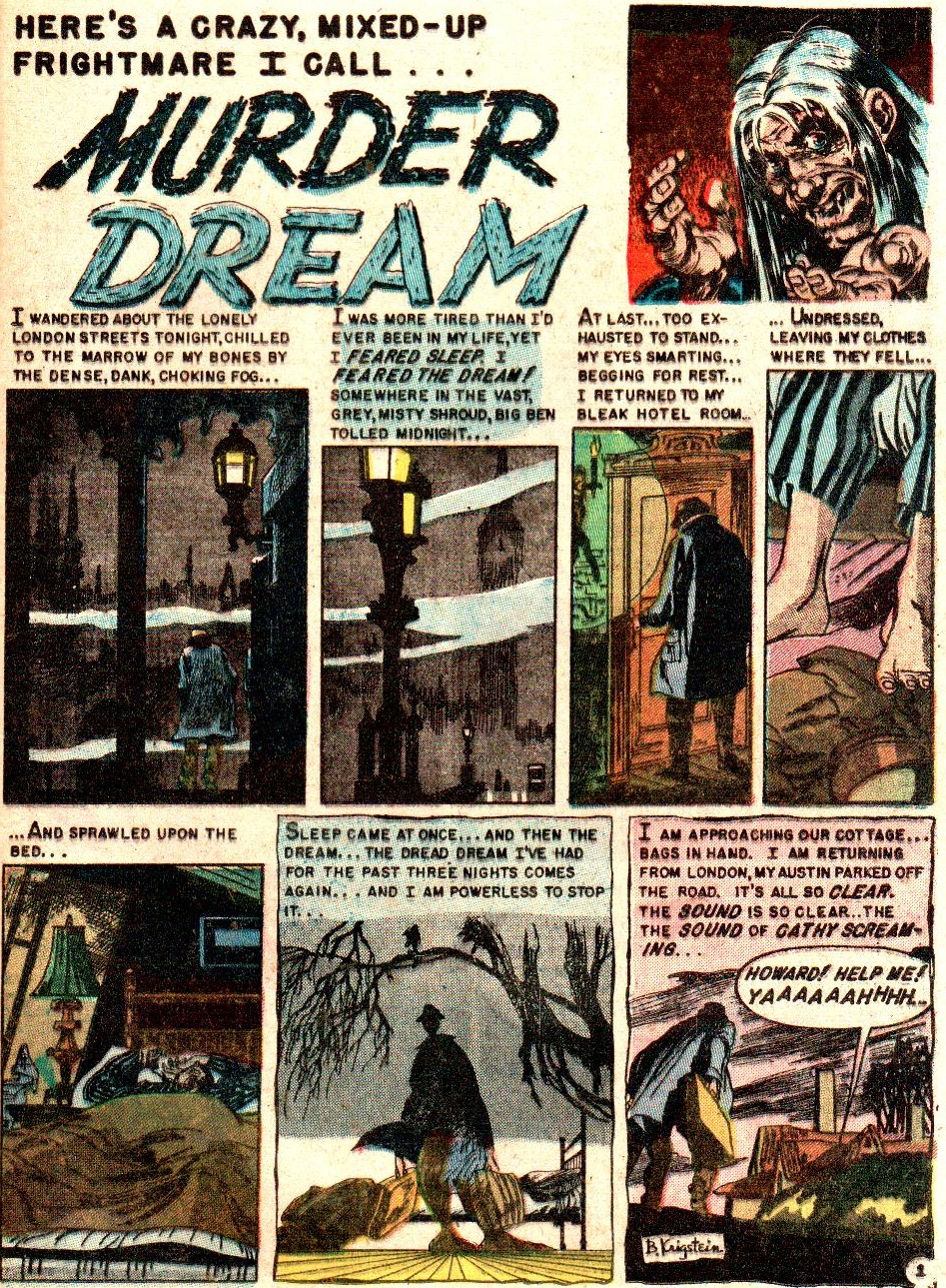
‘Murder Dream’ (originally published in Tales from the Crypt #45, cover-dated December 1954-January 1955), by Carl Wessler (script), Bernie Kriegstein (art), Marie Severin (colors), and Jim Wroten (letters)
This stream-of-consciousness narrative about a man plagued with nightmares about the apparent murder of his wife is an effective vehicle for Bernie Kriegstein to indulge in the kind of aesthetic experimentation he often sought, breaking loose in hallucinatory, deliberately disorienting Freudian dream sequences. You may find the ending a cheat or a superb twist, but in any case you’re bound to be struck by the last panel’s cruel, horrifying rawness.
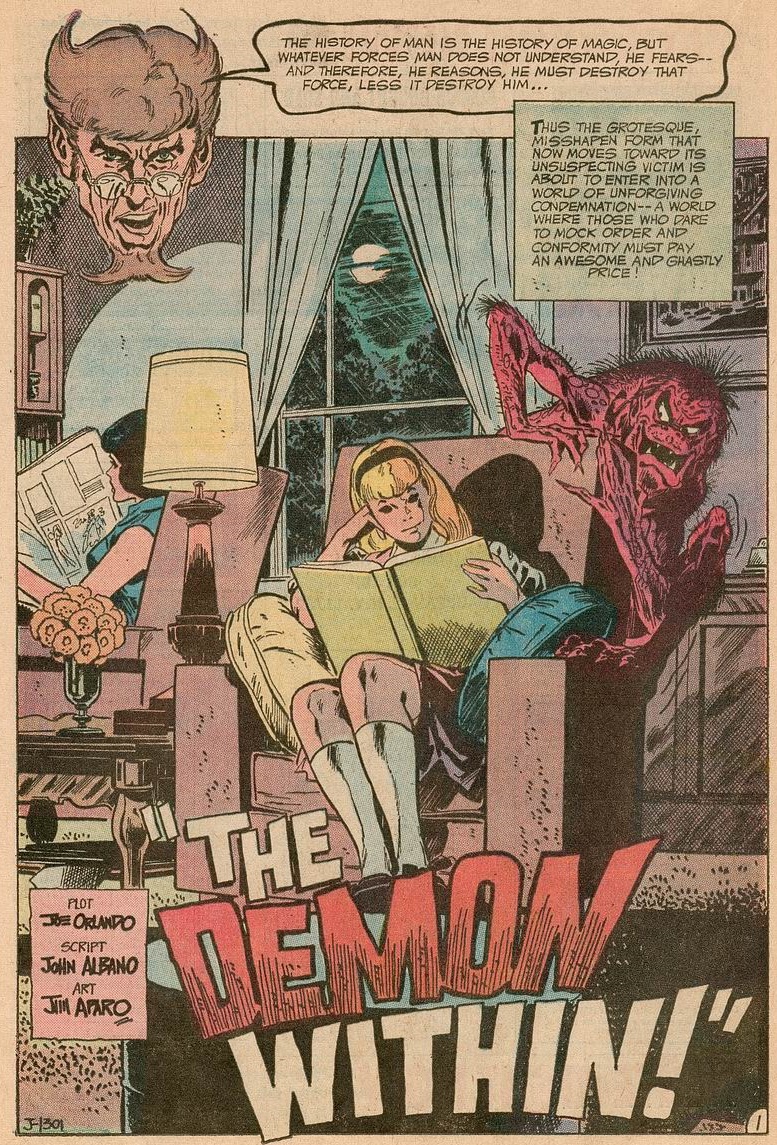
‘The Demon Within!’ (originally published in House of Mystery #201, cover-dated April 1972), by Joe Orlando (plot), John Albano (script), and Jim Aparo (art, letters)
Probably the most acclaimed comic on the list, this tale about a little boy who can turn into a scary monster at will won the Shazam Award for Best Individual Short Story and has been reprinted a number of times. The impact of ‘The Demon Within!’ derives from its Twilight Zone-ish sleight of hand – rather than the monster, the most terrifying force ends up being society itself… What truly scares the boy’s nuclear family is their possible loss of respectability and public standing in the community. Add to this Jim Aparo’s naturalistic depiction of suburbia, coupled with his signature tilted art and letters. Suitably, the creepiest images don’t even feature the monster – like the one with the doctor washing his hands before surgery at the Caufield hospital (a name reminiscent of Holden Caulfield, reinforcing the themes of loss of childhood innocence and repression of irreverence), not to mention the unforgettable final panel (a resolution that disturbingly evokes current parental strategies).
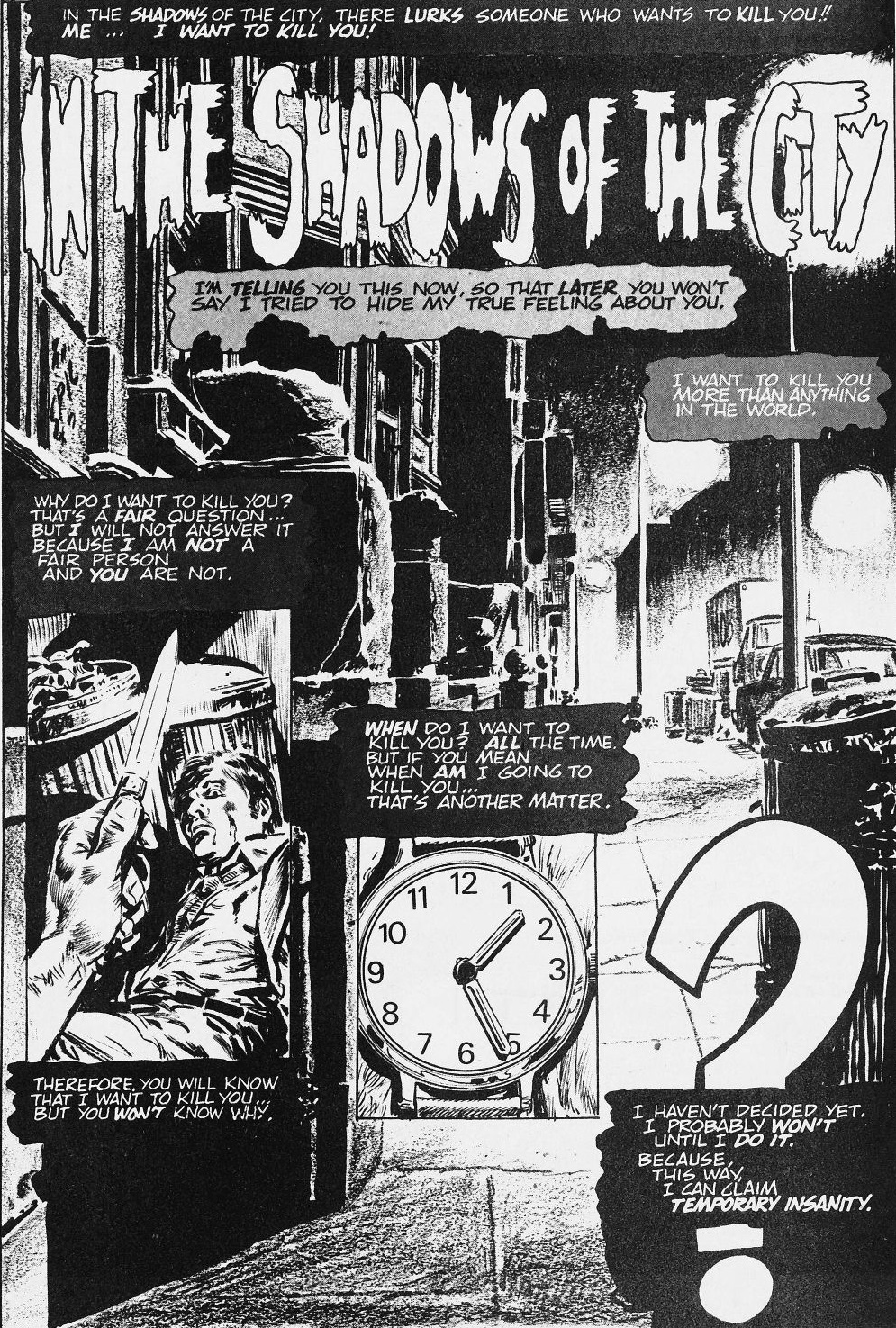
‘In the Shadows of the City’ (originally published in Haunt of Horror #1, cover-dated May 1974), by Steve Gerber (script) and Vicente Alcazar (art)
Always one to push the medium, writer Steve Gerber provides not so much a story as an exercise in instilling dread, upsettingly exploiting the mid-70s paranoia over urban crime (especially in NYC) by nudging readers’ fear of sudden, random, violent death. ‘In the Shadows of the City’ revolves around a psychopath obsessed with murder fantasies, somehow able to project them to potential victims. While the various POV shots make us share his horrific visions, the narration addresses us directly, breaking the fourth wall. The result is a diabolical comic that explicitly threatens its audience.
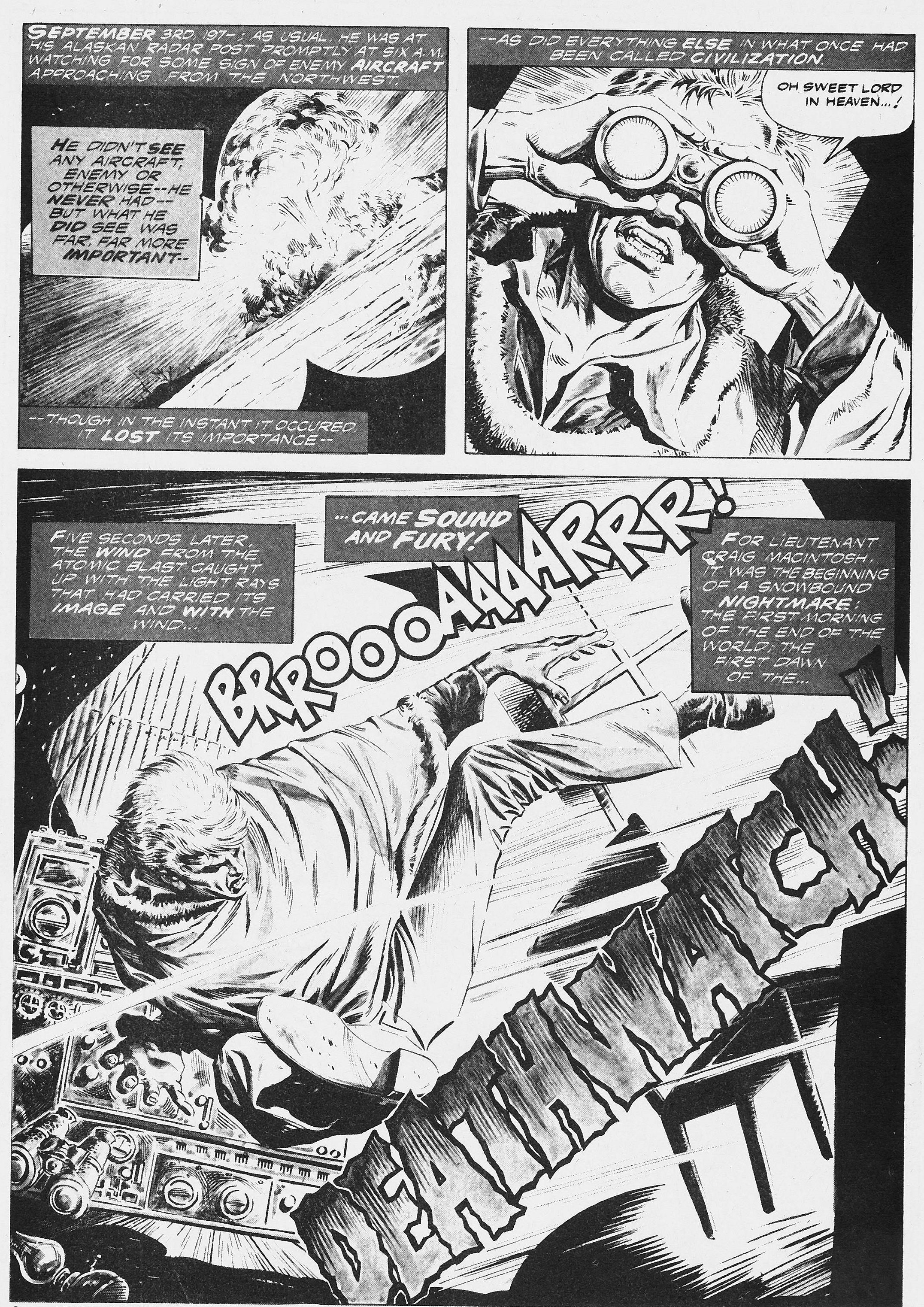
‘Deathwatch’ (originally published in Haunt of Horror #4, cover-dated November 1974), by Gerry Conway (script) and Young Montano (art)
Although nuclear war-themed post-apocalyptic fiction tends to be labelled as sci-fi, there is a reason this story was published in Marvel’s mature readers’ horror magazine. ‘Deathwatch’ is less concerned with realistically speculating about the specific outcome of an atomic exchange (here presented as catastrophic event, albeit not an end-of-the-world scenario) than with the horror that such an exchange could actually take place *at all*, hence its setting in a near future. We follow the aftermath through the perspective of Craig Macintosh, a soldier stationed in Alaska who, having survived the strike, comes to a life-changing realization about the conflict. Ultimately, Gerry Conway’s powerful agitprop script should be read as an indictment, not just of the Cold War, but of the military establishment itself, a message that cannot be delinked from the events in Vietnam at the time.
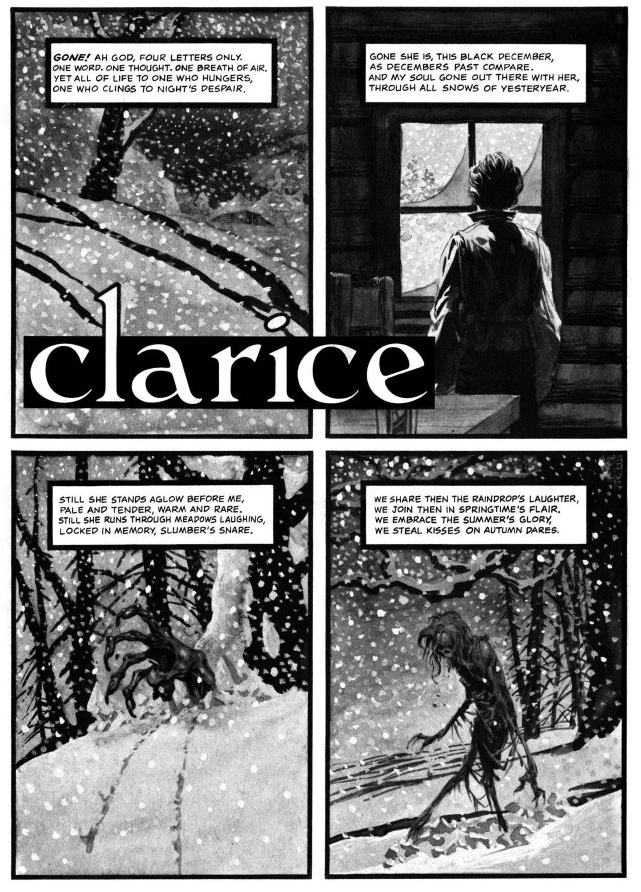
‘Clarice’ (originally published in Creepy #77, cover-dated February 1976), by Bruce Jones (script) and Bernie Wrightson (art)
Bruce Jones’ devastating gothic poem about a man in a cabin recalling his lover who died in the snow is morbidly beautiful and melancholic. The extra punch comes from the fact that ‘Clarice’ isn’t just about mourning, but also about guilt. Moreover, pleasingly, Bernie Wrightson’s haunting art doesn’t stick to literal illustrations – instead, it shows another layer of the story that you can take as either fantastical or metaphorical.
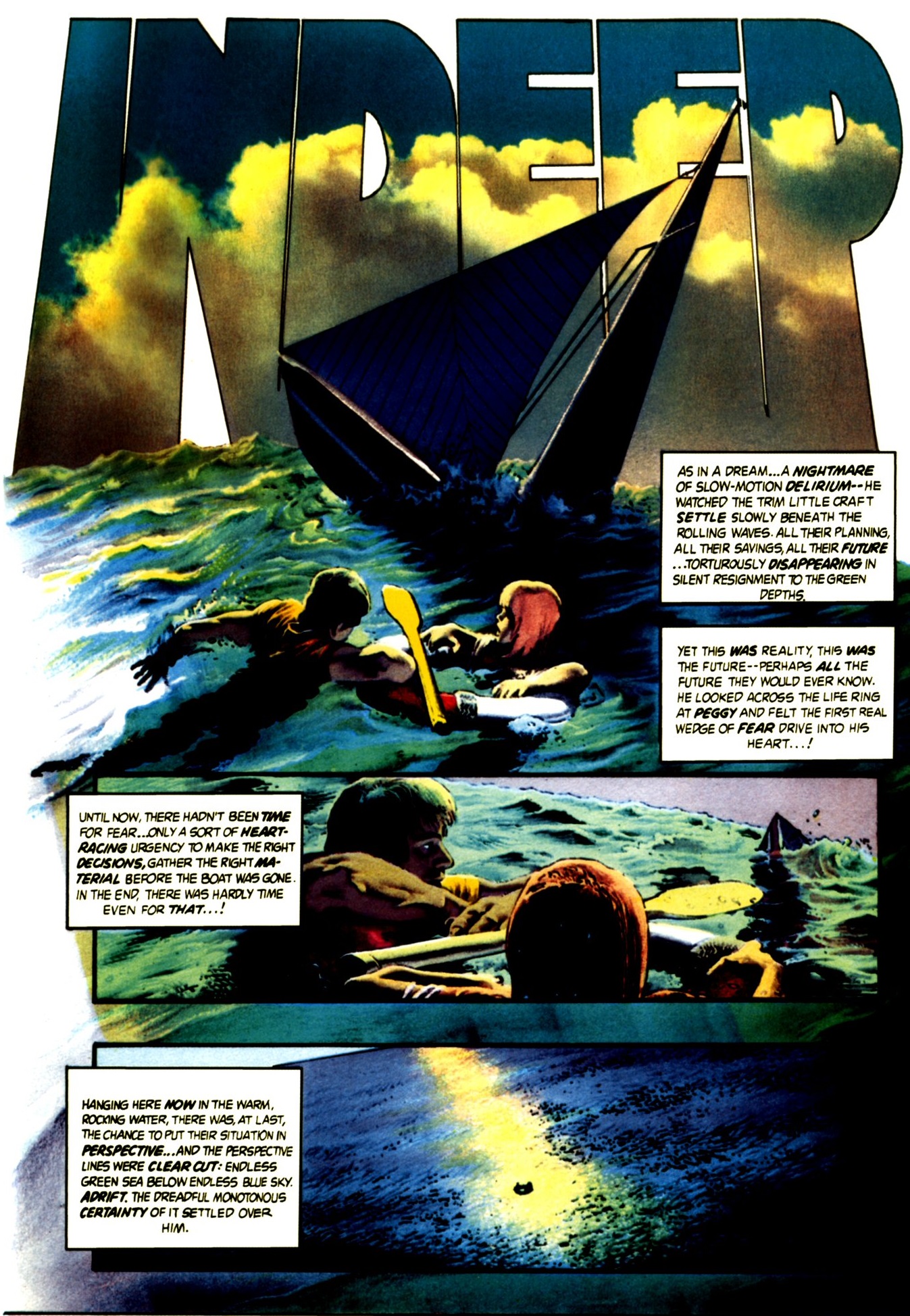
‘In Deep’ (originally published in Creepy #83, cover-dated October 1976), by Bruce Jones (script) and Richard Corben (art, colors)
Bruce Jones revisited some of the themes of ‘Clarice’ in this harrowing tale about a couple adrift at sea, where they have to deal with the merciless sun, the dangerous waters, the unavoidable tiredness, and, of course, the hunger and thirst. The great Richard Corben, who drew and colored ‘In Deep,’ delivered some truly desolate visuals as well as a couple of startlingly gory sequences. This is the stuff traumas are made of.
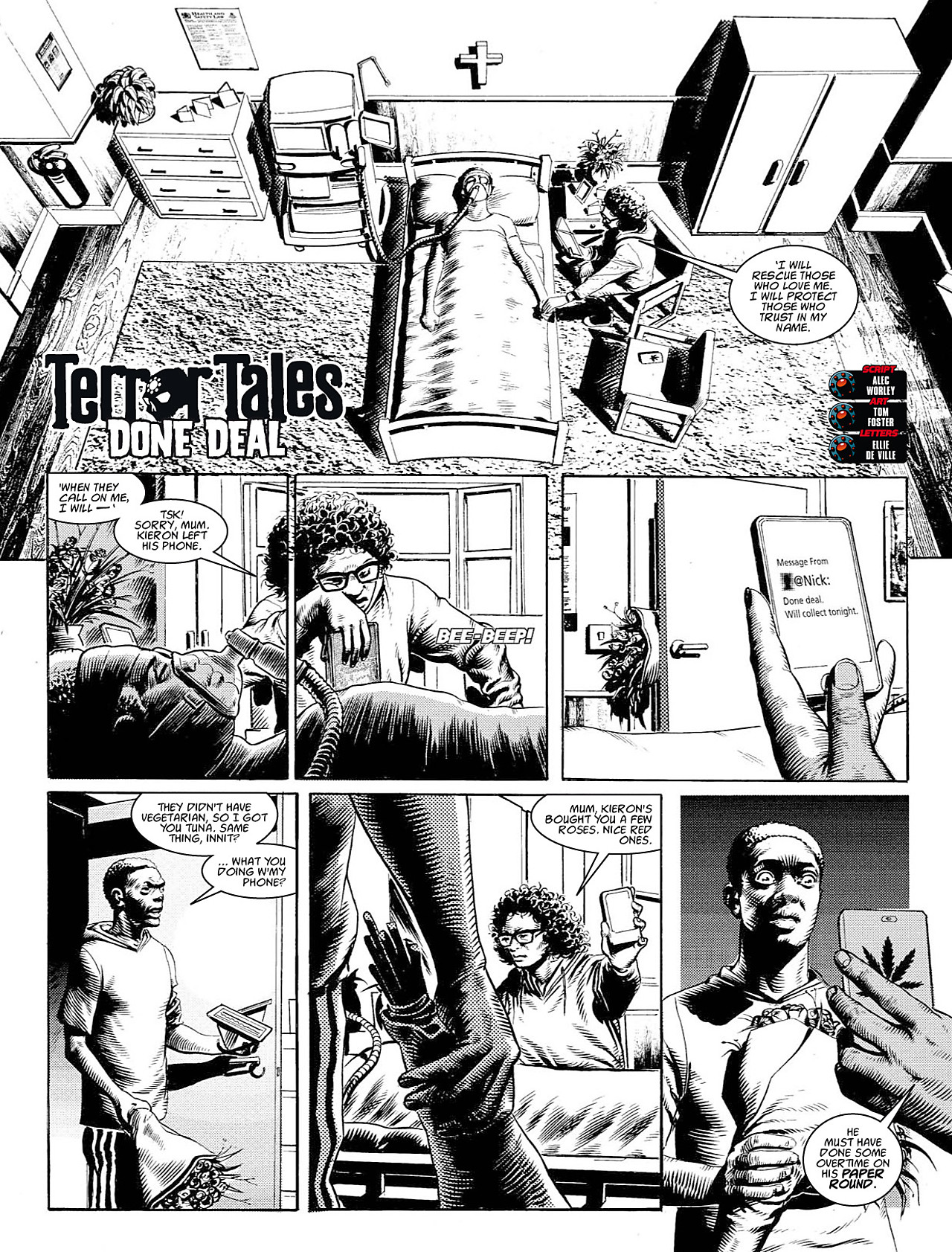
‘Done Deal’ (originally published in 2000 AD #1886, cover-dated June 2014), by Alec Worley (script), Tom Foster (art), and Ellie De Ville (letters)
Finally, a bit of urban horror with a more modern vibe worthy of the New Weird school of fiction. A tale of two teens with a comatose mother, ‘Done Deal’ effectively uses shorthand and familiarity to establish – in just *four pages* – both a slice of realistic family drama and a sinister revelation.
Posted in FANTASTIC ADVENTURES
Tagged 2000 AD, Al Feldstein, Alec Worley, Bernie Krigstein, Bernie Wrightson, Bill Gaines, Bruce Jones, Carl Wessler, Charlotte Jetter, Cold War, Ellie De Ville, Gerry Conway, Harry Harrison, horror, Jim Aparo, Jim Wroten, Joe Orlando, John Albano, Marie Severin, noir, politics, Reed Crandall, Richard Corben, science fiction, Steve Ditko, Steve Gerber, Tom Foster, Vicente Alcazar, Wally Wood, Young Montano
2 Comments
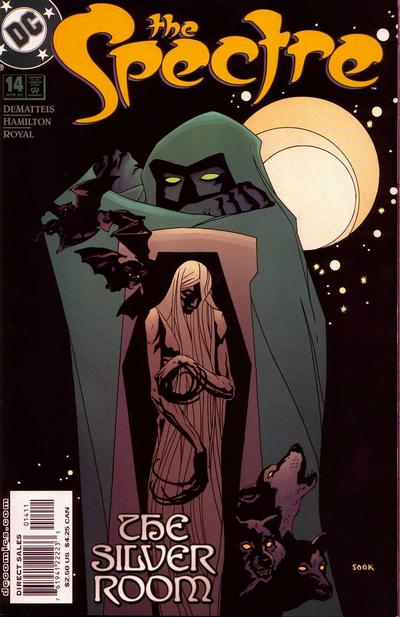
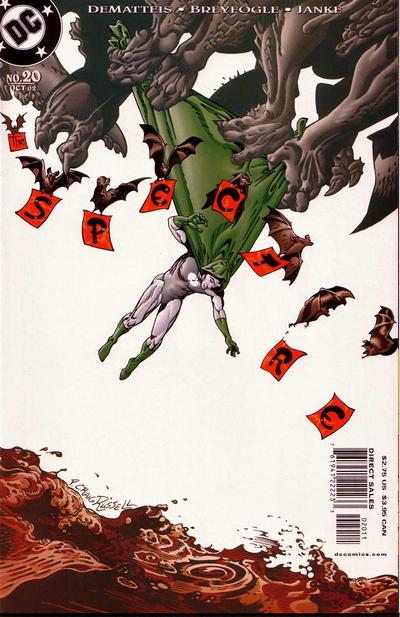
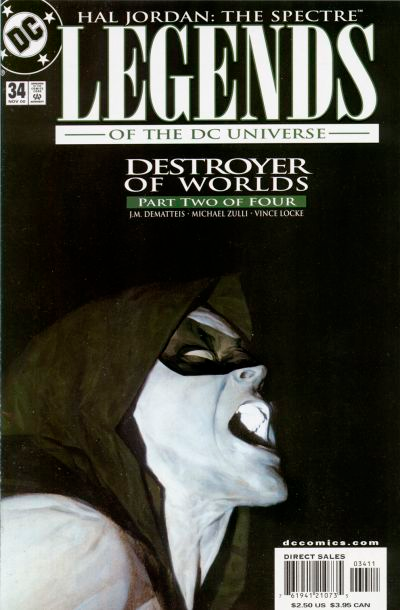
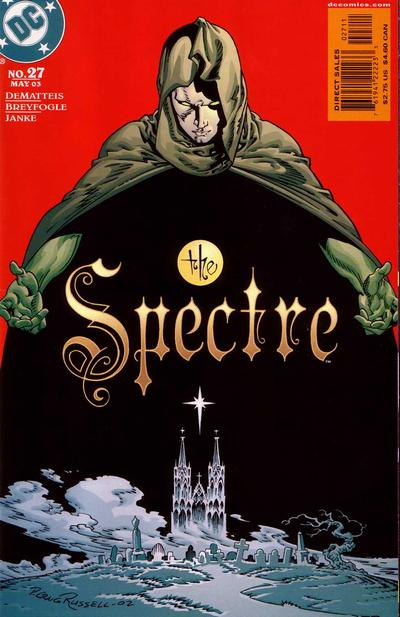
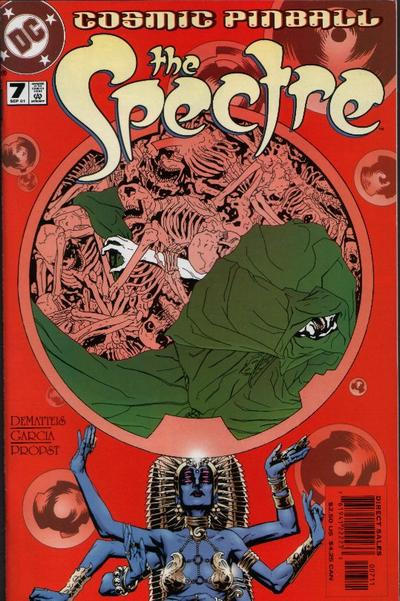
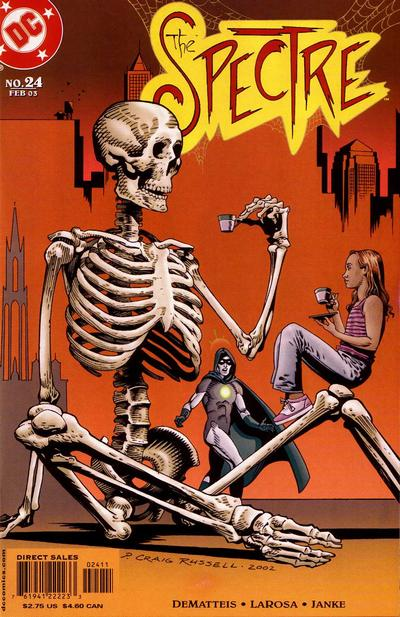
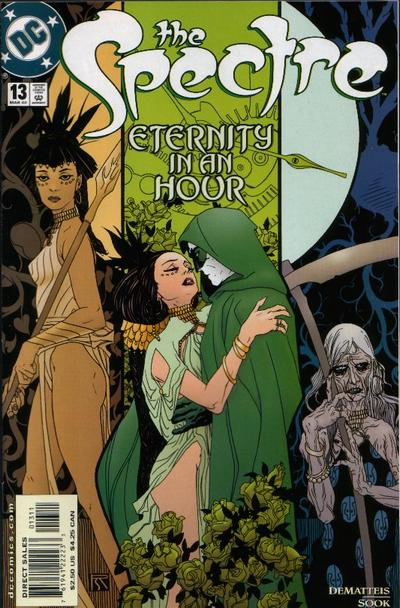
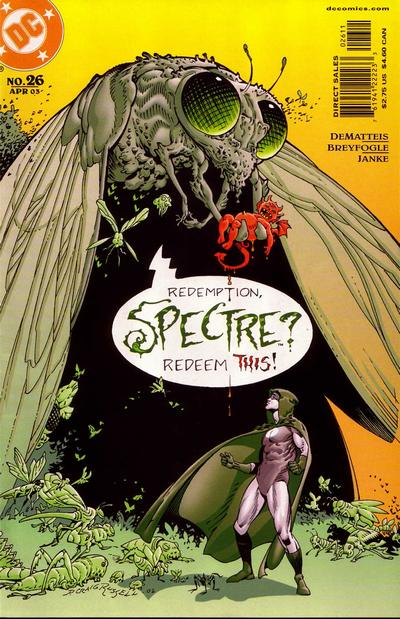
Spectacular Spectre covers from the Hal Jordan era
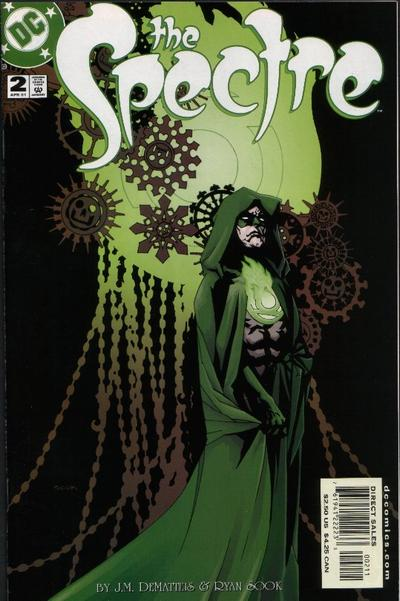
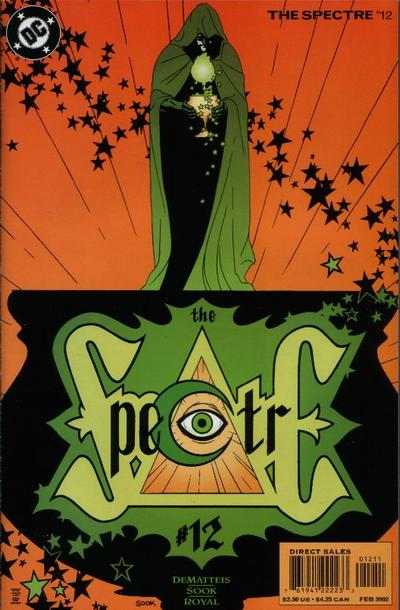
A couple of years ago, I did a post spotlighting covers revolving around the Spectre, one of DC’s most aesthetically remarkable creations. As a character, this mega-powerful spirit of vengeance is not that easy to write, but his spooky looks do tend to bring out the best in artists, including the ones responsible for the series’ covers. In fact, the Spectre is such a strong visual presence in the DCU that, when his alter ego Jim Corrigan was finally allowed to move on (at the climax of John Ostrander’s and Tom Mandrake’s magnificent run), in 2001 the company ended up reviving the character with a different human host – former Green Lantern Hal Jordan, of all people (who, in seeking atonement for his villainous actions as Parallax, shifted the Spectre’s mission by focusing on redemption rather than vengeance).
Say what you want about that era, but at least it gave us its fair share of truly amazing covers. Because it was now Hal Jordan behind the Spectre, the character’s design was tweaked, incorporating elements from Green Lantern’s costume. Artists like Ryan Sook and P. Craig Russell ran with this, making the most out of the new look through beautiful covers that combined lyrical fantasy, horror imagery, and a dash of surrealism:
Superhero horror movies
Writing about Todd Phillips’ Joker last week got me thinking about the fact that, by now, taking superhero iconography and filming it like a horror movie has become a proper subgenre onto itself. I’m not just talking about the occasional Lovecraft-influenced sequence in Aquaman or Doctor Strange, but about movies in which horror is clearly the main sensibility.
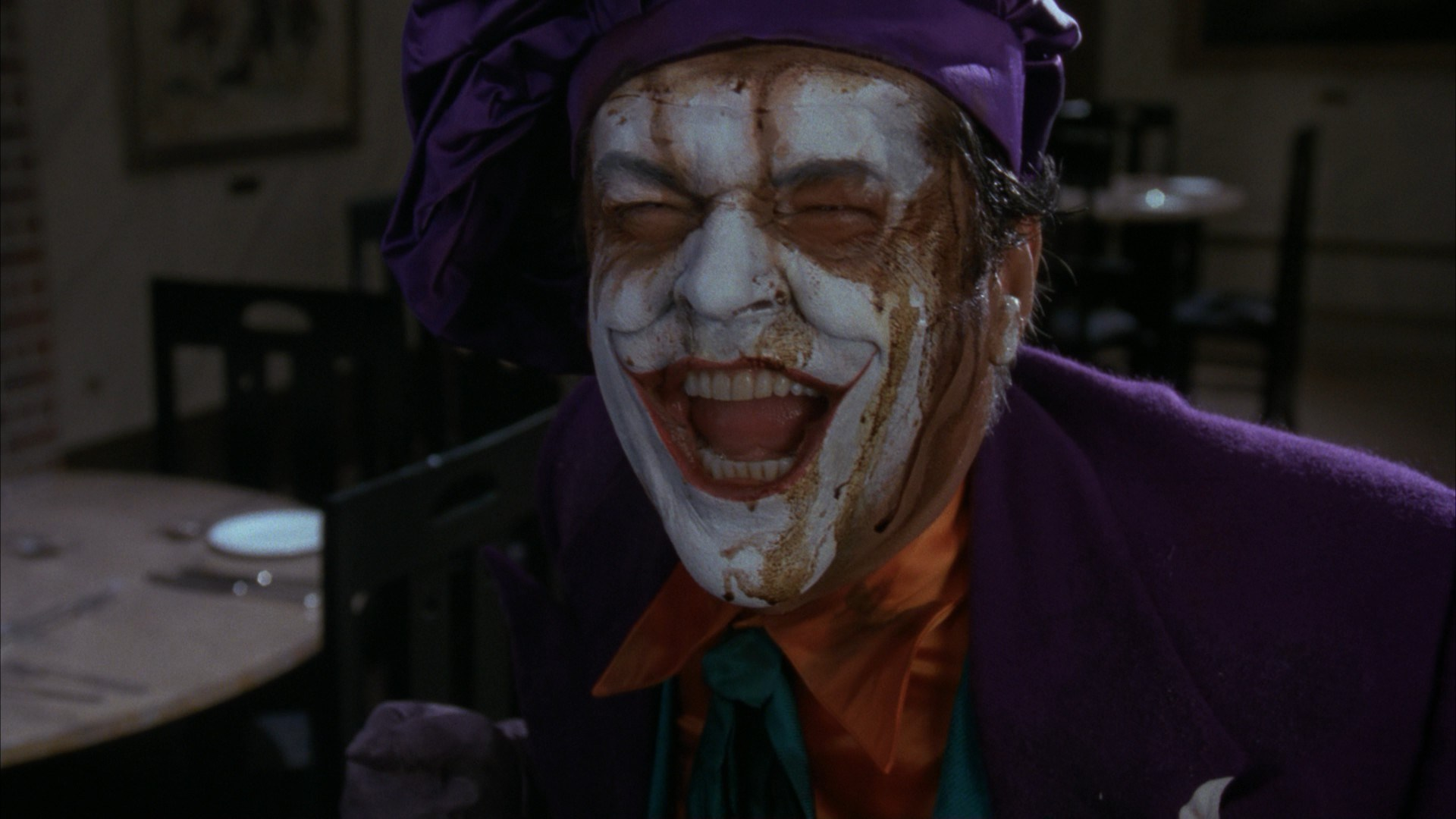
I guess it all goes back to 1989’s super-successful Batman, which Tim Burton shot like the creepy nightmare of a traumatized child from the forties, starting with Jack Nicholson’s own memorable take on the Joker…
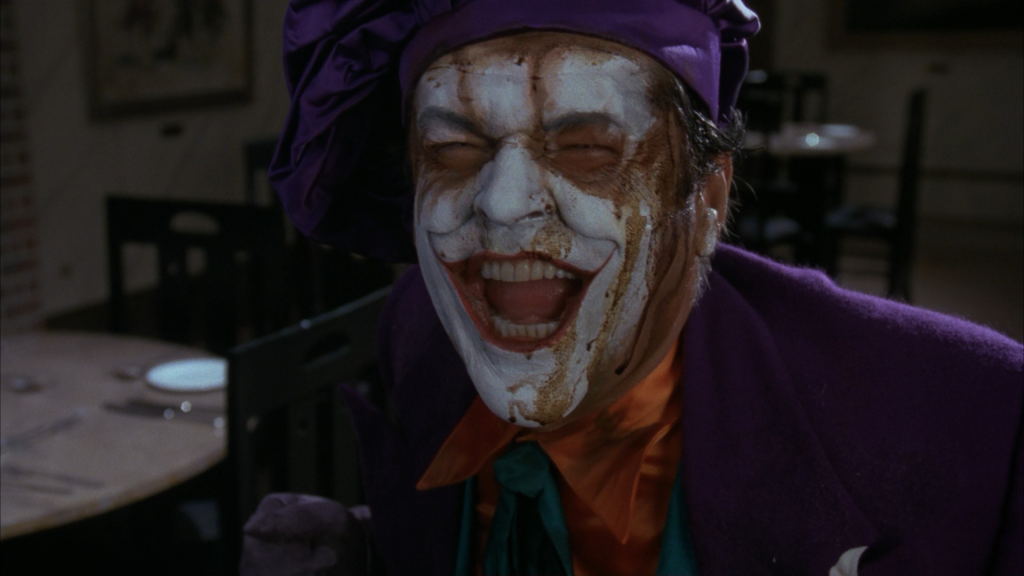 Batman (1989)
Burton was clearly on to something here, recognizing the sinister potential of bringing comic book characters to life. Both genres lend themselves to easy allegories, which can lead to interesting hybrids: if superhero fiction is about ideals and aspirations, horror is a vehicle to tackle anxieties and fears, so there is something enthrallingly disturbing about combining the two.
Moreover, although Burton’s film departed from the source material in several key ways, this specific link wasn’t all that strange… From the very start, Batman comics had been full of vampires, mad scientists, and monsters, drawing on the aesthetics of horror movie posters and pulp covers. This has remained an enduring dimension of the franchise:
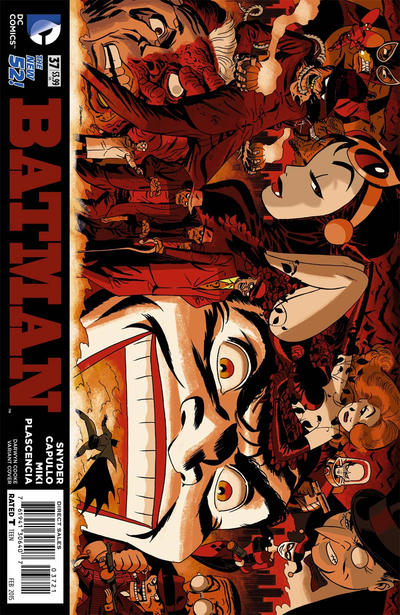
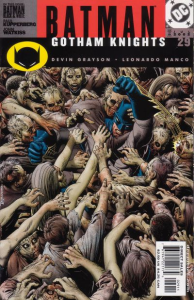
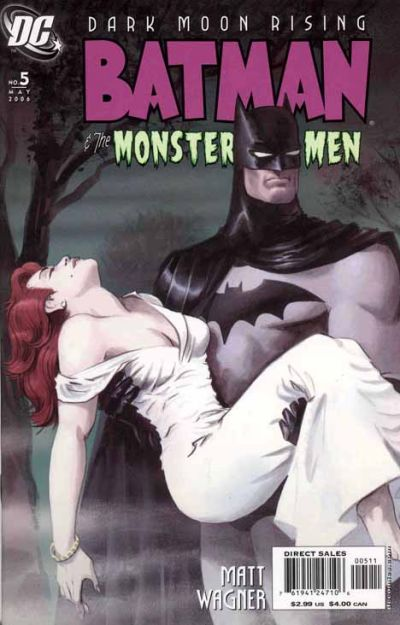
(Damn it, I forgot to include that last cover on my post about lying in Batman’s arms…)
Tim Burton went on to expand his idiosyncratic vision of the Dark Knight’s world through 1992’s Batman Returns, which also borrowed heavily from classic horror cinema (Christopher Walken’s character was actually called Max Schreck). That said, the sequel came across as (even) more of a macabre farce. Seriously, that film’s grotesque Penguin and twisted zombie Catwoman wouldn’t have looked out of place in the following year’s Addams Family Values…
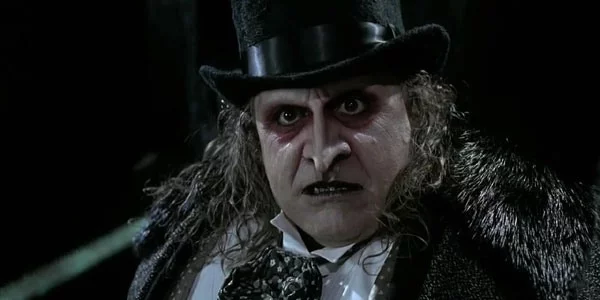 Batman Returns (1992)
To be fair, much of Batman Returns’ bizarre sense of humor is probably due to the involvement of screenwriter Daniel Waters, who also wrote the cult black comedy Heathers, not to mention the outrageously cartoonish action movies Hudson Hawk and Demolition Man…
The latter one even got a shout-out in the comics, at the time of release:
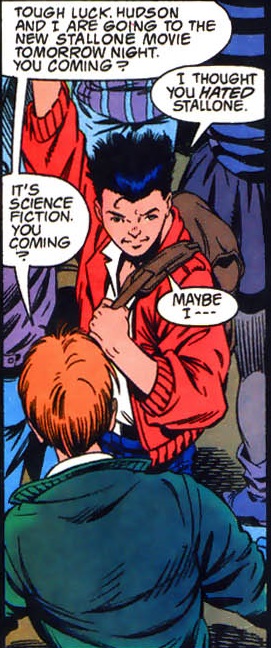 Robin (v4) #1
Between Tim Burton’s two Batman pictures, Sam Raimi did his own Danny Elfman-scored, violent blend of dark superhero opera, R-rated action movie, and cornball tribute to old Universal monster films (with a few echoes of RoboCop as well). In 1990’s Darkman, Liam Neeson plays a disfigured scientist on a revenge quest against the gangsters who brutally attacked him and destroyed his lab. When he’s not brooding or shouting in agony, he is setting up zany traps for his opponents, playing them against each other by temporarily assuming their identities (he has developed a malleable synthetic skin that lasts for 99 minutes in the light!).
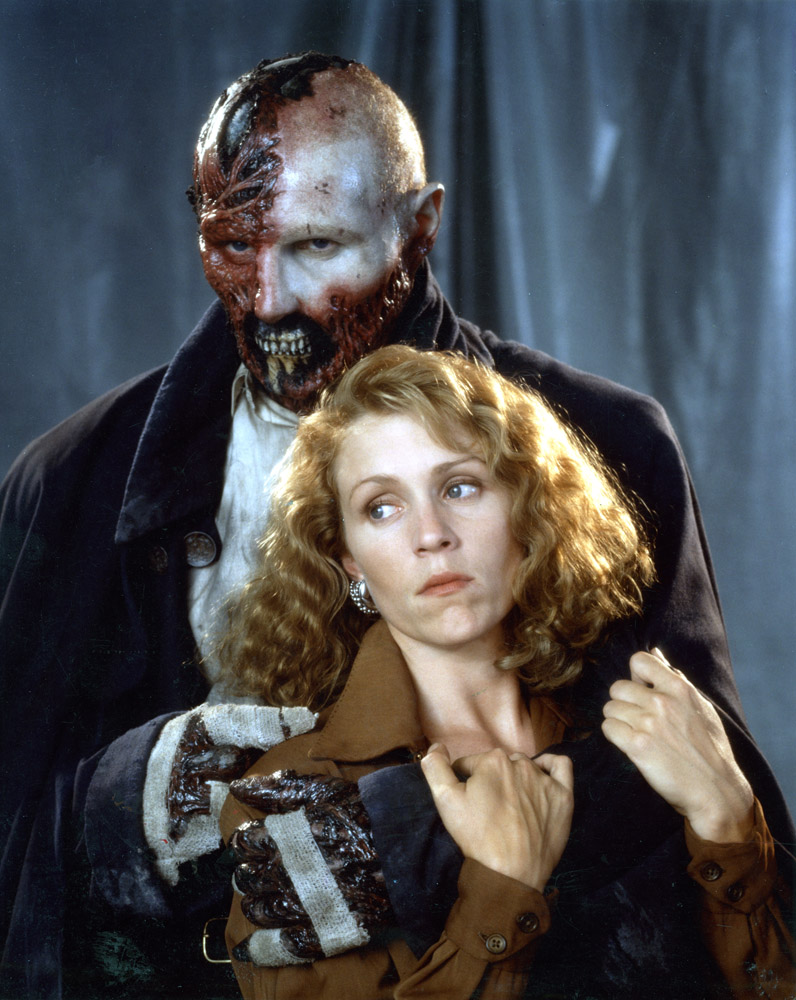 Darkman (1990)
Darkman’s tone is gritty and often over-the-top, from the finger-chopping mobster to montages of explosions superimposed on close-ups of Neeson’s eyes. The gothic flair is particularly prominent in a subplot about the anti-hero’s girlfriend, played by Frances McDormand. This could almost be the origin tale of one of the Caped Crusader’s many tragic villains… In fact, the grim, sadistic edge is quite in tune with the overall zeitgeist of post-Dark Knight Returns comics at the time (although the climax would’ve felt more subversive if Burton hadn’t played a similar card in the previous year’s blockbuster).
In Sam Raimi’s oeuvre, this stands halfway between the gory comedy of the Evil Dead series and the more conventional superhero shenanigans of his Spider-Man trilogy – not as cartoony as the former, yet much, much more deranged than the latter!
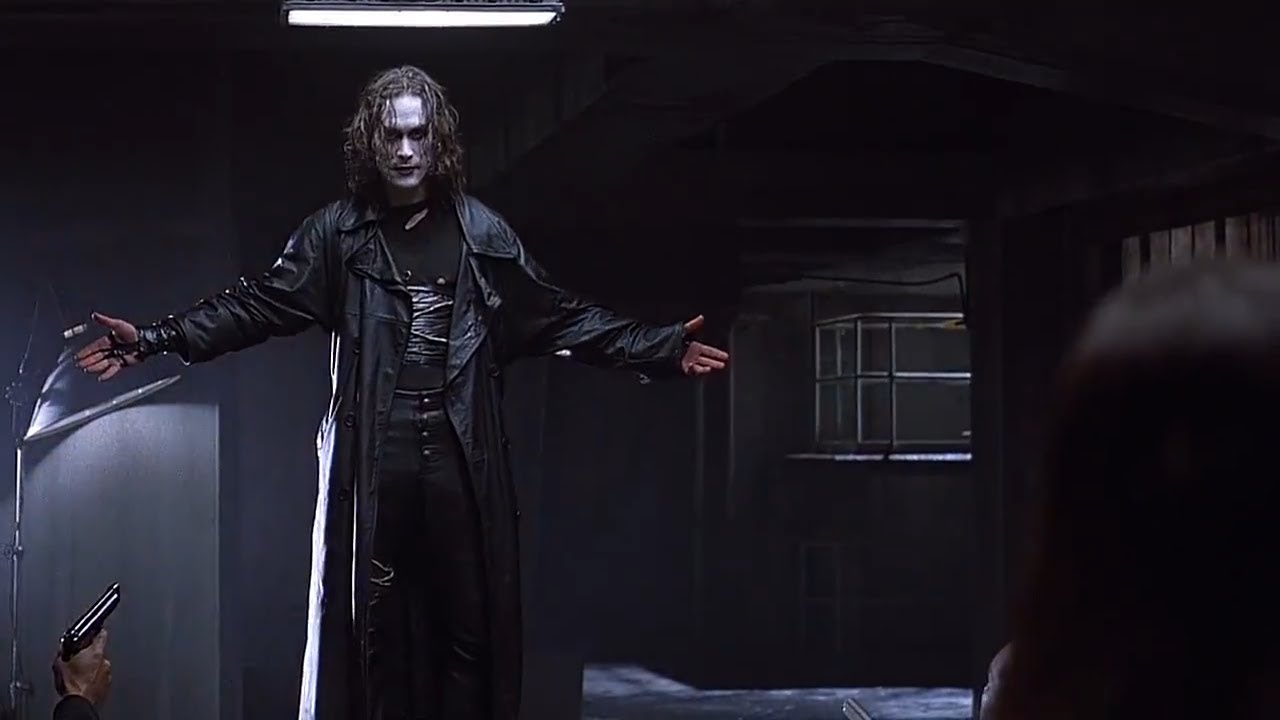
This initial cycle of surrealist gothic superhero flicks culminated in 1994’s The Crow, Alex Proya’s trippy adaptation of James O’Barr’s comic book about a guitarist who comes back from the dead to avenge his raped and murdered bride. I’m not a fan: the whole thing feels too much like an extended emocore music video. Unlike the comic’s version, at least the film’s protagonist doesn’t deal with his emotional pain by engaging in self-mutilation, but you can still count on plenty of poseur moves and pretentious, proto-poetic lines.
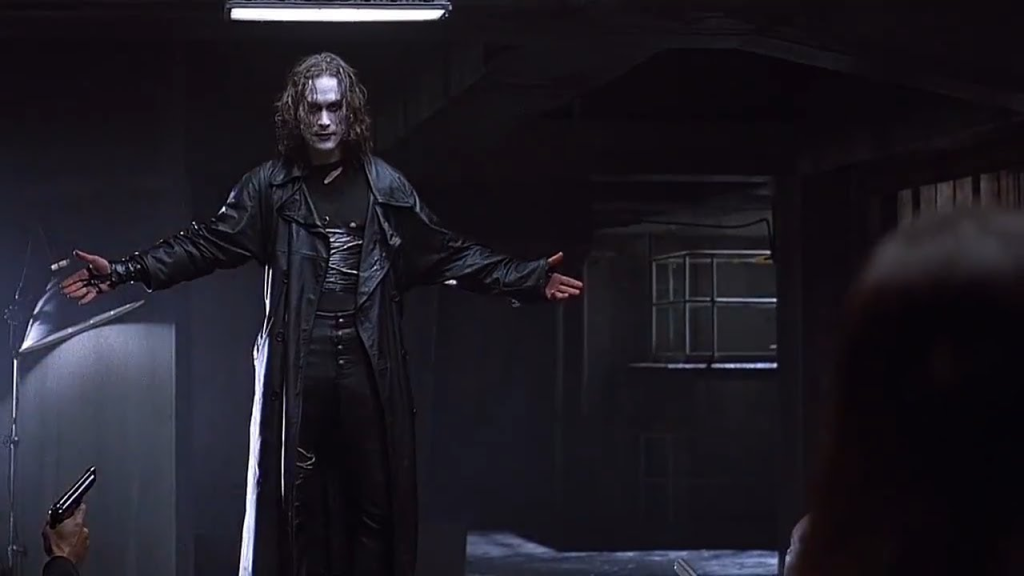 The Crow (1994)
Like its predecessors, The Crow was packed with overwrought pathos and pyrotechnic travelling shots, yet it also imbued the genre with an edgier attitude of nineties’ leather jackets, gun fu action, and harsh profanity. With the possible exception of 1997’s Spawn (which I haven’t seen), the one film that picked up on this new approach – and ran with it in a much more entertaining way – was 1998’s Blade, stylishly directed by Stephen Norrington and starring Wesley Snipes as the titular vampire hunter. This sleazy, adrenaline-charged thriller is like a time capsule of the late ‘90s understanding of coolness: there are techno beats, decadent orgies, bloody violence, mixed martial arts, swordfights, embarrassing CGI, and a firm belief in sunglasses.
Blatantly inspired by Hong Kong cinema, borrowing elements from the Punisher, and clearly anticipating the following year’s The Matrix, Blade is a visual treat, especially the delirious set design (which at one point includes a penthouse with a retractable wall and a waterfall with floating rubber duckies). Above all, Snipes totally owns the part, somehow landing even the weirdest one-liners, like the infamous: ‘some motherfuckers are always tryin’ to ice skate uphill.’
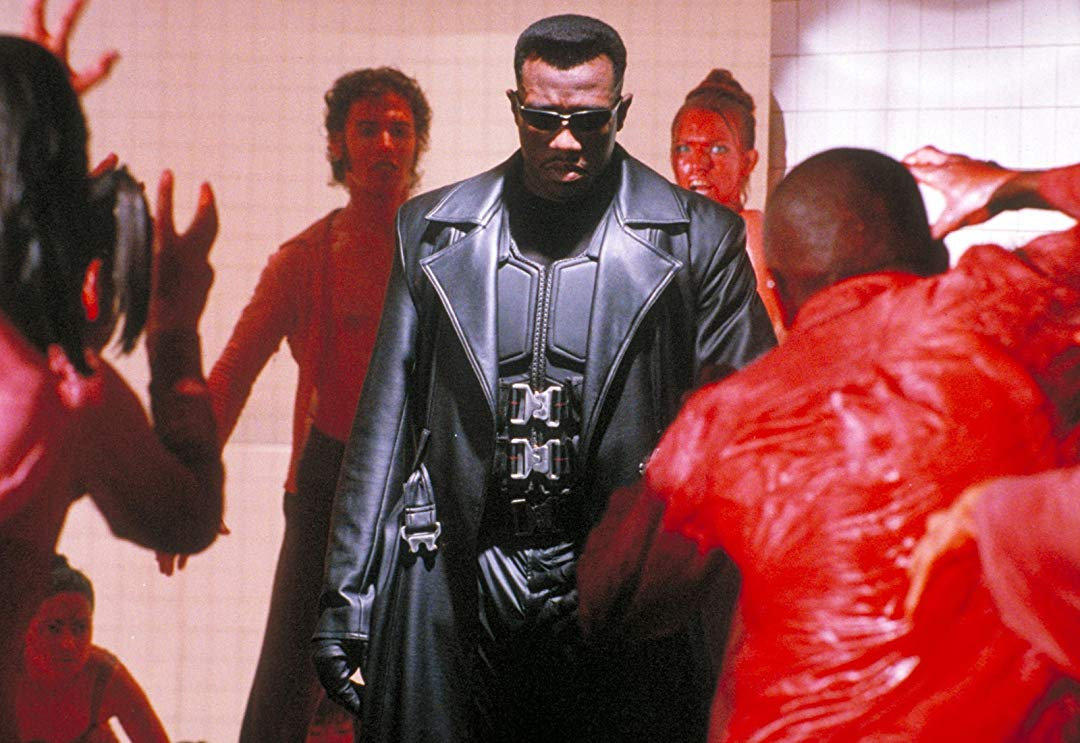 Blade (1998)
A shamelessly fun ride, Blade wastes no time on pointless origins, throwing viewers into a fully-developed world of underground vampire clubs and secret societies while trusting you to be familiar with enough of these tropes not to need too much guidance. The plot is nothing to write home about, but David S. Goyer did fill the script with some interesting ideas, like a specific type of vampiric racism or the generation clash between the gloomy old guard and the younger crowd who mostly wants to party (it’s as if the vampires of classic literature had to put up with all the millennial goths inspired by Neil Gaiman). Goyer also mercilessly reinvented the character created by Marv Wolfman and Gene Colan way back in 1973’s The Tomb of Dracula #10 (in fact, the film’s depiction ended up having a greater influence on the comics than the other way around).
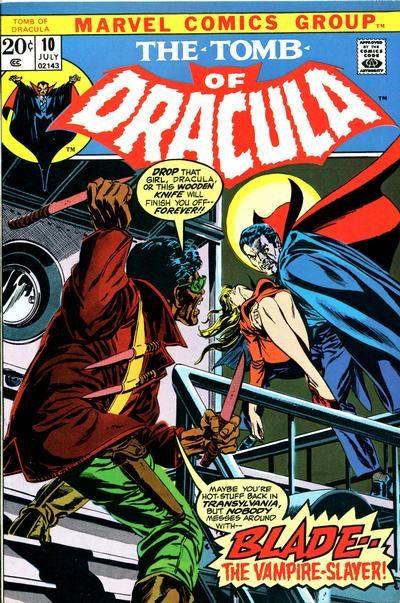
You can argue that Blade is not exactly a superhero – he doesn’t have a secret identity, wear a mask, or display any reticence about slaughtering his opponents. Still, he has supernatural powers, a schlocky arsenal (a deadly silver boomerang, hollow point bullets filled with garlic), and finds himself saving the world from a monster, so I think he fits pretty comfortably in the genre. As for the horror side of the equation, the ‘blood rave party’ scene early on perfectly sets the tone with its mix of relentless gorefest and pitch-black comedy.
Following Blade’s success, David Goyer scripted a couple of sequels, both of them lacking the original’s freshness and manic energy. Although they expanded the franchise’s mythology, they didn’t do it in particularly creative ways. 2002’s Blade II was directed by Guillermo del Toro, so at least it had a couple of neat visuals (especially the vaginal-looking design of the new breed of vampires). 2004’s Blade: Trinity, directed by Goyer himself, has a deservedly poor reputation, but it works as serviceable trashy entertainment if you’re in the right mood.
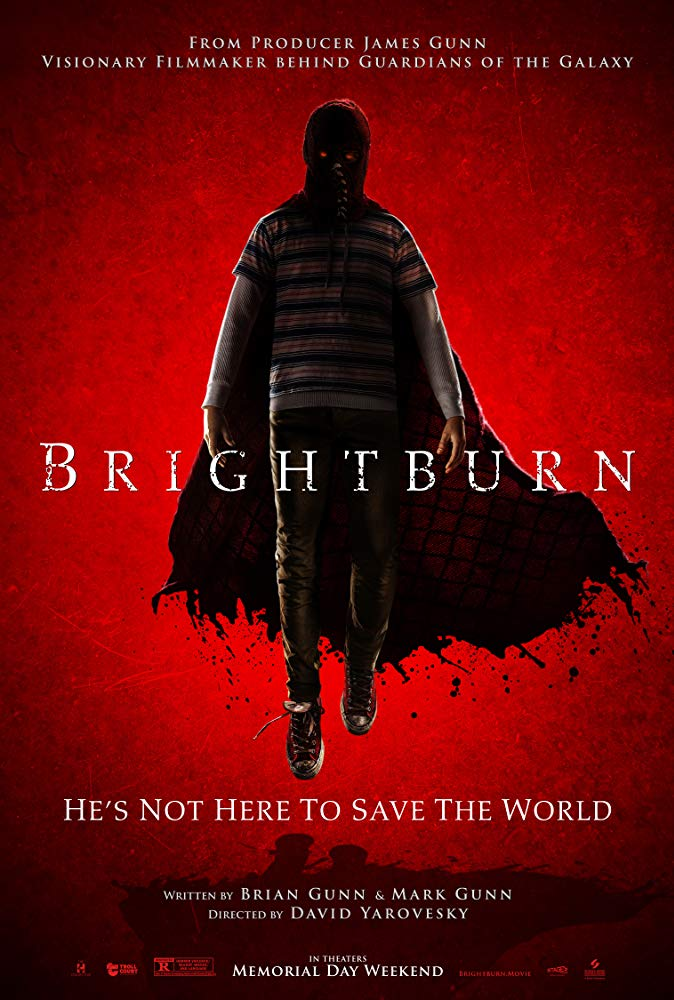
The Blade franchise marks a kind of shift that came about around the turn of the millennium. If the 1990s’ movies mostly tapped into that decade’s gothic fashion, the 21st century installments veered more into ultra-violence and psychological horror. This is in part due to David Goyer, who actually went on to shape much of the latest upsurge of superhorror, having become one of the architects of the DC Extended Universe (on top of producing a couple of Ghost Rider flicks, which I haven’t seen but, given the source material, I assume fall well within this subgenre). Most notably, Goyer scripted 2013’s Man of Steel, directed by Zack Snyder (who had made his film debut with a pointless remake of Dawn of the Dead). That controversial blockbuster sought to put a bleak, terrifying spin on the Superman mythos – an approach that David Yarovesky took even further in this year’s (regrettably uninspired) Brightburn.
Not long after Man of Steel, Josh Trank shot some of 2015’s Fantastic Four like Cronenbergian body horror, presumably building up on what Goyer and Snyder had done with Superman (although perhaps he was merely inspired by Jae Lee’s haunting art in the Fantastic Four: 1234 mini-series…). It wasn’t Trank’s first foray into this field: he had previously directed 2012’s Chronicle, which viciously merged the subgenres of teen superheroes and found footage horror. His Fantastic Four, however, was a flop, either because it was notoriously botched in postproduction or because mainstream audiences weren’t all that keen for a gritty reboot of Marvel’s First Family.
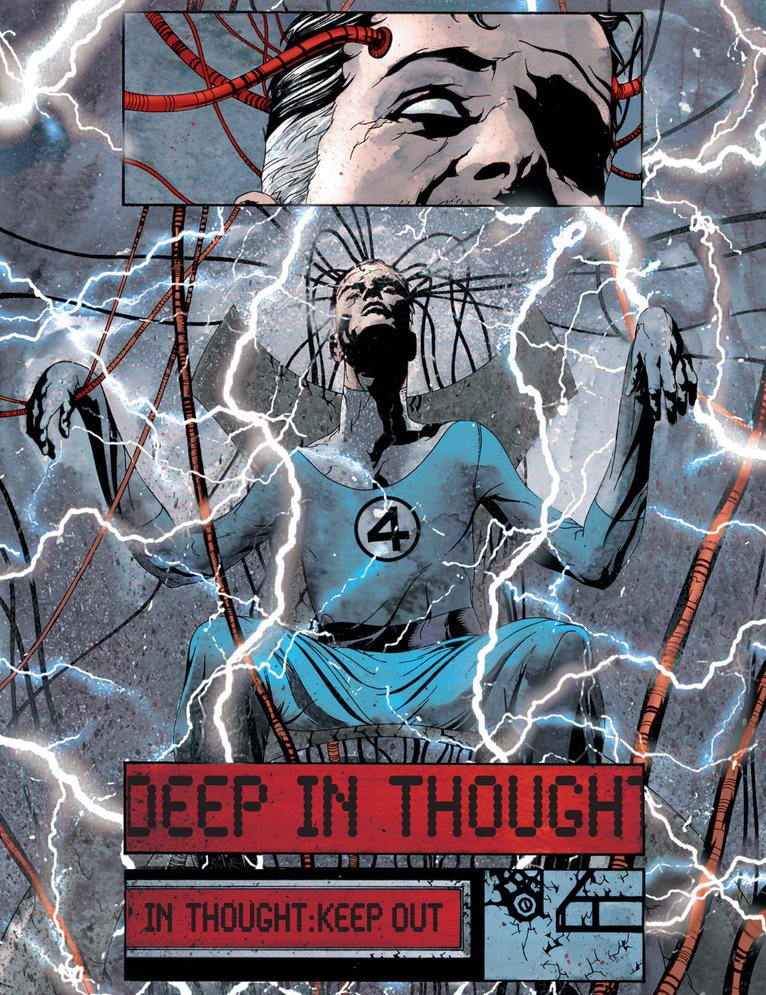 Fantastic Four: 1234 #1
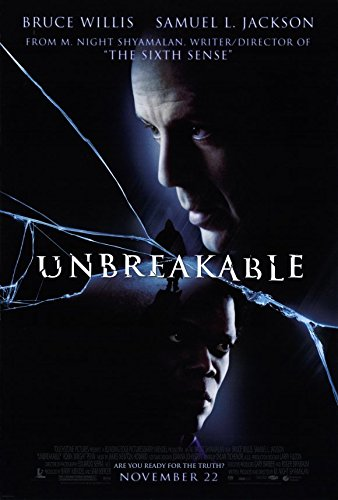
In order to look at a much more interesting take on superhero horror, we have to go back to 2000’s Unbreakable, in which middle-aged security guard David Dunn (Bruce Willis) gradually realizes he has super powers. This understated, slow-burn psychological thriller was written and directed by M. Night Shyamalan back when he was on top of the world, before becoming mostly a widespread pop culture joke. Shyamalan’s artistic fall from grace occurred at different stages for different people (for some with Signs, for many with The Village, for most – including me – with either Lady in the Lake or The Happening), but I would go so far as to say that Unbreakable is his greatest work, complete with top-notch acting, thoughtful characterization, and tight direction (including, early on, a Hitchcockian long take inside the Eastrail 177 train that is a masterful example of cinematic storytelling).
One way to look at this movie is to see it as way ahead of its time. With its drab colors, depressing tone, deliberate lack of action, and proto-realistic approach to superheroes, Unbreakable was a piece of genre deconstructionism before superheroes became a recognizable mainstream film genre (sure, there had been Superman and Batman blockbusters in the past, but those were the exception, not the rule). However, if the movie had been released today, when audiences are so used to superhero origin stories and even to tense, down-to-earth approaches to the genre (like Marvel’s Netflix shows), I don’t think Unbreakable would’ve had nearly the same shocking impact. So perhaps it makes more sense to regard it as an extension of adult, revisionist comics like Watchmen or Neil Gaiman’s and Dave McKean’s Black Orchid, pushing their sensibilities even further by bringing to the screen a truly mundane, flesh and blood superhuman, filmed through discrete travelling shots that do not evoke the comic book format.
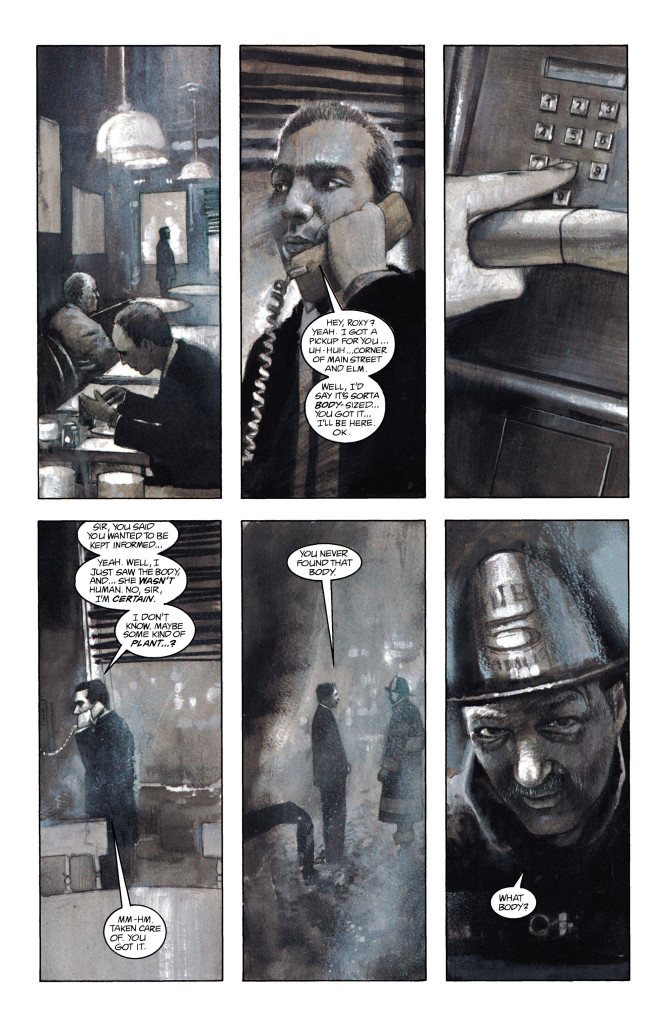 Black Orchid #1
That said, at the end of the day I don’t think comic geeks were M. Night Shyamalan’s main target audience here (hence the opening text explaining to viewers that comics are a big deal). Rather, the point of Unbreakable was precisely to disguise, for as long as possible, its superhero narrative. Shyamalan’s breakout feature, the previous year’s The Sixth Sense, had been a massively acclaimed horror picture with a satisfying surprise ending. Audiences coming to Unbreakable – even those who had seen the trailers – were bound to expect a supernatural tale along the same lines and the film’s eerie, suspenseful tone led them further in that direction. The twist this time around was that they had been tricked into enjoying a superhero movie (a concept that at the time brought to mind Joel Schumacher’s infamous, ultra-campy Batman & Robin). The final payoff clinched this idea, revealing to viewers that they had been watching an even more traditional superhero story than they had realized, albeit an exceptionally well-told one.
In 2016, M. Night Shyamalan gave us a second installment in what was to become the Eastrail 177 trilogy, Split, revolving around a creepy man with multiple personalities (James McAvoy) who kidnaped three teenage girls. If Unbreakable started out as an intimate drama that painstakingly built up towards a genre entry, Split presented itself as an unashamed spine-chiller from the get-go, kicking things off with a frightening cold open and escalating from there (Shyamalan had already embraced Blumhouse Productions’ low-budget horror house style in the previous year’s The Visit). On top of some pacing issues, the movie’s depiction of mental illness ranged from tasteless to ridiculous, but you’ve got to admire Shyamalan’s willingness to develop mind-bending, preposterous-sounding concepts with a straight face.
This time the very final twist – which I must spoil to discuss the film – was that Split was set in the same universe as Unbreakable, despite the fact that this had not been announced anywhere… It could’ve been a fan-pleasing throwaway cameo (akin to the one that unites Trading Places and Coming to America), but the implications were vaster than that. Revealing this to be a stealth sequel to a film set in a superhero universe (even if a toned-down one) recontextualized Split: instead of a regular horror tale, it retroactively became a supervillain origin.
This year, Shyamalan tied the two films closer together through a third installment, Glass, which brought back the surviving cast of both Unbreakable and Split. Even if you don’t see in this move a wink to the boom of expanded superhero cinematic universes, Glass is a full-on metafictional thriller: a chunk of it is set in a mental institution for people convinced they’re similar to comic book characters where psychiatrist Ellie Staple (Sarah Paulson) analyses their alleged powers, deconstructing the fantasy and thus suggesting yet another plot twist on the previous films. The horror, in part, comes from the fact that, although the patients aren’t necessarily deluded, that is the only rational way society can look at them (apart from the signature twist endings, Shyamalan’s oeuvre also has a strong leitmotif of spirituality, the two facets ultimately celebrating in their own way the act of letting yourself believe). Staple’s counterpart – i.e. the character who goes the farthest in terms of merging comics and ‘reality’ – is the titular Glass, whose genre self-awareness means that the film does for superheroes what Scream did for slasher movies. The fact that Glass is played by none other than Samuel ‘Nick Fury’ Jackson is the icing on the cake.
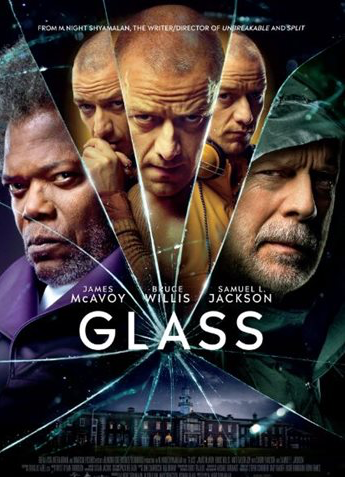
The result is definitely nowhere near as brilliant as Unbreakable, but Glass is still a clever, spellbinding – if uneven – film. M. Night Shyamalan pulls off a low-key superhero crossover event filled with existential dread. And while Bruce Willis doesn’t bring the same heartfelt nuance to his performance as in the former movie, Samuel Jackson is his reliable self and James McAvoy totally commits to his bizarre part(s).
Which brings us back to Joker. On the one hand, there is no denying that Todd Phillips – like Shyamalan – plays with superhero conventions, delving into a villain’s perspective while consciously avoiding the usual overblown set pieces. Hell, with its twisted, nihilistic Clown Prince of Crime and socio-political references, Joker should replace The Dark Knight Rises as the proper final installment of Christopher Nolan’s trilogy (following The Dark Knight). On the other hand, the horror of a supervillain origin works on a different level than in Split, because with Joker we know from the start where everything is heading: trapped in a prequel about an established character, we are never allowed to imagine that the protagonist can become anything other than a genocidal jester, which gives Phillips’ psychodrama a greater fatalistic vibe, like watching the tape of a deadly crash in slow motion.
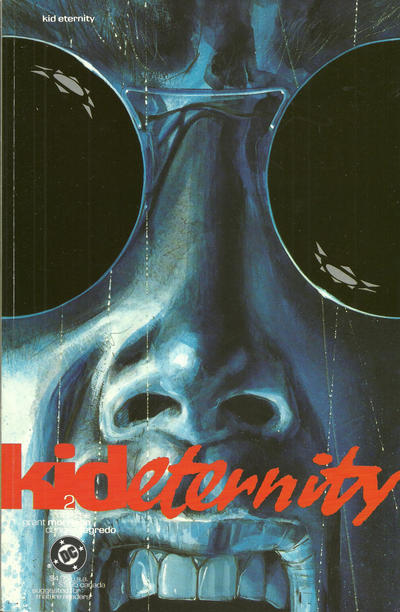
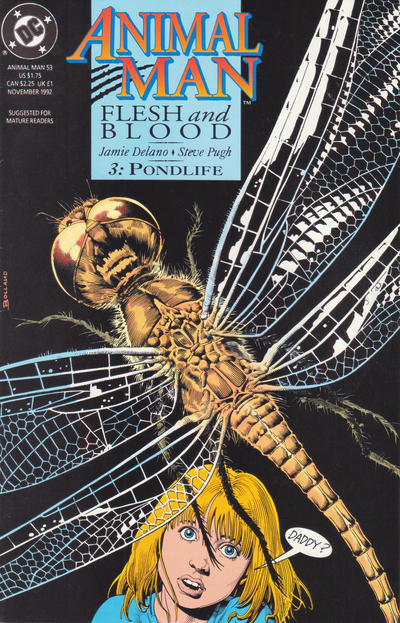
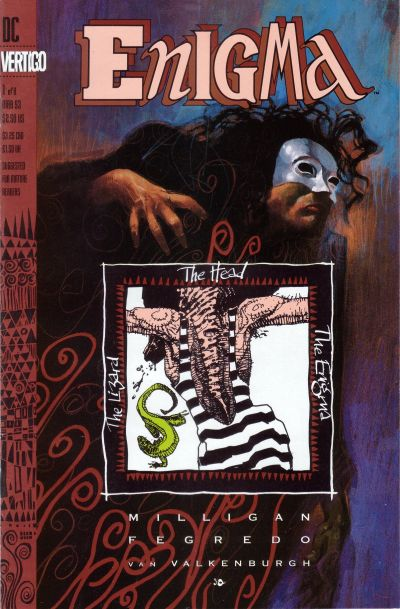
In any case, it’s quite fitting that Joker came out in the same year as Glass, signaling the growing openness of superhero films to cerebral experimentation, which mirrors what happened in the comics decades ago. Indeed, by taking superhero elements and reimagining them in an odd, sinister light, Joker and the Eastrail 177 trilogy have created for cinema the kind of provocative genre hybrids that would’ve felt at home in early 1990s’ DC/Vertigo comics – the kind written by the likes of Grant Morrison, Peter Milligan, and Jamie Delano, with art by Duncan Fegredo or Steve Pugh. Like those creators, Todd Philips and M. Night Shyamalan don’t always hit the mark, but it’s fascinating enough that they attempted to go there in the first place.
On Todd Phillips’ Joker
It turns out the most satisfying way to appreciate Todd Phillips’ Joker was to almost forget that it was a Joker movie.
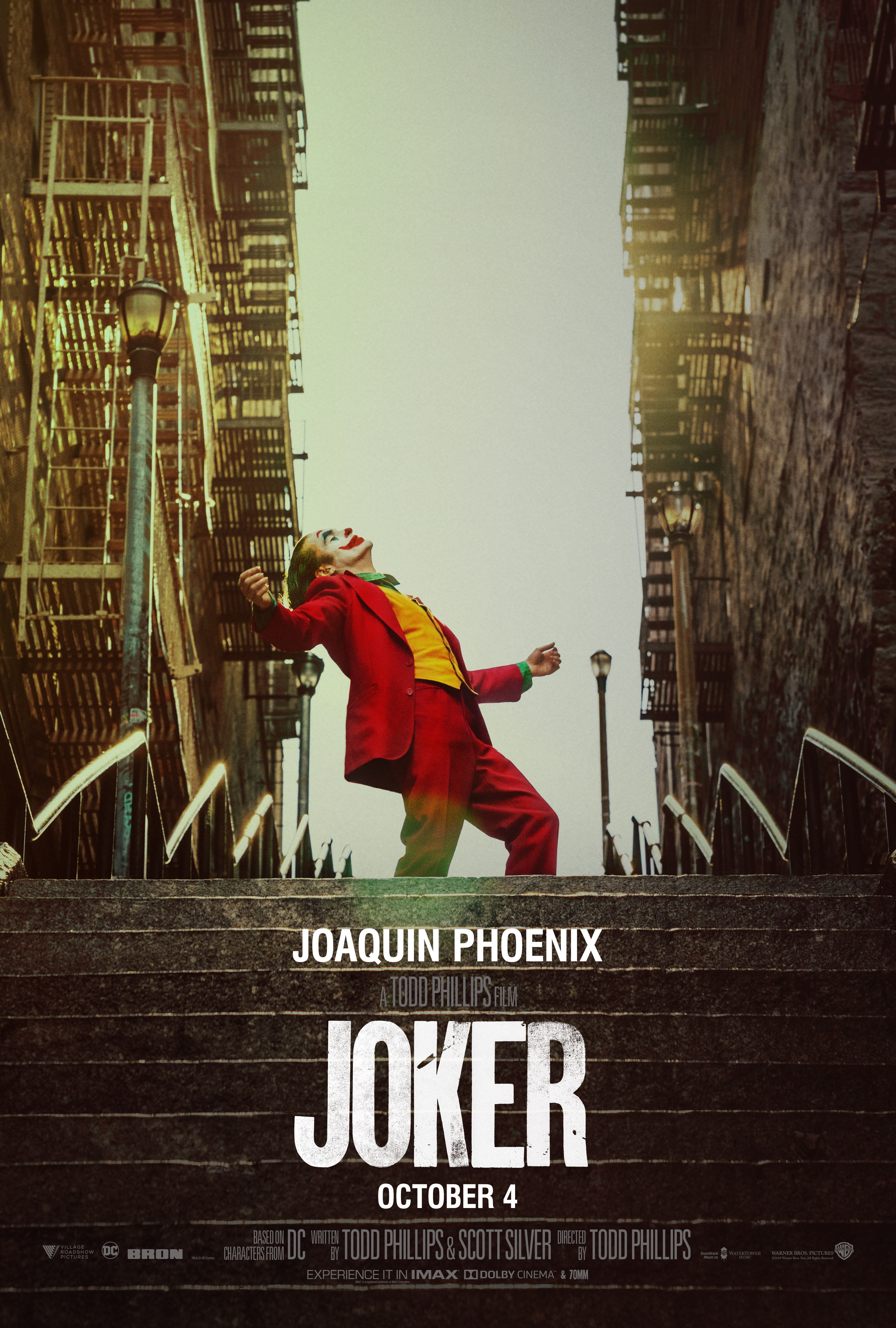
Taken as a DCU entry, the project didn’t particularly appeal to me: a Joker origin story (when the character has always worked best as an enigmatic wild card who is more force of nature than relatable person) taking the Clown Prince of Crime seriously (rather than embracing his caustic wackiness) and apparently removing Batman from the proceedings (even though the Joker is much more interesting as an opponent to the hero).
Still, at least I knew Phillipps’ origin wasn’t going to be as lame as this one:
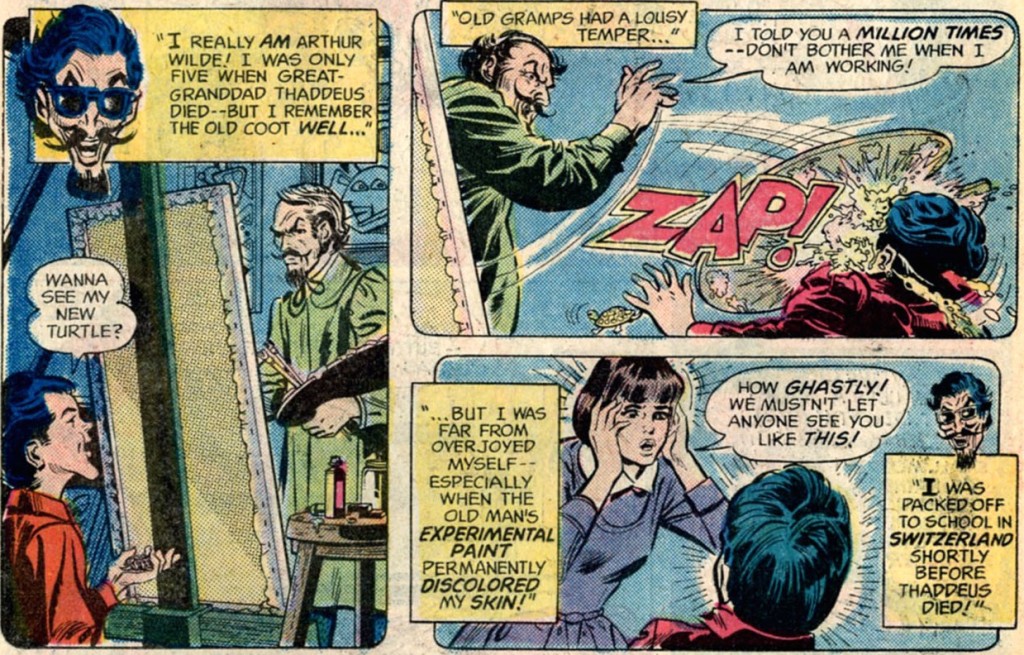 The Joker #5
In the past, I’ve enjoyed tales told from the Joker’s point of view (Robin #85, a couple of issues of the 1970s’ short-lived The Joker comic, The Brave and the Bold’s ‘Joker: The Vile and the Villainous!’ episode), but they’ve tended to exploit the amusing absurdity of the character’s surreal perspective rather than humanize him in a deliberately depressing way. And while I admit there is much to like in Alan Moore’s and Brian Bolland’s The Killing Joke (even if not all of it has aged well), I still haven’t gotten over the sour taste of Brian Azzarello’s and Lee Bermejo’s Joker graphic novel – by far one of the most atrocious works ever published by DC – so the thought of a grim, stripped-down approach to the Harlequin of Hate didn’t stir up pleasant memories.
Then again, I do love Elseworld tales, where I am much more forgiving of revisionist twists that would’ve upset me if they were canonical retcons. Making the Waynes’ murder a product of class warfare (implicitly recasting the Dark Knight as a reactionary retaliation from the 1%) and linking the Joker’s and Batman’s origins (both more *and* less directly than in Tim Burton’s blockbuster) aren’t completely new approaches, but they are elegantly pulled off – at least the latter, with both characters simultaneously realizing who they will be for the rest of their lives, thus retroactively (if subtly, offscreen) presenting the Joker as Batman’s primal counterpart.
In any case, it has long been established – and the epilogue toys with this – that, when it comes to the Joker, origins and recollections aren’t meant to be accepted at face value… As Moore famously had him declare: ‘If I’m going to have a past, I prefer it to be multiple choice!’
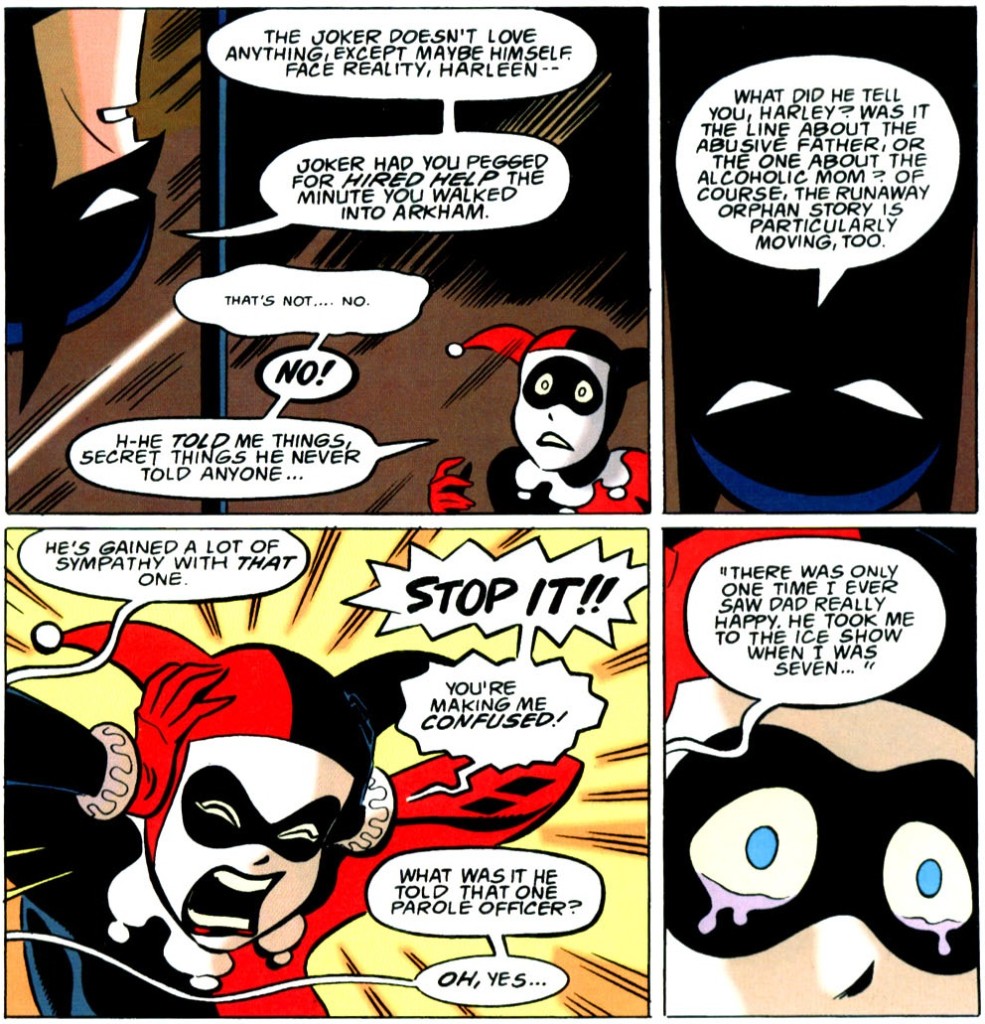 Mad Love
More rewarding that looking at Todd Phillips’ movie as yet another attempt to ground Batman’s cartoonier elements in sullen, self-serious pseudo-realism is to look at it from the opposite direction, approaching Joker as a quirky Joaquin Phoenix-vehicle that uses a goofy comic book character – just like it blatantly riffs on Martin Scorsese’s Taxi Driver and King of Comedy – to spin a tragicomic arthouse drama about mental illness. Since most of Joker can ultimately be interpreted as a sick joke the titular character came up with (along the lines of ‘What if things had actually happened like this?’), you can go further and see it as the fantasy of a real-world patient, called Arthur Fleck, who is weaving into his memories bits from old movies and comics he came across over the years.
That said, it’s pointless to ignore the genre dimension intrinsic to any story starring a member of the Caped Crusader’s rogues’ gallery. Between the encroaching mood, the sudden bursts of violence, and the disturbing imagery (those blood stains on the white makeup…), Joker is – on top of everything else and true to the source material – a seriously mean slice of psychological horror with sprinkles of dark humor.
Moreover, even setting aside what I believe are pretty misguided controversies over the film’s discourse on terrorism, it sure is tempting to uncover in it a statement that goes beyond Gotham City, whether it’s a topical contribution to debates over the links between ‘lone wolf’ massacres and insufficient state provision of mental health care or just a populist indictment of social inequality (although, let’s face it, if you want to see an imaginative parable about class struggle on the big screen this year, you’ll be better served with Bong Joon-ho’s Parasite). Ambiguously playing into the ongoing culture wars, Joker suggests that comedy can be (literally) violent and its enjoyment conditioned by your position in the world. At one point, Phillips even doubles the ‘sad clown’ trope, as he slightly echoes a Quino cartoon involving Chaplin’s Little Tramp:
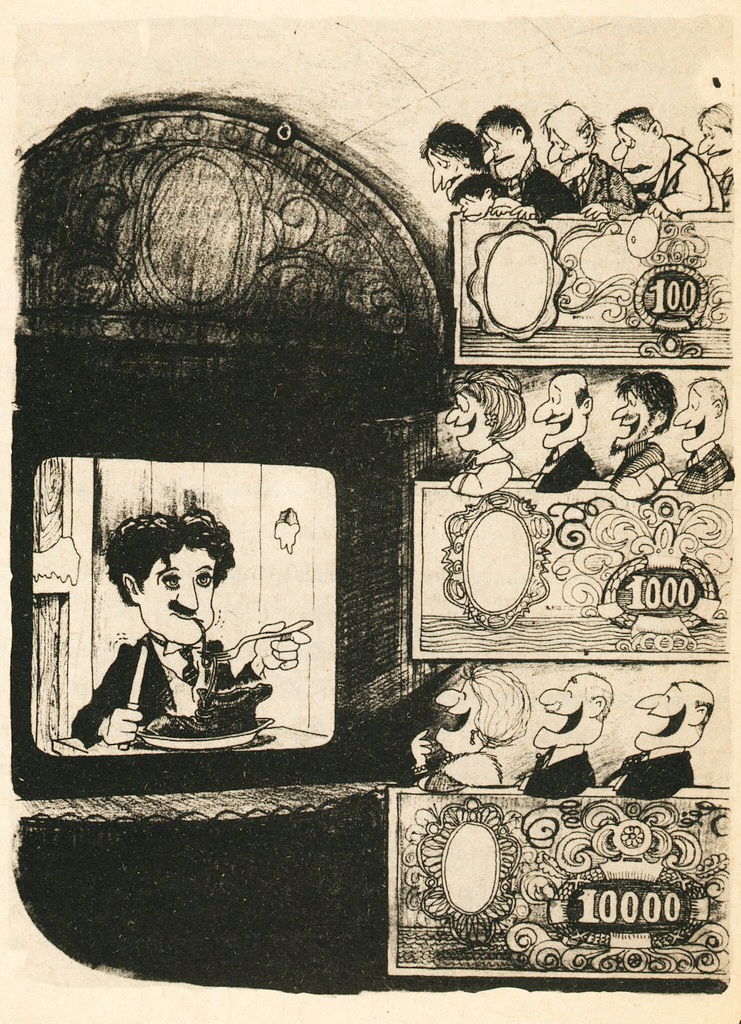
Yet I think reducing the film to such readings does it a disservice. Joker is at its most powerful when taken as a genuine character study, conveying the interiority of a damaged man falling apart (or, from another perspective, coming together) as he tries to simultaneously cope with a mental disorder and with everyday life’s micro- and macroaggressions, from wider social pressures to personal family drama. The protagonist himself explicitly tells his audience that he doesn’t want to be a political symbol, he wants to be treated as a human being with specific issues. Indeed, the film doesn’t justify the Joker’s actions so much as conceive a (physical and psychological) context in which they could emerge. The fact that we somehow empathize with this messed up protagonist is the greatest accomplishment of Todd Phillips’ atmospheric direction, which makes the most out of Lawrence Sher’s beautifully melancholic cinematography and plenty of effective needle drops along the way.
Above all, what unquestionably elevates the whole thing is Joaquin Phoenix’s nuanced, compelling performance, which, for long stretches of the film, invites you to abandon any preconceptions and just accept Arthur Fleck’s subjectivity. If part of the fun is watching Batman’s mythos turned upside down, the most enjoyable moments actually take place when you let yourself forget Joker is set in the DCU at all. Phoenix’s gentle dancing, his unsettling gaze, his unexpected mood swings, his uncontrollable laughter, his facial plasticity, and his bony, contorted body make the character more concrete than a mere metaphor for urban malaise or rampant capitalism – and surely more unique than the embodiment of a multi-media franchise harkening back to a design Bill Finger, Jerry Robinson, and Bob Kane created almost eighty years ago.
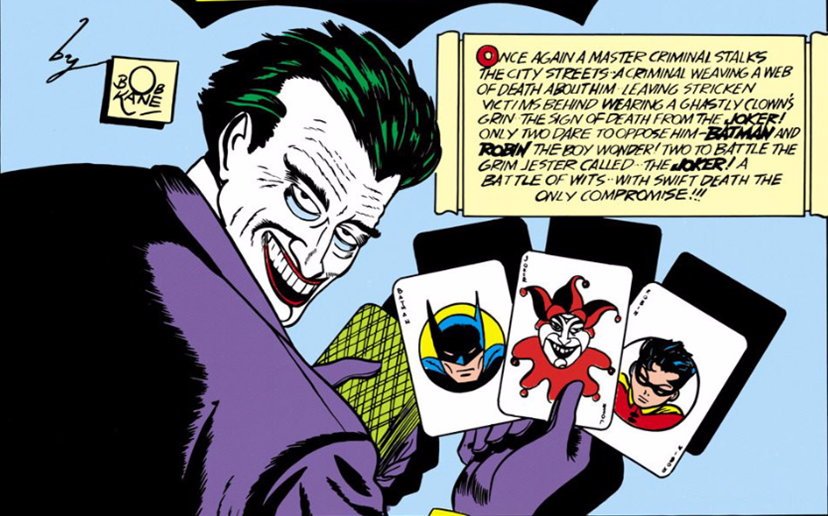 Batman #1
What won me over was not just finding at Joker‘s core a surprisingly rich and touching character-driven piece, but also the experience of navigating the tension between all the abovementioned layers, at times responding to the more dramatic aspects, other times to the geekier thrills of intertextuality, clearly not always in sync with the rest of the room. Like Arthur Fleck sitting in the audience at the comedy club, trying to make sense of what he’s seeing, I laughed when everyone was quiet and did so with a laughter that often betrayed discomfort, but I definitely got a kick out of it.
Posted in WEBS OF FICTION
Tagged Alan Moore, Bill Finger, Bob Kane, horror, Jerry Robinson, Joker, movies, politics, Quino
Leave a comment