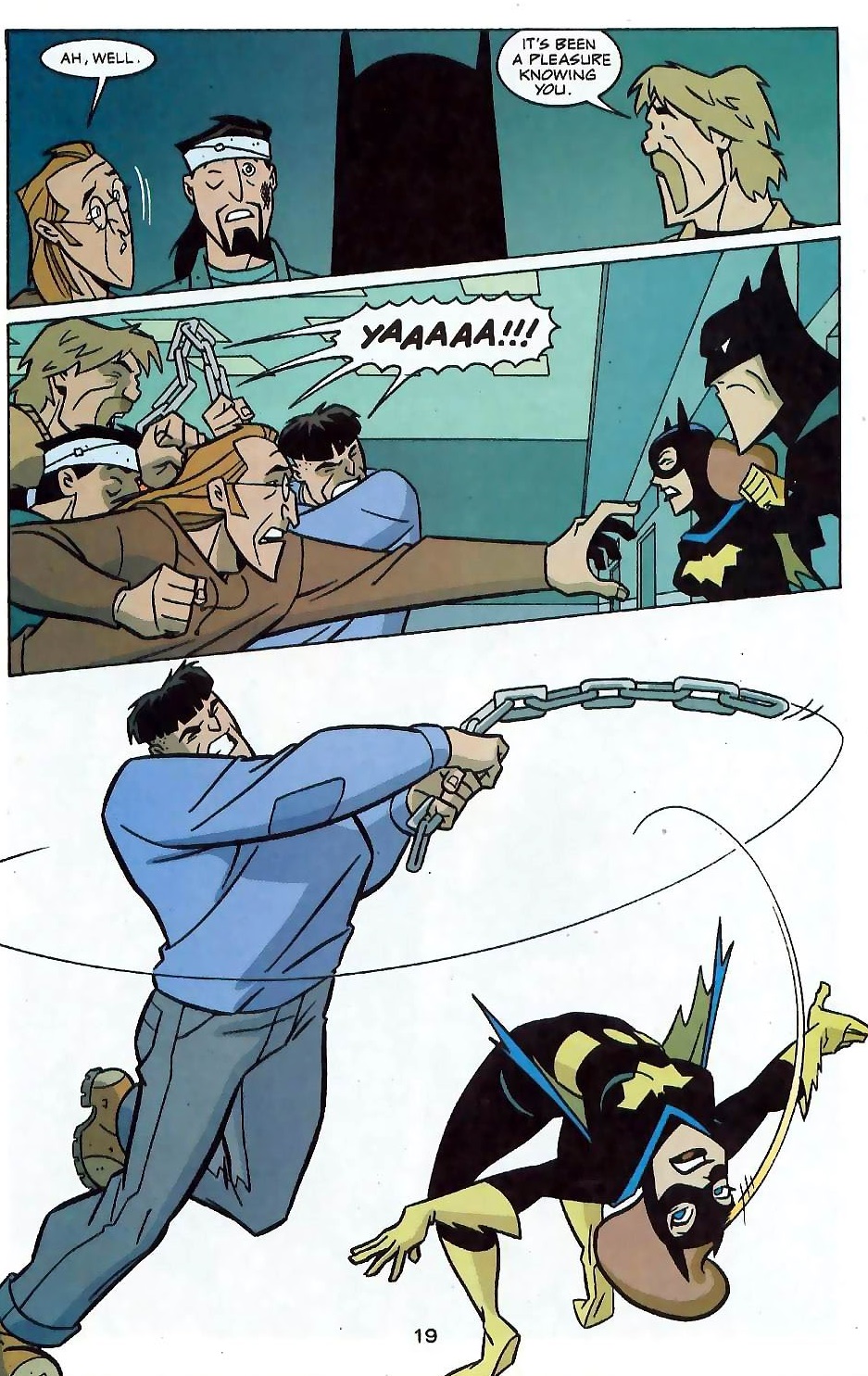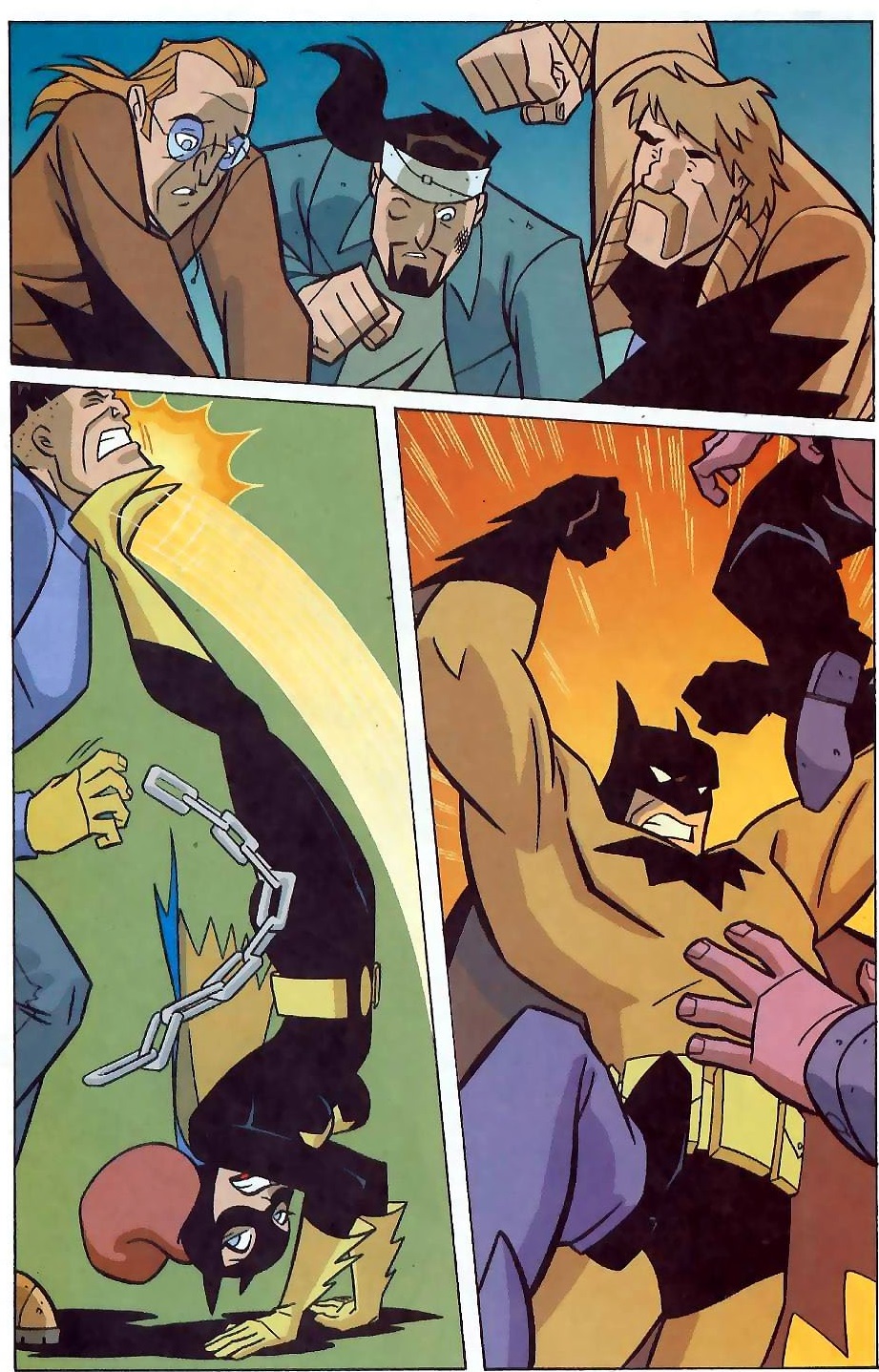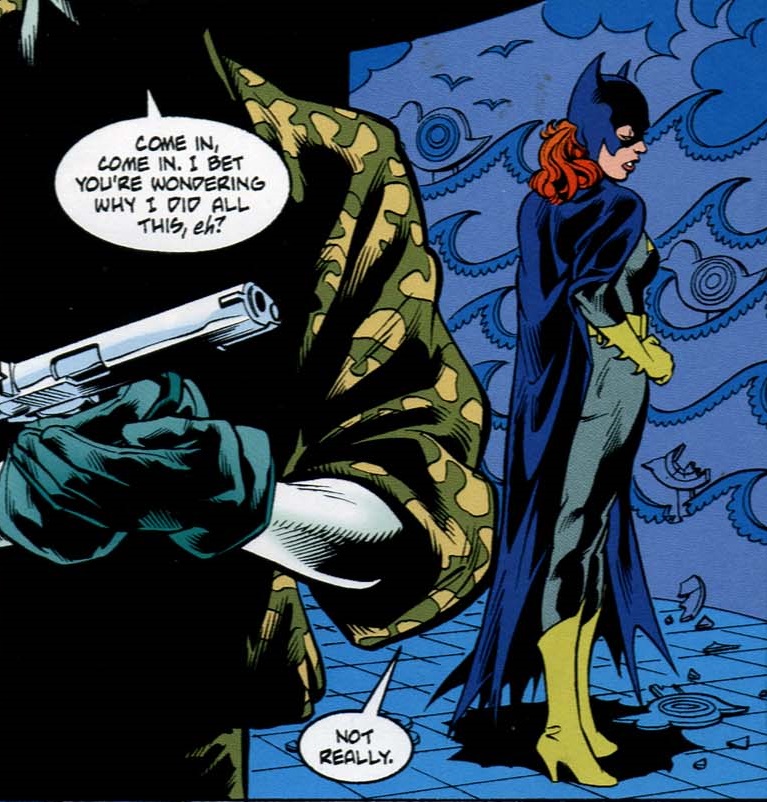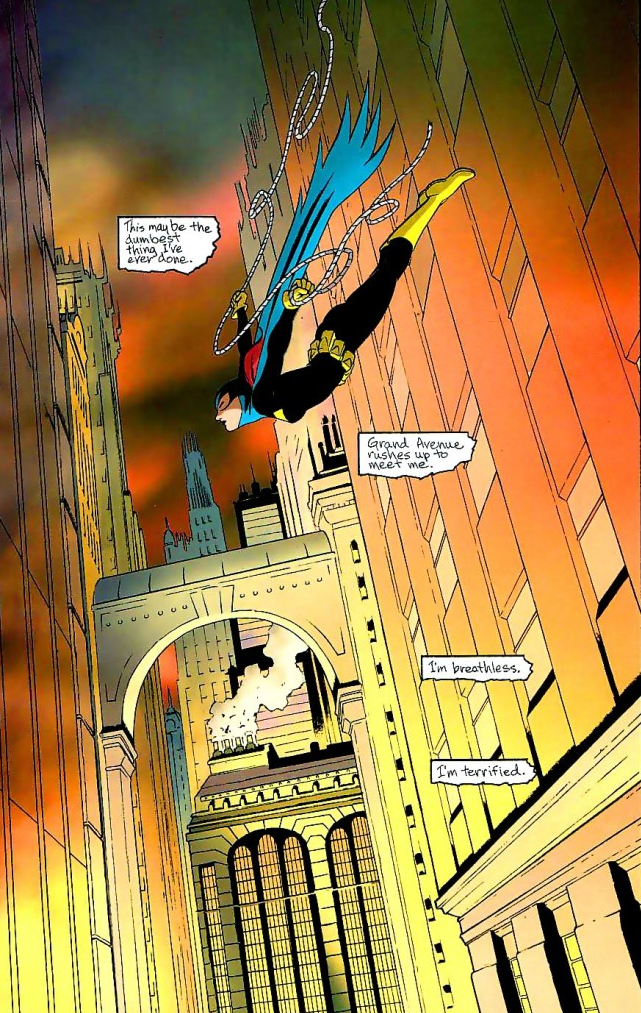
Spotlight on The Punisher – part 1

Punisher 002

Having looked at DC’s most renowned leftist vigilante last week, today Gotham Calling turns to Marvel’s notorious right-wing anti-hero, the Punisher. While he is usually quite a one-note guy (wears a skull on his chest, kills criminals, that’s it), what makes this character so fascinating is how variedly writers have approached him throughout his long, mass murderous career. Since the Punisher’s debut in 1974, depictions of his exploits have ranged from escapist guilty pleasure to thoughtful exploration of violence to downright disturbing wish-fulfilment!

Because this is a Gotham-centric blog, let me begin by pointing out the obvious: The Punisher is a very different character from Batman. Whereas Bruce Wayne saw his two parents killed when he was a kid, Frank Castle (formerly Castiglione) saw his two children and wife killed (during a picnic in Central Park) when he was an adult – in fact, by then he was already a veteran of the Vietnam War. This is important, because Bruce went on to study and train himself in order to become someone who prevents crime, especially murder (hence the ‘no killing’ rule), while Frank drew on his prior military combat experience to become someone who punishes criminals by committing as much (targeted) murder as possible.

The result is, typically, two different types of comics starring these characters. One is about a billionaire in an imaginary town with a super-theatrical alter ego who matches wits with tragic (recurring) villains, with the climax often involving the Caped Crusader preventing some ultimate evil scheme. The other is about a Manhattan-based, no-nonsense, gun-toting vet who methodically kills his way up the food chain, with the climax involving the Punisher finally killing that story’s most spiteful baddie in a particularly amusing or satisfying way.

Punisher - Batman - Deadly KnightsDeadly Knights

You can argue that, politically, both protagonists are conservative in the sense that they seek to compensate for the flaws of a presumably too liberal criminal justice system, disregarding civil rights in order to more effectively investigate (through torture, hacking, unsupervised B&E) and/or punish (execution without due process). That said, there’s an anti-death penalty message at the core of Batman comics, in contrast to the Punisher’s bloodthirsty eye-for-an-eye logic. Likewise, the former tend to have a pro-gun-control slant, with the hero going out of his way not to use guns and to prevent illegal arms traffic, while Punisher comics reflect more of a ‘Guns don’t kill people, people kill people’ attitude, not to mention ‘The best way to stop a bad guy with a gun is a good guy with a gun.’

The two franchises also feel different because they originate in distinct genre traditions. While Batman goes back to noirish pulp, the Punisher emanates from ‘70s exploitation. More specifically, his creator, Gerry Conway, modelled Frank Castle on the lead of The Executioner series of books about a former Green Beret who wages a war against organized crime to avenge his family (but, as far as I know, does not wear a skull on his chest).

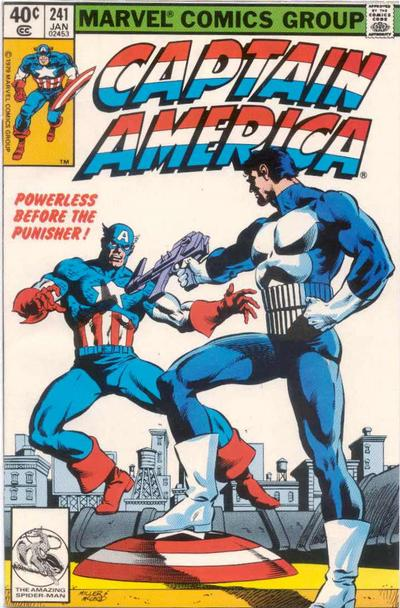
The Punisher made his debut in The Amazing Spider-Man #129. His early stories were mostly guest appearances in popular titles. Frank’s black & white morality and extreme methods would make him either the antagonist or at least a revealing contrast vis-à-vis the main star (most notably in Frank Miller’s classic Daredevil run). This means that, regardless of the character’s roots in Nixon-era vigilante fantasies, the Punisher’s initial decade-worth of comics didn’t exactly look like Dirty Harry or Death Wish, since he was constantly clashing with a dude with arachnid powers or with a shield-carrying captain dressed with an American flag…
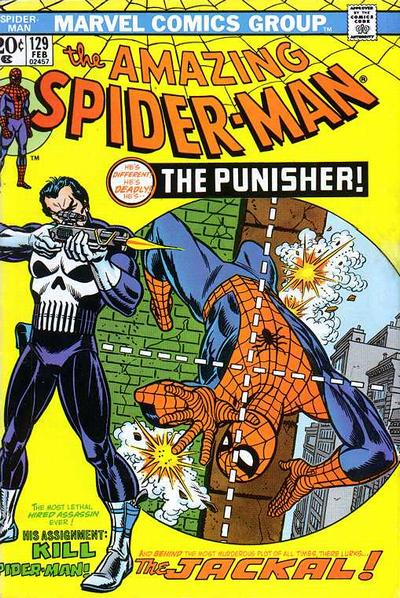
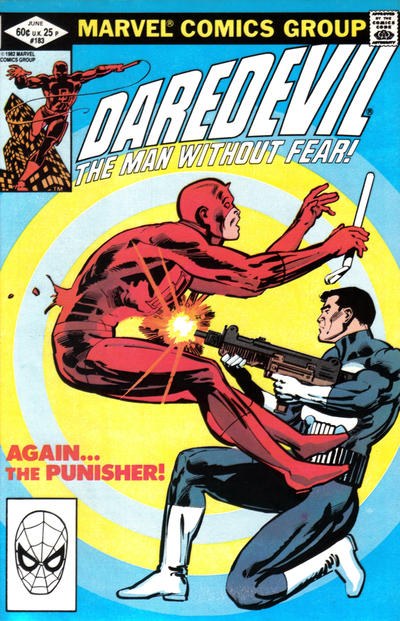
Amazing Spider-Man 129     Daredevil 183     Captain America 241

He has continued to regularly guest-star in other heroes’ adventures to this day. Writers like Matt Fraction and Rick Remender had a lot fun turning even the Punisher’s own series into straight-up superhero comics, treating Frank Castle as just another madcap aspect of the madcap Marvel Universe.

But that was not the spirit of the Punisher’s first solo series, the 1986 mini later collected as Circle of Blood:
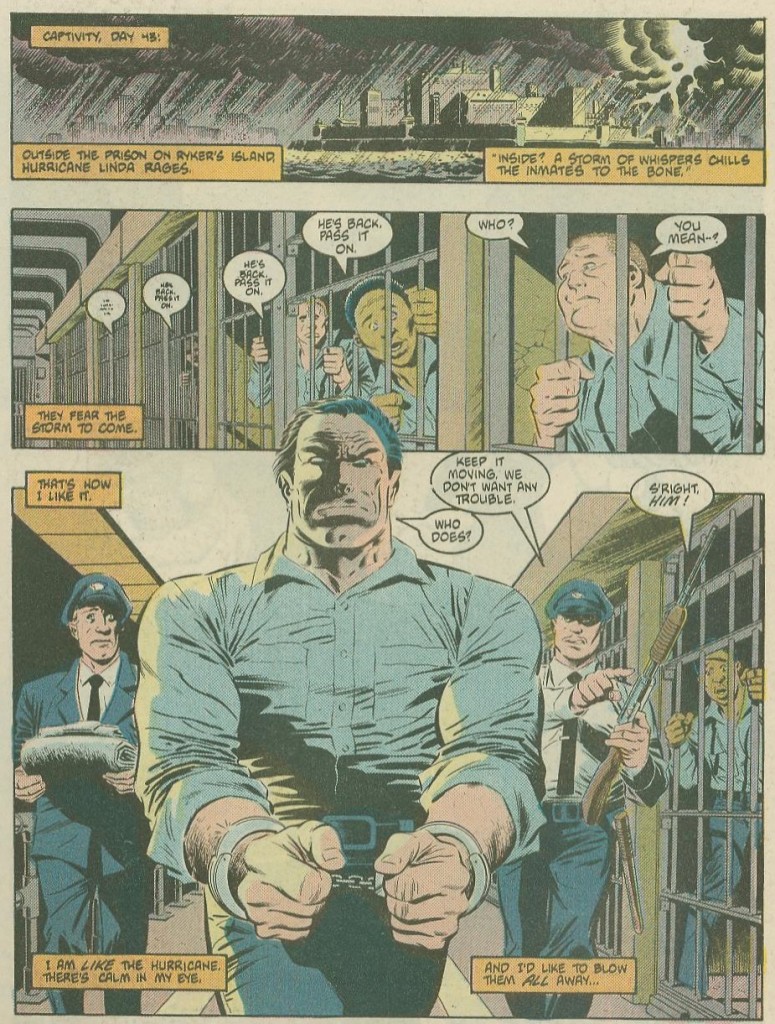
The Punisher 01 - Circle of Blood The Punisher #1

Written by Steven Grant and drawn by Mike Zeck (the duo who did the ultra-hardboiled Batman two-parter ‘Criminals’), this was one badass yarn, from the opening prison sequence all the way down to the The Italian Job-esque finale. There were no masks around and just a few brief mentions of events and characters from other Marvel comics (including Wilson Fisk and Ben Urich). As brutal as the tone was, though, the plot was still a bit hokey, as it ultimately involved Frank going up against a citizens’ organization that brainwashed criminals in order to make them part of a private squad of punishers!

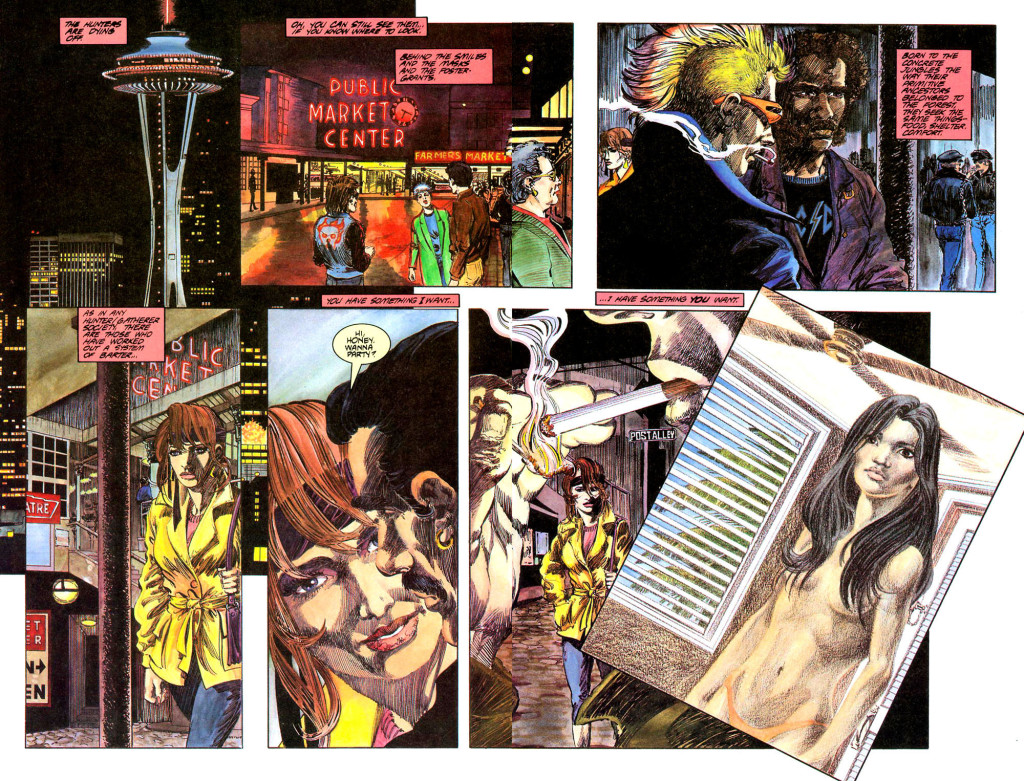
Grant and Zeck outdid themselves with Return to Big Nothing, one of the most hard-hitting Punisher stories of all time. This original graphic novel dug under the skin of the character, who went after a smuggling ring and ran into an old rival from his Vietnam days. The book provided powerful glimpses into the Punisher’s damaged psyche, as he referred to his past self in the third person (‘Frank Castle knew him.’) and fantasized about his dead wife, Maria, while sleeping with a prostitute:
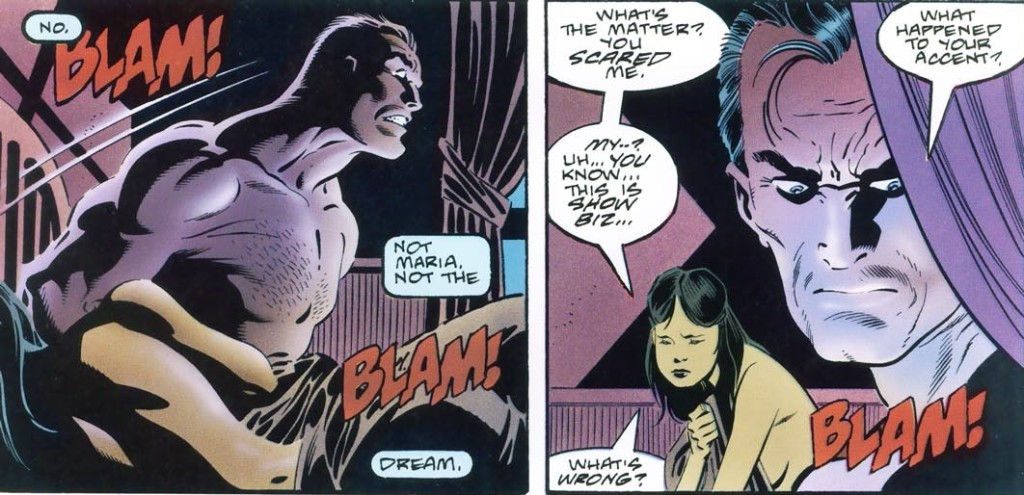
The Punisher - Return to Big Nothing Return to Big Nothing
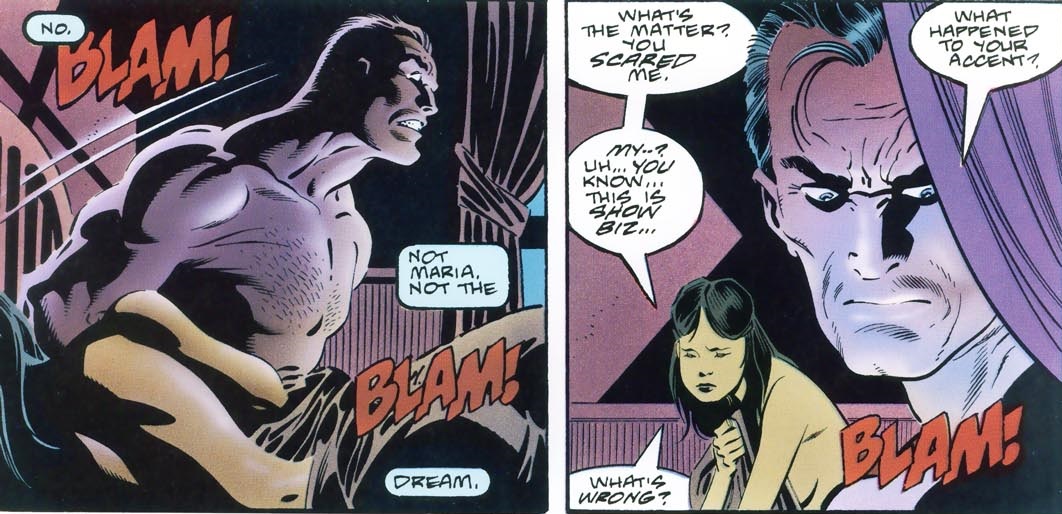
Return to Big Nothing is one of those Punisher books that also works as just a gritty, well-crafted crime comic in its own right. Another example from this time is Assassin’s Guild, written by Jo Duffy and illustrated by Jorge Zaffino. Duffy, who also helped out with Circle of Blood, is perhaps best known to Bat-fans for her ‘90s run in Catwoman (and to Marvel fans for her run in Power Man and Iron Fist, which was the most amusing combination of Blaxploitation and Kung Fu since Cleopatra Jones and the Casino of Gold).

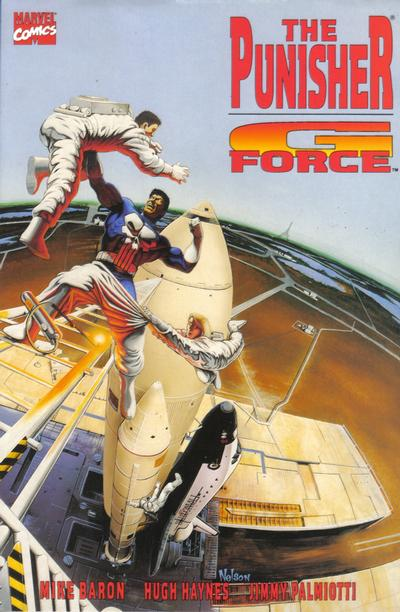
The most prolific Punisher writer of the late-eighties/early-nineties, Mike Baron, had more of a popcorn entertainment approach to the character. Baron, who among other things launched The Punisher ongoing series that would last for over one hundred issues, wrote big, brash escapades full of explosive action. His Frank Castle wasn’t a grim Eastwood or Bronson but more the gung-ho Schwarzenegger/Stallone of Commando, True Lies, Rambo, and Tango & Cash.

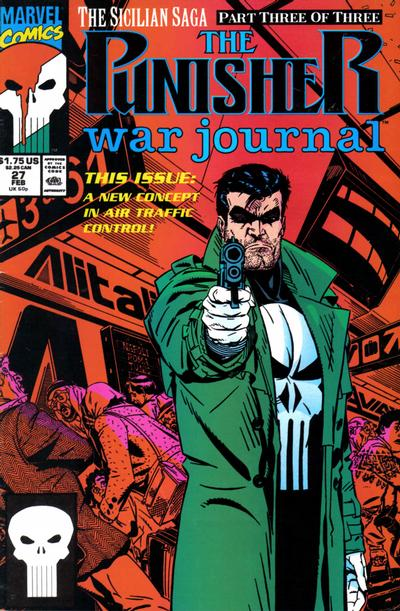
The Punisher 001     Punisher War Journal 27     Punisher G-Force

Better yet, Mike Baron’s comics, written through a coked-up haze, didn’t feel like blockbusters as much as like sleazy post-grindhouse, straight-to-VHS B-movies gleefully ripping off box office hits. The Punisher used every conceivable tactic of urban guerrilla and, likewise, suffered all kinds of torture before escaping with the help of a ‘diamond-tipped manicure’ that enabled him to cut through ropes with ultra-sharp fake fingernails. Enacting id-driven revenge scenarios, Frank slaughtered enemies straight from the headlines – in the first ten issues of The Punisher (still quite taut, before things got really over-the-top), he took his war to ghetto drug dealers, a Bolivian cartel, Missouri white supremacists, a cult led by a proto-Charles Manson, Arab terrorists, and Wall Street inside traders.

Baron and other writers of that era tended to depict the Punisher in a sympathetic light. Although he was clearly a psycho, for the most part this version of the character didn’t come across as necessarily more unbalanced than your average action movie hero. Apart from the size of the body count, he could’ve been called Martin ‘Lethal Weapon’ Riggs or Marion ‘Cobra’ Cobretti. Frank Castle was just one tough bastard who had declared war on criminals and, true to his marine background, was willing to kill them in cold blood, but he hadn’t completely lost his humanity. He could blend in and be charming with the ladies. He even had a buddy, Microchip, a hacker who regularly helped him out – with their military banter and resourceful libertarian justice, they were like a two-men A-Team.

What’s more, true to the character’s ‘Men’s adventure’ origins, the Punisher became a veritable globetrotter, going wherever he felt righteous killing needed to be dispensed. This is him in Marvel’s version of the Middle East, trying to blend in by wearing a moustache:
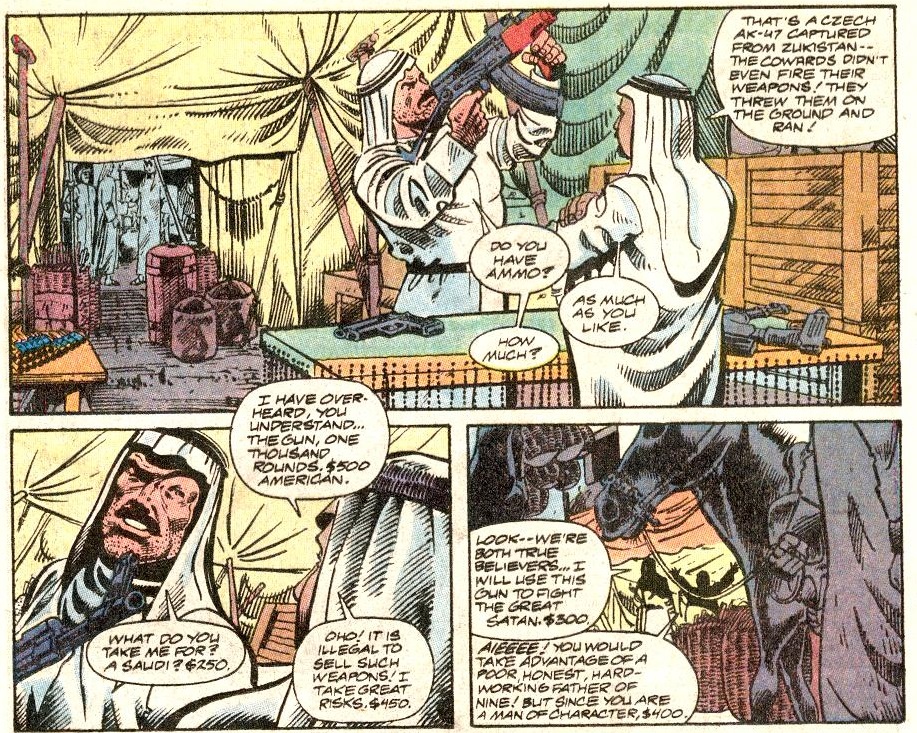
The Punisher 047 The Punisher (v2) #47

All this traveling meant that the Punisher also got involved in international politics. It helped that Microchip was a self-professed Zionist and that one of the few recurring villains was Saracen, an Arab mercenary.

Saracen played a role in memorable storylines, including ‘The Sicilian Saga’ (which had an amusing follow-up titled ‘Let Them Eat Cake’), ‘The Brattle Gun,’ and ‘The Kamchatkan Konspiracy.’ No holds were barred in these comics, particularly in the latter one, which featured a proto-Jane Fonda, the Crips, the Bloods, a disintegrating Soviet Union, and a radical environmentalist group called HOP – Humans Off Planet. It also contained a curious scene in which Saracen reacted to his depiction as an Orientalized stereotype:
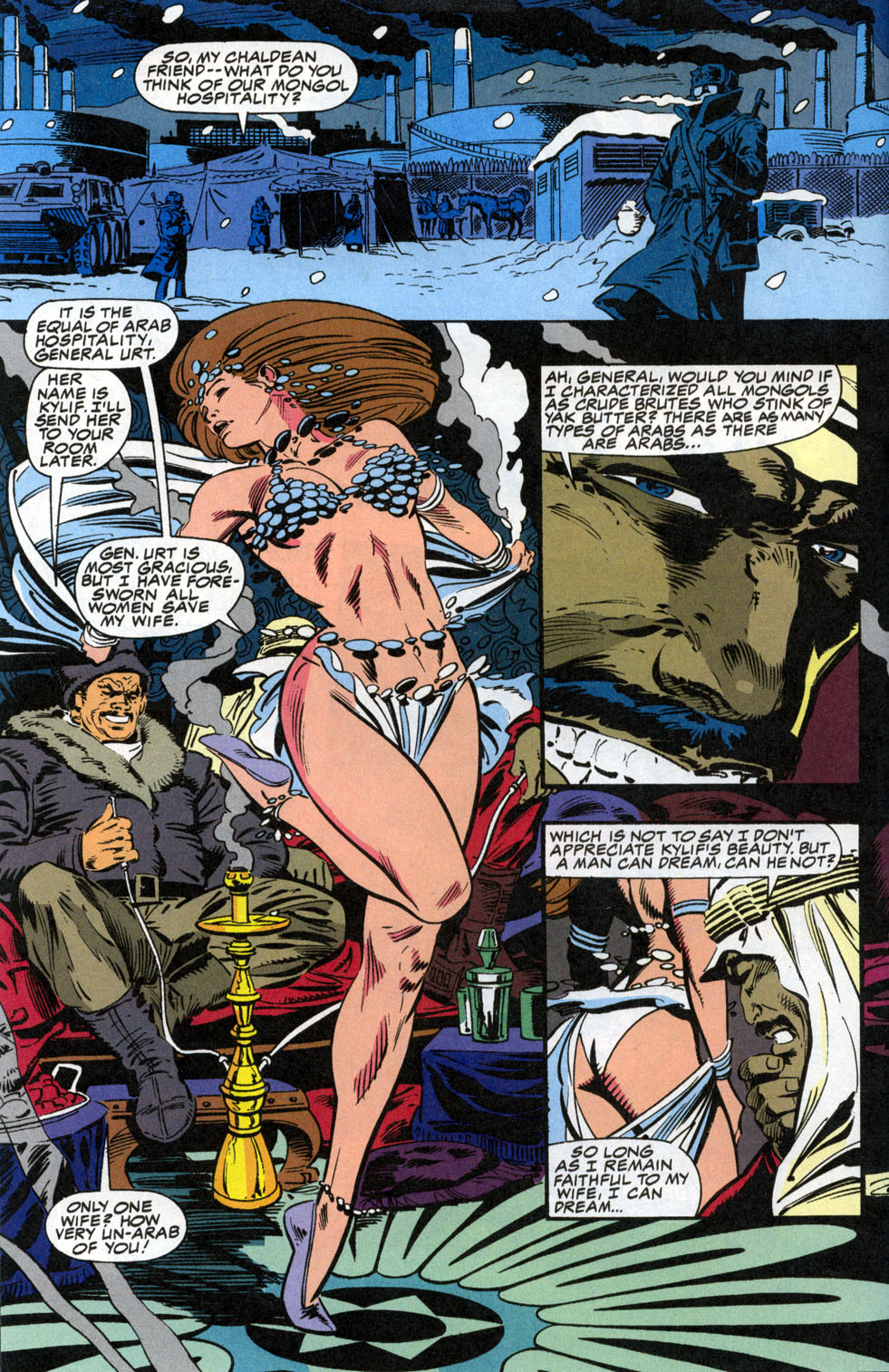
The Punisher War Journal 33The Punisher War Journal #33

Me, I’m a sucker for short, kick’em-and-leave’em stories like ‘Border Run,’ which operate on the premise of just dropping the Punisher on a hostile location, with a clear objective, and watching him improvise while out of his element for 22 pages.

The master of this type of self-contained single issues was Chuck Dixon. With his clipped dialogue and dynamic storytelling, Dixon wrote a bunch of tight variations of Die Hard starring the Punisher – in a taxi cab (‘One Way Fare’), in the snow (‘Death Below Zero’), in the supermarket (‘The Big Check-Out’), in a train (‘Armageddon Express’), or while falling from a goddamn airplane (‘Terminal Velocity’).
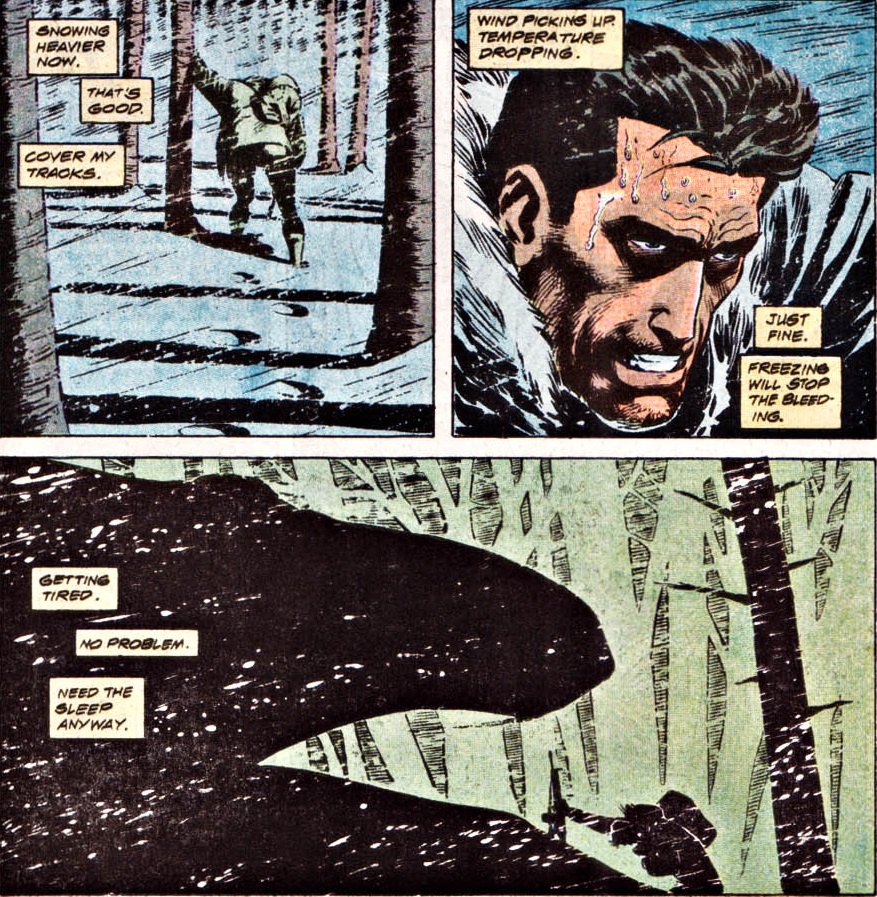
The Punisher 049The Punisher (v2) #49

Chuck Dixon also got to do a Frank-Castle-in-Vietnam flashback for Marvel’s surprisingly long-running Vietnam War comic The ‘Nam (issues #67-69). Frank had shown up in the series before (issues #52-53), but letting Dixon have a go at it just seems like a logical option since he’s such a great author of war tales (check out his Team Zero or, if you like a bit more pizzaz to go with your military fiction, his prose novels about time-travelling Army Rangers, Bad Times, starting with ‘Cannibal Gold’). Dixon later brought back The ‘Nam character Ice Phillips in the neat two-parter ‘Heart of Ice/Heart of Stone.’

Moreover, Dixon could write epic adventure better than anyone else, throwing the Punisher into large-scale, twist-filled missions in the Caribbean and Eastern Europe. Kingdom Gone (art by Jorge Zaffino), River of Blood (art by Joe Kubert), and Barbarian with a Gun (art by John Buscema) remain hands-down some of the best Punisher comics ever.

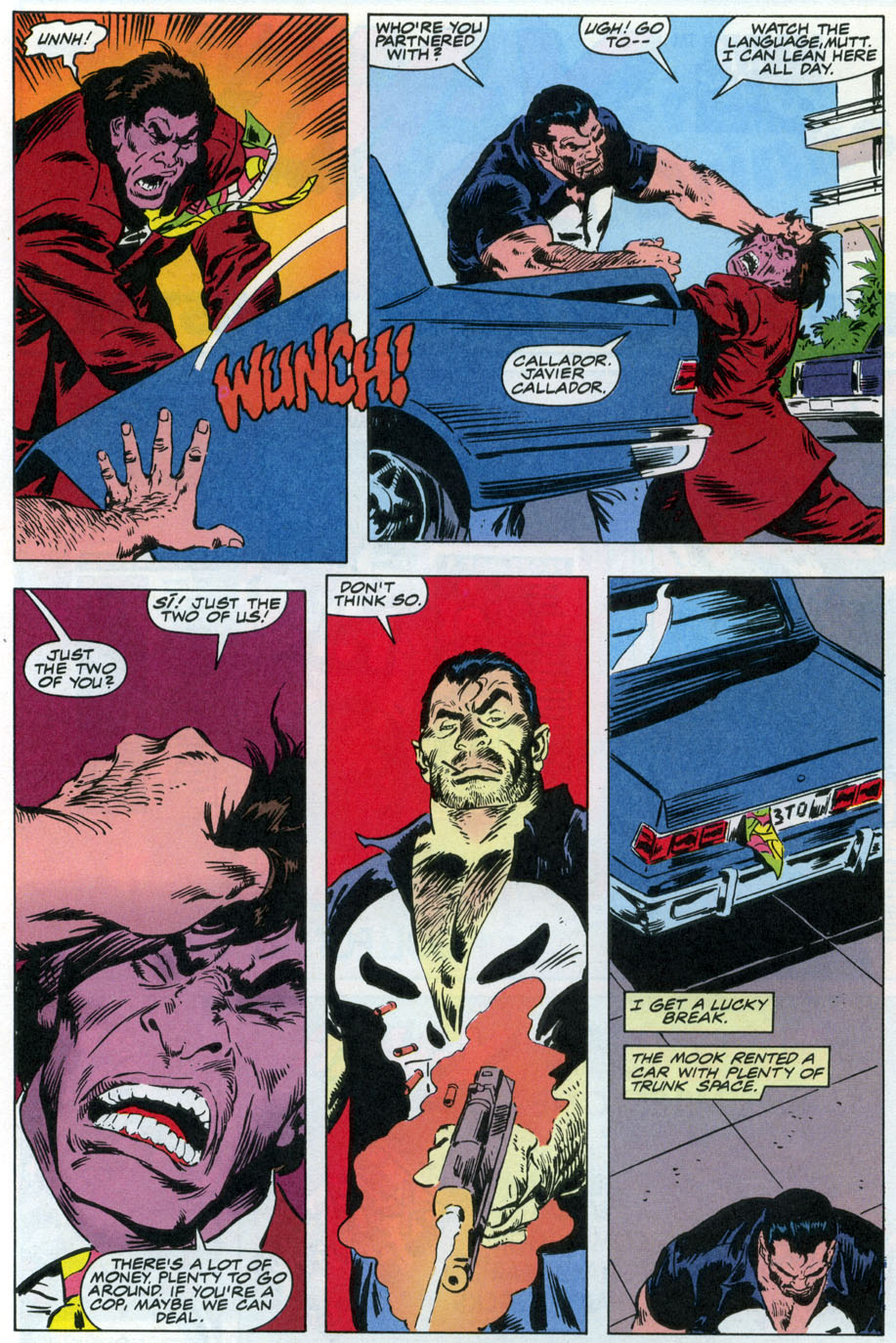
The Punisher - War Zone 26 The Punisher - War Zone 26 The Punisher War Zone #26

It’s hard to overstate how popular the Punisher was in the early 1990s. At one point, he had three simultaneous ongoing series: The Punisher, The Punisher War Journal, and The Punisher War Zone. Then there were the yearly Holiday Special (my all-time favorites), Summer Special, and Back to School Special, plus several one-shots, plus a semi-regular series devoted to Frank’s weapons called The Punisher Armory. That’s right, there was a time when Marvel targeted kids with comics that consisted entirely of pin-ups detailing the killing power of various weapons!

Ultimately, your enjoyment of the Punisher’s escapades hinges on how seriously you are willing to take their moral implications. Some readers just dig the exhilaration and catharsis. Others, worryingly, may find themselves regarding the series’ hero with a measure of understanding or even admiration. Others will no doubt object, not only to the celebration of macho violence, but to the comics’ problematic racial dimension.

I would argue that some writers got away with it by keeping their comics on the border between actually embracing the Punisher’s quasi-fascist values and merely entertaining readers with his high-octane exploits. Notably, there was a streak of dark humor running through many of these issues. For example, capping stories with dry punchlines was a common move used by Steven Grant (‘Red Christmas,’ ‘Last Confession,’ ‘Bodies of Evidence’), Mike Baron (‘The Spider,’ ‘Bad Tip,’ ‘Confession’), and Chuck Dixon (‘Slay Ride,’ ‘Good Money After Bad,’ ‘Ten-To-One’).

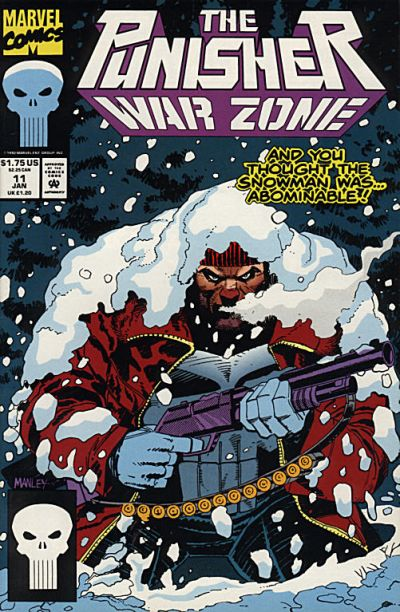
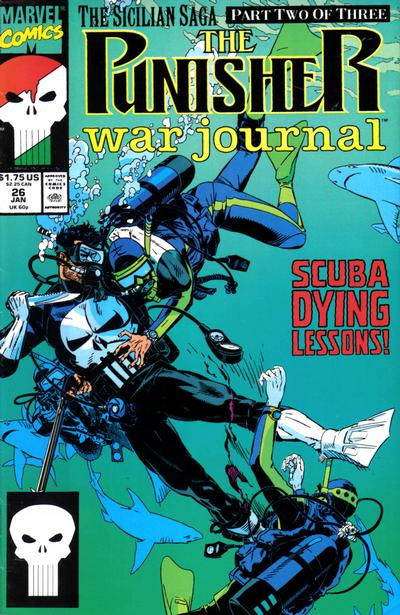
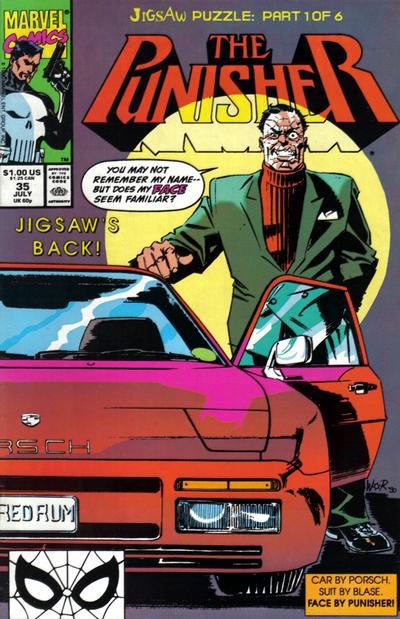
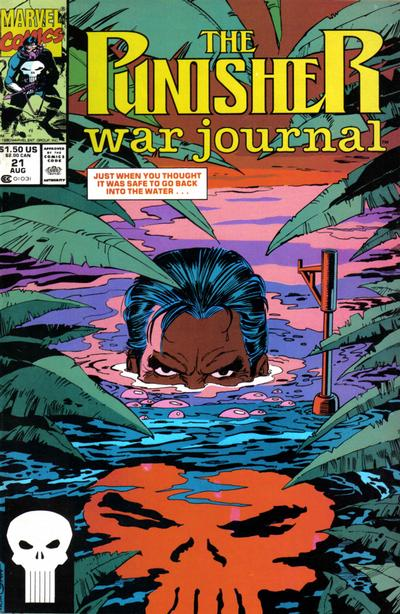
The covers were quite tongue-in-cheek as well. They featured a menacing-looking Punisher, yet superimposed hilariously cheesy tag lines like ‘Every year, Hawaiian vacations end safely and happily for more than a million people. They aren’t in this issue.’ or ‘Summertime… and the living ain’t easy… but dying is… in the killing fields!’
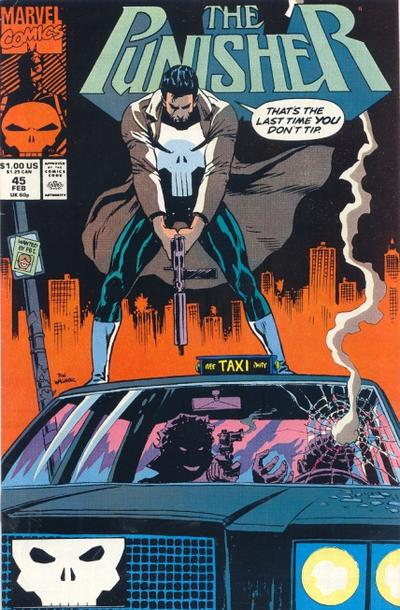
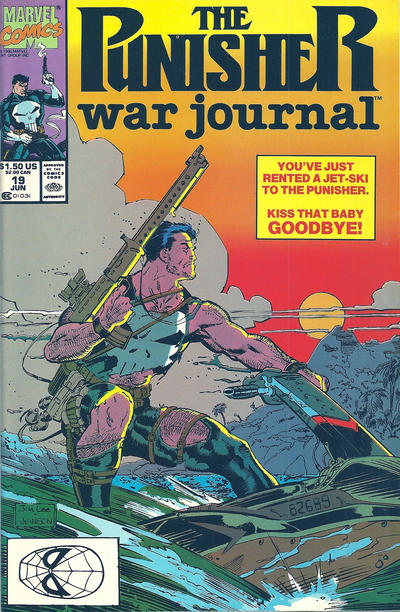
The Punisher 45     The Punisher War Journal 19     Punisher War Zone 11

Punisher War Journal 26     Punisher 35     Punisher War Journal 21

Still, despite the awesome covers, the ’90s Punisher comics weren’t treated as *primarily* comedic. But that was about to change…

NEXT: More Punisher.
Posted in HARDBOILED CRIME | Tagged , , , , , , , , , , , , , , | 2 Comments

Spotlight on Mike Grell’s Green Arrow

Every once in a while, I like to shift gears and talk about comics set outside Gotham City that Batman fans should nevertheless enjoy because their genres (crime, superhero, fantastic adventure) are close to the mood of the Dark Knight. This month I’m taking it one step further: each week, I’ll be looking at comics about street vigilantes who don’t dress as bats yet also kick tons of ass.

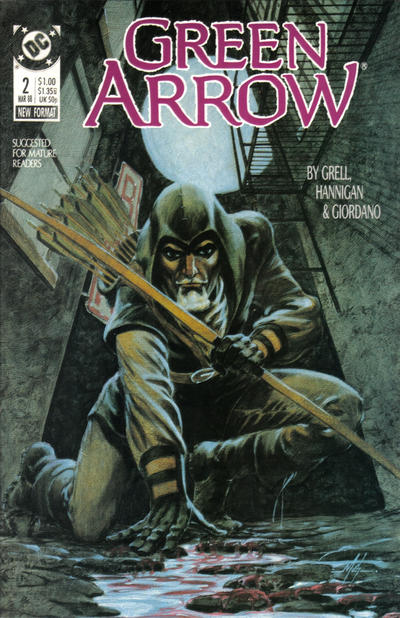
To get things started, let’s have a look at Mike Grell’s extraordinary run on Green Arrow (1987-1994):

Green Arrow 002

First, some context. Oliver ‘Ollie’ Queen, aka Green Arrow, had been around since 1941. He operated out of Star City and his main gimmick was archery, with Ollie’s weapon of choice being trick arrows (including an infamous one tipped with a boxing glove). That said, for most of his crime-fighting career Green Arrow had been little more than a Batman knockoff. He was a billionaire playboy with a teen sidekick (Roy Harper, aka Speedy). He even drove an Arrow-Car and flew an Arrow-Plane and his headquarters were an Arrow-Cave and he was summoned by a freaking Arrow-Signal!

The Brave and the Bold cartoon had a lot of fun implying that basically Batman and Ollie had an alpha male dick competition going on. Regardless, the fact is that their team-ups really gelled, both in the show and in the comic (especially in the neat stories ‘The Senator’s Been Shot!’ and ‘Double Your Money – and Die!’). Green Arrow even played a memorable role at the climax of The Dark Knight Returns.

Expanding on the whole archer motif, in 1969 Green Arrow became more like Robin Hood. Neal Adams redesigned his looks to bring him closer to Errol Flynn while Denny O’Neil turned him into DC’s voice of social consciousness. Writers found in the ‘left wing hero’ persona a way to carve out a niche for the character and, crucially, to help distinguish him from Batman’s more by-the-book, law-and-order, keeper-of-the-status-quo attitude:

detective comics 559Detective Comics #559

Which brings us to Mike Grell’s The Longbow Hunters, a 1987 prestige format mini-series which revamped Green Arrow with a more realistic and oh-so-eighties’ vibe. In fact, this is about as ‘eighties’ as a comic can get: there’s drugs, sex, serial killers, the Yakuza, gallons of graphic violence (particularly towards women), post-Vietnam trauma, and a whole subplot inspired by the Iran-Contra scandal.

If you’re into grit, though, this is as good as it gets. And let’s be fair, there is some enduring appeal to that kind of intense ‘80s mood (which is why we’ve seen so many great throwbacks to that period in recent movies such as Cold in July, The Guest, and House of the Devil). While there were plenty of cringeworthy, uninspired attempts to ride the post-Watchmen, post-Dark Knight Returns grim ‘n gritty comics wave, The Longbow Hunters actually pulled it off. Grell wrote Oliver Queen as an ageing romantic (just turned 43), in a mature relationship, coming to terms with the complexities of a brutal world. The book densely and powerfully overlapped symbols and narrative strands.

It also benefitted from gorgeous art by Mike Grell and Lurene Haines, with colors by Julia Lacquement:

Green Arrow longbow huntersThe Longbow Hunters #1

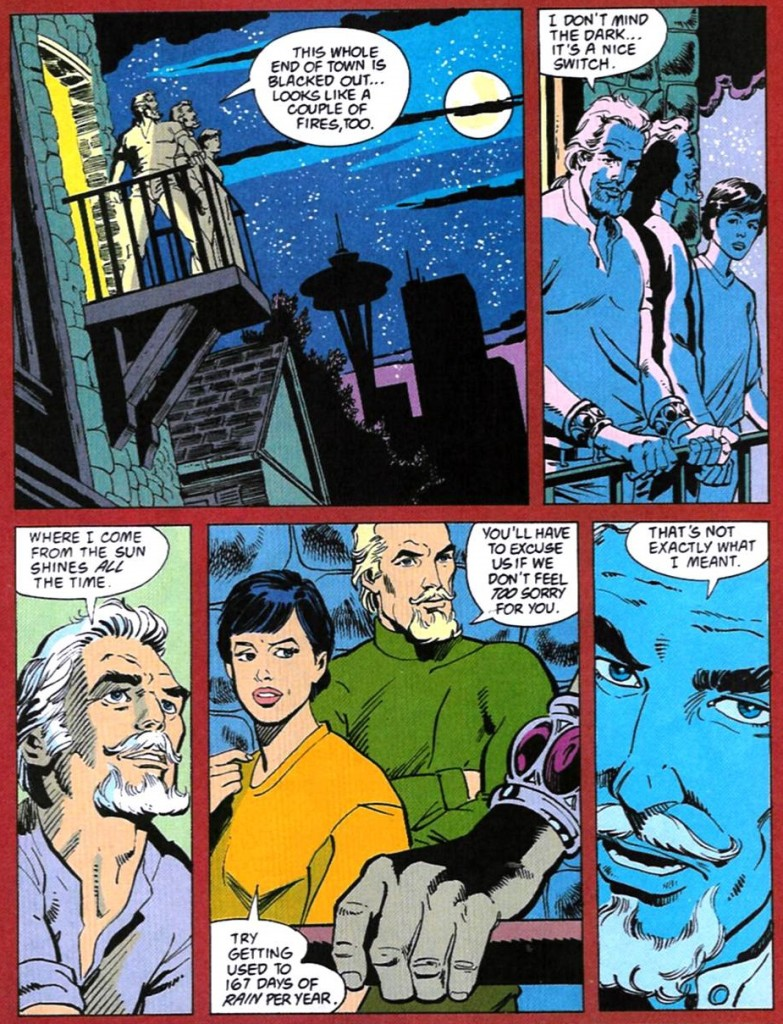
The Longbow Hunters built on some of Green Arrow’s established elements (including his love for Robin Hood and Errol Flynn) while throwing others completely out the window. Oliver Queen moved to Seattle with his girlfriend Dinah Lance (aka Black Canary) and did away with the trick arrows and the most ridiculous features of his costume. This was a soft reboot, though, with Grell briefly acknowledging the past and showing, in-story, the characters’ decision to evolve. For example, you can still see a bunch of old trick arrows in the basement as Dinah explains to Ollie that the new costume is more practical for Seattle weather.

Dinah’s subplot is the most notorious aspect of the comic, as she is captured and tortured (although not, as some insist, raped), leading Ollie to kill in order to rescue her. For better or worse, this reinforced Mike Grell’s dark, pull-no-punches approach, soon carried into a peerless, long-running Green Arrow series for which he wrote the first 80 issues.

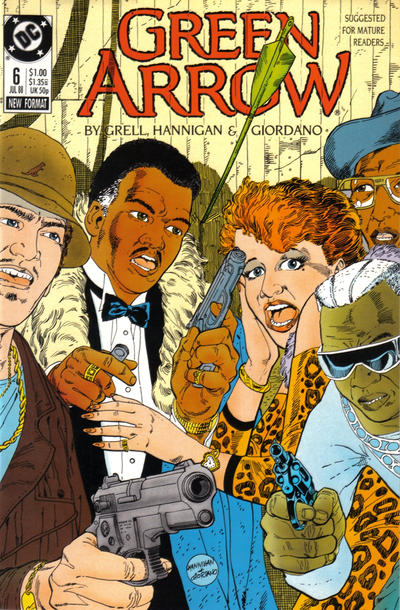
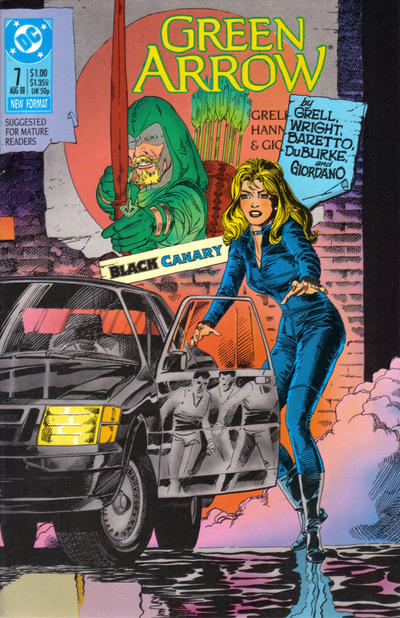
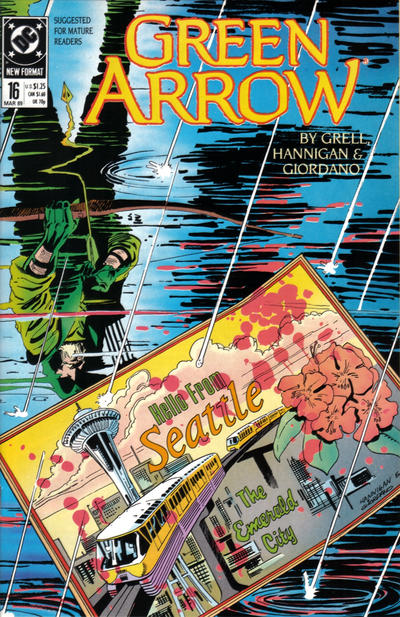
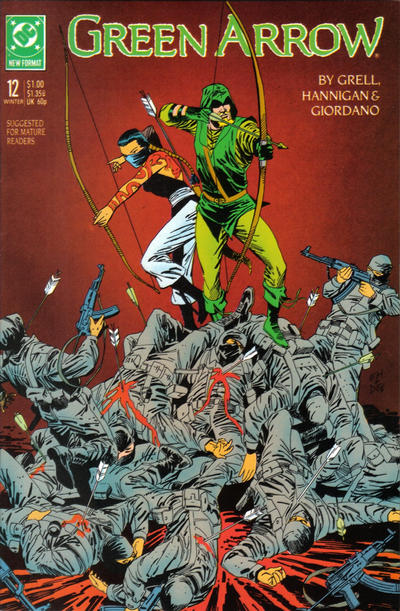
As impressive as The Longbow Hunters was, what followed was a tremendous action series. Seriously, you knew they were doing something right because you didn’t even find yourself questioning how a guy armed with a bow and arrow repeatedly managed to outdraw dudes carrying guns! Of course, it helped that penciller Ed Hannigan and inker Dick Giordano were the first team to take over art duties, because those two can get away with murder. Even better, not only did we get truly stylish inside art, but also a set of covers that almost rivals their work on Batman:

Green Arrow 006     Green Arrow 009     Green Arrow 014

Green Arrow 7     Green Arrow 16     Green Arrow 12

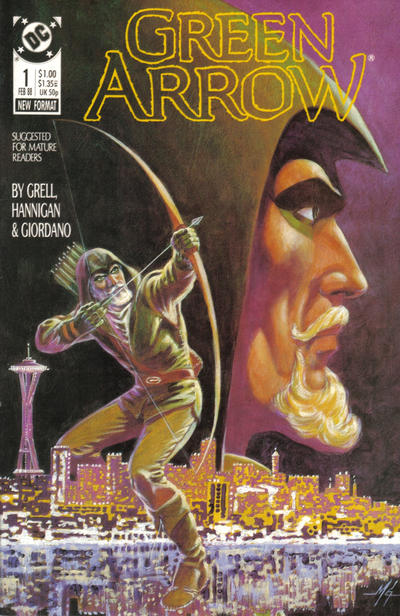
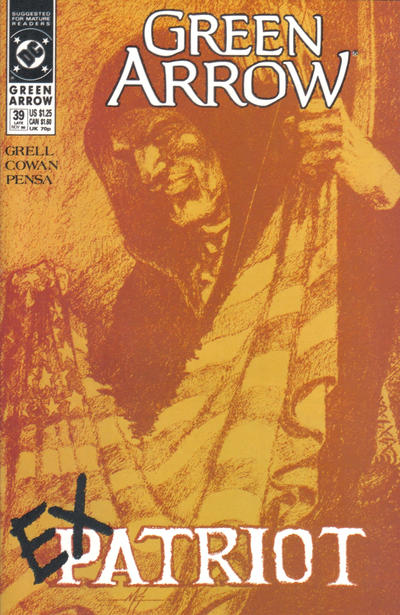
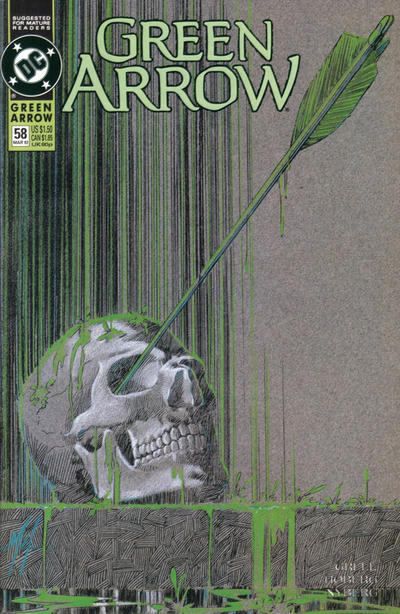
To be fair, Mike Grell painted some pretty amazing covers as well:

Green Arrow 01     Green Arrow 39     Green Arrow 58

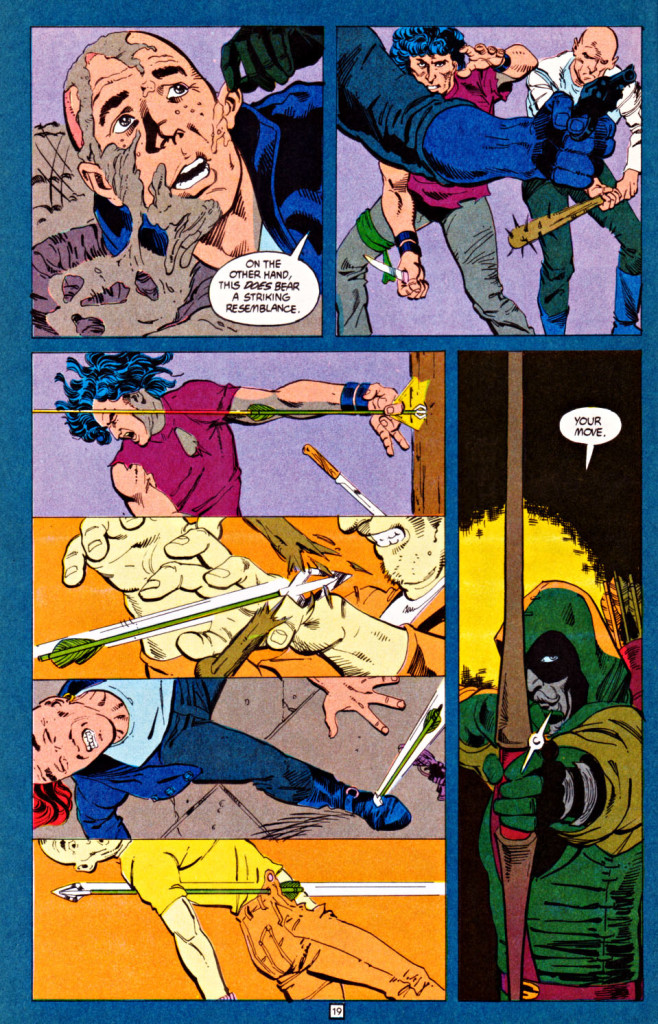
Running with the notion that Green Arrow was an urban hunter and criminals his prey, Mike Grell effectively wrote the comic as a ‘mature readers’ crime book with some two-fisted adventure and espionage thrown in for good measure (there was even occasional swearing and nudity). Many stories were tight, two-part mysteries, although Grell kept shaking up the status quo, thus preventing things from becoming too formulaic. My favorite of these is probably ‘Moving Target’ (issues #1314), a taut whodunit full of great character work and fine Dan Jurgens art:

Green Arrow 13Green Arrow 13Green Arrow (v2) #13

(The mix of skins and punks in the gang is a bit confusing, though. Doesn’t their leader know that skinheads aren’t allowed in Mohawk Town?)

Notably, Mike Grell stripped Oliver Queen’s life of any superhero shenanigans – the protagonist wasn’t even referred to as ‘Green Arrow’ despite that being the title of the series! Yet, perversely, part of the fun of reading the comic is spotting how far Grell can get away with acknowledging that these tales take place in the DC Universe while hiding any otherworldly elements. Dinah Lance was still around, but she lost her Black Canary sonic scream powers as a result of the torture she endured in The Longbow Hunters (she didn’t even suit up until issue #59, except for some foreplay in #34). Hal Jordan (aka Green Lantern) showed up in issues #19 and #20 (and in a photo in #69) but he didn’t wear his signature costume or magic ring. He also didn’t *explicitly* mention the fact that they had once fought a telepathic girl who looked like Richard Nixon:

Green Arrow 20Green Arrow (v2) #20

John Constantine (of Hellblazer fame) had a cameo in issue #25. Travis Morgan (of The Warlord fame) popped up in issues #27 and #28. Grell, who had created Travis back in 1975, played with how similar the two heroes looked, with several characters unable to tell them apart. And beautifully, Mike Grell managed to fit this warrior from a sword & sorcery comic into Green Arrow’s more grounded tone by only alluding to the character’s origin in very cryptic terms:

Green Arrow 28Green Arrow (v2) #28

Apart from Green Arrow and Black Canary, the only other hero to show up in costume was Roy Harper, who had upgraded from Speedy to Arsenal. This was close to the end of Grell’s run, in issue #75!

For all the winks to the DC Universe, Mike Grell decisively kept his feet in our own reality, dealing with topical issues such as gay-bashing, oil spills, and illegal poaching (although sadly we never got to see Ollie’s reaction to the premiere of Mel Brooks’ Robin Hood: Men in Tights). While the comic didn’t usually feel as preachy as back in Denny O’Neil’s time, Grell often engaged with real world politics, like in issues #61-62, where Green Arrow and Black Canary came across a town violently torn over the possible institution of a military draft. Significantly, Oliver Queen seemed to shift from a mouthpiece of liberal progressivism into more telluric libertarian territory, especially as the vigilante sometimes used deadly force and lawlessly fought against sinister government conspiracies. At one point, Ollie even befriended an IRA terrorist.

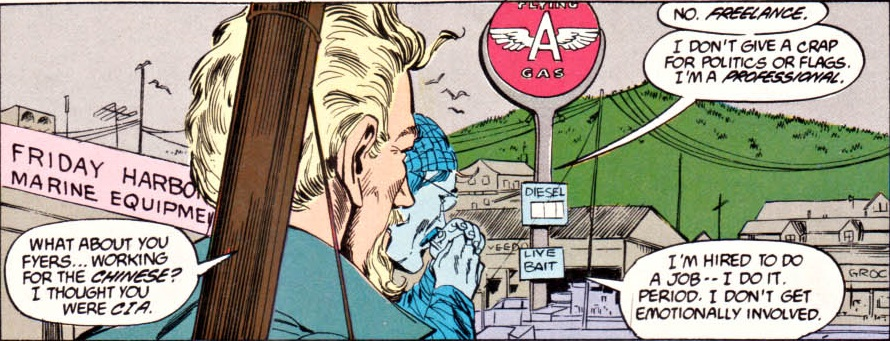
In line with this political undercurrent, one of the most awesome additions to Green Arrow’s cast was the cynical mercenary Eddie Fyers, who was amusingly unpredictable.

Green Arrow 04Green Arrow 04Green Arrow (v2) #4

This is a scene from the ‘The Champions,’ in which the Soviets send Green Arrow to retrieve a strayed biological weapon before the Chinese can get their hands on it. (Hey, it was the late Cold War, OK? They were getting desperate!)

Oliver Queen’s involvement with shadowy agencies doesn’t stop there. In ‘Here There Be Dragons,’ the CIA blackmails our hero into recovering a treasure map (although of course things prove to be way more complicated than that). In ‘Blood of the Dragon,’ he prevents the assassination of a major world leader. In ‘The Black Arrow Saga,’ Ollie is arrested for treason, having been framed for helping to blow up a U.S. Navy vessel in the Panama Canal (leading to a great moment in which he tells President George Bush to kiss his ass). He works with the Mossad in ‘…And Not a Drop to Drink.’

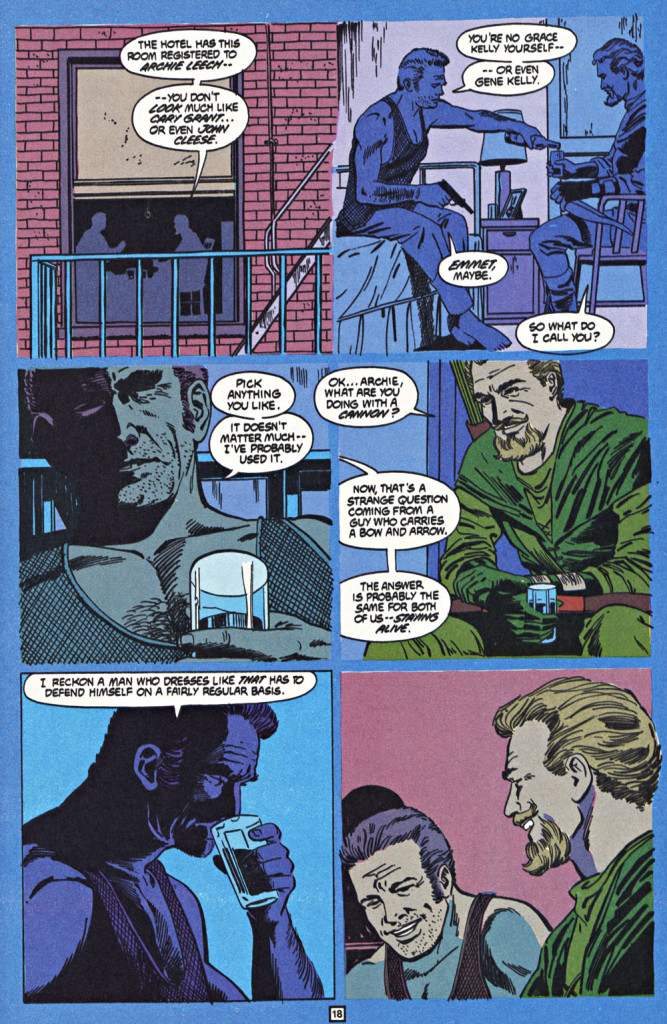
In ‘Seattle & Die,’ Green Arrow meets a mercenary who fought in Rhodesia and Mozambique and who is now on the run from the Australian Security Intelligence Organization. Check out this nice moment they share:

Green Arrow 15Green Arrow (v2) #15

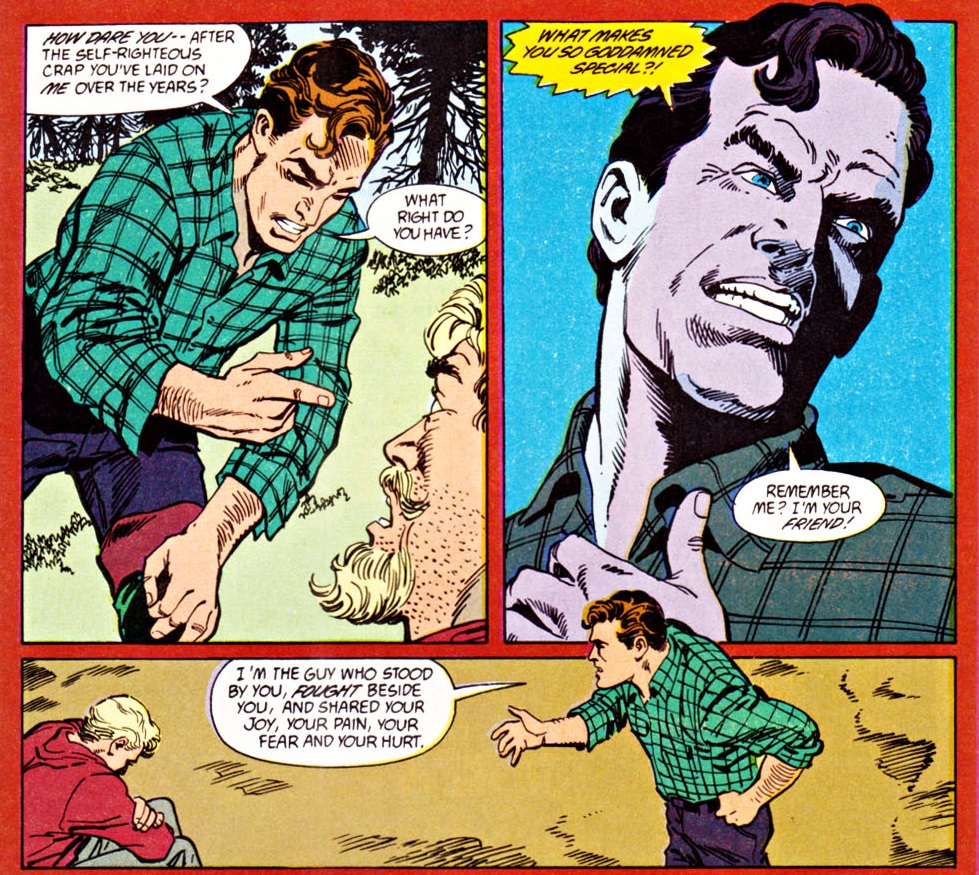
As you can probably tell by now, many of these comics involved male bonding between Oliver Queen and other tough guys. But it wasn’t a total sausage fest. Dinah Lance had a strong presence and a well-rounded arc throughout the series. For one thing, after dealing with the trauma of the earlier torture scene, Dinah got to rescue Ollie when he found himself in a similar predicament and break with the gender stereotype. And crucially, The Longbow Hunters had introduced Shado, a mysterious Japanese archer whose family had suffered in a WWII internment camp. She became part of a cool yearly tradition – Mike Grell wrapped Shado-related storylines around Ollie’s birthdays, with the two characters growing increasingly closer. Grell also gave Shado her own spinoff mini-series, the hard-hitting Song of the Dragon.

In another Grell-written spinoff, The Wonder Year, the writer expanded Green Arrow’s origin (he had already briefly reimagined it in The Longbow Hunters and, with greater detail, in the neat Secret Origins #38). This series was particularly fun because it was set in the 1970s, so Grell got to play with that era’s own brand of conspiratorial paranoia (the kind you see in movies like The Parallax View or The Conversation). What’s more, we got to see Ollie trying out his old costume:

Green Arrow The Wonder YearThe Wonder Year #2

Unsurprisingly, after Mike Grell left Green Arrow the tone of the book quickly turned quite superhero-y, which at the time actually felt like a refreshing change. Since then, attempts to explore the character have scored almost as many hits as misses. Chuck Dixon’s enjoyable run on the title followed up on Grell’s contributions even though it mostly focused on Ollie’s son, Connor Hawke. Kevin Smith’s flawed yet entertaining run returned the focus to Oliver Queen, but this version had no recollection of the events of The Longbow Hunters or anything since then – in fact, neither Smith nor his successor Brad Meltzer shared Grell’s spirit of down-to-earth antics, instead they proudly embraced the full mythology of the DC Universe.

More recently, the writer-artist-colorist team of Jeff Lemire, Andrea Sorrentino, and Marcelo Maiolo did a hyperkinetic take on the rebooted Oliver Queen that clearly drew some inspiration from the Grell era, although it was much more inward-looking, with little interest in contemporary affairs. Also, I’m pretty sure the creators of the Arrow TV show aren’t completely unfamiliar with those comics…

At the end of the day, Mike Grell’s work on Green Arrow remains essential reading for fans of hardcore vigilante action and gritty crime fiction, particularly those who also get a kick out of Batman’s more street-level exploits!

NEXT: The Punisher.
Posted in HARDBOILED CRIME | Tagged , , , , , , , , , , , , , , , , | 3 Comments

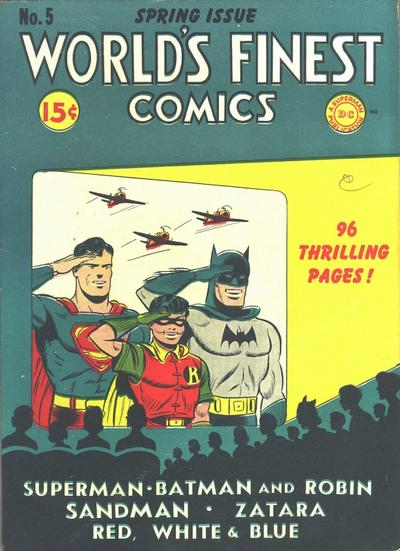
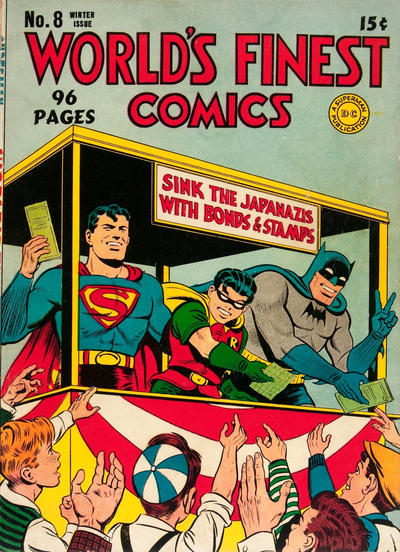
Batman comics and World War II

World's Finest Comics 5          World's Finest Comics 8

Although nowadays movies set in World War II have become mostly synonymous with tearjerker melodramas or grim military epics, this wasn’t always the case. The gravitas of that conflict and the overwhelming consensus about who the heroes and villains were helped raise the stakes in a myriad of enjoyable films over the last seven decades, from the vicious thrills of Billy Wilder’s Stalag 17 and John Frankenheimer’s The Train to the twist-filled shenanigans of John Sturges’ The Eagle Has Landed and George Seaton’s 36 Hours. Steven Spielberg himself approached the Nazi era with quite a zany exuberance in Raiders of the Lost Ark and Indiana Jones and the Last Crusade, not to mention 1941, before going on to direct the self-important Schindler’s List and Saving Private Ryan.

I’m certainly not saying the Second World War doesn’t deserve to be taken seriously. However, I do take issue with the notion some critics have that to treat WWII in any way other than Band of Brothers shows a lack of respect for the Greatest Generation. If you actually watch the movies that generation was cranking out back when fascism was a real threat, back when soldiers and civilians were actually getting killed on a massive scale in Europe and Asia, back when the outcome of the war was not at all certain, hell, even before the American participation was taken for granted… those movies include hilarious comedies making fun of the Nazis, like Ernst Lubitsch’s To Be Or Not To Be and Charlie Chaplin’s The Great Dictator (plus a bunch of sharp home front satires, such as Hail the Conquering Hero, The Miracle of Morgan’s Creek, The More the Merrier, and The Major and the Minor). Even political dramas like Michael Curtiz’ Casablanca and Fritz Lang’s Hangmen Also Die! didn’t forget to be highly entertaining.

As for the Batman comics which came out at the time, those were kind of a mixed bag…

Batman 015Batman #15

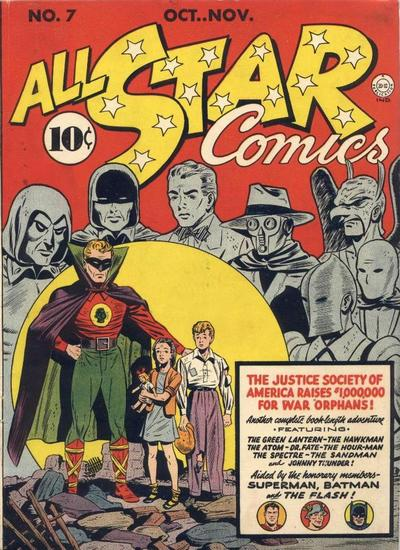
The Caped Crusader could hardly disregard what was going on in the world. For one thing, he was an honorary member of the Justice Society of America, which means he was asked to chip in $100,000 in 1941, when the JSA decided to raise a million dollars for the relief of refugee children in war-torn democracies:

All Star Comics 07

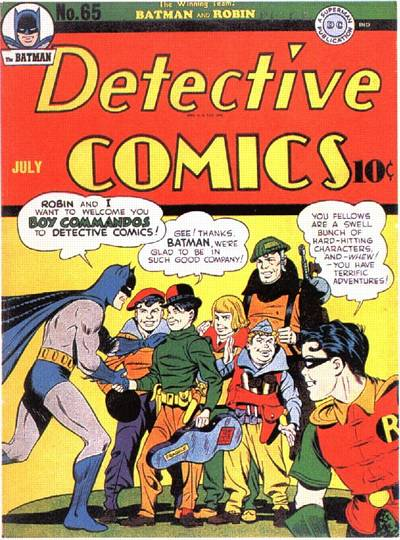
Moreover, starting in June 1942, Batman shared Detective Comics with the Boy Commandos, a special unit of the Allies that was basically an international gang of cocky teenage street kids (a goofy concept, for sure, but not even one of Jack Kirby’s craziest creations).

Detective Comics 65

A lot  of it was predictably crude (even if not as disturbing as the Batman serial released at the time). Bill Finger’s and Jack Burnley’s ‘The Two Futures’ (Batman #15) is basically a 13-page long ad to support the war effort, thinly disguised as a Batman story. The Dynamic Duo goes to Gotham University and asks the ‘world’s greatest historian’ to predict the aftermath of the war. They are told two possible versions, one version involving the Nazis and the Japanese taking over America and turning it into a fascist dystopia (with Batman and Robin ultimately executed by a firing squad), the other version involving the defeat of the Axis powers and the emergence of a better world. That’s it. The tale doesn’t have much of a plot and, even as a piece of propaganda aimed at kids, doesn’t seem very creative – until you recall that the cover is dated February-March 1943, a time when merely picturing the end of the war required a fair share of imagination.

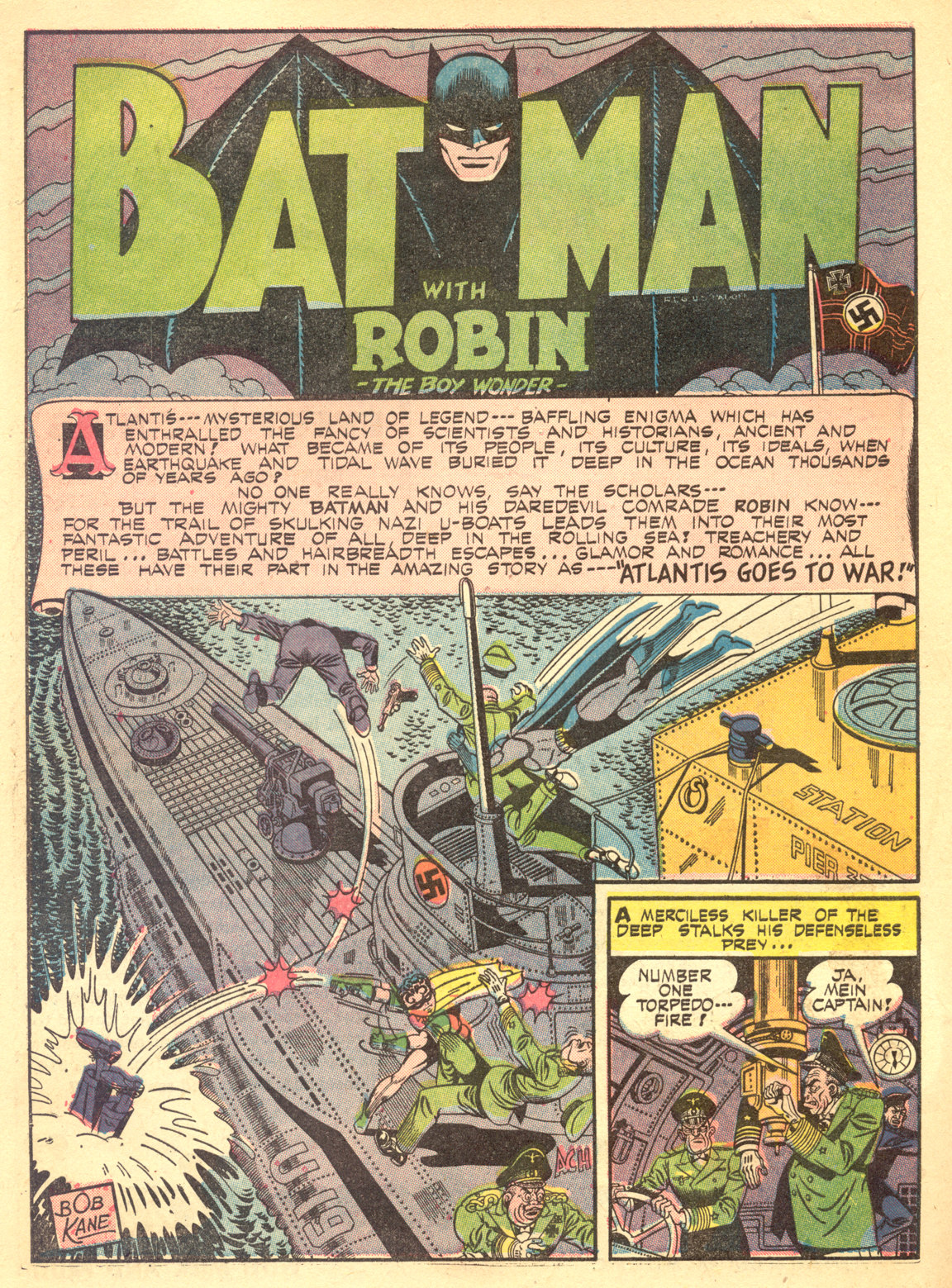
Still, all these years later, Don Cameron’s lighthearted approach to WWII is way more enjoyable to read, not least because it is seriously bonkers! I know I’ve already discussed the comic he wrote in which the Dynamic Duo literaly crushes a ring of Nazi spies with a swastika-shaped lamp, but even that pales in comparison to ‘Atlantis Goes to War!’

Batman 019Batman #19

Written by Don Cameron and illustrated by Dick Sprang (ghosting for Bob Kane), with the cover date October-November 1943, ‘Atlantis Goes to War!’ is wall-to-wall adventure.

Robin convinces the Dark Knight to use the Batplane to search the Caribbean for a secret German submarine base. And damn it if they don’t fall into a whirlpool that leads them to the lost, underwater Kingdom of Atlantis:

Batman 019Batman #19

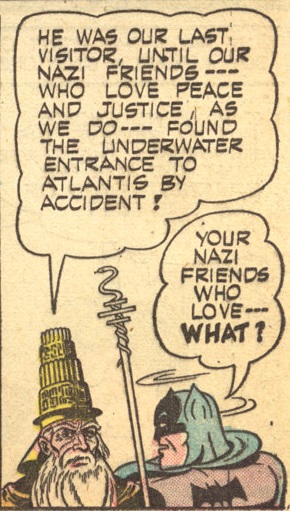
It turns out the Kingdom of Atlantis has been isolated from the surface world for over ten thousand years, with the exception of an encounter with a 16th century philosopher who (conveniently) taught the locals English. Also, more recently, they’ve become friends with the Third Reich…

Batman 019Batman #19

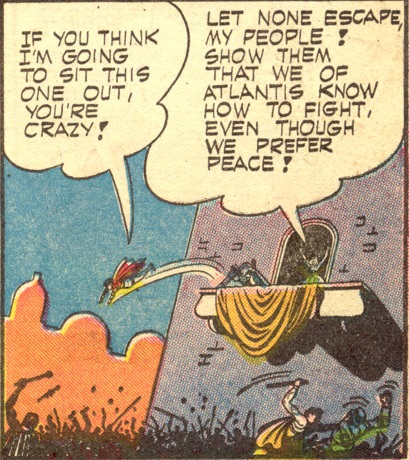
Even though Aquaman had been created a couple of years before, there wasn’t yet anything resembling a coherent DC Universe. So this version of Atlantis is actually ruled by Emperor Taro, a kid who looks like Robin, and by his sister Lanya, who awkwardly gets the hots for the Boy Wonder. Because Taro trusts his Nazi friends, he sentences the Caped Crusader to be burned to death in a particularly horrific way. Fortunately, though, Robin manages to escape, knock out the emperor, take his place, order Batman’s release, win Lanya’s heart, and ultimately start a massive brawl which he gleefully joins:

Batman 019Batman #19

The story finishes with the Kingdom of Atlantis secretly fighting on the side of the Allies and with Empress Lanya asking Robin to always remember her. The adorable last panel features a love-struck Dick Grayson sighing for the-one-that-got-away while Bruce Wayne casually reads the newspaper.
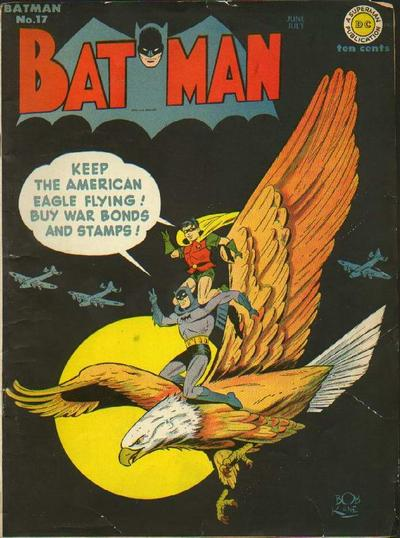
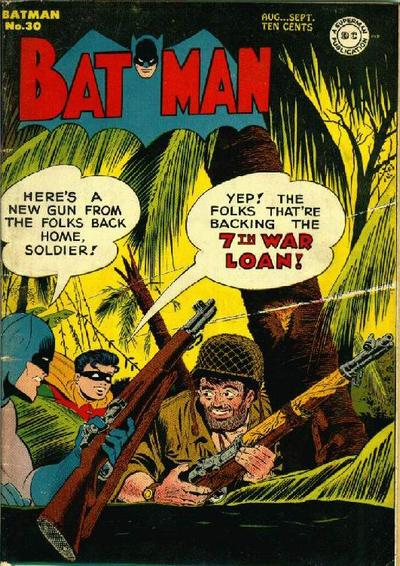
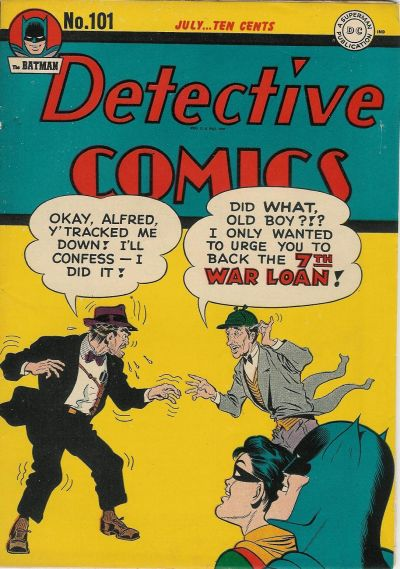
Even when they weren’t engaged in such rip-roaring derring-do, Batman and Robin were all over the campaign for war bonds (because the Caped Crusader may hate guns, but he hates Nazis even more, goshdarn it). You can see the Dynamic Duo take time off from their busy crime-fighting schedule to help sell bonds to their fellow Americans in Batman #12 and Batman #14. They also support the campaign in the front covers of their comics, although choosing the weirdest places and occasions to do so:

Batman 17Batman 30Detective Comics 101

One story which is entirely devoted to the war bond campaign is ‘The Bond Wagon’ (Detective Comics #78), scripted by Joe Greene, with pencils by Jack Burnley (as Bob Kane), and inks and letters by George Roussos. In this comic, dated August 1943, the Dynamic Duo hire men and women to dress as famous Americans from the Revolutionary War and travel the land in order to encourage people to buy war bonds. As if that weren’t heavy-handed enough, a group of Nazis try to sabotage this initiative, so you get to see George Washington beating up fascists, making this officially the Tea Party’s favorite comic!

To be sure, Batman’s involvement in World War II didn’t end when the war did. Twenty-four years later, Bob Haney and Neal Adams reimagined Bruce Wayne’s participation in the conflict, giving him a more active role in the preparation for D-Day, in ‘The Angel, the Rock and the Cowl.’

Brave and the Bold #84The Brave and the Bold #84

Archie Goodwin and Gary Gianni also retroactively pitted Batman against proper Nazis, albeit shortly before the war, in the charming short story ‘Heroes.’

batman - black & white #4 Batman: Black & White #4

And, coolest of all, way before Michael Caine toughened up the posture of Bruce Wayne’s butler, Alfred had already been established as a badass operative in WWII:

Untold Legend of the Batman #2The Untold Legend of the Batman #2

NEXT: Green Arrow.

Posted in POLITICS OF BATMAN COMICS | Tagged , , , , , , , , , , , , , , | Leave a comment

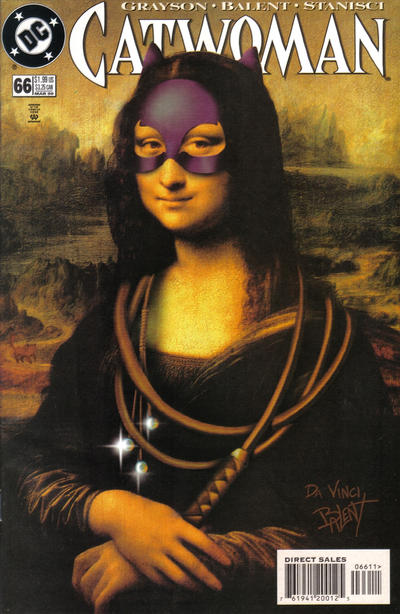
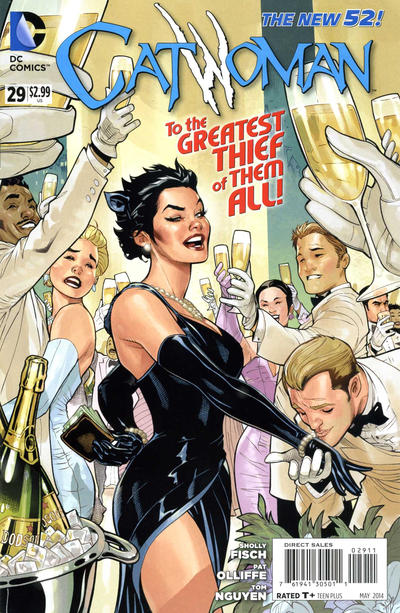
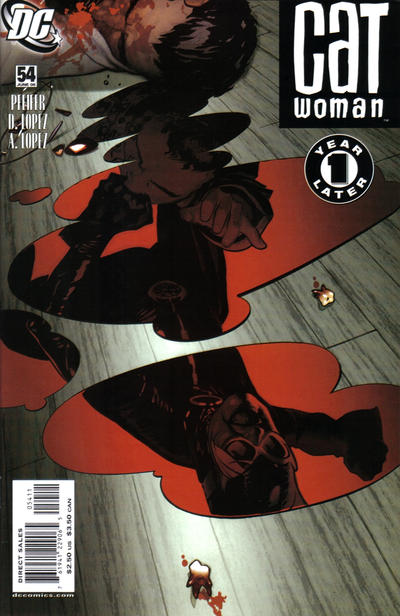
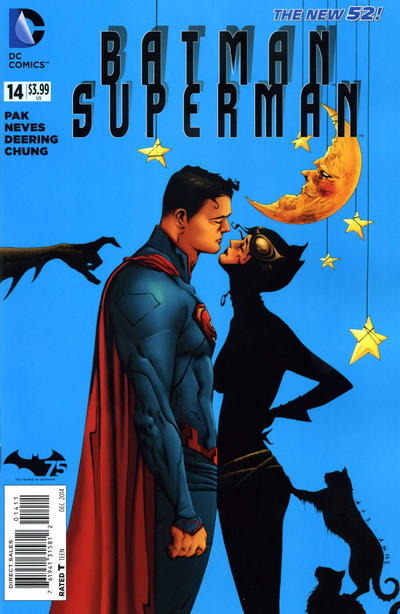
10 great Catwoman covers

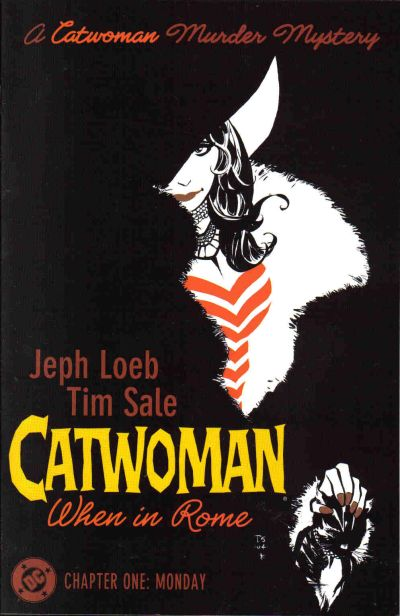
The thing about Catwoman is that, even though she has starred in plenty of cool stories, she has often been settled with lame art. Notably, many of her covers are little more than anatomically dubious cheesecake… so I figured it was time for Gotham Calling to highlight 10 covers that are actually pretty great!

It’s not that Catwoman doesn’t look nice in these, but they all have some neat detail or design choice that stylishly elevates the image beyond just T&A. And while some of these artists are consistently amazing, others aren’t yet somehow outdid themselves here.

Tim Sale:

Catwoman: When in Rome

Jock:

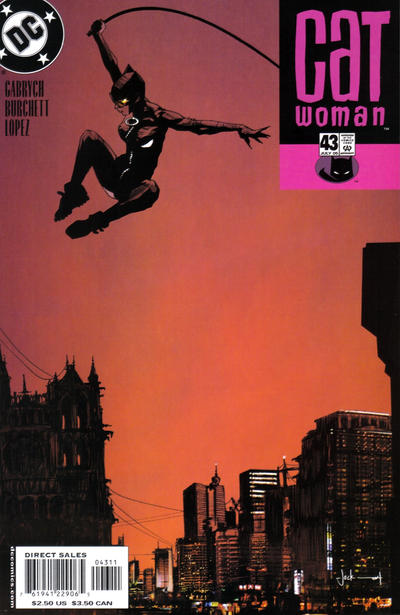
Catwoman 43

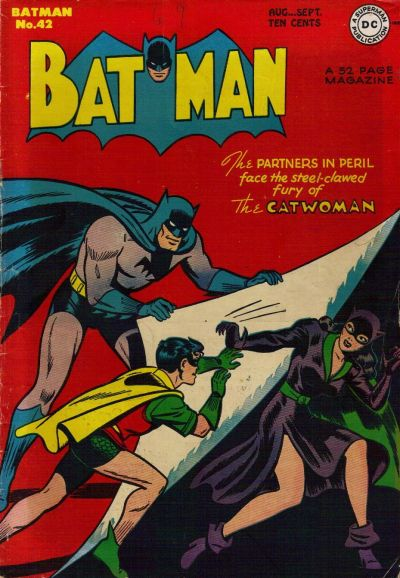
Jack Burnley and Charles Paris:

Batman 42

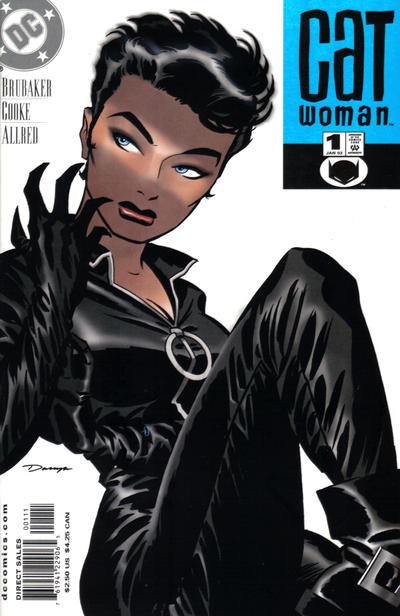
Darwyn Cooke:

Catwoman 01

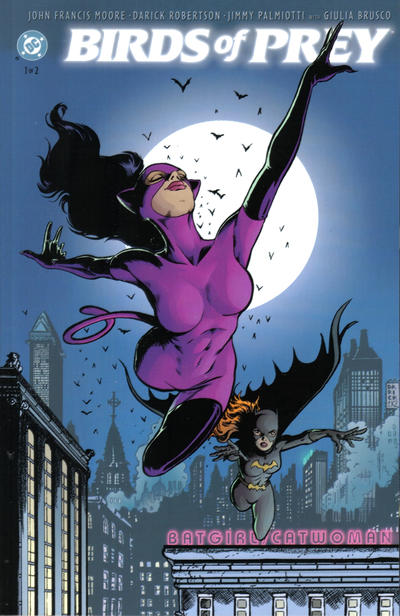
Darick Robertson and Giulia Brusco:

Birds of Prey Batgirl Catwoman

Jim Balent and Leonardo da Vinci:

Catwoman 66

Terry Dodson and Rachel Dodson:

Catwoman 29

Adam Hughes:

Catwoman 54

Jae Lee and June Chung:

Batman / Superman 14

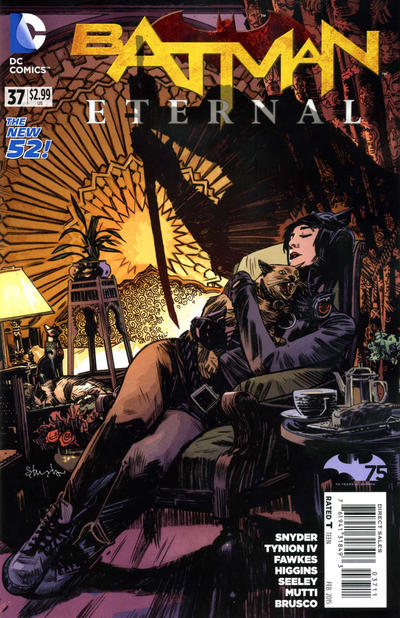
Tommy Lee Edwards:

Batman Eternal 37

NEXT: Batman goes to war.
Posted in COVERS OF BATMAN COMICS | Tagged , , , , , , , , , , , , , , , , | Leave a comment

On Barbara Gordon, Batgirl

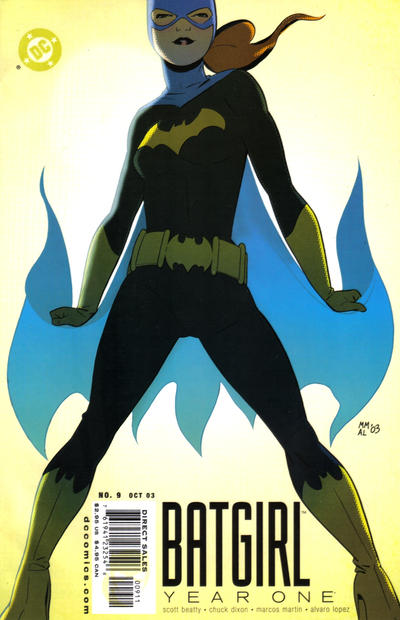
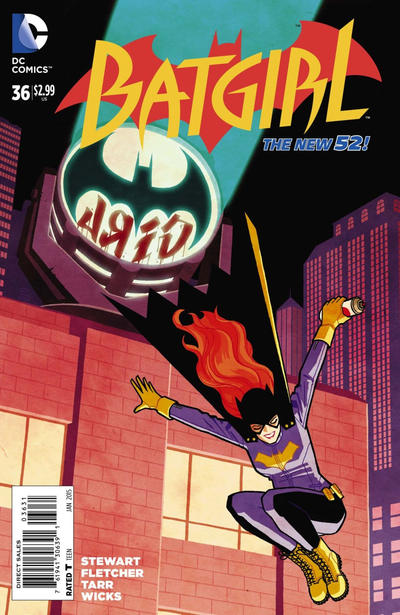
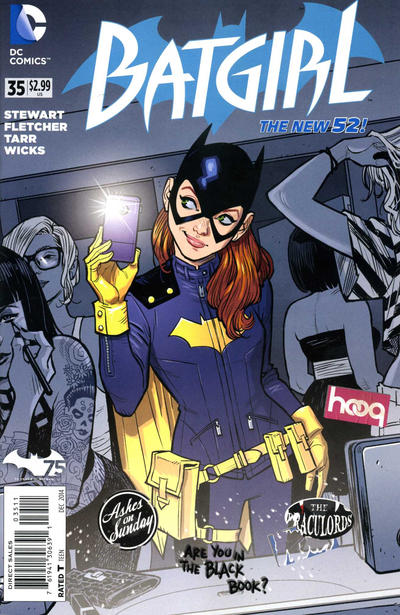
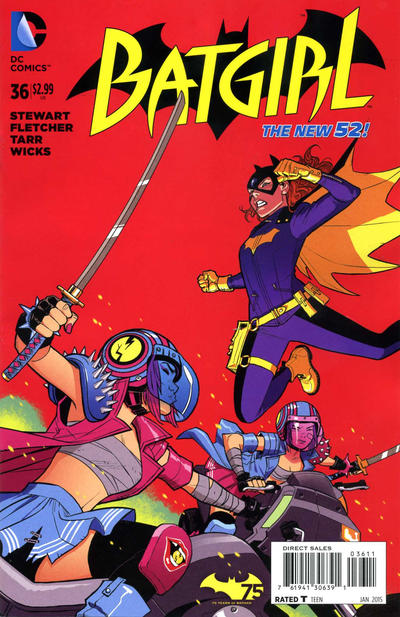
Batgirl Year One          Batgirl 36

Leave it to comics to take a completely perfunctory and derivative concept and actually do loads of fascinating stuff with it. The best example I can think of is Batgirl, aka Barbara ‘Babs’ Gordon, who turned out to be one of the coolest characters hanging around Gotham City! And with the current run of Batgirl getting all sorts of praise, it’s worth looking back on her amazingly eventful butt-kicking career.
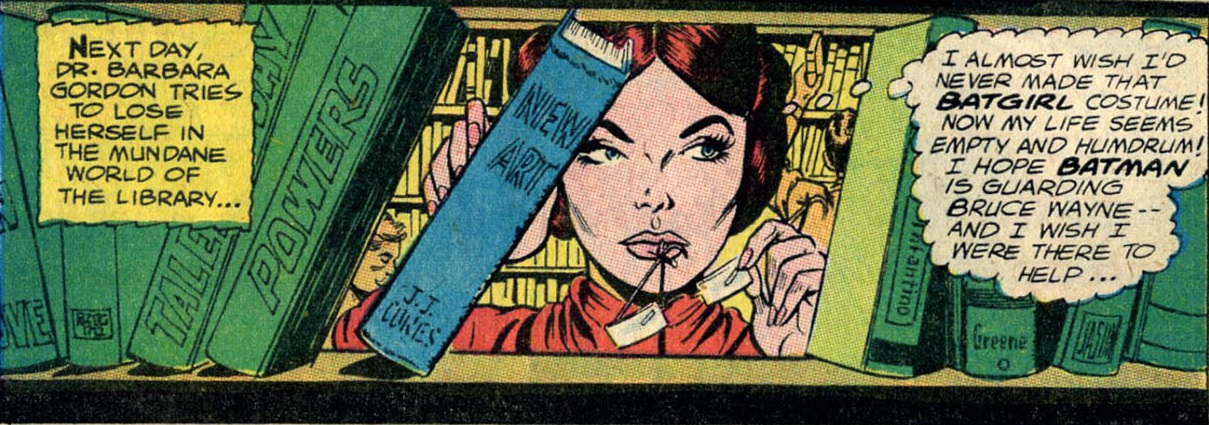
Barbara’s real world origin isn’t all that exciting. In the mid-1960s, editor Julie Schwartz was asked to develop a new female character that could be used in the Batman television show and the result was the librarian daughter of Commissioner James Gordon fighting crime in a batsuit. The name ‘Batgirl’ isn’t particularly inspired (she wasn’t even the first to be called that), but it does the job – she is like Batman, only younger and female. Also, like any character working in the Ancient Age of Alliteration, she was soon given plenty of fun nicknames, like Dominoed Daredoll, Darknight Damsel, or Daughter of Darkness. My personal favorite: the Flame-Haired Woman of the Shadows!

In-story, there was nothing too complex about Batgirl’s origin either. In fact, she showed up in Detective Comics #359 almost fully formed. In the second page of her debut issue, we learned that Barbara Gordon had already completed a PhD from Gotham State University and wore a brown belt at judo. Unlike Batman or Robin, there was no defining tragedy to motivate her – she just happened to be on her way to a masquerade ball when she bumped into Killer Moth and his gang trying to kidnap Bruce Wayne. After beating up some of the thugs, she decided she dug it and started doing it more often.
The nonchalantness of it all may have been one of the most refreshing things about her. Barbara wasn’t rich or traumatized and didn’t spend years training for the role (although she did mention a special protein diet and intensive exercise). In fact, this was her ‘I shall become a bat’ moment:
detective comics 359Detective Comics #359

The best scene in that issue, though? Robin’s reaction when he first sees Batgirl butting in on his turf:

detective comics 359Detective Comics #359

While there’s something inherently feminist about a badass female character that keeps sticking it to all the men who underestimate her, I should also point out that the early adventures of the Dominoed Daredoll took place in some totally ‘60s comics, with all that entails… including a predictable dose of over-the-top misogyny:

detective comics 371 Detective Comics #371

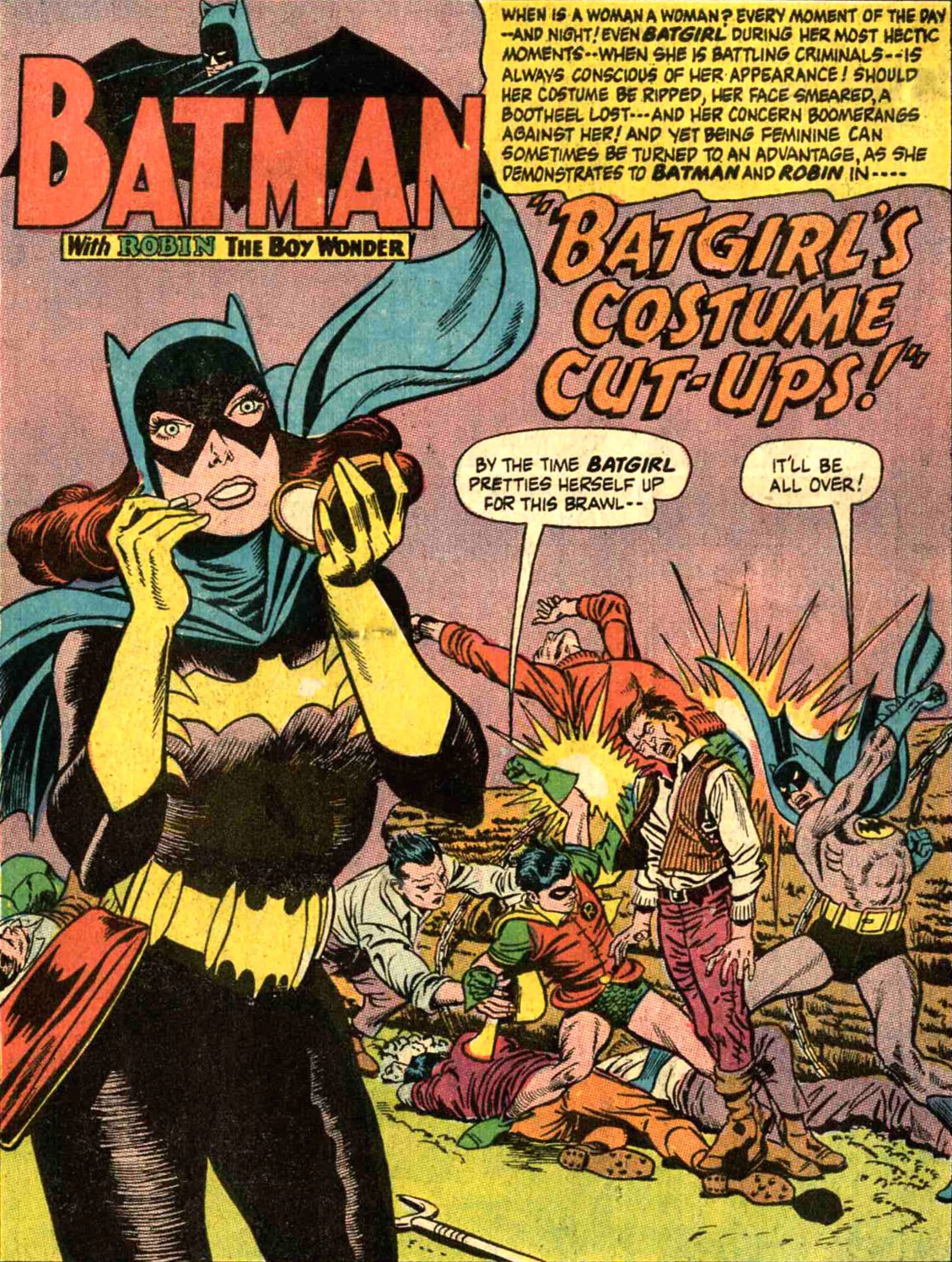
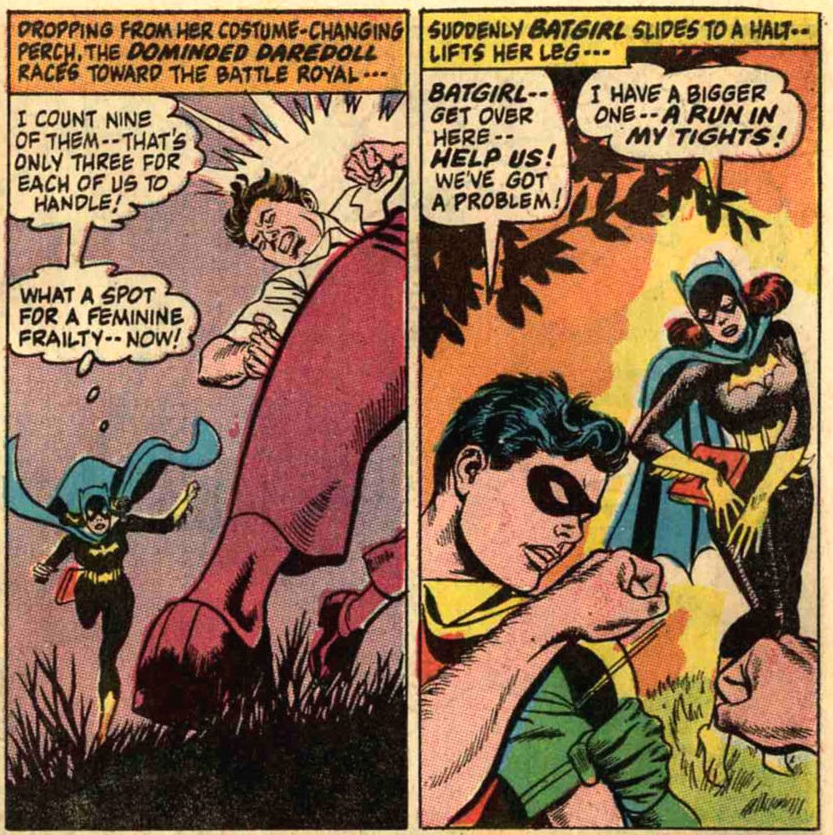
‘Batgirl’s Costume Cut-Ups!’ is probably the worst offender, although it was written by Gardner Fox and drawn by Gil Kane, so impossible to completely dislike… That said, the plot basically revolves around the notion that Babs keeps screwing up in her crime-fighting because, as a woman, she’s too obsessed with her looks and gets easily distracted by her vanity:

detective comics 371Detective Comics #371

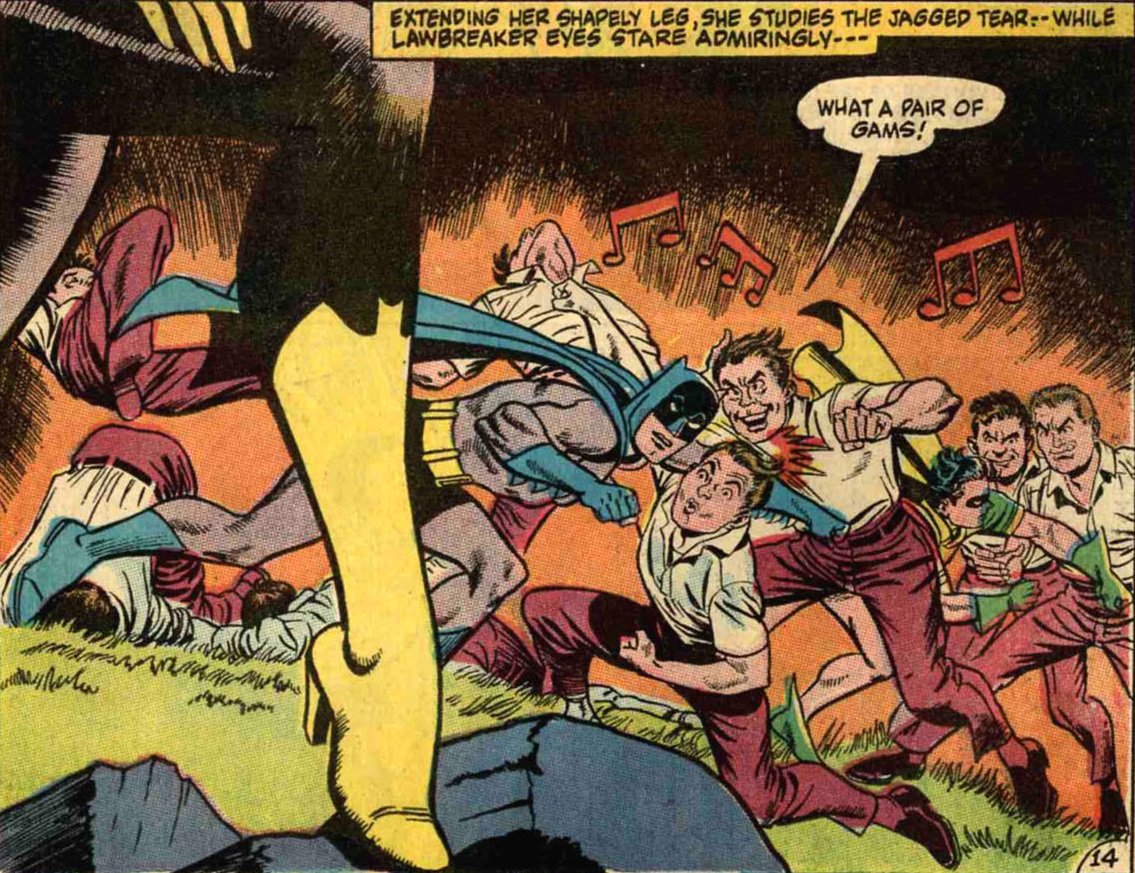
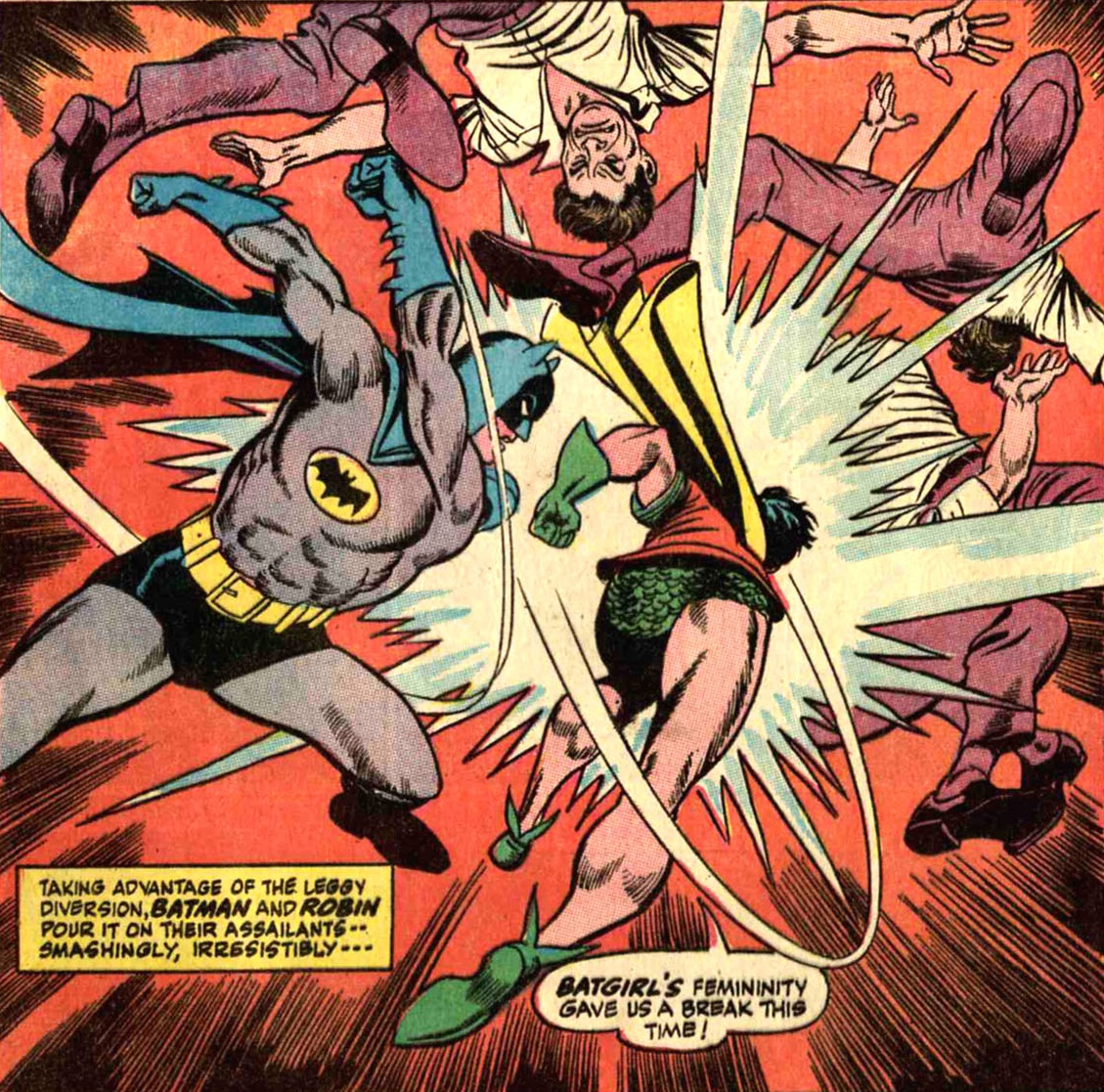
In Gardner Fox’s defense, the story’s sexist set-up does lead to a truly unexpected, if equally sexist, pay-off:

detective comics 371 detective comics 371 Detective Comics #371

The final punchline is that Batgirl actually knew what she was doing: she tore off her tights deliberately to give herself an excuse for showing off her leg and distract the crooks… in order to prove to Batman that her feminine side had its strong points too! So, yeah, make of that what you will.

In any case, Barbara Gordon did become increasingly fleshed out in the backup features of Detective Comics, where she was depicted as an intelligent and resourceful crime-fighter in her own right. Notably, Frank Robbins’ scripts in the early ‘70s pitted the Darknight Damsel against all the latest trends, with adventures about pop art, fashion-setting, the wigs craze, and youth activism, often with dated results that now seem more than a bit weird:

detective comics 407Detective Comics #407

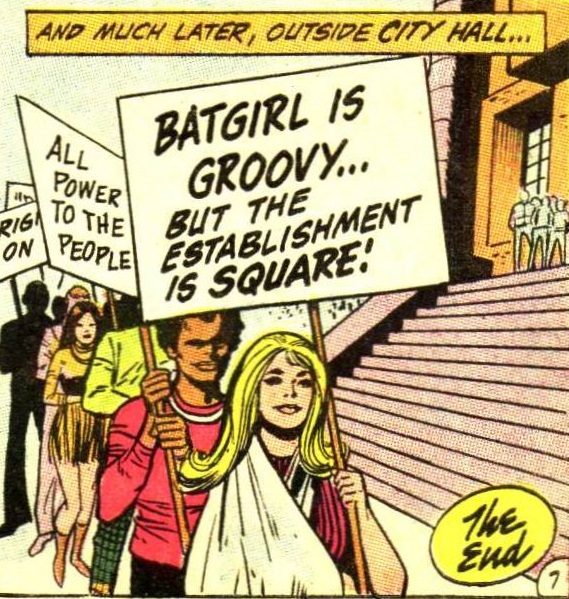
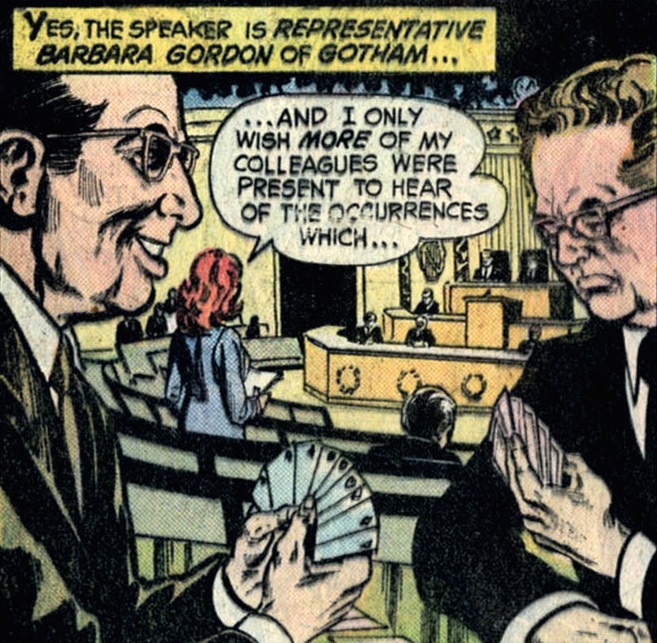
In 1972, Barbara Gordon decided she was too frustrated with her reactionary role of punishing crime while failing to prevent it. She then managed to get herself elected to Congress on a youth-oriented populist platform of ‘Boot the rascals out – elect me!’

National politics may seem like a dramatic shift for a character who got such a kick out of busting heads, but hey, at least Babs became one of the most hardworking representatives in the House:

batman family 01Batman Family #1

You go, Batgirl. You take back the power!

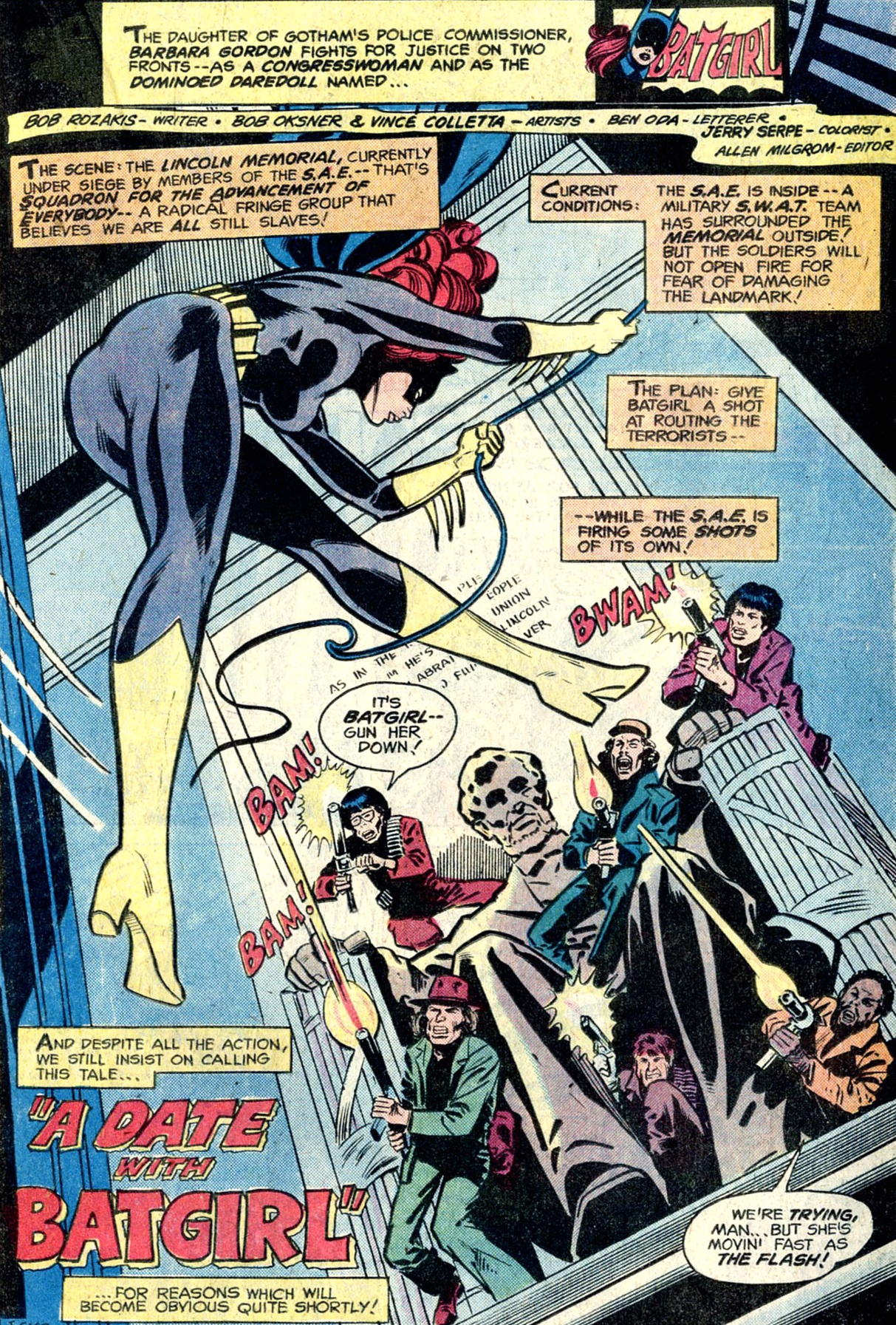
Now based in Washington, Congresswoman Barbara Gordon faced some of her most outlandish challenges in the pages of Batman Family, where in the first handful of issues alone she went against the Devil, a couple of rampaging dinosaurs, and the Spanish Inquisition… of the future! She also had a fling with Robin, the Teen Wonder.
Indeed, Washington was no more boring than Gotham City – there was always something going on, whether it was committee kickback investigations, a witch called Madame Zodiac trying to turn the Pentagon into a mystical pentagram, or an attack by the most catch-all of terrorist groups:

detective comics 483Detective Comics #483

Babs was so busy fighting kooks that it’s no wonder she neglected her campaigning, thus failing to get reelected for a second time at the end of the decade. She returned to Gotham City (and to the hellhole of mediocre Detective Comics backups) to work in a Humanities Research and Development Center.
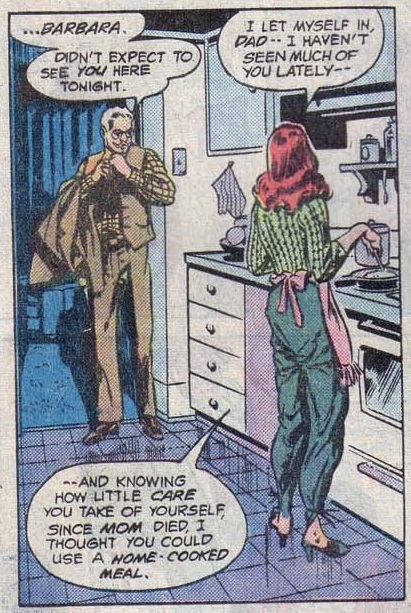
And while the early 1980s is the period in Batgirl’s career where things get really bizarre (yes, I’m talking about the issues in which she turns part-snake), over in the main titles Barbara actually got some strong characterization. For example, around this time she played an instrumental role in supporting her father when he got close to a nervous breakdown:

batman 346Batman #346

My favorite ‘80s out-of-costume Barbara Gordon story, though, is from Detective Comics #533, by Doug Moench and Gene Colan. A gang of criminals tries to kill a hospitalized James Gordon and, although dizzy from sleeping gas, Babs manages to save her father by stumblingly carrying him across the hospital while drawing strength from a mantra he told her when she was a kid: ‘Look to the mountaintop.’ (This is from the era when Moench saturated all his comics with overlapping symbolism, so everyone in the story keeps looking up and down at stuff – it’s great!)

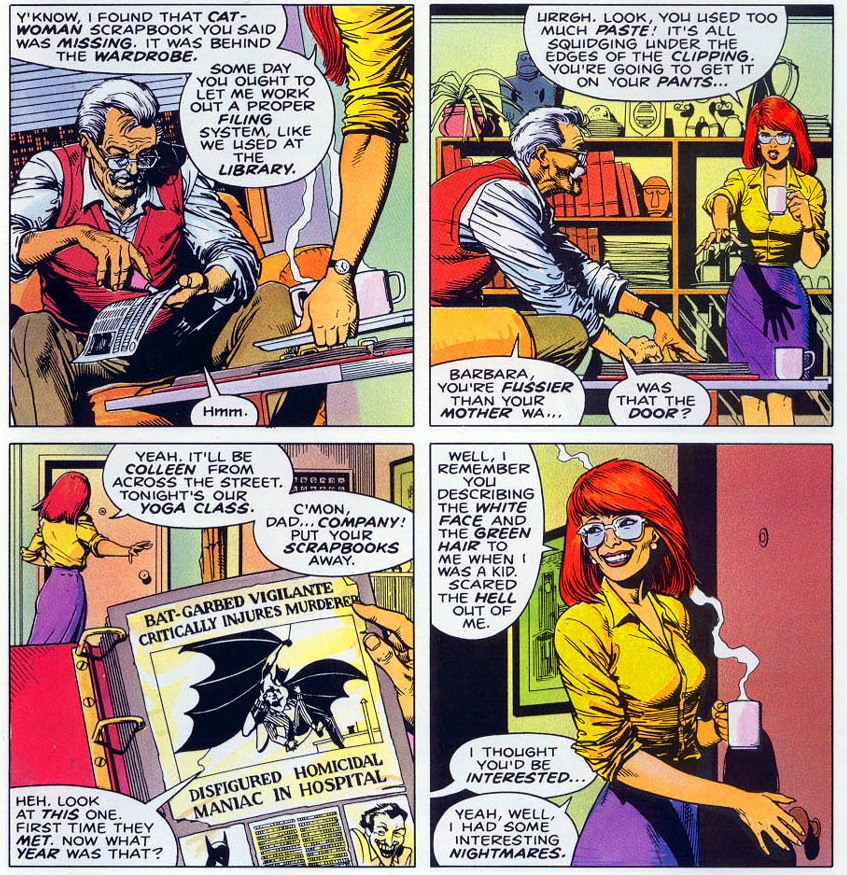
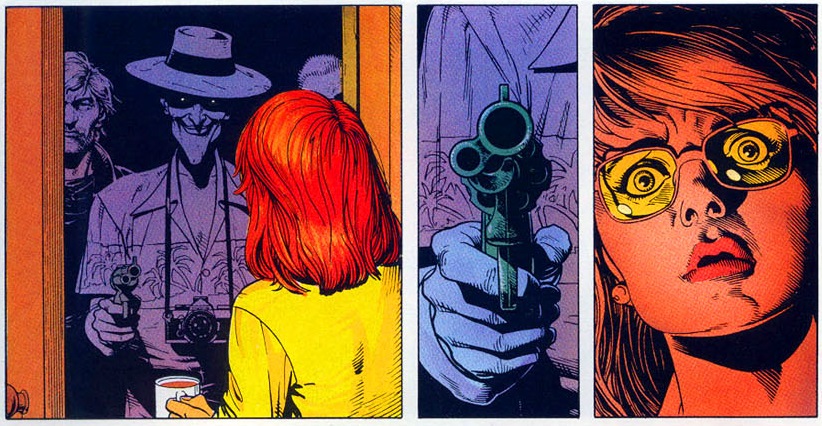
Babs’ Batgirl career came to an end in 1988. In the forgettable ‘The Last Batgirl Story,’ written by Barbara Randall, the Daughter of Darkness put away her costume. And in the unforgettable (for better or worse) The Killing Joke, written by Alan Moore, she was shot by the Joker and crippled for life.

Batman - The Killing Joke Batman - The Killing Joke The Killing Joke

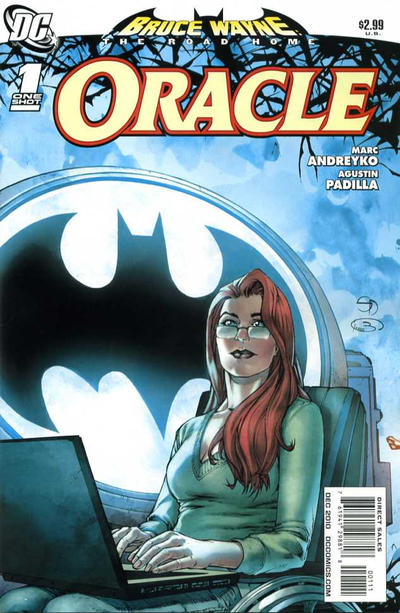
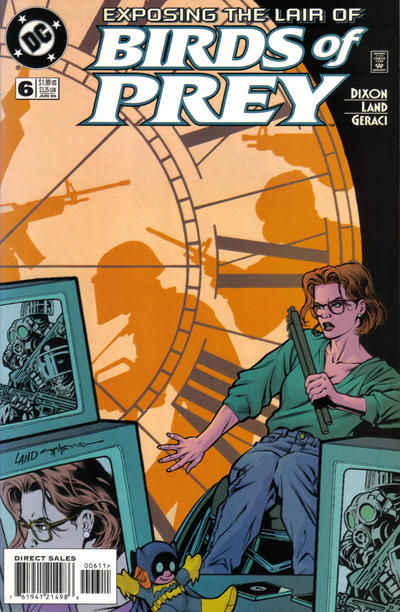
Now stuck in a wheelchair, over the next couple of decades Barbara Gordon went on to become Oracle, a brilliant computer expert and information broker… and an awesome crime-fighter in her own right (the subject of a future post).

Bruce Wayne The Road Home Oracle          Birds of Prey 6

Yet if you desperately wanted to see a red-haired Batgirl kicking ass in the 1990s and early 2000s, then you could still do it in the alternative continuity of Gotham Adventures, where she became Batman’s regular partner:

Gotham Adventures 46Gotham Adventures 46Gotham Adventures #46

There were also the flashbacks. In 1997, DC published a prestige one-shot set in Babs’ past in an attempt to cash in on the not-yet-infamous Batman & Robin movie… Fortunately, writer Kelley Puckett didn’t have to use the film’s version of Barbara, who had been recast as Alfred’s niece, back from studying in ‘Oxbridge Academy,’ in what I assume was the British province of Portmanteau (geddit?), even though actress Alicia Silverstone totally kept her American accent, because that movie just didn’t give a damn!

Although it was gun-for-hire work, Puckett took the assignment with brio, and so did the art team of Matt Haley, Karl Kesel, and Kevin Somers. Their Batgirl one-shot is a neat comic, which even gave Babs a kind of retroactive payback by having her face the Joker years before his brutal attack on her:

Batgirl (1997)Batgirl (1997)

Kelley Puckett followed this up with the dynamic two-parter ‘Folie a Deux’ (Legends of the DC Universe #10-11), also set during Barbara’s Batgirl days yet looking closer at her relationship with James Gordon (who in the meantime had been retconned as her adoptive father).

The most extensive reimagining of Babs’ early ventures into the world of costumed vigilantism, however, was the extremely fun and smart mini-series Batgirl: Year One, which remains one of the character’s highest points:

Batgirl Year One 4Batgirl: Year One #4

Honestly, I didn’t need more than that. Barbara Gordon was doing fine as Oracle in the main titles and other heroines had stepped in to take the Batgirl mantle, including fan favorites Cassandra Cain and, later, Stephanie Brown.

There was a lot of debate in 2011, when DC announced they were taking Barbara out of the wheelchair and putting her back in the Batgirl outfit. Me, I was apprehensive, to say the least. Here was a character who had evolved in so many interesting directions, yet DC wanted to push her back to her starting point (indeed, that was DC’s policy across the board in 2011). And as much as I love Gail Simone’s writing on other comics, what I read of the reboot didn’t convince me it was worth it…

I’m still not entirely convinced. With a densely packed yet lighthearted style, Cameron Stewart, Brenden Fletcher, and Babs Tarr have turned Batgirl into one of the hippest series around, integrating social media, hashtagtivism, and millennial sensibilities into their stories while populating them with one of the most diverse casts on the stands – but the comic would’ve probably worked just as well with Stephanie Brown in the main role.

Still, it does look as if the current team is willing to take Barbara Gordon into new and original places, which is what she deserves. And with its finger-on-the-pulse-of-pop-culture vibe, the series will hopefully reach a different kind of audience, introducing a new generation to the Flame-Haired Woman of the Shadows…

Batgirl 35          Batgirl 36

NEXT: The various faces of Catwoman.

Posted in GOTHAM CITIZENS | Tagged , , , , , , , , , , , , , , , , , , | Leave a comment

Alfred Hitchcock homages in Batman comics

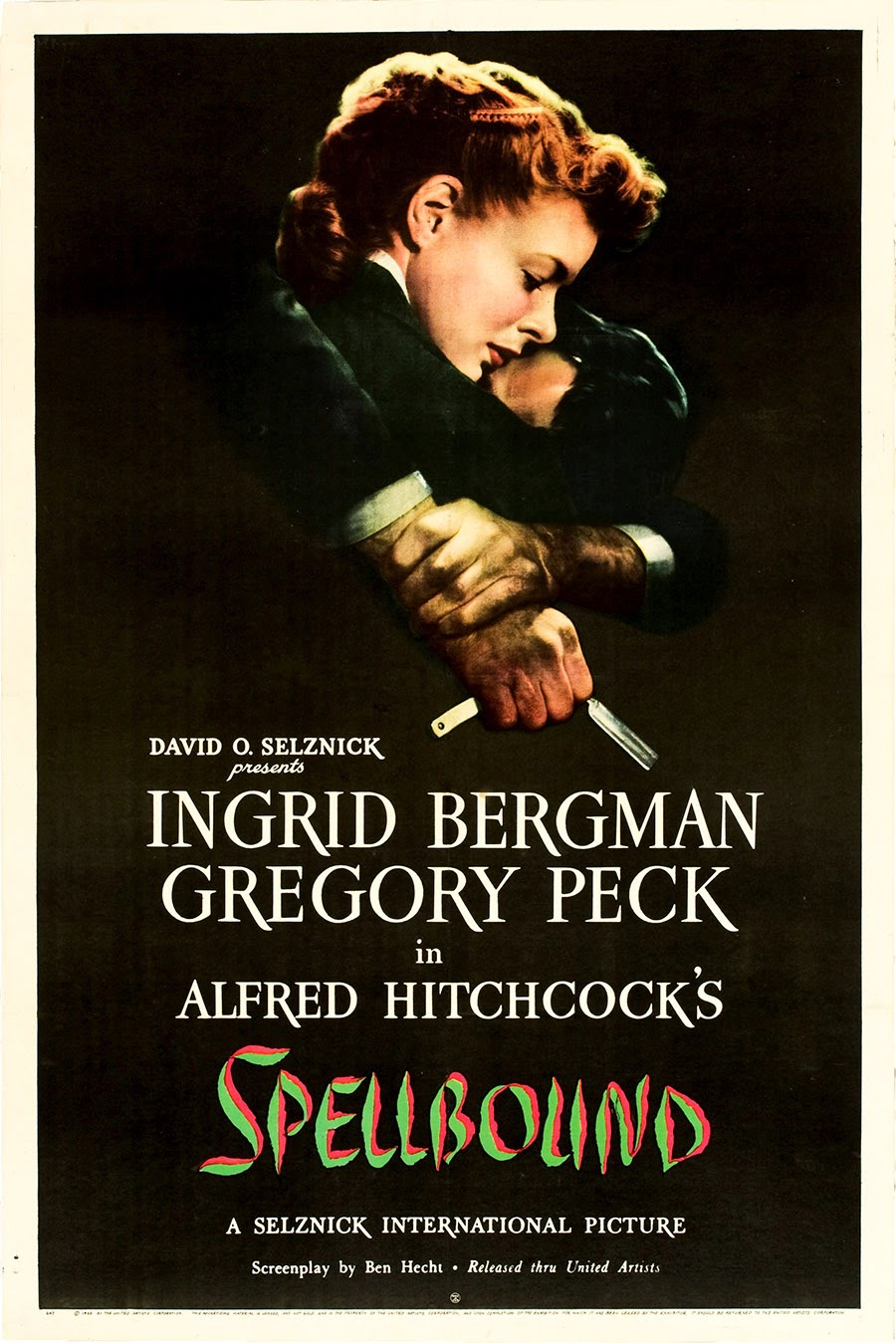
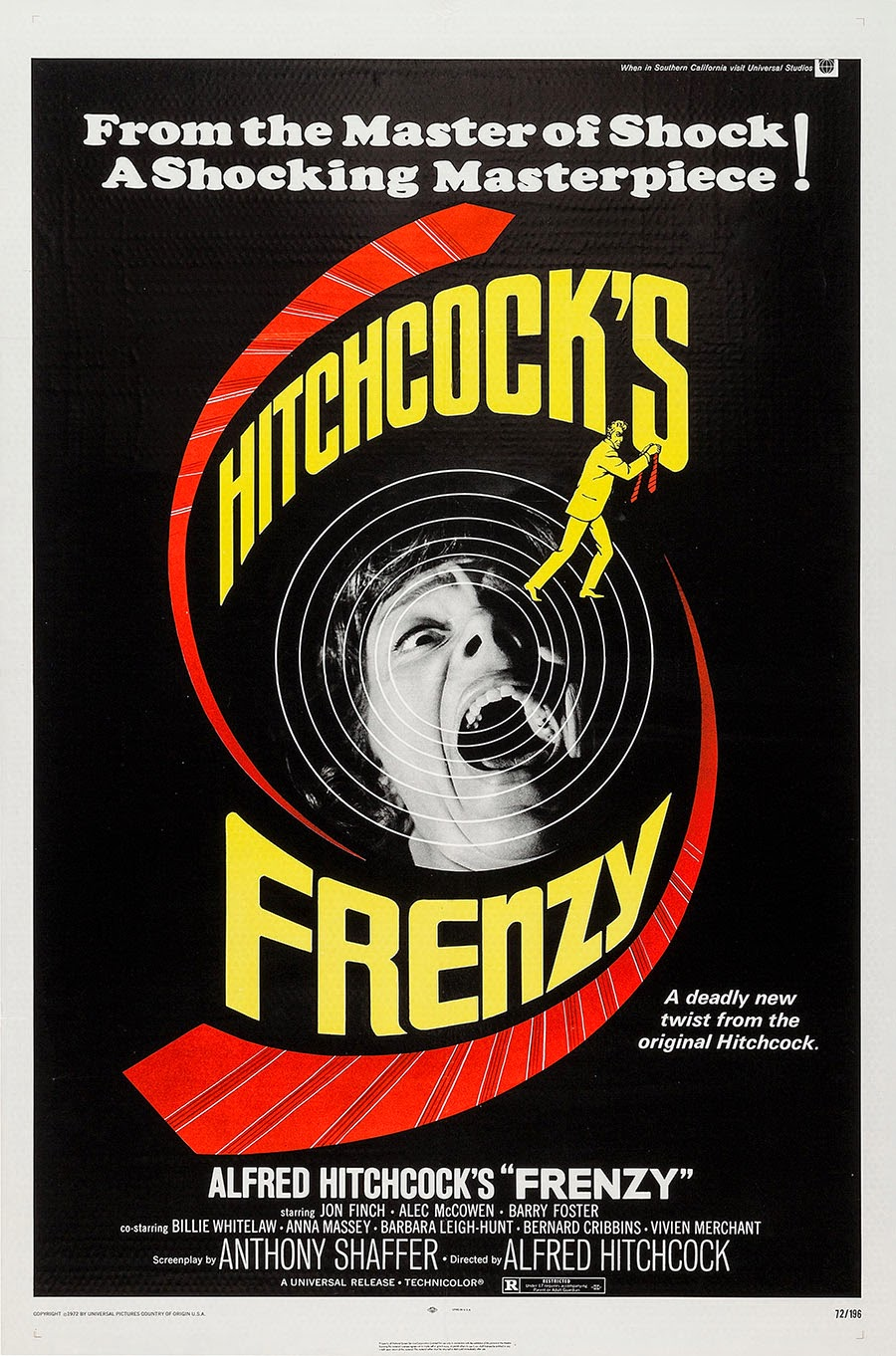
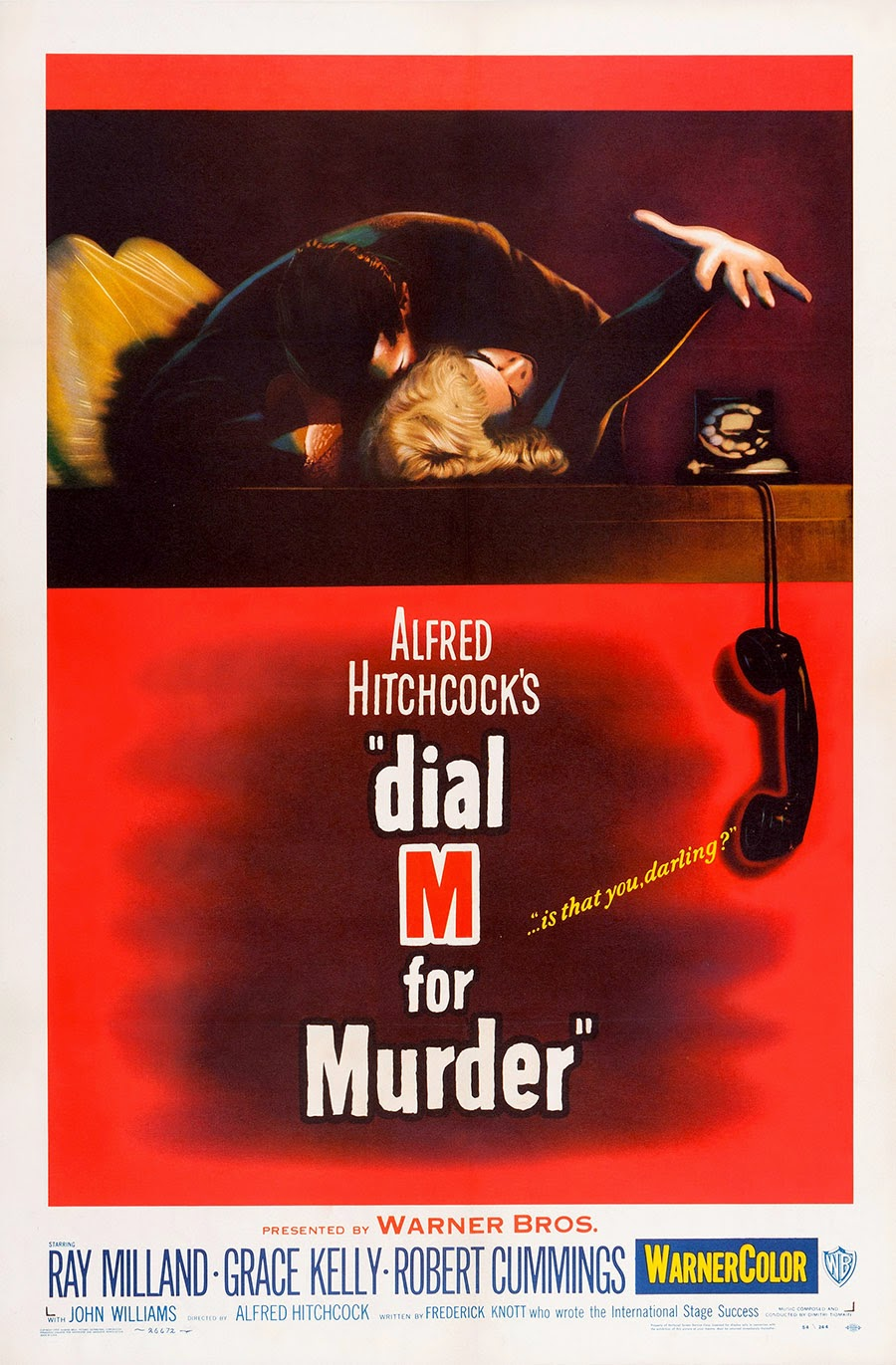
SpellboundFrenzyDial M for Murder

The amazing thing about Alfred Hitchcock isn’t just that he directed what the latest Sight & Sound poll considers the greatest film of all time (Vertigo), or that on top of that he was behind numerous other classics, but that even when digging through his lesser known catalogue you can still find absolute gems like Lifeboat, Sabotage, or Blackmail. Sure, some Hitchcock thrillers haven’t aged that well, and even those that have aren’t perfect, but they are always entertaining to some degree. Also, the more you watch the work of the so-called Master of Suspense, the more you start to pick up on hypnotic patterns beyond the famous director cameo.

Although my favorite Alfred Hitchcock movie is probably Rope, I’ve pointed out that the British director came the closest to the feel of a Batman adventure with Foreign Correspondent. And while that movie in particular didn’t leave much of a mark on the comics, others certainly have!

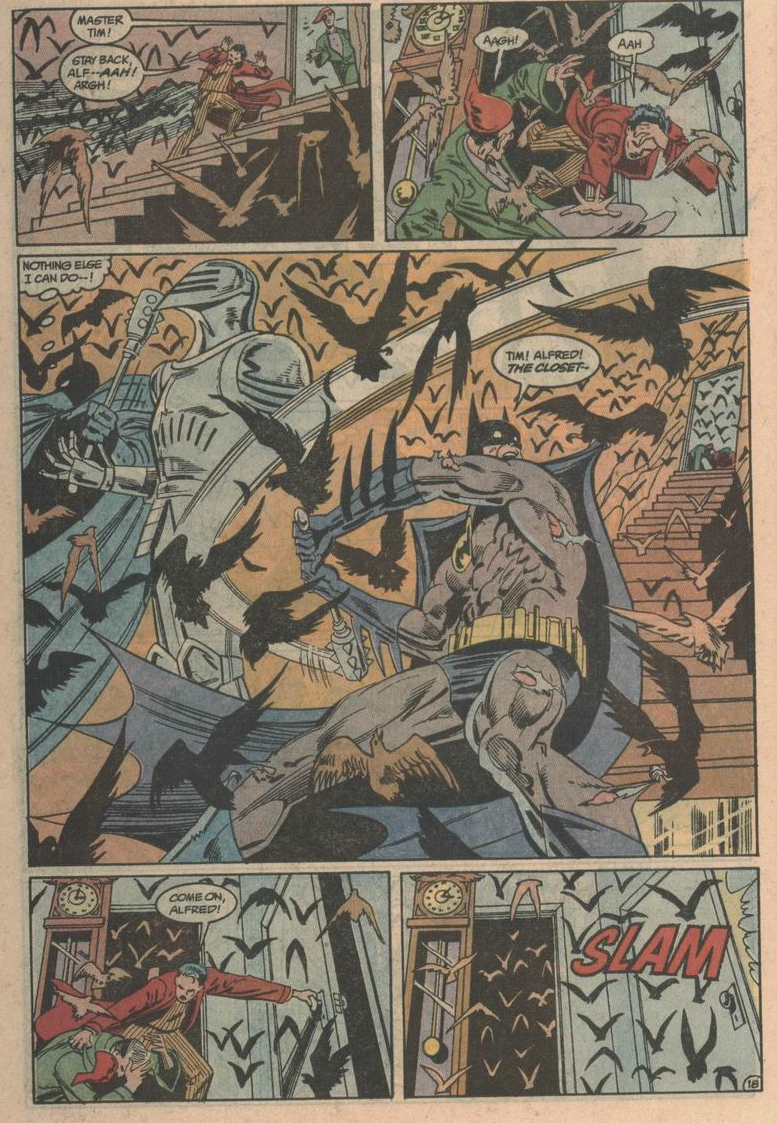
For example, it’s hard to imagine that Norm Breyfogle didn’t have Hitchcock’s The Birds in mind when he drew this bird attack on Wayne Manor…

Detective Comics 615Detective Comics #615

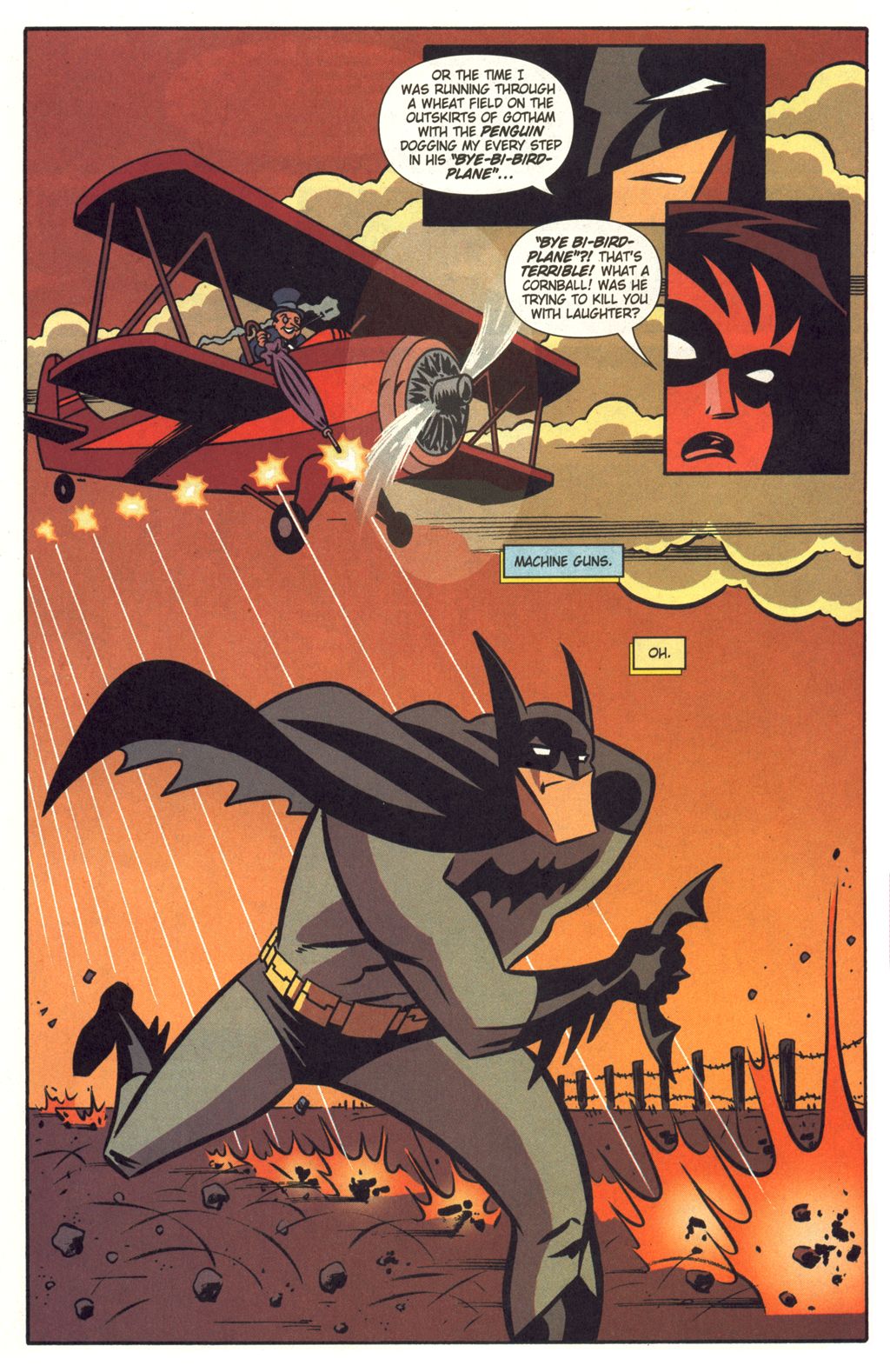
…or that Gabe Soria didn’t ask artist Dean Haspiel to do an obvious homage to the crop duster chase scene from the spy comedy North by Northwest:

batman adventures 9Batman Adventures (v2) #9

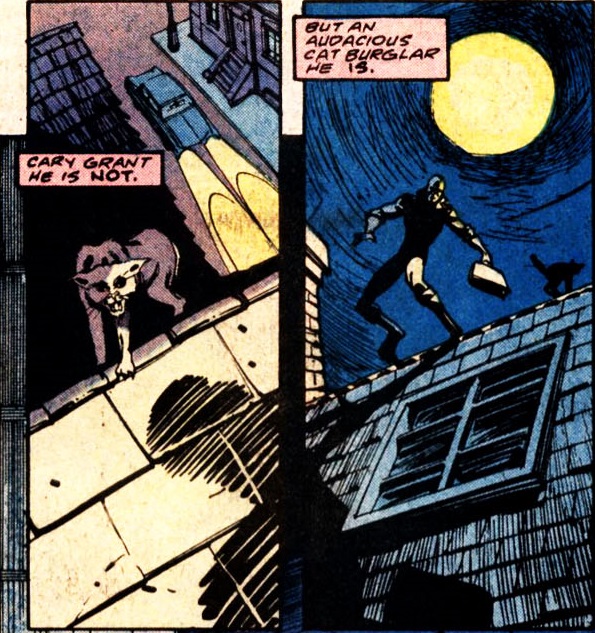
Batman #395 was more explicit. That issue, written by Doug Moench and illustrated by Tom Mandrake, introduced a villain called Film Freak, who based his crimes on classic movies. And sure enough, the issue started with a reference to Alfred Hitchcock’s romantic caper To Catch a Thief…

Batman #395Batman #395

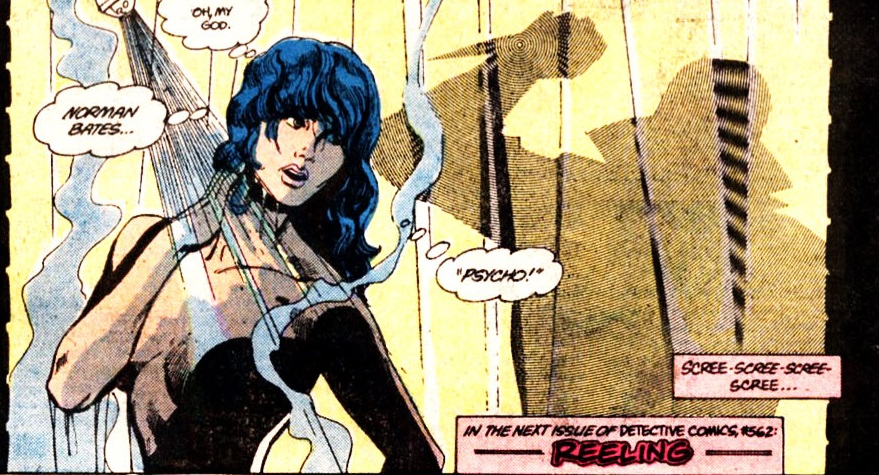
…and finished with a callback to the horror masterpiece Psycho:

Batman #395Batman #395

This cool story arc continued into Detective Comics #562 and finished in Batman #396, but not without key plot twists inspired by Hitchcock’s Rear Window and The Man Who Knew Too Much (the remake).

That was back in 1986. Since then, sadly the Film Freak hasn’t made many appearances, but a modern version of the character did feature rather prominently in Will Pfeifer’s Catwoman run. In an issue with pencils by David Lopez, inks by Alvaro Lopez, and colors by Jeromy Cox, the Film Freak explained his fascination with the Master of Suspense:

catwoman 56Catwoman (v3) #56

Yet no Batman comic paid a greater homage to Sir Alfred Hitchcock than the awesome ‘The Third Door’ (The Batman Adventures #6).

That whole issue was designed as a tribute, with the only thing missing being a title sequence by Saul Bass. The plot revolved around a falsely accused Bruce Wayne having to prove his innocence to the authorities, which was the premise of most Hitchcock thrillers. The credits even named the authors after some of them: writer Kelley “The Wrong Man” Puckett, penciller Brad “Psycho” Rader, inker Rick “Rope” Burchett, colorist Rick “Vertigo” Taylor, letterer Tim “Spellbound” Harkins, and editor Scott “Frenzy” Peterson.

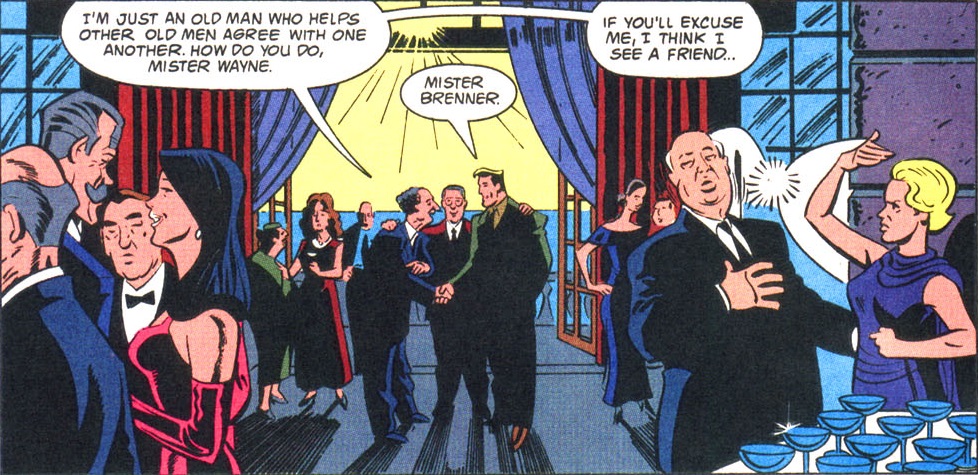
Brad Rader did an excellent job of mimicking Hitchcockian camera angles. And of course he couldn’t resist adding the director’s cameo:

batman adventures #6 The Batman Adventures #6

If you ask me, the reason Tippi Hedren is slapping Hitch in the face is because he never got around to direct a Batman movie… Ah, one can dream.

NEXT: Batgirl fights the power.

Posted in WEBS OF FICTION | Tagged , , , , , , , , , , , , , , , , , | Leave a comment

Balls-to-the-wall adventure comics – part 2

If you read the last post, you know what’s going on. Here are another five wild, no-holds-barred adventure comics:

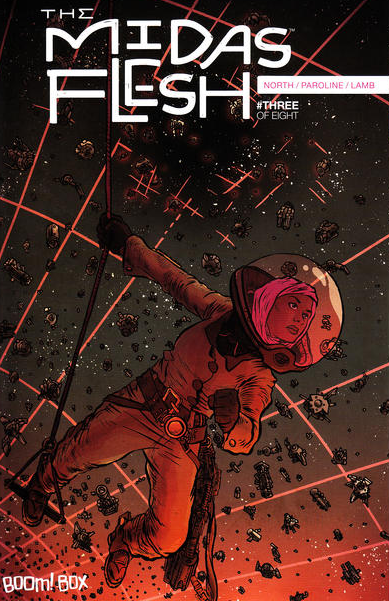
THE MIDAS FLESH

The Midas Flesh 3

Remember the Greek myth of King Midas, who turned everything he touched into gold? Well, imagine space rebels and an evil intergalactic federation trying to get hold of Midas’ dead body in order to weaponize this odd power. Now imagine action-packed chases, explosions, betrayals, dismemberments, planetary genocide, and plenty of conversations about (fake) science and complex moral choices with far-reaching implications.

Does this sound too grim and serious? It’s not. Ryan North keeps a comedic tone all the way through while at the same time continuously escalating the stakes and hardly giving readers room to breathe between each edge-of-your-seat set piece. With crisp, lighthearted art by Shelli Paroline and Braden Lamb, the comic does a particularly great job of establishing three very likable heroes (well, two heroines and one talking dinosaur) who are a joy to read even as you may question some of their actions and their casual attitude towards all the horrible shit that goes down.

What The Midas Flesh lacks in pathos or common sense, it makes up for in intelligent, riveting fun!

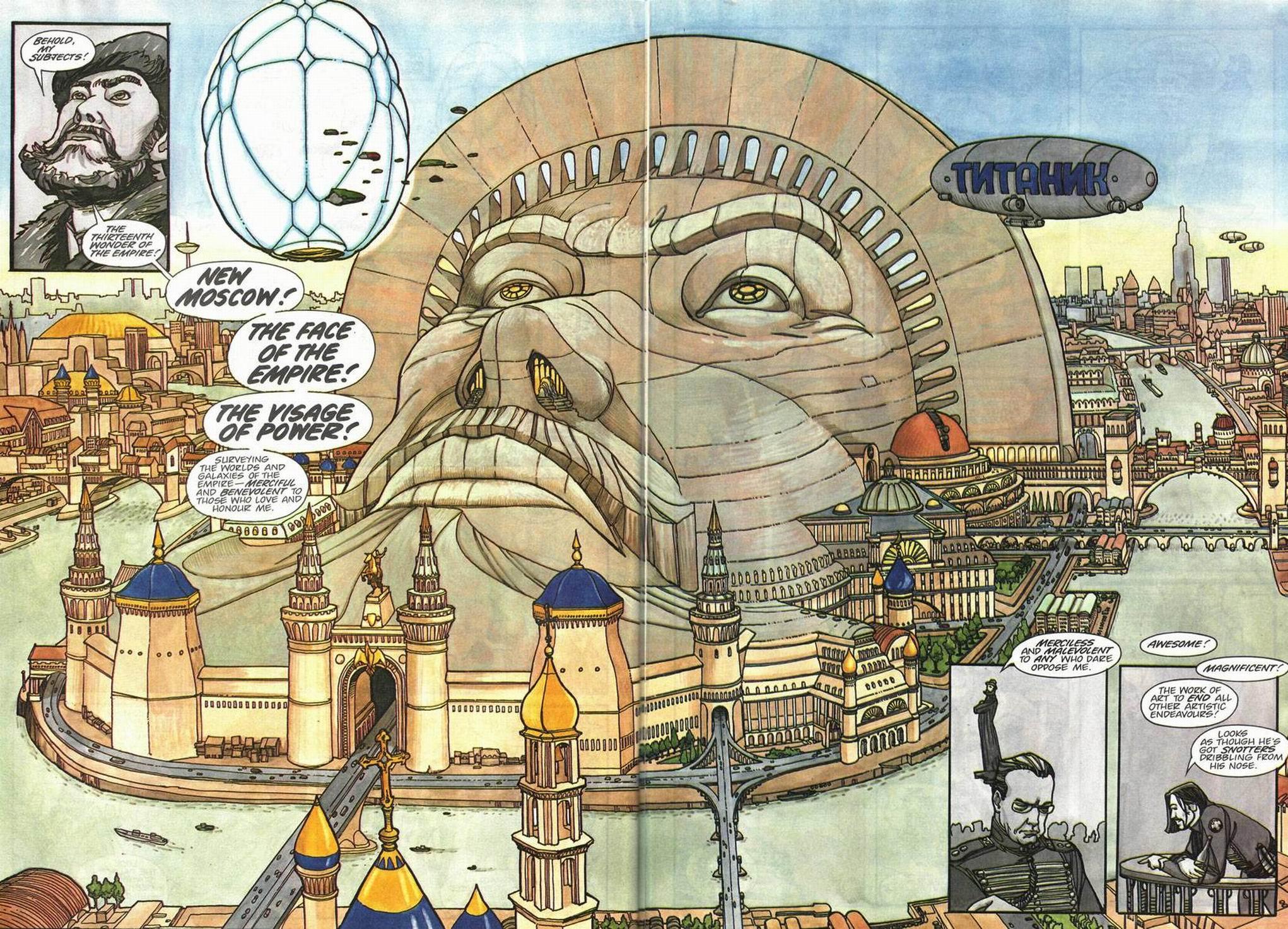
NIKOLAI DANTE

Nikolai Dante

Yeltsin’s liver! In a 27th century where the Russian Empire dominates the planet, Nikolai Dante is a swashbuckling thief who never misses a chance to humiliate the imperial elites… and to get laid. While this hard drinking, brawling, womanizing hero at first veers uncomfortably closer to Pepé Le Pew than to Errol Flynn, for the most part his energy and panache more than make up for it.

The same can be said of the comic itself: individual vignettes and stories can be hit-or-miss, but the whole is an impressive, sprawling epic of love and war that blends Robin Hood, D’Artagnan, Scarlet Pimpernel, and Zorro with Eisensteinian iconography… and then throws it all into a fantastical world of cyborg aristocrats. The gorgeous visuals, by several talented artists (mostly Simon Fraser and John Burns), wouldn’t look out of place in a futuristic sequel to Terry Gilliam’s The Adventures of Baron Munchausen.

During the 15 years that Robbie Morrison wrote the series, he populated it with all sorts of offbeat ideas, like a fanatical cult devoted to Rasputin (where even the women grew large beards) and a version of China that dealt with overpopulation by developing an equation which shrunk all its citizens. And after so much shameless folly, Morrison somehow still managed to deliver a genuinely moving ending.

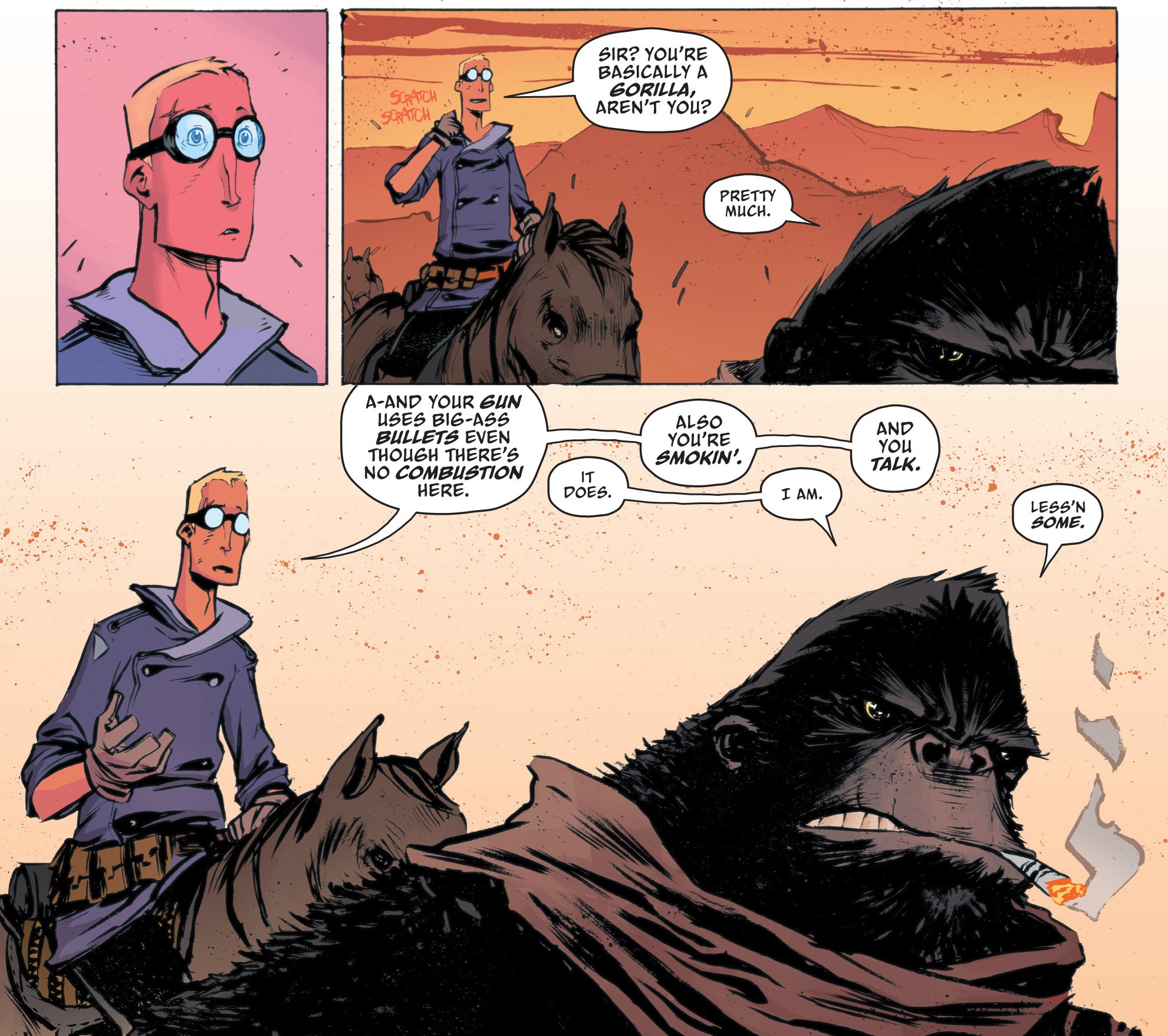
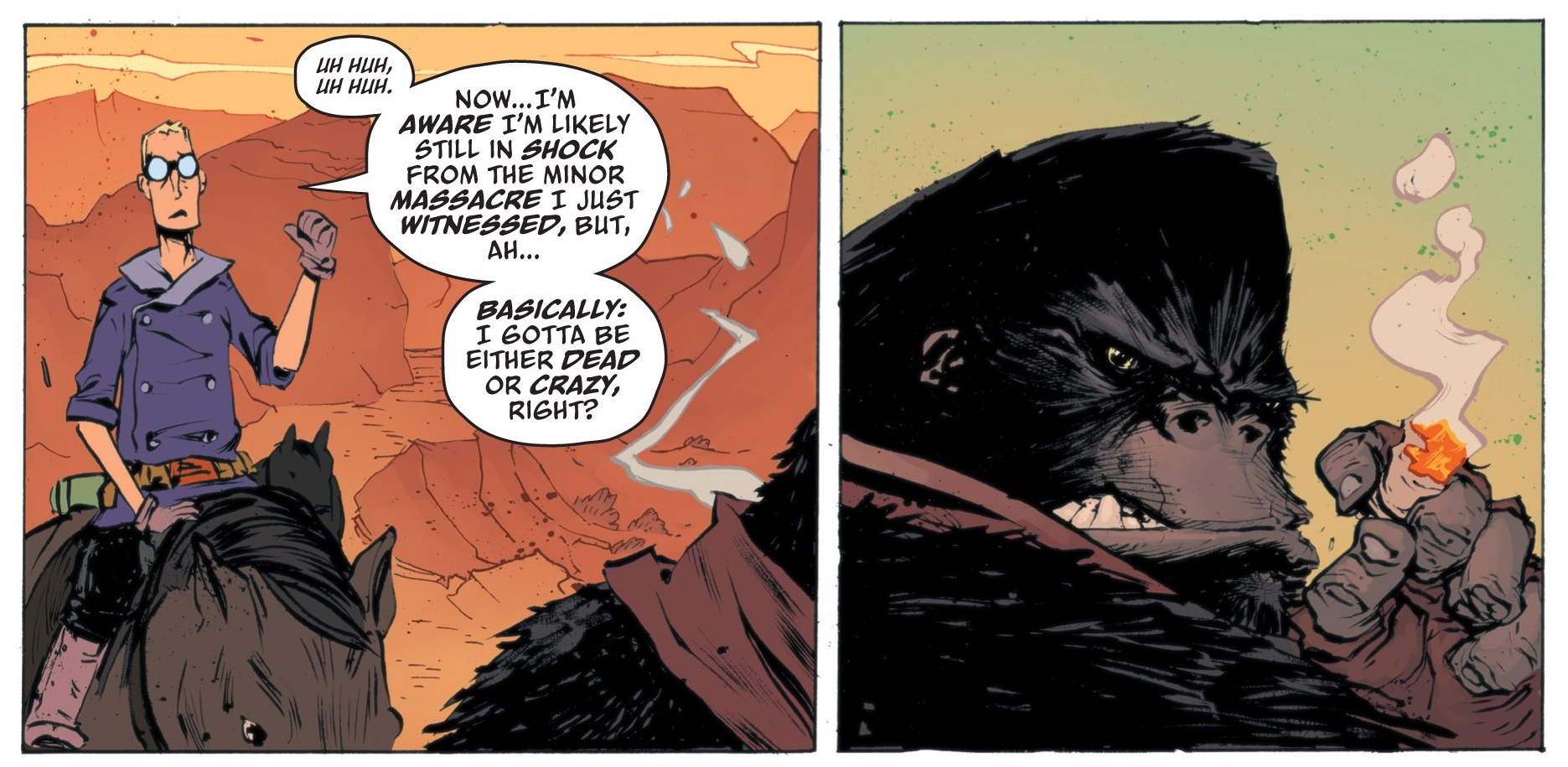
SIX-GUN GORILLA

Six-Gun GorillaSix-Gun Gorilla

A suicidal reality TV show. An interdimensional colonial war in a strange world without combustion. A sarcastic primate who wears a poncho and packs a couple of humongous revolvers. This book has it all.

But while that description may make it sound like just a bunch of awesome concepts thrown together, the result is actually much more thoughtful and emotionally engaging than a comic called Six-Gun Gorilla has any right to be. Simon Spurrier’s clever, satisfying story manages to top his work in Numbercruncher. Meanwhile, Jeff Stokely is asked to draw some truly outlandish stuff, and boy does he deliver like a motherfucker.

Satirical, fantastical, and brazenly metafictional, Spurrier’s and Stokely’s high-octane tour de force is a stirring love letter to pulp narratives.

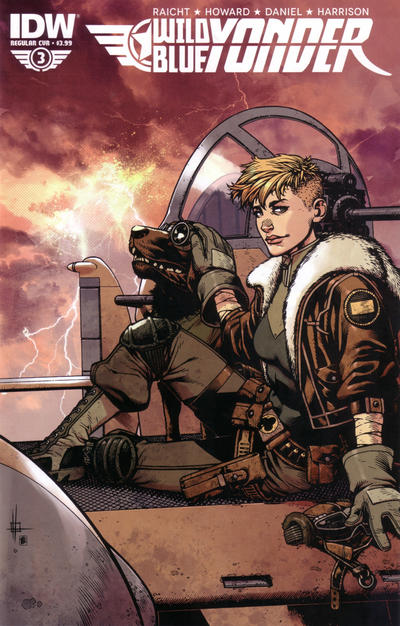
WILD BLUE YONDER

Wild Blue Yonder 3

When radiation and pollution consumed the Earth, humanity took to the skies, and it is now engaged in a brutal aerial war. With a hard-hitting post-apocalyptic neo-western vibe, this is basically Mad Max in the clouds (albeit more the visionary action craft of The Road Warrior than the amazing insanity of Fury Road). That said, not only does Wild Blue Yonder deliver all the white-knuckle dogfights and explosive jetpack-driven violence you’d expect from such a premise, it wisely anchors the story on some strong character work, making us feel for the people inside the aircraft. In that sense, there’s some of those great Howard Hawks pilot dramas (like Ceiling Zero and Only Angels Have Wings) in there as well!

Mike Raicht, Zach Howard, and Austin Harrison share story credit for this nifty comic. Yet Howard’s art is the main star here, in no small degree due to Nelson Daniel’s gritty colors, which give what could’ve been a silly world an impressive lived-in feel.

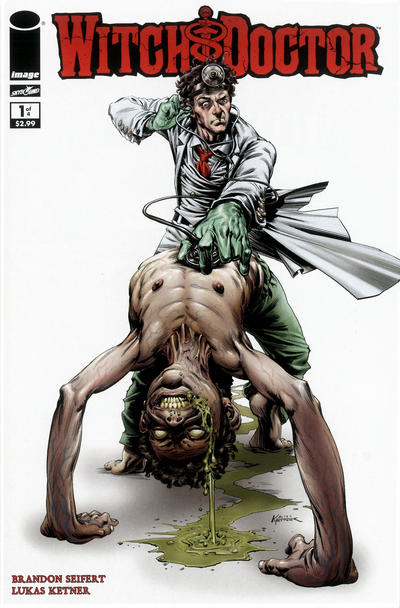
WITCH DOCTOR

Witch Doctor 01

Finally, I just can’t recommend this one enough. Drenched in humor, horror, and medical jargon, Brandon Seifert’s and Lukas Ketner’s Witch Doctor is a hoot.

The easiest way to describe it is basically House with supernatural medicine. The comic follows the misadventures of Dr. Vincent Morrow, occult physician. He is just as brilliant and arrogant as Hugh Laurie’s character, only his diagnoses and methods are even more outrageous (including slashing up diseases with the Excalibur sword), which is understandable since he’s dealing with patients whose conditions involve actual demonic possession and vampiric infection.

And just wait until you meet his freaky assistant!


NEXT: Batman and Alfred… Hitchcock.

Posted in FANTASTIC ADVENTURES | Tagged , , , , , , , , , , , , , , , , , , , , , , | Leave a comment

Balls-to-the-wall adventure comics – part 1

Comics is a medium, not a genre. And as a medium, comics can be used to tell all kinds of mature stories, from powerful biographies (Maus, Persepolis, Fun Home, Stitches) to fascinating historical and journalistic accounts (Brought to Light, Pyongyang, Safe Area Gorazde, A Treasury of Victorian Murder) to realistic tales of human drama and comedy (Exit Wounds, Mister Wonderful, Bad Houses, Stuffed!). The one type of stories which is most associated with comics, however, is crazy action-adventure that draws on childish and adolescent fantasies – this is what critics are referring to, for example, when they say that a movie ‘feels like a comic book.’

Of course it frustrates me how the whole medium, for all its diversity of content and sophistication, is still so narrowly perceived by many people. That said, I have no problem admitting that there is a kind of over-the-top ‘Hell yeah!’ pulp adventure that comics, with their dynamic visuals and daring ideas less restricted by budgetary concerns, often deliver better than any other media – the kind of stories whose joyous exuberance can both stimulate our imagination and condition us to a state of arrested development. In short, the kind of stories Batman often finds himself a part of, especially when he’s being written by the likes of Grant Morrison or Alan Grant.

And if you enjoy Batman’s wildest adventures, here are some other ongoing or more-or-less recent comics that are even wilder:

ATOMIC ROBO

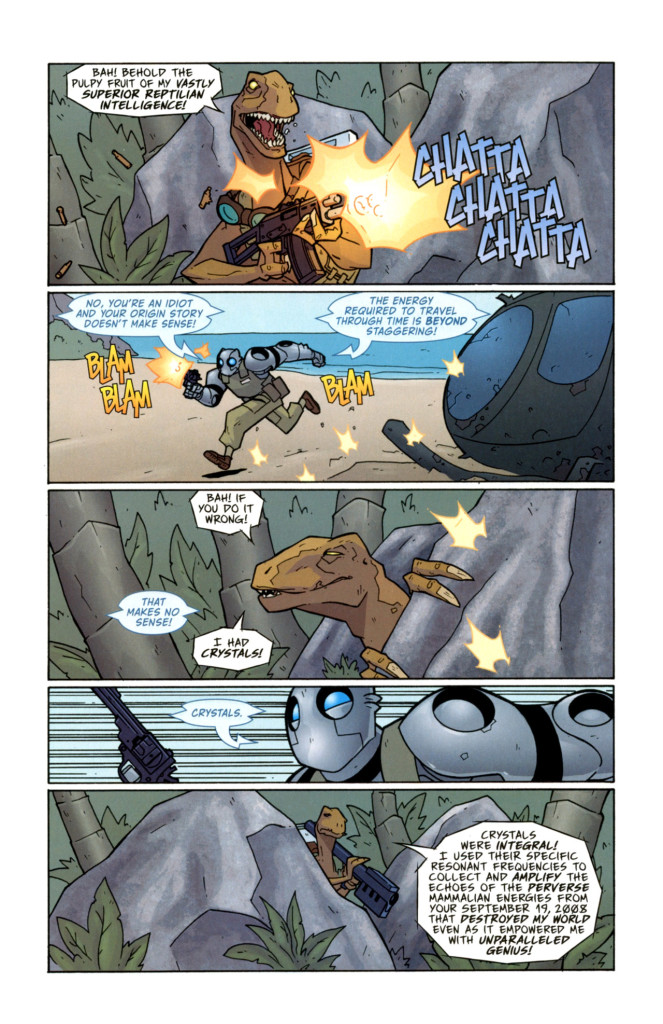
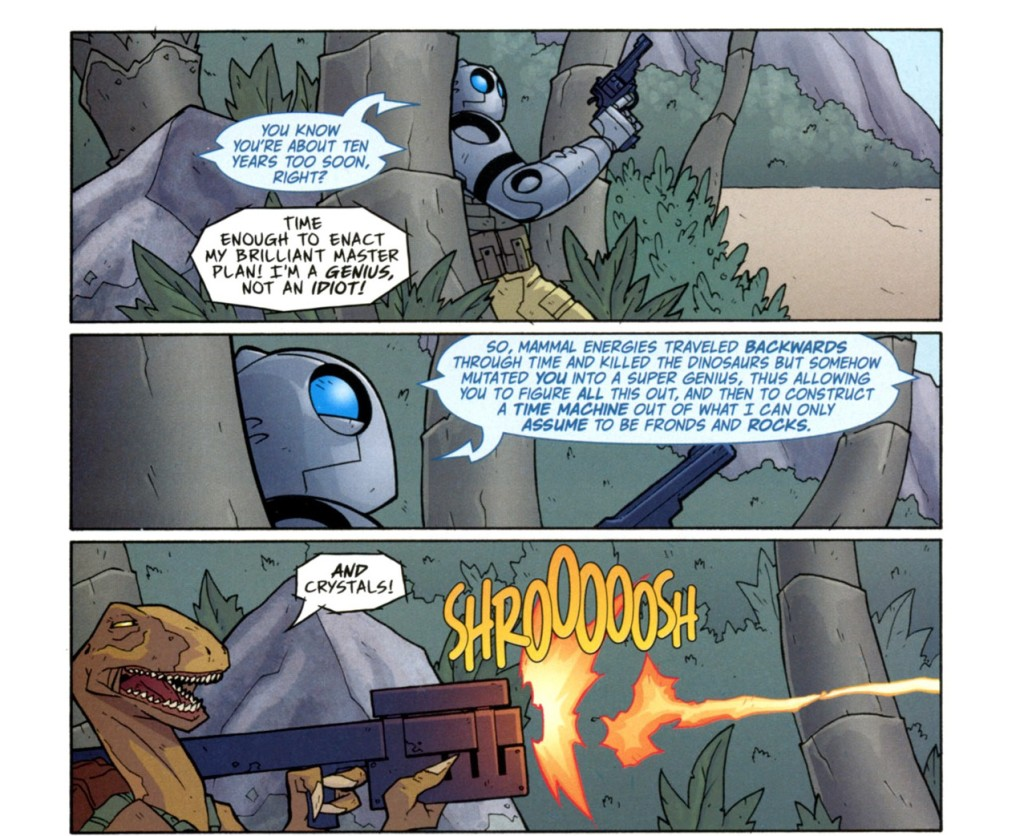
Atomic RoboAtomic Robo

This series about the rip-roaring life of a robot created by Nikola Tesla who fights his way through the weirdest threats of the 20th and 21st centuries is everything an all-ages comic should be. Chockfull of hilarious dialogue and super-science, Atomic Robo is clever and exciting enough to appeal to anyone who likes pulpy fun, as it follows 5 basic promises from creators Brian Clevinger and Scott Weneger: no angst, no cheesecake, no reboots, no filler, and the main robot will punch a different robot (or maybe a monster).

What’s more, the series grows awesomer with each new volume. The Fightin’ Scientists of Tesladyne jumps back and forth between tales of an evil genius, giant insects, and mechanical mummies. In The Dogs of War, set during WWII, Atomic Robo fights Nazi super-soldiers and walking tanks. In The Shadow From Beyond Time, he faces a Lovecraftian hyper-dimensional creature across different eras. Other Strangeness shows us a typical week in the life of Atomic Robo, complete with a vampire invasion and an undead Thomas Edison.

The Deadly Art of Science is a bittersweet yarn of gangsters, vigilantes, and mystic skulls in the 1930s. The Ghost of Station X ends the very first page with NASA telling Robo: ‘We have astronauts trapped in orbit. They’ve got seven hours to live. You are their only chance.’ – and it doesn’t freaking slow down for over 100 pages… The Flying She-Devils of the Pacific features a secret militia of rocket-pack flying women trying to stop a rogue Japanese counter-attack against the US in the early 1950s and, unsurprisingly, it reads like a sensational, cartoony serial (even if it oddly disregards the Korean War going on at the time). The Savage Sword of Dr. Dinosaur features the series’ most ludicrous villain while still managing to be ingeniously imaginative and relentless as hell. And wait until you see Robo kicking butt in the old west, in The Knights of the Golden Circle!

Additionally, Clevinger has launched the anthology Real Science Adventures, which totally includes a team-up between Atomic Robo and Bruce Lee.

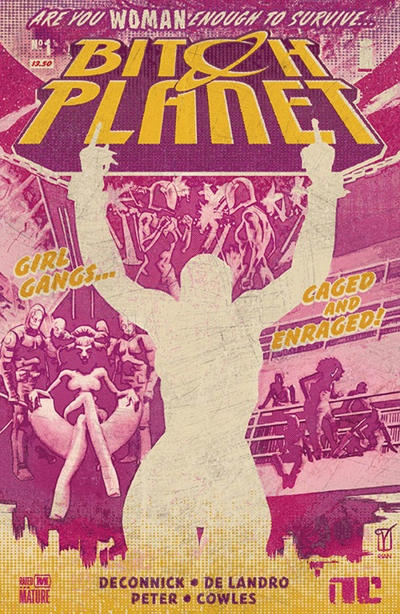
BITCH PLANET

Bitch Planet

When the patriarchy deems some women inconvenient, it sentences them to an Auxiliary Compliance Outpost, by which I mean it sends them to a freaking prison planet where they are expected to play a deadly sport on live TV. If this sounds like grindhouse material, it’s because it proudly is. Valentine de Landro’s grungy art clearly draws on blaxploitation aesthetics, to the point that one of the protagonists even looks like Pam Grier.

Yet Bitch Planet isn’t a mere pastiche. Writer Kelly Sue DeConnick, after having put her own spin on the western genre with Pretty Deadly, is now taking the clichés of 1970s’ low-budget cinema (the graphic violence, the racist douchebag, the lesbian shower scene) and turning them into shameless feminist exploitation. The final product has the iconoclastic defiance of a punk Susan B. Anthony. What a kick-ass comic!

BRAIN BOY

Dark Horse Presents 023

A sci-fi/espionage series about a telepathic, telekinetic agent of the US Secret Service (technically, a subcontractor from a shadowy private company run by an eccentric mutant who compulsively tests new technology on herself), Brain Boy mixes political intrigue and thrilling supernatural action. For example, there is a story in which the titular spy is assigned with protecting an ersatz-Hugo Chávez and damn it if he doesn’t soon find himself fighting against a horde of possessed U.N. diplomats!

The main character was originally created at the height of the Cold War era, in the early 1960s, but he was rebooted a couple of years ago. And since the comic is now being written by Fred Van Lente, it goes without saying that the whole thing is smart, fast-paced, and highly entertaining, with Brain Boy using his telepathy in various cool and inventive ways.

CASANOVA

Casanova

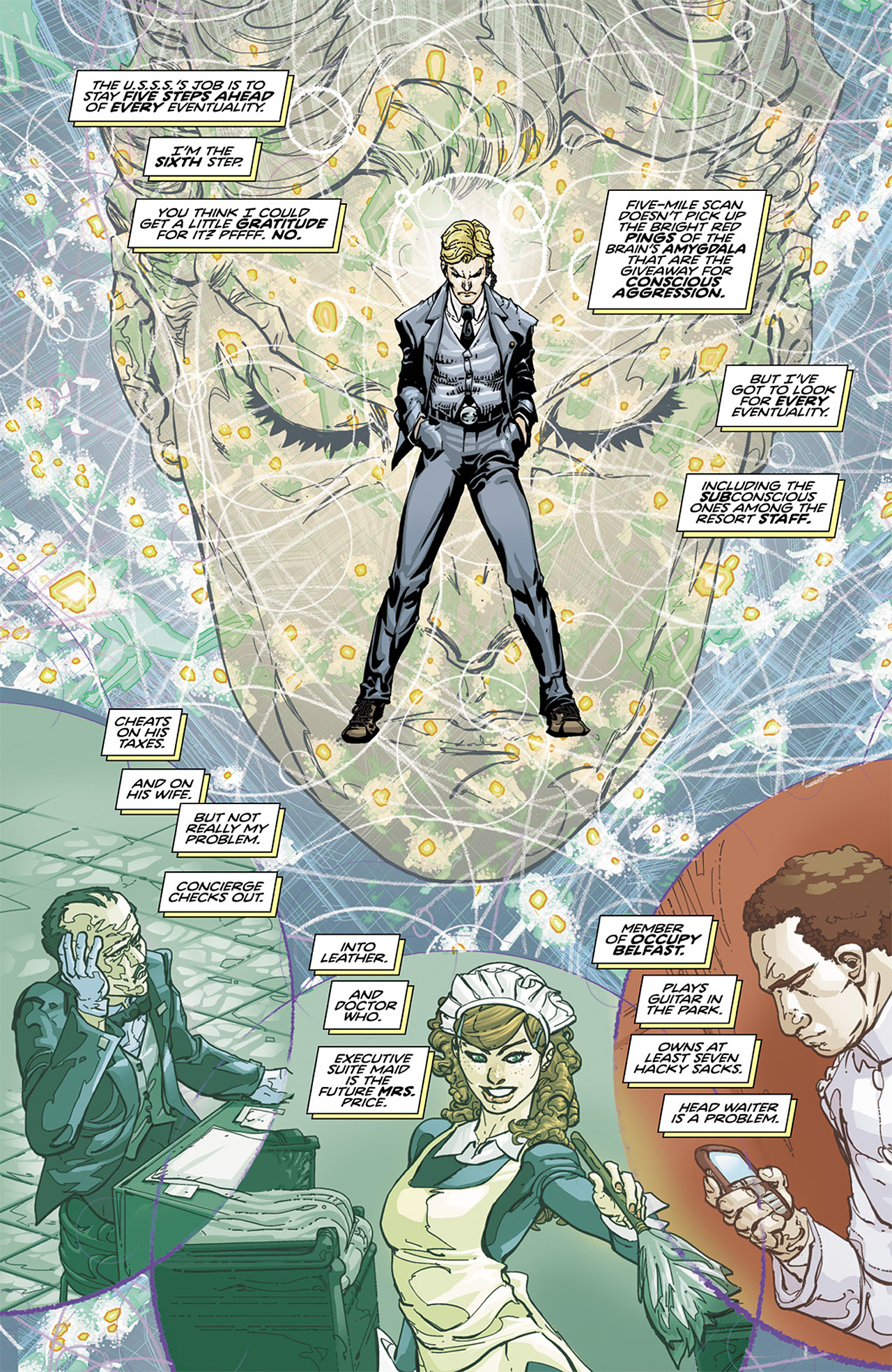
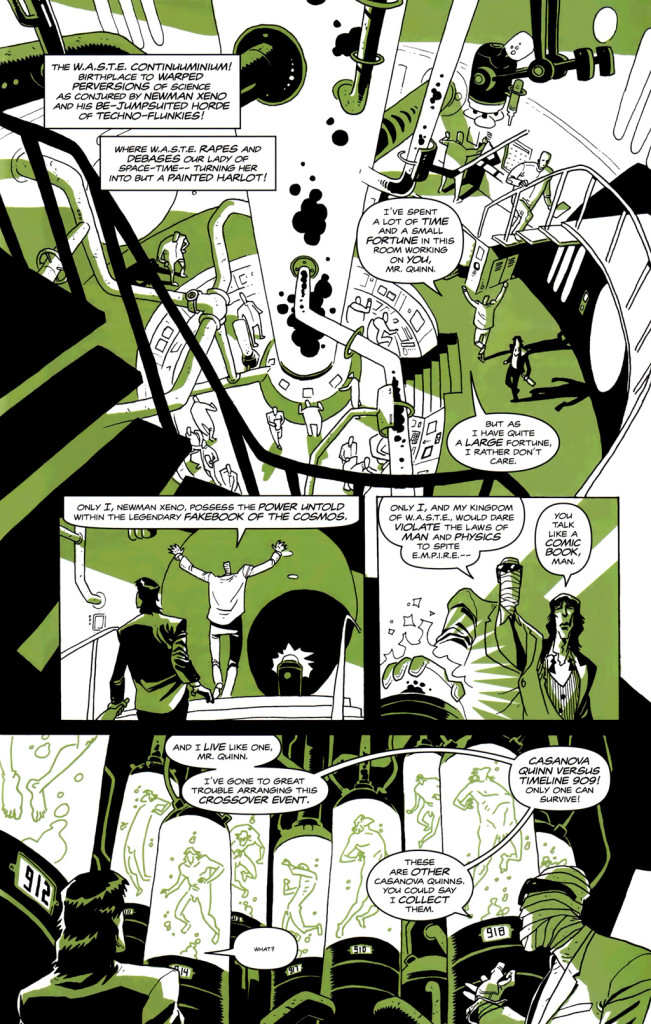
Despite a successful career writing Marvel superheroes, Matt Fraction’s coolest work has always been in the indie scene (go ahead, call me a hipster!), with stuff like The Five Fists of Science (a witty steampunk version of Ghostbusters, starring Mark Twain) and Sex Criminals (a charming sex comedy/thriller with splashes of magic realism). And sure enough, Casanova is Fraction’s masterpiece, a spectacular-looking extravaganza of psychedelic dimension-hopping and twisted family dynamics.

Like Brain Boy, this is a sci-fi/espionage series with a lead who engages in psychic combat, but Casanova has a whole different attitude. Matt Fraction sacrifices lean narrative for sensory overload, packing each page with as many mind-blowing concepts as he can (often delivered as asides, with the characters addressing the reader) and frantically changing the hero’s allegiances, timelines, and even his gender. Casanova Quinn is sometimes an agent of E.M.P.I.R.E. (Extra-Military Police, Intelligence, Rescue, and Espionage), other times an agent of W.A.S.T.E. (an anagram whose meaning changes every second), or both at once, or none at all. His missions include, for example, destabilizing a Brazilian town that runs on wireless sexual energy and stealing a pop illusionist-turned-god.

The comic helped launch artists Gabriel Bá and Fábio Moon, whom you may also know from the surrealist The Umbrella Academy or from the more realistic and deeply moving Daytripper. The two brothers draw the hell out of Casanova, with pencils that can be at once racy, light as a feather, and totally rock & roll.

So, can it possibly get any better? It can: the latest volume has backup stories written by Michael fucking Chabon.

DEFOE

2000AD 15402000AD 1540

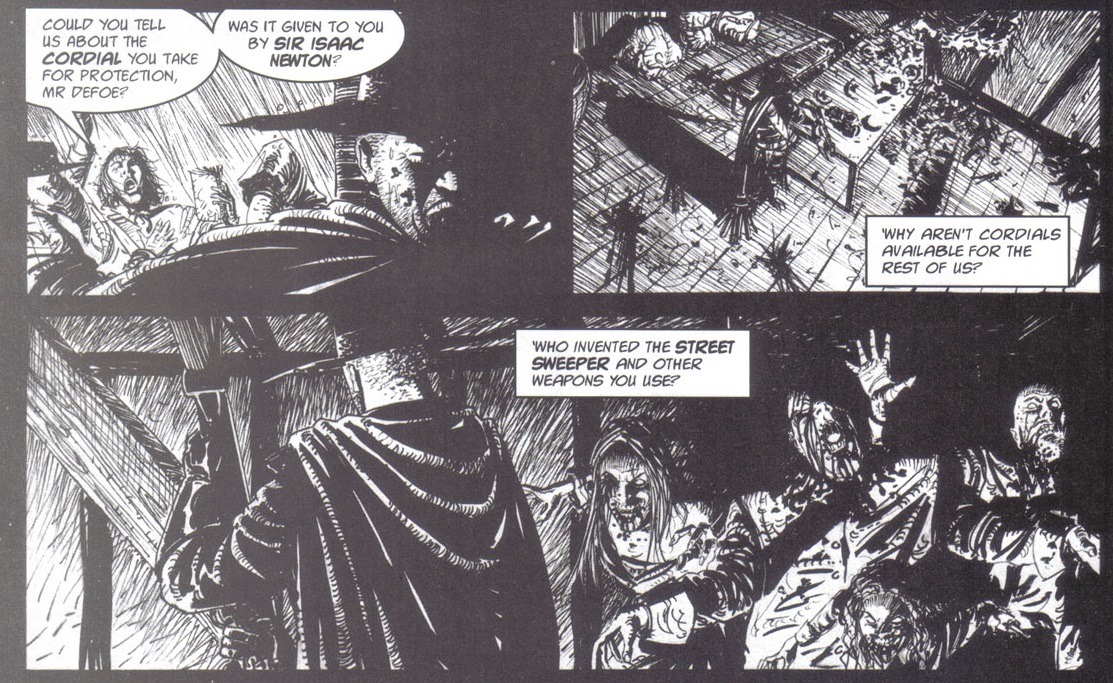
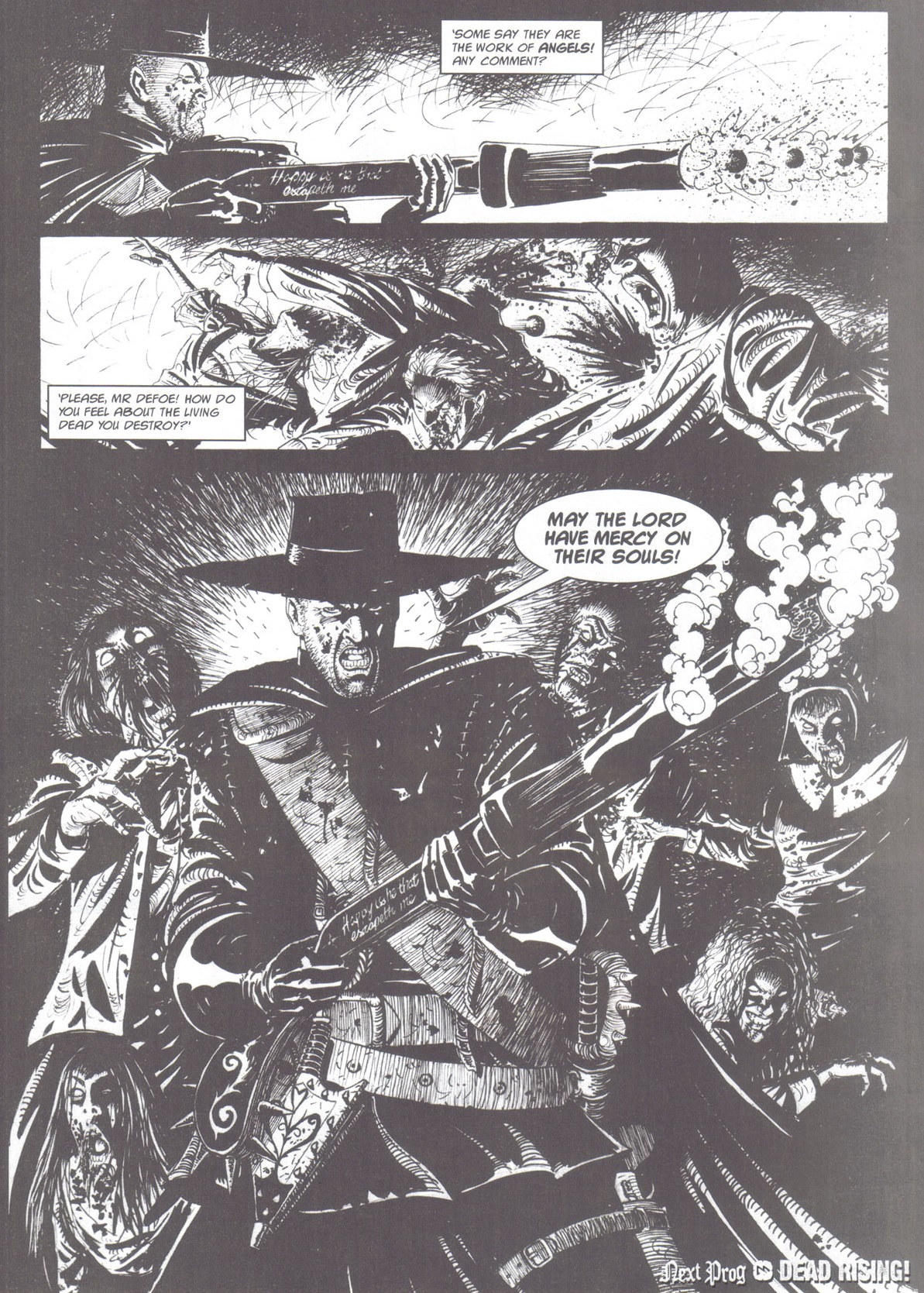
2000 AD has given the universe its fair share of avant-garde adventures, from violent satire involving the proto-fascist Judge Dredd to the misanthropic Flesh, where time-travelling futuristic cowboys are chased by a vengeful T-Rex (and you find yourself rooting for the dinosaur). Of all the glorious contributions of this British anthology, though, a personal favorite of mine is the series about zombie-slayer Titus Defoe, set in a steampunk 17th century London (technically pre-steam, but so infested with celestial technology that it doesn’t make much difference). Channeling writer Pat Mills’ typical anti-authority motifs, the best bit is that Defoe is a committed Leveller who hates the royals and aristocrats he works for almost as much as he hates the zombies.

Mills and artist Leigh Gallagher sculpt a detailed world of palace politics and magical lore, inhabited by actual historical figures alongside eccentric creations such as a secret agent called If-Christ-Had-Not-Died-For-Thee-Thou-Wouldst-Be-Damned Jones and a gang of outcasts tasked with suicidal missions, appropriately named The Dirty Dozenne. In fact, one could say that the comic takes some time to establish all the intricacies of this alternate world and the very large cast of characters, but once it finally gets rolling, it’s one hell of a ride!


NEXT: More balls-to-the-wall adventure.

Posted in FANTASTIC ADVENTURES | Tagged , , , , , , , , , , , , , , , , , , , , | Leave a comment

3 more nods to the Batman TV show, by Klaus Janson

Last month I pointed out how various Batman comics have featured nods to the 1960s’ Batman TV show. I spotlighted some of the most obvious ones, but of course there have been plenty more sprinkled here and there throughout the years. One artist who seems particularly fond of them is Klaus Janson.

Check out this sequence:

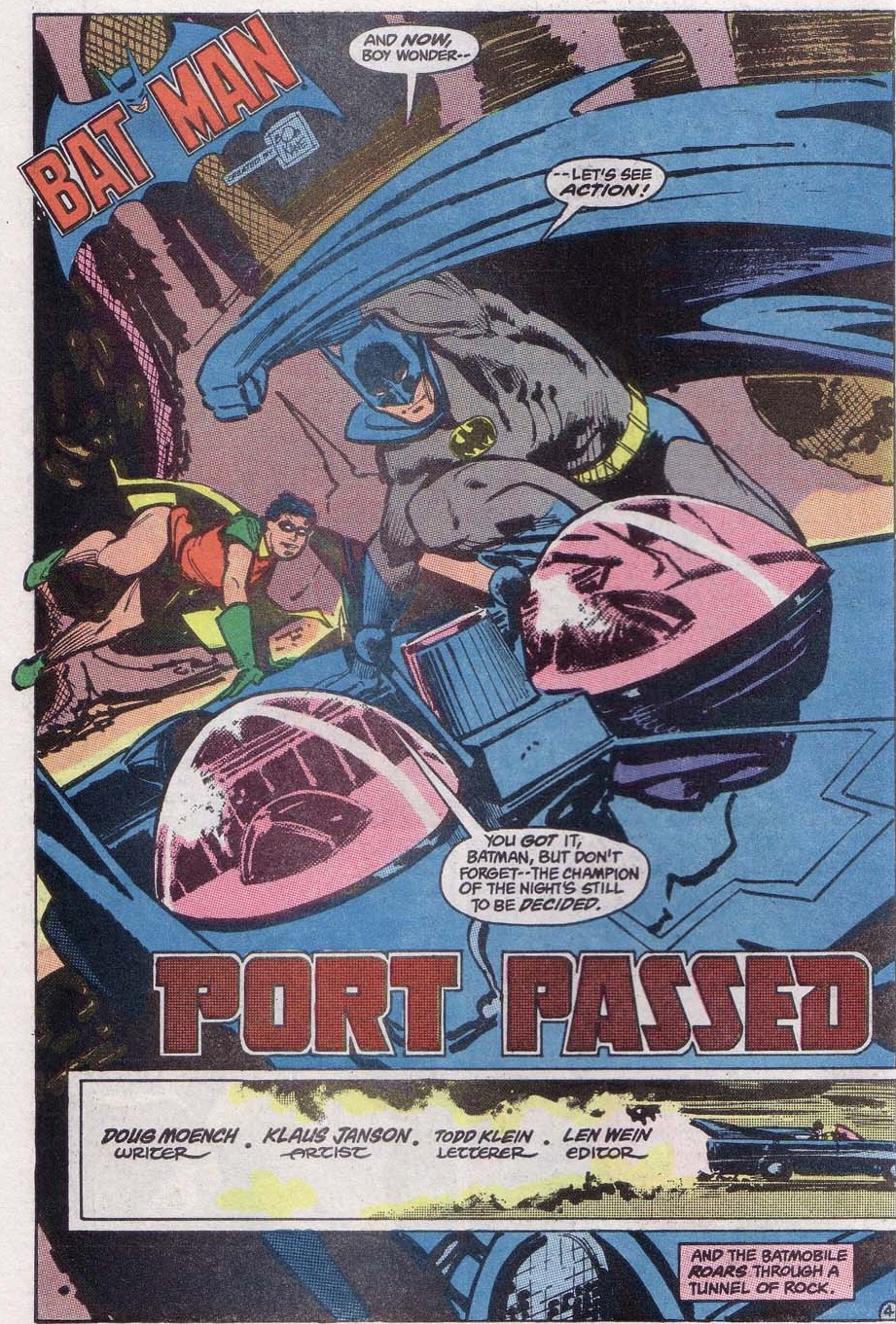
detective comics 554detective comics 554Detective Comics #554

I’m not positive that Batman and Robin playing chess is necessarily a homage to their game at the beginning of the episode ‘A Riddle A Day Keeps The Riddler Away’ (not to mention the quadruple-decker chess game in ‘The Purr-fect Crime’) but that last page sure has the TV show all over it. The Dutch angle, the upbeat Dynamic Duo, the Lincoln Futura Batmobile, the fire bursting out the back as they leave the Batcave…

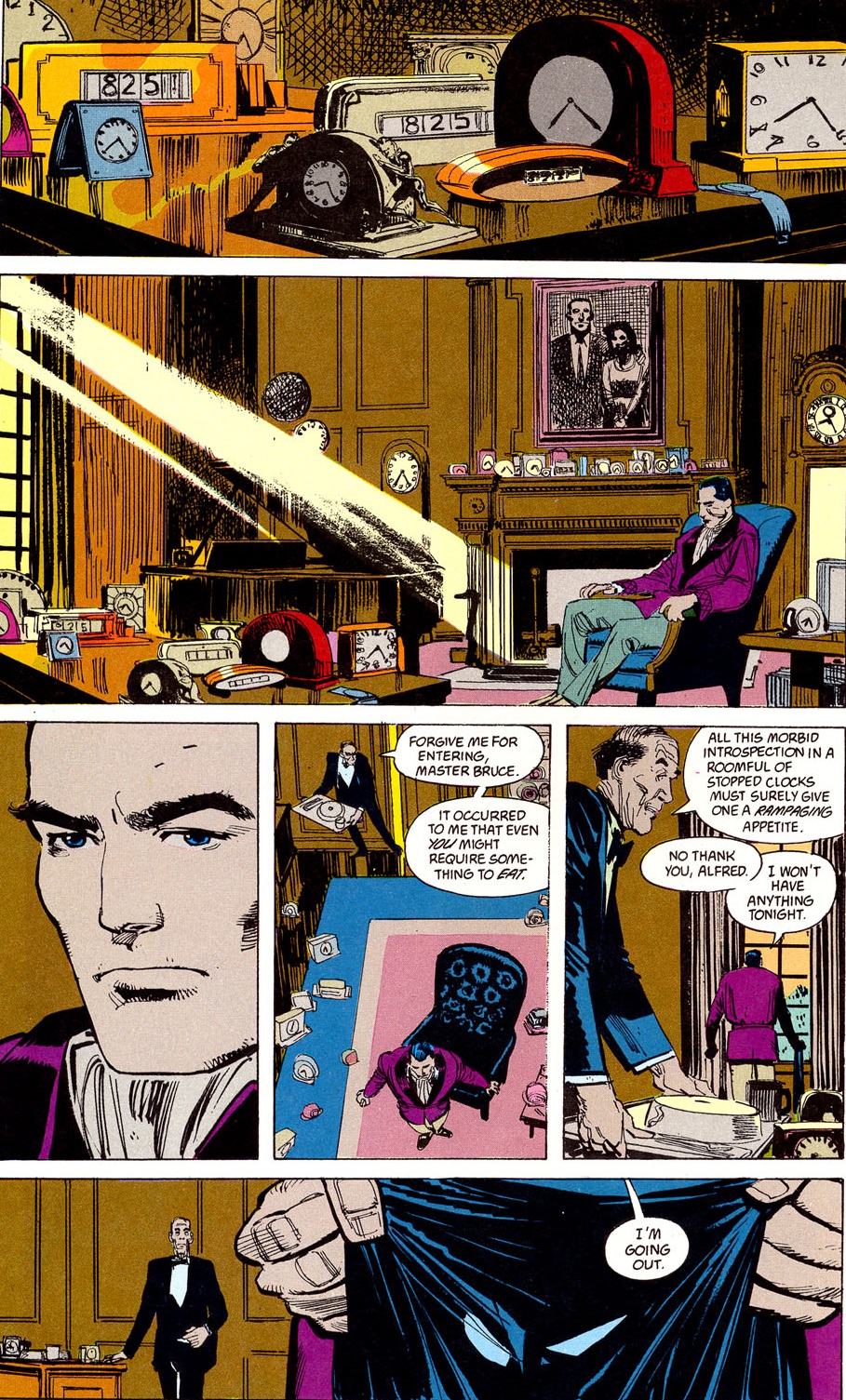
Although with a more somber tone, Klaus Janson also seems to have drawn inspiration from the show’s look in this page from Gothic, most notably by dressing Bruce Wayne in typical Adam West attire:

Legends Of The Dark Knight 06Legends of the Dark Knight #6

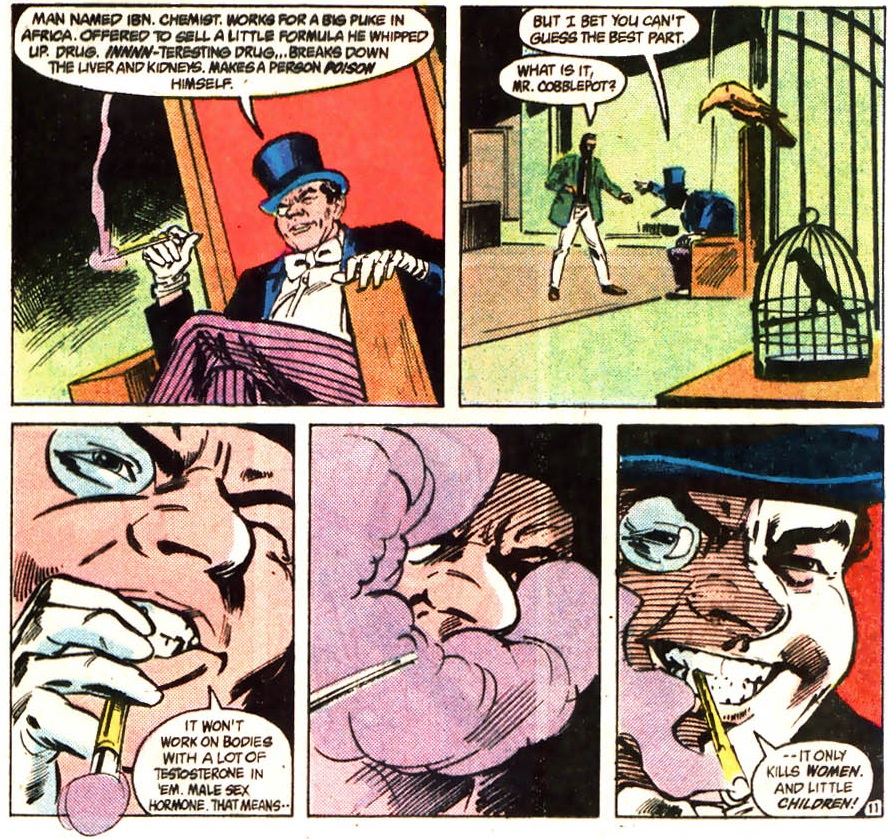
Finally, when tasked with drawing the Penguin, Klaus Janson took the opportunity to make him look like actor Burgess Meredith in the TV series:

Detective Comics Annual #1Detective Comics Annual #1

NEXT: Balls-to-the-wall adventure.

Posted in ART OF BATMAN COMICS | Tagged , | Leave a comment

On Dick Grayson, the Teen Wonder

If Dick Grayson’s childhood was pretty unusual, his adolescence was totally out there.

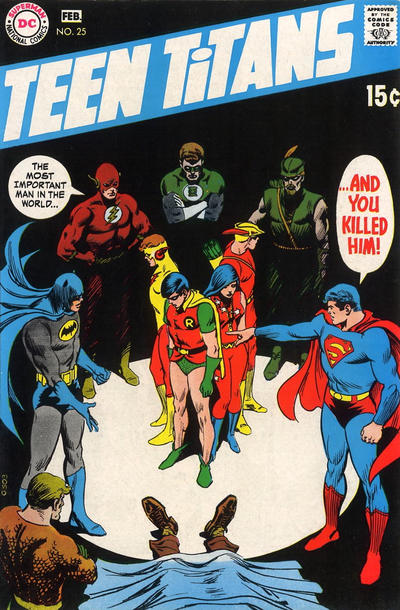
While Detective Comics didn’t promote him from Boy Wonder to Teen Wonder until 1970, in the mid-60s Robin became a founding member of the Teen Titans:

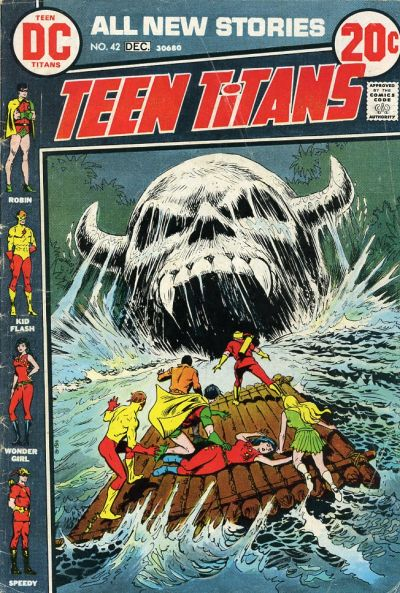
Teen Titans 25          Teen Titans 42

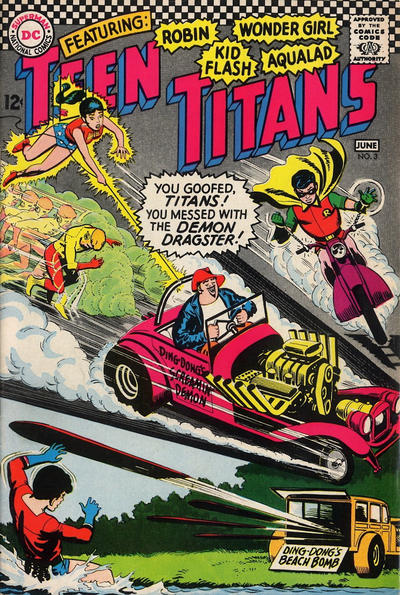
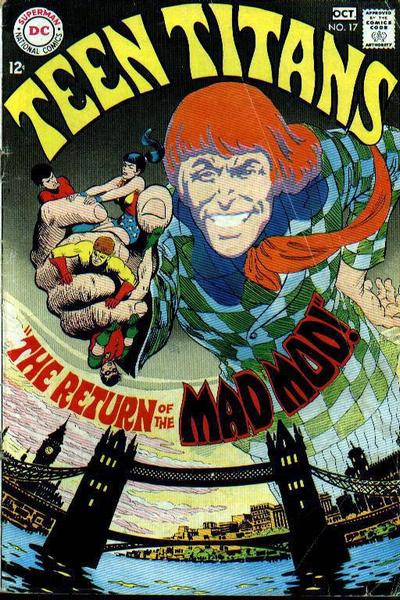
The Teen Titans comic revolved around a team made up of young sidekicks, including Robin, Kid Flash, Wonder Girl, Aqualad, and, later, Speedy (the sidekicks of Batman, Flash, Wonder Woman, Aquaman, and Green Arrow, respectively). Because the series sought to appeal to teen readers, the villains were often lifted from current trends. And because the writer was Bob Haney, the result was close to insane:

Teen Titans 3          Teen Titans 17

Like other comics of the era, the series was shamelessly political. In the very first issue, the Teen Titans joined the Peace Corps and went on a mission to South America (which involved fighting a giant conquistador robot, because Bob Haney). In the third issue, Washington enrolled the Titans in a national campaign to persuade dropouts to stay in school. There were also stories in which the team joined Uncle Sam’s ‘good neighbor’ cultural exchange campaign with other nations (but not before saluting a picture of JFK) and helped rescue the foreign student exchange program from American xenophobes (and from a German spy). In ‘Eye of the Beholder,’ the Titans befriended a Soviet superhero. In ‘The Titans Kill a Saint?’ they agonized over the death of a Nobel Peace Prize laureate at an anti-war protest.

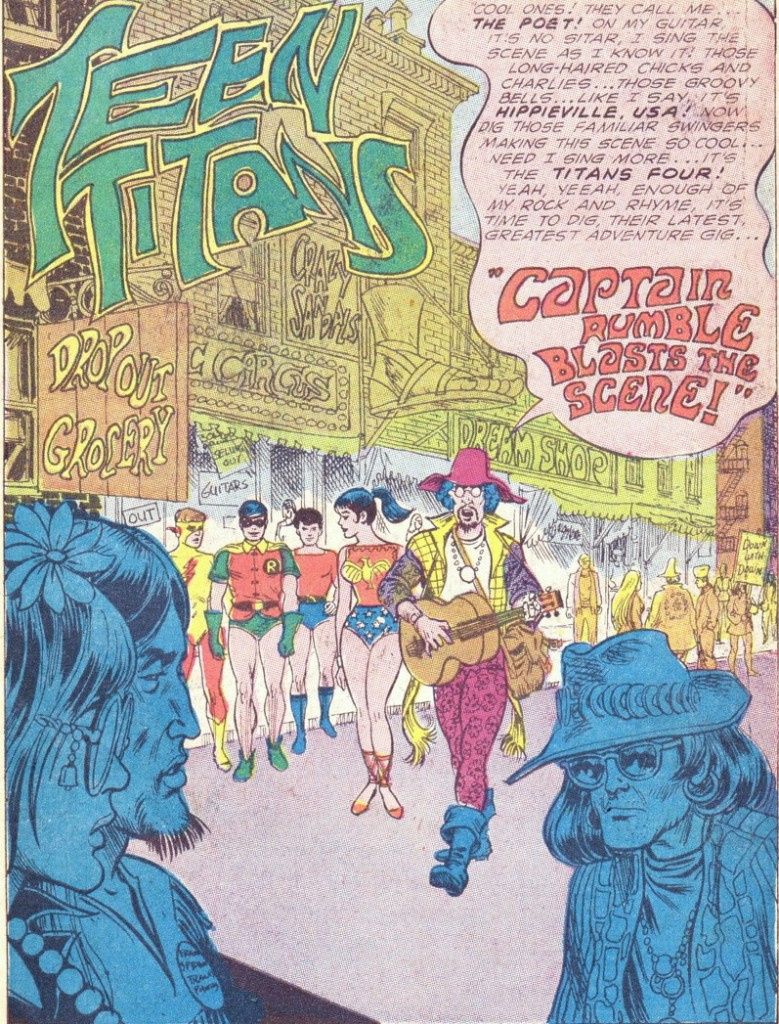
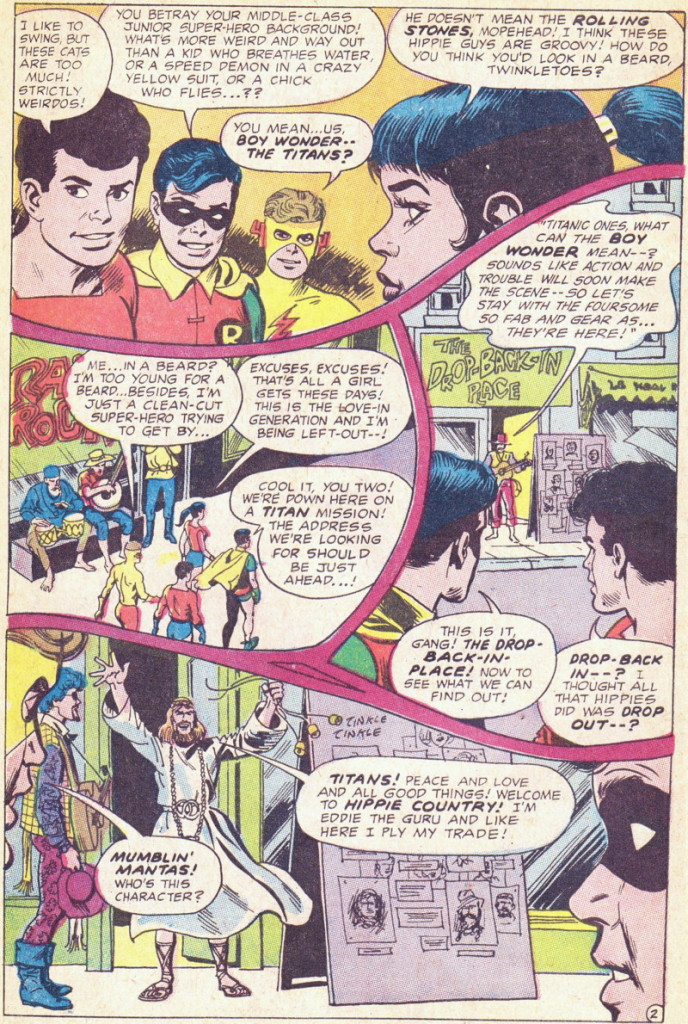
And then there is the issue where the Titans travel to Hippieville, which is as trippy as it sounds…

Teen Titans 15Teen Titans 15Teen Titans #15

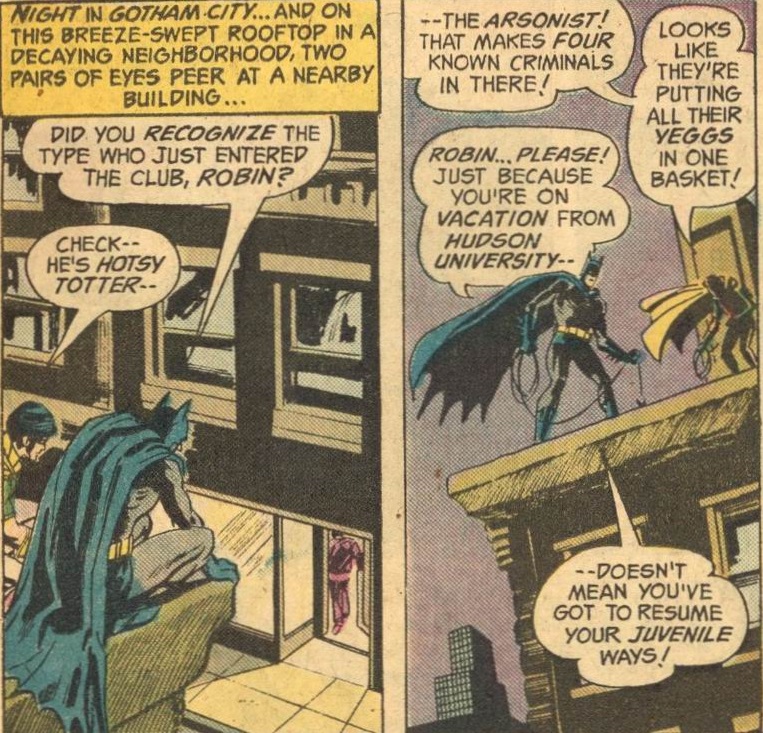
Robin’s adventures with the Teen Titans didn’t prevent him from continuing to fight crime alongside Batman. But in 1969 the Dynamic Duo did finally break up as Dick Grayson moved out of Wayne Manor and left for Hudson University. The editorial reasoning behind this was probably to let the Dark Knight do his Sturm und Drang brooding alone, which would suggest Dick was no longer necessary as a character in Batman’s world. However, as demonstrated by the Teen Titans comic, with the rise of youth culture Robin may have been more relevant than ever.

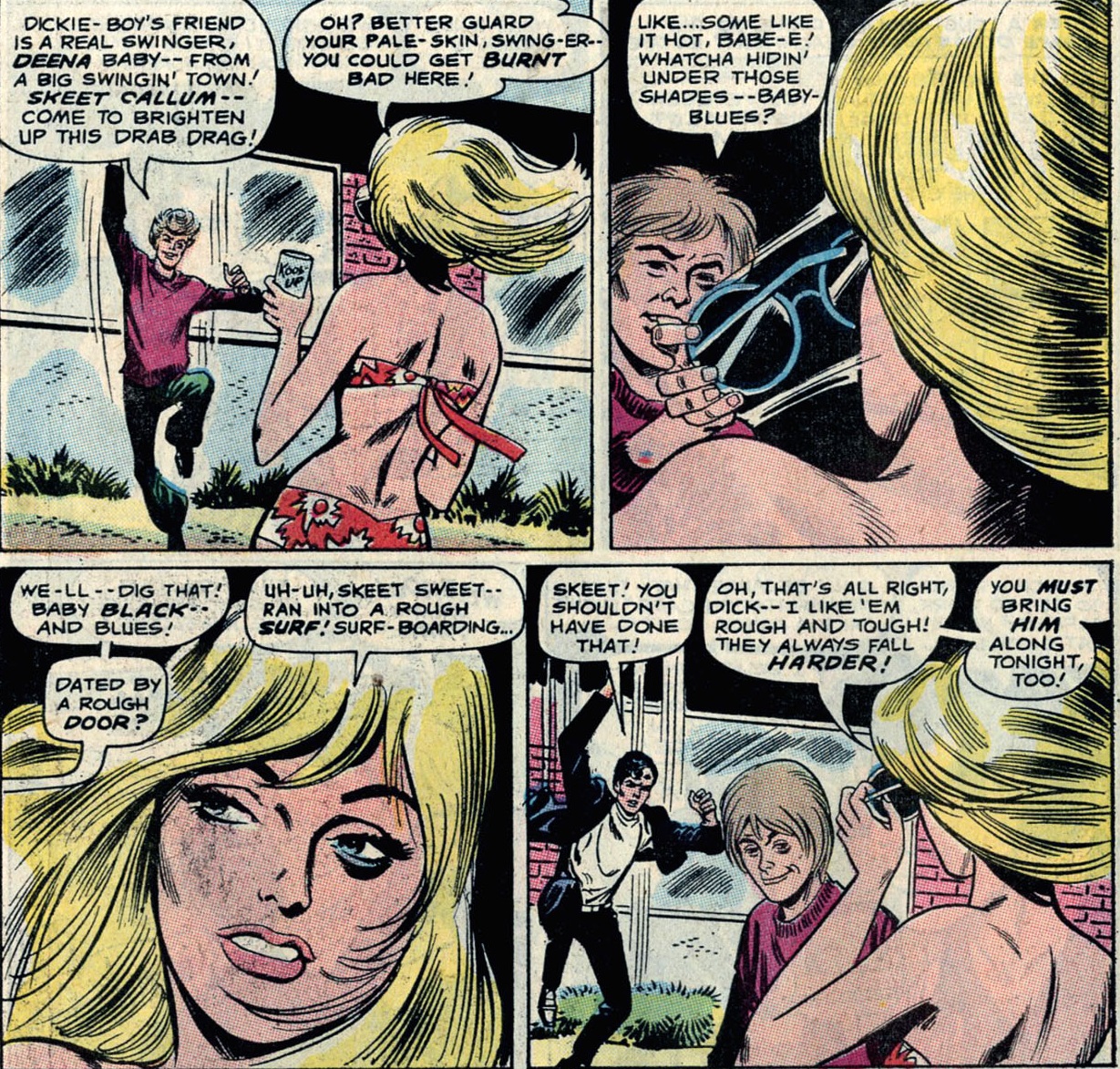
Some Batman stories had already begun to explicitly address the generation gap, not so much within the Dynamic Duo, but in the cast of suspects of crimes they investigated (most notably in Detective Comics#387 and #393). The last story before Robin leaves is a great example. On the one hand, Dick is kind of a useless sidekick – his major contribution, I kid you not, is to distract a bunch of goons by surfing under the moonlight. On the other hand, Dick serves as a link to a new generation, giving us access to some groovy dialogue:

detective comics 393Detective Comics #393

Robin transitioned to solo adventures in the backup features of Batman and Detective Comics, which depicted Hudson University as a hub of student counterculture. In ‘Vengeance for a Cop,’ an officer describes the campus’ outskirts as ‘the border between the U.S.A. and the Woodstock Nation.’ These comics treaded the line between staying attuned to the latest trends and remaining faithful to Robin’s pro-establishment respect for law and order, with scripting duties alternating between the hippie Denny O’Neil and the cynical Frank Robbins, as well as twenty-year-olds Mike Friedrich and Elliot S! Maggin.

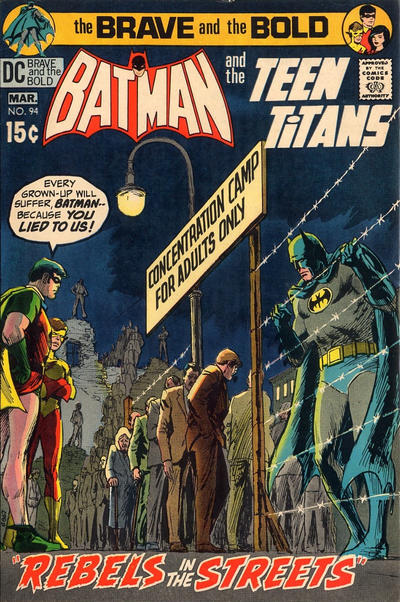
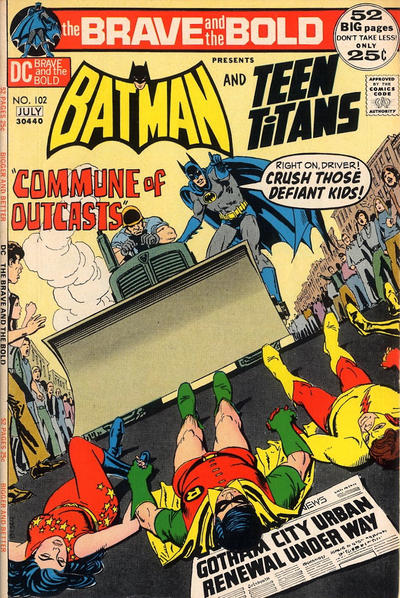
Needless to say, though, as usual the most outlandish take on the subject came from Bob Haney in The Brave and the Bold, where Gotham City was temporarily taken over by a youth rebellion movement called STOPP – Society To Outlaw Parent Power.

Brave and the Bold 94          Brave and the Bold 102

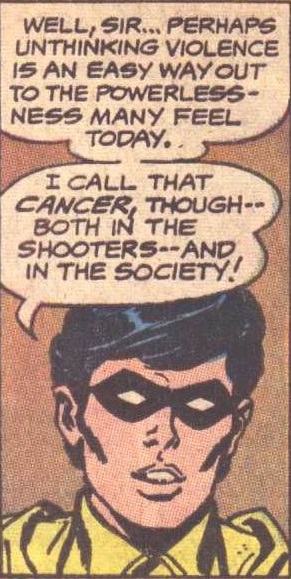
The bulk of Robin’s tales were written by Mike Friedrich, himself in college at the time. These stories aren’t much fun (or any good, really) but they do provide a fascinating glimpse into the early 1970s. Friedrich’s Robin kept a balanced position on the culture wars, as he sought to restrain both sides of the national divide. For a character rooted in righteous vengeance and violent crime-fighting, Dick Grayson increasingly came across as a pacifist, constantly appealing to calm and dialogue, whether talking to the police, to his colleagues, or to the Jesus people.

Thus, instead of kicking butt, Dick now spent most of the time trying to prevent conflict:

Batman 234 Batman #234

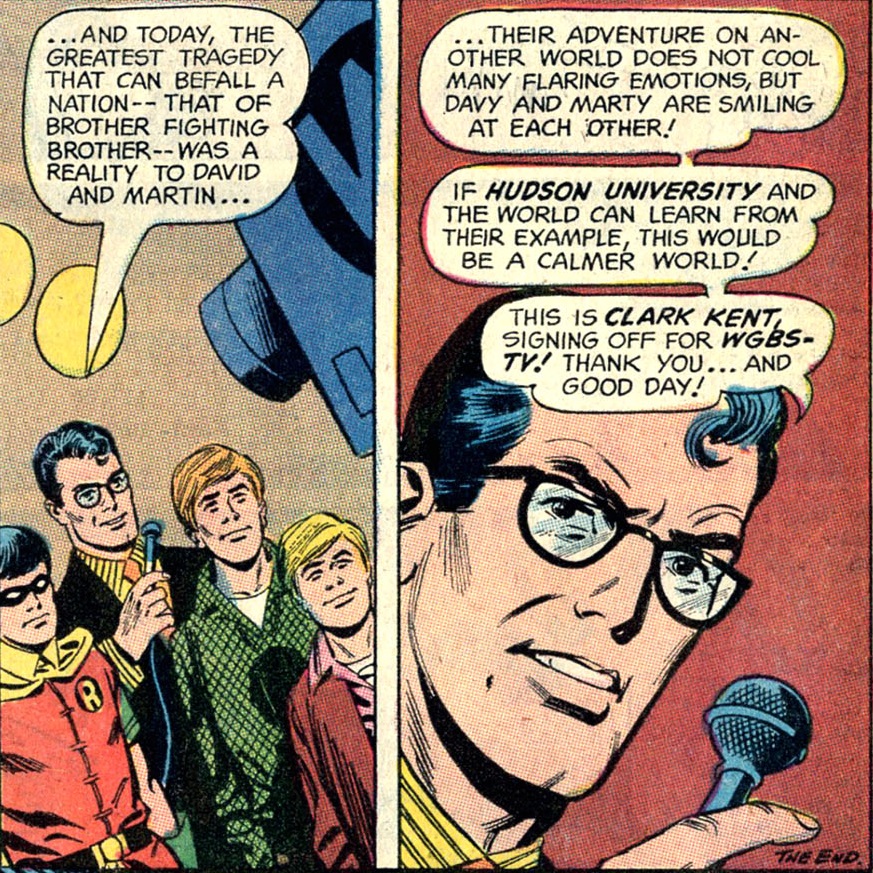
He even recruited Superman’s help to make the point:

WORLD'S FINEST COMICS 200World’s Finest Comics #200

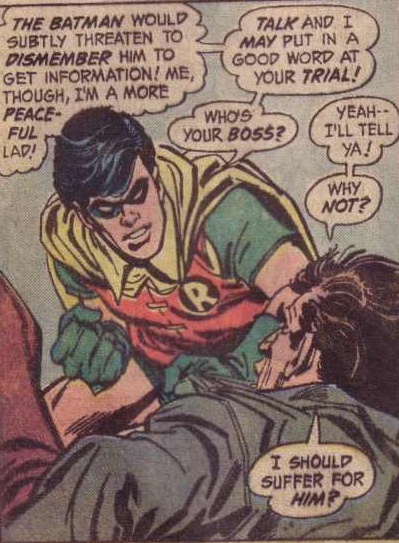
Robin’s ‘pacifism’ would also help distinguish him from his mentor:

Batman 257Batman #257

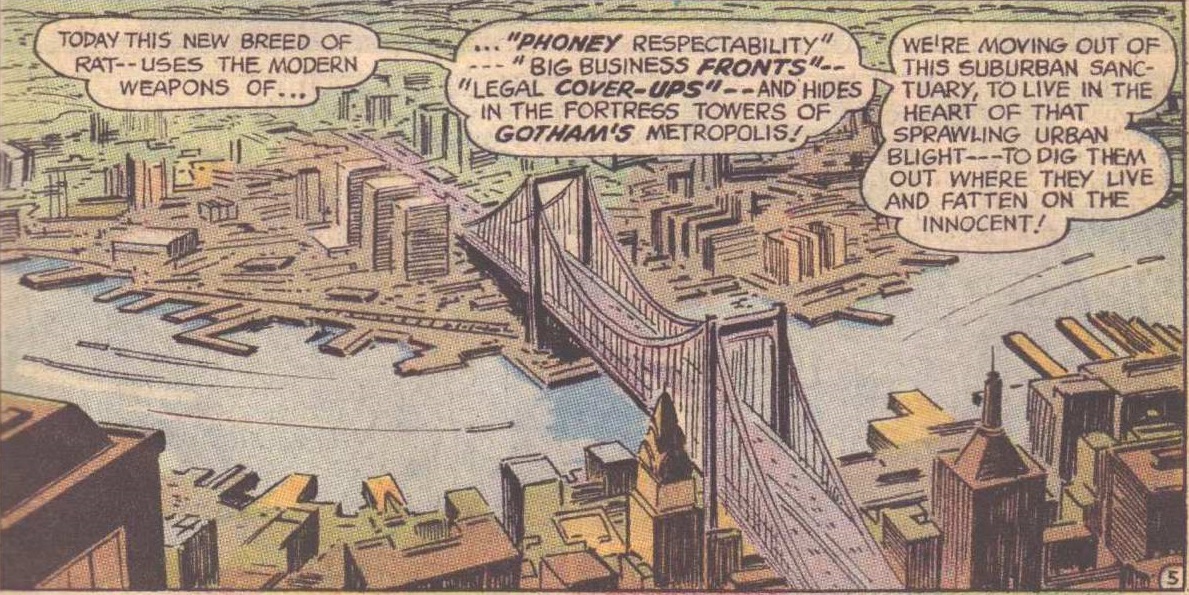
Meanwhile, back home the Caped Crusader himself was getting a makeover. Bruce Wayne became more of an activist entrepreneur, replaced the Batmobile with a fashionable sports car, and even left the old mansion for a modern penthouse in central Gotham. Or to put it in Batman terms:

Batman 217Batman #217

With Batman now mostly working alone and Robin’s presence in the main titles reduced to rare appearances, the notion of a Dynamic Duo seemed more and more pointless. Even when Dick Grayson occasionally popped up for a supporting bit, his role was usually that of a weak link in need of rescue, such as in ‘Daughter of the Demon’ or in ‘How Many Ways Can a Robin Die?’

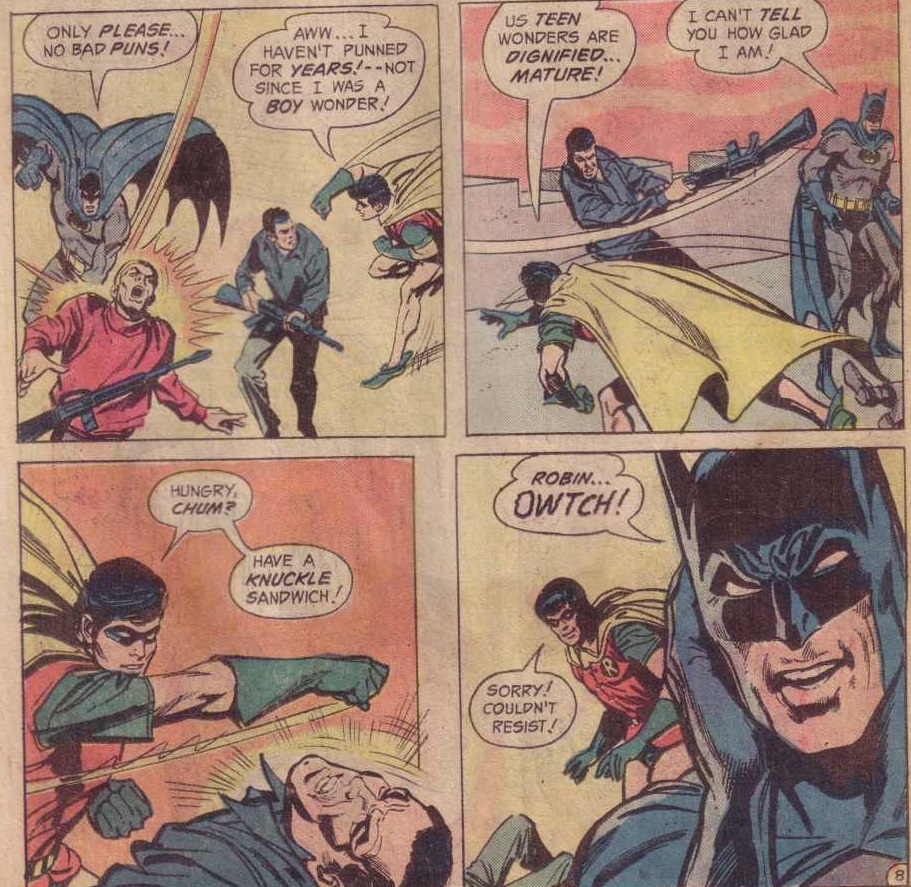
Things changed a bit in the mid-70s, with Robin guest-starring more often and being given a more active role in the stories, not to mention a cockier attitude. Having successfully reestablished Batman’s stripped down hardass street cred, writer Denny O’Neil was now lightening things up by revitalizing old concepts and characters who had hardly been seen since the ’60s. O’Neil even embraced Robin’s punning tendencies, although not without some ironic self-awareness – wordplay was presented as not just a throwback to another era, but as a symbol of childishness:

Batman 257Batman #257
Batman 258Batman #258

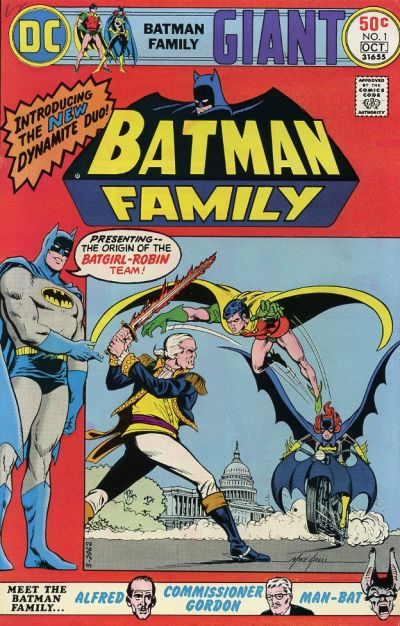
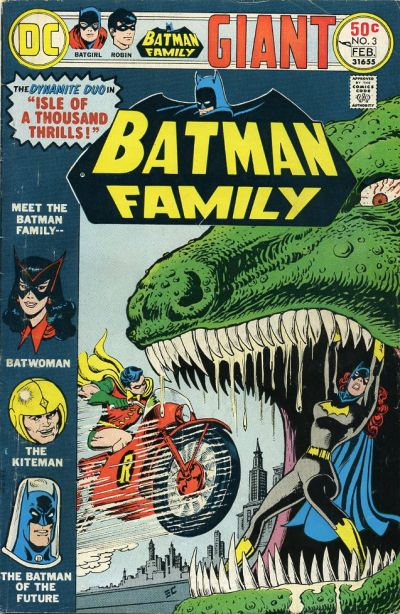
With his teen hormones bouncing around, Dick Grayson also became much more of a ladies’ man. For one thing, he openly flirted with Batgirl in between fighting demons and dinosaurs on the pages of Batman Family:

Batman Family 1          Batman Family 3

But it wasn’t just Batgirl….

detective comics 474 Detective Comics #474

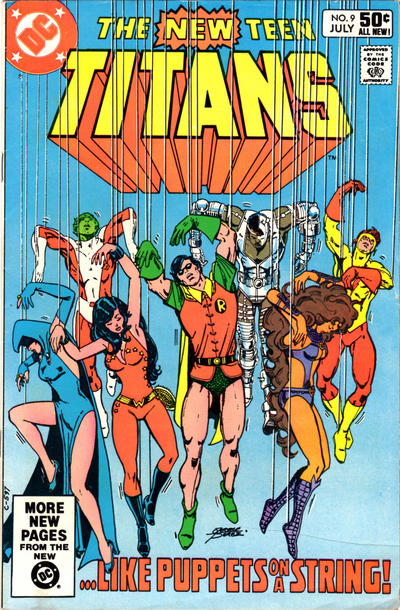
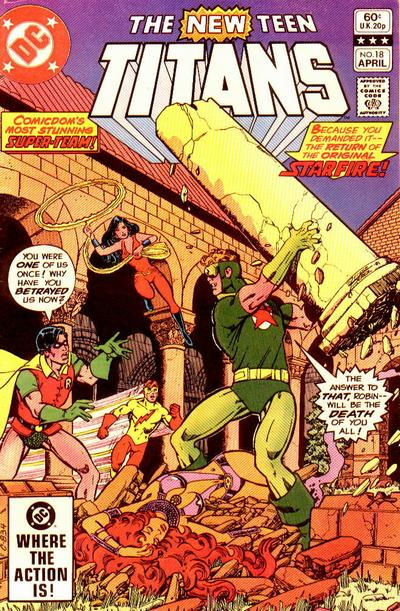
By the time they were reaching their twenties, the Teen Titans had clearly outgrown their teen sidekick identities and so they disbanded the team. Maybe they realized they looked kind of silly in those costumes now that they had to shave every day, or maybe they just couldn’t put up with Kid Flash anymore… In any case, they soon overcame these issues, because in 1980 Marv Wolfman and George Pérez revived the team for what would become one of the most popular comic series of the decade:

New Teen Titans 9          New Teen Titans 18

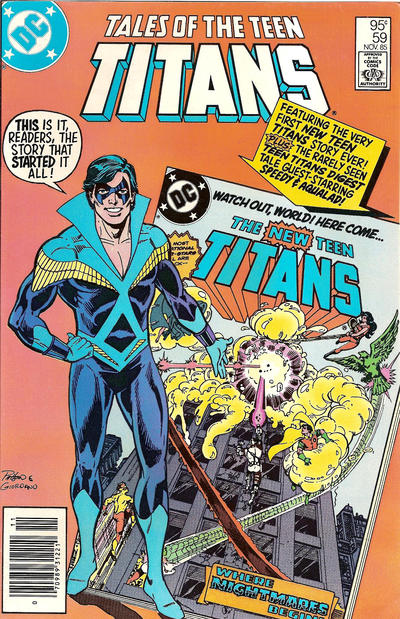
In the early ’80s, Dick Grayson’s relationship with Batman became more and more estranged. In typical coming-of-age fashion, Dick dropped out of college and fell in love with an alien princess. Finally, in 1984, he put his Robin suit away for good and adopted a less tacky look.

Well, arguably:

Tales of the Teen Titans 59

NEXT: Same bat-time. Same bat-channel.

Posted in GOTHAM CITIZENS | Tagged , , , , , , , , , , | Leave a comment